REVIEW 3 major objections 4 minor 8 references
Learning to generate physical ocean states: Towards hybrid climate modeling
T0 review · 3 major / 4 minor · reviewed 2026-08-09 · deepseek-v4-flash
Pith's one-line read A diffusion model can generate ocean states that a numerical ocean model accepts as stable initial conditions for 10-year integrations.
desk verdict A useful proof-of-concept for diffusion-generated ocean initial states with 10-year NEMO integrations, but the 'hydrostatic' constraint is really a mean-profile projection and the spin-up benefit is untested. read the letter →
The pith
A machine-rendered reading of the paper's core claim, the machinery that carries it, and where it could break.
The reading
What carries the argument
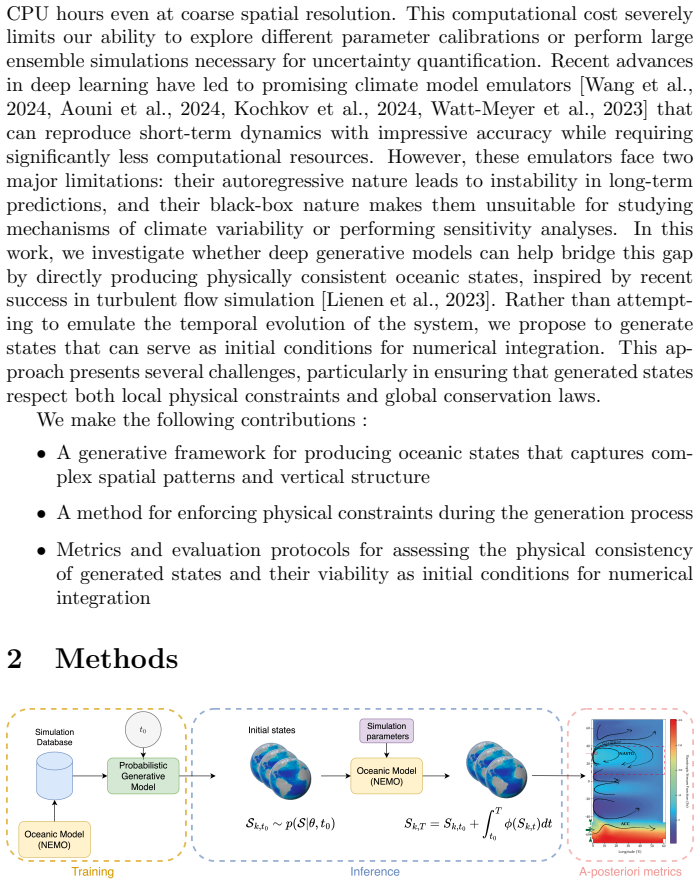
The load-bearing object is a denoising diffusion probabilistic model (DDPM) trained to reproduce the joint distribution of three-dimensional conservative temperature and absolute salinity fields. During sampling, the usual denoising step is modified by subtracting the gradient of a constraint function $C(x) = \sum_k \left(\mu_k - \tfrac{1}{N}\sum_{i,j} x_{ijk}\right)^2$, which penalizes each generated field's horizontal mean at every vertical level for deviating from its training-data mean $\mu_k$, weighted by a schedule $\kappa(s)$ that applies the constraint most strongly near the end of generation. This turns the diffusion sampler into a guided generator whose outputs are then inserted into NEMO; the 10-year numerical integration serves as the a posteriori test of whether the generated states are dynamically consistent.
What would settle it
Run the same NEMO configuration from a constrained generated state and from a conventional spun-up state to the same equilibrium criterion (for example, global-mean drift below a few millikelvins per century and overturning streamfunction within a target band); if the generated state does not reach equilibrium measurably faster, or if another random seed yields a 10-year integration that develops convection or drifts away from the training distribution, the central claim is falsified.
Extended reading notes
Core claim
The paper's central claim is that a diffusion model trained on ocean temperature and salinity fields, with a guidance term that penalizes deviation from the training data's per-depth mean profile during sampling, produces states that are physically valid initial conditions for the NEMO ocean circulation model. By their density-instability metric, constrained generated states are nearly as stable as the training data itself (1.8% of ocean volume, versus 0.4% in the data and 26.8% without the constraint), and 10-year NEMO integrations from constrained states stay stratified and close to the training distribution, while unconstrained states drift. The intended payoff, stated in the abstract, is that such states can reduce the computational burden of running climate models to equilibrium and reduce uncertainties in projections by minimizing drift in baseline simulations.
Load-bearing premise
The central assumption is that a generated state matching the training data's mean vertical temperature and salinity profile, with few density inversions, will behave like an equilibrated ocean state when inserted into NEMO and will reach equilibrium faster than a standard spin-up; the paper demonstrates the first part over 10 years but does not measure time-to-equilibrium or compare with a standard spin-up.
Editorial extensions
If this is right
- If the central claim is correct, a hybrid workflow becomes possible: generate initial ocean states with a diffusion model, then run a numerical ocean model, avoiding part of the multi-million-CPU-hour spin-up.
- Constrained generation is necessary: without the hydrostatic constraint, roughly 26.8% of the ocean volume is statically unstable and 10-year integrations drift, while with the constraint instability drops to 1.8% and integrations stay near the training distribution.
- The reported trade-off means that physically constraining generation reduces the variance of surface temperature and salinity fields, so users must choose between diversity and immediate physical consistency.
- The same guided-sampling setup could be extended to conditional generation, for example conditioned on physical parameters, to produce initial-condition ensembles for uncertainty quantification.
Reading between the lines
- The paper's constraint targets only the per-layer mean profile, so a generated state could still contain local density inversions in high-variance regions; a column-wise hydrostatic check would be a stricter and more direct test.
- Over ocean equilibration timescales of centuries, 10 simulated years is a short window; a state that is stable for a decade may still contain deep-ocean transients that slow later adjustment, so the spin-up savings could be smaller than the 10-year result suggests.
- A fair assessment of the spin-up claim requires comparing generated initializations against a standard spin-up to the same equilibrium criterion; the paper leaves that comparison to future work.
- The same guided-sampling idea could be applied to other prognostic variables or to coupled atmosphere–ocean states, since the constraint only needs a reference climatological vertical structure.
Editorial analysis
A structured set of objections, weighed in public.
Referee Report
Summary. The paper proposes a hybrid approach to ocean climate modeling in which a denoising diffusion probabilistic model (DDPM) is trained on 1800 snapshot states from the idealized DINO/NEMO configuration, and new ocean temperature and salinity states are generated under a 'hydrostatic constraint' enforced during sampling by gradient-based guidance. The generated states are then inserted into NEMO and integrated for 10 years. The paper reports that the constraint reduces the fraction of statically unstable ocean volume from about 26.8% to 1.8%, preserves spatial patterns and water-mass properties, and leads to more stable long-term integration than unconstrained generation. The abstract and introduction further claim that this approach can reduce the computational burden of spinning up climate models to equilibrium and reduce uncertainties in climate projections.
Significance. The paper's narrow experimental protocol, which combines a generative model with numerical integration as an a posteriori validation, is a useful step toward using machine learning to produce initial conditions for ocean models. The reported reduction in density instabilities and the demonstrated 10-year NEMO integrations are interesting and, if confirmed, would support further work on learned initialization. The paper is also honest about its exploratory nature, noting in the conclusion that no comparison with traditional spin-up was performed. However, the central advertised benefit—reducing the computational cost to reach equilibrium and reducing projection uncertainty—is not tested by the presented experiments. The physical constraint in Eq. (2) is also mischaracterized as a hydrostatic constraint, and the reported stability gain may be a direct consequence of projecting samples toward the training climatology rather than of learning physically consistent joint T-S structure. These issues are load-bearing for the paper's headline claims and require either additional experiments or a substantial reframing of the claims.
major comments (3)
- [Section 2, Eq. (2)] The constraint C(x) = sum_k (mu_k - mean_{i,j} x_ijk)^2 penalizes deviations of each layer's horizontal mean from the training-layer mean; it contains no local vertical density gradient and cannot enforce hydrostatic stability. Calling this a 'hydrostatic balance constraint' is therefore inaccurate. The large reduction in density instabilities reported in Table 1 (26.8% to 1.8%) may be trivially explained by the fact that the constraint projects generated fields toward the climatological mean profile, which is by construction stable in the mean. To support the claim that the model learns physically consistent joint T-S structure, please add a control experiment in which the same constraint is applied as a post-hoc projection of unconstrained samples (or equivalently, initialize states with each layer set to its mean and measure the density instability fraction), and compare this baseline with the constrained generation results.
- [Section 4 and abstract] The abstract claims that the hybrid approach 'can effectively reduce the computational burden of running climate models to equilibrium, and reduce uncertainties in climate projections.' The paper itself concedes in Section 4 that no comparison with traditional spin-up was performed. This is a load-bearing gap: without measuring time-to-equilibrium or drift relative to a standard spun-up initialization, the central advertised benefit is untested. Please either add an experiment that compares the trajectory and equilibration time from generated initial conditions against a conventional spin-up baseline, or revise the abstract and introduction to state the narrower claim that the method produces stable initial conditions within the DINO configuration.
- [Section 3, Figure 3 and 10-year integrations] The description of the 10-year NEMO integrations is underspecified. It is not clear how many generated states were integrated, what quantitative metric defines 'drift' or 'stability,' or how the resulting trajectories compare with the natural variability of DINO. Please report quantitative diagnostics (e.g., global-mean temperature and salinity drift, meridional overturning streamfunction, or density error over time) with confidence intervals, and state the number of ensemble members. Without such numbers, the qualitative statement that constrained states 'maintain physically consistent trajectories' is not fully supported.
minor comments (4)
- [Section 3, Figure 3 caption] The sentence 'The constraint successfully realistic stratification' is missing a verb; it should read 'The constraint successfully produces realistic stratification.'
- [Appendix D] The hyperparameters η, λ, and k are selected empirically, but no sensitivity analysis is reported. Since the trade-off between physical consistency and diversity depends on these values, a brief discussion of their influence would improve reproducibility.
- [Section 2.1, Eq. (2)] The text notes that µ_k is zero after per-level standardization; this should be stated more explicitly before Eq. (2) so that readers do not infer that the constraint is comparing against a nontrivial climatological profile.
- [Appendix C.2, Eq. (5)] The density error metric uses 1{ρ_{i,j,k+1} - ρ_{i,j,k} < 0}; please clarify the index convention for k (whether increasing k is downward) so that the sign of the instability criterion is unambiguous.
Circularity Check
No equation-level circularity: the 10-year NEMO integration is an external dynamical check, and Eq. (2) does not by construction minimize the Eq. (5) instability metric.
full rationale
The claimed derivation chain is not circular. The diffusion model is trained on DINO snapshots, and the sampling constraint C(x) in Eq. (2) penalizes each layer's horizontal mean deviation from the training layer mean (mu_k = 0 after standardization). The headline success metric, Eq. (5), counts local vertical density inversions, which are not determined by horizontal layer means, so the reported reduction from 26.8% to 1.8% instabilities is an empirical effect rather than a tautology. Likewise, the 10-year NEMO integrations are an external dynamical test: starting near the training climatology does not by construction guarantee stability over a decade of simulation, since NEMO's equations can amplify small perturbations and the unconstrained samples also share the same layer means yet drift. The paper contains a legitimate labeling and scope concern, not a circularity: Eq. (2) is a climatological-mean projection, not a local hydrostatic constraint, and the spin-up-reduction claim is untested because the conclusion explicitly states that a 'comprehensive comparison with traditional spin-up methods' remains future work. These concerns affect interpretation and external validity, but they do not make any prediction equivalent to its inputs by construction.
Assumptions & free parameters
free parameters (3)
- η (constraint scale) =
1e-3
- λ (constraint boost factor) =
40
- k (constraint decay rate) =
20
assumptions (4)
- standard math DDPM reverse sampling produces samples from the training distribution when the denoiser is trained well.
- domain assumption 50 years of DINO simulation with 1,800 snapshots is a representative sample of the model's equilibrium distribution.
- domain assumption Stable 10-year NEMO integration is a sufficient test for whether generated states are viable initial conditions for climate projections.
- ad hoc to paper A constraint on per-layer horizontal mean temperature and salinity is enough to produce hydrostatically stable, physically consistent states.
Cite this review
Pith. "Pith review of Learning to generate physical ocean states: Towards hybrid climate modeling." pith.science (2026). https://pith.science/paper/SF6MU25Z
@misc{pith2026250202499,
  author       = {Pith},
  title        = {Pith review of: Learning to generate physical ocean states: Towards hybrid climate modeling},
  year         = {2026},
  howpublished = {\url{https://pith.science/paper/SF6MU25Z}},
  note         = {Machine review of arXiv:2502.02499}
}
read the original abstract
Ocean General Circulation Models require extensive computational resources to reach equilibrium states, while deep learning emulators, despite offering fast predictions, lack the physical interpretability and long-term stability necessary for climate scientists to understand climate sensitivity (to greenhouse gas emissions) and mechanisms of abrupt % variability such as tipping points. We propose to take the best from both worlds by leveraging deep generative models to produce physically consistent oceanic states that can serve as initial conditions for climate projections. We assess the viability of this hybrid approach through both physical metrics and numerical experiments, and highlight the benefits of enforcing physical constraints during generation. Although we train here on ocean variables from idealized numerical simulations, we claim that this hybrid approach, combining the computational efficiency of deep learning with the physical accuracy of numerical models, can effectively reduce the computational burden of running climate models to equilibrium, and reduce uncertainties in climate projections by minimizing drifts in baseline simulations.
Figures


Figures from the paper (1 more)

Reference graph
Works this paper leans on
-
[1]
Glonet: Mercator's end-to-end neural forecasting system, 2024
Anass El Aouni, Quentin Gaudel, Charly Regnier, Simon Van Gennip, Marie Drevillon, Yann Drillet, and Jean-Michel Lellouche. Glonet: Mercator's end-to-end neural forecasting system, 2024. URL https://arxiv.org/abs/2412.05454
arXiv 2024
-
[2]
Denoising diffusion probabilistic models
Jonathan Ho, Ajay Jain, and Pieter Abbeel. Denoising diffusion probabilistic models. In Advances in Neural Information Processing Systems, 2020
2020
-
[3]
Dmitrii Kochkov, Janni Yuval, Ian Langmore, Peter Norgaard, Jamie Smith, Griffin Mooers, Milan Klöwer, James Lottes, Stephan Rasp, Peter Düben, Sam Hatfield, Peter Battaglia, Alvaro Sanchez-Gonzalez, Matthew Willson, Michael P. Brenner, and Stephan Hoyer. Neural general circulation models for weather and climate. Nature, 632 0 (8027): 0 1060–1066, July 20...
-
[4]
From zero to turbulence: Generative modeling for 3d flow simulation
M Lienen, D Lüdke, J Hansen-Palmus, and S Günnemann. From zero to turbulence: Generative modeling for 3d flow simulation. arXiv preprint arXiv:2306.01776, 2023
arXiv 2023
-
[5]
U-Net : Convolutional networks for biomedical image segmentation
Olaf Ronneberger, Philipp Fischer, and Thomas Brox. U-Net : Convolutional networks for biomedical image segmentation. In Medical Image Computing and Computer-Assisted Intervention (MICCAI), pages 234--241, 2015
work page 2015
-
[6]
Diffusers: State-of-the-art diffusion models
Patrick von Platen, Suraj Patil, Anton Lozhkov, Pedro Cuenca, Nathan Lambert, Kashif Rasul, Mishig Davaadorj, Dhruv Nair, Sayak Paul, William Berman, Yiyi Xu, Steven Liu, and Thomas Wolf. Diffusers: State-of-the-art diffusion models. https://github.com/huggingface/diffusers, 2022
2022
-
[7]
Xihe: A data-driven model for global ocean eddy-resolving forecasting
X Wang, R Wang, N Hu, P Wang, P Huo, G Wang, and J Song. Xihe: A data-driven model for global ocean eddy-resolving forecasting. arXiv preprint arXiv:2402.02995, 2024
arXiv 2024
-
[8]
Ace: A fast, skillful learned global atmospheric model for climate prediction
O Watt-Meyer, G Dresdner, J McGibbon, S K Clark, B Henn, J Duncan, and C S Bretherton. Ace: A fast, skillful learned global atmospheric model for climate prediction. arXiv preprint arXiv:2310.02074, 2023
arXiv 2023
Reviewed August 9, 2026 · model on record in the stance chip above.
Discussion (0). Continue with ORCID to comment.