REVIEW 2 major objections 5 minor 1 cited by
Gravitational lensing: towards combining the multi-messengers
T0 review · 2 major / 5 minor · reviewed 2026-08-09 · deepseek-v4-flash
Pith's one-line read Strong lensing of gravitational waves and their electromagnetic counterparts will open a new multi-messenger window on cosmology, gravity, and compact-object physics.
desk verdict A well-written review of multi-messenger strong lensing that makes its case on broad literature, but the quantitative rate estimates are preliminary and need uncertainty quantification against existing null searches. read the letter →
The pith
A machine-rendered reading of the paper's core claim, the machinery that carries it, and where it could break.
The reading
What carries the argument
The load-bearing object is the strongly lensed multi-messenger event: a compact-binary merger whose GW signal and its electromagnetic counterpart are both multiply imaged by a foreground galaxy. The governing identity is the equality of arrival-time delays across messengers, $\Delta t_{\rm GW}=\Delta t_{\rm EM}$ in the geometric-optics regime, with the delay set by the Fermat potential difference $\Delta\psi$ (the lensing quantity that controls arrival-time differences); this identity turns a time-delay measurement in one band into a prediction in the other. The paper's calculations also rest on a detection probability $P_{\rm det}(\theta,D_L)$ for short GRBs that is unity for on-axis jets within the core angle and falls off as a Gaussian in off-axis angle, and on network signal-to-noise thresholds (SNR greater than 6 or 8) for GW detectability, with wave-optics modulation allowed for low-mass lenses. Microlensing by stars in the lens galaxy is treated as a separate frequency-dependent distortion: wave-optics effects for GWs versus geometric-optics magnification for optical emission, which the paper proposes to use jointly to constrain the microlens population.
What would settle it
Run the scenario-1 calculation for one year at the assumed sensitivities: detecting no lensed short-GRB pair with matching light curves and time delays would rule out the roughly $10\,{\rm yr}^{-1}$ forecast, while finding the predicted number would support it. For the gravity test, a single strongly lensed GW+EM source with $\Delta t_{\rm GW}\neq\Delta t_{\rm EM}$ in the geometric-optics regime (lens mass well above $10^5\,M_\odot$) would falsify the premise that equal delays are guaranteed by general relativity.
Extended reading notes
Core claim
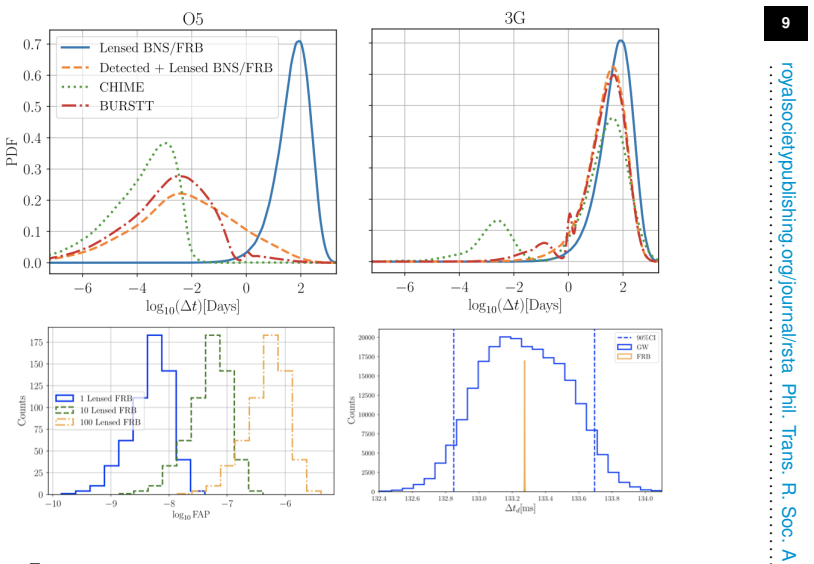
The paper's central claim is that multi-messenger strong lensing turns the rare event of a lensed compact-binary merger into a high-precision laboratory. When a GW source with an electromagnetic counterpart is strongly lensed, the multiple GW arrivals and the multiple EM images share the same geometric and Shapiro time delays, so the difference $\Delta t_{\rm GW}-\Delta t_{\rm EM}$ isolates any messenger-dependent propagation effect without knowing the intrinsic emission delay. The same repeated-image structure lets a lensed FRB be associated with a lensed GW at false-alarm probability $\sim 10^{-8}$, and lets sub-threshold GW images be recovered by searching a few seconds around a detected lensed GRB. The paper's quantitative estimates, from simulations reported here, are that combining gamma-ray monitors with a 50% sky duty cycle and a three-detector GW network at design sensitivity yields about $10\,{\rm yr}^{-1}$ detectable lensed GRB systems, and that starting from detectable lensed GW events gives about one associated lensed GRB per thirteen GW lenses. The authors further argue that lensed binary neutron star mergers, although rarer than lensed binary black hole mergers, are the more promising targets for modified-gravity and kilonova studies because they are more magnified, sit at higher redshift, and have detectable electromagnetic counterparts.
Load-bearing premise
The predicted rates assume that every detectable short gamma-ray burst comes from a binary neutron-star merger, shines as brightly as GRB 170817A, and has its jet aligned with the binary's orbital inclination; if many short bursts instead come from neutron-star-black-hole mergers or have dimmer, broader jets, the forecast of about ten lensed GRB systems per year and one GRB companion per thirteen GW lenses shrinks.
Editorial extensions
If this is right
- A combined year of design-sensitivity GW data plus gamma-ray data should find roughly ten lensed short-GRB systems, and about one in every thirteen lensed GW events should have a detectable lensed GRB counterpart in a two-second time window.
- Lensed FRBs can be matched to lensed GW events at false-alarm probability near $10^{-8}$, which can identify counterparts even when one signal is sub-threshold or affected by wave-optics modulation.
- A strongly lensed GW+EM source with measured $\Delta t_{\rm GW}$ and $\Delta t_{\rm EM}$ constrains the speed of gravitational waves without needing to know the intrinsic delay between the merger and its electromagnetic flash.
- Lensed binary neutron star mergers at high redshift can deliver early-warning time-delay predictions on hour-to-day timescales, allowing kilonova observations within days and tighter constraints on ejecta properties and the neutron-star equation of state before third-generation detectors arrive.
- Millisecond-precision time delays from lensed GW and FRB systems could carry $H_0$ constraints to sub-percent precision, complementing the few-percent-level results from lensed quasars.
Reading between the lines
- If the roughly ten-per-year lensed-GRB estimate holds, the first joint GW and GRB lensing seasons will simultaneously constrain the binary neutron star merger rate, the jet opening angle, and the short-GRB luminosity function, since all three enter the detection probability.
- The time-delay matching strategy does not depend on the specific messenger: the same logic would apply to lensed neutrinos or other future signals, provided multiple images are resolved and arrival times can be measured.
- The paper's idealized finding that double-image lenses have smaller Fermat-potential uncertainties than quads suggests that follow-up resources for lensed GW and GRB events should be weighted toward doubles; realistic-noise simulations would sharpen or overturn that targeting rule.
- A null result in the first two years of joint gamma-ray and GW lens searches would itself constrain jet models, because the predicted rate rests on GRB 170817A-like luminosity and aligned-jet assumptions.
Signed reviews
Editorial analysis
A structured set of objections, weighed in public.
Referee Report
Summary. This review article argues that strong gravitational lensing of multi-messenger sources—gravitational waves, gamma-ray bursts, kilonovae, and fast radio bursts—will enable new probes of cosmology, tests of general relativity, and a better understanding of compact-object merger physics. It surveys time-delay cosmology, microlensing systematics, modified gravitational-wave propagation, progenitor physics, and search strategies for lensed counterparts. The most concrete new quantitative claims appear in Sec. 2(d)(ii): roughly 10 detectable GRB lens systems per year and a 1-in-13 chance of a lensed GRB counterpart to a detectable lensed GW event, based on simulations described as in preparation and a linked notebook.
Significance. If the rate estimates hold, multi-messenger strong lensing would indeed open an unprecedented observational window, and the article's qualitative science case is broadly persuasive and well grounded in the cited literature. The paper is commendably candid about idealizations (e.g., the Fermat-potential uncertainty results are explicitly stated to be valid only in idealized scenarios), and the inclusion of a public notebook for the GRB–GW rate calculation is a useful reproducibility step. The main quantitative rate estimates, however, rest on strong simplifying assumptions and are not yet supported by an uncertainty analysis or reconciled with existing null searches, so the paper's central quantitative promise needs strengthening before publication.
major comments (2)
- [Sec. 2(d)(ii), Fig. 4 and Eq. (2.1)] The estimates of "approximately 10 yr−1" detectable GRB lens systems and "1 GRB lens out of 13 GW lenses" are derived under the stated assumptions that all detectable sGRBs come from BNS mergers with GRB 170817A-like luminosity and with the GW inclination angle aligned with the GRB jet axis. The text itself notes (Sec. 2(c)(i) and Sec. 3(b)) that NSBH mergers can also produce sGRBs and kilonovae, so these assumptions are not innocuous. No sensitivity analysis, error bars, or dependence on the chosen luminosity function and jet structure is provided. Please add a quantitative assessment of how the rates change under plausible variations (e.g., NSBH contribution fraction, luminosity function, jet opening angle, or inclination distribution), or explicitly reframe these numbers as order-of-magnitude illustrations rather than predictive rates.
- [Sec. 2(d)(ii)] The predicted ~10 detectable lensed GRB systems per year is not reconciled with the null results of the 11-year Fermi GBM lensed-GRB searches [97,98]. Since those searches found no confirmed lensed GRB, the paper should explain why the predicted systems would have been missed by existing searches (e.g., different time-delay ranges, flux thresholds, sky coverage, or the possibility that many lensed images are sub-threshold and only recoverable via the GW association). Without such a discussion, the estimate appears optimistic and is difficult to evaluate. The qualitative science case does not depend on this number, but as stated it is a load-bearing quantitative claim.
minor comments (5)
- [Sec. 2(a)] The sentence "These measurements are consistent with early-Universe probes but amplify the tension with late-Universe values" is unclear: the quoted TDCOSMO value H0 = 65+23−14 km/s/Mpc is formally consistent with both Planck and SH0ES at the quoted uncertainties, so "amplify" may be misleading. Please rephrase.
- [Sec. 2(d)(ii), Eq. (2.1)] The off-axis detection condition involving 1.61×10^8/(4π D_L^2) exp(−θ^2/(2×21.2^2)) ≥ 1 is not derived or referenced. Please define all variables and explain the origin of the numerical factor, or replace the equation with a reference to the source of this detection probability.
- [References] Several references are incomplete: ref. 3 lacks authors, refs. 60, 84, and 86 lack author or title information. The reference list should be completed to journal standards.
- [Fig. 4 caption] The caption says "See Sec. 2 d ii" while the text uses "Sec. 2(d)(ii)"; please standardize the notation.
- [Abstract] The abstract would benefit from one sentence summarizing the expected event rates, since the quantitative claims are a key part of the paper's forward-looking message.
Circularity Check
No construction-equivalent circularity; rate forecasts are forward-modeled from published inputs, with self-citations present but not load-bearing.
full rationale
The paper is a review whose central claims are a synthesis of an external literature, and its concrete quantitative forecasts are forward simulations rather than fitted quantities. In Sec. 2(d)(ii), the estimates of approximately 10 lensed GRB systems per year and 1 GRB lens per 13 GW lenses are explicitly described as the outcome of 'extensive sampling and simulation' using published merger-rate densities [103,104], a published luminosity function [105], and the stated detectability criterion in Eq. (2.1). The simplifying assumptions (all detectable sGRBs from BNS mergers, GRB 170817A-like luminosity, GW inclination aligned with the jet axis) are stated openly and make the estimate uncertain, but they do not make the prediction equal to its input by construction. The authors cite their own work (e.g., the notebook [108] and 'Phurailatpam et al., in prep.') for the rate calculations, but that work is code-reproduced and uses external population inputs; it is not a case of fitting a subset of data and then renaming the fit a prediction. The Ali & More in-prep citations support preliminary Fermat-potential uncertainty statements, which are not load-bearing for the paper's main synthesis. The possible tension with null Fermi lensed-GRB searches is a sensitivity and validation concern, not a circularity. No equation in the paper reduces to its own output, and no claim is forced by a self-citation chain.
Assumptions & free parameters
assumptions (4)
- domain assumption For galaxy-scale lenses with M > 10^5 M⊙, both GW and EM signals can be treated in the geometric-optics limit, so equal time delays are predicted by GR.
- domain assumption All detectable sGRBs originate from BNS mergers with GRB170817A-like luminosity and jet axis aligned with the GW inclination.
- domain assumption The population models for BNS merger rates and GRB luminosity function are taken from [103,104,105], and the lensing rates from [106,107].
- ad hoc to paper The Fermat-potential uncertainty trends in Fig. 1, based on Ali & More (in prep), are valid in idealized power-law + shear lens models.
Cite this review
Pith. "Pith review of Gravitational lensing: towards combining the multi-messengers." pith.science (2026). https://pith.science/paper/PFNMHSDL
@misc{pith2026250202536,
  author       = {Pith},
  title        = {Pith review of: Gravitational lensing: towards combining the multi-messengers},
  year         = {2026},
  howpublished = {\url{https://pith.science/paper/PFNMHSDL}},
  note         = {Machine review of arXiv:2502.02536}
}
read the original abstract
The next generation of gravitational wave detectors and electromagnetic telescopes are beckoning the onset of the multi-messenger era and the exciting science that lies ahead. Multi-messenger strong gravitational lensing will help probe some of the most important questions of the Universe in an unprecedented manner. In particular, understanding the nature of gravitational wave sources, the underlying physical processes and mechanisms that produce emissions well before or right until the time of the merger, their associations to the seemingly distinct populations of gamma ray bursts, fast radio bursts and kilonovae. Not to mention, multi-messenger lensing will offer unique probes of test of gravity models and constraints on cosmological parameters complementary to other probes. Enabling multi-messenger science calls for concerted follow-up efforts and development of new and shared resources required in the community.
Figures


Figures from the paper (2 more)


Forward citations
Cited by 1 Pith paper
-
gwsnr: A Python package for efficient signal-to-noise ratio calculations of gravitational waves
gwsnr is a Python package that computes gravitational-wave signal-to-noise ratios and detection probabilities for large compact-binary populations using interpolation, neural networks, and GPU acceleration.
Reference graph
Works this paper leans on
-
[1]
Schneider P , Ehlers J, Falco EE. 1992Gravitational Lenses. (10.1007/978-3-662-03758-4)
-
[2]
1996 Lectures on Gravitational Lensing
Narayan R, Bartelmann M. 1996 Lectures on Gravitational Lensing. arXiv e-prints pp. astro– ph/9606001. (10.48550/arXiv.astro-ph/9606001)
-
[3]
(10.48550/arXiv.astro-ph/0407232)
2006 Gravitational Lensing: Strong, Weak and Micro . (10.48550/arXiv.astro-ph/0407232)
-
[4]
2023 GWTC-3: compact binary coalescences observed by LIGO and Virgo during the second part of the third observing run
Abbott R, Abbott T, Acernese F, Ackley K, Adams C, Adhikari N, Adhikari R, Adya V , Affeldt C, Agarwal D et al.. 2023 GWTC-3: compact binary coalescences observed by LIGO and Virgo during the second part of the third observing run. Phys. Rev. X 13, 041039
2023
-
[5]
The LIGO Scientific Collaboration et al.. 2015 Advanced LIGO. Classical and Quantum Gravity 32, 074001. (10.1088/0264-9381/32/7/074001) 3https://github.com/lenscat/lenscat 14royalsocietypublishing.org/journal/rsta Phil. Trans. R. Soc. A 0000000
-
[6]
2014 Advanced Virgo: a second-generation interferometric gravitational wave detector
Acernese F, Agathos M, Agatsuma K, Aisa D, Allemandou N, Allocca A, Amarni J, Astone P , Balestri G, Ballardin G, Barone F, Baronick JP , Barsuglia M, Basti A, Basti F, Bauer TS, Bavigadda V , Bejger M, Beker MG, Belczynski C, Bersanetti D, Bertolini A, et al MB. 2014 Advanced Virgo: a second-generation interferometric gravitational wave detector. Classic...
-
[7]
2020 Overview of KAGRA: Detector design and construction history
Akutsu T, Ando M, Arai K, Arai Y, Araki S, Araya A, Aritomi N, Aso Y, Bae S, Bae Y, Baiotti L, Bajpai R, Barton MA, Cannon Kea. 2020 Overview of KAGRA: Detector design and construction history. Progress of Theoretical and Experimental Physics 2021, 05A101. (10.1093/ptep/ptaa125)
-
[8]
1996 Gravitational Lensing of Gravitational Waves from Merging Neutron Star Binaries
Wang Y, Stebbins A, Turner EL. 1996 Gravitational Lensing of Gravitational Waves from Merging Neutron Star Binaries. Phys. Rev. Lett. 77, 2875–2878. (10.1103/PhysRevLett.77.2875)
Show all 118 references
-
[9]
2003 Wave Effects in the Gravitational Lensing of Gravitational Waves from Chirping Binaries
Takahashi R, Nakamura T. 2003 Wave Effects in the Gravitational Lensing of Gravitational Waves from Chirping Binaries. Astrophys. J. 595, 1039–1051. (10.1086/377430)
2003 doi
-
[10]
2011 Cosmography with strong lensing of LISA gravitational wave sources
Sereno M, Jetzer P , Sesana A, Volonteri M. 2011 Cosmography with strong lensing of LISA gravitational wave sources. Mon. Not. Roy. Astron. Soc. 415, 2773. (10.1111/j.1365- 2966.2011.18895.x)
2011
-
[11]
2019 Search for Gravitational Lensing Signatures in LIGO-Virgo Binary Black Hole Events
Hannuksela OA, Haris K, Ng KKY, et al.. 2019 Search for Gravitational Lensing Signatures in LIGO-Virgo Binary Black Hole Events. Astrophys. J. Lett. 874, L2. (10.3847/2041-8213/ab0c0f)
2019 doi
-
[12]
2021 Search for Lensing Signatures in the Gravitational-Wave Observations from the First Half of LIGO-Virgo’s Third Observing Run
Abbott R, Abbott TD, Abraham S, et al.. 2021 Search for Lensing Signatures in the Gravitational-Wave Observations from the First Half of LIGO-Virgo’s Third Observing Run. Astrophys. J. 923, 14. (10.3847/1538-4357/ac23db)
2021 doi
-
[13]
2021 Identifying Strong Gravitational-wave Lensing during the Second Observing Run of Advanced LIGO and Advanced Virgo
Liu X, Magaña Hernandez I, Creighton J. 2021 Identifying Strong Gravitational-wave Lensing during the Second Observing Run of Advanced LIGO and Advanced Virgo. Astrophys. J. 908,
2021
-
[14]
2023 Search for gravitational-lensing signatures in the full third observing run of the LIGO- Virgo network
The LIGO Scientific Collaboration, the Virgo Collaboration, the KAGRA Collaboration, et al.. 2023 Search for gravitational-lensing signatures in the full third observing run of the LIGO- Virgo network. arXiv e-prints p. arXiv:2304.08393. (10.48550/arXiv.2304.08393)
-
[15]
2023 Targeted subthreshold search for strongly lensed gravitational-wave events
Li AK, Lo RK, Sachdev S, Chan J, Lin E, Li TG, Weinstein AJ. 2023 Targeted subthreshold search for strongly lensed gravitational-wave events. Physical Review D 107. (10.1103/physrevd.107.123014)
2023 doi
-
[16]
2020 Search for strongly lensed counterpart images of binary black hole mergers in the first two LIGO observing runs
McIsaac C, Keitel D, Collett T, et al.. 2020 Search for strongly lensed counterpart images of binary black hole mergers in the first two LIGO observing runs. Phys. Rev. D 102, 084031. (10.1103/PhysRevD.102.084031)
2020 doi
-
[17]
2020 Search for Lensed Gravitational Waves Including Morse Phase Information: An Intriguing Candidate in O2
Dai L, Zackay B, Venumadhav T, Roulet J, Zaldarriaga M. 2020 Search for Lensed Gravitational Waves Including Morse Phase Information: An Intriguing Candidate in O2
2020
-
[18]
2023 Follow-up analyses to the O3 LIGO–Virgo–KAGRA lensing searches
Janquart J, Wright M, Goyal S, Chan JCL, Ganguly A, Garron A, Keitel D, Li AKY, Liu A, Lo RKL, Mishra A, More A, Phurailatpam H, Prasia P , Ajith P , Biscoveanu S, Cremonese P , Cudell JR, Ezquiaga JM, Garcia-Bellido J, Hannuksela OA, Haris K, Harry I, Hendry M, Husa S, Kapadi...
2023
-
[19]
2017a GW170817: Observation of Gravitational Waves from a Binary Neutron Star Inspiral
Abbott B et al.. 2017a GW170817: Observation of Gravitational Waves from a Binary Neutron Star Inspiral. Phys. Rev. Lett. 119, 161101. (10.1103/PhysRevLett.119.161101)
-
[21]
2017c Multi-messenger Observations of a Binary Neutron Star Merger
Abbott BP et al.. 2017c Multi-messenger Observations of a Binary Neutron Star Merger. Astrophys. J. Lett. 848, L12. (10.3847/2041-8213/aa91c9)
-
[22]
2017 The Electromagnetic Counterpart of the Binary Neutron Star Merger LIGO/Virgo GW170817
Alexander KD, Berger E, Fong W, Williams PKG, Guidorzi C, Margutti R, Metzger BD, Annis J, Blanchard PKea. 2017 The Electromagnetic Counterpart of the Binary Neutron Star Merger LIGO/Virgo GW170817. VI. Radio Constraints on a Relativistic Jet and Predictions for Late-time Emis...
2017 doi
-
[23]
2017 Follow Up of GW170817 and Its Electromagnetic Counterpart by Australian-Led Observing Programmes
Andreoni I, Ackley K, Cooke J, Acharyya A, Allison JR, Anderson GE, Ashley MCB, Baade D, Bailes M, Bannister Kea. 2017 Follow Up of GW170817 and Its Electromagnetic Counterpart by Australian-Led Observing Programmes. Publications of the Astronomical Society of Australia
2017
-
[24]
2017 A radio counterpart to a neutron star merger
Hallinan G, Corsi A, Mooley KP , Hotokezaka K, Nakar E, Kasliwal MM, Kaplan DLea. 2017 A radio counterpart to a neutron star merger. Science 358, 1579–1583. (10.1126/science.aap9855) 15royalsocietypublishing.org/journal/rsta Phil. Trans. R. Soc. A 0000000
2017 doi
-
[25]
2017 The Electromagnetic Counterpart of the Binary Neutron Star Merger LIGO/Virgo GW170817
Margutti R, Berger E, Fong W, Guidorzi C, Alexander KD, Metzger BD, Blanchard PK, Cowperthwaite PS, Chornock R, Eftekhari T, Nicholl M, Villar VA, Williams PKG, Annis J, Brown DA, Chen H, Doctor Z, Frieman JA, Holz DE, Sako M, Soares-Santos M. 2017 The Electromagnetic Counterp...
2017 doi
-
[26]
2017 Illuminating gravitational waves: A concordant picture of photons from a neutron star merger
Kasliwal MM, Nakar E, Singer LP , et al.. 2017 Illuminating gravitational waves: A concordant picture of photons from a neutron star merger. Science 358, 1559–1565. (10.1126/science.aap9455)
2017 doi
-
[27]
2020 Measuring the speed of gravitational waves from the first and second observing run of Advanced LIGO and Advanced Virgo
Liu X, He VF, Mikulski TM, Palenova D, Williams CE, Creighton J, Tasson JD. 2020 Measuring the speed of gravitational waves from the first and second observing run of Advanced LIGO and Advanced Virgo. Physical Review D 102. (10.1103/physrevd.102.024028)
2020 doi
-
[28]
2017 A gravitational-wave standard siren measurement of the Hubble constant
Abbott BP , Abbott R, Abbott TD, et al.. 2017 A gravitational-wave standard siren measurement of the Hubble constant. Nature 551, 85–88. (10.1038/nature24471)
2017 doi
-
[29]
2009 The role of luminous substructure in the gravitational lens system MG 2016+112
More A, McKean JP , More S, Porcas RW, Koopmans LVE, Garrett MA. 2009 The role of luminous substructure in the gravitational lens system MG 2016+112. Monthly Notices of the Royal Astronomical Society 394, 174–190. (10.1111/j.1365-2966.2008.14342.x)
2009
-
[30]
2019 Microlensing constraints on primordial black holes with Subaru/HSC Andromeda observations
Niikura H, Takada M, Yasuda N, Lupton RH, Sumi T, More S, Kurita T, Sugiyama S, More A, Oguri M, Chiba M. 2019 Microlensing constraints on primordial black holes with Subaru/HSC Andromeda observations. Nature Astronomy 3, 524–534. (10.1038/s41550-019- 0723-1)
2019 doi
-
[31]
2020 Constraining the abundance of primordial black holes with gravitational lensing of gravitational waves at LIGO frequencies
Diego JM. 2020 Constraining the abundance of primordial black holes with gravitational lensing of gravitational waves at LIGO frequencies. Phys. Rev. D 101, 123512. (10.1103/PhysRevD.101.123512)
2020 doi
-
[32]
2022 Constraints on Compact Dark Matter from Gravitational Wave Microlensing
Basak S, Ganguly A, Haris K, Kapadia S, Mehta AK, Ajith P . 2022 Constraints on Compact Dark Matter from Gravitational Wave Microlensing. The Astrophysical Journal Letters 926, L28. (10.3847/2041-8213/ac4dfa)
2022 doi
-
[33]
2023 Strong gravitational lensing as a probe of dark matter
Vegetti S, Birrer S, Despali G, Fassnacht CD, Gilman D, Hezaveh Y, Perreault Levasseur L, McKean JP , Powell DM, O’Riordan CM, Vernardos G. 2023 Strong gravitational lensing as a probe of dark matter. arXiv e-prints p. arXiv:2306.11781. (10.48550/arXiv.2306.11781)
-
[34]
(10.1017/pasa.2017.65)
2017 doi
-
[35]
2022 A Comprehensive Measurement of the Local Value of the Hubble Constant with 1 km s−1 Mpc−1 Uncertainty from the Hubble Space Telescope and the SH0ES Team
Riess AG, Yuan W, Macri LM, Scolnic D, Brout D, Casertano S, Jones DO, Murakami Y, Anand GS, Breuval L, Brink TG, Filippenko AV , Hoffmann S, Jha SW, Darcy Kenworthy W, Mackenty J, Stahl BE, Zheng W. 2022 A Comprehensive Measurement of the Local Value of the Hubble Constant wi...
2022 doi
-
[37]
2019 H0LiCOW – XIII
Wong KC, Suyu SH, Chen GCF, Rusu CE, Millon M, Sluse D, Bonvin Vea. 2019 H0LiCOW – XIII. A 2.4 per cent measurement of H0 from lensed quasars: 5.3 σ tension between early- and late-Universe probes. Monthly Notices of the Royal Astronomical Society 498, 1420–1439. (10.1093/mnra...
2019 doi
-
[38]
1964 On the possibility of determining Hubble’s parameter and the masses of galaxies from the gravitational lens effect
Refsdal S. 1964 On the possibility of determining Hubble’s parameter and the masses of galaxies from the gravitational lens effect. Mon. Not. Roy. Astron. Soc. 128, 307. (10.1093/mnras/128.4.307)
1964 doi
-
[39]
2023 TDCOSMO
Shajib AJ, Mozumdar P , Chen GCF, Treu T, Cappellari M, Knabel S, Suyu SH, Bennert VN, Frieman JA, Sluse D, Birrer S, Courbin F, Fassnacht CD, Villafaña L, Williams PR. 2023 TDCOSMO. XII. Improved Hubble constant measurement from lensing time delays using spatially resolved st...
2023 doi
-
[41]
2023 Constraints on the Hubble constant from supernova Refsdal’s reappearance
Kelly PL, Rodney S, Treu T, et al.. 2023 Constraints on the Hubble constant from supernova Refsdal’s reappearance. Science 380, abh1322. (10.1126/science.abh1322)
2023 doi
-
[42]
2024 TDCOSMO: XVI
Wong KC, Dux F, Shajib AJ, Suyu SH, Millon M, Mozumdar P , Wells PR, Agnello A, Birrer S, Buckley-Geer EJ, Courbin F, Fassnacht CD, Frieman J, Galan A, Lin H, Marshall PJ, Poh J, Schuldt S, Sluse D, Treu T. 2024 TDCOSMO: XVI. Measurement of the Hubble constant from the lensed ...
2024 doi
-
[43]
2014 Detection of the Gravitational Lens Magnifying a Type Ia Supernova
Quimby RM, Oguri M, More A, More S, Moriya TJ, Werner MC, Tanaka M, Folatelli G, Bersten MC, Maeda K, Nomoto K. 2014 Detection of the Gravitational Lens Magnifying a Type Ia Supernova. Science 344, 396–399. (10.1126/science.1250903)
2014 doi
-
[44]
Pascale M, Frye BL, Pierel JDR, Chen W, Kelly PL, Cohen SH, et al. RAW. 2024 SN H0pe: The First Measurement of H0 from a Multiply-Imaged Type Ia Supernova, Discovered by JWST
2024
-
[46]
2019 Rates and Properties of Supernovae Strongly Gravitationally Lensed by Elliptical Galaxies in Time-domain Imaging Surveys
Goldstein DA, Nugent PE, Goobar A. 2019 Rates and Properties of Supernovae Strongly Gravitationally Lensed by Elliptical Galaxies in Time-domain Imaging Surveys. The Astrophysical Journal Supplement Series 243, 6. (10.3847/1538-4365/ab1fe0)
2019 doi
-
[47]
2006 Microlensing of Lensed Supernovae
Dobler G, Keeton CR. 2006 Microlensing of Lensed Supernovae. ApJ 653, 1391–1399. (10.1086/508769)
2006 doi
-
[48]
2018 Strongly lensed repeating fast radio bursts as precision probes of the universe.Nature Communications 9, 3833
Li ZX, Gao H, Ding XH, Wang GJ, Zhang B. 2018 Strongly lensed repeating fast radio bursts as precision probes of the universe.Nature Communications 9, 3833. (10.1038/s41467-018-06303-0)
2018 doi
-
[49]
2023 Exploring the Impact of Microlensing on Gravitational Wave Signals: Biases, Population Characteristics, and Prospects for Detection
Mishra A, Meena AK, More A, Bose S. 2023 Exploring the Impact of Microlensing on Gravitational Wave Signals: Biases, Population Characteristics, and Prospects for Detection. Mon. Not. Roy. Astron. Soc. . (10.1093/mnras/stae836)
2023 doi
-
[50]
2021 Gravitational lensing of gravitational waves: effect of microlens population in lensing galaxies.Mon
Mishra A, Meena AK, More A, Bose S, Bagla JS. 2021 Gravitational lensing of gravitational waves: effect of microlens population in lensing galaxies.Mon. Not. Roy. Astron. Soc. 508, 4869–
2021
-
[51]
2017 Testing the speed of gravitational waves over cosmological distances with strong gravitational lensing
Collett TE, Bacon D. 2017 Testing the speed of gravitational waves over cosmological distances with strong gravitational lensing. Phys. Rev. Lett. 118, 091101. (10.1103/PhysRevLett.118.091101)
2017 doi
-
[52]
2017 Speed of Gravitational Waves from Strongly Lensed Gravitational Waves and Electromagnetic Signals.Phys
Fan XL, Liao K, Biesiada M, Piórkowska-Kurpas A, Zhu ZH. 2017 Speed of Gravitational Waves from Strongly Lensed Gravitational Waves and Electromagnetic Signals.Phys. Rev. Lett. 118, 091102. (10.1103/PhysRevLett.118.091102)
2017 doi
-
[53]
2022 Gravitational lensing of gravitational waves: Probability of microlensing in galaxy-scale lens population.Mon
Meena AK, Mishra A, More A, Bose S, Bagla JS. 2022 Gravitational lensing of gravitational waves: Probability of microlensing in galaxy-scale lens population.Mon. Not. Roy. Astron. Soc. 517, 872–884. (10.1093/mnras/stac2721)
2022 doi
-
[54]
2021 Probing modified gravitational wave propagation with strongly lensed coalescing binaries
Finke A, Foffa S, Iacovelli F, Maggiore M, Mancarella M. 2021 Probing modified gravitational wave propagation with strongly lensed coalescing binaries. Phys. Rev. D 104, 084057. (10.1103/PhysRevD.104.084057)
2021 doi
-
[55]
2024 How well can modified gravitational wave propagation be constrained with strong lensing?
Narola H, Janquart J, Haegel L, Haris K, Hannuksela OA, Van Den Broeck C. 2024 How well can modified gravitational wave propagation be constrained with strong lensing?. Phys. Rev. D 109, 084064. (10.1103/PhysRevD.109.084064)
2024 doi
-
[56]
2017 ARRIVAL TIME DIFFERENCES BETWEEN GRAVITATIONAL WAVES AND ELECTROMAGNETIC SIGNALS DUE TO GRAVITATIONAL LENSING
Takahashi R. 2017 ARRIVAL TIME DIFFERENCES BETWEEN GRAVITATIONAL WAVES AND ELECTROMAGNETIC SIGNALS DUE TO GRAVITATIONAL LENSING. The Astrophysical Journal 835, 103. (10.3847/1538-4357/835/1/103)
2017 doi
-
[58]
2017 Gravitational Waves and Gamma-Rays from a Binary Neutron Star Merger: GW170817 and GRB 170817A
Abbott BP , Abbott R, Abbott TD et al.. 2017 Gravitational Waves and Gamma-Rays from a Binary Neutron Star Merger: GW170817 and GRB 170817A. The Astrophysical Journal Letters 848, L13. (10.3847/2041-8213/aa920c)
2017 doi
-
[59]
2023 Discovering gravitationally lensed gravitational waves: predicted rates, candidate selection, and localization with the Vera Rubin Observatory
Smith GP , Robertson A, Mahler G, et al.. 2023 Discovering gravitationally lensed gravitational waves: predicted rates, candidate selection, and localization with the Vera Rubin Observatory. Mon. Not. Roy. Astron. Soc. 520, 702–721. (10.1093/mnras/stad140)
2023 doi
-
[60]
2018 A decade of fast radio bursts
Lorimer DR. 2018 A decade of fast radio bursts
2018
-
[61]
2015 Short gamma-ray bursts: A review
D’Avanzo P . 2015 Short gamma-ray bursts: A review. Journal of High Energy Astrophysics 7, 73–80. (10.1016/j.jheap.2015.07.002)
2015 doi
-
[62]
2017 A kilonova as the electromagnetic counterpart to a gravitational-wave source
Smartt SJ et al.. 2017 A kilonova as the electromagnetic counterpart to a gravitational-wave source. Nature 551, 75–79. (10.1038/nature24303)
2017 doi
-
[63]
Rastinejad JC, Gompertz BP , Levan AJ, Fong Wf, Nicholl M, Lamb GP , Malesani DB, Nugent AE, Oates SR, Tanvir NR, de Ugarte Postigo A, Kilpatrick CD, Moore CJ, Metzger BD, Ravasio 17royalsocietypublishing.org/journal/rsta Phil. Trans. R. Soc. A 0000000. . . . . . . . . . . . ....
2022
-
[64]
2022 A nearby long gamma-ray burst from a merger of compact objects.Nature 612, 228–231
Troja E, Fryer CL, O’Connor B, Ryan G, Dichiara S, Kumar A, Ito N, Gupta R, Wollaeger RT, Norris JP , Kawai N, Butler NR, Aryan A, Misra K, Hosokawa R, Murata KL, Niwano M, Pandey SB, Kutyrev A, van Eerten HJ, Chase EA, Hu YD, Caballero-Garcia MD, Castro- Tirado AJ. 2022 A nea...
2022 doi
- [65]
-
[66]
2024 The Early Radio Afterglow of Short GRB 230217A
Anderson GE, Schroeder G, van der Horst AJ, Rhodes L, Rowlinson A, Bahramian A, Chastain SI, Gompertz BP , Hancock PJ, Laskar T, Leung JK, Wijers RAMJ. 2024 The Early Radio Afterglow of Short GRB 230217A. The Astrophysical Journal Letters 975, L13. (10.3847/2041- 8213/ad85e9)
2024 doi
-
[67]
2022 A long-duration gamma-ray burst with a peculiar origin
Yang J, Ai S, Zhang BB, Zhang B, Liu ZK, Wang XI, Yang YH, Yin YH, Li Y, Lue HJ. 2022 A long-duration gamma-ray burst with a peculiar origin. Nature 612, 232–235. (10.1038/s41586- 022-05403-8)
2022 doi
-
[68]
2023 The First JWST Spectrum of a GRB Afterglow: No Bright Supernova in Observations of the Brightest GRB of all Time, GRB 221009A
Levan AJ, Lamb GP , Schneider B, Hjorth J, Zafar T, de Ugarte Postigo A, Sargent B, Mullally SE, Izzo L, D’Avanzo P , Burns E, FernAndez JFA, Barclay T, Bernardini MG, Bhirombhakdi K, Bremer M, Brivio R, Campana S, Chrimes AA, D’Elia V , Valle MD, De Pasquale M, Ferro M, Fong ...
2023
-
[69]
2015 Relativistic Shocks: Particle Acceleration and Magnetization
Sironi L, Keshet U, Lemoine M. 2015 Relativistic Shocks: Particle Acceleration and Magnetization. Space Science Reviews 191, 519–544. (10.1007/s11214-015-0181-8)
2015 doi
-
[70]
2010 Gravitationally lensed quasars and supernovae in future wide- field optical imaging surveys: Lensed quasars and supernovae
Oguri M, Marshall PJ. 2010 Gravitationally lensed quasars and supernovae in future wide- field optical imaging surveys: Lensed quasars and supernovae. Monthly Notices of the Royal Astronomical Society pp. no–no. (10.1111/j.1365-2966.2010.16639.x)
2010
-
[71]
2022 The case for a minute-long merger-driven gamma-ray burst from fast-cooling synchrotron emission
Gompertz BP , Ravasio ME, Nicholl M, Levan AJ, Metzger BD, Oates SR, Lamb GP , Fong Wf, Malesani DB, Rastinejad JC, Tanvir NR, Evans PA, Jonker PG, Page KL, Pe’er A. 2022 The case for a minute-long merger-driven gamma-ray burst from fast-cooling synchrotron emission. Nature As...
2022 doi
-
[72]
1999 Mass ejection in neutron star mergers.Astronomy & Astrophysics 341, 499–526
Rosswog S, Liebendörfer M, Thielemann FK, Davies MB, Benz W, Piran T. 1999 Mass ejection in neutron star mergers.Astronomy & Astrophysics 341, 499–526. (10.48550/arXiv.astro- ph/9811367)
1999 doi
-
[73]
2015 Neutron-powered precursors of kilonovae
Metzger BD, Bauswein A, Goriely S, Kasen D. 2015 Neutron-powered precursors of kilonovae. Mon. Not. Roy. Astron. Soc. 446, 1115–1120. (10.1093/mnras/stu2225)
2015 doi
-
[74]
1998 Transient Events from Neutron Star Mergers.Astrophys
Li LX, Paczy ´ nski B. 1998 Transient Events from Neutron Star Mergers.Astrophys. J. Lett. 507, L59–L62. (10.1086/311680)
1998 doi
-
[75]
1999 R-Process in Neutron Star Mergers.ApJ Lett
Freiburghaus C, Rosswog S, Thielemann FK. 1999 R-Process in Neutron Star Mergers.ApJ Lett. 525, L121–L124. (10.1086/312343)
1999 doi
-
[76]
2021 Tight multimessenger constraints on the neutron star equation of state from GW170817 and a forward model for kilonova light-curve synthesis
Nicholl M, Margalit B, Schmidt P , Smith GP , Ridley EJ, Nuttall J. 2021 Tight multimessenger constraints on the neutron star equation of state from GW170817 and a forward model for kilonova light-curve synthesis. Mon. Not. Roy. Astron. Soc. 505, 3016–3032. (10.1093/mnras/stab1523)
2021 doi
-
[77]
1974 Black-Hole-Neutron-Star Collisions
Lattimer JM, Schramm DN. 1974 Black-Hole-Neutron-Star Collisions. ApJ Lett. 192, L145. (10.1086/181612)
1974 doi
-
[78]
2007 A Bright Millisecond Radio Burst of Extragalactic Origin
Lorimer DR, Bailes M, McLaughlin MA, Narkevic DJ, Crawford F. 2007 A Bright Millisecond Radio Burst of Extragalactic Origin. Science 318, 777–780. (10.1126/science.1147532)
2007 doi
-
[79]
Thornton D, Stappers B, Bailes M, Barsdell B, Bates S, Bhat NDR, Burgay M, Burke-Spolaor S, Champion DJ, Coster P , D’Amico N, Jameson A, Johnston S, Keith M, Kramer M, Levin 18royalsocietypublishing.org/journal/rsta Phil. Trans. R. Soc. A 0000000. . . . . . . . . . . . . . . ...
2013
-
[80]
2023 The luminosity functions of kilonovae from binary neutron star mergers under different equation of states
Zhao C, Lu Y, Chu Q, Zhao W. 2023 The luminosity functions of kilonovae from binary neutron star mergers under different equation of states. Mon. Not. Roy. Astron. Soc. 522, 912–936. (10.1093/mnras/stad1028)
2023 doi
-
[81]
2019 Fast Radio Bursts: An Extragalactic Enigma
Cordes JM, Chatterjee S. 2019 Fast Radio Bursts: An Extragalactic Enigma. Annu. Rev. Astron. Astrophys. 57, 417–465. (10.1146/annurev-astro-091918-104501)
2019 doi
-
[82]
2022 The discovery and scientific potential of fast radio bursts
Bailes M. 2022 The discovery and scientific potential of fast radio bursts. Science 378, abj3043. (10.1126/science.abj3043)
2022 doi
-
[83]
2021 The First CHIME/FRB Fast Radio Burst Catalog
CHIME/FRB Collaboration, Amiri M, Andersen BC, Bandura K, Berger S, Bhardwaj M, Boyce MM, Boyle PJ, Brar C, Breitman D, Cassanelli T, Chawla Pea. 2021 The First CHIME/FRB Fast Radio Burst Catalog. ApJ Suppl. 257, 59. (10.3847/1538-4365/ac33ab)
2021 doi
-
[84]
Nature 566, 230–234
2019 Observations of fast radio bursts at frequencies down to 400 megahertz. Nature 566, 230–234. (10.1038/s41586-018-0867-7)
2019 doi
-
[85]
2020 A fast radio burst associated with a Galactic magnetar.Nature 587, 59–62
Bochenek CD, Ravi V , Belov KV , Hallinan G, Kocz J, Kulkarni SR, McKenna DL. 2020 A fast radio burst associated with a Galactic magnetar.Nature 587, 59–62. (10.1038/s41586-020-2872- x)
2020 doi
-
[86]
2019 Use of fast radio burst dispersion measures as distance measures
Kumar P , Linder EV . 2019 Use of fast radio burst dispersion measures as distance measures. Phys. Rev. D 100, 083533. (10.1103/PhysRevD.100.083533)
2019 doi
-
[87]
2013 Cosmological Fast Radio Bursts from Binary Neutron Star Mergers
Totani T. 2013 Cosmological Fast Radio Bursts from Binary Neutron Star Mergers. Publ. Astron. Soc. Japan 65, L12. (10.1093/pasj/65.5.L12)
2013 doi
-
[88]
2023 Associating fast radio bursts with compact binary mergers via gravitational lensing
Singh MK, Kapadia SJ, Basak S, Ajith P , Tendulkar SP . 2023 Associating fast radio bursts with compact binary mergers via gravitational lensing. Mon. Not. Roy. Astron. Soc. 527, 4234–4243. (10.1093/mnras/stad3376)
2023 doi
-
[89]
Nature 587, 54–58
2020 A bright millisecond-duration radio burst from a Galactic magnetar. Nature 587, 54–58. (10.1038/s41586-020-2863-y)
2020 doi
-
[90]
2017 Probing Motion of Fast Radio Burst Sources by Timing Strongly Lensed Repeaters
Dai L, Lu W. 2017 Probing Motion of Fast Radio Burst Sources by Timing Strongly Lensed Repeaters. The Astrophysical Journal 847, 19. (10.3847/1538-4357/aa8873)
2017 doi
-
[91]
2022 Search for Coincident Gravitational-wave and Fast Radio Burst Events from 4-OGC and the First CHIME/FRB Catalog
Wang YF, Nitz AH. 2022 Search for Coincident Gravitational-wave and Fast Radio Burst Events from 4-OGC and the First CHIME/FRB Catalog. The Astrophysical Journal 937, 89. (10.3847/1538-4357/ac82ae)
2022 doi
-
[92]
2014 Constraining fast radio burst progenitors with gravitational lensing
Li C, Li L. 2014 Constraining fast radio burst progenitors with gravitational lensing. Science China Physics, Mechanics, and Astronomy 57, 1390–1394. (10.1007/s11433-014-5465-6)
2014 doi
-
[93]
2019 Gravitational wave observations, distance measurement uncertainties, and cosmology
Chassande-Mottin E, Leyde K, Mastrogiovanni S, Steer D. 2019 Gravitational wave observations, distance measurement uncertainties, and cosmology. Physical Review D 100. (10.1103/physrevd.100.083514)
2019 doi
-
[94]
2020 Probing the Intergalactic Turbulence with Fast Radio Bursts
Xu S, Zhang B. 2020 Probing the Intergalactic Turbulence with Fast Radio Bursts. The Astrophysical Journal Letters 898, L48. (10.3847/2041-8213/aba760)
2020 doi
-
[95]
2023 Search for Gravitational Waves Associated with Fast Radio Bursts Detected by CHIME/FRB during the LIGO–Virgo Observing Run O3a
Abbott R et al.. 2023 Search for Gravitational Waves Associated with Fast Radio Bursts Detected by CHIME/FRB during the LIGO–Virgo Observing Run O3a. Astrophys. J. 955, 155. (10.3847/1538-4357/acd770)
2023 doi
-
[96]
2022 BURSTT: Bustling Universe Radio Survey Telescope in Taiwan.134, 094106
Lin HH, yang Lin K, Li CT, Tseng YH, Jiang H, Wang JH, Cheng JC, Pen UL, Chen MT, Chen P , Chen Y, Goto T, Hashimoto T, Hwang YJ, et al SKK. 2022 BURSTT: Bustling Universe Radio Survey Telescope in Taiwan.134, 094106. (10.1088/1538-3873/ac8f71)
2022 doi
-
[97]
(10.3847/1538-4357/abd7eb)
-
[98]
2018 The CHIME Fast Radio Burst Project: System Overview
CHIME/FRB Collaboration, Amiri M, Bandura K, Berger P , Bhardwaj M, Boyce MM, Boyle PJ, Brar C, Burhanpurkar M, Chawla P , Chowdhury Jea. 2018 The CHIME Fast Radio Burst Project: System Overview. ApJ 863, 48. (10.3847/1538-4357/aad188)
2018 doi
-
[99]
2021 GRB 200716C: Evidence for a Short Burst Being Lensed
Wang Y, Jiang LY, Li CK, Ren J, Tang SP , Zhou ZM, Liang YF, Fan YZ. 2021 GRB 200716C: Evidence for a Short Burst Being Lensed. The Astrophysical Journal Letters 918, L34. (10.3847/2041-8213/ac1ff9)
2021 doi
-
[100]
2020 A Search for Lensed Gamma-Ray Bursts in 11 yr of Observations by Fermi GBM
Ahlgren B, Larsson J. 2020 A Search for Lensed Gamma-Ray Bursts in 11 yr of Observations by Fermi GBM. Astrophys. J. 897, 178. (10.3847/1538-4357/ab9b8a)
2020 doi
-
[101]
2022 Searching for Gravitationally Lensed Gamma-Ray Bursts with Their Afterglows
Chen S, Wen X, Gao H, Liao K, Liu L, Zhao L, Li Z, Biesiada M, Piorkowska-Kurpas A, Xiao S, Xiong S. 2022 Searching for Gravitationally Lensed Gamma-Ray Bursts with Their Afterglows. The Astrophysical Journal 924, 49. (10.3847/1538-4357/ac31ad)
2022 doi
-
[102]
2016 Perspectives on Gamma-Ray Burst 19royalsocietypublishing.org/journal/rsta Phil
Yuan W, Amati L, Cannizzo JK, Cordier B, Gehrels N, Ghirlanda G, Götz D, Produit N, Qiu Y, Sun J, Tanvir NR, Wei J, Zhang C. 2016 Perspectives on Gamma-Ray Burst 19royalsocietypublishing.org/journal/rsta Phil. Trans. R. Soc. A 0000000. . . . . . . . . . . . . . . . . . . . . ....
2016 doi
-
[103]
2021 Evidence for Gravitational Lensing of GRB 200716C
Yang X, Lue HJ, Yuan HY, Rice J, Zhang Z, Zhang BB, Liang EW. 2021 Evidence for Gravitational Lensing of GRB 200716C. The Astrophysical Journal Letters 921, L29. (10.3847/2041-8213/ac2f39)
2021 doi
-
[104]
2024 Be careful in multi-messenger inference of the Hubble constant: A path forward for robust inference
Mueller M, Mukherjee S, Ryan G. 2024 Be careful in multi-messenger inference of the Hubble constant: A path forward for robust inference
2024
-
[105]
2019 Joint gravitational wave – gamma-ray burst detection rates in the aftermath of GW170817
Howell EJ, Ackley K, Rowlinson A, Coward D. 2019 Joint gravitational wave – gamma-ray burst detection rates in the aftermath of GW170817. Monthly Notices of the Royal Astronomical Society 485, 1435–1447. (10.1093/mnras/stz455)
2019 doi
-
[106]
2018 Effect of gravitational lensing on the distribution of gravitational waves from distant binary black hole mergers
Oguri M. 2018 Effect of gravitational lensing on the distribution of gravitational waves from distant binary black hole mergers. Monthly Notices of the Royal Astronomical Society 480, 3842–3855. (10.1093/mnras/sty2145)
2018 doi
-
[107]
2021 Beyond the detector horizon: Forecasting gravitational-wave strong lensing
Wierda ARA, Wempe E, Hannuksela OA, Koopmans LV , Agnello A, Bonvin C, Bucciarelli B, Camera C, Czoske O, Finke C et al.. 2021 Beyond the detector horizon: Forecasting gravitational-wave strong lensing. The Astrophysical Journal 921, 154. (10.3847/1538- 4357/ac1bb4)
2021 doi
-
[108]
2024 Calculation of detectable Gamma ray burst (GRB) event rate associated with Binary Neutron Star (BNS) mergers
Phurailatpam H, More A, Hannuksela O. 2024 Calculation of detectable Gamma ray burst (GRB) event rate associated with Binary Neutron Star (BNS) mergers.. https://git.ligo.org/hemantakumar.phurailatpam/grb-gw-lensing/-/ blob/v1.0.2/lensed-grb-gw-plot/data-generator.ipynb . Acce...
2024
-
[109]
H, More A, Narola H, Yin NC, Janquart J, Broeck CVD, HANNUKSELA OA
Ph. H, More A, Narola H, Yin NC, Janquart J, Broeck CVD, HANNUKSELA OA. 2024 ler: LVK (LIGO-Virgo-KAGRA collaboration) Event (compact-binary mergers) Rate calculator and simulator.. https://ler.readthedocs.io. GitHub repository: https://github. com/hemantaph/ler
2024
-
[110]
2024 gwsnr: A Python Package for Efficient SNR Calculation of GWs
Phurailatpam H, Hannuksela OA. 2024 gwsnr: A Python Package for Efficient SNR Calculation of GWs
2024
-
[111]
2022 The science case for LIGO-India
Saleem M, Rana J, Gayathri V , Vijaykumar A, Goyal S, Sachdev S, Suresh J, Sudhagar S, Mukherjee A, Gaur G, Sathyaprakash B, Pai A, Adhikari RX, Ajith P , Bose S. 2022 The science case for LIGO-India. Classical and Quantum Gravity 39, 025004. (10.1088/1361-6382/ac3b99)
2022 doi
-
[112]
2012 Scientific Benefit of Enlarging Gravitational Wave Detector Networks
Chu Q, Wen L, Blair D. 2012 Scientific Benefit of Enlarging Gravitational Wave Detector Networks. Journal of Physics: Conference Series 363, 012023. (10.1088/1742-6596/363/1/012023)
2012 doi
-
[113]
2014 Improved source localization with LIGO-India
Fairhurst S. 2014 Improved source localization with LIGO-India. In Journal of Physics Conference Series vol. 484 Journal of Physics Conference Series p. 012007. IOP . (10.1088/1742- 6596/484/1/012007)
2014 doi
-
[114]
2020 Strong lensing as a giant telescope to localize the host galaxy of gravitational wave event
Yu H, Zhang P , Wang FY. 2020 Strong lensing as a giant telescope to localize the host galaxy of gravitational wave event. Mon. Not. Roy. Astron. Soc. 497, 204–209
2020
-
[115]
2024 Pinpointing coalescing binary neutron star sources with the IGWN, including LIGO-Aundha
Shukla SR, Pathak L, Sengupta AS. 2024 Pinpointing coalescing binary neutron star sources with the IGWN, including LIGO-Aundha. Phys. Rev. D 109, 044051. (10.1103/PhysRevD.109.044051)
2024 doi
-
[116]
2014 Synergy of short gamma ray burst and gravitational wave observations: Constraining the inclination angle of the binary and possible implications for off-axis gamma ray bursts
Arun KG, Tagoshi H, Pai A, Mishra CK. 2014 Synergy of short gamma ray burst and gravitational wave observations: Constraining the inclination angle of the binary and possible implications for off-axis gamma ray bursts. Phys. Rev. D 90, 024060. (10.1103/PhysRevD.90.024060)
2014 doi
-
[117]
2012 The Orphan Lenses Project
Moustakas LA, Brownstein J, Fadely R, Fassnacht CD, Gavazzi R, Goodsall T, Griffith RL, Keeton CR, Kneib JP , Koekemoer A, Koopmans LVE, Marshall PJ, Merten J, Metcalf RB, Oguri M, Papovich C, Rein H, Ryan R, Stewart KR, Treu T. 2012 The Orphan Lenses Project. In American Astr...
2012
-
[118]
2024 On the detection and precise localization of merging black holes events through strong gravitational lensing
Wempe E, Koopmans LVE, Wierda ARAC, et al.. 2024 On the detection and precise localization of merging black holes events through strong gravitational lensing. Mon. Not. Roy. Astron. Soc. 530, 3368–3390. (10.1093/mnras/stae1023)
2024 doi
-
[119]
2023 A multimessenger model for neutron star-black hole mergers
Gompertz BP , Nicholl M, Smith JC, Harisankar S, Pratten G, Schmidt P , Smith GP . 2023 A multimessenger model for neutron star-black hole mergers. Mon. Not. Roy. Astron. Soc. 526, 4585–4598. (10.1093/mnras/stad2990)
2023 doi
-
[120]
1986 Fermat’s Principle, Caustics, and the Classification of Gravitational Lens Images
Blandford R, Narayan R. 1986 Fermat’s Principle, Caustics, and the Classification of Gravitational Lens Images. ApJ 310, 568. (10.1086/164709)
1986 doi
-
[121]
2020 Localizing merging black holes with sub-arcsecond precision using gravitational-wave lensing
Hannuksela OA, Collett TE, Çalı¸ skan M, Li TGF. 2020 Localizing merging black holes with sub-arcsecond precision using gravitational-wave lensing. Mon. Not. Roy. Astron. Soc. 498, 3395–3402. (10.1093/mnras/staa2577)
2020 doi
-
[122]
2024 lenscat: a Public and Community- Contributed Catalog of Known Strong Gravitational Lenses
Vujeva L, Lo RKL, Ezquiaga JM, Chan JCL. 2024 lenscat: a Public and Community- Contributed Catalog of Known Strong Gravitational Lenses
2024
-
[4886]
(10.1093/mnras/stab2875)
Reviewed August 9, 2026 · model on record in the stance chip above.
Discussion (0). Continue with ORCID to comment.