REVIEW 4 major objections 4 minor 15 references
Slowing Learning by Erasing Simple Features
T0 review · 4 major / 4 minor · reviewed 2026-08-09 · deepseek-v4-flash
Pith's one-line read The paper derives QLEACE, a closed-form method that removes all class information available to quadratic classifiers, and shows it reliably slows feedforward learning while expressive vision models recover the labels from higher-order…
desk verdict Solid closed-form quadratic erasure with a real backfiring finding, but the empirical support is thinner than the causal claims. read the letter →
The pith
A machine-rendered reading of the paper's core claim, the machinery that carries it, and where it could break.
The reading
What carries the argument
The load-bearing machine is QLEACE's per-class affine transport map $T_i(x) = \Sigma_i^{-1/2}(\Sigma_i^{1/2}\bar{\Sigma}\Sigma_i^{1/2})^{1/2}\Sigma_i^{-1/2}(x-m_i)+\bar{m}$, with target mean $\bar{m}$ and covariance $\bar{\Sigma}$ defined as the Gaussian Wasserstein barycenter of the class means and covariances. This map is proven to minimize the total expected squared edit among all transports that equalize class means and covariances, and moment equalization is proven sufficient and, under conditions on the loss, necessary for a degree-$N$ polynomial classifier to be no better than the constant predictor. The other machinery includes LEACE linear erasure, ALF-QLEACE's rank-$d-r$ projection that removes the directions of largest class variance differences, L-BFGS gradient-based moment erasure, and prequential MDL as the measure of learning difficulty.
What would settle it
Run QLEACE on a dataset whose class-conditional covariance is rank-deficient, then fit a quadratic classifier to the erased data; if it beats chance, the full-rank assumption is violated and the closed-form guarantee is not met. Equivalently, on any real dataset, compare the empirical mean and covariance of each erased class to the barycenter target; any significant mismatch is direct evidence the method did not equalize second moments.
Extended reading notes
Core claim
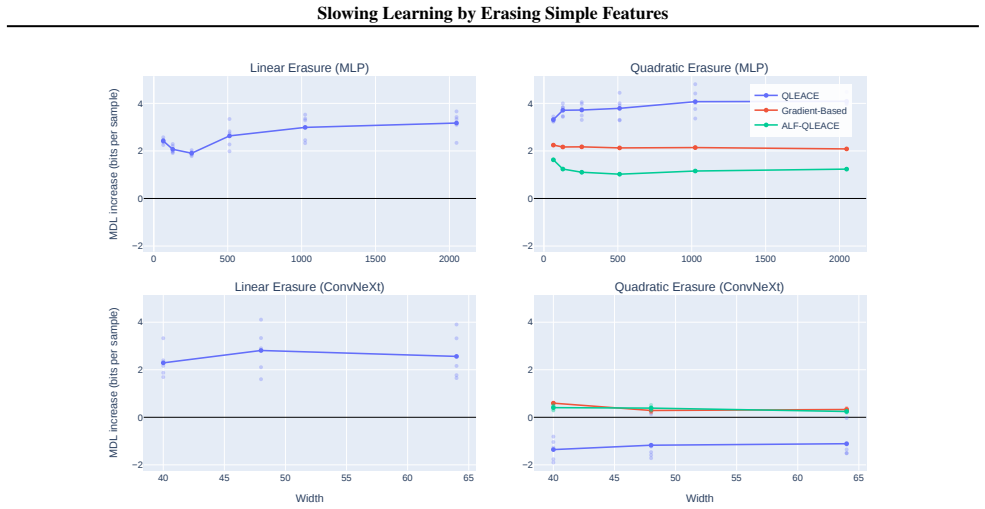
The paper's central discovery is that there is a closed-form, provably minimal way to erase every piece of class information that a quadratic, degree-2 polynomial classifier could use, and that this erasure behaves very differently from linear erasure. QLEACE applies, per class, the optimal transport map from the class-conditional distribution to a common target distribution whose mean and covariance are the Gaussian Wasserstein barycenter of the class means and covariances; Theorems 2.2 and 2.3 show matching first- and second-order moments makes the constant predictor optimal among polynomial predictors, and Theorem 2.6 proves this particular target minimizes the expected squared edit. On CIFAR-10, CIFARNet, and SVHN, QLEACE consistently slows feedforward MLPs and LeNets more than LEACE does, but in ConvNeXt and Swin models it backfires after about 16 epochs: the models exploit higher-order Shannon information QLEACE injected about class labels and can reach lower final loss than on unerased data. The approximate label-free variant ALF-QLEACE avoids injection because it applies the same projection to every point, yet it sometimes makes learning easier, acting as data augmentation. The paper concludes that quadratic concept erasure is unreliable in practice, while LEACE is a reliable way to make features less salient.
Load-bearing premise
The guarantee that QLEACE removes all quadratically available information assumes every class has a full-rank covariance matrix and an exact deterministic transport map exists; on real image data those conditions often fail, so the computed erasure may fall short of the guarantee.
Editorial extensions
If this is right
- Because QLEACE transforms each class with a different map, it can inject label-dependent geometry into higher-order moments; the observed backfiring means moment-matching is not information-erasure when the downstream network is expressive.
- LEACE remains the reliable erasure: it raises prequential MDL and final loss across every architecture, dataset, width, and depth tested, with roughly constant effect as networks widen.
- The backfiring transition, which appears around 16 epochs in ConvNeXt and Swin on CIFAR-10, is direct evidence that distributional simplicity bias breaks down once networks have had enough time to exploit higher-order statistics.
- ALF-QLEACE and gradient-based erasure do not backfire because they do not depend on the class label, but their effects are smaller and sometimes negative, acting as data augmentation, so quadratic erasure is dataset- and architecture-dependent.
- Any practitioner wanting to make a feature harder to learn should prefer LEACE; quadratic erasers should be used with caution and validated for backfiring on the target architecture.
Reading between the lines
- A testable extension the authors leave implicit: if backfiring is caused by class-dependent geometry, then a deep network trained on QLEACE'd data should show the same late-epoch loss collapse on any dataset where the barycenter maps are non-isometric, while ALF-QLEACE should never show it.
- We infer that moment erasure is insufficient as a fairness or safety intervention in deployment, since a trained adversarial network, not a polynomial classifier, is the relevant threat model; a label-independent or Shannon-information erasure would be safer.
- The sharp transition around epoch 16 suggests that probing intermediate layers of ConvNeXt or Swin before and after that epoch could reveal exactly where higher-order statistics are decoded, making the mechanism observable rather than inferred from loss curves.
- An open design question follows: can the data-augmentation effect of ALF-QLEACE be harnessed deliberately? Since it removes high-variance class-specific directions, it may act as a regularizer; comparing it to standard augmentation on the same architectures would separate the two effects.
Editorial analysis
A structured set of objections, weighed in public.
Referee Report
Summary. The paper derives QLEACE, a closed-form optimal-transport-based erasure method that equalizes class-conditional means and covariances, and compares it with LEACE, an approximate label-free variant (ALF-QLEACE), and a gradient-based erasure method on CIFAR-10, CIFARNet, and SVHN. The main empirical findings are that LEACE consistently slows learning across architectures, while QLEACE slows learning in feedforward networks but backfires in ConvNeXt and Swin models, and approximate variants can act as data augmentation. The authors interpret backfiring as evidence that expressive architectures exploit injected higher-order Shannon information about class labels.
Significance. If the QLEACE guarantee holds in practice, the paper provides a clean minimal-distortion method for removing all second-order class information and a novel intervention-based demonstration of the distributional simplicity bias. The theoretical core (Theorems 2.2, 2.3, and 2.6) is clearly stated with proofs in the appendix; the use of maximal update parametrization and prequential MDL is appropriate, and the width-scaling comparison is informative. The backfiring phenomenon is a striking and potentially influential result. However, the empirical verification of the second-moment guarantee is absent, which leaves the main interpretation underdetermined.
major comments (4)
- [Section 2.2 (Theorem 2.6) and Section 4] The exact second-moment guarantee is not verified empirically. The theorem assumes full-rank class-conditional covariance matrices and an exact solution to the barycenter equation (4), but on raw-pixel CIFAR-10/SVHN (d=3072) the empirical covariance is severely ill-conditioned; the paper does not state whether QLEACE uses shrinkage, a pseudoinverse, or truncated SVD, and it reports no post-erasure diagnostic of residual class-conditional covariance differences. Since the central backfiring interpretation attributes the late ConvNeXt/Swin performance to injected higher-order Shannon information, the missing quadratic-residual check leaves the plausible alternative that residual second-order signal drives the effect. Please report a diagnostic such as max_k ||Σ_k − Σ̄||_F (and the mean/covariance deviations for all erasers) and specify the numerical solver, regularization, and convergence tolerance.
- [Section 2.3, Eq (11), and Figure 1] The rank of the ALF-QLEACE projection is specified inconsistently. Eq (11) says 'rank d−k', the next paragraph says 'rank d − 1', Figure 1 says 'rank d − 15', and the iterative-erasure paragraph says 'up to d rank 1 erasures' can be added. In addition, the claimed min-max optimality of truncating the singular-value decomposition of the worst-class difference matrix is asserted but not proved; the objective (11) is over a projection matrix P and is not obviously solved by that heuristic. Please give the exact algorithm (rank parameter, iteration count, class selection rule) and a proof or citation for the projection optimality.
- [Section 2.4] The gradient-based erasure method is not reproducible. The three loss-term weights are said to be 'tuned' to ensure near-zero quadratic information while staying close to the original images, but their final values, the L-BFGS hyperparameters, and the optimization budget are not reported, and no code or data are released. Because the comparison across erasers is the empirical backbone of the paper, please provide code/data or a complete hyperparameter table (including per-dataset values) for all erasure methods.
- [Section 4, QLEACE paragraph] The causal claim that backfiring reflects learned use of 'injected higher order Shannon information' is not directly supported by any quantitative measurement of higher-order statistics. The paper shows sample images and learning curves, but does not report third- or fourth-order conditional moment differences, mutual-information estimates, or the accuracy of a nonlinear probe on QLEACE'd data. Without such a probe, the alternative explanation that the backfiring is due to residual quadratic information (or some other artifact) is not excluded. Please add a higher-order statistic probe or soften the causal interpretation.
minor comments (4)
- [Section 4, CIFARNet] 'Backfiring occurs in all two- and three-layer MLPs on the CIFARNet dataset' conflicts with the Figure 8 caption, which says 'for some model dimensions'; please reconcile the text with the figure.
- [Section 2.3, Eq (11)] The notation 'k∼K' is nonstandard and should be 'k ∈ K'; also, the sentence invoking the min-max theorem should state explicitly which matrix norm is being used.
- [Section 4 and Table 16] The z-score normalization analysis is described as 'ambiguous' but no sample sizes, standard errors, or test details are given; please clarify how the ambiguity was assessed.
- [Section 2.2, footnote 2] The footnote acknowledges that the Monge problem may not have a solution; since real image covariances may be low-rank, a brief discussion of a Kantorovich relaxation or a regularized solver would help readers judge when QLEACE's guarantee applies.
Circularity Check
No significant circularity: QLEACE is derived from external optimal-transport lemmas and its erasure guarantee is proved, while the backfiring observations are empirical rather than fitted.
full rationale
The derivation chain in Section 2 is self-contained. Theorem 2.2 and Theorem 2.3 extend Belrose et al. (2023) by a direct Jensen/first-order-optimality argument, and the extension does not assume the target conclusion. Theorem 2.6 solves the moment-equalization and edit-distance tradeoff using external optimal-transport results (Rüschendorf & Uckelmann 2002; Cuesta-Albertos et al. 1996), so the QLEACE map's second-moment-erasure property is a proved consequence of its construction rather than a fitted prediction. ALF-QLEACE likewise follows from a stated min-max and SVD argument. The experiments report measured MDL and loss differences, and the backfiring phenomenon is an observed outcome; the higher-order-information interpretation is not used to fit the erasers. The paper does cite the authors' own LEACE and DSB work for method and motivation, but neither citation is load-bearing: the QLEACE and ALF-QLEACE guarantees and the learning curves stand on the paper's own equations and data. One caveat belongs under correctness rather than circularity: Theorem 2.6 assumes full-rank class-conditional covariances and a feasible Monge map (stated in Section 2.2), and the paper reports no diagnostic confirming that post-erasure class-conditional second moments are equal on CIFAR-10/SVHN, so residual quadratic signal is a possible alternative explanation for backfiring.
Assumptions & free parameters
free parameters (2)
- Gradient-based erasure loss weights =
not reported
- ALF-QLEACE projection rank =
d-15 in Figure 1; text also states d-k and d-1
assumptions (5)
- domain assumption Class-conditional distributions have full-rank covariance matrices and finite second moment.
- domain assumption The Monge formulation of optimal transport is feasible on real-world datasets.
- domain assumption Neural networks exhibit a distributional simplicity bias, learning low-order moments before higher-order statistics.
- domain assumption Prequential MDL area under the learning curve is a valid proxy for learning difficulty.
- standard math Gaussian barycenter equation (Lemma 2.4) and 2-Wasserstein lower bound (Lemma 2.5) hold as stated.
Cite this review
Pith. "Pith review of Slowing Learning by Erasing Simple Features." pith.science (2026). https://pith.science/paper/BIARRDC3
@misc{pith2026250202820,
  author       = {Pith},
  title        = {Pith review of: Slowing Learning by Erasing Simple Features},
  year         = {2026},
  howpublished = {\url{https://pith.science/paper/BIARRDC3}},
  note         = {Machine review of arXiv:2502.02820}
}
read the original abstract
Prior work suggests that neural networks tend to learn low-order moments of the data distribution first, before moving on to higher-order correlations. In this work, we derive a novel closed-form concept erasure method, QLEACE, which surgically removes all quadratically available information about a concept from a representation. Through comparisons with linear erasure (LEACE) and two approximate forms of quadratic erasure, we explore whether networks can still learn when low-order statistics are removed from image classification datasets. We find that while LEACE consistently slows learning, quadratic erasure can exhibit both positive and negative effects on learning speed depending on the choice of dataset, model architecture, and erasure method. Use of QLEACE consistently slows learning in feedforward architectures, but more sophisticated architectures learn to use injected higher order Shannon information about class labels. Its approximate variants avoid injecting information, but surprisingly act as data augmentation techniques on some datasets, enhancing learning speed compared to LEACE.
Figures


Figures from the paper (13 more)


Reference graph
Works this paper leans on
-
[2]
15 Slowing Learning by Erasing Simple Features 2 2.5 3 3.5 2 2.5 3 3.5 2 2.5 3 3.5 2 2.5 3 3.5 2 2.5 3 3.5 2 2.5 3 3.5 2 2.5 3 3.5 2 2.5 3 3.5 2 2.5 3 3.5 2 2.5 3 3.5 2 0 2 1 2 2 2 3 2 4 2 5 2 6 2 7 2 8 2 9 2 2.5 3 3.5 2 0 2 1 2 2 2 3 2 4 2 5 2 6 2 7 2 8 2 9 2 10 2 11 2 2.5 3 3.5 Eraser type Control LEACE QLEACE ALF-QLEACE Gradient-Based Loss over 5 seeds...
-
[4]
MDL over 5 random seeds for feedforward networks of various lengths and widths on linearly erased CIFAR-10. All models have a constant depth of 2 when width is varying and a constant width of 128 when depth is varying. 10 Slowing Learning by Erasing Simple Features 0 500 1000 1500 2000 1 2 3 4 5 2 4 6 8 1 2 3 4 5 0 500 1000 1500 2000 1 2 3 4 5 2 4 6 8 1 2...
-
[6]
V oita, E. and Titov, I. Information-theoretic probing with minimum description length. arXiv preprint arXiv:2003.12298,
arXiv 2003
- [7]
-
[8]
This yields a “square” order-n tensor whose axes are all of size d
(15) 3We are using NumPy-style indexing here, so that A(n) ...j refers to the slice of A(n) where the final axis index is set to j. This yields a “square” order-n tensor whose axes are all of size d. 8 Slowing Learning by Erasing Simple Features If P(Z ̸= j) = 0, then all class-conditional moments are trivially equal to the unconditional moments. Otherwis...
work page 2000
-
[9]
Cross-entropy loss over 5 random seeds for ReLU MLPs of various lengths and widths on the CIFAR-10 dataset. 14 Slowing Learning by Erasing Simple Features 2 2.5 3 3.5 4 2 2.5 3 3.5 4 2 2.5 3 3.5 4 2 2.5 3 3.5 4 2 2.5 3 3.5 4 2 2.5 3 3.5 4 2 2.5 3 3.5 4 2 2.5 3 3.5 4 2 2.5 3 3.5 4 2 2.5 3 3.5 4 2 0 2 1 2 2 2 3 2 4 2 5 2 6 2 7 2 8 2 9 2 2.5 3 3.5 4 2 0 2 1 ...
-
[10]
MDL over 5 random seeds for Swin Transformers and ConvNeXts of various lengths and widths on the quadratically erased CIFAR-10 dataset. The ConvNeXts exhibit backfiring, achieving lower mean MDLs on surgically quadratically erased data than on unerased data. 12 Slowing Learning by Erasing Simple Features 0 500 1000 1500 2000 1 1.5 2 2 4 6 8 1 1.5 2 Width ...
work page 2000
-
[11]
The MLPs exhibit backfiring on the CIFARNet dataset for some model dimensions
MDL over 5 random seeds for MLPs of various lengths and widths on the linearly and quadratically erased CIFARNet and SVHN datasets. The MLPs exhibit backfiring on the CIFARNet dataset for some model dimensions. 13 Slowing Learning by Erasing Simple Features 2 2.5 3 2 2.5 3 2 2.5 3 2 2.5 3 2 2.5 3 2 2.5 3 2 2.5 3 2 2.5 3 2 2.5 3 2 2.5 3 2 0 2 1 2 2 2 3 2 4...
Show all 15 references
-
[13]
Cross-entropy loss over five random seeds for Swin transformers of various lengths and widths on the CIFAR-10 dataset. 17 Slowing Learning by Erasing Simple Features 1 1.5 2 2.5 3 3.5 1 1.5 2 2.5 3 3.5 1 1.5 2 2.5 3 3.5 1 1.5 2 2.5 3 3.5 1 1.5 2 2.5 3 3.5 1 1.5 2 2.5 3 3.5 1 1...
-
[14]
Cross-entropy loss over 5 random seeds for ReLU MLPs of various lengths and widths on the SVHN dataset. 18 Slowing Learning by Erasing Simple Features 1 2 3 1 2 3 1 2 3 1 2 3 1 2 3 1 2 3 1 2 3 1 2 3 1 2 3 1 2 3 2 0 2 1 2 2 2 3 2 4 2 5 2 6 2 7 2 8 2 9 2 10 1 2 3 2 0 2 1 2 2 2 3...
-
[1996]
A., Mehta, H., Mishchenko, K., Khaled, A., and Cutkosky, A
Defazio, A., Yang, X. A., Mehta, H., Mishchenko, K., Khaled, A., and Cutkosky, A. The road less scheduled. arXiv preprint arXiv:2405.15682,
-
[2016]
Leace: Perfect lin- ear concept erasure in closed form
Belrose, N., Schneider-Joseph, D., Ravfogel, S., Cotterell, R., Raff, E., and Biderman, S. Leace: Perfect lin- ear concept erasure in closed form. arXiv preprint arXiv:2306.03819,
-
[2022]
Refusal in llms is an affine function
Marshall, T., Scherlis, A., and Belrose, N. Refusal in llms is an affine function. arXiv preprint arXiv:2411.09003,
-
[2023]
Krizhevsky, A., Hinton, G., et al
URL https://arxiv.org/abs/ 2305.07810. Krizhevsky, A., Hinton, G., et al. Learning multiple layers of features from tiny images
-
[2024]
Netzer, Y ., Wang, T., Coates, A., Bissacco, A., Wu, B., and Ng, A. Y . Reading digits in natural images with unsupervised feature learning. In NIPS Workshop on Deep Learning and Unsuper- vised Feature Learning 2011 ,
2011
Reviewed August 9, 2026 · model on record in the stance chip above.
Discussion (0). Continue with ORCID to comment.