REVIEW 4 major objections 6 minor 59 references
Robust Reward Alignment via Hypothesis Space Batch Cutting
T0 review · 4 major / 6 minor · reviewed 2026-08-09 · deepseek-v4-flash
Pith's one-line read By voting on each batch of preferences, an agent can keep the true reward inside its hypothesis space even when some labels are wrong, and with clean labels the method PAC-learns the reward in a bounded number of queries.
desk verdict A useful practical method for noisy preference learning, but the headline PAC guarantee does not apply to the implemented query process and the robustness claim leans on an oracle-tuned gamma. read the letter →
The pith
A machine-rendered reading of the paper's core claim, the machinery that carries it, and where it could break.
The reading
What carries the argument
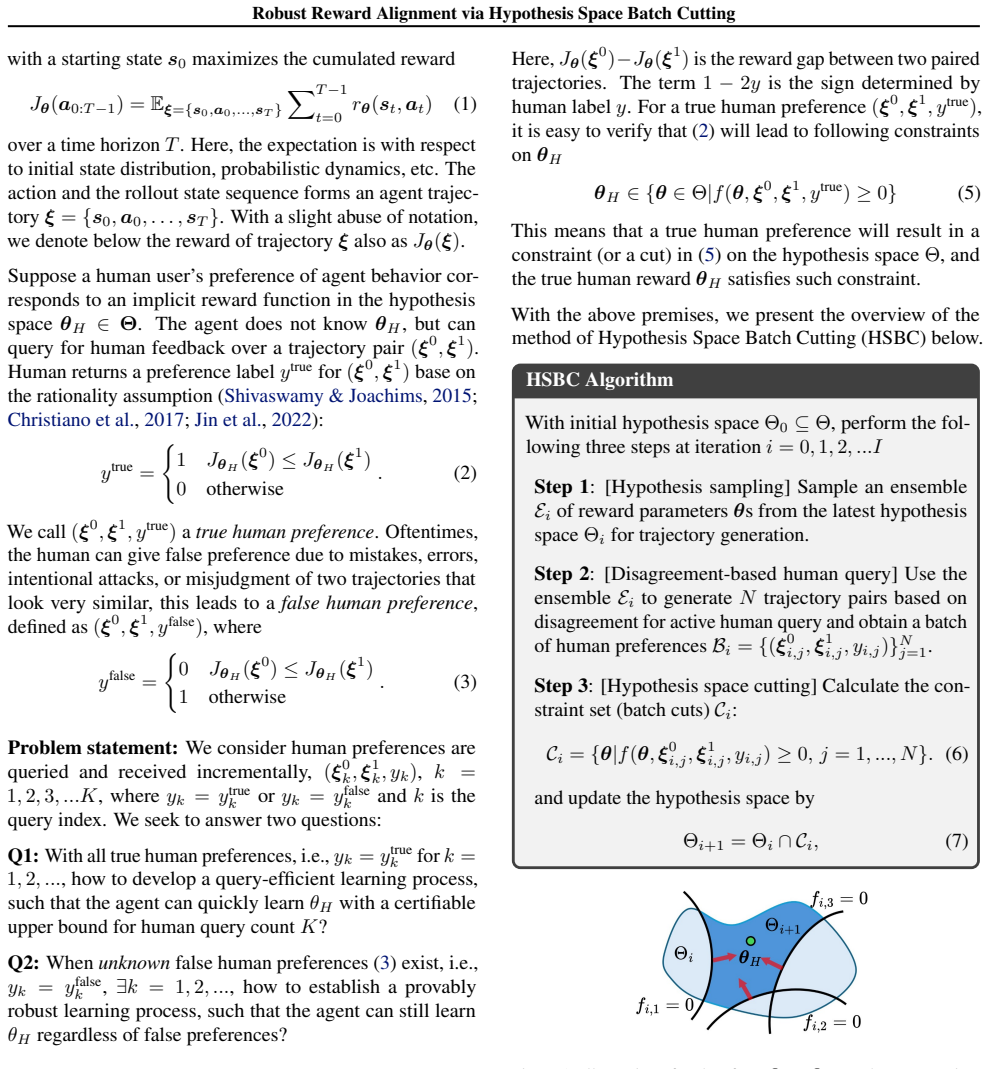
The load-bearing object is the voting function $V_i(\theta) = \sum_{j=1}^{N} H\bigl(f(\theta, \xi^0_{i,j}, \xi^1_{i,j}, y_{i,j})\bigr)$, where $H$ is the Heaviside step function and $f$ records whether reward parameter $\theta$ agrees with the preference label $y_{i,j}$ on a trajectory pair. It turns a batch of preferences into a geometric cut through the thresholded indicator $\mathbf{1}_{C_i}(\theta) = H\bigl(V_i(\theta) - \lfloor(1-\gamma)N\rfloor + 0.5\bigr)$. The threshold is chosen so that the true reward, which receives one vote from every true label, is preserved exactly when false labels are budgeted by $\gamma$. In the analysis, the disagreement coefficient and the VC-dimension of the reward model convert disagreement-based active sampling into a label-complexity bound.
What would settle it
Construct a single batch with $\lceil \gamma N \rceil + 1$ false labels arranged against the true reward: then $V_i(\theta_H) \le \lfloor (1-\gamma)N \rfloor - 1$, which is below the threshold $\lfloor (1-\gamma)N \rfloor - 0.5$, so $\theta_H$ is removed from the hypothesis space and the claimed invariance fails exactly beyond its stated budget.
Extended reading notes
Core claim
The central discovery is that the strict intersection cut of a preference batch, which fails on a single wrong label, can be replaced by a thresholded vote $C_i = \{\theta \mid V_i(\theta) > \lfloor (1-\gamma)N \rfloor - 0.5\}$, where $V_i(\theta)$ counts how many labels in the batch agree that $\theta$ is consistent with them. Because true labels always vote for $\theta_H$ and false labels vote against it, $\theta_H$ collects at least $\lfloor (1-\gamma)N \rfloor$ votes whenever the batch has at most $\lceil \gamma N \rceil$ false labels; the threshold is set just below that number, so $\theta_H$ is never cut out. With all-true preferences, $\gamma=0$ reduces the thresholded cut to the intersection, and disagreement-based queries give the PAC bound $K = O\bigl(\zeta(d\log\zeta + \log(\log(1/\epsilon)/\delta))\log(1/\epsilon)\bigr)$ with error at most $\epsilon$ and confidence at least $1-\delta$. The paper further reports that in six simulated control and manipulation tasks the method matches a standard preference-learning baseline at zero false rate and outperforms it and several robust variants at 10% to 30% false rates.
Load-bearing premise
The load-bearing premise is that every batch contains no more than $\lceil \gamma N \rceil$ false labels and that trajectory pairs are drawn independently from one fixed distribution; the implemented online algorithm generates its own trajectories from the evolving reward, so the fixed-distribution assumption is not met.
Editorial extensions
If this is right
- With error-free preferences, HSBC learns a reward whose preference-prediction error is at most $\epsilon$ with probability at least $1-\delta$ using $K = O(\zeta(d\log\zeta + \log(\log(1/\epsilon)/\delta))\log(1/\epsilon))$ queries.
- When every batch honors at most $\lceil \gamma N \rceil$ false labels, the true reward hypothesis is never removed, so planning stays aligned even at the 20% and 30% label-error rates reported in the experiments.
- The method needs no separate classifier, no label-flipping step, and no assumption about the distribution of false preferences; robustness comes from the vote threshold alone.
- Setting $\gamma=0$ recovers exact intersection cutting, so the robust procedure is a strict generalization of the clean-label version.
- In the reported experiments, performance degrades only mildly from 0% to 30% false labels while a standard preference-learning baseline collapses, and the method also learns from real human volunteers with a conservativeness level of 40%.
Reading between the lines
- The PAC theorem assumes trajectory pairs are drawn independently from a fixed distribution $P_{XY}$, but the implemented agent generates trajectories from its own evolving model-predictive controller under the current reward ensemble; the paper does not close this gap, so the stated bound likely does not directly govern the online experiments. A concrete test would run HSBC on a fixed offline pref
- The vote threshold implies a robustness-conservativeness trade-off: setting $\gamma$ above the true false rate preserves $\theta_H$ but cuts less volume per batch. The paper notes that a higher $\gamma$ increases query complexity, and one could quantify this by measuring hypothesis-space volume removed per query.
- A reported weakness concerns a stochastic teacher that labels nearly tied trajectories inconsistently; this suggests that label noise concentrated inside the disagreement region can exceed a batch-level budget. An adaptive $\gamma$ or a disagreement-weighted voting scheme is a testable remedy the paper leaves implicit.
- The geometric picture aligns with standard active learning, where the disagreement coefficient controls label complexity; HSBC can therefore be read as a label-noise-tolerant form of disagreement-based active learning rather than an entirely new statistical model.
Editorial analysis
A structured set of objections, weighed in public.
Referee Report
Summary. The paper proposes Hypothesis Space Batch Cutting (HSBC), an iterative reward-alignment method that maintains a hypothesis space of reward parameters and cuts it using batches of preference labels. For clean labels, it claims a PAC bound with active query complexity K = O(ζ(d log ζ + log(log(1/ε)/δ)) log(1/ε)) (Theorem 4.2). For noisy labels, it replaces the strict intersection cut with a thresholded vote Ci = {θ | Vi(θ) > ⌊(1−γ)N⌋ − 0.5} and proves that the true reward remains in the hypothesis space whenever each batch contains at most ⌈γN⌉ false labels (Lemma 5.2). Experiments in an MPC setting across six tasks compare HSBC with PEBBLE, RIME, SURF, MAE, and t-CE, showing competitive clean-label performance and improved robustness at 10–30% false-preference rates, plus ablations and real-human-data tests.
Significance. If the theoretical claims were established for the implemented algorithm, the paper would make a useful contribution: it provides a geometrically interpretable, query-efficient active-learning framework for preference-based reward learning, a conservative voting cut with a distribution-free containment guarantee under a false-label budget, and a broad empirical comparison including real human feedback. The code and website are advertised, which is helpful for reproducibility. However, the central PAC certificate is proved for a disagreement-based active-learning protocol that differs from the implemented MPC-based query process, and the robust guarantee is only a containment result, not a convergence or error bound. These gaps are load-bearing for the paper's headline claims, so the contribution is not yet fully established.
major comments (4)
- [§6.3, Algorithm 1; Appendix E.4, Eqs. (43)–(49)] Theorem 4.2's proof requires each batch Bi to consist of independent draws from P_XY conditioned on the disagreement region DIS(Vi) of the current version space. In the implemented HSBC (Algorithm 1, Section 6.3), trajectory pairs are produced by sampling-based MPC under the current reward ensemble (Eq. 21), with exploration noise and a disagreement filter (Eq. 22). This query process is neither i.i.d. nor drawn from a fixed P_XY: it depends on the current ensemble Ei, which changes with i and with the policy induced by the learned reward. Consequently, conditional on passing the disagreement filter, the queried pairs are not samples from P_X|DIS(Vi), so the conditional-error bound in Eq. (43) has no basis and the halving inequality in Eq. (49) is not established for the actual algorithm. Appendix E.4 does not close this gap. The advertised query-complexity certificate is a central contribution, and all experiments use the online MPC protocol, so this mismatch needs to be resolved either by changing the analysis to fit the protocol or by changing the protocol to satisfy the theorem's assumptions.
- [§7, Fig. 5 caption; §5.1, Lemma 5.2] The robust guarantee of Lemma 5.2 is conditional on a per-batch false-label budget of at most ⌈γN⌉. In the simulated-human experiments, the conservativeness level is set equal to the actual false rate (Fig. 5 caption), and false labels are generated by 'a random selection of human preference labels is flipped' (Section 7). For N = 10 and a 30% false rate, the probability that a batch contains more than 3 false labels is about 0.35, so Lemma 5.2's condition is violated on a substantial fraction of batches even though the average rate matches γ. The experiments therefore validate robustness under a favorable calibration of γ, not under the unknown-false-preference scenario advertised in the abstract. Please either set γ as a true upper bound in the experiments, report the empirical maximum number of false labels per batch, or provide results with γ strictly above the unknown rate across all tasks.
- [Appendix E.4, Eq. (44)] The proof of Theorem 4.2 asserts log(N/d) ≤ log ζ 'with proper choice of c, c′'. From N = c ζ(d log ζ + log(1/δ′)), we have N/d ≈ c ζ log ζ, so log(N/d) ≤ log ζ would require c ζ log ζ ≤ ζ, i.e., c log ζ ≤ 1, which is false for ζ < e^{1/c}. Unless additional assumptions on ζ or a different choice of N are supplied, the step from Eq. (44) to the halving inequality Eq. (49) is not justified for all ζ > 0. This is load-bearing for the query-complexity bound, so the proof needs a corrected bound or an explicit restriction on the disagreement coefficient.
- [§5, Lemma 5.2; §3, Q2] The robust section establishes only that the true reward θH remains in every hypothesis space when the false-label budget holds; it does not provide any PAC-style guarantee that the returned ensemble has low preference-prediction error err(rθ) under false labels. The problem statement Q2 asks whether the agent can 'still learn θH regardless of false preferences', but the theory never bounds err(rθ) for the robust procedure, nor does it show that the hypothesis space shrinks to a small error region in the presence of false labels. The empirical results suggest graceful degradation, but the 'provable robustness' claim in the abstract is stronger than the proven containment result. Please state this limitation explicitly or add an error bound for the robust algorithm.
minor comments (6)
- [Algorithm 1] Line 3 contains a typo: 'Sample an assemble Ei' should read 'Sample an ensemble Ei'.
- [Eq. (22)] The disagreement score formula is written as '4n+Ei n−Ei /N^2', which is ambiguous; it should be typeset as 4 n+_{Ei} n−_{Ei} / N^2, with n+_{Ei} and n−_{Ei} defined explicitly.
- [Appendix E.3] The passive PAC bound uses the symbol 'LP ASS' and later switches to 'M' and 'N' without defining the relationship; please use the batch size N consistently throughout the proof.
- [Section 7.4, Table 3] In the Walker row, the correlation at 0% false rate (0.584±0.035) is lower than at 10% (0.636±0.060), which is inconsistent with the text's claim of strong correlations across all rates; this deserves a comment or a corrected interpretation.
- [References] The Uni-RLHF reference 'Yuan et al.' lacks a year, venue, and page/arXiv information; please complete it.
- [Fig. 5 caption, Section 7.1] The caption states that the conservativeness level equals the actual false rate, but Section 5.1 frames γ as an unknown-rate hyperparameter; please reconcile this in the main text and discuss the limitation that this favorable calibration does not test unknown false rates.
Circularity Check
Lemma 5.2's robustness guarantee restates the gamma false-label budget as a vote threshold; Theorem 4.2 is an independent active-learning bound.
-
self definitional
[Section 5.1, Eq. (16); Lemma 5.2; Appendix D.3]
"With the conservativeness level γ, one can change (9) into Ci = {θ|Vi(θ) > ⌊(1 − γ)N ⌋ −0.5}, ... Lemma 5.2. With the conservativeness level γ and replacing (9) with Ci in (16), the HSBC Algorithm will have θH ∈ Ci and θH ∈ Θi, i=1,2,3...I, regardless of false human preference."
The cut threshold in (16) is set exactly one half-vote above ⌊(1−γ)N⌋, the vote count that θH is guaranteed to receive whenever a batch contains at most ⌈γN⌉ false labels. The proof of Lemma 5.2 (Appendix D.3) only counts these guaranteed correct votes and then invokes (16) to conclude θH ∈ Ci. Thus the robustness claim is the false-label budget rewritten as the threshold; it is true by construction of (16), not an independent property established about the learning process.
full rationale
The paper's principal PAC result (Theorem 4.2, Appendix E) is not circular: it gives a self-contained disagreement-based active-learning argument under an explicit i.i.d. P_XY assumption and a finite VC-dimension, with no load-bearing reliance on the authors' prior work. The cited self-work (Xie et al., 2024) is contextual, not load-bearing. The one definition-level reduction is Lemma 5.2: once γ is assumed to upper-bound the false-preference count per batch, the chosen threshold in (16) is precisely the vote level that keeps θH, so the 'provable robustness' follows immediately from the assumption and the cut definition. This is a partial, by-construction circularity in the robustness guarantee, but it does not invalidate the independent query-complexity analysis. A separate correctness concern—Theorem 4.2 assumes queries are i.i.d. from a fixed P_XY while Algorithm 1 generates trajectories from a shifting MPC reward ensemble—is a validity gap rather than a circularity and is not scored here. Experiments also set γ equal to the actual false rate, which supplies the guarantee's input but is an experimental-design choice.
Assumptions & free parameters
free parameters (1)
- conservativeness level gamma =
0, 0.1, 0.2, 0.3 (equal to simulated false rate in Fig. 5); 0.4 for real human data
assumptions (5)
- domain assumption True reward theta_H exists in the initial hypothesis space Theta_0 = R^r.
- domain assumption Human preferences follow the threshold rationality model in Eq. (2), so true labels are deterministic comparisons of J_theta_H.
- ad hoc to paper Each preference batch contains at most ceil(gamma N) false labels.
- domain assumption Trajectory pairs are drawn i.i.d. from a fixed distribution P_XY over pairs, and the version-space disagreement region is accessible for sampling.
- standard math The concept class of reward-induced classifiers has finite VC dimension d and a finite disagreement coefficient zeta.
Cite this review
Pith. "Pith review of Robust Reward Alignment via Hypothesis Space Batch Cutting." pith.science (2026). https://pith.science/paper/5GJC53II
@misc{pith2026250202921,
  author       = {Pith},
  title        = {Pith review of: Robust Reward Alignment via Hypothesis Space Batch Cutting},
  year         = {2026},
  howpublished = {\url{https://pith.science/paper/5GJC53II}},
  note         = {Machine review of arXiv:2502.02921}
}
read the original abstract
Reward design in reinforcement learning and optimal control is challenging. Preference-based alignment addresses this by enabling agents to learn rewards from ranked trajectory pairs provided by humans. However, existing methods often struggle from poor robustness to unknown false human preferences. In this work, we propose a robust and efficient reward alignment method based on a novel and geometrically interpretable perspective: hypothesis space batched cutting. Our method iteratively refines the reward hypothesis space through "cuts" based on batches of human preferences. Within each batch, human preferences, queried based on disagreement, are grouped using a voting function to determine the appropriate cut, ensuring a bounded human query complexity. To handle unknown erroneous preferences, we introduce a conservative cutting method within each batch, preventing erroneous human preferences from making overly aggressive cuts to the hypothesis space. This guarantees provable robustness against false preferences, while eliminating the need to explicitly identify them. We evaluate our method in a model predictive control setting across diverse tasks. The results demonstrate that our framework achieves comparable or superior performance to state-of-the-art methods in error-free settings while significantly outperforming existing methods when handling a high percentage of erroneous human preferences.
Figures


Figures from the paper (6 more)



Reference graph
Works this paper leans on
-
[1]
L., Almeida, D., Altenschmidt, J., Altman, S., Anadkat, S., et al
Achiam, J., Adler, S., Agarwal, S., Ahmad, L., Akkaya, I., Aleman, F. L., Almeida, D., Altenschmidt, J., Altman, S., Anadkat, S., et al. Gpt-4 technical report. arXiv preprint arXiv:2303.08774, 2023
arXiv 2023
-
[2]
April: Active preference learning-based reinforcement learning
Akrour, R., Schoenauer, M., and Sebag, M. April: Active preference learning-based reinforcement learning. In Machine Learning and Knowledge Discovery in Databases: European Conference, ECML PKDD 2012, Bristol, UK, September 24-28, 2012. Proceedings, Part II 23, pp.\ 116--131. Springer, 2012
2012
-
[3]
Akrour, R., Schoenauer, M., Sebag, M., and Souplet, J.-C. Programming by feedback. In International Conference on Machine Learning, volume 32, pp.\ 1503--1511. JMLR. org, 2014
work page 2014
-
[4]
Amid, E., Warmuth, M. K., Anil, R., and Koren, T. Robust bi-tempered logistic loss based on bregman divergences. Advances in Neural Information Processing Systems, 32, 2019
work page 2019
-
[5]
Fine-tuning language models to find agreement among humans with diverse preferences
Bakker, M., Chadwick, M., Sheahan, H., Tessler, M., Campbell-Gillingham, L., Balaguer, J., McAleese, N., Glaese, A., Aslanides, J., Botvinick, M., et al. Fine-tuning language models to find agreement among humans with diverse preferences. Advances in Neural Information Processing Systems, 35: 0 38176--38189, 2022
2022
-
[6]
L., Harvey, N., Liaw, C., and Mehrabian, A
Bartlett, P. L., Harvey, N., Liaw, C., and Mehrabian, A. Nearly-tight vc-dimension and pseudodimension bounds for piecewise linear neural networks. Journal of Machine Learning Research, 20 0 (63): 0 1--17, 2019
2019
-
[7]
Biyik, E. and Sadigh, D. Batch active preference-based learning of reward functions. In Conference on robot learning, pp.\ 519--528. PMLR, 2018
work page 2018
-
[8]
Batch active learning of reward functions from human preferences
Biyik, E., Anari, N., and Sadigh, D. Batch active learning of reward functions from human preferences. ACM Transactions on Human-Robot Interaction, 13 0 (2): 0 1--27, 2024
work page 2024
Show all 59 references
-
[9]
J., and Sadigh, D
B y k, E., Huynh, N., Kochenderfer, M. J., and Sadigh, D. Active preference-based gaussian process regression for reward learning and optimization. The International Journal of Robotics Research, 43 0 (5): 0 665--684, 2024
2024
-
[10]
Bradley, R. A. and Terry, M. E. Rank analysis of incomplete block designs: I. the method of paired comparisons. Biometrika, 39 0 (3/4): 0 324--345, 1952
1952
-
[11]
K., Scheurer, J., Rando, J., Freedman, R., Korbak, T., Lindner, D., Freire, P., Wang, T
Casper, S., Davies, X., Shi, C., Gilbert, T. K., Scheurer, J., Rando, J., Freedman, R., Korbak, T., Lindner, D., Freire, P., Wang, T. T., Marks, S., Segerie, C.-R., Carroll, M., Peng, A., Christoffersen, P. J., Damani, M., Slocum, S., Anwar, U., Siththaranjan, A., Nadeau, M., ...
2023
-
[12]
Rime: Robust preference-based reinforcement learning with noisy preferences
Cheng, J., Xiong, G., Dai, X., Miao, Q., Lv, Y., and Wang, F.-Y. Rime: Robust preference-based reinforcement learning with noisy preferences. In International Conference on Machine Learning, pp.\ 8229--8247. PMLR, 2024
2024
-
[13]
F., Leike, J., Brown, T., Martic, M., Legg, S., and Amodei, D
Christiano, P. F., Leike, J., Brown, T., Martic, M., Legg, S., and Amodei, D. Deep reinforcement learning from human preferences. Advances in neural information processing systems, 30, 2017
2017
-
[14]
Active reward learning
Daniel, C., Viering, M., Metz, J., Kroemer, O., and Peters, J. Active reward learning. In Robotics: Science and systems, volume 98, 2014
2014
-
[15]
Feng, L., Shu, S., Lin, Z., Lv, F., Li, L., and An, B. Can cross entropy loss be robust to label noise? In Proceedings of the twenty-ninth international conference on international joint conferences on artificial intelligence, pp.\ 2206--2212, 2021
2021
-
[16]
Ghosh, A., Kumar, H., and Sastry, P. S. Robust loss functions under label noise for deep neural networks. In Proceedings of the AAAI conference on artificial intelligence, volume 31, 2017
2017
-
[17]
Dextreme: Transfer of agile in-hand manipulation from simulation to reality
Handa, A., Allshire, A., Makoviychuk, V., Petrenko, A., Singh, R., Liu, J., Makoviichuk, D., Van Wyk, K., Zhurkevich, A., Sundaralingam, B., et al. Dextreme: Transfer of agile in-hand manipulation from simulation to reality. In 2023 IEEE International Conference on Robotics an...
2023
-
[18]
A bound on the label complexity of agnostic active learning
Hanneke, S. A bound on the label complexity of agnostic active learning. In Proceedings of the 24th international conference on Machine learning, pp.\ 353--360, 2007
2007
-
[19]
Contrastive preference learning: Learning from human feedback without rl
Hejna, J., Rafailov, R., Sikchi, H., Finn, C., Niekum, S., Knox, W., and Sadigh, D. Contrastive preference learning: Learning from human feedback without rl. In International Conference on Learning Representations, 2024
2024
-
[20]
Hejna III, D. J. and Sadigh, D. Few-shot preference learning for human-in-the-loop rl. In Conference on Robot Learning, pp.\ 2014--2025. PMLR, 2023
2014
-
[21]
J., Kim, J., Kwak, M
Heo, J., Lee, Y. J., Kim, J., Kwak, M. G., Park, Y. J., and Kim, S. B. Mixing corrupted preferences for robust and feedback-efficient preference-based reinforcement learning. Knowledge-Based Systems, 309: 0 112824, 2025
2025
-
[22]
Anymal parkour: Learning agile navigation for quadrupedal robots
Hoeller, D., Rudin, N., Sako, D., and Hutter, M. Anymal parkour: Learning agile navigation for quadrupedal robots. Science Robotics, 9 0 (88): 0 eadi7566, 2024
2024
-
[23]
Bayesian active learning for classification and preference learning
Houlsby, N., Husz \'a r, F., Ghahramani, Z., and Lengyel, M. Bayesian active learning for classification and preference learning. stat, 1050: 0 24, 2011
2011
-
[24]
Predictive Sampling: Real-time Behaviour Synthesis with MuJoCo
Howell, T., Gileadi, N., Tunyasuvunakool, S., Zakka, K., Erez, T., and Tassa, Y. Predictive Sampling: Real-time Behaviour Synthesis with MuJoCo . dec 2022. doi:10.48550/arXiv.2212.00541. URL https://arxiv.org/abs/2212.00541
-
[25]
Reward learning from human preferences and demonstrations in atari
Ibarz, B., Leike, J., Pohlen, T., Irving, G., Legg, S., and Amodei, D. Reward learning from human preferences and demonstrations in atari. Advances in neural information processing systems, 31, 2018
2018
-
[26]
Mentornet: Learning data-driven curriculum for very deep neural networks on corrupted labels
Jiang, L., Zhou, Z., Leung, T., Li, L.-J., and Fei-Fei, L. Mentornet: Learning data-driven curriculum for very deep neural networks on corrupted labels. In International conference on machine learning, pp.\ 2304--2313. PMLR, 2018
2018
-
[27]
D., Lu, Z., and Mou, S
Jin, W., Murphey, T. D., Lu, Z., and Mou, S. Learning from human directional corrections. IEEE Transactions on Robotics, 39 0 (1): 0 625--644, 2022
2022
-
[28]
Kingma, D. P. Adam: A method for stochastic optimization. arXiv preprint arXiv:1412.6980, 2014
2014 arXiv
-
[29]
Crafting papers on machine learning
Langley, P. Crafting papers on machine learning. In Langley, P. (ed.), Proceedings of the 17th International Conference on Machine Learning (ICML 2000), pp.\ 1207--1216, Stanford, CA, 2000. Morgan Kaufmann
2000
-
[30]
Robust inference via generative classifiers for handling noisy labels
Lee, K., Yun, S., Lee, K., Lee, H., Li, B., and Shin, J. Robust inference via generative classifiers for handling noisy labels. In International conference on machine learning, pp.\ 3763--3772. PMLR, 2019
2019
-
[31]
B-pref: Benchmarking preference-based reinforcement learning
Lee, K., Smith, L., Dragan, A., and Abbeel, P. B-pref: Benchmarking preference-based reinforcement learning. In 35th Conference on Neural Information Processing Systems (NeurIPS). Neural Information Processing Systems Foundation, 2021 a
2021
-
[32]
M., and Abbeel, P
Lee, K., Smith, L. M., and Abbeel, P. Pebble: Feedback-efficient interactive reinforcement learning via relabeling experience and unsupervised pre-training. In Meila, M. and Zhang, T. (eds.), Proceedings of the 38th International Conference on Machine Learning, volume 139 of P...
2021
-
[33]
Li, Y., Das, S., and Taylor, M. E. Candere-coach: Reinforcement learning from noisy feedback. arXiv preprint arXiv:2409.15521, 2024
2024 arXiv
-
[34]
Reward uncertainty for exploration in preference-based reinforcement learning
Liang, X., Shu, K., Lee, K., and Abbeel, P. Reward uncertainty for exploration in preference-based reinforcement learning. In International Conference on Learning Representations, 2022. URL https://openreview.net/forum?id=OWZVD-l-ZrC
2022
-
[35]
Meta-reward-net: Implicitly differentiable reward learning for preference-based reinforcement learning
Liu, R., Bai, F., Du, Y., and Yang, Y. Meta-reward-net: Implicitly differentiable reward learning for preference-based reinforcement learning. Advances in Neural Information Processing Systems, 35: 0 22270--22284, 2022
2022
-
[36]
Does label smoothing mitigate label noise? In International Conference on Machine Learning, pp.\ 6448--6458
Lukasik, M., Bhojanapalli, S., Menon, A., and Kumar, S. Does label smoothing mitigate label noise? In International Conference on Machine Learning, pp.\ 6448--6458. PMLR, 2020
2020
-
[37]
Normalized loss functions for deep learning with noisy labels
Ma, X., Huang, H., Wang, Y., Romano, S., Erfani, S., and Bailey, J. Normalized loss functions for deep learning with noisy labels. In International conference on machine learning, pp.\ 6543--6553. PMLR, 2020
2020
-
[38]
Learning multimodal rewards from rankings
Myers, V., Biyik, E., Anari, N., and Sadigh, D. Learning multimodal rewards from rankings. In Faust, A., Hsu, D., and Neumann, G. (eds.), Proceedings of the 5th Conference on Robot Learning, volume 164 of Proceedings of Machine Learning Research, pp.\ 342--352. PMLR, 08--11 Nov 2022
2022
-
[39]
Active reward learning from online preferences
Myers, V., Bıyık, E., and Sadigh, D. Active reward learning from online preferences. In 2023 IEEE International Conference on Robotics and Automation (ICRA), pp.\ 7511--7518, 2023. doi:10.1109/ICRA48891.2023.10160439
2023
-
[40]
Surf: Semi-supervised reward learning with data augmentation for feedback-efficient preference-based reinforcement learning
Park, J., Seo, Y., Shin, J., Lee, H., Abbeel, P., and Lee, K. Surf: Semi-supervised reward learning with data augmentation for feedback-efficient preference-based reinforcement learning. arXiv preprint arXiv:2203.10050, 2022
2022 arXiv
-
[41]
In-hand object rotation via rapid motor adaptation
Qi, H., Kumar, A., Calandra, R., Ma, Y., and Malik, J. In-hand object rotation via rapid motor adaptation. In Conference on Robot Learning, pp.\ 1722--1732. PMLR, 2023
2023
-
[42]
Real-world humanoid locomotion with reinforcement learning
Radosavovic, I., Xiao, T., Zhang, B., Darrell, T., Malik, J., and Sreenath, K. Real-world humanoid locomotion with reinforcement learning. Science Robotics, 9 0 (89): 0 eadi9579, 2024
2024
-
[43]
D., Sastry, S
Sadigh, D., Dragan, A. D., Sastry, S. S., and Seshia, S. A. Active preference-based learning of reward functions. In Robotics: Science and Systems, 2017. URL https://api.semanticscholar.org/CorpusID:12226563
2017
-
[44]
Active Learning
Settles, B. Active Learning. Morgan & Claypool Publishers, 2012. ISBN 1608457257
2012
-
[45]
and Joachims, T
Shivaswamy, P. and Joachims, T. Coactive learning. Journal of Artificial Intelligence Research, 53: 0 1--40, 2015
2015
-
[46]
Mujoco: A physics engine for model-based control
Todorov, E., Erez, T., and Tassa, Y. Mujoco: A physics engine for model-based control. In 2012 IEEE/RSJ International Conference on Intelligent Robots and Systems, pp.\ 5026--5033. IEEE, 2012. doi:10.1109/IROS.2012.6386109
2012
-
[47]
Deepgait: Planning and control of quadrupedal gaits using deep reinforcement learning
Tsounis, V., Alge, M., Lee, J., Farshidian, F., and Hutter, M. Deepgait: Planning and control of quadrupedal gaits using deep reinforcement learning. IEEE Robotics and Automation Letters, 5 0 (2): 0 3699--3706, 2020
2020
-
[48]
Statistical learning theory
Vapnik, V. Statistical learning theory. John Wiley & Sons google schola, 2: 0 831--842, 1998
1998
-
[49]
Model predictive path integral control using covariance variable importance sampling
Williams, G., Aldrich, A., and Theodorou, E. Model predictive path integral control using covariance variable importance sampling. arXiv preprint arXiv:1509.01149, 2015
2015 arXiv
-
[50]
A survey of preference-based reinforcement learning methods
Wirth, C., Akrour, R., Neumann, G., and F \"u rnkranz, J. A survey of preference-based reinforcement learning methods. Journal of Machine Learning Research, 18 0 (136): 0 1--46, 2017
2017
-
[51]
J., and Jin, W
Xie, Z., Zhang, W., Ren, Y., Wang, Z., Pappas, G. J., and Jin, W. Safe mpc alignment with human directional feedback. arXiv preprint arXiv:2407.04216, 2024
2024
-
[52]
Reinforcement learning from diverse human preferences
Xue, W., An, B., Yan, S., and Xu, Z. Reinforcement learning from diverse human preferences. In Proceedings of the Thirty-Third International Joint Conference on Artificial Intelligence, IJCAI '24, 2024. ISBN 978-1-956792-04-1. doi:10.24963/ijcai.2024/586. URL https://doi.org/1...
2024 doi
-
[53]
W., Zhang, Y., Sun, J., Zhang, C., and Zhang, R
Yao, J., Wang, J., Tsang, I. W., Zhang, Y., Sun, J., Zhang, C., and Zhang, R. Deep learning from noisy image labels with quality embedding. IEEE Transactions on Image Processing, 28 0 (4): 0 1909--1922, 2018
1909
-
[54]
Rotating without seeing: Towards in-hand dexterity through touch
Yin, Z.-H., Huang, B., Qin, Y., Chen, Q., and Wang, X. Rotating without seeing: Towards in-hand dexterity through touch. Robotics: Science and Systems, 2023
2023
-
[55]
Uni-rlhf: Universal platform and benchmark suite for reinforcement learning with diverse human feedback
Yuan, Y., Jianye, H., Ma, Y., Dong, Z., Liang, H., Liu, J., Feng, Z., Zhao, K., and Zheng, Y. Uni-rlhf: Universal platform and benchmark suite for reinforcement learning with diverse human feedback. In The Twelfth International Conference on Learning Representations
-
[56]
N., and Lopez-Paz, D
Zhang, H., Cisse, M., Dauphin, Y. N., and Lopez-Paz, D. mixup: Beyond empirical risk minimization. In International Conference on Learning Representations, 2018. URL https://openreview.net/forum?id=r1Ddp1-Rb
2018
-
[57]
Robust curriculum learning: from clean label detection to noisy label self-correction
Zhou, T., Wang, S., and Bilmes, J. Robust curriculum learning: from clean label detection to noisy label self-correction. In International Conference on Learning Representations, 2020
2020
-
[58]
A., Atkeson, C
Zucker, M., Bagnell, J. A., Atkeson, C. G., and Kuffner, J. An optimization approach to rough terrain locomotion. In 2010 IEEE International Conference on Robotics and Automation, pp.\ 3589--3595. IEEE, 2010
2010
-
[59]
write newline
" write newline "" before.all 'output.state := FUNCTION n.dashify 't := "" t empty not t #1 #1 substring "-" = t #1 #2 substring "--" = not "--" * t #2 global.max substring 't := t #1 #1 substring "-" = "-" * t #2 global.max substring 't := while if t #1 #1 substring * t #2 gl...
Reviewed August 9, 2026 · model on record in the stance chip above.
Discussion (0). Continue with ORCID to comment.