REVIEW 4 major objections 4 minor 64 references
Thermoelastic Damping Across the Phase Transition in van der Waals Magnets
T0 review · 4 major / 4 minor · reviewed 2026-08-09 · deepseek-v4-flash
Pith's one-line read Thermoelastic damping in van der Waals magnets peaks at the magnetic phase transition, with dissipation set by the square of the thermal-expansion anomaly divided by specific heat, and by which anisotropic heat-flow path resonates.
desk verdict The anisotropic TED model is a genuine extension of Zener-Lifshitz-Roukes and worth having, but the experimental validation is not quantitative—it's propped up by a 100–300x conductivity rescaling and an unquantified magnetoelastic channel. read the letter →
The pith
A machine-rendered reading of the paper's core claim, the machinery that carries it, and where it could break.
The reading
What carries the argument
The central object is an anisotropic thermoelastic-damping model for a clamped circular drum, which generalizes the standard through-thickness theory by keeping both out-of-plane ($\kappa_\perp$) and in-plane ($\kappa_\parallel$) heat conduction. The temperature field induced by the oscillating flexural strain is expanded in Bessel modes $J_0(j_n^0 r/a)$ along the radius with a $\cosh$-profile across the thickness, and the dissipated energy is computed from the out-of-phase part of the resulting thermal strain. The magnetic side enters through an effective Grüneisen parameter that merges magnetoelastic coupling into the thermal expansion coefficient, so that the anomaly in $\alpha_T$ at the phase transition becomes an anomaly in the relaxation strength. Two thermal relaxation times, $\tau_z = h^2 \rho c_V/(\pi \kappa_\perp)$ and $\tau_r = a^2 \rho c_V/(\mu^2 \kappa_\parallel)$, control whether the through-plane or radial heat flow resonates with the mechanical period; the model's $Q^{-1}$ is the sum over thermal modes of these resonant overlaps.
What would settle it
Measure $Q^{-1}(T)$ on a suspended FePS3 drum while independently determining the thermal expansion anomaly of the same flake: if the dissipation peak does not scale with $\alpha_T^2/c_v$ across the Néel temperature, or if it remains when magnetic order is suppressed and the expansion anomaly disappears, the thermoelastic explanation is falsified.
Extended reading notes
Core claim
The central claim is that the inverse quality factor of a suspended van der Waals magnet carries a direct imprint of the magnetic phase transition through the thermoelastic relaxation strength, which the paper derives as proportional to $\alpha_T^2/c_v$ (Eq. 20). Magnetoelastic coupling makes the thermal expansion coefficient $\alpha_T$ peak at the magnetic ordering temperature, so the dissipation $Q^{-1}$ should show a pronounced maximum there, superimposed on the conventional Debye peak governed by the thermal relaxation time. The paper further claims that standard through-thickness-only thermoelastic models miss essential physics in van der Waals materials: with anisotropic thermal conductivity, heat also relaxes radially, and $Q^{-1}$ acquires extra resonance conditions when the radial thermal time constant matches the mechanical period. For FePS3 drums the model predicts a temperature-dependent peak at the Néel temperature $T_N \approx 118$ K and a radius-dependent Debye peak whose position shifts with temperature; comparison with published resonator data reproduces the shape of the dissipation, while matching its magnitude requires reducing the out-of-plane thermal conductivity by roughly two orders of magnitude relative to bulk values.
Load-bearing premise
The measured dissipation in the FePS3 resonators is dominated by thermoelastic damping, with magnetoelastic and other loss channels too small to matter near the phase transition.
Editorial extensions
If this is right
- A suspended FePS3 drum should show a dissipation peak at the Néel temperature whose height tracks the square of the thermal expansion anomaly divided by the specific heat.
- At fixed temperature, $Q^{-1}$ as a function of radius is a Debye peak, and its position shifts with temperature because the through-plane thermal relaxation time changes, so geometry selects the dominant loss regime.
- In anisotropic van der Waals materials, radial heat conduction creates additional dissipation resonances when the in-plane thermal relaxation time matches the mechanical period, producing a second peak in $Q^{-1}$ as a function of $\kappa_\parallel$.
- Matching the measured magnitude of dissipation in FePS3 requires an out-of-plane thermal conductivity about two orders of magnitude smaller than bulk values, implying that effective heat transport in suspended nanoscale flakes is strongly suppressed.
- For any anisotropic two-dimensional material with known thermodynamic properties, the model supplies quantitative $Q^{-1}$ predictions without magnetic fitting parameters.
Reading between the lines
- If the predicted peak is confirmed to scale with $\alpha_T^2/c_v$, resonator damping measurements would become a local, quantitative probe of magnetoelastic coupling and magnetic order in two-dimensional magnets, complementing magnetometry and optical techniques.
- The two-order-of-magnitude conductivity reduction needed to match experiment could indicate that boundary scattering or disorder in suspended flakes suppresses heat transport far below bulk values; direct thermal transport measurements on the same devices would separate that uncertainty from the thermoelastic mechanism itself.
- The model points to a testable mode-number signature: higher-order mechanical modes should excite additional thermal modes and yield extra dissipation peaks in $Q^{-1}$ versus $\kappa_\parallel$, so a multimode drum experiment could confirm the anisotropic heat-flow picture.
- Near the transition, nonlinear spin-mechanical coupling that the paper intentionally neglects may become significant; if so, the dissipation peak would acquire an amplitude dependence, a clean experimental way to distinguish thermoelastic from spin-mediated loss.
Signed reviews
Editorial analysis
A structured set of objections, weighed in public.
Referee Report
Summary. The paper develops a theory of thermoelastic damping (TED) in suspended van der Waals membranes with anisotropic thermal conduction, and applies it to FePS3 drum resonators. Starting from the thin-plate equation with tension and the coupled thermoelastic heat equation, the authors derive an analytic expression for Q^{-1} that includes in-plane and out-of-plane heat flow, showing regimes governed by the thermal relaxation times in the two directions. They combine this with a model of the thermal expansion anomaly near the magnetic phase transition, in which magnetoelastic coupling enters through an effective Grüneisen parameter, and they predict a dissipation peak at the Néel temperature. The predictions are compared with existing FePS3 resonator data; with published bulk thermal conductivity the model underestimates the measured dissipation by about an order of magnitude, and agreement is obtained only after reducing the calculated conductivity by factors of 100–300.
Significance. If validated, the anisotropic TED model would be a useful and broadly applicable tool for vdW nanomechanics, since it goes beyond the standard Zener and Lifshitz–Roukes treatments in a direction that is physically important for layered materials. The derivation in Section III is systematic and analytic, and the model makes concrete, falsifiable predictions about the temperature and radius dependence of dissipation and about the role of the in-plane/out-of-plane conductivity ratio. The paper also clearly identifies the key limitation—the large conductivity reduction needed to match experiment—in Section VI. However, the central claim that the observed FePS3 dissipation peak is quantitatively captured by TED is not yet established, because the agreement hinges on an ad hoc rescaling of thermal conductivity and on an unquantified neglect of competing magnetic dissipation channels.
major comments (4)
- [Section V, Fig. 6] The validation of the central claim is not quantitative. In Fig. 6(a), all model variants using experimentally reported thermal conductivity values underestimate the measured dissipation by about a factor of 10, and the model curves are scaled by 10 only for visual comparison. The agreement in Fig. 6(b) is obtained after dividing the calculated thermal conductivity by 100–300, a factor that the authors themselves note is not supported by measurements. Since Q^{-1} in this regime depends on the thermal relaxation times and hence on conductivity, this rescaling is load-bearing; without a physical justification for such a strong reduction, the paper does not demonstrate that TED quantitatively explains the measured peak.
- [Section II and Table IV] The attribution of the measured dissipation to TED rests on the neglect of magnetoelastic damping, but that neglect is not quantitatively justified. The argument in Section II is only the frequency mismatch between MHz mechanics and GHz–THz spin waves, and the text itself notes that nonlinear spin–mechanical coupling can become important close to the phase transition (ref. [19]). Table IV lists magnetoelastic damping as “Unknown” with no estimate, and no calculation is provided for its magnitude near T_N. Since the experimental peak is broad and extends into the antiferromagnetic phase, the possibility that a non-TED channel contributes significantly is not excluded by the evidence presented.
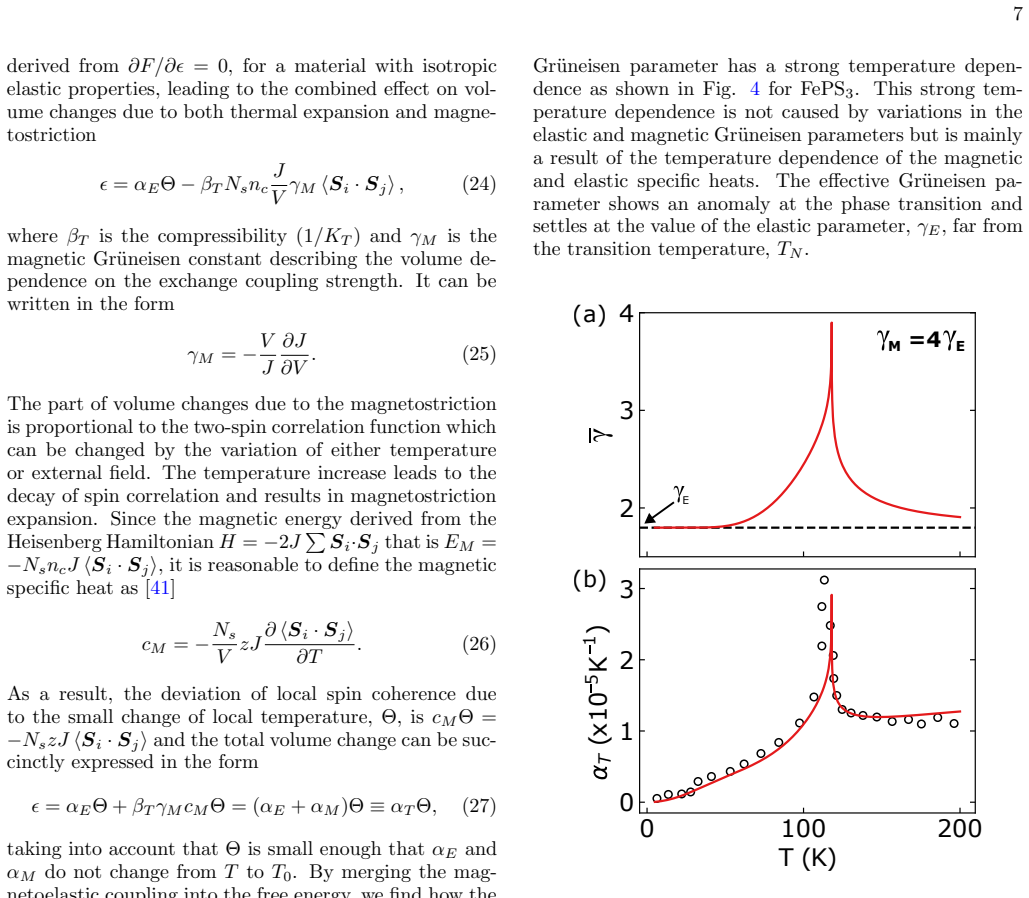
- [Sections IV and V, Eqs. (28)–(29), Appendix B] The predictive power of the phase-transition peak is weakened by fitted parameters that control its magnitude. The magnetic Grüneisen parameter γ_M is fitted to the thermal expansion data and enters α_T through Eq. (28), and since Q^{-1} depends on α_T^2, the height of the predicted peak is set by this fit. Similarly, the pretension N_0 in Appendix B is a fitting parameter that affects the resonance frequency and mode shape entering the dissipation. The peak position is robust because it follows from the c_V anomaly, but the quantitative agreement shown in Fig. 6(b) is not a parameter-free test of the theory.
- [Section V, Fig. 7] The two in-plane relaxation peaks in Fig. 7 are explained by a hypothesized renormalized length scale λ ≈ 0.1, but this hypothesis is not derived from the model; the calculation in Section III contains only one in-plane thermal mode set indexed by the Bessel zeros. The statement that the strain generates heat in two localized regions that travel different distances is plausible but is not demonstrated from Eq. (10) or the modal sum. Since this feature is one of the paper’s claimed new qualitative results, it should either be derived from the modal structure or clearly presented as a speculation rather than a result.
minor comments (4)
- [Introduction and Acknowledgments] Ref. [23] is cited as “Prabhakar and Vanglatore” but the correct name is Vengallatore; this appears also in the introduction text.
- [Section V and Fig. 6] Ref. [38] is written as “A. Halmund” but the thesis author is A. Haglund; please correct the citation.
- [Section III, Eq. (20)] The symbol ΔE is used for both the energy loss per cycle in Eq. (15) and the dimensionless relaxation strength in Eq. (20). This reuse of notation makes the proportionality in Eq. (20) confusing; a separate symbol such as Δ_TED would improve readability.
- [Appendix C, Eq. (C1)] The term “∇²” in the first line of Eq. (C1) appears to be a typographical leftover, since the full Laplacian is already written out in the following terms; please remove it for clarity.
Circularity Check
Phase-transition peak has independent content from the c_V anomaly, but its magnitude is controlled by a fitted magnetic Grüneisen parameter, and the quantitative match to the measured Q^{-1} is obtained only by arbitrarily rescaling thermal conductivity by factors of 100–300.
-
fitted input called prediction
[Section IV, Eqs. (28)–(30), Fig. 4b, Table III]
"The elastic Grüneisen parameter can be calculated from the Poisson ratio for isotropic materials: γE = 1.5(1 + ν)/(2 − 3ν) [44], and the magnetic Grüneisen parameter can be extracted from fitting the measured thermal expansion coefficient as shown in Fig. 4. ... ∆E ∝ α2_T/cV = (βT ργ̄ cV )2/cV = (βTρ)2γ̄2cV."
The magnetic Grüneisen parameter γM is a free constant fitted to the measured thermal expansion coefficient of FePS3 (Fig. 4b, data from ref. [16]). Equation (28) then reconstructs αT = βT ρ(γE cE + γM cM), and Eq. (30) makes the TED relaxation strength proportional to αT^2/cV. Therefore the height of the predicted dissipation peak at TN is set by a parameter fitted to the same material—and the same prior experimental dataset [16]—that later provides the Q^{-1} data used for validation. The peak shape still has independent support from the calculated magnetic specific-heat anomaly, so the reduction is partial rather than complete.
-
fitted input called prediction
[Section V, Fig. 6b and Discussion]
"If instead we take into account a thermal conductivity modeled with a constant lifetime for both phonons and magnons and include a proportionality factor that reduces its value, the magnitude of the dissipation changes appreciably as presented in panel b). The calculated dissipation curves correspond to thermal conductivities reduced by factors of 100, 200, and 300, respectively. These curves present a better agreement with the experimental data, both in shape and magnitude."
The proportionality factor is not measured or derived; the factors 100, 200, and 300 are chosen to bring the calculated Q^{-1} onto the experimental curve. In the Discussion the paper acknowledges that "quantitative agreement with experimental data was only achieved when the out-of-plane thermal conductivities were reduced by two orders of magnitude compared to bulk measurements." Thus the quantitative agreement that is presented as validation is produced by fitting a scale factor to the target data. The shape of the peak at TN is not forced by this rescaling, but the magnitude comparison is a fit, so the central quantitative claim reduces to an input rather than being an independent prediction.
full rationale
The anisotropic TED derivation itself is not circular: Eqs. (1)–(20) build a self-contained extension of Zener and Lifshitz–Roukes theory, and the phase-transition peak has genuine independent content because cM is computed from the exact 2D Ising solution and magnon dispersion using literature parameters. However, two fitted inputs compromise the predictive claim. First, γM is explicitly fitted to the measured thermal expansion coefficient of FePS3 (Fig. 4b), and since Q^{-1} is proportional to αT^2/cV (Eq. 30), this fit controls the magnitude of the dissipation peak. Second, the quantitative match to the measured Q^{-1} in Fig. 6b is achieved only after multiplying the calculated thermal conductivity by arbitrary factors of 100–300, which the authors themselves acknowledge is not supported by measurements. The self-citations to refs. [16] and [19] are not load-bearing in the sense of an unverified theorem: ref. [16] supplies experimental data, and ref. [19] is cited as a caveat about nonlinear damping near TN. Overall, the qualitative prediction of a peak at TN and of radius-dependent Debye-like behavior is independent, but the quantitative validation is partially circular, giving a score of 5.
Assumptions & free parameters
free parameters (5)
- Magnetic Grüneisen parameter γM =
4γE = 7.192 (with γE=1.798)
- Pretension N0 =
6.85 N/m
- Phonon lifetime τph =
67 ps
- Magnon lifetime τmag =
100 ns
- Thermal conductivity reduction factor =
1/100, 1/200, 1/300
assumptions (6)
- domain assumption The suspended material is a thin elastic plate with isotropic elastic properties, even though its thermal conductivity is anisotropic.
- domain assumption TED is the dominant dissipation mechanism in the measured FePS3 resonators; magnetoelastic damping is negligible due to frequency mismatch.
- domain assumption Perfect thermal contact at the clamped edge, Θ0(a,z)=0, and no heat flux at the free surfaces.
- domain assumption The thermal conductivity of the suspended flake follows the bulk temperature dependence scaled by room-temperature anisotropy.
- domain assumption The magnetoelastic coupling can be captured by a single effective Grüneisen parameter through α = βρ(γE cE + γM cM).
- domain assumption Quasiparticle lifetimes are temperature-independent in the thermal conductivity model.
Cite this review
Pith. "Pith review of Thermoelastic Damping Across the Phase Transition in van der Waals Magnets." pith.science (2026). https://pith.science/paper/UDOXZQ6E
@misc{pith2026250202987,
  author       = {Pith},
  title        = {Pith review of: Thermoelastic Damping Across the Phase Transition in van der Waals Magnets},
  year         = {2026},
  howpublished = {\url{https://pith.science/paper/UDOXZQ6E}},
  note         = {Machine review of arXiv:2502.02987}
}
abstract
A quantitative understanding of the microscopic mechanisms responsible for damping in van der Waals nanomechanical resonators remains elusive. In this work, we investigate van der Waals magnets, where the thermal expansion coefficient exhibits an anomaly at the magnetic phase transition due to magnetoelastic coupling. Thermal expansion mediates the coupling between mechanical strain and heat flow and determines the strength of thermoelastic damping (TED). Consequently, variations in the thermal expansion coefficient are reflected directly in TED, motivating our focus on this mechanism. We extend existing TED models to incorporate anisotropic thermal conduction, a critical property of van der Waals materials. By combining the thermodynamic properties of the resonator material with the anisotropic TED model, we examine dissipation as a function of temperature. Our findings reveal a pronounced impact of the phase transition on dissipation, along with transitions between distinct dissipation regimes controlled by geometry and the relative contributions of in-plane and out-of-plane thermal conductivity. These regimes are characterized by the resonant interplay between strain and in-plane or through-plane heat propagation. To validate our theory, we compare it to experimental data of the temperature-dependent mechanical resonances of FePS$_3$ resonators.
Figures


Figures from the paper (4 more)


Reference graph
Works this paper leans on
-
[19]
Nonlinear dynamics and magneto-elasticity of nanodrums near the phase transition
M. ˇSiˇ skins, A. Ke¸ skekler, M. J. A. Houmes, S. Ma˜ nas- Valero, E. Coronado, Y. M. Blanter, H. S. J. van der Zant, P. G. Steeneken, and F. Alijani, Nat. Commun. (2025), to be published, arXiv:2309.09672
work page Pith review arXiv 2025
-
[1]
C. Gong, L. Li, Z. Li, H. Ji, A. Stern, Y. Xia, T. Cao, W. Bao, C. Wang, Y. Wang, Z. Q. Qiu, R. J. Cava, S. G. Louie, J. Xia, and X. Zhang, Nature 546, 265 (2017)
2017
-
[2]
Huang, G
B. Huang, G. Clark, E. Navarro-Moratalla, D. R. Klein, R. Cheng, K. L. Seyler, D. Zhong, E. Schmidgall, M. A. McGuire, D. H. Cobden, W. Yao, D. Xiao, P. Jarillo- Herrero, and X. Xu, Nature 546, 270 (2017)
2017
-
[3]
K. S. Burch, D. Mandrus, and J.-G. Park, Nature 563, 47 (2018)
2018
-
[4]
F. D. M. Haldane, Phys. Rev. Lett. 61, 2015 (1988)
1988
- [5]
-
[6]
T. Song, X. Cai, M. W.-Y. Tu, X. Zhang, B. Huang, N. P. Wilson, K. L. Seyler, L. Zhu, T. Taniguchi, K. Watanabe, M. A. McGuire, D. H. Cobden, D. Xiao, W. Yao, and X. Xu, Science 360, 1214 (2018)
2018
- [7]
Show all 64 references
-
[8]
M. J. A. Houmes, G. Baglioni, M. Siˇ skins, M. Lee, D. L. Esteras, A. M. Ruiz, S. Ma˜ nas-Valero, C. Boix-Constant, J. J. Baldov ´ ı, E. Coronado, Y. M. Blanter, H. S. J. van der Zant, and P. G. Steeneken, Nature Communi- cations 14, 8503 (2023)
2023
-
[9]
F. Fei, Y. Mao, W. Fang, W. Liu, J. P. Rollins, A. L. N. Kondusamy, B. Lv, Y. Ping, Y. Wang, and J. Xiao, Nanoletters 24, 10.1021/acs.nanolett.4c01751 (2024)
2024 doi
-
[10]
R. K. Kremer and E. Br¨ ucher, Phys. Rev. Mater. 8, 024002 (2024)
2024
-
[11]
Y. J. Bae, T. Handa, Y. Dai, J. Wang, H. Liu, A. Scheie, D. G. Chica, M. E. Ziebel, A. D. Kent, X. Xu, K. Shen, X. Roy, and X. Zhu, Phys. Rev. B 109, 104401 (2024)
2024
-
[12]
D. A. Bozhko, V. I. Vasyuchka, A. V. Chumak, and A. A. Serga, Low Temperature Physics 46, 383 (2020)
2020
-
[13]
Tabuchi, S
Y. Tabuchi, S. Ishino, A. Noguchi, T. Ishikawa, R. Ya- mazaki, K. Usami, and Y. Nakamura, Science 349, 405 (2015)
2015
-
[14]
Li, Y.-P
J. Li, Y.-P. Wang, W.-J. Wu, S.-Y. Zhu, and J. You, 11 PRX Quantum 2, 040344 (2021)
2021
-
[15]
Engelhardt, V
F. Engelhardt, V. Bittencourt, H. Huebl, O. Klein, and S. V. Kusminskiy, Phys. Rev. Appl. 18, 044059 (2022)
2022
-
[16]
ˇSiˇ skins, M
M. ˇSiˇ skins, M. Lee, S. Ma˜ nas-Valero, E. Coronado, Y. M. Blanter, H. S. van der Zant, and P. G. Steeneken, Nature Communications 11, 2698 (2020)
2020
-
[17]
P. G. Steeneken, R. J. Dolleman, D. Davidovikj, F. Al- ijani, and H. S. van der Zant, 2D Materials 8, 042001 (2021)
2021
-
[18]
Bachtold, J
A. Bachtold, J. Moser, and M. I. Dykman, Rev. Mod. Phys. 94, 045005 (2022)
2022
-
[20]
Zhang, C.-L
X. Zhang, C.-L. Zou, L. Jiang, and H. X. Tang, Science Advances 2, e1501286 (2016)
2016
-
[21]
Zener, Phys
C. Zener, Phys. Rev. 52, 230 (1937)
1937
-
[22]
Lifshitz and M
R. Lifshitz and M. L. Roukes, Phys. Rev. B 61, 5600 (2000)
2000
-
[23]
Prabhakar and S
S. Prabhakar and S. Vengallatore, Journal of Microelec- tromechanical Systems 17, 494 (2008)
2008
-
[24]
C. Ma, S. Chen, and F. Guo, Journal of Thermal Stresses 43, 175 (2020)
2020
-
[25]
Y. Tai, N. Chen, J. Xu, and P. Li, IEEE Access 8, 214300 (2020)
2020
-
[26]
H. Zhou, X. Song, and P. Li, International Journal of Mechanical Sciences 252, 108371 (2023)
2023
-
[27]
S. E. Kim, F. Mujid, A. Rai, F. Eriksson, J. Suh, P. Pod- dar, A. Ray, C. Park, E. Fransson, Y. Zhong, D. A. Muller, P. Erhart, D. G. Cahill, and J. Park, Nature597, 660 (2021)
2021
-
[28]
Kargar, E
F. Kargar, E. A. Coleman, S. Ghosh, J. Lee, M. J. Gomez, Y. Liu, A. S. Magana, Z. Barani, A. Moham- madzadeh, B. Debnath, R. B. Wilson, R. K. Lake, and A. A. Balandin, ACS Nano 14, 2424 (2020)
2020
-
[29]
Leissa and M
A. Leissa and M. S. Qatu, Vibrations of Continuous Sys- tems (McGraw Hill, 2011)
2011
-
[30]
L. D. Landau and E. M. Lifshitz, Theory of Elasticity (Pergamon Press, 1917)
1917
-
[31]
W. A. Day, Heat Conduction Within Linear Thermoelas- ticity, Vol. 30 (Springer New York, 1985)
1985
-
[32]
Schmid, L
S. Schmid, L. G. Villanueva, and M. L. Roukes, Fun- damentals of Nanomechanical Resonators(Springer Na- ture, 2016)
2016
-
[33]
A. S. Nowick and B. S. Berry, Anelastic Relaxation in Crystalline Solids (Academic Press, 1972)
1972
-
[34]
Baglioni, M
G. Baglioni, M. ˇSiˇ skins, M. Houmes, M. Lee, D. H. Shin, S. Ma˜ nas-Valero, E. Coronado, Y. M. Blanter, H. S. J. van der Zant, and P. G. Steeneken, Nano Letters23, 6973 (2023)
2023
-
[35]
Pulvirenti and D
P. Pulvirenti and D. Jiles, IEEE Transactions on Mag- netics 32, 4785 (1996)
1996
-
[36]
G. O. Gomes, L. Squillante, A. C. Seridonio, A. Ney, R. E. Lagos, and M. de Souza, Phys. Rev. B 100, 054446 (2019)
2019
-
[37]
Takano, N
Y. Takano, N. Arai, A. Arai, Y. Takahashi, K. Takase, and K. Sekizawa, Journal of Magnetism and Magnetic Materials 272-276, 593 (2004)
2004
-
[38]
Haglund, Thermal Conductivity of MXY3 Magnetic Layered Trichalcogenides, Ph.D
A. Haglund, Thermal Conductivity of MXY3 Magnetic Layered Trichalcogenides, Ph.D. thesis, University of Tenessee (2019)
2019
-
[39]
X. Wu, Z. Liu, and T. Luo, Journal of Applied Physics 123, 085109 (2018)
2018
-
[40]
Wyzula, I
J. Wyzula, I. Mohelsk´ y, D. V´ aclavkov´ a, P. Kapuscinski, M. Veis, C. Faugeras, M. Potemski, M. E. Zhitomirsky, and M. Orlita, Nano Letters 22, 9741 (2022)
2022
-
[41]
B. E. Argyle, N. Miyata, and T. D. Schultz, Phys. Rev. 160, 413 (1967)
1967
-
[42]
Shapira, R
Y. Shapira, R. D. Yacovitch, C. C. Becerra, S. Foner, E. J. McNiff, D. R. Nelson, and L. Gunther, Phys. Rev. B 14, 3007 (1976)
1976
-
[43]
Shapira and N
Y. Shapira and N. F. Oliveira, Phys. Rev. B 18, 1425 (1978)
1978
-
[44]
Sanditov and V
D. Sanditov and V. Belomestnykh, Technical Physics 56, 1619 (2011)
2011
-
[45]
Seo´ anez, F
C. Seo´ anez, F. Guinea, and A. H. Castro Neto, Phys. Rev. B 76, 125427 (2007)
2007
-
[46]
M. Will, M. Hamer, M. M¨ uller, A. Noury, P. We- ber, A. Bachtold, R. V. Gorbachev, C. Stampfer, and J. G¨ uttinger, Nano Letters17, 5950 (2017)
2017
-
[47]
Y. Wei, G. Ru, W. Qi, K. Tang, and T. Xue, Frontiers in Mechanical Engineering 8, 10.3389/fmech.2022.879561 (2022)
2022
-
[48]
Mohanty, D
P. Mohanty, D. A. Harrington, K. L. Ekinci, Y. T. Yang, M. J. Murphy, and M. L. Roukes, Phys. Rev. B 66, 085416 (2002)
2002
-
[49]
V. A. Shklovskij, Low Temp. Phys. 47, 621 (2021)
2021
-
[50]
K. Wang, J. He, M. Zhang, H. Wang, and G. Zhang, Nanotechnology 31, 435705 (2020)
2020
-
[51]
Aspelmeyer, T
M. Aspelmeyer, T. J. Kippenberg, and F. Marquardt, Rev. Mod. Phys. 86, 1391 (2014)
2014
-
[52]
Middelmann, A
T. Middelmann, A. Walkov, G. Bartl, and R. Sch¨ odel, Phys. Rev. B 92, 174113 (2015)
2015
-
[53]
S. M. Rezende, A. Azevedo, and R. L. Rodr ´ ıguez-Su´ arez, Journal of Applied Physics 126, 151101 (2019)
2019
-
[54]
S. M. Rezende, R. L. Rodr ´ ıguez-Su´ arez, J. C. Lopez Or- tiz, and A. Azevedo, Phys. Rev. B 89, 134406 (2014)
2014
-
[55]
Shen, New Journal of Physics 20, 043025 (2018)
K. Shen, New Journal of Physics 20, 043025 (2018)
2018
-
[56]
N. W. Ashcroft and N. D. Mermin, Solid State Physics (Cengage, 1976)
1976
-
[57]
R. K. Pathria and P. D. Beale, Statistical Mechanics(El- sevier, 2011)
2011
-
[58]
J. M. D. Coey, Magnetism and Magnetic Materials(Cam- bridge University Press, 2009)
2009
-
[59]
J.-U. Lee, S. Lee, J. H. Ryoo, S. Kang, T. Y. Kim, P. Kim, C.-H. Park, J.-G. Park, and H. Cheong, Nano Letters 16, 7433 (2016)
2016
-
[60]
A. R. Wildes, K. C. Rule, R. I. Bewley, M. Enderle, and T. J. Hicks, Journal of Physics: Condensed Matter 24, 416004 (2012)
2012
-
[61]
J. M. Zhang, Y. Z. Nie, X. G. Wang, Q. L. Xia, and G. H. Guo, Journal of Magnetism and Magnetic Materials 525, 167687 (2021)
2021
-
[62]
Lan¸ con, H
D. Lan¸ con, H. C. Walker, E. Ressouche, B. Ouladdiaf, K. C. Rule, G. J. McIntyre, T. J. Hicks, H. M. Rønnow, and A. R. Wildes, Phys. Rev. B 94, 214407 (2016)
2016
-
[63]
Houtappel, Physica 16, 425 (1950)
R. Houtappel, Physica 16, 425 (1950)
1950
-
[64]
Matveev and R
V. Matveev and R. Shrock, J. Phys. A: Math. Gen 29, 803 (1996). Appendix A: Dissipation Mechanisms In Table IV we show a list of possible dissipation mechanisms that could be relevant in a magnetic nano- mechanical resonator. This list was elaborated to pin- 12 point the most ...
1996
Reviewed August 9, 2026 · model on record in the stance chip above.
Discussion (0). Continue with ORCID to comment.