REVIEW 3 major objections 6 minor 63 references
On Zero-Initialized Attention: Optimal Prompt and Gating Factor Estimation
T0 review · 3 major / 6 minor · reviewed 2026-08-09 · deepseek-v4-flash
Pith's one-line read The paper aims to establish that zero-initialized attention is a mixture-of-experts model in which both the prompt parameters and the scalar gating factor are recoverable at the optimal parametric rate, giving polynomial rather than…
desk verdict The MoE-style analysis is careful, but the central rates require an injectivity condition on the projection matrices that the actual zero-initialized attention architecture does not satisfy. read the letter →
The pith
A machine-rendered reading of the paper's core claim, the machinery that carries it, and where it could break.
The reading
What carries the argument
The load-bearing machinery is the MoE reformulation of zero-initialized attention: the output is a sum of pretrained experts weighted by a softmax gate plus $\tanh(\alpha)$ times a sum of prompt experts weighted by their own softmax gate. To turn the regression rate of Proposition 4.1 into prompt-level rates, the paper introduces the Voronoi loss $D(G, G^*)$ (Eq. 15), which accounts separately for mass errors, single-atom location errors, and multi-atom squared location errors. The proof shows a coercivity lower bound, $\|f_{G,\alpha} - f_{G^*,\alpha^*}\|_{L^2(\mu)} \gtrsim D(G,G^*) + |\alpha-\alpha^*|$, by Taylor expansion around the true prompts, linear independence of the resulting exponential and polynomial terms, and Fatou's lemma.
What would settle it
On synthetic data drawn from the MoE model (12) with known $G^*$, $\alpha^*$, and a non-injective activation such as ReLU, run the least-squares estimator (18) for sample sizes $n$ from $10^2$ to $10^6$ and measure $D(\hat{G}_n, G^*)$ and $|\hat{\alpha}_n - \alpha^*|$; if the errors do not decrease at the rate $\sqrt{\log n/n}$, the assumptions behind Theorem 4.4 are violated in the exact regime the experiments use.
Extended reading notes
Core claim
The central claim is that zero-initialized attention can be written as a mixture of frozen pretrained experts and trainable prompt experts, with a single learnable gating factor $\alpha$ wrapping the prompt experts (Eq. 10). Under the MoE regression model (12), the least-squares estimator (13) satisfies $D(\hat{G}_n, G^*) = O_P(\sqrt{\log n/n})$ and $|\hat{\alpha}_n - \alpha^*| = O_P(\sqrt{\log n/n})$ (Theorem 4.2), where $D$ is the Voronoi loss. Theorem 4.4 extends these rates to non-linear prompts of the form $\sigma(p)$ with $\sigma$ injective and uniformly Lipschitz. The authors conclude that zero-initialized attention is more sample-efficient than random-initialized attention, needing polynomial rather than exponential data, and that non-linear prompts retain this efficiency while adding flexibility.
Load-bearing premise
The non-linear results require the prompt activation $\sigma$ to be injective, uniformly Lipschitz, and sufficiently differentiable in the sense of Assumptions A.1-A.2; the paper's experiments instead use a ReLU-based MLP, which is neither injective nor differentiable everywhere, so the proven non-linear rates do not formally cover the reported non-linear experiments.
Editorial extensions
If this is right
- Zero-initialized attention with linear prompts requires $O(\epsilon^{-2})$ or $O(\epsilon^{-4})$ samples to estimate prompts to error $\epsilon$, versus exponentially many samples for random-initialized attention, so it is the sample-efficient choice for low-data fine-tuning.
- Non-linear prompts can be estimated at the same rates as linear prompts, so reparameterizing prompts through a smooth injective MLP adds flexibility without sacrificing statistical efficiency.
- The gating factor $\alpha$ is identifiable and consistently estimated at the parametric rate, so the learned gate can be used as a reliable indicator of how strongly prompts influence the frozen model.
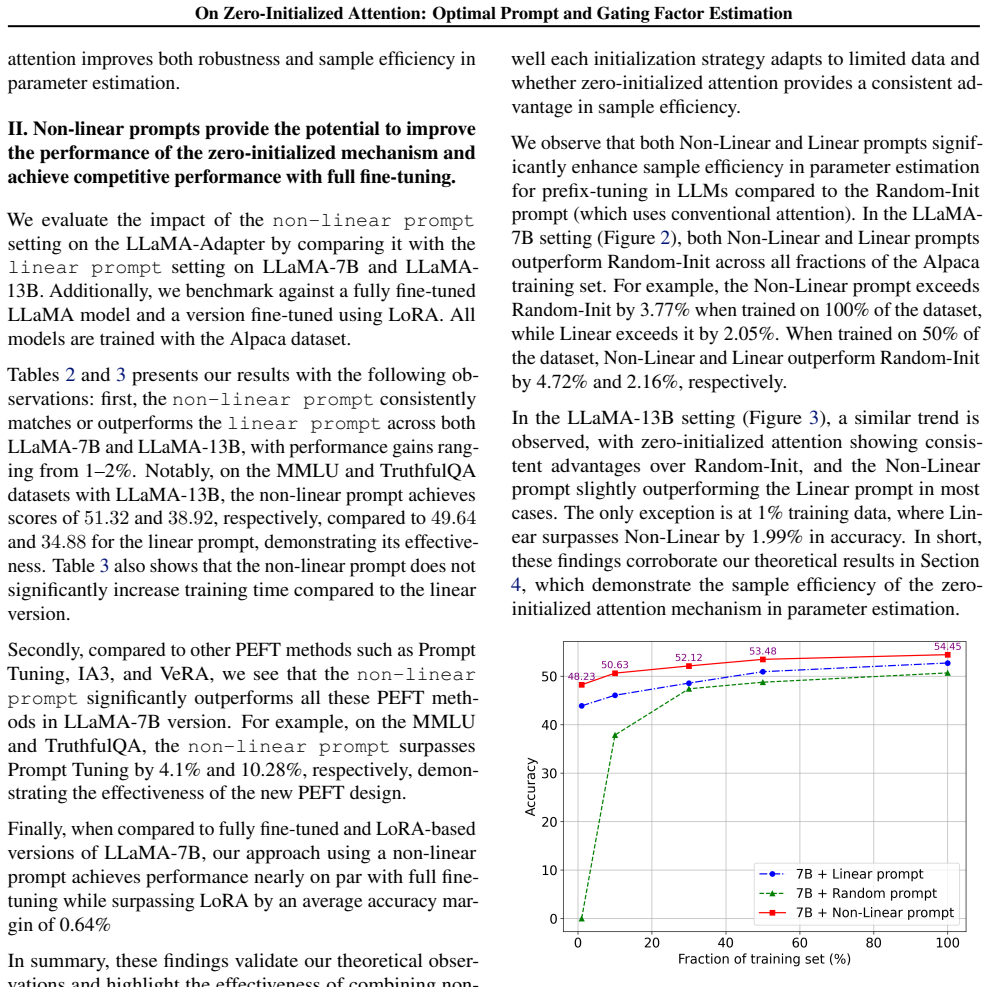
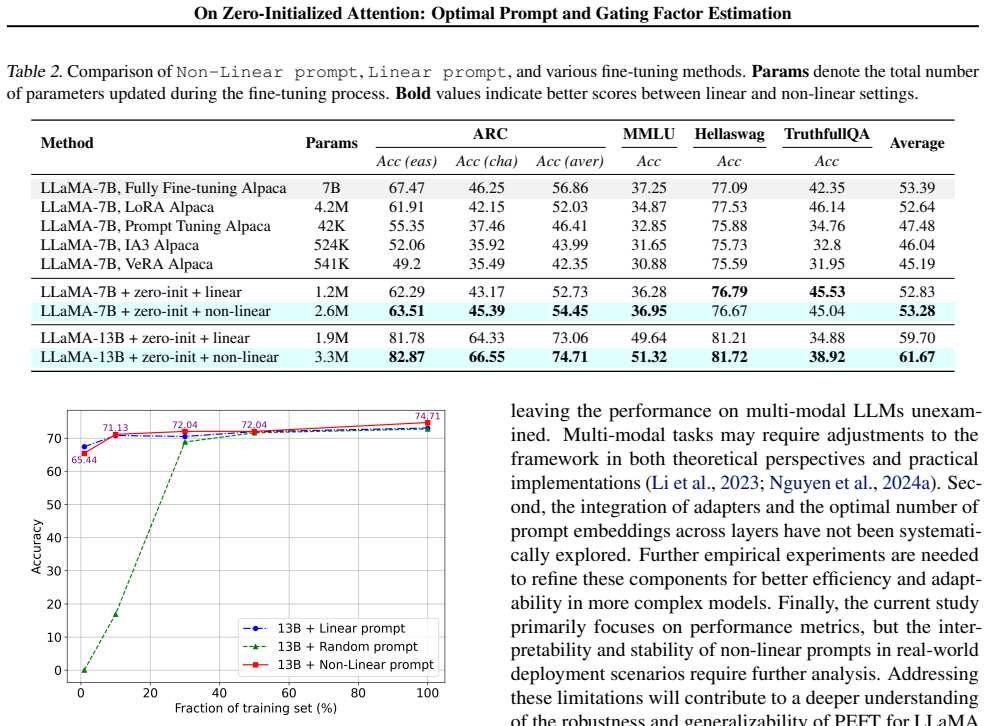
- The paper's empirical findings — zero-initialized attention beating random-initialized attention at every data fraction, with non-linear prompts matching or beating linear prompts — are direct consequences of the claimed rates and the benchmark setup.
Reading between the lines
- Because the theorem covers only a scalar $\alpha$, extending the gate to be per-layer or per-head is a natural testable step; the current proof's Taylor argument for $\tanh(\alpha)$ would need to be reworked for vector-valued gates.
- The reported 1-2 point advantage of non-linear over linear prompts is larger than the theory predicts, since both share the same rates; this suggests the advantage comes from optimization dynamics or initialization geometry rather than estimation accuracy.
- The experimental activation is a ReLU-based MLP, which is not injective, so the paper's own non-linear experiments operate outside the assumptions of Theorem 4.4; a direct synthetic check with an injective activation (e.g., tanh) would cleanly separate the theory from the heuristic.
Editorial analysis
A structured set of objections, weighed in public.
Referee Report
Summary. The paper studies zero-initialized attention in LLaMA-Adapter from a statistical perspective. It rewrites the zero-initialized attention output as a mixture-of-experts model (Eq. 10), introduces a regression model (11)-(12) with L unknown linear prompt atoms and a gating factor α*, and proves via a least-squares estimator (13) that the Voronoi loss D(Ĝ_n, G*) and |α̂_n - α*| are O_P(√(log n/n)), for both linear and non-linear prompts under stated assumptions (Theorems 4.2 and 4.4). The paper then claims these polynomial rates are optimal, concludes that zero-initialized attention is more sample-efficient than random-initialized attention, and reports LLaMA-7B/13B experiments where non-linear prompts outperform linear ones.
Significance. The paper's strength is the systematic transfer of Voronoi-loss and Hellinger-rate machinery from the mixture-of-experts literature to a prompt-tuning model, together with detailed proofs and large-scale experiments with public code. If the identifiability issues are resolved, the polynomial sample-complexity result would be a meaningful contribution toward a statistical theory of zero-initialized attention. Currently, however, the main theorems are unproven as stated, and the experimental non-linear prompts violate the theory's assumptions. The significance of the contribution is therefore conditional on a substantial revision.
major comments (3)
- [Theorem 4.2 and Appendix A.1 (Step 2 and 'Proof for the identifiability property')] The theorem requires an unstated injectivity condition on the projection matrices ĀB and ĀC. If v ∈ ker(ĀB) ∩ ker(ĀC), then p*_j and p*_j + v produce identical softmax scores and expert values in the model (12), so distinct mixing measures generate the same regression function, and D(Ĝ_n, G*) cannot converge to zero for the true G*. The proof's Step 2 asserts linear independence of {exp((ĀB p*_j)^⊤X)} and the identifiability proof concludes {p_j} = {p*_j} from {( ĀB p_j, ĀC p_j)} = {(ĀB p*_j, ĀC p*_j)}; both steps fail without injectivity of ĀB. In zero-initialized attention, ĀB = W^Q W^{K^⊤} and ĀC = W^V have rank at most d_k and d_v, typically far below the token dimension d, so the kernel intersection is generically non-trivial, meaning the claimed prompt-identification rates do not apply to the intended attention setting.
- [Theorem 4.4 and Assumptions A.1-A.2 (Appendix A.2)] Assumption A.2 only states that σ is injective, which is insufficient: the objects that must be injective are the combined maps ĀB∘σ and ĀC∘σ. The identifiability proof in Appendix A.2 again equates {p_j} with {p*_j} from equality of {(ĀB σ(p_j))^⊤, σ(p_j)} without requiring ĀB to be injective on the range of σ. Moreover, the experimental σ in Eq. (21), implemented as a two-layer MLP with ReLU, is neither injective nor differentiable everywhere, so Theorem 4.4's assumptions do not cover the reported non-linear prompt experiments.
- [Section 4.1 (after Theorem 4.2) and Section 4.2] The paper labels the rates as 'optimal' and concludes that zero-initialized attention is more sample-efficient than random-initialized attention. No minimax lower bound is proved or cited for the model (12), so 'optimal' is an overclaim. In addition, the comparison to random-initialized attention relies on external rates O(1/log^τ n) from Akbarian et al. (2024) and Le et al. (2024) without defining the corresponding estimator or model in this paper; as it stands, the sample-complexity comparison is not self-contained.
minor comments (6)
- [Proposition 4.1 (Appendix A.3) and Eq. (11)] The proof of Proposition 4.1 assumes Gaussian noise ε_i|X_i ∼ N(0_d, σ² I_{d'}) and invokes maximum likelihood estimation, but the model in Eq. (11) only states E[ε_i|X_i]=0 and Var(ε_i|X_i)=σ² I_{d'}. Please either add the Gaussian assumption explicitly to the model or provide a proof that does not require normality.
- [Section 5.2, item II and Table 2] The statement that non-linear prompts 'consistently' match or outperform linear prompts is too strong, since for LLaMA-7B the non-linear prompt is slightly worse than the linear prompt on HellaSwag (76.67 vs 76.79) and TruthfulQA (45.04 vs 45.53).
- [Table 1] The task name 'TruthfullQA' is misspelled and should be 'TruthfulQA'.
- [Appendix A.1, Step 2] The same limit for ĀL_{2,n}(p*_j)(u)/(D_n + |α_n - α*|) appears multiple times consecutively; this appears to be a copy-and-paste error that should be cleaned up.
- [Appendix A.1 and A.2] The notation ĀM_{n,j,0_d} is used before it is defined; the index 0_d is easy to confuse with the zero vector, so the definition should be stated at first use.
- [Eq. (15) and Section 4.1 text] The paper states that the Voronoi-loss rates range from O_P((log n/n)^{1/2}) to O_P((log n/n)^{1/4}) without a formal derivation from the definition of D; a short derivation or pointer to the relevant inequalities would improve readability.
Circularity Check
No circular derivation: the MoE equivalence in Eq. (10) is explicit algebraic rewriting, and the convergence theorems are proved in the appendix from standard empirical-process and Voronoi-loss arguments rather than being assumed or fitted.
full rationale
The paper's claimed connection between zero-initialized attention and mixture-of-experts is an explicit identity, not a hidden reduction: Eqs. (7)-(9) define the experts and gates so that Eq. (10) is exactly the attention output of Eq. (6). This is a modeling equivalence, and the subsequent least-squares analysis is a genuine statistical theorem rather than a restatement of the definition. Theorem 4.2 and Theorem 4.4 are proved in Appendix A through the standard route of a parametric regression-function rate (Proposition 4.1, via van de Geer 2000 and Pardo 2018) plus a Voronoi-loss lower bound that is reproduced in the appendix, not merely imported by citation. The heavy use of prior MoE theory, including Voronoi cells and softmax-gating rates from Manole & Ho (2022) and Ho et al. (2022), is consistent with normal mathematical dependency; those results are not this paper's own fitted values, and the proofs here do not collapse into the cited statements. The comparison to random-initialized attention does cite papers with overlapping authorship for the slow OP(1/log^tau(n)) rates, but that is an external comparative claim about a different initialization scheme, not a parameter fitted in this paper and renamed as a prediction. The most serious issue is not circularity: the identifiability proof at the end of Appendix A.1, and its non-linear analogue, silently requires injectivity of p -> (B p, C p) or p -> (B sigma(p), C sigma(p)), a condition that is neither stated nor satisfied by the low-rank projections in actual zero-initialized attention. That is a soundness gap about identifiability, not a reduction of the derivation to its own inputs, so it does not raise the circularity score.
Assumptions & free parameters
free parameters (4)
- True prompt atoms p*_j and biases b*_j =
unknown (targets of estimation)
- Gating factor alpha* =
unknown
- Number of true prompts L =
unknown
- Experimental prompt length L and number of adapted layers K =
L=10, K=30 (7B) or K=38 (13B)
assumptions (5)
- domain assumption The data follow the MoE regression model (12) with Gaussian noise.
- domain assumption Parameter spaces Theta and Omega are compact.
- domain assumption Activation sigma satisfies injectivity and uniform Lipschitz conditions A.1-A.2.
- domain assumption Identifiability of the MoE parameterization holds on the support of mu.
- standard math Hellinger rate for the least-squares estimator follows van de Geer (2000).
Cite this review
Pith. "Pith review of On Zero-Initialized Attention: Optimal Prompt and Gating Factor Estimation." pith.science (2026). https://pith.science/paper/QRZVECMP
@misc{pith2026250203029,
  author       = {Pith},
  title        = {Pith review of: On Zero-Initialized Attention: Optimal Prompt and Gating Factor Estimation},
  year         = {2026},
  howpublished = {\url{https://pith.science/paper/QRZVECMP}},
  note         = {Machine review of arXiv:2502.03029}
}
read the original abstract
The LLaMA-Adapter has recently emerged as an efficient fine-tuning technique for LLaMA models, leveraging zero-initialized attention to stabilize training and enhance performance. However, despite its empirical success, the theoretical foundations of zero-initialized attention remain largely unexplored. In this paper, we provide a rigorous theoretical analysis, establishing a connection between zero-initialized attention and mixture-of-expert models. We prove that both linear and non-linear prompts, along with gating functions, can be optimally estimated, with non-linear prompts offering greater flexibility for future applications. Empirically, we validate our findings on the open LLM benchmarks, demonstrating that non-linear prompts outperform linear ones. Notably, even with limited training data, both prompt types consistently surpass vanilla attention, highlighting the robustness and adaptability of zero-initialized attention.
Figures

Figures from the paper (3 more)


Reference graph
Works this paper leans on
-
[1]
write newline
" write newline "" before.all 'output.state := FUNCTION n.dashify 't := "" t empty not t #1 #1 substring "-" = t #1 #2 substring "--" = not "--" * t #2 global.max substring 't := t #1 #1 substring "-" = "-" * t #2 global.max substring 't := while if t #1 #1 substring * t #2 global.max substring 't := if while FUNCTION format.date year duplicate empty "emp...
-
[2]
Quadratic gating functions in mixture of experts: A statistical insight
Akbarian, P., Nguyen, H., Han, X., and Ho, N. Quadratic gating functions in mixture of experts: A statistical insight. arXiv preprint arXiv:2410.11222, 2024
arXiv 2024
-
[3]
Anil, R., Dai, A. M., Firat, O., Johnson, M., Lepikhin, D., Passos, A., Shakeri, S., Taropa, E., Bailey, P., Chen, Z., et al. Palm 2 technical report. arXiv preprint arXiv:2305.10403, 2023
arXiv 2023
-
[4]
Beeching, E., Fourrier, C., Habib, N., Han, S., Lambert, N., Rajani, N., Sanseviero, O., Tunstall, L., and Wolf, T. Open llm leaderboard. https://huggingface.co/spaces/HuggingFaceH4/open_llm_leaderboard, 2024. Accessed:2024
work page 2024
-
[5]
D., Dhariwal, P., Neelakantan, A., Shyam, P., Sastry, G., Askell, A., et al
Brown, T., Mann, B., Ryder, N., Subbiah, M., Kaplan, J. D., Dhariwal, P., Neelakantan, A., Shyam, P., Sastry, G., Askell, A., et al. Language models are few-shot learners. Advances in neural information processing systems, 33: 0 1877--1901, 2020
1901
-
[6]
Chen, S., Jie, Z., and Ma, L. Llava-mole: Sparse mixture of lora experts for mitigating data conflicts in instruction finetuning mllms. arXiv preprint arXiv:2401.16160, 2024
arXiv 2024
-
[7]
Adamv-moe: Adaptive multi-task vision mixture-of-experts
Chen, T., Chen, X., Du, X., Rashwan, A., Yang, F., Chen, H., Wang, Z., and Li, Y. Adamv-moe: Adaptive multi-task vision mixture-of-experts. In Proceedings of the IEEE/CVF International Conference on Computer Vision, pp.\ 17346--17357, 2023
work page 2023
-
[8]
Towards understanding the mixture-of-experts layer in deep learning
Chen, Z., Deng, Y., Wu, Y., Gu, Q., and Li, Y. Towards understanding the mixture-of-experts layer in deep learning. In Koyejo, S., Mohamed, S., Agarwal, A., Belgrave, D., Cho, K., and Oh, A. (eds.), Advances in Neural Information Processing Systems, volume 35, pp.\ 23049--23062. Curran Associates, Inc., 2022
work page 2022
Show all 63 references
-
[9]
Think you have solved question answering? try arc, the ai2 reasoning challenge
Clark, P., Cowhey, I., Etzioni, O., Khot, T., Sabharwal, A., Schoenick, C., and Tafjord, O. Think you have solved question answering? try arc, the ai2 reasoning challenge. arXiv preprint arXiv:1803.05457, 2018
2018 arXiv
-
[10]
Bert: Pre-training of deep bidirectional transformers for language understanding
Devlin, J. Bert: Pre-training of deep bidirectional transformers for language understanding. arXiv preprint arXiv:1810.04805, 2018
2018 arXiv
-
[11]
Switch transformers: Scaling to trillion parameter models with simple and efficient sparsity
Fedus, W., Zoph, B., and Shazeer, N. Switch transformers: Scaling to trillion parameter models with simple and efficient sparsity. Journal of Machine Learning Research, 23 0 (120): 0 1--39, 2022
2022
-
[12]
Clip-adapter: Better vision-language models with feature adapters
Gao, P., Geng, S., Zhang, R., Ma, T., Fang, R., Zhang, Y., Li, H., and Qiao, Y. Clip-adapter: Better vision-language models with feature adapters. International Journal of Computer Vision, 132 0 (2): 0 581--595, 2024
2024
-
[13]
Fusemoe: Mixture-of-experts transformers for fleximodal fusion
Han, X., Nguyen, H., Harris, C., Ho, N., and Saria, S. Fusemoe: Mixture-of-experts transformers for fleximodal fusion. In Advances in Neural Information Processing Systems, 2024
2024
-
[14]
Measuring massive multitask language understanding
Hendrycks, D., Burns, C., Basart, S., Zou, A., Mazeika, M., Song, D., and Steinhardt, J. Measuring massive multitask language understanding. arXiv preprint arXiv:2009.03300, 2020
2009 arXiv
-
[15]
Ho, N., Yang, C.-Y., and Jordan, M. I. Convergence rates for G aussian mixtures of experts. Journal of Machine Learning Research, 23 0 (323): 0 1--81, 2022
2022
-
[16]
Parameter-efficient transfer learning for nlp
Houlsby, N., Giurgiu, A., Jastrzebski, S., Morrone, B., De Laroussilhe, Q., Gesmundo, A., Attariyan, M., and Gelly, S. Parameter-efficient transfer learning for nlp. In International conference on machine learning, pp.\ 2790--2799. PMLR, 2019
2019
-
[17]
J., Shen, Y., Wallis, P., Allen-Zhu, Z., Li, Y., Wang, S., Wang, L., and Chen, W
Hu, E. J., Shen, Y., Wallis, P., Allen-Zhu, Z., Li, Y., Wang, S., Wang, L., and Chen, W. Lora: Low-rank adaptation of large language models. arXiv preprint arXiv:2106.09685, 2021
2021 arXiv
-
[18]
A., Jordan, M
Jacobs, R. A., Jordan, M. I., Nowlan, S. J., and Hinton, G. E. Adaptive mixtures of local experts. Neural Computation, 3, 1991
1991
-
[19]
Jordan, M. I. and Jacobs, R. A. Hierarchical mixtures of experts and the em algorithm. Neural computation, 6 0 (2): 0 181--214, 1994
1994
-
[20]
Compacter: Efficient low-rank hypercomplex adapter layers
Karimi Mahabadi, R., Henderson, J., and Ruder, S. Compacter: Efficient low-rank hypercomplex adapter layers. Advances in Neural Information Processing Systems, 34: 0 1022--1035, 2021
2021
-
[21]
J., Blankevoort, T., and Asano, Y
Kopiczko, D. J., Blankevoort, T., and Asano, Y. M. Vera: Vector-based random matrix adaptation. arXiv preprint arXiv:2310.11454, 2023
2023 arXiv
-
[22]
Mixture of experts meets prompt-based continual learning
Le, M., Nguyen, A., Nguyen, H., Nguyen, T., Pham, T., Van Ngo, L., and Ho, N. Mixture of experts meets prompt-based continual learning. Advances in Neural Information Processing Systems, 38, 2024
2024
-
[23]
Revisiting prefix-tuning: Statistical benefits of reparameterization among prompts
Le, M., Nguyen, C., Nguyen, H., Tran, Q., Le, T., and Ho, N. Revisiting prefix-tuning: Statistical benefits of reparameterization among prompts. In The Thirteenth International Conference on Learning Representations, 2025
2025
-
[24]
The power of scale for parameter-efficient prompt tuning
Lester, B., Al-Rfou, R., and Constant, N. The power of scale for parameter-efficient prompt tuning. arXiv preprint arXiv:2104.08691, 2021
2021 arXiv
-
[25]
Llava-med: Training a large language-and-vision assistant for biomedicine in one day
Li, C., Wong, C., Zhang, S., Usuyama, N., Liu, H., Yang, J., Naumann, T., Poon, H., and Gao, J. Llava-med: Training a large language-and-vision assistant for biomedicine in one day. Advances in Neural Information Processing Systems, 36: 0 28541--28564, 2023
2023
-
[26]
Mixlora: Enhancing large language models fine-tuning with lora based mixture of experts
Li, D., Ma, Y., Wang, N., Cheng, Z., Duan, L., Zuo, J., Yang, C., and Tang, M. Mixlora: Enhancing large language models fine-tuning with lora based mixture of experts. arXiv preprint arXiv:2404.15159, 2024 a
2024 arXiv
-
[27]
Li, H., Lin, S., Duan, L., Liang, Y., and Shroff, N. B. Theory on mixture-of-experts in continual learning. arXiv preprint arXiv:2406.16437, 2024 b
2024 arXiv
-
[28]
Graphadapter: Tuning vision-language models with dual knowledge graph
Li, X., Lian, D., Lu, Z., Bai, J., Chen, Z., and Wang, X. Graphadapter: Tuning vision-language models with dual knowledge graph. Advances in Neural Information Processing Systems, 36, 2024 c
2024
-
[29]
Li, X. L. and Liang, P. Prefix-tuning: Optimizing continuous prompts for generation. arXiv preprint arXiv:2101.00190, 2021
2021 arXiv
-
[30]
Truthfulqa: Measuring how models mimic human falsehoods
Lin, S., Hilton, J., and Evans, O. Truthfulqa: Measuring how models mimic human falsehoods. arXiv preprint arXiv:2109.07958, 2021
2021 arXiv
-
[31]
Liu, H., Tam, D., Muqeeth, M., Mohta, J., Huang, T., Bansal, M., and Raffel, C. A. Few-shot parameter-efficient fine-tuning is better and cheaper than in-context learning. Advances in Neural Information Processing Systems, 35: 0 1950--1965, 2022
1950
-
[32]
L., Du, Z., Yang, Z., and Tang, J
Liu, X., Ji, K., Fu, Y., Tam, W. L., Du, Z., Yang, Z., and Tang, J. P-tuning v2: Prompt tuning can be comparable to fine-tuning universally across scales and tasks. arXiv preprint arXiv:2110.07602, 2021
2021 arXiv
-
[33]
Peft: State-of-the-art parameter-efficient fine-tuning methods
Mangrulkar, S., Gugger, S., Debut, L., Belkada, Y., Paul, S., and Bossan, B. Peft: State-of-the-art parameter-efficient fine-tuning methods. URL: https://github. com/huggingface/peft, 2022
2022
-
[34]
and Ho, N
Manole, T. and Ho, N. Refined convergence rates for maximum likelihood estimation under finite mixture models. In Proceedings of the 39th International Conference on Machine Learning, volume 162 of Proceedings of Machine Learning Research, pp.\ 14979--15006. PMLR, 17--23 Jul 2022
2022
-
[35]
Large language models: A survey
Minaee, S., Mikolov, T., Nikzad, N., Chenaghlu, M., Socher, R., Amatriain, X., and Gao, J. Large language models: A survey. arXiv preprint arXiv:2402.06196, 2024
2024 arXiv
-
[36]
M., Diep, N
Nguyen, D. M., Diep, N. T., Nguyen, T. Q., Le, H.-B., Nguyen, T., Nguyen, T., Nguyen, T., Ho, N., Xie, P., Wattenhofer, R., et al. Logra-med: Long context multi-graph alignment for medical vision-language model. arXiv preprint arXiv:2410.02615, 2024 a
-
[37]
M., Le, A
Nguyen, D. M., Le, A. T., Nguyen, T. Q., Diep, N. T., Nguyen, T., Duong-Tran, D., Peters, J., Shen, L., Niepert, M., and Sonntag, D. Dude: Dual distribution-aware context prompt learning for large vision-language model. Asian Conference on Machine Learning (ACML), 2024 b
2024
-
[38]
Demystifying softmax gating function in gaussian mixture of experts
Nguyen, H., Nguyen, T., and Ho, N. Demystifying softmax gating function in gaussian mixture of experts. Advances in Neural Information Processing Systems, 36: 0 4624--4652, 2023
2023
-
[39]
Is temperature sample efficient for softmax G aussian mixture of experts? In Proceedings of the ICML, 2024 c
Nguyen, H., Akbarian, P., and Ho, N. Is temperature sample efficient for softmax G aussian mixture of experts? In Proceedings of the ICML, 2024 c
2024
-
[40]
A general theory for softmax gating multinomial logistic mixture of experts
Nguyen, H., Akbarian, P., Nguyen, T., and Ho, N. A general theory for softmax gating multinomial logistic mixture of experts. In Proceedings of the ICML, 2024 d
2024
-
[41]
W., Saria, S., and Ho, N
Nguyen, H., Han, X., Harris, C. W., Saria, S., and Ho, N. On expert estimation in hierarchical mixture of experts: Beyond softmax gating functions. arxiv preprint arxiv 2410.02935, 2024 e
2024 arXiv
-
[42]
Sigmoid gating is more sample efficient than softmax gating in mixture of experts
Nguyen, H., Ho, N., and Rinaldo, A. Sigmoid gating is more sample efficient than softmax gating in mixture of experts. In Advances in Neural Information Processing Systems, 2024 f
2024
-
[43]
Statistical advantages of perturbing cosine router in mixture of experts
Nguyen, H., Akbarian, P., Pham, T., Nguyen, T., Zhang, S., and Ho, N. Statistical advantages of perturbing cosine router in mixture of experts. In International Conference on Learning Representations, 2025
2025
-
[44]
OpenAI. Chatgpt. https://chat.openai.com, 2025. Accessed: 2025
2025
-
[45]
A., Adler, S., Agarwal, S., Ahmad, L., Akkaya, I., Aleman, F
OpenAI, J. A., Adler, S., Agarwal, S., Ahmad, L., Akkaya, I., Aleman, F. L., Almeida, D., Altenschmidt, J., Altman, S., Anadkat, S., et al. Gpt-4 technical report, 2024. URL https://arxiv. org/abs/2303.08774, 2: 0 6, 2024
2024 arXiv
-
[46]
Statistical Inference Based on Divergence Measures
Pardo, L. Statistical Inference Based on Divergence Measures. Statistics: A Series of Textbooks and Monographs. CRC Press, 2018. ISBN 9781420034813. URL https://books.google.com/books?id=ziDGGIkhqlMC
2018
-
[47]
Instruction tuning with gpt-4
Peng, B., Li, C., He, P., Galley, M., and Gao, J. Instruction tuning with gpt-4. arXiv preprint arXiv:2304.03277, 2023
2023 arXiv
-
[48]
T., Ramasamy, S., Li, X., Hoi, S., and Ho, N
Pham, Q., Do, G., Nguyen, H., Nguyen, T., Liu, C., Sartipi, M., Nguyen, B. T., Ramasamy, S., Li, X., Hoi, S., and Ho, N. Competesmoe -- effective training of sparse mixture of experts via competition. arXiv preprint arXiv:2402.02526, 2024
2024 arXiv
-
[49]
Language models are unsupervised multitask learners
Radford, A., Wu, J., Child, R., Luan, D., Amodei, D., Sutskever, I., et al. Language models are unsupervised multitask learners. OpenAI blog, 1 0 (8): 0 9, 2019
2019
-
[50]
Raffel, C., Shazeer, N., Roberts, A., Lee, K., Narang, S., Matena, M., Zhou, Y., Li, W., and Liu, P. J. Exploring the limits of transfer learning with a unified text-to-text transformer. Journal of machine learning research, 21 0 (140): 0 1--67, 2020
2020
-
[51]
Adapterdrop: On the efficiency of adapters in transformers
R \"u ckl \'e , A., Geigle, G., Glockner, M., Beck, T., Pfeiffer, J., Reimers, N., and Gurevych, I. Adapterdrop: On the efficiency of adapters in transformers. arXiv preprint arXiv:2010.11918, 2020
2010 arXiv
-
[52]
Outrageously large neural networks: The sparsely-gated mixture-of-experts layer
Shazeer, N., Mirhoseini, A., Maziarz, K., Davis, A., Le, Q., Hinton, G., and Dean, J. Outrageously large neural networks: The sparsely-gated mixture-of-experts layer. arXiv preprint arXiv:1701.06538, 2017
2017 arXiv
-
[53]
and Lipani, A
Shi, Z. and Lipani, A. Dept: Decomposed prompt tuning for parameter-efficient fine-tuning. arXiv preprint arXiv:2309.05173, 2023
2023 arXiv
-
[54]
Taori, R., Gulrajani, I., Zhang, T., Dubois, Y., Li, X., Guestrin, C., Liang, P., and Hashimoto, T. B. Stanford alpaca: An instruction-following llama model, 2023
2023
-
[56]
Llama: Open and efficient foundation language models
Touvron, H., Lavril, T., Izacard, G., Martinet, X., Lachaux, M.-A., Lacroix, T., Rozi \`e re, B., Goyal, N., Hambro, E., Azhar, F., et al. Llama: Open and efficient foundation language models. arXiv preprint arXiv:2302.13971, 2023 b
2023 arXiv
-
[57]
Llama 2: Open foundation and fine-tuned chat models
Touvron, H., Martin, L., Stone, K., Albert, P., Almahairi, A., Babaei, Y., Bashlykov, N., Batra, S., Bhargava, P., Bhosale, S., et al. Llama 2: Open foundation and fine-tuned chat models. arXiv preprint arXiv:2307.09288, 2023 c
2023 arXiv
-
[58]
Empirical processes in M-estimation
van de Geer, S. Empirical processes in M-estimation. Cambridge University Press, 2000
2000
-
[59]
Attention is all you need
Vaswani, A. Attention is all you need. Advances in Neural Information Processing Systems, 2017
2017
-
[60]
Understanding expert structures on minimax parameter estimation in contaminated mixture of experts
Yan, F., Nguyen, H., Le, D., Akbarian, P., and Ho, N. Understanding expert structures on minimax parameter estimation in contaminated mixture of experts. In Proceedings of The 28th International Conference on Artificial Intelligence and Statistics, 2025
2025
-
[61]
Hellaswag: Can a machine really finish your sentence? arXiv preprint arXiv:1905.07830, 2019
Zellers, R., Holtzman, A., Bisk, Y., Farhadi, A., and Choi, Y. Hellaswag: Can a machine really finish your sentence? arXiv preprint arXiv:1905.07830, 2019
1905 arXiv
-
[62]
Adalora: Adaptive budget allocation for parameter-efficient fine-tuning
Zhang, Q., Chen, M., Bukharin, A., Karampatziakis, N., He, P., Cheng, Y., Chen, W., and Zhao, T. Adalora: Adaptive budget allocation for parameter-efficient fine-tuning. arXiv preprint arXiv:2303.10512, 2023
2023 arXiv
-
[63]
Llama-adapter: Efficient fine-tuning of large language models with zero-initialized attention
Zhang, R., Han, J., Liu, C., Zhou, A., Lu, P., Qiao, Y., Li, H., and Gao, P. Llama-adapter: Efficient fine-tuning of large language models with zero-initialized attention. In The Twelfth International Conference on Learning Representations, 2024
2024
-
[64]
C., and Liu, Z
Zhou, K., Yang, J., Loy, C. C., and Liu, Z. Learning to prompt for vision-language models. International Journal of Computer Vision, 130 0 (9): 0 2337--2348, 2022
2022
Reviewed August 9, 2026 · model on record in the stance chip above.
Discussion (0). Continue with ORCID to comment.