REVIEW 3 major objections 4 minor 75 references
Aggregate to Adapt: Node-Centric Aggregation for Multi-Source-Free Graph Domain Adaptation
T0 review · 3 major / 4 minor · reviewed 2026-08-09 · deepseek-v4-flash
Pith's one-line read GraphATA claims that multi-source-free graph domain adaptation should be done node by node: each target node gets its own graph-convolution weight matrix, mixed from source models' matrices according to its local context.
desk verdict Genuinely new setting and mechanism with solid experiments, but a wrong equality in the analysis and an unstated architecture constraint need fixing before publication. read the letter →
The pith
A machine-rendered reading of the paper's core claim, the machinery that carries it, and where it could break.
The reading
What carries the argument
The load-bearing object is the node-personalized graph-convolution matrix $W^l_v$ defined in Eq. (4). It does the work of adaptation: instead of one shared weight matrix per layer, each node runs its own affine filter formed by (i) a context-dependent diagonal scaling $\Lambda(c^l_v)$ applied to each source matrix $W^l_i$, (ii) attention weights $\alpha^l_{vi}$ that are normalized and sparsified with sparsemax so irrelevant sources drop out, and (iii) a global shared matrix $W^l_g$ that preserves generic patterns. The attention scores are generated by a shared linear map applied to $W_i^\top c^l_v$, so the same source model can dominate for one node and be ignored for another. Setting the context to the all-ones vector and the global matrix to zero reduces the construction to layer-centric aggregation, and restricting it to the final layer reduces it to model-centric prediction aggregation.
What would settle it
Train two source models with different hidden dimensions on the same task and check whether GraphATA, using only padded or projected weight matrices, still beats prediction averaging; if its gains vanish under architectural mismatch, the linear-combination assumption is the reason.
Extended reading notes
Core claim
GraphATA's central claim is that the unit of adaptation in multi-source-free graph domain adaptation should be the node, not the model or the layer. At each layer $l$, node $v$ receives a personalized convolutional matrix $W^l_v = \sum_{i=1}^m \alpha^l_{vi}\Lambda(c^l_v)W^l_i + \lambda W^l_g$, where $c^l_v$ is the mean of the neighbor representations from the previous layer, $\Lambda(c^l_v)$ turns that context into a diagonal scaling, $\alpha^l_{vi}$ are sparse attention scores computed from the context and the source matrices, and $W^l_g$ is a shared global matrix. The sparse selection, implemented by sparsemax, is meant to suppress source models that would cause negative transfer for a given node. The paper also shows that existing model-centric and layer-centric aggregations are special cases of this construction, and reports that GraphATA outperforms prior multi-source-free methods on citation, social, synthetic, and molecule-classification benchmarks.
Load-bearing premise
GraphATA assumes that all source GNNs share the same layer widths and depths so that their weight matrices can be linearly combined in Eq. (4), and that the optimal target filter for each node is close to the linear span of those matrices plus one shared matrix.
Editorial extensions
If this is right
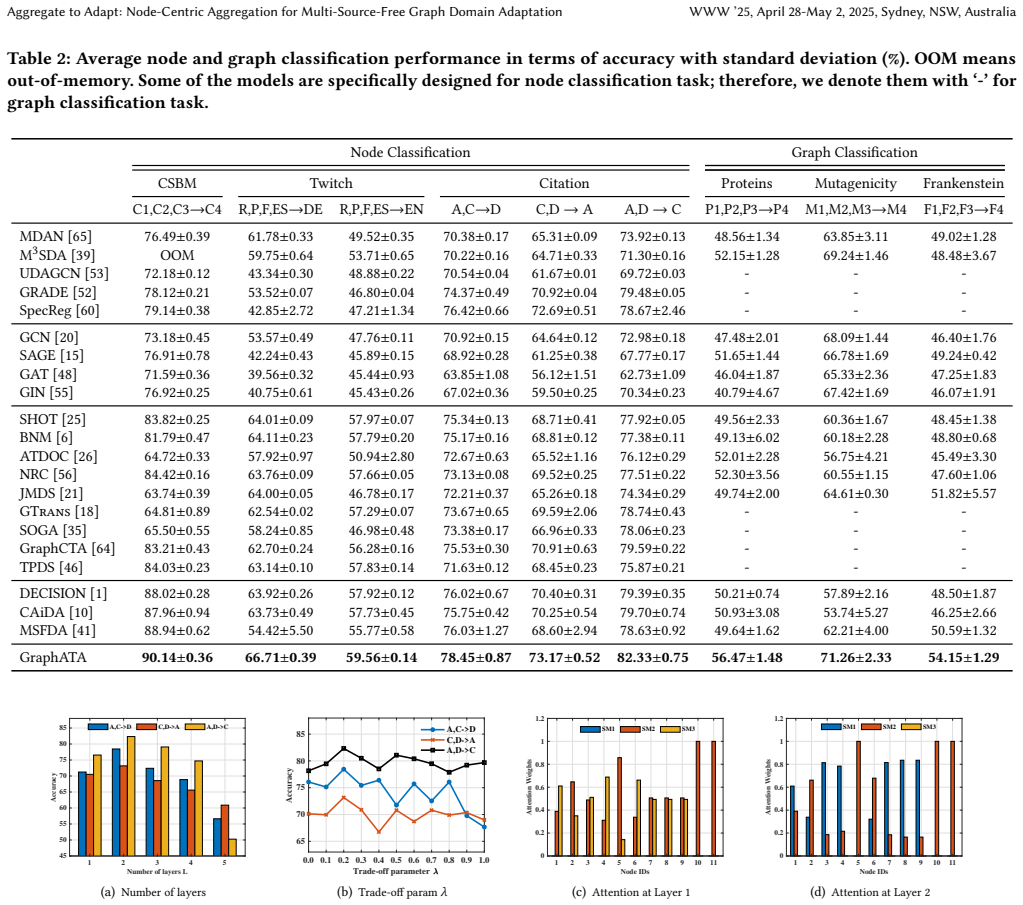
- Node-centric aggregation yields consistent accuracy gains over model-level ensembles: for example, GraphATA improves the A,D to C citation task by 12.20% over the naive averaged GCN baseline.
- Sparse selection is what preserves those gains, since replacing sparsemax with softmax drops 2 to 4 percentage points on citation tasks.
- Degenerating GraphATA to layer-centric or model-centric variants loses 2.93 to 4.26 percentage points, indicating the per-node matrix is doing the work.
- The construction applies to graph classification as well as node classification and to several GNN backbones, and it reduces time and space cost compared with running each source model separately on the target graph.
Reading between the lines
- A direct corollary the paper leaves implicit is that GraphATA's expected gain should grow with the heterogeneity of the target graph's local patterns; a target graph with uniformly homophilic or uniformly heterophilic neighborhoods should show smaller margins over model-centric methods.
- The same per-node mixing idea could be pushed to finer granularities, such as edges, ego-subgraphs, or temporal snapshots, when domain shift operates below the node level, though the paper does not test those variants.
- The architecture-compatibility assumption suggests a natural extension: projecting source matrices of different widths into a common space before applying Eq. (4), which would widen applicability to heterogeneous source models, but this is not addressed in the paper.
- Because pseudo-labels come from nearest neighbors, the method's ceiling likely depends on target graph label smoothness; on strongly heterophilic targets, neighbor voting may mislead the pseudo-label bank.
Editorial analysis
A structured set of objections, weighed in public.
Referee Report
Summary. The manuscript proposes GraphATA, a method for multi-source-free unsupervised graph domain adaptation. Given several frozen source-pretrained GNNs and an unlabeled target graph, GraphATA assigns each node a personalized graph convolutional matrix at every layer by combining the source layer matrices according to the node's local context, plus a shared global matrix (Eq. 4). Sparse attention (sparsemax) is used to select useful source models, and adaptation is trained with nearest-neighbor pseudo-labels and an entropy regularization term. The authors report consistent improvements over source-needed, single-source-free, and multi-source-free baselines on node and graph classification benchmarks, including large-scale experiments on ogbn-arxiv and TRIANGLE, and they include ablations, complexity analyses, and code.
Significance. If the results hold, the node-centric aggregation idea is a useful step beyond model-level and layer-level source aggregation in source-free multi-source graph domain adaptation. Strengths of the paper include the reproducible artifact, a complexity analysis showing lower cost than the representative DECISION baseline, ablation studies for sparsemax versus softmax, and additional large-scale experiments. The main caveats are that the method is validated only for homogeneous source architectures while the problem statement is broader, and that one claimed model-analysis equivalence is mathematically incorrect as written. These are fixable, but they currently affect the strength of the paper's generality claims.
major comments (3)
- [Section 3 and Section 4, Eq. (4); Section 5.2] Eq. (4) is only well-defined when all source matrices W_i^l have the same shape, i.e., when all source GNNs share the same layer widths and depths. The problem statement in Section 3 does not state this restriction, and Section 5.2 says the experiments use 'the same graph neural network backbone with identical layers'; no experiment mixes sources with different widths or depths. Since the central claim is a general multi-source-free graph domain adaptation method, this is a load-bearing scope gap. Please either state the homogeneous-architecture assumption explicitly as a limitation, or add a mechanism (e.g., a projection or alignment step) and experiments that cover heterogeneous source architectures.
- [Section 4, Model Analysis] The displayed equality H^l = sigma(\~AH^{l-1} sum_i alpha_i W_i^l) = sum_i alpha_i sigma(\~AH^{l-1} W_i^l) is false for ReLU and for any nonlinear activation function, because activation does not distribute over a sum of pre-activations. This equality is the basis for the claim that layer-centric methods are special cases of GraphATA. Please correct the derivation or state explicitly under which conditions it holds (e.g., linear activation) or describe it as an approximation.
- [Section 5.2 and Table 5] Table 5 tests different GNN architectures only in the homogeneous setting: all source models use the same architecture (GCN, SAGE, GAT, or GIN). It does not test source ensembles with mixed architectures. The conclusion that the framework can be applied to various graph neural network architectures is therefore stronger than what the experiments support; please restrict the claim to the homogeneous-architecture case or add experiments with mixed source architectures.
minor comments (4)
- [Figure 5 caption and surrounding text] The phrase 'different different classes' appears in the text describing Figure 5; the duplicate word should be removed.
- [Section 4, Eq. (5)] The same symbol alpha_vi is used for both the raw attention score produced by Eq. (5) and the normalized sparse coefficient used in Eq. (4); using a separate symbol for the unnormalized score would improve readability.
- [Section 4, Node Neighborhood Disparity] The homophily analysis in Eq. (2) and Figure 3 uses the class labels y_v, but the adaptation setting assumes the target graph is unlabeled; please clarify that labels are used only for this motivating analysis and not during adaptation.
- [Appendix A, Eq. (7)] The word 'sparsemax' is misspelled as 'sprasemax' in Eq. (7) and in several places in Appendix A; this should be corrected throughout.
Circularity Check
No significant circularity: GraphATA's node-centric aggregation is a self-contained construction, and its results are empirical against external baselines.
full rationale
The paper does not derive its central result from assumptions that already contain it. Eq. (4) defines a per-node convolution matrix as a linear combination of source weight matrices, with attention weights computed from node context via Eq. (5); this is a construction, not a prediction derived from the conclusion. The pseudo-label objective in Eqs. (8)-(10) is a standard self-training mechanism for source-free UDA, and using the target model's own predictions as pseudo-labels is not a circular derivation of a claimed external result. The 'Model Analysis' section shows that layer-centric and model-centric methods are special cases of Eq. (4) when c_v=1, W_g=0 or when aggregation is restricted to the last layer; this is an explicit reduction by construction, but it is presented as an illustration of generality, not as an empirical prediction, and it does not import the result from the authors' prior work. The only self-citations (Refs. [28], [29], [64]) are used as related work or as baselines and are not load-bearing for the core claim. The architectural homogeneity assumption required for Eq. (4) (all W_i^l having identical shapes) is a scope limitation that is enforced in experiments but not stated in the problem definition; however, this is a correctness/scope concern, not a circularity. The empirical evaluation is against external published baselines on public datasets, so the paper's central claim is independently testable.
Assumptions & free parameters
free parameters (4)
- lambda (trade-off parameter) =
0.2 (on citation tasks)
- L (number of GNN layers) =
2
- r (number of nearest neighbors for pseudo-labels) =
40
- gamma (momentum smoothing) =
0.9
assumptions (4)
- domain assumption Source models share the same architecture and layer dimensions
- domain assumption Local context c_v (mean of neighbor representations) is informative for selecting source models and for pseudo-labeling
- domain assumption Target representations are locally clustered so that nearest-neighbor pseudo-labels are reliable
- standard math Sparsemax projection and KKT conditions in Appendix A are standard math
Cite this review
Pith. "Pith review of Aggregate to Adapt: Node-Centric Aggregation for Multi-Source-Free Graph Domain Adaptation." pith.science (2026). https://pith.science/paper/MAP3BTZN
@misc{pith2026250203033,
  author       = {Pith},
  title        = {Pith review of: Aggregate to Adapt: Node-Centric Aggregation for Multi-Source-Free Graph Domain Adaptation},
  year         = {2026},
  howpublished = {\url{https://pith.science/paper/MAP3BTZN}},
  note         = {Machine review of arXiv:2502.03033}
}
read the original abstract
Unsupervised graph domain adaptation (UGDA) focuses on transferring knowledge from labeled source graph to unlabeled target graph under domain discrepancies. Most existing UGDA methods are designed to adapt information from a single source domain, which cannot effectively exploit the complementary knowledge from multiple source domains. Furthermore, their assumptions that the labeled source graphs are accessible throughout the training procedure might not be practical due to privacy, regulation, and storage concerns. In this paper, we investigate multi-source-free unsupervised graph domain adaptation, i.e., adapting knowledge from multiple source domains to an unlabeled target domain without utilizing labeled source graphs but relying solely on source pre-trained models. Unlike previous multi-source domain adaptation approaches that aggregate predictions at model level, we introduce a novel model named GraphATA which conducts adaptation at node granularity. Specifically, we parameterize each node with its own graph convolutional matrix by automatically aggregating weight matrices from multiple source models according to its local context, thus realizing dynamic adaptation over graph structured data. We also demonstrate the capability of GraphATA to generalize to both model-centric and layer-centric methods. Comprehensive experiments on various public datasets show that our GraphATA can consistently surpass recent state-of-the-art baselines with different gains.
Figures


Figures from the paper (3 more)


Reference graph
Works this paper leans on
-
[1]
Sk Miraj Ahmed, Dripta S Raychaudhuri, Sujoy Paul, Samet Oymak, and Amit K Roy-Chowdhury. 2021. Unsupervised multi-source domain adaptation without access to source data. InProceedings of the IEEE/CVF conference on computer vision and pattern recognition. 10103–10112
work page 2021
-
[2]
Filippo Maria Bianchi, Daniele Grattarola, Lorenzo Livi, and Cesare Alippi. 2021. Graph neural networks with convolutional arma filters. IEEE transactions on pattern analysis and machine intelligence 44, 7 (2021), 3496–3507
work page 2021
-
[3]
Marc Brockschmidt. 2020. Gnn-film: Graph neural networks with feature-wise linear modulation. In ICML. PMLR, 1144–1152
work page 2020
-
[4]
Zhangjie Cao, Mingsheng Long, Jianmin Wang, and Michael I Jordan. 2018. Partial transfer learning with selective adversarial networks. In Proceedings of the IEEE conference on computer vision and pattern recognition . 2724–2732
work page 2018
-
[5]
Hejie Cui, Wei Dai, Yanqiao Zhu, Xuan Kan, Antonio Aodong Chen Gu, Joshua Lukemire, Liang Zhan, Lifang He, Ying Guo, and Carl Yang. 2022. Braingb: a benchmark for brain network analysis with graph neural networks. IEEE transactions on medical imaging 42, 2 (2022), 493–506
work page 2022
-
[6]
Shuhao Cui, Shuhui Wang, Junbao Zhuo, Liang Li, Qingming Huang, and Qi Tian
-
[7]
Michaël Defferrard, Xavier Bresson, and Pierre Vandergheynst. 2016. Convolu- tional neural networks on graphs with fast localized spectral filtering. Advances in neural information processing systems 29 (2016)
2016
-
[8]
Yash Deshpande, Subhabrata Sen, Andrea Montanari, and Elchanan Mossel. 2018. Contextual stochastic block models. Advances in Neural Information Processing Systems 31 (2018)
work page 2018
Show all 75 references
-
[9]
Jiahua Dong, Yang Cong, Gan Sun, Bineng Zhong, and Xiaowei Xu. 2020. What can be transferred: Unsupervised domain adaptation for endoscopic lesions segmentation. In Proceedings of the IEEE/CVF conference on computer vision and pattern recognition. 4023–4032
2020
-
[10]
Jiahua Dong, Zhen Fang, Anjin Liu, Gan Sun, and Tongliang Liu. 2021. Confi- dent anchor-induced multi-source free domain adaptation. Advances in Neural Information Processing Systems 34 (2021), 2848–2860
2021
-
[11]
Wenqi Fan, Yao Ma, Qing Li, Yuan He, Eric Zhao, Jiliang Tang, and Dawei Yin
-
[12]
Matthias Fey and Jan Eric Lenssen. 2019. Fast graph representation learning with PyTorch Geometric. arXiv preprint arXiv:1903.02428 (2019)
2019 arXiv
-
[13]
Shuyun Gu, Xiao Wang, Chuan Shi, and Ding Xiao. 2022. Self-supervised Graph Neural Networks for Multi-behavior Recommendation.. In IJCAI. 2052–2058
2022
-
[14]
Jiang Guo, Darsh J Shah, and Regina Barzilay. 2018. Multi-source domain adapta- tion with mixture of experts. arXiv preprint arXiv:1809.02256 (2018)
2018 arXiv
-
[15]
Will Hamilton, Zhitao Ying, and Jure Leskovec. 2017. Inductive representation learning on large graphs. NeurIPS 30 (2017)
2017
-
[16]
Xiangnan He, Kuan Deng, Xiang Wang, Yan Li, Yongdong Zhang, and Meng Wang. 2020. Lightgcn: Simplifying and powering graph convolution network for recommendation. In Proceedings of the 43rd International ACM SIGIR conference on research and development in Information Retrieval ...
2020
-
[17]
Judy Hoffman, Eric Tzeng, Taesung Park, Jun-Yan Zhu, Phillip Isola, Kate Saenko, Alexei Efros, and Trevor Darrell. 2018. Cycada: Cycle-consistent adversarial domain adaptation. In ICML. Pmlr, 1989–1998
2018
-
[18]
Wei Jin, Tong Zhao, Jiayuan Ding, Yozen Liu, Jiliang Tang, and Neil Shah. 2022. Empowering graph representation learning with test-time graph transformation. arXiv preprint arXiv:2210.03561 (2022)
2022 arXiv
-
[19]
Diederik P Kingma and Jimmy Ba. 2014. Adam: A method for stochastic opti- mization. arXiv preprint arXiv:1412.6980 (2014)
2014 arXiv
-
[20]
Thomas N Kipf and Max Welling. 2016. Semi-supervised classification with graph convolutional networks. arXiv preprint arXiv:1609.02907 (2016)
2016 arXiv
-
[21]
Jonghyun Lee, Dahuin Jung, Junho Yim, and Sungroh Yoon. 2022. Confidence score for source-free unsupervised domain adaptation. InInternational Conference on Machine Learning. PMLR, 12365–12377
2022
-
[22]
Han Li, Dan Zhao, and Jianyang Zeng. 2022. KPGT: knowledge-guided pre- training of graph transformer for molecular property prediction. In KDD. 857– 867
2022
-
[23]
Xiang Li, Renyu Zhu, Yao Cheng, Caihua Shan, Siqiang Luo, Dongsheng Li, and Weining Qian. 2022. Finding global homophily in graph neural networks when meeting heterophily. In ICML. PMLR, 13242–13256
2022
-
[24]
Zijian Li, Ruichu Cai, Hong Wei Ng, Marianne Winslett, Tom ZJ Fu, Boyan Xu, Xiaoyan Yang, and Zhenjie Zhang. 2021. Causal mechanism transfer network for time series domain adaptation in mechanical systems. ACM Transactions on Intelligent Systems and Technology (TIST) 12, 2 (20...
2021
-
[25]
Jian Liang, Dapeng Hu, and Jiashi Feng. 2020. Do we really need to access the source data? source hypothesis transfer for unsupervised domain adaptation. In International conference on machine learning . PMLR, 6028–6039
2020
-
[26]
Jian Liang, Dapeng Hu, and Jiashi Feng. 2021. Domain adaptation with auxiliary target domain-oriented classifier. In Proceedings of the IEEE/CVF conference on computer vision and pattern recognition . 16632–16642
2021
-
[27]
Jian Liang, Dapeng Hu, Yunbo Wang, Ran He, and Jiashi Feng. 2021. Source data-absent unsupervised domain adaptation through hypothesis transfer and labeling transfer. IEEE Transactions on Pattern Analysis and Machine Intelligence 44, 11 (2021), 8602–8617
2021
-
[28]
Meihan Liu, Zeyu Fang, Zhen Zhang, Ming Gu, Sheng Zhou, Xin Wang, and Jiajun Bu. 2024. Rethinking propagation for unsupervised graph domain adaptation. In Proceedings of the AAAI Conference on Artificial Intelligence, Vol. 38. 13963–13971
2024
-
[29]
Meihan Liu, Zhen Zhang, Jiachen Tang, Jiajun Bu, Bingsheng He, and Sheng Zhou. 2024. Revisiting, Benchmarking and Understanding Unsupervised Graph Domain Adaptation. arXiv preprint arXiv:2407.11052 (2024)
2024 arXiv
-
[30]
Shikun Liu, Tianchun Li, Yongbin Feng, Nhan Tran, Han Zhao, Qiang Qiu, and Pan Li. 2023. Structural re-weighting improves graph domain adaptation. In International Conference on Machine Learning . PMLR, 21778–21793
2023
-
[31]
Zemin Liu, Yuan Fang, Chenghao Liu, and Steven CH Hoi. 2021. Node-wise localization of graph neural networks. arXiv preprint arXiv:2110.14322 (2021)
2021 arXiv
-
[32]
Mingsheng Long, Yue Cao, Jianmin Wang, and Michael Jordan. 2015. Learning transferable features with deep adaptation networks. In International conference on machine learning. PMLR, 97–105
2015
-
[33]
Mingsheng Long, Zhangjie Cao, Jianmin Wang, and Michael I Jordan. 2018. Conditional adversarial domain adaptation. Advances in neural information processing systems 31 (2018)
2018
-
[34]
Haitao Mao, Zhikai Chen, Wei Jin, Haoyu Han, Yao Ma, Tong Zhao, Neil Shah, and Jiliang Tang. 2023. Demystifying Structural Disparity in Graph Neural Networks: Can One Size Fit All? arXiv preprint arXiv:2306.01323 (2023)
2023 arXiv
-
[35]
Haitao Mao, Lun Du, Yujia Zheng, Qiang Fu, Zelin Li, Xu Chen, Shi Han, and Dongmei Zhang. 2021. Source free unsupervised graph domain adaptation. arXiv preprint arXiv:2112.00955 (2021)
2021 arXiv
-
[36]
Andre Martins and Ramon Astudillo. 2016. From softmax to sparsemax: A sparse model of attention and multi-label classification. In International conference on machine learning. PMLR, 1614–1623
2016
-
[37]
Christopher Morris, Nils M Kriege, Franka Bause, Kristian Kersting, Petra Mutzel, and Marion Neumann. 2020. Tudataset: A collection of benchmark datasets for learning with graphs. arXiv preprint arXiv:2007.08663 (2020)
2020 arXiv
-
[38]
Hongbin Pei, Bingzhe Wei, Kevin Chen-Chuan Chang, Yu Lei, and Bo Yang
-
[39]
Xingchao Peng, Qinxun Bai, Xide Xia, Zijun Huang, Kate Saenko, and Bo Wang
-
[40]
Benedek Rozemberczki, Carl Allen, and Rik Sarkar. 2019. Multi-scale Attributed Node Embedding. arXiv preprint arXiv:1909.13021 (2019)
2019 arXiv
-
[41]
arXiv preprint arXiv:2002.05287 (2020)
Geom-gcn: Geometric graph convolutional networks. arXiv preprint arXiv:2002.05287 (2020)
2020 arXiv
-
[42]
Xiao Shen, Quanyu Dai, Fu-lai Chung, Wei Lu, and Kup-Sze Choi. 2020. Adversar- ial deep network embedding for cross-network node classification. InProceedings of the AAAI conference on artificial intelligence . 2991–2999
2020
-
[43]
In Proceedings of the IEEE/CVF international conference on computer vision
Moment matching for multi-source domain adaptation. In Proceedings of the IEEE/CVF international conference on computer vision . 1406–1415
-
[44]
Hannes Stärk, Dominique Beaini, Gabriele Corso, Prudencio Tossou, Christian Dallago, Stephan Günnemann, and Pietro Liò. 2022. 3d infomax improves gnns for molecular property prediction. In International Conference on Machine Learning . PMLR, 20479–20502
2022
-
[45]
Maohao Shen, Yuheng Bu, and Gregory W Wornell. 2023. On balancing bias and variance in unsupervised multi-source-free domain adaptation. In International Conference on Machine Learning . PMLR, 30976–30991
2023
-
[46]
Song Tang, An Chang, Fabian Zhang, Xiatian Zhu, Mao Ye, and Changshui Zhang
-
[47]
Xiao Shen, Quanyu Dai, Sitong Mao, Fu-lai Chung, and Kup-Sze Choi. 2020. Network together: Node classification via cross-network deep network embed- ding. IEEE Transactions on Neural Networks and Learning Systems 32, 5 (2020), 1935–1948
2020
-
[48]
Petar Veličković, Guillem Cucurull, Arantxa Casanova, Adriana Romero, Pietro Lio, and Yoshua Bengio. 2017. Graph attention networks. arXiv preprint arXiv:1710.10903 (2017)
2017 arXiv
-
[49]
Jie Tang, Jing Zhang, Limin Yao, Juanzi Li, Li Zhang, and Zhong Su. 2008. Ar- netminer: extraction and mining of academic social networks. In Proceedings of the 14th ACM SIGKDD international conference on Knowledge discovery and data mining. 990–998
2008
-
[50]
Zirui Wang, Zihang Dai, Barnabás Póczos, and Jaime Carbonell. 2019. Character- izing and avoiding negative transfer. In Proceedings of the IEEE/CVF conference on computer vision and pattern recognition . 11293–11302
2019
-
[51]
Felix Wu, Amauri Souza, Tianyi Zhang, Christopher Fifty, Tao Yu, and Kilian Weinberger. 2019. Simplifying graph convolutional networks. In International conference on machine learning . PMLR, 6861–6871. WWW ’25, April 28-May 2, 2025, Sydney, NSW, Australia Zhen Zhang and Bingsheng He
2019
-
[52]
Laurens Van der Maaten and Geoffrey Hinton. 2008. Visualizing data using t-SNE. Journal of machine learning research 9, 11 (2008)
2008
-
[53]
Man Wu, Shirui Pan, Chuan Zhou, Xiaojun Chang, and Xingquan Zhu. 2020. Unsupervised domain adaptive graph convolutional networks. In Proceedings of The Web Conference 2020. 1457–1467
2020
-
[54]
Haotian Wang, Wenjing Yang, Zhipeng Lin, and Yue Yu. 2019. TMDA: Task- specific multi-source domain adaptation via clustering embedded adversarial training. In 2019 IEEE International Conference on Data Mining (ICDM) . IEEE, 1372–1377
2019
-
[55]
Keyulu Xu, Weihua Hu, Jure Leskovec, and Stefanie Jegelka. 2018. How powerful are graph neural networks? arXiv preprint arXiv:1810.00826 (2018)
2018 arXiv
-
[56]
Shiqi Yang, Joost van de Weijer, Luis Herranz, Shangling Jui, et al. 2021. Exploiting the intrinsic neighborhood structure for source-free domain adaptation.Advances in neural information processing systems 34 (2021), 29393–29405
2021
-
[57]
Jun Wu, Jingrui He, and Elizabeth Ainsworth. 2023. Non-iid transfer learning on graphs. In Proceedings of the AAAI Conference on Artificial Intelligence . 10342– 10350
2023
-
[58]
Rex Ying, Ruining He, Kaifeng Chen, Pong Eksombatchai, William L Hamilton, and Jure Leskovec. 2018. Graph convolutional neural networks for web-scale recommender systems. In Proceedings of the 24th ACM SIGKDD international conference on knowledge discovery & data mining . 974–983
2018
-
[59]
Zonghan Wu, Shirui Pan, Fengwen Chen, Guodong Long, Chengqi Zhang, and S Yu Philip. 2020. A comprehensive survey on graph neural networks. IEEE transactions on neural networks and learning systems 32, 1 (2020), 4–24
2020
-
[60]
Yuning You, Tianlong Chen, Zhangyang Wang, and Yang Shen. 2022. Graph domain adaptation via theory-grounded spectral regularization. In The Eleventh International Conference on Learning Representations
2022
-
[61]
Werner Zellinger, Thomas Grubinger, Edwin Lughofer, Thomas Natschläger, and Susanne Saminger-Platz. 2017. Central moment discrepancy (cmd) for domain- invariant representation learning. arXiv preprint arXiv:1702.08811 (2017)
2017 arXiv
-
[62]
Nan Yin, Li Shen, Mengzhu Wang, Long Lan, Zeyu Ma, Chong Chen, Xian-Sheng Hua, and Xiao Luo. 2023. CoCo: A Coupled Contrastive Framework for Unsu- pervised Domain Adaptive Graph Classification. arXiv preprint arXiv:2306.04979 (2023)
2023 arXiv
-
[63]
Xiyue Zhang, Chao Huang, Yong Xu, Lianghao Xia, Peng Dai, Liefeng Bo, Junbo Zhang, and Yu Zheng. 2021. Traffic flow forecasting with spatial-temporal graph diffusion network. In Proceedings of the AAAI conference on artificial intelligence . 15008–15015
2021
-
[64]
Zhitao Ying, Jiaxuan You, Christopher Morris, Xiang Ren, Will Hamilton, and Jure Leskovec. 2018. Hierarchical graph representation learning with differentiable pooling. Advances in neural information processing systems 31 (2018)
2018
-
[65]
Han Zhao, Shanghang Zhang, Guanhang Wu, José MF Moura, Joao P Costeira, and Geoffrey J Gordon. 2018. Adversarial multiple source domain adaptation. Advances in neural information processing systems 31 (2018)
2018
-
[66]
Sicheng Zhao, Guangzhi Wang, Shanghang Zhang, Yang Gu, Yaxian Li, Zhichao Song, Pengfei Xu, Runbo Hu, Hua Chai, and Kurt Keutzer. 2020. Multi-source distilling domain adaptation. In Proceedings of the AAAI Conference on Artificial Intelligence. 12975–12983
2020
-
[67]
Qi Zhang, Jianlong Chang, Gaofeng Meng, Shiming Xiang, and Chunhong Pan
-
[68]
In Proceed- ings of the AAAI conference on artificial intelligence
Spatio-temporal graph structure learning for traffic forecasting. In Proceed- ings of the AAAI conference on artificial intelligence . 1177–1185
-
[70]
Zhen Zhang, Meihan Liu, Anhui Wang, Hongyang Chen, Zhao Li, Jiajun Bu, and Bingsheng He. 2024. Collaborate to Adapt: Source-Free Graph Domain Adaptation via Bi-directional Adaptation. In Proceedings of the ACM on Web Conference 2024. 664–675
2024
-
[73]
Yu Zhou, Haixia Zheng, Xin Huang, Shufeng Hao, Dengao Li, and Jumin Zhao
-
[75]
Yongchun Zhu, Fuzhen Zhuang, and Deqing Wang. 2019. Aligning domain- specific distribution and classifier for cross-domain classification from multiple sources. In Proceedings of the AAAI conference on artificial intelligence. 5989–5996. A Proof for Equation (7) To summarize, ...
2019
-
[2019]
In The world wide web conference
Graph neural networks for social recommendation. In The world wide web conference. 417–426
-
[2020]
In Proceedings of the IEEE/CVF conference on computer vision and pattern recognition
Towards discriminability and diversity: Batch nuclear-norm maximization under label insufficient situations. In Proceedings of the IEEE/CVF conference on computer vision and pattern recognition . 3941–3950
-
[2022]
Graph neural networks: Taxonomy, advances, and trends.ACM Transactions on Intelligent Systems and Technology (TIST) 13, 1 (2022), 1–54
2022
-
[2024]
International journal of computer vision 132, 3 (2024), 654–672
Source-free domain adaptation via target prediction distribution searching. International journal of computer vision 132, 3 (2024), 654–672
2024
Reviewed August 9, 2026 · model on record in the stance chip above.
Discussion (0). Continue with ORCID to comment.