REVIEW 3 major objections 5 minor 32 references
Smeared $R$-ratio in isospin symmetric QCD with Low Mode Averaging
T0 review · 3 major / 5 minor · reviewed 2026-08-09 · deepseek-v4-flash
Pith's one-line read Combining Low Mode Averaging with the HLT spectral-density reconstruction reduces the statistical error of the light vector-vector correlator by a factor of about 3.6 and resolves the rho resonance in the smeared R-ratio at a Gaussian…
desk verdict The LMA gain is solid and useful; the sigma=250 MeV smeared R-ratio is interesting but the HLT systematic control at that width is not yet demonstrated. read the letter →
The pith
A machine-rendered reading of the paper's core claim, the machinery that carries it, and where it could break.
The reading
What carries the argument
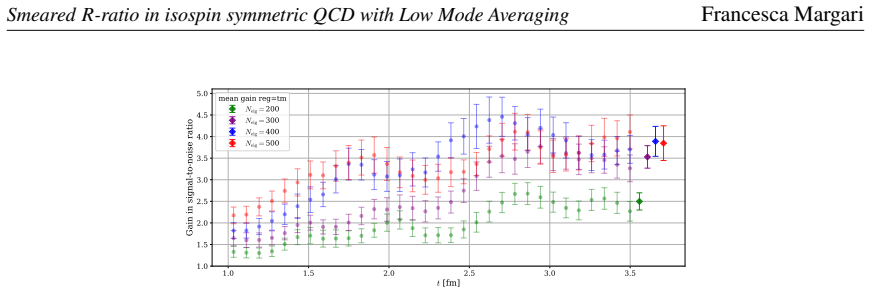
The machinery has two parts. Low Mode Averaging (LMA) deflates the Hermitian Dirac operator $Q_W = \gamma_5 D_W$: its $N_v$ lowest eigenpairs are computed exactly and used to build an all-to-all infrared propagator, while the ultraviolet part is still estimated stochastically. Because the stochastic sources are time- and spin-diluted, the deflated and non-deflated two-point correlators differ only in their infrared part, so the exact infrared contribution can be added back without touching the ultraviolet noise. The second part is the HLT spectral-density reconstruction, which approximates the target smearing kernel by a short exponential sum $\sum_\tau g_\tau e^{-a\omega\tau}$, fixing the coefficients $g_\tau$ by minimizing a weighted $L^2$ distance to the desired Gaussian kernel subject to a covariance penalty. The correlator $C(t) = (12\pi^2)^{-1}\int d\omega\, e^{-\omega t}\,\omega^2 R(\omega)$ then supplies the smeared R-ratio. The gain in signal-to-noise is quantified by comparing deflated and non-deflated correlators with adjusted numbers of configurations and stochastic sources.
What would settle it
Run the HLT analysis at $\sigma = 250$ MeV with several truncation values $\tau_{\rm max}$ and with 400 versus 500 eigenvectors: if the reconstructed R-ratio at $E \sim 770$ MeV moves by more than the quoted roughly 3% statistical error when $\tau_{\rm max}$ is increased, or if the two lattice regularizations no longer agree after unblinding, then the systematic control claim for the narrower width would be disproven.
Extended reading notes
Core claim
The central claim is that deflating the low eigenmodes of the Dirac operator does not merely reduce noise in the correlator; it changes which physics can be extracted from the same lattice ensembles. In the mixed-action twisted-mass setup, the deflated two-point function is obtained from the stochastic correlator by removing the stochastically estimated infrared part and adding back the exact all-to-all infrared part. With around 400 eigenvectors and about 1000 time-diluted stochastic sources per configuration, the signal-to-noise ratio on the light vector-vector correlator improves by a factor of 3.63(15) and 3.57(16) for the two current regularizations, at a cost increase of 2.7(2), i.e. a net speedup of about 5. Feeding these correlators into the HLT spectral-density reconstruction yields the connected $u/d$ contribution to the Gaussian-smeared R-ratio $R^\ell_\sigma(E)$ with $\sigma = 250$ MeV, where the relative error at $E \sim 770$ MeV drops from roughly 11% to 3%, exposing the rho resonance. The same pipeline is applied at three lattice spacings (about 0.057, 0.068 and 0.080 fm) and the results from the two regularizations are mutually compatible, so the authors regard the rho signal as a genuine physics outcome rather than a discretization artifact.
Load-bearing premise
The load-bearing premise is that the HLT reconstruction stays systematically under control at the narrower Gaussian width of 250 MeV, because the method had previously been validated only for widths of 440 to 630 MeV and this paper does not yet give an explicit error analysis for truncation or excited-state contamination at the new width.
Editorial extensions
If this is right
- At $E \sim 770$ MeV and $\sigma = 250$ MeV, the relative error on the smeared R-ratio drops from about 11% to about 3%, making the rho resonance visible in the lattice data.
- The signal-to-noise gain is 3.63(15) for one current regularization and 3.57(16) for the other; with a computational cost increase of about 2.7(2), the net speedup to reach a given accuracy is about 5(1).
- The method is demonstrated at three lattice spacings (about 0.057, 0.068 and 0.080 fm) with volumes up to about 5.5 fm, so the smeared R-ratio can be computed with controlled discretization effects.
- Results from the two lattice regularizations are compatible within the reached precision, allowing low-energy lattice artifacts specific to each regularization to be identified.
- Combining LMA with HLT makes Gaussian widths of 250 MeV feasible, roughly half the previously accessible width, enabling a more direct comparison with phenomenological smeared R-ratio data.
Reading between the lines
- Going beyond the paper: if the HLT truncation systematics are confirmed at 250 MeV, the same LMA plus HLT combination could plausibly reach widths near 150-200 MeV, where the omega and phi resonances, and possibly excited vector states, would come into view rather than just the rho.
- The gain factor is expected to grow on larger physical volumes because the number of low Dirac modes scales with the spacetime volume, so on boxes larger than the 5.1-5.5 fm used here the statistical advantage of LMA should become even more pronounced.
- Because LMA removes only the exactly-deflated infrared noise, its benefit should transfer to other bilinear channels, such as axial or scalar correlators, using the same eigenvector set and at no extra inversion cost; testing this on the same ensembles would be a direct extension.
- A practical consequence for the muon g-2 program is that cutting the statistical error on the connected light-quark contribution by about 3.6 times at fixed cost would allow the disconnected and strange or charm contributions to be computed at comparable precision, which often dominate the error budget.
Editorial analysis
A structured set of objections, weighed in public.
Referee Report
Summary. The paper reports a proof-of-concept application of Low Mode Averaging (LMA) to the light-quark connected vector-vector correlator in the ETMC mixed-action setup, with the goal of enabling Hansen-Lupo-Tantalo (HLT) spectral reconstruction of the smeared R-ratio at a Gaussian width of sigma = 250 MeV. The LMA estimator is defined in Eq. (13), and the authors show that it reduces the statistical error of the correlator by a factor of 3.63(15) for TM and 3.57(16) for OS regularizations, with a net computational speedup of about 5. Using these improved correlators, they present preliminary, blinded results for the light connected contribution to the smeared R-ratio at sigma = 250 MeV, reporting that the relative error at E around 770 MeV drops from about 11% to 3%, which they interpret as enough to resolve the rho resonance.
Significance. If the HLT systematic errors at sigma = 250 MeV are under control, this paper would be a significant methodological advance: LMA makes spectral reconstruction at smaller Gaussian widths feasible, and the quantitative error-reduction benchmark against data from Ref. [11] is a concrete and reproducible result. The LMA part is well supported: Eq. (13) is a clean deflation identity, and the measured noise reductions and cost model give a net speedup of about 5. The HLT extension to sigma = 250 MeV, however, is the load-bearing novelty, and it is not yet backed by a systematic error analysis. The agreement between TM and OS is a useful cross-check but does not constrain the shared HLT bias. The paper is a preliminary proceedings contribution, and the central physics claim therefore remains conditional on the missing systematic validation.
major comments (3)
- [Sec. 3, Eqs. (15)-(17), Fig. 5] The central claim that sigma = 250 MeV is sufficient to resolve the rho resonance is not yet supported by a systematic error analysis for the HLT reconstruction at this width. The approximation space in Eq. (15) is a truncated exponential basis, and the Tikhonov regularization in Eq. (17) introduces a bias; both become more severe as the Gaussian kernel narrows. Ref. [1] validated HLT for widths of 440-630 MeV, while the present paper uses sigma = 250 MeV without providing a tau_max scan, a lambda-stability study, or a synthetic-data test at this width. Consequently, the reported reduction from 11% to 3% at E ~ 770 MeV is purely statistical. The TM/OS agreement in Fig. 5 (right) is a useful cross-check, but it does not constrain the shared HLT systematic. I ask for an explicit HLT stability analysis or a synthetic-data validation at sigma = 250 MeV before the rho-resolution claim is made.
- [Sec. 3, Fig. 5] No systematic error budget is provided for the smeared R-ratio: there is no continuum extrapolation (only two lattice spacings, B64 and C80, are shown), no estimate of finite-volume, O(a), or isospin-breaking effects, and the results are blinded. As a result, the error bars in Fig. 5 do not represent the total uncertainty relevant for comparing with the rho peak, and the TM/OS agreement cannot be taken as evidence of continuum behavior. A proceedings paper may report preliminary status, but the phrase 'enough to appreciate the rho resonance' should be qualified as referring to statistical precision only, pending the systematic analysis.
- [Sec. 3, Fig. 5] The plotted quantity is the connected light-quark (u/d) contribution to the smeared R-ratio, not the full R-ratio defined in Eq. (2), which also receives disconnected and heavier-quark contributions. The text should consistently say 'light-quark connected contribution' when discussing the rho signal, and it should state how much of the rho peak is expected to arise from this partial contribution. Without this qualification, the claim that the full R-ratio has been resolved at sigma = 250 MeV is stronger than what the data show.
minor comments (5)
- [Eq. (14), Sec. 2.2] The formula for the Gain contains a stray symbol 'vt' before the two ratios; this is likely a LaTeX artifact and should be removed.
- [Title and Abstract] The name 'Hansen-Lupo-Tantatlo' is misspelled; it should be 'Hansen-Lupo-Tantalo', matching the reference list and Sec. 2.3.
- [Sec. 2.2, Table 1] For the B64 ensemble the optimal value Neig = 400 is supported by Fig. 2, but Table 1 lists Neig = 530 for C80 and D96 without showing the corresponding optimization scans; the choice for the finer ensembles should be justified or described as a scaling assumption.
- [Sec. 2.3, Eq. (16)] The notation for the weight function is inconsistent: the text says 'weight-functions w_n > 0', while Eq. (16) uses w_n(omega); the relation between the subscript n and the functional A_n should be stated explicitly.
- [References] Ref. [8] is incomplete ('JHEP 04 (2004) .') and Ref. [15] is a preprint 'In preparation'; these entries should be completed where possible.
Circularity Check
No significant circularity: the LMA gain is measured and the HLT output is defined by a known kernel fit, with the sigma=250 MeV systematic an open uncertainty rather than a circular reduction.
full rationale
The paper's central results are not circular. The LMA method is presented through the exact relation Eq. (13), C_defl = C_stoch - C_IR_stoch + C_IR_exact, which is an identity for the deflated estimator, not a fit. The quoted gain in signal-to-noise, 3.63(15) and 3.57(16), is computed from measured correlator errors and the stated numbers of configurations and sources; it is not adjusted to produce any particular final value. The HLT reconstruction is likewise not circular: the coefficients g_tau are determined by minimizing A_n[g] = ∫ dω w_n(ω) |K(ω;g) - 12π² G_σ(E-ω)/ω²|², in which the target is the known Gaussian smearing kernel, not the measured R-ratio. The subsequent R_σ(E) is then a linear combination of the lattice correlators. The comparison with the no-LMA result and the TM/OS cross-check in Fig. 5 are independent checks, and the stated blinding further reduces the possibility of tuning toward a desired phenomenological shape. Refs. [1], [2], and [11] include overlapping authors, but they supply the HLT algorithm and the earlier no-LMA data rather than an unverified uniqueness theorem or a fitted parameter disguised as a prediction. The main weakness, that HLT at σ=250 MeV has not yet been validated with a tau_max scan or a systematic error analysis at that width, is a correctness and robustness limitation, not a circularity: the estimator is still defined by the kernel objective and could be tested against synthetic data or other ensembles, as the paper itself implies by labeling the results preliminary and blinded. No load-bearing derivation reduces by construction to its inputs.
Assumptions & free parameters
free parameters (4)
- Number of low modes Neig =
400 (B64), 530 (C80, D96)
- Number of stochastic sources Neta =
1024 (B64), 960 (C80, D96)
- IR eigenmode threshold lambda_tilde_thrs =
approximately 8 mu_sea
- HLT Tikhonov parameter lambda =
varied in stability analysis
assumptions (4)
- standard math Spectral representation C(t) = (1/12pi^2) * integral domega exp(-omega t) omega^2 R(omega)
- domain assumption Eigenvalue density near zero scales as Banks-Casher: (Delta N / Delta lambda_tilde)(0) proportional to Lambda_QCD^3 L^3 T
- standard math Spin-diluted stochastic sources allow the UV contribution to be identical between deflated and non-deflated propagators
- domain assumption Identical stochastic sources can be generated on different node configurations using site-specific random seeds
Cite this review
Pith. "Pith review of Smeared $R$-ratio in isospin symmetric QCD with Low Mode Averaging." pith.science (2026). https://pith.science/paper/5KQUCJAD
@misc{pith2026250203187,
  author       = {Pith},
  title        = {Pith review of: Smeared $R$-ratio in isospin symmetric QCD with Low Mode Averaging},
  year         = {2026},
  howpublished = {\url{https://pith.science/paper/5KQUCJAD}},
  note         = {Machine review of arXiv:2502.03187}
}
abstract
Low Mode Average (LMA) is a technique to improve the quality of the signal-to-noise ratio in the long time separation of Euclidean correlation functions. We report on its beneficial impact in computing the vector-vector light connected two-point correlation functions and derived physical quantities in the mixed action lattice setup adopted by ETM collaboration. We focus on preliminary results of the computation within isospin symmetric QCD (isoQCD) of the $R$-ratio smeared with Gaussian kernels of widths down to $\sigma\sim250$ MeV, which is enough to appreciate the $\rho$ resonance around 770 MeV, using the Hansen-Lupo-Tantatlo (HLT) spectral-density reconstruction method.
Figures


Figures from the paper (2 more)


Reference graph
Works this paper leans on
-
[1]
Alexandrou et al., Probing the Energy-Smeared R Ratio Using Lattice QCD, Phys
Extended Twisted Mass Collaboration (ETMC) collaboration, C. Alexandrou et al., Probing the Energy-Smeared R Ratio Using Lattice QCD, Phys. Rev. Lett.130 (2023) 241901 [2212.08467]
arXiv 2023
-
[15]
Extended Twisted Mass Collaboration (ETMC) collaboration, C. Alexandrou et al., Light quark contributions to the muon anomalous magnetic moment in lattice QCD with twisted-mass fermions,In preparation(2025)
work page 2025
-
[11]
Extended Twisted Mass Collaboration collaboration, C. Alexandrou, S. Bacchio, P.Dimopoulos,J.Finkenrath,R.Frezzotti,G.Gagliardietal., Latticecalculationoftheshort and intermediate time-distance hadronic vacuum polarization contributions to the muon magnetic moment using twisted-mass fermions,Phys. Rev. D107 (2023) 074506
work page 2023
- [2]
-
[3]
A. Keshavarzi, D. Nomura and T. Teubner,𝑔− 2 of charged leptons,𝛼(𝑀2 𝑍) , and the hyperfine splitting of muonium, Phys. Rev. D101 (2020) 014029 [1911.00367]
arXiv 2020
-
[4]
R. Frezzotti and G. C. Rossi,Chirally improving Wilson fermions. 1. O(a) improvement, JHEP 08(2004) 007 [hep-lat/0306014]. 9 Smeared𝑅-ratio in isospin symmetric QCD with Low Mode Averaging Francesca Margari
arXiv 2004
-
[5]
R. Frezzotti and G. C. Rossi,Chirally improving Wilson fermions. II. Four-quark operators, JHEP 10 (2004) 070 [hep-lat/0407002]
arXiv 2004
-
[6]
Extended Twisted Mass Collaboration (ETMC) collaboration, C. Alexandrou et al., Strange and charm quark contributions to the muon anomalous magnetic moment in lattice QCD with twisted-mass fermions, 2411.08852
Show all 32 references
-
[7]
H. Neff, N. Eicker, T. Lippert, J. W. Negele and K. Schilling,Low fermionic eigenmode dominance in qcd on the lattice, Phys. Rev. D64 (2001) 114509
2001
-
[8]
Giusti et al.,Low-energy couplings of QCD from current correlators near the chiral limit, JHEP 04 (2004)
L. Giusti et al.,Low-energy couplings of QCD from current correlators near the chiral limit, JHEP 04 (2004)
2004
-
[9]
T. A. DeGrand and S. Schaefer,Improving meson two point functions in lattice QCD, Comput. Phys. Commun.159(2004) 185 [hep-lat/0401011]
2004 arXiv
-
[10]
Borsanyi et al.,Leading hadronic contribution to the muon magnetic moment from lattice QCD, Nature 593 (2021) 51 [2002.12347]
S. Borsanyi et al.,Leading hadronic contribution to the muon magnetic moment from lattice QCD, Nature 593 (2021) 51 [2002.12347]
2021 arXiv
-
[12]
Banks and A
T. Banks and A. Casher,Chiral symmetry breaking in confining theories, Nuclear Physics B 169 (1980) 103
1980
-
[13]
Leutwyler and A
H. Leutwyler and A. V. Smilga,Spectrum of Dirac operator and role of winding number in QCD, Phys. Rev. D46(1992) 5607
1992
-
[14]
Luscher,Local coherence and deflation of the low quark modes in lattice QCD,JHEP 07 (2007) 081 [0706.2298]
M. Luscher,Local coherence and deflation of the low quark modes in lattice QCD,JHEP 07 (2007) 081 [0706.2298]
2007 arXiv
-
[16]
Alexandrou et al.,Status of the ETMC ensemble generation effort, PoS LATTICE2024 (2025) 429
C. Alexandrou et al.,Status of the ETMC ensemble generation effort, PoS LATTICE2024 (2025) 429
2025
-
[17]
Jansen and C
K. Jansen and C. Urbach,tmLQCD: A Program suite to simulate Wilson Twisted mass Lattice QCD,Comput. Phys. Commun.180 (2009) 2717 [0905.3331]
2009 arXiv
-
[18]
A.Abdel-Rehim,F.Burger,A.Deuzeman,K.Jansen,B.Kostrzewa,L.Scorzatoetal., Recent developments in the tmLQCD software suite, PoS LATTICE2013(2014) 414 [1311.5495]
2014 arXiv
-
[19]
Deuzeman, K
A. Deuzeman, K. Jansen, B. Kostrzewa and C. Urbach,Experiences with OpenMP in tmLQCD,PoS LATTICE2013(2014) 416 [1311.4521]. 10 Smeared𝑅-ratio in isospin symmetric QCD with Low Mode Averaging Francesca Margari
2014 arXiv
-
[20]
Kostrzewa, S
ETM collaboration, B. Kostrzewa, S. Bacchio, J. Finkenrath, M. Garofalo, F. Pittler, S. Romiti et al.,Twisted mass ensemble generation on GPU machines,PoS LATTICE2022 (2023) 340 [2212.06635]
2023 arXiv
-
[21]
Deuzeman, S
ETM collaboration, A. Deuzeman, S. Reker and C. Urbach,Lemon: an MPI parallel I/O library for data encapsulation using LIME, Comput. Phys. Commun.183 (2012) 1321 [1106.4177]
2012 arXiv
-
[22]
Frommer, K
A. Frommer, K. Kahl, S. Krieg, B. Leder and M. Rottmann,Adaptive Aggregation-Based Domain Decomposition Multigrid for the Lattice Wilson–Dirac Operator, SIAM J. Sci. Comput. 36(2014) A1581 [1303.1377]
2014 arXiv
-
[23]
Alexandrou, S
C. Alexandrou, S. Bacchio, J. Finkenrath, A. Frommer, K. Kahl and M. Rottmann,Adaptive Aggregation-based Domain Decomposition Multigrid for Twisted Mass Fermions,Phys. Rev. D 94(2016) 114509 [1610.02370]
2016 arXiv
-
[24]
Bacchio, C
S. Bacchio, C. Alexandrou and J. Finkerath,Multigrid accelerated simulations for Twisted Mass fermions,EPJ Web Conf.175 (2018) 02002 [1710.06198]
2018 arXiv
-
[25]
Alexandrou, S
C. Alexandrou, S. Bacchio and J. Finkenrath,Multigrid approach in shifted linear systems for the non-degenerated twisted mass operator, Comput. Phys. Commun.236 (2019) 51 [1805.09584]
2019 arXiv
-
[26]
B. Joó, D. D. Kalamkar, T. Kurth, K. Vaidyanathan and A. Walden,Optimizing Wilson-Dirac Operator and Linear Solvers for Intel® KNL, inHigh Performance Computing(M. Taufer, B. Mohr and J. M. Kunkel, eds.), (Cham), pp. 415–427, Springer International Publishing, 2016
2016
-
[27]
Schröck, S
M. Schröck, S. Simula and A. Strelchenko,Accelerating Twisted Mass LQCD with QPhiX, PoS LATTICE2015(2016) 030 [1510.08879]
2016 arXiv
-
[28]
M. A. Clark, R. Babich, K. Barros, R. C. Brower and C. Rebbi,Solving Lattice QCD systems of equations using mixed precision solvers on GPUs, Comput. Phys. Commun.181 (2010) 1517 [0911.3191]
2010 arXiv
-
[29]
Babich, M
R. Babich, M. A. Clark, B. Joo, G. Shi, R. C. Brower and S. Gottlieb,Scaling Lattice QCD beyond 100 GPUs, inSC11 International Conference for High Performance Computing, Networking, Storage and Analysis Seattle, Washington, November 12-18, 2011, 2011, 1109.2935, DOI
2011 arXiv
-
[30]
M. A. Clark, B. Joó, A. Strelchenko, M. Cheng, A. Gambhir and R. C. Brower,Accelerating Lattice QCD Multigrid on GPUs Using Fine-Grained Parallelization, inSC ’16: Proceedings of the International Conference for High Performance Computing, Networking, Storage and Analysis, pp....
2016 arXiv
-
[31]
11 Smeared𝑅-ratio in isospin symmetric QCD with Low Mode Averaging Francesca Margari
Jülich Supercomputing Centre,JUWELS: Modular Tier-0/1 Supercomputer at the Jülich Supercomputing Centre,Journal of large-scale research facilities5 (2019) . 11 Smeared𝑅-ratio in isospin symmetric QCD with Low Mode Averaging Francesca Margari
2019
-
[32]
Jülich Supercomputing Centre,JUWELS Cluster and Booster: Exascale Pathfinder with Modular Supercomputing Architecture at Juelich Supercomputing Centre, Journal of large-scale research facilities7 (2021) . 12
2021
Reviewed August 9, 2026 · model on record in the stance chip above.
Discussion (0). Continue with ORCID to comment.