REVIEW 4 major objections 6 minor 2 cited by
Search for a Lee-Yang edge singularity in high-statistics Wuppertal-Budapest data
T0 review · 4 major / 6 minor · reviewed 2026-08-09 · deepseek-v4-flash
Pith's one-line read High-statistics lattice data place the Lee-Yang edge critical temperature at a broad median of 34 MeV.
desk verdict A transparent but fragile Padé-based Lee-Yang edge search on high-statistics WB data; the honest result is a wide CDF, not a value of T_c. read the letter →
The pith
A machine-rendered reading of the paper's core claim, the machinery that carries it, and where it could break.
The reading
What carries the argument
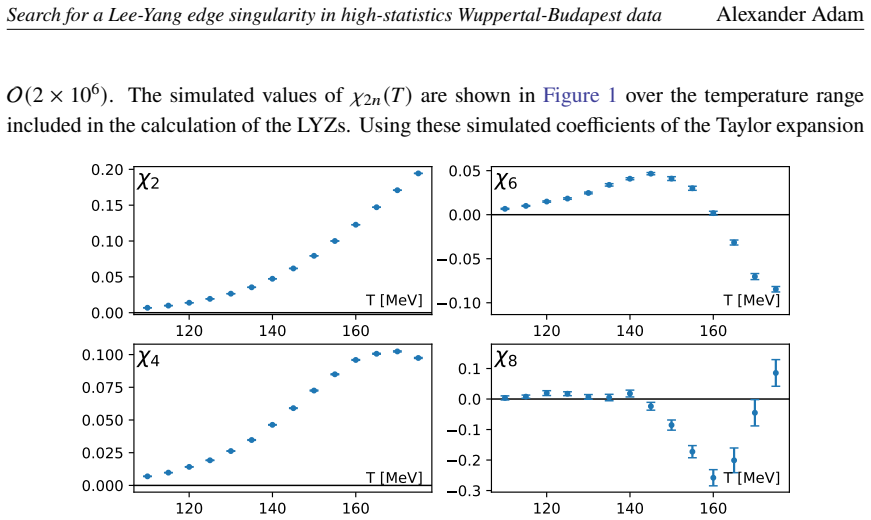
The core object is the Lee-Yang edge singularity, the endpoint of the locus of complex baryon chemical potentials where the QCD partition function vanishes; its distance from the real axis is governed by universal scaling near a critical point. To estimate it, the paper uses the baryon susceptibilities $\chi_{2n}(T)$ as Taylor coefficients of the pressure in $\hat{\mu}=\mu_B/T$, and algebraically converts the truncated Taylor series into a [1,2] Padé approximant (a rational function with numerator $a_1 x + a_2 x^2$ and denominator $1+b_1 x + b_2 x^2$ in $x=\hat{\mu}^2$) for the pressure, density, and susceptibility. The roots of the denominator serve as the Lee-Yang zeros. The approach of these zeros to the real axis is then fitted with the 3D Ising scaling law $\operatorname{Im}[f(\mu_B^{LY},T)]^{1/(\beta\delta)} = \kappa (T-T_c)$, using four different scaling variables $f=\mu_B$, $\mu_B/T$, $\mu_B^2$, $\mu_B^2/T^2$; the temperature axis intercept of this linear relation is the claimed $T_c$.
What would settle it
Recomputing the pole locations on the same susceptibilities with increasingly higher-order Padé approximants, for instance a [2,3] or [3,4] in $\hat{\mu}$, would settle whether the [1,2] poles are genuine: if the pole nearest the real axis moves by more than the jackknife uncertainty as the order increases, the identification with a Lee-Yang zero is falsified. A second decisive check is to exclude the 140–150 MeV window from all fits; the paper shows this shifts the extrapolated $T_c$ by dozens of MeV, and if a particular ansatz then yields a result inconsistent with the quoted 34 MeV median, the central estimate is not stable.
Extended reading notes
Core claim
The central claim is that, under the assumption of a 3D Ising critical point, the Lee-Yang edge singularity extrapolated from high-statistics lattice QCD data lands at a critical temperature whose combined statistical and systematic distribution is centered near 34 MeV but is extremely broad. This is not a sharp determination: the distribution extends to negative temperatures at its 16th percentile and to 67 MeV at its 84th percentile, so the data are consistent with a very wide range of critical temperatures, including no critical point at all in the scanned range. The paper also shows that the extrapolation is highly sensitive to the choice of scaling variable and to which temperatures are included in the fit—using the same observable but different temperature windows shifts the result from about 41 MeV to about 110 MeV. The intended contribution is therefore a cautionary, high-statistics test of the Lee-Yang edge method: with the current lattice data and a [1,2] Padé ansatz, the approach does not produce a precise or stable critical-endpoint location.
Load-bearing premise
The result depends on the assumptions that the poles of a simple [1,2] Padé built from only four cumulants are genuine Lee-Yang zeros rather than truncation artifacts, that the 140–150 MeV temperature window lies within the 3D Ising asymptotic scaling region, and that the QCD critical point is indeed of 3D Ising type.
Editorial extensions
If this is right
- If the result is taken at face value, the QCD critical endpoint, assuming it exists, is not detectable by the Lee-Yang edge method with this dataset: the 16th percentile at negative $T_c$ means the data are consistent with no critical point in the simulated range.
- The strong dependence of $T_c$ on the fit window—shifting from about 41 MeV to 110 MeV when the high-temperature points are included or excluded—implies that any future Lee-Yang edge search must first establish the range of validity of the scaling ansatz, which the current analysis does not do.
- Since the paper uses only a single Padé order, the systematic error estimate does not include the uncertainty from the choice of the rational approximant; a conservative interpretation is that the true uncertainty is even larger than the quoted 84th-versus-16th percentile spread.
- The comparison of the three observables (pressure, density, susceptibility) giving different pole locations shows that the choice of observable is a significant systematic, so a reliable extraction would require the pole positions from all observables to agree.
Reading between the lines
- One testable extension would be to repeat the analysis with higher-order Padé approximants and with a finer lattice to see whether the pole positions converge; if the median $T_c$ moves systematically toward the crossover temperature with improving precision, the 'edge singularity' being seen is likely the crossover's analytic structure rather than a true critical endpoint.
- A more conservative reading than the paper's is that the data place only an upper bound on the Lee-Yang edge temperature, since 16% of the accepted fits already give negative $T_c$; a careful upper limit, rather than a central value, might be the more robust output of this method.
- The slope change near 160 MeV reported by the authors and also visible in Dyson-Schwinger calculations [8] suggests that the scaling variable's linear form breaks down at the crossover, so restricting the fit to temperatures below 140 MeV may be necessary; a dedicated test would be to see whether the extrapolated $T_c$ stabilizes under that restriction.
Editorial analysis
A structured set of objections, weighed in public.
Referee Report
Summary. The paper applies [1,2] Padé approximants to the pressure, net-baryon density, and baryon susceptibility, with coefficients built from the Taylor cumulants chi_2, chi_4, chi_6, and chi_8 from Wuppertal-Budapest simulations on a 16^3 x 8 lattice. The poles of these approximants are identified with Lee-Yang zeros, and their imaginary parts are extrapolated to zero using an assumed 3D Ising scaling form with one of four scaling variables. Fit ranges are varied while always including 140–150 MeV, accepted fits pass a 5% p-value cut and a Tc > -500 MeV cut, and all results are combined with flat weighting into a cumulative distribution. The quoted result is a median Tc = 34 MeV with an 84th percentile of 67 MeV and a 16th percentile of -127 MeV. The paper explicitly acknowledges that only a single Padé order was used and that the corresponding systematic uncertainty is not accounted for.
Significance. If the result were robust, it would provide an interesting data-driven constraint on the QCD critical endpoint from a high-statistics lattice dataset. The paper is transparent about several limitations: it uses jackknife errors, compares three observables and four scaling variables, and explicitly states the omission of Padé-order systematics. However, the central numerical estimate rests on the unvalidated identification of a low-order Padé pole with a Lee-Yang branch point, and the quoted CDF is sensitive to arbitrary selection cuts. I therefore view the paper as a useful methods demonstration rather than a definitive CEP determination; the requested revision should convert the acknowledged omissions into quantitative systematics.
major comments (4)
- [Sec. 3, paragraph beginning "It should be noted..."] The paper explicitly states that only a [1,2]-Padé was used and that systematic effects from the order of the functional ansatz are not accounted for. Since all Lee-Yang zero locations in Figs. 2 and 3 come from this single rational form, the CDF in Sec. 4 is conditional on this ansatz. Without a comparison to other rational approximants (for example [2,1] or [2,2] Padé forms in the same variable) or a validation on a synthetic free energy with a known branch-point singularity, there is no evidence that the denominator roots track the true Lee-Yang edge rather than truncation artifacts. This is the central load-bearing issue and must be addressed before the numerical result can be considered reliable.
- [Sec. 3, CDF construction paragraph] The final distribution depends on several post-hoc choices: the 5% p-value cut, the requirement that every fit range include 140–150 MeV, and the arbitrary Tc > -500 MeV cut that removes about 10% of fits. The sensitivity of the reported median (34 MeV) and 84th percentile (67 MeV) to these choices is not quantified. Figure 5 shows that changing only the upper boundary of the fit range changes the extrapolated Tc from 41.3 MeV to 110.1 MeV, so the range selection is not innocuous; a stability scan over the p-value cut and the Tc outlier cut, or an explicit accounting of these choices as systematic weights, is needed.
- [Sec. 4 and Fig. 6] The quoted result includes a 16th percentile of -127 MeV and the CDF reaches 34% at Tc = 0. Since a negative physical critical temperature is not meaningful in this context, this large probability mass below zero indicates that a substantial fraction of the accepted fits are inconsistent with the assumed scaling behavior, rather than being a genuine physics outcome. The paper should report the fraction of fits with Tc > 0, discuss what the negative-intercept fits imply about the validity of the scaling ansatz over the fitted ranges, and test whether excluding the scaling variables or ranges that produce negative intercepts materially changes the median.
- [Sec. 2, Eq. (8) and Eq. (10)] The identification of Padé poles with the Lee-Yang edge singularity is assumed rather than demonstrated. The Lee-Yang edge is a branch-point singularity, and a single pole pair from a four-parameter rational function need not reproduce its location. Additionally, Eq. (10) assumes that the 3D Ising linear scaling form is already valid in the fitted temperature range (roughly 110–175 MeV), even though the extrapolated median Tc is approximately 34 MeV, far below the lowest fitted temperature. The paper should at least test the linear-in-T form against a known equation of state and quantify how much of the final CDF comes from extrapolations many tens of MeV beyond the fitted domain.
minor comments (6)
- [Fig. 1 caption] The caption says the susceptibilities are plotted over the temperature range 110–175 MeV, but the axis labels end at 160 MeV; please reconcile the figure and the text.
- [Fig. 4 caption and axis labels] The y-axis label of the first panel, "Im( LY/[MeV])(1/ ) 2", appears to have a missing superscript, and the meaning of the quoted "red:0.69707" values is not defined in the caption; please clarify.
- [Eq. (11) and Fig. 4] The list of scaling observables in Eq. (11) includes mu^2/T^2, while the fourth panel of Fig. 4 appears to plot Im((mu_LY/T)^2); please make the notation uniform.
- [Fig. 3 caption] In the caption, "nominator" should be "numerator".
- [Acknowledgments] The word "Schorlarship" should be "Scholarship".
- [Sec. 2, after Eq. (8)] Please clarify which four coefficients in Eq. (8) are matched by the four free parameters a1, a2, b1, b2; the text says n ranges from zero to three, but it would help to spell out the resulting four equations explicitly.
Circularity Check
No significant circularity: the Tc estimate is an extrapolation from lattice Taylor coefficients through a Padé proxy and an assumed 3D Ising scaling form, neither of which is equivalent to its own output.
full rationale
The derivation chain is not self-referential in a way that forces the reported Tc. The input is a fixed set of lattice Taylor coefficients chi_2 through chi_8 (Sec. 2, Eq. 1). The [1,2]-Padé denominator roots are algebraically determined from those coefficients (Eqs. 5-8), so the Lee-Yang zero locations are derived quantities, not fitted to Tc. The subsequent scaling extrapolation (Eqs. 9-10) assumes the 3D Ising universal scaling form and uses Im[f(mu_LYZ,T)] as the y-variable; the target Tc appears only as the x-axis intersection of a linear fit and is not inserted anywhere as an input or fit parameter. The paper explicitly acknowledges that the 3D Ising scaling is assumed and that only a single Padé order is used, which is an admitted model-dependence and limitation rather than circular reasoning. The one self-citation with author overlap, Ref. [9], is used only as background for radius-of-convergence estimates and is not load-bearing for the central extrapolation. The broad CDF and negative 16th percentile are consequences of unstable extrapolations, not of a circular construction. Therefore the analysis is self-contained against the data and does not reduce, by definition or by construction, to its own inputs.
Assumptions & free parameters
free parameters (4)
- Scaling constant kappa =
not reported (linear fit slope in Eq. 10)
- Fit range boundaries in temperature =
varied, always including 140-150 MeV
- p-value cut =
5%
- Tc outlier cutoff =
-500 MeV
assumptions (4)
- domain assumption 3D Ising universality class and scaling exponents beta, delta at the QCD critical endpoint.
- ad hoc to paper [1,2] Padé approximant with only leading nonzero coefficients reproduces the true analytic structure of the QCD free energy near the Lee-Yang edge.
- domain assumption 16^3 x 8 lattice data are close enough to thermodynamic and continuum limits for this analysis.
- domain assumption Taylor coefficients up to chi_8 are sufficient to construct the Padé approximant.
Cite this review
Pith. "Pith review of Search for a Lee-Yang edge singularity in high-statistics Wuppertal-Budapest data." pith.science (2026). https://pith.science/paper/EVEMLID4
@misc{pith2026250203211,
  author       = {Pith},
  title        = {Pith review of: Search for a Lee-Yang edge singularity in high-statistics Wuppertal-Budapest data},
  year         = {2026},
  howpublished = {\url{https://pith.science/paper/EVEMLID4}},
  note         = {Machine review of arXiv:2502.03211}
}
abstract
Near a critical endpoint the Lee-Yang edge singularity approaches the real axis in the complex chemical potential plane. In the vicinity of the critical point the functional form of this approach depends on the universality class. Assuming a three dimensional Ising critical point in the QCD phase diagram the location of the critical endpoint can be extrapolated provided that the position of the Lee-Yang edge singularity is known at multiple temperatures. A popular method to estimate the position of a singularity is to model the free energy as a rational function of the baryon chemical potential $\mu_\text{B}$. The parameters of this model can be constrained by the cumulants of the net baryon density taken at $\mu_\text{B}^2\leq0$ . Using high-statistics simulations on a lattice $16^3\times8$ by the Wuppertal-Budapest Collaboration we estimate the location of the closest singularity in the QCD phase diagram. We also compare various models for the functional form of the free energy and discuss the predictive power of this approach.
Figures


Figures from the paper (3 more)


Forward citations
Cited by 2 Pith papers
-
Lattice QCD constraints on the critical point from an improved precision equation of state
An improved lattice QCD equation of state, combined with entropy contours continued from imaginary chemical potential, excludes a QCD critical point below μB = 450 MeV at 2σ confidence.
-
The effect of charm quark on the QCD chiral phase diagram
Adding a dynamical charm quark moves the predicted QCD critical endpoint from (102.9 MeV, 618.8 MeV) to (104.3 MeV, 600.1 MeV).
Reference graph
Works this paper leans on
-
[1]
Y. Aoki, G. Endrodi, Z. Fodor, S. D. Katz and K. K. Szabo,The Order of the quantum chromodynamics transition predicted by the standard model of particle physics, Nature443 (2006), 675-678 [hep-lat/0611014]
arXiv 2006
-
[2]
L. Du, A. Sorensen and M. Stephanov,The QCD phase diagram and Beam Energy Scan physics: a theory overview, Int. J. Mod. Phys. E33(2024), 2430008 [2402.10183]
arXiv 2024
-
[3]
C. N. Yang and T. D. Lee,Statistical theory of equations of state and phase transitions. 1. Theory of condensation, Phys. Rev.87 (1952), 404
work page 1952
-
[4]
V. V. Skokov,Two lectures on Yang-Lee edge singularity and analytic structure of QCD equation of state, 2411.02663
-
[5]
D. Bollweget al.[HotQCD], Taylor expansions and Padé approximants for cumulants of conserved charge fluctuations at nonvanishing chemical potentials, Phys. Rev. D105 (2022), 074511 [2202.09184]
arXiv 2022
-
[6]
D.A.Clarke,P.Dimopoulos,F.DiRenzo,J.Goswami,C.Schmidt,S.SinghandK.Zambello, SearchingfortheQCDcriticalendpointusingmulti-pointPadéapproximations , 2405.10196
-
[7]
C 110 (2024), 015203 [2312.06952]
G.Basar, QCDcriticalpoint,Lee-Yangedgesingularities,andPadéresummations ,Phys.Rev. C 110 (2024), 015203 [2312.06952]
arXiv 2024
-
[8]
Z. Y. Wan, Y. Lu, F. Gao and Y. X. Liu,Lee-Yang edge singularities in QCD via the Dyson- Schwinger equations, Eur. Phys. J. C84 (2024), 899 [2401.04957]
arXiv 2024
Show all 11 references
-
[9]
Giordanoand A.Pásztor,Reliable estimationof theradius ofconvergence infinite density QCD, Phys
M. Giordanoand A.Pásztor,Reliable estimationof theradius ofconvergence infinite density QCD, Phys. Rev. D99(2019), 114510 [1904.01974]
2019 arXiv
-
[10]
Mukherjee and V
S. Mukherjee and V. Skokov,Universality driven analytic structure of the QCD crossover: radius of convergence in the baryon chemical potential, Phys. Rev. D103 (2021), L071501 [1909.04639]
2021 arXiv
-
[11]
UnconventionalprobesintotheQCDphasediagramusingRational approximations and Lefschetz thimbles
S.SinghDoctoralthesis,“UnconventionalprobesintotheQCDphasediagramusingRational approximations and Lefschetz thimbles”https://hdl.handle.net/1889/5098 9
Reviewed August 9, 2026 · model on record in the stance chip above.
Discussion (0). Continue with ORCID to comment.