REVIEW 3 major objections 4 minor 20 references
HMC and gradient flow with machine-learned classically perfect fixed-point actions
T0 review · 3 major / 4 minor · reviewed 2026-08-09 · deepseek-v4-flash
Pith's one-line read This paper claims that a machine-learned fixed-point lattice action for SU(3) gauge theory removes tree-level artifacts from the gradient flow, so continuum results emerge from coarse lattices with only mild O(a^2) corrections.
desk verdict A promising progress report on machine-learned FP actions for SU(3), whose scaling test is worth taking seriously, but whose central C_FP=1 argument is asserted rather than derived. read the letter →
The pith
A machine-rendered reading of the paper's core claim, the machinery that carries it, and where it could break.
The reading
What carries the argument
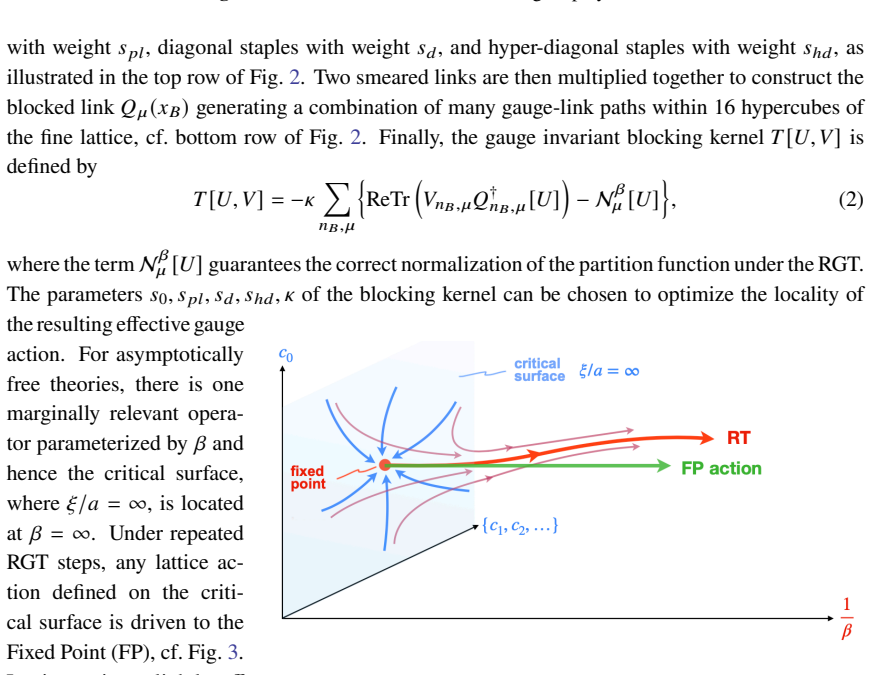
The central object is the fixed-point action defined by the FP equation $A_{\mathrm{FP}}[V] = \min_U (A_{\mathrm{FP}}[U] + T[U,V])$, where $T$ is an RG blocking kernel. The machinery that carries the argument is a lattice gauge-covariant convolutional neural network (L-CNN), a gauge-equivariant network that builds complicated Wilson loops through convolutions with parallel transports and preserves exact gauge invariance, and whose backpropagation yields the action derivatives needed for HMC. For the gradient-flow claim, the key mechanism is that repeated RG blocking drives the propagator to have poles at $(p + 2\pi l)^2$ for all integers $l$, so the tree-level lattice coefficient $C(a^2/t)$ becomes identically 1.
What would settle it
Directly substitute the L-CNN parameterized action's propagator into the tree-level coefficient formula (Eq. (7)/(8)) and evaluate $C(a^2/t)$; if it deviates from 1 by more than a few percent for $t/a^2 \sim 1$, the simulated action is not classically perfect in the flow, independent of any scaling fit.
Extended reading notes
Core claim
On the paper's own terms, the discovery is that the exact fixed-point action has no tree-level artifacts in the gauge-field gradient flow: because iterated RG transformations extend the effective momentum range to $\pm\infty$, the FP propagator has the continuum dispersion relation, so the tree-level coefficient in Eq. (8) satisfies $C_{\mathrm{FP}}(a^2/t) = 1$ at any finite lattice spacing. For the parameterized action actually simulated, the paper reports that discretization effects are very mild, with an $O(a^2)$ extrapolation of data at $a \lesssim 0.13$ fm sufficient for a reliable continuum limit, in contrast to the Wilson action. The parameterization itself is done with an L-CNN trained on FP action values and their derivatives, and the paper shows it outperforms earlier traced-loop and fat-link parameterizations.
Load-bearing premise
The whole argument rests on the assumption that the trained neural network approximates the true fixed-point action closely enough on the simulated ensembles that whatever error the approximation introduces is too small to affect the measured scaling.
Editorial extensions
If this is right
- Continuum quantities such as $t_0/w^2$ could be extracted from lattices with $a \simeq 0.11\text{--}0.13$ fm without the large systematic errors of Wilson-type extrapolations.
- Gradient-flow scale setting and a flow-based $\beta$-function could be computed with much smaller lattice artifacts when flow action, observable, and simulation action are all the FP action.
- The L-CNN parameterization makes the FP approach practical for HMC simulation, since exact derivatives are available through backpropagation and standard symplectic integrators apply.
- If the small-artifact behavior persists in full QCD, the same strategy would mitigate critical slowing down and topological freezing in the approach to the continuum.
Reading between the lines
- A testable extension not in the paper is to compute the tree-level coefficient $C(a^2/t)$ for the learned L-CNN action directly, not just for the exact FP propagator, to see how much parameterization error re-introduces artifacts.
- The paper's comparison of parameterizations reports no error bars on the training data; an independent check would be to generate several HMC streams from different random starts and compare the spread of $t_{0.3}/w^2_{0.3}$ at fixed $\beta_{\mathrm{FP}}$.
- One could extend the same learned-action logic to the Dirac operator: if a classically perfect FP fermion action can be parameterized in a similar gauge-equivariant network, coarser lattices might also control chiral symmetry breaking and index-theorem effects.
Editorial analysis
A structured set of objections, weighed in public.
Referee Report
Summary. The paper reports on the construction and first use of a machine-learned parameterization of the fixed-point (FP) action for four-dimensional SU(3) gauge theory. The FP action is represented by a gauge-equivariant convolutional network (L-CNN), trained on FP action values and derivatives obtained from the FP equation. The authors show that this parameterization reproduces FP data better than previous loop-based or fat-link parameterizations, and they simulate the resulting action with HMC, checking the Hamiltonian constraint. They then argue that the exact FP action leads to a classically perfect gradient flow with tree-level coefficient C_FP(a^2/t)=1, and they present a scaling study of the ratio t_{0.3}/w^2_{0.3} on coarse lattices, reporting much milder discretization effects than for the Wilson action. The paper is a proceedings contribution presenting initial results rather than a complete analysis.
Significance. If the central claims hold, the work opens a practical route to continuum physics from coarser lattices, potentially reducing critical slowing down and topological freezing. The L-CNN parameterization with exact derivatives through backpropagation is a genuine technical advance over earlier FP-action parameterizations, and the explicit HMC implementation with a Hamiltonian-constraint check is a valuable step. The scaling results, while preliminary, are suggestive and would be significant if backed by controlled statistics. However, the paper's central theoretical claim about the exact FP gradient flow is not proven, and the scaling evidence is presented without the ensemble-level detail needed to support the stated conclusion.
major comments (3)
- [Section 4, Eq. (8)] The claim that the exact FP action gives C_FP(a^2/t)=1 is asserted rather than derived. Equation (8) is an integral over the first Brillouin zone of an integrand built from the lattice quadratic form A, with no sum over momenta p+2πl. Even if the FP propagator has poles at (p+2πl)^2 for all integer vectors l, that does not by itself imply that the first-Brillouin-zone integral in Eq. (8) equals the continuum all-momentum integral, because A_f and A_e in that equation are still functions of the Brillouin-zone momentum p. A concrete counterexample is any quadratic form equal to p^2 on the Brillouin zone, for which the integral in Eq. (8) would differ from the continuum result by O(a^2/t) contributions. The authors need to provide an explicit free-field solution of the FP equation (3) or a direct calculation of Eq. (8) for the exact FP action before the statement 'This results in C_FP(a^2/t)=1' can be accepted. This point is load-bearing because Section 5 attributes all residual artifacts to 'an imperfect parameterization or to quantum effects', which presupposes that the exact FP flow has no tree-level artifacts.
- [Section 5, Fig. 8] The scaling study is presented without the information needed to assess its reliability. The right panel of Fig. 8 shows three FP lattice sizes (10^4, 14^4, 16^4), but no table is given with the corresponding beta values, statistics, autocorrelation times, or the number of configurations used in the gradient-flow measurement. The left panel shows a single example ensemble without stating how many configurations are averaged. With only three lattice sizes and no statistical errors or finite-volume checks, the claim that 'an O(a^2) extrapolation of the data with a ≲ 0.13 fm is sufficient for a reliable continuum limit' is not supported. The authors should provide ensemble details and a quantitative estimate of the parameterization error on the actual HMC ensembles used in the scaling test.
- [Section 5, discussion of residual artifacts] The sentence attributing any remaining lattice artifacts to 'an imperfect parameterization or to quantum effects' depends critically on the unproved result C_FP=1 from Section 4. If the exact FP action is not shown to yield a tree-level perfect gradient flow, then the observed mild scaling violations could equally be caused by flow-action artifacts. The attribution should either be removed or made conditional on a completed free-field derivation. This is not a mere wording issue; it changes the interpretation of the scaling data.
minor comments (4)
- [Figure 5] The comparison of parameterization errors for the L-CNN and previous constructions would be much more informative if the figure included uncertainties or at least the number of configurations and the range of beta values used for each ensemble.
- [Section 3, around Eq. (2)] The notation N_beta_mu[U] is introduced but not defined in detail; a short explanation of how this term fixes the normalization of the partition function would help the reader.
- [Figure 8] The plot uses t_{0.3}/w^2_{0.3} where both scales are extracted from the same flowed observables; the statistical correlation between them should be discussed when errors are reported.
- [Section 4, Figure 7] It would be useful to state explicitly that the hard-cutoff and Wilson curves in Fig. 7 are obtained from known analytic expressions, and to give the corresponding formulas or references in the text.
Circularity Check
No significant circularity: the learned FP action is validated against the FP equation and the scaling test is a genuine simulation, not a fitted prediction.
full rationale
The derivation chain is not circular. The L-CNN parameterization is trained to reproduce the FP action values given by the RHS of Eq. (3), and Fig. 5 checks the parameterization against those same numerical-minimization targets; this is a fit-quality test, not the prediction of an independent quantity from a fitted input. The HMC evolution and the scaling ratio t0.3/w2_0.3 in Fig. 8 come from actual Monte Carlo simulations with the parameterized FP action, and no parameter of the scaling extrapolation is adjusted to force agreement with the Wilson comparison. Self-citations [2,3,5] provide the L-CNN architecture and earlier parameterizations, but they are not load-bearing for the new numerical results. The Section 4 claim that C_FP(a^2/t)=1 is not itself circular, but it is under-derived: Eq. (8) remains an integral over the first Brillouin zone, and the statement that poles at (p+2πl)^2 extend the momentum range to ±∞ does not by itself turn that integral into the continuum integral. That is a mathematical-support gap, not a reduction of the output to the input; the scaling result is not fitted to the C_FP=1 claim.
Assumptions & free parameters
free parameters (2)
- L-CNN weights (3 layers, 12/24/24 channels, kernel sizes 2,2,1) =
Trained on FP-equation action values and derivatives; values not published
- Blocking kernel parameters s0, s_pl, s_d, s_hd, kappa in Eq. (2) =
Not reported
assumptions (5)
- domain assumption The RGT defined by Eq. (2) yields a well-defined, local fixed-point action solving Eq. (3).
- domain assumption For asymptotically free theories, actions on the critical surface flow to the FP under repeated RGTs, and FP actions suppress lattice artifacts at weak coupling.
- domain assumption L-CNN layers preserve exact gauge covariance and backpropagation yields exact derivatives of the action.
- ad hoc to paper The exact FP propagator has poles at (p+2πl)^2 for all integers l, so its dispersion is continuum-like on the lattice.
- standard math Tree-level discretization artifacts of gradient flow are captured by C(a^2/t) in Eq. (7) from perturbation theory [16].
Cite this review
Pith. "Pith review of HMC and gradient flow with machine-learned classically perfect fixed-point actions." pith.science (2026). https://pith.science/paper/SIE4PTMS
@misc{pith2026250203315,
  author       = {Pith},
  title        = {Pith review of: HMC and gradient flow with machine-learned classically perfect fixed-point actions},
  year         = {2026},
  howpublished = {\url{https://pith.science/paper/SIE4PTMS}},
  note         = {Machine review of arXiv:2502.03315}
}
read the original abstract
Fixed-point (FP) lattice actions are classically perfect, i.e., they have continuum classical properties unaffected by discretization effects and are expected to have suppressed lattice artifacts at weak coupling. Therefore they provide a possible way to extract continuum physics with coarser lattices, allowing to circumvent problems with critical slowing down and topological freezing towards the continuum limit. We use machine-learning methods to parameterize a FP action for four-dimensional SU(3) gauge theory using lattice gauge-covariant convolutional neural networks. The large operator space allows us to find superior parameterizations compared to previous studies and we show how such actions can be efficiently simulated with the Hybrid Monte Carlo algorithm. Furthermore, we argue that FP lattice actions can be used to define a classically perfect gradient flow without any lattice artifacts at tree level. We present initial results for scaling of the gradient flow with the FP action.
Figures


Figures from the paper (5 more)


Reference graph
Works this paper leans on
-
[1]
ALPHA collaboration, S. Schaefer, R. Sommer and F. Virotta,Critical slowing down and error analysis in lattice QCD simulations, Nucl. Phys. B845 (2011) 93, [1009.5228]
arXiv 2011
-
[2]
K. Holland, A. Ipp, D. I. Müller and U. Wenger,Machine learning a fixed point action for SU(3) gauge theory with a gauge equivariant convolutional neural network,Phys. Rev. D110 (2024) 074502, [2401.06481]
arXiv 2024
-
[3]
K. Holland, A. Ipp, D. I. Müller and U. Wenger,Fixed point actions from convolutional neural networks,PoSLATTICE2023(2024) 038, [2311.17816]
arXiv 2024
-
[4]
P. Hasenfratz and F. Niedermayer,Perfect lattice action for asymptotically free theories, Nucl. Phys. B414 (1994) 785, [hep-lat/9308004]
arXiv 1994
- [5]
-
[6]
M. Blatter and F. Niedermayer,New fixed point action for SU(3) lattice gauge theory, Nucl. Phys. B482 (1996) 286, [hep-lat/9605017]
arXiv 1996
-
[7]
F. Niedermayer, P. Rufenacht and U. Wenger,Fixed point gauge actions with fat links: Scaling and glueballs, Nucl. Phys. B597 (2001) 413, [hep-lat/0007007]
arXiv 2001
- [8]
Show all 20 references
-
[9]
S. A. Gottlieb, W. Liu, D. Toussaint, R. L. Renken and R. L. Sugar,Hybrid Molecular Dynamics Algorithms for the Numerical Simulation of Quantum Chromodynamics,Phys. Rev. D35(1987) 2531
1987
-
[10]
Takaishi and P
T. Takaishi and P. de Forcrand,Testing and tuning new symplectic integrators for hybrid Monte Carlo algorithm in lattice QCD, Phys. Rev. E73 (2006) 036706, [hep-lat/0505020]
2006 arXiv
-
[11]
I. P. Omelyan, I. M. Mryglod and R. Folk,Symplectic analytically integrable decomposition algorithms: classification, derivation, and application to molecular dynamics, quantum and celestial mechanics simulations, Comput. Phys. Commun.151 (2003) 272
2003
-
[12]
Lüscher,Properties and uses of the Wilson flow in lattice QCD, JHEP08(2010) 071, [1006.4518]
M. Lüscher,Properties and uses of the Wilson flow in lattice QCD, JHEP08(2010) 071, [1006.4518]
2010 arXiv
-
[13]
Luscher and P
M. Luscher and P. Weisz,Perturbative analysis of the gradient flow in non-abelian gauge theories, JHEP02(2011) 051, [1101.0963]
2011 arXiv
-
[14]
9 HMC and gradient flow with machine-learned classically perfect FP actions U
Z.Fodor,K.Holland,J.Kuti,D.NogradiandC.H.Wong, Anewmethodforthebetafunction in the chiral symmetry broken phase, EPJ Web Conf.175 (2018) 08027, [1711.04833]. 9 HMC and gradient flow with machine-learned classically perfect FP actions U. Wenger
2018 arXiv
-
[15]
Hasenfratz and O
A. Hasenfratz and O. Witzel,Continuous renormalization group𝛽 function from lattice simulations,Phys. Rev. D101 (2020) 034514, [1910.06408]
2020 arXiv
-
[16]
Fodor, K
Z. Fodor, K. Holland, J. Kuti, S. Mondal, D. Nogradi and C. H. Wong,The lattice gradient flow at tree-level and its improvement, JHEP09(2014) 018, [1406.0827]
2014 arXiv
-
[17]
T. A. DeGrand, A. Hasenfratz, P. Hasenfratz and F. Niedermayer,The Classically perfect fixed point action for SU(3) gauge theory,Nucl. Phys. B454 (1995) 587, [hep-lat/9506030]
1995 arXiv
-
[18]
Hasenfratz,Lattice QCD without tuning, mixing and current renormalization, Nucl
P. Hasenfratz,Lattice QCD without tuning, mixing and current renormalization, Nucl. Phys. B 525 (1998) 401, [hep-lat/9802007]
1998 arXiv
-
[19]
Hasenfratz, V
P. Hasenfratz, V. Laliena and F. Niedermayer,The Index theorem in QCD with a finite cutoff, Phys. Lett. B427 (1998) 125, [hep-lat/9801021]
1998 arXiv
-
[20]
Borsányi, S
BMWcollaboration, S. Borsányi, S. Dürr, Z. Fodor, C. Hoelbling, S. D. Katz, S. Krieg et al., High-precision scale setting in lattice QCD, JHEP09(2012) 010, [1203.4469]. 10
2012 arXiv
Reviewed August 9, 2026 · model on record in the stance chip above.
Discussion (0). Continue with ORCID to comment.