REVIEW 2 major objections 5 minor 90 references
Measurements of $\varUpsilon$ States Production in $\textit{p+p}$ Collisions at $\sqrt{s} = 500\:\mathrm{GeV}$ with STAR: Cross Sections, Ratios, and Multiplicity Dependence
T0 review · 2 major / 5 minor · reviewed 2026-08-09 · deepseek-v4-flash
Pith's one-line read The paper reports the first measurement of Upsilon(1S), Upsilon(2S), and Upsilon(3S) production in proton-proton collisions at 500 GeV, with a combined cross section of 199 ± 13 ± 33 pb in |y|<1 and a multiplicity trend that matches…
desk verdict The 500 GeV Upsilon cross sections are solid and worth having; the multiplicity-dependence claim has a real, unaddressed autocorrelation from including the Upsilon decay electrons in Nch. read the letter →
The pith
A machine-rendered reading of the paper's core claim, the machinery that carries it, and where it could break.
The reading
What carries the argument
The measurement chain is carried by dielectron reconstruction in the time-projection chamber and barrel calorimeter, followed by a simultaneous unbinned-likelihood fit to the invariant-mass spectrum $6.6<M_{ee}<16$ GeV/$c^2$. The signal shapes are Crystal Ball functions fixed from embedded full-detector Monte Carlo; the combinatorial background is an exponential anchored to like-sign pairs; and the correlated b-bbar/Drell-Yan background is a power law constrained by PYTHIA8. Efficiency corrections come from embedding simulated Upsilon decays into data, while the multiplicity dependence uses a four-iteration Bayesian unfolding that maps measured time-of-flight track counts to true charged multiplicity with a PYTHIA8 response built separately for Upsilon and minimum-bias events. These pieces together convert raw electron-pair counts into cross sections, ratios, and yield-versus-multiplicity trends.
What would settle it
Rebuild the unfolding response matrix from a data-driven embedding or from an event generator with a very different multiparton-interaction model and recompute the multiplicity curves; a shift larger than the quoted tune systematic (up to roughly 13%) would falsify the trend. The absolute cross section could be checked independently by measuring the same 500 GeV p+p system through the dimuon decay channel.
Extended reading notes
Core claim
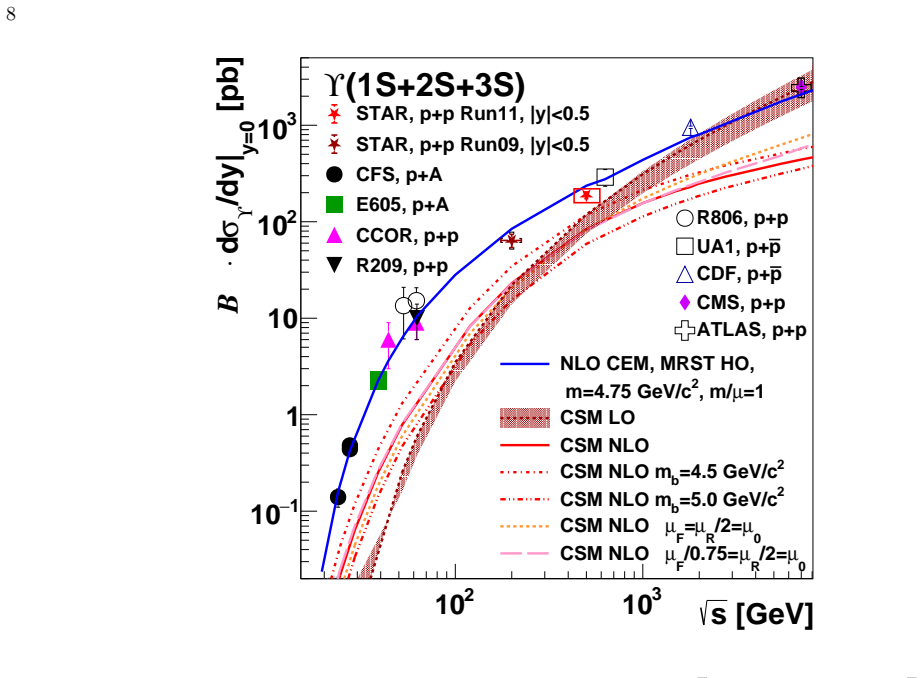
The central claim is that a single dataset from a 2011 run at $\sqrt{s}=500$ GeV with 13 pb$^{-1}$ of integrated luminosity yields the first differential cross sections for the three bottomonium states in p+p collisions at that energy. In the dielectron channel, the combined Upsilon(1S+2S+3S) cross section is $199 \pm 13 \pm 33$ pb for $|y|<1$. The per-state spectra and ratios set a new benchmark: CEM reproduces Upsilon(1S); CGC+NRQCD overestimates all states, with the largest excess for $p_T<2$ GeV/c; and CSM at LO and NLO underestimates the rapidity dependence. The multiplicity study shows $N_{\Upsilon}/\langle N_{\Upsilon}\rangle$ rising with $N_{\mathrm{ch}}/\langle N_{\mathrm{ch}}\rangle$, a trend consistent with PYTHIA8, CGC/saturation, and string percolation, while the excited-to-ground ratios stay flat, indicating little comover suppression.
Load-bearing premise
The multiplicity measurement assumes that the simulation used in the unfolding correction correctly maps the number of detector tracks to the true charged-particle multiplicity; if that mapping is wrong, the reported rise of the Upsilon yield with multiplicity is biased.
Editorial extensions
If this is right
- The 500 GeV data become a new normalization point between 19.4 GeV and 1 TeV, so model tunes of quarkonium production now have to pass a four-decade energy sweep that includes this measurement.
- Because CEM matches Upsilon(1S) while CSM does not, the result favors production through color evaporation or non-perturbative color-octet matrix elements over color-singlet dominance at this energy.
- The CGC+NRQCD overshoot at low $p_T$, which improves when the first $p_T$ bin is dropped, quantifies how much Sudakov resummation is needed in that framework.
- The flat ratios of Upsilon(2S)/Upsilon(1S) and Upsilon(3S)/Upsilon(1S) with multiplicity put an upper bound on comover dissociation of excited bottomonia at 500 GeV.
- The rise of the Upsilon yield with charged multiplicity matches J/psi trends and is reproduced by PYTHIA8, CGC/saturation, and string percolation, so the measurement adds a bottomonium constraint on how hard and soft QCD processes are entangled.
Reading between the lines
- A natural extension the authors do not develop: the slope of the multiplicity rise should be compared between 200 GeV and 500 GeV p+p data; if multiple parton interactions drive it, the slope should grow with collision energy, whereas a saturation-driven rise would be flatter in energy.
- The flatness of the state ratios with multiplicity could serve as a baseline for heavy-ion measurements: any suppression of excited bottomonia in nucleus-nucleus collisions cannot then be attributed to comover interactions that are already ruled out in p+p.
- The unfolding response is generated by one family of event-generator tunes, so a data-driven closure test that uses embedded reconstructed tracks as pseudo-data would make the multiplicity trend model-independent; this is a testable follow-up, not a claim in the paper.
Editorial analysis
A structured set of objections, weighed in public.
Referee Report
Summary. The paper reports STAR measurements of Υ(1S), Υ(2S), and Υ(3S) production in p+p collisions at √s = 500 GeV using an integrated luminosity of 13 pb^-1 from the 2011 run. It presents a combined integrated cross section, per-state differential cross sections in pT and rapidity, cross-section ratios, and a measurement of the Υ yield versus charged-particle multiplicity. The results are compared with CEM, CGC+NRQCD, CSM, PYTHIA8 STAR Heavy Flavor Tune, CGC/Saturation, and String Percolation models. The main novelty is the first measurement of these observables at √s = 500 GeV and the multiplicity dependence of Υ production at RHIC.
Significance. If the cross-section and ratio results are correct, they fill an energy gap between fixed-target and Tevatron/LHC measurements and provide new constraints on quarkonium production models, in particular on the low-pT behavior where CGC+NRQCD overshoots the data and on the rapidity dependence where CSM undershoots. The analysis follows standard practices: Crystal Ball signal shapes fixed from full detector embedding, like-sign combinatorial background subtraction, a correlated-background model constrained by PYTHIA8, and a systematic budget that includes trigger response, polarization, tracking efficiency, and unfolding choices. The multiplicity measurement, if robust, would extend the J/ψ multiplicity studies to the Υ sector at RHIC energies and sharpen tests of saturation, percolation, and multi-parton-interaction scenarios.
major comments (2)
- [III A, IV C] Section III A explicitly states that the electrons and positrons from Υ decays are included in the Nch calculation, while Section IV C uses the minimum-bias Nch distribution as the reference. In the self-normalized ratio N_Y/<N_Y> versus N_ch/<N_ch>, the numerator events have their measured multiplicity shifted upward by about 2 units relative to the denominator events for the same underlying multiplicity. Because the minimum-bias multiplicity distribution falls steeply (mean <Nch> ≈ 8), this shift artificially suppresses the first Nch bin and enhances the high-multiplicity bins, exactly the pattern visible in Fig. 10(a). The systematic checks in Section III E (unfolding iterations, NBD shape, 4Cx tune, tracking-efficiency variations) all retain the decay leptons in the response matrix and binning, so they do not test this physics-level autocorrelation. Please either exclude the two Υ-decay leptons from the numerator multiplicity, or quantify the expected shift using the measured minimum-bias Nch distribution and apply it as a correction or an explicit systematic; without this, the multiplicity trend in Fig. 10 cannot be interpreted as a genuine enhancement of Υ production in high-multiplicity events.
- [III D and IV C, Fig. 10(b)] The Bayesian unfolding response matrix for the multiplicity measurement is generated with PYTHIA8 using the STAR Heavy Flavor Tune, and the same tune is later shown as a model comparison in Fig. 10(b). The 4Cx tune check in Section III E varies only one neighboring configuration within the same event-generator family; it does not validate the use of a PYTHIA8-based response matrix for the Nch dependence. This self-referentiality does not affect the cross-section results, but it weakens the abstract's statement that the multiplicity trend is 'consistent with ... PYTHIA8'. The paper should explicitly state that the model comparison shares the same simulation framework as the correction, and ideally test the unfolding with a non-PYTHIA8 response or with a larger model variation.
minor comments (5)
- [III A] In the sentence describing the minimum-bias Nch distribution, 'criteia' should be 'criteria'.
- [References] Reference [31] lists the author as 'A. Angelis and ohers'; this should read 'others'.
- [Fig. 5] The colors for the CGC+NRQCD bands in the Fig. 5 captions are inconsistent with the text: Fig. 5(b) is described as a brown band in the caption but light blue in the text, and Fig. 5(c) is reversed; these should be made consistent.
- [Fig. 6] The same color inconsistency for the CGC+NRQCD bands appears in the Fig. 6 captions and should be corrected.
- [Fig. 10] The axis labels in Fig. 10 appear garbled in the manuscript (e.g., the x-axis shows a trailing '>' symbol); the rendered labels should be checked so that the reader can read 'N_ch/<N_ch>' and 'N_Y/<N_Y>' unambiguously.
Circularity Check
Multiplicity-dependence headline is partially self-constructed: Upsilon decay leptons are counted in the signal-event Nch but absent from the minimum-bias denominator, offsetting the numerator bins and printing an apparent rise (the paper's own 'notable exception of first point' is the signature); cross-section and ratio results are independent.
-
self definitional
[Section III A (Nch definition) together with Section IV C and Fig. 10 (multiplicity-dependence result)]
"The electrons and positrons coming from Υ decays are included in the Nch calculation. ... The minimum-bias Nch distribution is obtained with the same criteia listed above from a separate low-luminosity dataset. The measured value of ⟨Nch⟩ after the unfolding corrections is ⟨Nch⟩ = 8.078 ± 0.007. Bins are chosen as integer multiples of ⟨Nch⟩, so that the bin limits are: 0 − ⟨Nch⟩, ⟨Nch⟩ −2⟨Nch⟩, 2⟨Nch⟩ −3⟨Nch⟩ and 3⟨Nch⟩ −8⟨Nch⟩. The dependence of Υ production on charged particle multiplicity is studied by calculating the yield NΥ/⟨NΥ⟩ vs. Nch/⟨Nch⟩."
Each Υ event's Nch includes the two decay leptons while the minimum-bias reference does not, so Nch(Υ) ≈ Nch(other) + 2. The numerator yield in bin B counts Υ events with non-signal multiplicity in [B−2], while the denominator counts [B]. The first-bin anomaly the paper notes ('the notable exception of first point at low-Nch') is the predicted signature: with a falling minimum-bias distribution (⟨Nch⟩ = 8.078), the shifted/unshifted ratio is <1 in bin 1 and >1 in higher bins, so NΥ/⟨NΥ⟩ appears to rise with Nch/⟨Nch⟩ even for a flat per-event yield. No Section III E systematic (unfolding iterations, NBD shape, 4Cx tune, tracking efficiency) removes the decay leptons from Nch, so the offset is untested; the 4Cx variant shares the definition.
full rationale
The core cross-section results (Section IV A) are model-independent and self-contained: raw yields come from unbinned fits to the invariant-mass spectra, efficiencies from Υ(nS)→e+e− decays embedded into raw data, and luminosity from BBC studies; the CEM, CSM, and CGC+NRQCD comparisons use externally computed predictions, so those results do not reduce to their inputs. The cross-section ratios (Section IV B) are likewise independent, although the reference fits in Fig. 8(a) include the STAR points being tested (Ref. [58] plus world data), which slightly dilutes rather than creates the quoted 2.1σ deviation. The multiplicity-dependence result (Section IV C and Fig. 10), one of the three headline claims, is different: Section III A defines the Υ-event multiplicity to include the two decay leptons, while the minimum-bias reference used for the denominator and bin positions excludes them, offsetting the numerator bins by about +2. With ⟨Nch⟩ = 8.078 and a steeply falling minimum-bias distribution, this offset suppresses the first bin (which the paper itself singles out as 'the notable exception of first point at low-Nch') and enhances the higher bins, producing part of the reported rise even for a flat per-event yield. The systematics in Section III E vary the unfolding iterations, NBD shape, tracking efficiency, and PYTHIA tune, but never remove the decay leptons from Nch, so the construction is untested; the 4Cx cross-check shares the same offset. The Fig. 10(b) comparison with PYTHIA8 STAR Heavy Flavor Tune [90] additionally involves self-reliance, since the same tune generates the unfolding response matrix, although the yield-versus-Nch shape is not imposed by the unfolding and the CGC/Saturation and Percolation curves are independent. Overall, the paper's central cross-section and ratio claims are clean, but the multiplicity-dependence claim is partially constructed by the paper's own Nch definition, warranting a partial-circularity score rather than a clean 0-2.
Assumptions & free parameters
free parameters (2)
- p_T momentum smearing coefficient a =
not quoted
- polarization parameter lambda =
0 (assumed)
assumptions (4)
- domain assumption The STAR detector simulation (TPC, BEMC, TOF) accurately models tracking, electron identification, and trigger response.
- domain assumption Upsilon(nS) mesons are produced unpolarized in the simulation.
- domain assumption PYTHIA8 with the STAR Heavy Flavor Tune correctly models the relation between TOF-track multiplicity and true N_ch.
- domain assumption The correlated background shape from b anti-b pairs and Drell-Yan is described by a power-law whose parameters are constrained by PYTHIA8.
Cite this review
Pith. "Pith review of Measurements of $\varUpsilon$ States Production in $\textit{p+p}$ Collisions at $\sqrt{s} = 500\:\mathrm{GeV}$ with STAR: Cross Sections, Ratios, and Multiplicity Dependence." pith.science (2026). https://pith.science/paper/A35XBHJ7
@misc{pith2026250203769,
  author       = {Pith},
  title        = {Pith review of: Measurements of $\varUpsilon$ States Production in $\textitp+p$ Collisions at $\sqrts = 500\:\mathrmGeV$ with STAR: Cross Sections, Ratios, and Multiplicity Dependence},
  year         = {2026},
  howpublished = {\url{https://pith.science/paper/A35XBHJ7}},
  note         = {Machine review of arXiv:2502.03769}
}
abstract
We report measurements of $\varUpsilon(1S)$, $\varUpsilon(2S)$ and $\varUpsilon(3S)$ production in $\textit{p+p}$ collisions at $\sqrt{s}=500\:\mathrm{GeV}$ by the STAR experiment in year 2011, corresponding to an integrated luminosity $\mathcal{L}_{int}=13\:\mathrm{pb^{-1}}$. The results provide precise cross sections, transverse momentum ($p_{T}$) and rapidity ($y$) spectra, as well as cross section ratios for $p_{\mathrm{T}}<10\:\mathrm{GeV/c}$ and $|y|<1$. The dependence of the $\varUpsilon$ yield on charged particle multiplicity has also been measured, offering new insights into the mechanisms of quarkonium production. The data are compared to various theoretical models: the Color Evaporation Model (CEM) accurately describes the $\varUpsilon(1S)$ production, while the Color Glass Condensate + Non-relativistic Quantum Chromodynamics (CGC+NRQCD) model overestimates the data, particularly at low $p_{T}$. Conversely, the Color Singlet Model (CSM) underestimates the rapidity dependence. These discrepancies highlight the need for further development in understanding the production dynamics of heavy quarkonia in high-energy hadronic collisions. The trend in the multiplicity dependence is consistent with CGC/Saturation and String Percolation models or $\varUpsilon$ production happening in multiple parton interactions modeled by PYTHIA8.
Figures


Figures from the paper (8 more)


Reference graph
Works this paper leans on
-
[1]
Aidala et al
C. Aidala et al. (PHENIX Collaboration), Physical Review D 98, 012006 (2018)
2018
-
[2]
M. S. Abdallah et al. (STAR Collaboration), Physical Review Letters 128, 122303 (2022)
2022
-
[3]
S. Chatrchyan et al. (CMS Collaboration), Physical Review Letters 109, 222301 (2012), arXiv:1208.2826
arXiv 2012
-
[4]
Matsui and H
T. Matsui and H. Satz, Physics Letters B 178, 416 (1986)
1986
-
[5]
H. D. Politzer, Physical Review Letters 30, 1346 (1973)
1973
-
[6]
D. J. Gross and F. Wilczek, Physical Review Letters 30, 1343 (1973)
1973
-
[7]
Chao-Hsi, Nuclear Physics B 172, 425 (1980)
C. Chao-Hsi, Nuclear Physics B 172, 425 (1980)
1980
-
[8]
E. L. Berger and D. Jones, Physical Review D 23, 1521 (1981)
1981
Show all 90 references
-
[9]
Baier and R
R. Baier and R. R¨ uckl, Physics Letters B102, 364 (1981)
1981
-
[10]
G. T. Bodwin, E. Braaten, and G. P. Lepage, Physical Review D 51, 1125 (1995)
1995
-
[11]
G. T. Bodwin, E. Braaten, and G. P. Lepage, Physical Review D 55, 5853 (1997)
1997
-
[12]
G. T. Bodwin, E. Braaten, T. C. Yuan, and G. P. Lepage, Physical Review D 46, R3703 (1992)
1992
-
[13]
Fritzsch, Physics Letters B 67, 217 (1977)
H. Fritzsch, Physics Letters B 67, 217 (1977)
1977
-
[14]
Kosarzewski, Physica Scripta 97, 064004 (2022)
L. Kosarzewski, Physica Scripta 97, 064004 (2022)
2022
-
[15]
Lansberg, Physics Reports 889, 1 (2020)
J.-P. Lansberg, Physics Reports 889, 1 (2020)
2020
-
[16]
Acosta et al
D. Acosta et al. (CDF Collaboration), Physical Review Letters 88, 161802 (2002)
2002
-
[17]
Acosta et al
D. Acosta et al. (CDF Collaboration), Physical Review D 71, 032001 (2005)
2005
-
[18]
Abe et al
F. Abe et al. (CDF Collaboration), Physical Review Letters 75, 4358 (1995)
1995
-
[19]
Acharya et al
S. Acharya et al. (ALICE Collaboration), The European Physical Journal C 83, 61 (2023)
2023
-
[20]
Sirunyan et al
A. Sirunyan et al. (CMS Collaboration), Physics Letters B 780, 251 (2018)
2018
-
[21]
Khachatryan et al
V. Khachatryan et al. (CMS Collaboration), Physical Review D 83, 112004 (2011), arXiv:1012.5545
2011 arXiv
-
[22]
Khachatryan et al
V. Khachatryan et al. (CMS Collaboration), Physics Letters B 749, 14 (2015), arXiv:1501.07750
2015 arXiv
-
[23]
Chatrchyan et al
S. Chatrchyan et al. (CMS Collaboration), Physics Letters B 727, 101 (2013), arXiv:1303.5900
2013 arXiv
-
[24]
Aad et al., Physical Review D 87, 052004 (2013), arXiv:1211.7255
G. Aad et al., Physical Review D 87, 052004 (2013), arXiv:1211.7255
2013 arXiv
-
[25]
Aaij et al
R. Aaij et al. (LHCb Collaboration), The European Physical Journal C 72, 2025 (2012), arXiv:1202.6579
2012 arXiv
-
[26]
Aaij et al
R. Aaij et al. (LHCb Collaboration), Journal of High Energy Physics 2013, 64 (2013), arXiv:1304.6977
2013 arXiv
-
[27]
Khachatryan et al
V. Khachatryan et al. (CMS Collaboration), Journal of High Energy Physics 2017, 13 (2017)
2017
-
[28]
Sirunyan et al
A. Sirunyan et al. (CMS Collaboration), Physics Letters B 808, 135578 (2020)
2020
-
[29]
J. K. Yoh et al., Physical Review Letters 41, 684 (1978)
1978
-
[30]
Kourkoumelis et al., Physics Letters B 91, 481 (1980)
C. Kourkoumelis et al., Physics Letters B 91, 481 (1980)
1980
-
[31]
Angelis and ohers, Physics Letters B 87, 398 (1979)
A. Angelis and ohers, Physics Letters B 87, 398 (1979)
1979
-
[32]
Adare et al
A. Adare et al. (PHENIX Collaboration), Physical Review C 91, 024913 (2015), arXiv:1404.2246
2015
-
[33]
B. I. Abelev et al. (STAR Collaboration), Physical Review D 82, 012004 (2010), arXiv:1001.2745
2010 arXiv
-
[34]
Adamczyk et al
L. Adamczyk et al. (STAR Collaboration), Physics Letters B 735, 127 (2014), arXiv:1312.3675
2014 arXiv
-
[35]
Abelev et al
B. Abelev et al. (ALICE Collaboration), Physics Letters B 712, 165 (2012), arXiv:1202.2816
2012 arXiv
-
[36]
Acharya et al
S. Acharya et al. (ALICE Collaboration), Physics Letters B 810, 135758 (2020), arXiv:2005.11123
2020 arXiv
-
[37]
Adam et al
J. Adam et al. (STAR Collaboration), Physics Letters B 786, 87 (2018), arXiv:1805.03745
2018 arXiv
-
[38]
Chatrchyan et al
S. Chatrchyan et al. (CMS Collaboration), Journal of High Energy Physics 2014, 103 (2014), arXiv:1312.6300
2014 arXiv
-
[39]
E. G. Ferreiro and C. Pajares, Physical Review C 86, 034903 (2012), arXiv:1203.5936
2012 arXiv
-
[40]
Y.-Q. Ma, P. Tribedy, R. Venugopalan, and K. Watanabe, Nuclear Physics A 982, 747 (2018), arXiv:1807.05655
2018 arXiv
-
[41]
Levin and M
E. Levin and M. Siddikov, The European Physical Journal C 79, 376 (2019), arXiv:1812.06783
2019 arXiv
-
[42]
Levin, I
E. Levin, I. Schmidt, and M. Siddikov, The European Physical Journal C 80, 560 (2020), arXiv:1910.13579
2020 arXiv
-
[43]
Adam et al
J. Adam et al. (ALICE Collaboration), Journal of High Energy Physics 2015, 148 (2015), arXiv:1505.00664 [nucl-ex]
2015 arXiv
-
[44]
B. Z. Kopeliovich, H. J. Pirner, I. K. Potashnikova, K. Reygers, and I. Schmidt, Physical Review D 88, 116002 (2013), arXiv:1308.3638
2013 arXiv
-
[45]
B. Z. Kopeliovich, H. J. Pirner, I. K. Potashnikova, K. Reygers, and I. Schmidt, Physical Review D 101, 054023 (2020), arXiv:1910.09682
2020 arXiv
-
[46]
K. H. Ackermann et al. (STAR Collaboration), Nuclear Instruments and Methods in Physics Research - Section A 499, 624 (2003)
2003
-
[47]
Beddo et al.(STAR Collaboration), Nuclear Instruments and Methods in Physics Research - Section A499, 725 (2003)
M. Beddo et al.(STAR Collaboration), Nuclear Instruments and Methods in Physics Research - Section A499, 725 (2003)
2003
-
[48]
C. A. Whitten, A. Kponou, Y. Makdisi, and A. Zelenski, in AIP Conference Proceedings, Vol. 980 (AIP, 2008) pp. 390–396
2008
-
[49]
Anderson et al
M. Anderson et al. (STAR Collaboration), Nuclear Instruments and Methods in Physics Research - Section A 499, 659 (2003)
2003
-
[50]
Llope et al., Nuclear Instruments and Methods in Physics Research - Section A522, 252 (2004), arXiv:0308022 [nucl-ex]
W. Llope et al., Nuclear Instruments and Methods in Physics Research - Section A522, 252 (2004), arXiv:0308022 [nucl-ex]
2004
-
[51]
Adye, Proceedings of the PHYSTAT 2011 Workshop , 6 (2011), arXiv:1105.1160
T. Adye, Proceedings of the PHYSTAT 2011 Workshop , 6 (2011), arXiv:1105.1160
2011 arXiv
-
[52]
Navas et al
S. Navas et al. (Particle Data Group Collaboration), Physical Review D 110, 030001 (2024)
2024
-
[53]
Bichsel, (2001), STAR note SN0439: https://drupal.star.bnl.gov/STAR/starnotes/public/sn0439
H. Bichsel, (2001), STAR note SN0439: https://drupal.star.bnl.gov/STAR/starnotes/public/sn0439
2001
-
[54]
Vogt, private communication (2014)
R. Vogt, private communication (2014). 15
2014
-
[55]
Verkerke, EPJ Web of Conferences 4, 02005 (2010)
W. Verkerke, EPJ Web of Conferences 4, 02005 (2010)
2010
-
[56]
Sj¨ ostrand, S
T. Sj¨ ostrand, S. Ask, J. R. Christiansen, R. Corke, N. Desai, P. Ilten, S. Mrenna, S. Prestel, C. O. Rasmussen, and P. Z. Skands, Computer Physics Communications 191, 159 (2014), arXiv:1410.3012
2014 arXiv
-
[57]
Gaiser, (1982), PhD thesis, Stanford University, 1982
J. Gaiser, (1982), PhD thesis, Stanford University, 1982. SLAC Report SLAC-R-255 http://www.slac.stanford.edu/ cgi-wrap/getdoc/slac-r-255.pdf
1982
-
[58]
W. Zha, C. Yang, B. Huang, L. Ruan, S. Yang, Z. Tang, and Z. Xu, Physical Review C88, 067901 (2013), arXiv:1308.4720
2013 arXiv
-
[59]
Kuhr, Upsilon polarization measurement at CDF (2010), arXiv:1011.0161 [hep-ex]
T. Kuhr, Upsilon polarization measurement at CDF (2010), arXiv:1011.0161 [hep-ex]
2010 arXiv
-
[60]
P. D. Group, P. A. Zyla, et al., Progress of Theoretical and Experimental Physics 2020, 083C01 (2020)
2020
-
[61]
Adam et al
J. Adam et al. (STAR Collaboration), Physical Review D 100, 052005 (2019)
2019
-
[62]
Adamczyk et al
L. Adamczyk et al. (STAR Collaboration), Physical Review D 86, 072013 (2012), arXiv:1204.4244
2012 arXiv
-
[63]
Adams et al
J. Adams et al. (STAR Collaboration), Physical Review Letters 91, 172302 (2003), arXiv:0305015 [nucl-ex]
2003
-
[64]
B. I. Abelev et al. (STAR Collaboration), Physical Review Letters 97, 252001 (2006), arXiv:0608030 [hep-ex]
2006
-
[65]
Corke and T
R. Corke and T. Sj¨ ostrand, Journal of High Energy Physics 2011, 9 (2011)
2011
-
[66]
Childress et al., Physical Review Letters 55, 1962 (1985)
S. Childress et al., Physical Review Letters 55, 1962 (1985)
1985
-
[67]
Ueno et al., Physical Review Letters 42, 486 (1979)
K. Ueno et al., Physical Review Letters 42, 486 (1979)
1979
-
[68]
W. R. Innes et al., Physical Review Letters 39, 1240 (1977)
1977
-
[69]
Moreno et al., Physical Review D 43, 2815 (1991)
G. Moreno et al., Physical Review D 43, 2815 (1991)
1991
-
[70]
Yoshida et al
T. Yoshida et al. ((E605 Collab.)), Phys. Rev. D 39, 3516 (1989)
1989
-
[71]
L. Y. Zhu et al. (FNAL E866/NuSea Collaboration), Physical Review Letters 100, 062301 (2008), arXiv:0710.2344
2008 arXiv
-
[72]
A. D. Frawley, T. Ullrich, and R. Vogt, Physics Reports 462, 125 (2008), arXiv:0806.1013
2008 arXiv
-
[73]
Feng, J.-P
Y. Feng, J.-P. Lansberg, and J.-X. Wang, The European Physical Journal C 75, 313 (2015), arXiv:1504.00317
2015 arXiv
-
[74]
Lansberg, private communication (2022)
J.-P. Lansberg, private communication (2022)
2022
-
[75]
Lansberg and M
J.-P. Lansberg and M. A. Ozcelik, The European Physical Journal C 81, 497 (2021)
2021
-
[76]
Lansberg, M
J.-P. Lansberg, M. Nefedov, and M. A. Ozcelik, Journal of High Energy Physics2022, 83 (2022), arXiv:2112.06789 [hep-ph]
2022 arXiv
-
[77]
Vogt, Physical Review C 92, 034909 (2015), arXiv:1507.04418
R. Vogt, Physical Review C 92, 034909 (2015), arXiv:1507.04418
2015 arXiv
-
[78]
Han, Y.-Q
H. Han, Y.-Q. Ma, C. Meng, H.-S. Shao, Y.-J. Zhang, and K.-T. Chao, Physical Review D 94, 014028 (2016), arXiv:1410.8537
2016 arXiv
-
[79]
Ma and R
Y.-Q. Ma and R. Venugopalan, Physical Review Letters 113, 192301 (2014), arXiv:1408.4075
2014 arXiv
-
[80]
Ma, private communication (2014)
Y.-Q. Ma, private communication (2014)
2014
-
[81]
S. J. Brodsky and J.-P. Lansberg, Physical Review D 81, 051502 (2010), arXiv:0908.0754
2010 arXiv
-
[82]
Venugopalan, private communication (2017)
R. Venugopalan, private communication (2017)
2017
-
[83]
Andronic et al., The European Physical Journal C 76, 107 (2016), arXiv:1506.03981
A. Andronic et al., The European Physical Journal C 76, 107 (2016), arXiv:1506.03981
2016 arXiv
-
[84]
Arleo, D
F. Arleo, D. D’Enterria, and A. S. Yoon, Journal of High Energy Physics 2010, 35 (2010), arXiv:1003.2963
2010 arXiv
-
[85]
S. M. Berman, J. D. Bjorken, and J. B. Kogut, Physical Review D 4, 3388 (1971)
1971
-
[86]
Adamczyk et al
L. Adamczyk et al. (STAR Collaboration), Physics Letters B 722, 55 (2013)
2013
-
[87]
Lafferty and T
G. Lafferty and T. Wyatt, Nuclear Instruments and Methods in Physics Research - Section A 355, 541 (1995)
1995
-
[88]
E. G. Ferreiro and J. P. Lansberg, Journal of High Energy Physics 2018, 10.1007/jhep10(2018)094 (2018)
2018 doi
-
[89]
E. G. Ferreiro and J. P. Lansberg, Journal of High Energy Physics 2019, 10.1007/JHEP03(2019)063 (2019)
2019 doi
-
[90]
Ullrich, http://www.star.bnl.gov/protected/heavy/ullrich/pythia8/
T. Ullrich, http://www.star.bnl.gov/protected/heavy/ullrich/pythia8/
Reviewed August 9, 2026 · model on record in the stance chip above.
Discussion (0). Continue with ORCID to comment.