REVIEW 3 major objections 5 minor 3 cited by
Sensitivity to Triple Higgs Couplings via Di-Higgs Production in the RxSM at the (HL-)LHC and future $e^+e^-$ Colliders
T0 review · 3 major / 5 minor · reviewed 2026-08-09 · deepseek-v4-flash
Pith's one-line read In the real singlet extension of the Standard Model, the heavy Higgs boson that enables a strong first-order electroweak phase transition leaves a broadened, interference-shaped imprint in the di-Higgs mass distribution; the paper argues…
desk verdict A competent RxSM di-Higgs study whose new piece is the full m_hh distributions on a FOEWPT benchmark plane; the central caveat is that the plane is not checked against existing LHC di-Higgs limits, which the authors admit. read the letter →
The pith
A machine-rendered reading of the paper's core claim, the machinery that carries it, and where it could break.
The reading
What carries the argument
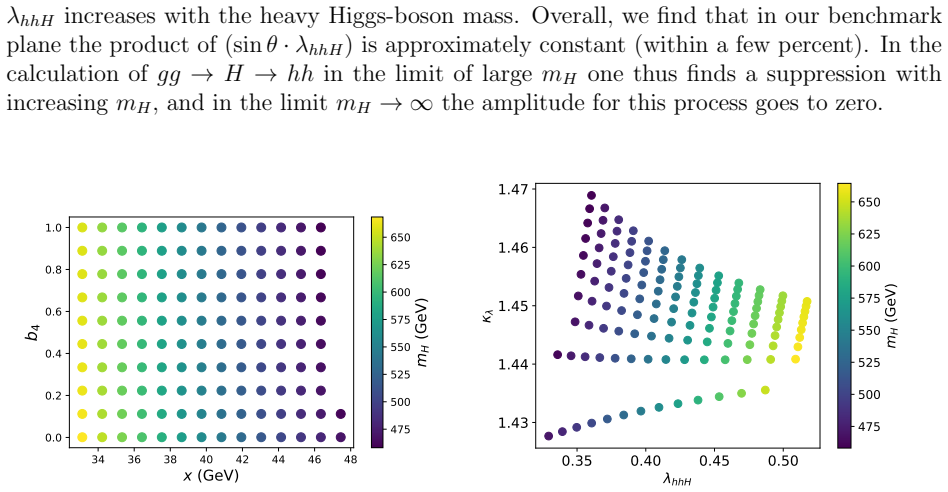
The load-bearing object is the differential di-Higgs invariant-mass distribution d(sigma)/dm_hh computed at leading order with the full set of diagrams: the top-quark box, the light-Higgs triangle (controlled by kappa_lambda), and the heavy-Higgs s-channel triangle (controlled by sin(theta)*lambda_hhH). Interference between the resonant and non-resonant amplitudes produces the characteristic peak-dip structure; the paper's observability measure is the estimator R, defined as the summed bin-by-bin difference between RxSM and SM event counts, normalized by the SM count, restricted to bins where the difference exceeds 20 GeV times the bin size (or a threshold of two events at the ILC). The benchmark plane itself is the second piece of machinery: it is defined by fixing the singlet VEV x and quartic b4 with relations a1*x = -32000, lambda = 0.18, and b3 = -560*sqrt(b4), which guarantees a strong first-order electroweak phase transition and keeps kappa_lambda = 1.45 with m_H between 458 and 660 GeV.
What would settle it
Re-run the current resonant di-Higgs search with the full leading-order RxSM m_hh templates for benchmark points P1-P8 instead of the pure-resonant template; if the exclusion status of the plane is unchanged, the claim that the approximation can lead to erroneous results would be refuted for these points. A complementary check is to compute NLO QCD m_hh distributions with full top-mass dependence for P1, P4, and P7 and see whether the broadened peak-dip structure survives the same smearing and binning.
Extended reading notes
Core claim
On its own terms, the paper establishes that in the RxSM benchmark plane the process gg -> hh receives a resonant contribution from the heavy Higgs boson H through the coupling lambda_hhH, and that this contribution interferes with the SM-like continuum. The resulting m_hh distribution is not a narrow resonance but a peak-dip structure whose position and shape depend on m_H and on the sign and size of the couplings. After a 15% Gaussian smearing and 50 GeV binning, the dip is largely washed out, but a sizeable excess over the SM remains around m_hh ~ m_H for benchmark points in all three regions defined by the total-cross-section significance; the paper's R estimator ranges from about 230 down to 80 at the HL-LHC. Comparing the full calculation with the resonant-only calculation used by the experimental collaborations, the paper finds that the full distribution is substantially broadened, especially toward lower m_hh, and concludes that the resonant-only approximation may fail to capture the relevant effects and lead to erroneous results. At the ILC1000, the m_hh distribution of e+e- -> Zhh shows a resonance structure whose R value is largest for the smallest lambda_hhH, giving a potential sensitivity to this coupling.
Load-bearing premise
The load-bearing premise is that the FOEWPT benchmark plane, which the authors explicitly did not test against existing LHC di-Higgs measurements, is not already excluded; if those data rule out the plane, all the cross-section predictions, m_hh shapes, and the critique of the experimental approximation lose their concrete target.
Editorial extensions
If this is right
- If the approximation critique is right, existing LHC exclusion limits for resonant di-Higgs production cannot be applied directly to singlet-extension models; each model needs a full-interference signal template or a reinterpretation of the limits.
- The HL-LHC can distinguish this RxSM benchmark plane from the SM in the m_hh distribution even when the total cross section shows no significant deviation, because of the broadened excess around the heavy-Higgs mass.
- The ILC1000 (or any e+e- collider at 1 TeV with 8 ab^-1) could determine lambda_hhH from e+e- -> Zhh; within this benchmark plane the sensitivity is largest for small lambda_hhH and decreases as m_H grows.
- A first measurement of a BSM triple Higgs coupling would allow the reconstruction of the scalar potential in a model that can explain the baryon asymmetry via a strong first-order electroweak phase transition.
- Because the plane has kappa_lambda = 1.45 but is not in the alignment limit, the same m_hh analysis indirectly tests the cosmological scenario of electroweak baryogenesis that motivated the model.
Reading between the lines
- The paper explicitly does not check against non-resonant di-Higgs data at the LHC; if those data already exclude the kappa_lambda = 1.45, m_H < 660 GeV plane, the claim's concrete target disappears. The authors' own caveat makes this the first thing to test.
- The same interference-broadening argument likely extends beyond the RxSM to other heavy-scalar models; one direct test would be to recast current resonant di-Higgs exclusions using full-interference templates for a range of singlet and doublet models and see how many excluded points move.
- The LO m_hh distributions are used with 15% smearing and 50 GeV bins because NLO distributions with full mass dependence are not available; if NLO corrections shift the dip position or smear the peak further, the quantitative R values and the 'visible after binning' conclusion could change. This is an editorial caution, not a paper claim.
- A natural future extension is to repeat the ILC analysis with polarized beams and a full detector simulation of the 4b+Z final state; the public R values suggest the coupling could be extracted, but only a complete experimental study can confirm the precision.
Editorial analysis
A structured set of objections, weighed in public.
Referee Report
Summary. The paper studies di-Higgs production in the real singlet extension of the Standard Model (RxSM) at the HL-LHC and at a future e+e− collider (ILC1000), with the goal of assessing sensitivity to the BSM triple Higgs coupling λhhH. The analysis is anchored to a two-dimensional benchmark plane, taken from Ref. [25], that is designed to feature a strong first-order electroweak phase transition. At the HL-LHC, the authors compute gg→hh cross sections and mhh distributions using a RxSM-adapted version of HPAIR. They find that the full, interference-inclusive mhh distribution is substantially broader than the pure-resonant template used by the ATLAS and CMS resonant di-Higgs searches, and they argue on this basis that the experimental approximation can fail for the RxSM. For the ILC1000, they compute e+e−→Zhh at tree level with MadGraph/SARAH, apply simple acceptance cuts, and use the same R estimator to characterize the visibility of the H resonance. The central qualitative result is that resonant-continuum interference broadens the apparent resonance and can shift the peak-dip structure, so that a pure-resonant template may misrepresent the model's prediction.
Significance. If the benchmark plane survives existing constraints, the paper makes a useful and concrete point: for a well-motivated FOEWPT scenario in the RxSM, the simplified resonant signal models used in current ATLAS/CMS searches are not an adequate description of the full leading-order prediction, because interference with the non-resonant diagrams substantially broadens the mhh structure. This extends earlier 2HDM-based criticism (Ref. [21]) to a model with a strong first-order phase transition, which is a phenomenologically relevant target. The authors are also honest about the limitations of their R estimator, repeatedly stating that it is not an experimental significance. The quantitative claims (R values, 'visibility', and the ILC sensitivity statement) are weaker than the qualitative shape argument, and one load-bearing input, the viability of the benchmark plane against current LHC di-Higgs constraints, is explicitly left unchecked. The paper does not ship machine-checked proofs or public code, but it uses established public tools (HPAIR, HiggsTools, MadGraph, SARAH, BSMPT) and cross-checks the benchmark points with BSMPTv3.
major comments (3)
- [Sect. 2.2 and Conclusions] Section 2.2 explicitly states 'we did not check for constraints arising from di-Higgs measurements at the LHC', yet the benchmark plane has mH in [458, 660] GeV, sinθ in [0.12, 0.18], and κλ ≈ 1.45. These are precisely the parameter ranges probed by current ATLAS and CMS non-resonant and resonant di-Higgs searches. If the plane is excluded by those data, the concrete demonstration in Sect. 3.3.3 loses its target. The Conclusions claim that 'the plane under consideration is in agreement with all theoretical and experimental constraints' is therefore inaccurate. This must be fixed, either by performing a recast or proper reference to existing HH limits for these eight points, or by explicitly reframing the plane as illustrative and not yet confronted with HH data.
- [Sect. 3.1 and Sect. 3.3 (Eq. (28), Figs. 9-12)] The quantitative claims about 'visibility' of the resonance and the R values rest on LO mhh distributions with a 15% smearing and 50 GeV bins. The authors justify using LO distributions by concerns about NLO mass effects, but they do not quantify how NLO corrections might shift the peak-dip position or the R values. Since the abstract and conclusions draw on these R values to support the claim that the full signal would be visible or missed by current searches, the analysis needs either an estimate of the associated theory uncertainty or a clear statement that the quantitative R values are illustrative only, with the robust claim being the qualitative shape difference.
- [Sect. 4 and Abstract] The abstract concludes 'We demonstrate the potential sensitivity to λhhH via an experimental determination at the ILC1000.' The body, however, uses the theory-level estimator R, explicitly stated not to be a true experimental significance, and applies only parton-level acceptance cuts without background or systematic uncertainties. The ILC analysis therefore does not demonstrate an experimental determination of λhhH; it shows that the mhh distribution has a feature that a future experimental analysis might exploit. The abstract and conclusions should be reworded to reflect this distinction.
minor comments (5)
- [Fig. 8 caption] The caption says '√s = 14 GeV'; this should be 14 TeV.
- [Sect. 4.2, Figs. 15-16] In the text preceding the figures, the green curve is first defined as σNoH, but then it says 'For comparison, the green curve indicates the SM result (σSM)'; these statements are inconsistent and the figure legend should be checked.
- [Throughout] There are several typographical errors: 'Acknoledgements' should be 'Acknowledgements', 'Shakharov' should be 'Sakharov', 'occurence' should be 'occurrence', and 'the the di-Higgs' appears twice in Sect. 2.3.
- [Ref. [28]] Reference [28] (Dawson, Dittmaier, Spira) is missing its arXiv number.
- [Sect. 4.1, Eq. (30)] The definition of N^C_i for the ILC estimator differs from the HL-LHC definition (non-resonant instead of SM), and this difference is only explained in a footnote; it would help to unify the notation or explain the distinction in the main text.
Circularity Check
No significant circularity: the RxSM cross sections and m_{hh} shapes are computed from defined Lagrangian inputs, and the self-cited estimators and benchmark selection are openly stated modeling choices rather than fitted predictions.
full rationale
The paper's derivation chain is: define the RxSM potential (Sect. 2.1), impose theoretical and experimental constraints (Sect. 2.2), adopt a FOEWPT benchmark plane from Ref. [25] (Sect. 2.3), compute gg->hh and e+e- -> Zhh cross sections and m_{hh} distributions with HPAIR/MadGraph (Sects. 3 and 4), and compare full versus resonant-only templates (Sect. 3.3.3). None of these steps fits a parameter to the quantity it later presents as a prediction. The empirical relations in Eqs. (22)-(24) are interpolating fits to eight reference points of Ref. [25]; they define the benchmark plane but are not recycled as output. The central values kappa_lambda ~ 1.45 and lambda_hhH are outputs of that parametrization, and the paper explicitly labels features like the approximately constant product sin(theta)*lambda_hhH and m_H ~ 1/x as artifacts of the plane definition, not as model predictions. The 'ATLAS/CMS approximation may fail' claim is supported by the paper's own comparison of full and resonant-only m_{hh} distributions in Fig. 12, not by a fitted parameter; the citation to Ref. [21] is corroborative rather than load-bearing. The R estimator and the 15% smearing/50 GeV binning are imported from the authors' earlier papers Refs. [20,35,36], but these are openly stated analysis conventions, and the qualitative broadening used for the main claim is shown at the unsmeared theory level. The principal limitation is external, not circular: Sect. 2.2 explicitly states that LHC di-Higgs constraints were not checked, so the benchmark plane's viability remains open; that is a completeness and correctness risk, not a circular derivation. Overall score 2 reflects minor self-citations and a signal-motivated benchmark selection, but no load-bearing reduction of any prediction to its own input.
Assumptions & free parameters
free parameters (3)
- singlet vev x =
33.1-46.3 GeV for the eight benchmark points (plane range 32.9-46.3 GeV)
- quartic singlet coupling b4 =
0.00-0.89 for benchmark points; plane range up to about 1
- empirical plane relations a1*x = -32000, lambda = 0.18, b3 = -560*sqrt(b4) =
as stated; deviations up to 30% for b3
assumptions (6)
- domain assumption The RxSM scalar potential with seven Lagrangian parameters and the minimization conditions correctly describes the Higgs sector.
- domain assumption The lighter scalar h is the 125 GeV Higgs boson and the benchmark plane from Ref [25] indeed features a strong first-order electroweak phase transition.
- domain assumption NLO QCD corrections rescale all cross sections by a common K-factor of about 2 and do not change the mhh distribution shapes.
- domain assumption A 15% Gaussian smearing and 50 GeV binning adequately represent the HL-LHC experimental resolution for mhh.
- ad hoc to paper Existing LHC non-resonant di-Higgs constraints do not exclude the benchmark plane.
- domain assumption The heavy Higgs H will have been observed at the HL-LHC in single production before the di-Higgs analysis is used.
Cite this review
Pith. "Pith review of Sensitivity to Triple Higgs Couplings via Di-Higgs Production in the RxSM at the (HL-)LHC and future $e^+e^-$ Colliders." pith.science (2026). https://pith.science/paper/ZRSM4ZWL
@misc{pith2026250203878,
  author       = {Pith},
  title        = {Pith review of: Sensitivity to Triple Higgs Couplings via Di-Higgs Production in the RxSM at the (HL-)LHC and future $e^+e^-$ Colliders},
  year         = {2026},
  howpublished = {\url{https://pith.science/paper/ZRSM4ZWL}},
  note         = {Machine review of arXiv:2502.03878}
}
abstract
The real Higgs singlet extension of the Standard Model (SM) without $Z_2$ symmetry, the RxSM, is the simplest extension of the SM that features a First Order Electroweak Phase Transition (FOEWPT) in the early universe. The FOEWPT is one of the requirements needed for electroweak baryogenesis to explain the baryon asymmetry of the universe (BAU). Thus, the RxSM is a perfect example to study features related to the FOEWPT at current and future collider experiments. The RxSM has two CP-even Higgs bosons, $h$ and $H$, with masses $m_h < m_H$, where we assume that $h$ corresponds to the Higgs boson discovered at the LHC. Our analysis is based on a benchmark plane that ensures the occurence of a strong FOEWPT, where $m_H > 2 m_h$ is found. In a first step we analyze the di-Higgs production at the (HL-)LHC, $gg \to hh$, with a focus on the impact of the trilinear Higgs couplings (THCs), $\lambda_{hhh}$ and $\lambda_{hhH}$. The interferences of the resonant $H$-exchange diagram involving $\lambda_{hhH}$ and the non-resonant diagrams result in a characteristic peak-dip (or dip-peak) structure in the $m_{hh}$ distribution. We analyze how $\lambda_{hhH}$ can be accessed, taking into account the experimental smearing and binning. We also demonstrate that the approximation used by ATLAS and CMS for the resonant di-Higgs searches may fail to capture the relevant effects and lead to erroneous results. In a second step we analyze the benchmark plane at a future high-energy $e^+e^-$ collider with $\sqrt{s} = 1000$ GeV (ILC1000). We demonstrate the potential sensitivity to $\lambda_{hhH}$ via an experimental determination at the ILC1000.
Figures


Figures from the paper (13 more)


Forward citations
Cited by 3 Pith papers
-
Complementarity of gravitational wave analyses and di-Higgs production in the exploration of the Electroweak Phase Transition dynamics in the RxSM
In the real singlet extension of the SM, strong first-order electroweak phase transitions split into singlet-driven transitions (loud in gravitational waves, quiet at colliders) and doublet-driven transitions (visible...
-
Investigating a strong first-order electroweak phase transition in the RxSM at future linear $e^+e^-$ colliders and LISA
In the RxSM, singlet-driven SFOEWPTs yield strong LISA GW signals with SM-like Higgs couplings, while doublet-driven ones yield large κ_λ deviations visible at ILC1000 but weak GWs.
-
Interference effects in new physics searches
Interference between new-physics resonances and Standard Model backgrounds must be included in collider searches; the review shows it can distort, enhance, or even cancel expected signals.
Reference graph
Works this paper leans on
-
[21]
S. Heinemeyer, M. M¨ uhlleitner, K. Radchenko and G. Weiglein, [arXiv:2403.14776 [hep-ph]]. 29
-
[25]
H. L. Lin, M. J. Ramsey-Musolf, S. Willocq, Phys.Rev.D 100 (2019) 7, 075035 [arXiv:1906.05289 [hep-ph]]
arXiv 2019
- [1]
-
[2]
S. Chatrchyan et al. [CMS Collaboration], Phys. Lett. B 716 (2012) 30 [arXiv:1207.7235 [hep-ex]]
arXiv 2012
- [3]
-
[4]
K. Kajantie, M. Laine, K. Rummukainen and M. E. Shaposhnikov, Phys. Rev. Lett. 77 (1996), 2887-2890 [arXiv:hep-ph/9605288 [hep-ph]]
arXiv 1996
-
[5]
V. A. Kuzmin, V. A. Rubakov and M. E. Shaposhnikov, Phys. Lett. B 155 (1985), 36
1985
- [6]
Show all 83 references
-
[7]
Profumo, M.J
S. Profumo, M.J. Ramsey-Musolf, G. Shaughnessy, JHEP08 (2007) 010, [arXiv:0705.2425 [hep-ph]]
2007 arXiv
- [8]
-
[9]
Espinosa, T
S.R. Espinosa, T. Konstandin, F. Riva Nucl. Phys. B 854 (2012) 592, [arXiv:1107.5441 [hep-ph]]
2012 arXiv
- [10]
-
[11]
Kurup, M
G. Kurup, M. Perelstein, Phys. Rev. D 96 (2017) 015036, [arXiv:1704.03381 [hep-ph]]
2017 arXiv
- [12]
-
[13]
Barger, P
V. Barger, P. Langacker, M. McCaskey, M.J. Ramsey-Musolf, G. Shaughnessy, Phys. Rev. D 79 (209) 015018, [arXiv:0811.0393 [hep-ph]]
-
[14]
Shakharov, Pisma Zh
A.D. Shakharov, Pisma Zh. Eksp. Teor. Fiz. 5 (1967) 32
1967
-
[15]
133 (2024) 10, 101801 [arXiv:2406.09971 [hep-ex]]
ATLAS Collaboration, Phys.Rev.Lett. 133 (2024) 10, 101801 [arXiv:2406.09971 [hep-ex]]
2024 arXiv
-
[16]
CMS Collaboration, (2024), [CMS-PAS-HIG-20-011]
2024
-
[17]
Abouabid et al., JHEP 09 (2022), 011 [arXiv:2112.12515 [hep-ph]]
H. Abouabid et al., JHEP 09 (2022), 011 [arXiv:2112.12515 [hep-ph]]
2022 arXiv
-
[18]
de Blas et al., JHEP 01 (2020), 139 [arXiv:1905.03764 [hep-ph]]
J. de Blas et al., JHEP 01 (2020), 139 [arXiv:1905.03764 [hep-ph]]
2020
-
[19]
Di Micco, et al
B. Di Micco, et al. Rev. Phys. 5 (2020), 100045 [arXiv:1910.00012 [hep-ph]]
2020 arXiv
-
[20]
F. Arco, S. Heinemeyer, M. M¨ uhlleitner and K. Radchenko, Eur. Phys. J. C 83 (2023) no.11, 1019 [arXiv:2212.11242 [hep-ph]]
2023 arXiv
-
[22]
A. M. Sirunyan et al. [CMS], JHEP 06 (2018), 127 [erratum: JHEP 03 (2019), 128], [arXiv:1804.01939 [hep-ex]]
2018 arXiv
-
[23]
R. N. Lerner, J. McDonald, Phys.Rev.D 80 (2009), 123507, [arXiv:0909.0520]
2009 arXiv
-
[24]
Costa, M
R. Costa, M. M¨ uhlleitner, M. O. P. Sampaio and R. Santos, JHEP 06 (2016), 034 [arXiv:1512.05355 [hep-ph]]
2016 arXiv
-
[26]
Alves, T
A. Alves, T. Ghosh, H.K. Guo, K. Sinha, D. Vagie, JHEP 04 (2019) 052, [arXiv:1812.09333 [hep-ph]]
2019 arXiv
-
[27]
Plehn, M
T. Plehn, M. Spira, P.M. Zerwas Nucl.Phys.B 479 (1996), 46-64, [erratum: Nucl.Phys.B 531 (1998), 655-655], [arXiv:9603205 [hep-ph]]
1996
-
[28]
Dawson, S
S. Dawson, S. Dittmaier, M. Spira, Phys.Rev.D 58 (1998), 115012, [arXiv: [hep-ph]]
1998
- [29]
-
[30]
P. N. Burrows et al. [CLICdp and CLIC] [arXiv:1812.06018 [physics.acc-ph]]
-
[31]
Djouadi, W
A. Djouadi, W. Kilian, M. M¨ uhlleitner, and P. M. Zerwas, Eur. Phys. J. C 10, 27-43 (1999) [arXiv:hep-ph/9903229 [hep-ph]]
1999 arXiv
-
[32]
Abramowicz et al., Eur
H. Abramowicz et al., Eur. Phys. J. C 77 (2017) no.7, 475 [arXiv:1608.07538 [hep-ex]]
2017 arXiv
-
[33]
Strube [ILC Physics and Detector Study], Nucl
J. Strube [ILC Physics and Detector Study], Nucl. Part. Phys. Proc. 273-275 (2016), 2463-2465
2016
-
[34]
Roloff et al
P. Roloff et al. [CLICdp], Eur. Phys. J. C 80 (2020) no.11, 1010 [arXiv:1901.05897 [hep-ex]]
2020 arXiv
-
[35]
F. Arco, S. Heinemeyer and M. J. Herrero, Eur. Phys. J. C 81 (2021) no.10, 913 [arXiv:2106.11105 [hep-ph]]
2021 arXiv
-
[36]
F. Arco, S. Heinemeyer, M. J. Herrero, Eur. Phys. J. C82 (2022) 6, 536, [arXiv:2203.12684 [hep-ph]]
2022 arXiv
-
[37]
Djouadi, W
A. Djouadi, W. Kilian, M. M¨ uhlleitner, and P.M. Zerwas, Eur. Phys. J. C.10 (1999), 45 [hep-ph/9904287 [hep-ph]]
1999 arXiv
-
[38]
Basler, M
P. Basler, M. M¨ uhlleitner, J. Wittbrodt, JHEP03 (2018), 061 [arXiv:1711.04097 [hep- ph]]
2018 arXiv
-
[39]
Basler, M
P. Basler, M. M¨ uhlleitner, J. M¨ uller, JHEP05 (2020), 016 [arXiv:1912.10477 [hep-ph]]
2020 arXiv
-
[40]
Zhang, H
W. Zhang, H. L. Li, K. Liu, M. J. Ramsey-Musolf, Y. Zeng and S. Arunasalam, JHEP 12 (2023), 018 [arXiv:2303.03612 [hep-ph]]. 30
2023 arXiv
-
[41]
Palit and S
P. Palit and S. Shil, J. Phys. G 51 (2024) no.9, 095005 [arXiv:2302.04191 [hep-ph]]
2024 arXiv
-
[42]
Ellis, M
J. Ellis, M. Lewicki, M. Merchand, J. M. No and M. Zych, JHEP 01 (2023), 093
2023
- [43]
- [44]
-
[45]
Giovanakis, Phys
A. Giovanakis, Phys. Dark Univ. 46 (2024), 101682 [arXiv:2410.04428 [hep-ph]]
2024 arXiv
-
[46]
Niemi, M
L. Niemi, M. J. Ramsey-Musolf and G. Xia, Phys. Rev. D 110 (2024) no.11, 115016 [arXiv:2405.01191 [hep-ph]]
2024 arXiv
-
[47]
M. J. Ramsey-Musolf, T. V. I. Tenkanen and V. Q. Tran, [arXiv:2409.17554 [hep-ph]]
-
[48]
Feuerstake, E
F. Feuerstake, E. Fuchs, T. Robens and D. Winterbottom, [arXiv:2409.06651 [hep-ph]]
-
[49]
I. M. Lewis, J. Scott, M. A. S. Alcaraz and M. Sullivan, [arXiv:2410.08275 [hep-ph]]
-
[50]
Aboudonia, C
M. Aboudonia, C. Balazs, A. Papaefstathiou and G. White, [arXiv:2410.22700 [hep-ph]]
-
[51]
Gonderinger, Y
M. Gonderinger, Y. Li, H. Patel, M. J. Ramsey-Musolf, JHEP 01 (2010), 053, [arXiv:0910.3167 [hep-ph]]
2010 arXiv
-
[52]
Bechtle, O
P. Bechtle, O. Brein, S. Heinemeyer, G. Weiglein and K. E. Williams, Comput. Phys. Commun. 181 (2010) 138 [arXiv:0811.4169 [hep-ph]]
2010 arXiv
-
[53]
Bechtle, O
P. Bechtle, O. Brein, S. Heinemeyer, G. Weiglein and K. E. Williams, Comput. Phys. Commun. 182 (2011) 2605 [arXiv:1102.1898 [hep-ph]]
2011 arXiv
-
[54]
Bechtle, O
P. Bechtle, O. Brein, S. Heinemeyer, O. St ˚ al, T. Stefaniak, G. Weiglein and K. E. Williams, Eur. Phys. J. C 74 (2014) no.3, 2693 [arXiv:1311.0055 [hep-ph]]
2014 arXiv
-
[55]
Bechtle, S
P. Bechtle, S. Heinemeyer, O. St ˚ al, T. Stefaniak and G. Weiglein, Eur. Phys. J. C75 (2015) no.9, 421 [arXiv:1507.06706 [hep-ph]]
2015 arXiv
-
[56]
Bechtle, D
P. Bechtle, D. Dercks, S. Heinemeyer, T. Klingl, T. Stefaniak, G. Weiglein and J. Wit- tbrodt, Eur. Phys. J. C 80 (2020) no.12, 1211 [arXiv:2006.06007 [hep-ph]]
2020 arXiv
-
[57]
H. Bahl, T. Biek¨ otter, S. Heinemeyer, C. Li, S. Paasch, G. Weiglein and J. Wittbrodt, Comput. Phys. Commun. 291 (2023), 108803 [arXiv:2210.09332 [hep-ph]]
2023 arXiv
-
[58]
Bechtle, S
P. Bechtle, S. Heinemeyer, O. St ˚ al, T. Stefaniak and G. Weiglein, Eur. Phys. J. C74 (2014) no.2, 2711 [arXiv:1305.1933 [hep-ph]]
2014 arXiv
-
[59]
Bechtle, S
P. Bechtle, S. Heinemeyer, O. St ˚ al, T. Stefaniak and G. Weiglein, JHEP1411 (2014) 039 [arXiv:1403.1582 [hep-ph]]
2014 arXiv
-
[60]
Bechtle, S
P. Bechtle, S. Heinemeyer, T. Klingl, T. Stefaniak, G. Weiglein and J. Wittbrodt, Eur. Phys. J. C 81 (2021) no.2, 145 [arXiv:2012.09197 [hep-ph]]. 31
2021 arXiv
-
[61]
Basler and M
P. Basler and M. M¨ uhlleitner, Comput. Phys. Commun. 237 (2019), 62-85 [arXiv:1803.02846 [hep-ph]]
2019 arXiv
-
[62]
Basler, M
P. Basler, M. M¨ uhlleitner and J. M¨ uller, Comput. Phys. Commun.269 (2021), 108124 [arXiv:2007.01725 [hep-ph]]
2021 arXiv
-
[63]
Basler, L
P. Basler, L. Biermann, M. M¨ uhlleitner, J. M¨ uller, R. Santos and J. Viana, [arXiv:2404.19037 [hep-ph]]
-
[64]
ATLAS Collaboration, Eur.Phys.J.C 81 (2021) 4, 332, [arXiv:2009.14791 [hep-ex]]
2021 arXiv
-
[65]
D. T. Nhung, M. M¨ uhlleitner, J. Streicher and K. Walz, JHEP 11 (2013), 181 [arXiv:1306.3926 [hep-ph]]
2013 arXiv
-
[66]
Gr¨ ober, M
R. Gr¨ ober, M. M¨ uhlleitner, M. Spira and J. Streicher, JHEP 09 (2015), 092 [arXiv:1504.06577 [hep-ph]]
2015 arXiv
-
[67]
Gr¨ ober, M
R. Gr¨ ober, M. M¨ uhlleitner, M. Spira, Nucl.Phys.B925 (2017), 1-27, [arXiv:1705.05314 [hep-ph]]
2017 arXiv
-
[68]
Borowka, N
S. Borowka, N. Greiner, G. Heinrich, S. P. Jones, M. Kerner, J. Schlenk, U. Schubert and T. Zirke, Phys. Rev. Lett. 117 (2016) no.1, 012001 [erratum: Phys. Rev. Lett. 117 (2016) no.7, 079901] [arXiv:1604.06447 [hep-ph]]
2016 arXiv
-
[69]
Borowka, N
S. Borowka, N. Greiner, G. Heinrich, S. P. Jones, M. Kerner, J. Schlenk and T. Zirke, JHEP 10 (2016), 107 [arXiv:1608.04798 [hep-ph]]
2016 arXiv
-
[70]
Baglio, F
J. Baglio, F. Campanario, S. Glaus, M. M¨ uhlleitner, M. Spira and J. Streicher, Eur. Phys. J. C 79 (2019) no.6, 459 [arXiv:1811.05692 [hep-ph]]
2019 arXiv
-
[71]
Baglio, F
J. Baglio, F. Campanario, S. Glaus, M. M¨ uhlleitner, J. Ronca, M. Spira and J. Streicher, JHEP 04 (2020), 181 [arXiv:2003.03227 [hep-ph]]
2020 arXiv
-
[72]
Baglio, F
J. Baglio, F. Campanario, S. Glaus, M. M¨ uhlleitner, J. Ronca and M. Spira, Phys. Rev. D 103 (2021) no.5, 056002 [arXiv:2008.11626 [hep-ph]]
2021 arXiv
-
[73]
Baglio, F
J. Baglio, F. Campanario, S. Glaus, M. M¨ uhlleitner, J. Ronca, M. Spira, Eur. Phys. J. C 83 (2023) 9, 826, [arXiv:2303.05409 [hep-ph]]
2023 arXiv
-
[74]
Baglio, F
J. Baglio, F. Campanario, S. Glaus, M. M. M¨ uhlleitner, J. Ronca and M. Spira, PoS PANIC2021 (2022), 393
2022
-
[75]
Buchalla, M
G. Buchalla, M. Capozi, A. Celis, G. Heinrich and L. Scyboz, JHEP 09 (2018), 057 [arXiv:1806.05162 [hep-ph]]
2018 arXiv
-
[76]
Cepeda et al
M. Cepeda et al. CERN Yellow Rep. Monogr. 7, 221-584 (2019) [arXiv:1902.00134 [hep-ph]]
2019 arXiv
-
[77]
[ATLAS], ATLAS-CONF-2022-050
2022
-
[78]
60 [arXiv:2207.00043 [hep-ex]]
[CMS], Nature 607 (2022), 7917, p. 60 [arXiv:2207.00043 [hep-ex]]. 32
2022 arXiv
-
[79]
Alwall, R
J. Alwall, R. Frederix, S. Frixione, V. Hirschi, F. Maltoni, O. Mattelaer, H. S. Shao, T. Stelzer, P. Torrielli and M. Zaro, JHEP 07 (2014), 079 [arXiv:1405.0301 [hep-ph]]
2014 arXiv
-
[80]
Staub, Comput
F. Staub, Comput. Phys. Commun. 185 (2014), 1773-1790 [arXiv:1309.7223 [hep-ph]]
2014 arXiv
- [81]
-
[82]
Moortgat-Pick, H
G. Moortgat-Pick, H. Baer, M. Battaglia, G. Belanger, K. Fujii, J. Kalinowski, S. Heine- meyer, Y. Kiyo, K. Olive and F. Simon, et al. Eur. Phys. J. C 75 (2015) no.8, 371 [arXiv:1504.01726 [hep-ph]]
2015 arXiv
-
[83]
C. F. D¨ urig, doi:10.3204/PUBDB-2016-04283 33
2016 doi
Reviewed August 9, 2026 · model on record in the stance chip above.
Discussion (0). Continue with ORCID to comment.