REVIEW 4 major objections 4 minor 5 cited by
Renormalization group invariant mean-field model for QCD at finite isospin density
T0 review · 4 major / 4 minor · reviewed 2026-08-08 · deepseek-v4-flash
Pith's one-line read A single-scale, RG-invariant quark-meson model reproduces lattice QCD thermodynamics at finite isospin density across nearly two orders of magnitude in chemical potential, and predicts a multicritical point at the chiral transition in the…
desk verdict A solid RG-invariant quark-meson model that reproduces lattice isospin thermodynamics, but the chiral-limit multicritical point rests on an imposed assumption about m_sigma scaling. read the letter →
The pith
A machine-rendered reading of the paper's core claim, the machinery that carries it, and where it could break.
The reading
What carries the argument
The machinery is the RG-invariant mean-field potential of Eq. (15), built from the field invariants $M^2 = g^2(\rho^2+\pi^2)$ and $\Delta^2 = g^2\pi^2$, which are renormalization-group invariant by construction. The two independent logarithmic ultraviolet divergences in the zero-temperature quark contribution, proportional to $M^4$ and to $\mu_I^2 \Delta^2$, require two renormalization constants, for the quartic meson coupling and the Yukawa coupling; their $\beta$-functions $\beta_u = N_c u^2/\pi^2$ and $\beta_v = N_c v^2/(2\pi^2)$ allow the explicit scale dependence to be eliminated in favor of the single invariant scale $M_0 = g_0 f_\pi$, after which the potential satisfies the simple renormalization-group equation $(\nu\,\partial_\nu + \beta_u \partial_u + \beta_v \partial_v)\Omega = 0$. A second, on-shell renormalization condition fixes the charged-pion two-point function at vanishing momentum, which guarantees that pion condensation starts at half the physical pion mass and preserves the Silver-Blaze property. Minimizing the potential in $M$ and $\Delta$ yields gap equations whose vacuum solution is $M = M_0$ and whose bifurcation point is at $2\mu_I = m_\pi$.
What would settle it
A direct falsifier is a functional renormalization group calculation in the same RG-invariant on-shell formulation: if the full FRG phase boundary develops a tricritical point or the speed of sound departs noticeably from the mean-field curves in Figs. 3--5, the mean-field agreement is not robust. A second, purely empirical test is lattice QCD at pion masses below half the physical value, which would either confirm the rectangular pion-condensation boundary connecting to the chiral transition or rule out the multicritical-point scenario.
Extended reading notes
Core claim
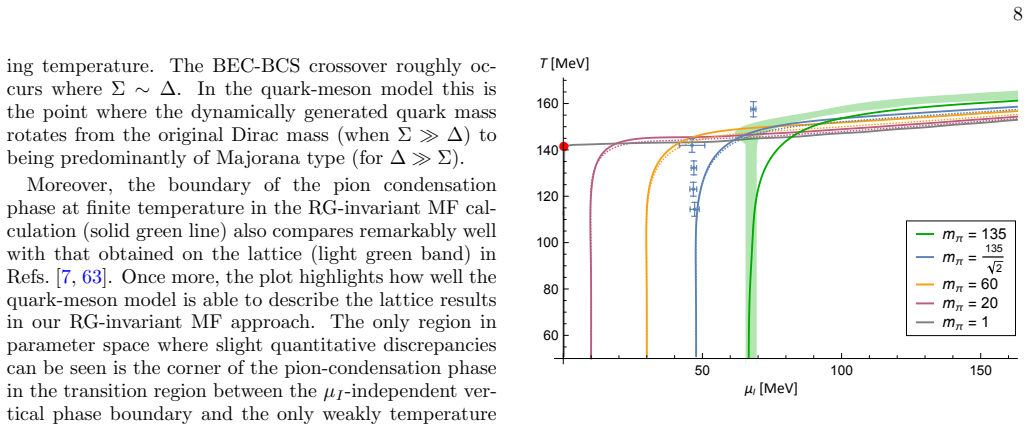
The central discovery is that the effective potential of Eq. (15), derived from the two-flavor quark-meson model in an on-shell renormalization scheme, is exactly renormalization-group invariant and contains no free parameters once the RG-invariant scale $M_0$ is fixed; at that point it is determined entirely by $m_\pi$, $f_\pi$, and $m_\sigma$. The construction uses the field invariants $M^2 = g^2(\rho^2 + \pi^2)$ and $\Delta^2 = g^2\pi^2$, which are scale-independent by construction, and eliminates the scale-dependent couplings $u = g^4/\lambda$ and $v = g^2$ through their $\beta$-functions. The paper shows that with $M_0 = 350$ MeV and $f_\pi = 90$ MeV the model matches the lattice data of Ref. [9] for the isospin density and describes the speed of sound from the chiral perturbation theory band through the intermediate regime, including the excess over the conformal bound, up to agreement with perturbative QCD with a BCS pairing gap. In the finite-temperature phase diagram the pion-condensation boundary and the chiral crossover are close to the lattice results of Ref. [7], and lowering the pion mass toward zero drives the pion-condensation boundary into a rectangular shape that meets the chiral transition at $T_c$, numerically realizing scenario (iii), the multicritical point with $T_\Delta(0) = T_c$.
Load-bearing premise
The load-bearing premise is that the mean-field saddle-point approximation, which neglects mesonic fluctuations, remains quantitatively accurate from pion-condensation onset up to the perturbative regime; the paper itself notes in Section IV that fluctuation (FRG) calculations yield a different phase boundary and a tricritical point, so if fluctuations matter the agreement with lattice data could be accidental.
Editorial extensions
If this is right
- The speed of sound at finite isospin density exceeds the conformal bound $c_s^2 = 1/3$ in the intermediate regime and approaches the conformal limit from above at large chemical potential, matching the signature seen in lattice data and in perturbative QCD with a BCS gap.
- The finite-temperature phase diagram acquires an almost rectangular pion-condensation phase boundary with a second-order transition, with only small deviations in the corner where the vertical and horizontal parts of the boundary meet.
- In the chiral limit the point $(\mu_I = 0,\ T = T_c)$ is a multicritical point where the pion-condensation boundary and the chiral transition meet, so the limits $\mu_I \to 0$ at $m_q = 0$ and $m_q \to 0$ at $\mu_I = 0$ do not commute.
- The zero-temperature isospin density is practically insensitive to the sigma-meson mass, so $m_\sigma$ can be tuned to the chiral pseudo-critical temperature, after which all model input is fixed by a single lattice comparison.
Reading between the lines
- If the mean-field agreement is genuine, the dominant physics at finite isospin density is carried by the quark determinant and the renormalized tree-level potential; a full FRG calculation in the same on-shell scheme would settle whether mesonic fluctuations mainly reshape the phase boundary without spoiling the equation of state.
- The scheme sensitivity explored in Appendix B suggests that part of the historical spread among quark-meson model results at finite density is a renormalization-scheme artifact, so other effective models might gain accuracy by adopting the same RG-invariant on-shell construction.
- The chiral-limit prediction is a concrete lattice target: simulations at pion masses below half the physical value should show the pion-condensation boundary sharpening toward the multicritical corner if scenario (iii) is correct.
- The multicritical-point logic drawn from the two-color QCD analogy could carry over to diquark condensation at finite baryon density in two-color QCD, which lattice studies there can test directly.
Editorial analysis
A structured set of objections, weighed in public.
Referee Report
Summary. The paper presents a renormalization-group-invariant mean-field formulation of the two-flavor quark-meson model at finite isospin chemical potential. The central object is the effective potential in Eq. (15), which is expressed in terms of the physical parameters m_pi, f_pi, m_sigma and a single RG-invariant scale M0 after two renormalization conditions. The authors fix M0 and f_pi from the zero-temperature isospin density data of Ref. [9], fix m_sigma by matching the mu_I=0 chiral crossover temperature, and then compare the model with lattice data for the equation of state, the speed of sound, and the finite-temperature phase diagram. They find good agreement over a wide range of mu_I and, in the approach to the chiral limit, they claim that the pion-condensation phase boundary meets the chiral transition at a multicritical point with T_Delta(0)=T_c.
Significance. If the central claims hold, the paper provides a practically useful effective theory for QCD at finite isospin density: the potential in Eq. (15) is derived rather than fitted term-by-term, the Silver-Blaze property and the onset at m_pi/2 are implemented, and the same parameter set describes the isospin density, the energy density, the speed of sound, and the phase diagram over roughly two orders of magnitude in mu_I. The comparison with lattice data and with chiral perturbation theory in Figs. 1-5 is a genuine strength, as is the explicit verification of the RG invariance in Eq. (14). The chiral-limit discussion is less robust: the multicritical-point conclusion depends on an imposed scaling of Tpc(m_pi) rather than on a self-consistent evolution of m_sigma from fixed bare parameters, so the abstract's strong claim is currently not fully supported. The paper also openly acknowledges that the mean-field truncation is a source of systematic uncertainty, which should be quantified before the model is presented as quantitatively reliable.
major comments (4)
- [Sec. IV (Fig. 6)] The central chiral-limit prediction is not derived from fixed model parameters but imposed through the choice of m_sigma. The text states that m_sigma(m_pi) could in principle be recomputed from the bare parameters of Eq. (5) via Eq. (A14), but instead the authors 'readjust' m_sigma so that Tpc(m_pi) follows an assumed O(4) or mean-field scaling ending at the input T_c=142 MeV. Because m_sigma enters directly in Eq. (15), the pion-condensation phase boundary and its intersection with the chiral transition in Fig. 6 are not independent of this imposed Tpc(m_pi); the solid and dashed curves test only the functional form of the input, not whether scenario (iii) is realized. To substantiate the abstract's claim, the authors should compute m_sigma(m_pi) self-consistently from Eq. (A14) with fixed bare parameters and show that Tpc(m_pi) indeed follows the assumed scaling; otherwise scenario (ii) with 0<T_Delta(0)<T_c cannot be excluded.
- [Sec. IV (FRG discussion)] The quantitative reliability of the mean-field saddle point is asserted rather than demonstrated. Section IV reports that the extended mean-field calculation of Ref. [34] produced a tricritical point and that the full FRG solution, including mesonic fluctuations, gave a pion-condensation phase boundary that is not as rectangular as in Fig. 5; the authors attribute this to cutoff artifacts and call for future FRG studies. Since all quantitative comparisons in Figs. 3-5 are obtained from the mean-field potential (15), a quantitative estimate of the size of mesonic fluctuations (for example, a one-loop correction to Eq. (15) in the BEC and crossover region) is needed before 'quantitative agreement' can be claimed as a property of the model rather than of the truncation.
- [Sec. III (Figs. 1-3)] The comparison with lattice data is partially circular. The parameters M0 and f_pi are determined by fitting the zero-temperature isospin density data of Ref. [9] in Fig. 1, and the same data set is then used as the benchmark for the isospin density, energy density, and speed of sound in Figs. 2 and 3. Similarly, m_sigma is fixed to the mu_I=0 crossover temperature from Ref. [7], which is one of the quantities compared in Fig. 5. This does not invalidate the comparison, but the paper would be stronger if it explicitly separated fitted data points from genuinely predicted observables and reported the number of fit parameters relative to the number of independent data points.
- [Sec. IV (chiral-limit scenarios)] The discussion of the three scenarios for T_Delta(0) is clear, but the numerical demonstration of scenario (iii) is not a parameter-free calculation. The text says that further lowering m_pi makes the phase boundary 'eventually' run parallel to the mu_I-axis and meet the red dot, but because m_sigma has been readjusted at each m_pi to enforce a chosen Tpc(m_pi), this behavior is at least partly a consequence of the input trajectory. The authors should either provide the self-consistent m_sigma(m_pi) calculation or soften the claim from a prediction to a consequence of the assumed scaling of the chiral crossover temperature.
minor comments (4)
- [Eq. (25)] The analytic expression for the linear sigma model speed of sound appears abruptly; a brief derivation or a clearer pointer to Refs. [34, 61, 62] would improve readability.
- [Sec. IV (footnote 4)] The choice of T_c=142 MeV, justified in footnote 4 as slightly higher than the (2+1)-flavor lattice estimate, should be stated in the main text because it is an input to the chiral-limit conclusion.
- [Fig. 6] The red dot should be explicitly identified in the caption as the point T_Delta(0)=T_c corresponding to scenario (iii), so that the reader does not have to infer the connection from the text.
- [Eq. (15)] The function F_q^0 is used in the main text but defined only in Appendix A, Eq. (A16); adding a pointer or a one-line definition at first use would help the reader.
Circularity Check
RG-invariant potential is not circular, but the chiral-limit multicritical point and part of the EoS comparison reduce to fitted inputs.
-
fitted input called prediction
[Section IV (chiral-limit discussion around Fig. 6)]
"Here, we follow a slightly different strategy starting from the grand potential in Eq. (15) and readjusting the σ-meson mass parameter to describe a dropping pseudo-critical temperature T pc of the chiral transition. To illustrate the general trend, in Fig. 6 we do this in two different ways, assuming O(4) scaling of T pc with the pion mass (solid lines) and mean-field scaling (dashed lines), with Tpc → T c = 142 MeV in either case. ..."
m_σ is not derived from fixed bare parameters as m_π is reduced; the paper explicitly notes this could in principle be done from the appendix, but instead readjusts m_σ at each m_π. The chosen m_σ(m_π) is the input that fixes T_pc(m_π) to reach T_c = 142 MeV in the chiral limit. Since the same grand potential Eq. (15) and its gap equations determine both the chiral crossover and the pion-condensation boundary, the rectangular boundary that ends exactly at the red dot in Fig. 6 reconstructs the imposed T_pc(m_π) trajectory. The two variants (O(4) vs mean-field scaling) only vary the functional form of the imposed trajectory; neither tests whether a self-consistent m_σ(m_π) from fixed bare parameters would produce T_∆(0)=T_c.
-
fitted input called prediction
[Section III (parameter fixing for Figs. 1-3)]
"For different values of M 0 we are then left with adjusting the pion decay constant f π to match the lattice data. Using a simple reduced χ-squared criterion for the goodness of the fits we obtain the best overall description of the lattice data for values of M 0 between 340 and 360 MeV. ... Using the central values of M 0 = 350 MeV and f π = 90 MeV ... the isospin density and the energy density ... are shown in Fig. 2 ... The resulting speed of sound is compared in Fig. 3 to the corresponding interpolation bands for the lattice data from Ref. [9]"
M0 and f_π are fitted to the zero-temperature isospin density n_I(µ_I) from Ref. [9], and the text presents this as the best fit. The energy density and speed of sound displayed in Figs. 2 and 3 are then computed from the same fitted equation of state and compared with the same Ref. [9] lattice data. At T=0, ε = -p + µ_I n_I and c_s^2 = dp/dε, so these quantities are thermodynamically determined by the fitted n_I; their agreement with the same data set is therefore partially inherited from the fit rather than an independent confirmation. The model does predict the shape of c_s^2 beyond the fitted window, and the comparison in Fig. 4 is independent, which limits the severity.
full rationale
The construction of the RG-invariant mean-field potential in Eq. (15) is not circular: it follows from a renormalizable Lagrangian, explicit β-functions, and on-shell renormalization conditions, with the physical parameters m_π, f_π, m_σ and scale M0. The comparisons against lattice data from Refs. [7,9,12] and χPT/pQCD are mostly genuine benchmarks, and the self-citations to Refs. [7,9,12] point to independent lattice simulations, not to unverified model premises. The circularity concerns are concentrated in two places. First, M0 and f_π are fitted to the zero-temperature isospin density of Ref. [9] (Fig. 1), and the energy density and speed of sound shown in Figs. 2-3 are thermodynamic derivatives/integrals of the same fitted quantity, so their agreement with Ref. [9] is partly inherited from the fit rather than a new prediction. Second, and more importantly, the chiral-limit conclusion T_∆(0)=T_c is not obtained from a self-consistent m_σ(m_π) computed from fixed bare parameters; the paper explicitly chooses to readjust m_σ so that T_pc(m_π) follows an assumed O(4) or mean-field scaling ending at T_c=142 MeV. Because the pion-condensation boundary in the same potential is sensitive to this readjusted m_σ, the sharp corner at the red dot in Fig. 6 is a consequence of the imposed T_pc(m_π) trajectory, not an emergent multicritical point. The two scaling variants test sensitivity to the form of the imposed trajectory only. These are cases of fitted inputs being presented as predictions, giving partial circularity rather than a fully self-contained derivation.
Assumptions & free parameters
free parameters (4)
- M0 (RG-invariant scale) =
350 MeV (best fit 340-360 MeV; 300-400 MeV variation)
- f_pi (pion decay constant) =
90 MeV at M0=350; 88-92 MeV variation; 92 MeV for the Ref. [12] comparison
- m_sigma (sigma meson mass) =
470 MeV
- m_sigma rescaling in the chiral limit =
Readjusted so Tpc follows O(4) or mean-field scaling toward Tc=142 MeV
assumptions (5)
- domain assumption The two-flavor quark-meson model with the O(4) symmetric quartic potential (Eq. 5) is a valid effective theory for QCD at finite isospin chemical potential.
- domain assumption The mean-field saddle point gives quantitatively reliable thermodynamics; mesonic fluctuations are negligible.
- standard math The one-loop mean-field beta functions in Eqs. (10) and (11) determine the renormalization group evolution.
- domain assumption The on-shell renormalization conditions, especially the charged pion pole condition (13), define the physical scheme and fix the finite constant C_phi.
- ad hoc to paper When approaching the chiral limit, M0 and f_pi stay fixed while m_sigma is readjusted to make Tpc follow O(4) or mean-field scaling toward Tc=142 MeV.
Cite this review
Pith. "Pith review of Renormalization group invariant mean-field model for QCD at finite isospin density." pith.science (2026). https://pith.science/paper/2MGKH2VF
@misc{pith2026250204025,
  author       = {Pith},
  title        = {Pith review of: Renormalization group invariant mean-field model for QCD at finite isospin density},
  year         = {2026},
  howpublished = {\url{https://pith.science/paper/2MGKH2VF}},
  note         = {Machine review of arXiv:2502.04025}
}
read the original abstract
QCD at nonzero isospin chemical potentials has phenomenological relevance for a series of physical systems and provides an ideal testground for the modeling of dense strongly interacting matter. The two-flavor quark-meson model is known to effectively describe the condensation of charged pions in QCD that occurs in this setting. In this paper, we derive a renormalization-group invariant mean-field formulation of the model and demonstrate that the resulting phase diagram and equation of state are in quantitative agreement with data from lattice QCD simulations at small and intermediate isospin chemical potentials. In particular, the speed of sound from the model shows an excess over the conformal bound as previously seen in lattice computations in agreement with chiral perturbation theory. We then consider the speed of sound in the limit of large isospin chemical potentials and see that it approaches the conformal limit from above, in qualitative agreement with recent lattice results and in quantitative agreement with perturbation theory in the presence of a BCS gap. Finally, we consider the phase diagram in the approach to the chiral limit. We find that within the model the chiral phase transition connects to the pion condensation phase boundary in the chiral limit and we discuss the implications for the properties of the chiral transition point.
Figures


Figures from the paper (1 more)
Forward citations
Cited by 5 Pith papers
-
Renormalization-Group Invariant Parity-Doublet Model for Nuclear and Neutron-Star Matter
Including baryonic vacuum fluctuations in the parity-doublet model through an RG-invariant mean-field scheme moves the chiral transition to higher densities and turns it into a smooth crossover for most values of the ...
-
Renormalization of the three-flavor quark-meson diquark model
The authors extend the quark-meson diquark model to three flavors, renormalize its thermodynamic potential in the CFL phase, and show the speed of sound approaches the conformal limit from above.
-
Renormalizing the Quark-Meson-Diquark Model
Renormalized and two RG-consistent versions of the Quark-Meson-Diquark model reproduce the BCS relation and Stefan-Boltzmann limit at high density, while the sigma-delta scheme violates the BCS relation.
-
Pion condensation versus 2SC, speed of sound, and charge neutrality effects in the quark-meson diquark model
In the quark-meson diquark model, dense two-flavor QCD matter has four phases, and its speed of sound peaks before approaching the conformal limit from above, with charge neutrality softening the equation of state.
-
Dense and Cold Magnetized Quark Matter: A Review of Magnetic-Field-Independent Regularization and the Medium Separation Scheme
Review of MFIR and MSS schemes showing the superconducting gap stays finite at high chemical potential in magnetized cold quark matter with no zero-temperature transition to normal phase.
Reference graph
Works this paper leans on
-
[9]
B. B. Brandt, G. Endr˝ odi, E. S. Fraga, M. Hippert, J. Schaffner-Bielich, and S. Schmalzbauer, Phys. Rev. D98, 094510 (2018), arXiv:1802.06685 [hep-ph]
arXiv 2018
-
[34]
Pion condensation in the two--flavor chiral quark model at finite baryochemical potential
T. Herpay and P. Kov´ acs, Phys. Rev. D78, 116008 (2008), arXiv:0811.2727 [hep-ph]
work page Pith review arXiv 2008
-
[7]
J. B. Kogut and D. K. Sinclair, Phys. Rev.D66, 034505 (2002), arXiv:hep-lat/0202028 [hep-lat]
arXiv 2002
-
[1]
Strong-interaction matter under extreme conditions
Note that with these definitions, the isospin charges of up and down quarks are±1 while those of the charged pions are±2, corresponding to the conserved isospin current j3 α = ¯ψτ3γαψ+π −∂απ+ −π +∂απ− .(2) At mean-field level, the quark contribution to the Landau free-energy density at temperatureTis given by [34] Ωq(T, µq, µI ) = −2T Nc Z d3p (2π)3 X ± l...
-
[2]
M. M. Wygas, I. M. Oldengott, D. B¨ odeker, and D. J. Schwarz, Phys. Rev. Lett.121, 201302 (2018), arXiv:1807.10815 [hep-ph]
arXiv 2018
-
[3]
M. M. Middeldorf-Wygas, I. M. Oldengott, D. B¨ odeker, and D. J. Schwarz, Phys. Rev. D105, 123533 (2022), arXiv:2009.00036 [hep-ph]
arXiv 2022
-
[4]
V. Vovchenko, B. B. Brandt, F. Cuteri, G. Endr˝ odi, F. Hajkarim, and J. Schaffner-Bielich, Phys. Rev. Lett. 126, 012701 (2021), arXiv:2009.02309 [hep-ph]
arXiv 2021
-
[5]
D. T. Son and M. A. Stephanov, Phys. Rev. Lett.86, 592 (2001), arXiv:hep-ph/0005225
arXiv 2001
Show all 77 references
-
[6]
J. B. Kogut and D. K. Sinclair, Phys. Rev.D66, 014508 (2002), arXiv:hep-lat/0201017 [hep-lat]
2002 arXiv
-
[8]
B. B. Brandt, G. Endr˝ odi, and S. Schmalzbauer, Phys. Rev. D97, 054514 (2018), arXiv:1712.08190 [hep-lat]
2018 arXiv
-
[10]
B. B. Brandt, F. Cuteri, and G. Endr˝ odi, JHEP07, 055 (2023), arXiv:2212.14016 [hep-lat]
2023 arXiv
-
[11]
Detmold, K
W. Detmold, K. Orginos, and Z. Shi, Phys. Rev. D86, 054507 (2012), arXiv:1205.4224 [hep-lat]
2012 arXiv
-
[12]
Abbott, W
R. Abbott, W. Detmold, F. Romero-L´ opez, Z. Davoudi, M. Illa, A. Parre˜ no, R. J. Perry, P. E. Shanahan, and M. L. Wagman (NPLQCD), Phys. Rev. D108, 114506 (2023), arXiv:2307.15014 [hep-lat]
2023 arXiv
-
[13]
Abbott, W
R. Abbott, W. Detmold, M. Illa, A. Parre˜ no, R. J. Perry, F. Romero-L´ opez, P. E. Shanahan, and M. L. Wag- man (NPLQCD), Phys. Rev. Lett.134, 011903 (2025), arXiv:2406.09273 [hep-lat]
2025 arXiv
-
[14]
Toublan and J
D. Toublan and J. B. Kogut, Phys. Lett. B564, 212 (2003), arXiv:hep-ph/0301183
2003 arXiv
-
[15]
Frank, M
M. Frank, M. Buballa, and M. Oertel, Phys. Lett. B 562, 221 (2003), arXiv:hep-ph/0303109
2003 arXiv
-
[16]
Barducci, R
A. Barducci, R. Casalbuoni, G. Pettini, and L. Ravagli, Phys. Rev. D69, 096004 (2004), arXiv:hep-ph/0402104
2004 arXiv
- [17]
-
[18]
Zhang and Y.-X
Z. Zhang and Y.-X. Liu, Phys. Rev. C75, 064910 (2007), arXiv:hep-ph/0610221
2007 arXiv
-
[19]
G.-f. Sun, L. He, and P. Zhuang, Phys. Rev. D75, 096004 (2007), arXiv:hep-ph/0703159
2007 arXiv
-
[20]
T. Xia, L. He, and P. Zhuang, Phys. Rev. D88, 056013 (2013), arXiv:1307.4622 [hep-ph]
2013 arXiv
-
[21]
Zhang and Q
Z. Zhang and Q. Miao, Phys. Lett. B753, 670 (2016), arXiv:1507.07224 [hep-ph]
2016 arXiv
-
[22]
Brauner and X.-G
T. Brauner and X.-G. Huang, Phys. Rev. D94, 094003 (2016), arXiv:1610.00426 [hep-ph]
2016 arXiv
-
[23]
T. G. Khunjua, K. G. Klimenko, and R. N. Zhokhov, Phys. Rev. D98, 054030 (2018), arXiv:1804.01014 [hep- ph]
2018 arXiv
-
[24]
T. G. Khunjua, K. G. Klimenko, and R. N. Zhokhov, Eur. Phys. J. C79, 151 (2019), arXiv:1812.00772 [hep- ph]
2019 arXiv
-
[25]
S. S. Avancini, A. Bandyopadhyay, D. C. Duarte, and R. L. S. Farias, Phys. Rev. D100, 116002 (2019), arXiv:1907.09880 [hep-ph]
2019 arXiv
-
[26]
Lu, C.-J
Z.-Y. Lu, C.-J. Xia, and M. Ruggieri, Eur. Phys. J. C 80, 46 (2020), arXiv:1907.11497 [hep-ph]
2020 arXiv
-
[27]
J. P. Carlomagno, D. G. Dumm, and N. N. Scoccola, Phys. Rev. D104, 074018 (2021), arXiv:2107.02022 [hep- ph]
2021 arXiv
-
[28]
B. S. Lopes, S. S. Avancini, A. Bandyopadhyay, D. C. Duarte, and R. L. S. Farias, Phys. Rev. D103, 076023 (2021), arXiv:2102.02844 [hep-ph]
2021 arXiv
-
[29]
L.-M. Liu, J. Xu, and G.-X. Peng, Phys. Rev. D104, 076009 (2021), arXiv:2108.09477 [hep-ph]
2021 arXiv
-
[30]
L.-M. Liu, J. Xu, and G.-X. Peng, Nucl. Phys. Rev.40, 493 (2023), arXiv:2301.07900 [hep-ph]
2023 arXiv
-
[31]
J. P. Carlomagno, D. Gomez Dumm, and N. N. Scoccola, Phys. Rev. D109, 094041 (2024), arXiv:2402.13842 [hep- ph]
2024 arXiv
-
[32]
L.-y. He, M. Jin, and P.-f. Zhuang, Phys. Rev. D71, 116001 (2005), arXiv:hep-ph/0503272
2005 arXiv
-
[33]
Kov´ acs and Z
P. Kov´ acs and Z. Sz´ ep, Phys. Rev. D77, 065016 (2008), arXiv:0710.1563 [hep-ph]
2008 arXiv
-
[35]
Kamikado, N
K. Kamikado, N. Strodthoff, L. von Smekal, and J. Wambach, Phys. Lett. B718, 1044 (2013), arXiv:1207.0400 [hep-ph]
2013 arXiv
-
[36]
H. Ueda, T. Z. Nakano, A. Ohnishi, M. Ruggieri, and K. Sumiyoshi, Phys. Rev. D88, 074006 (2013), arXiv:1304.4331 [nucl-th]
2013 arXiv
-
[37]
Stiele, E
R. Stiele, E. S. Fraga, and J. Schaffner-Bielich, Phys. Lett. B729, 72 (2014), arXiv:1307.2851 [hep-ph]
2014 arXiv
-
[38]
J. O. Andersen and P. Kneschke, Phys. Rev. D97, 076005 (2018), arXiv:1802.01832 [hep-ph]
2018 arXiv
-
[39]
Adhikari, J
P. Adhikari, J. O. Andersen, and P. Kneschke, Phys. Rev. D98, 074016 (2018), arXiv:1805.08599 [hep-ph]
2018 arXiv
-
[40]
Folkestad and J
A. Folkestad and J. O. Andersen, Phys. Rev. D99, 054006 (2019), arXiv:1810.10573 [hep-ph]
2019 arXiv
-
[41]
A. N. Tawfik, A. M. Diab, M. T. Ghoneim, and H. Anwer, Int. J. Mod. Phys. A34, 1950199 (2019), arXiv:1904.09890 [hep-ph]
2019
-
[42]
Ayala, A
A. Ayala, A. Bandyopadhyay, R. L. S. Farias, L. A. Hern´ andez, and J. L. Hern´ andez, Phys. Rev. D107, 074027 (2023), arXiv:2301.13633 [hep-ph]
2023 arXiv
-
[43]
A. N. Tawfik, Universe9, 276 (2023)
2023
-
[44]
Chiba and T
R. Chiba and T. Kojo, Phys. Rev. D109, 076006 (2024), arXiv:2304.13920 [hep-ph]
2024 arXiv
-
[45]
Ayala, B
A. Ayala, B. S. Lopes, R. L. S. Farias, and L. C. Parra, (2024), arXiv:2409.19406 [hep-ph]
2024 arXiv
-
[46]
Chiba, T
R. Chiba, T. Kojo, and D. Suenaga, Phys. Rev. D110, 054037 (2024), arXiv:2403.02538 [hep-ph]
2024 arXiv
-
[47]
T. Kojo, D. Suenaga, and R. Chiba, Universe10, 293 (2024), arXiv:2406.11059 [hep-ph]
2024 arXiv
-
[48]
Mannarelli, Particles2, 411 (2019), arXiv:1908.02042 [hep-ph]
M. Mannarelli, Particles2, 411 (2019), arXiv:1908.02042 [hep-ph]
2019 arXiv
-
[49]
B. B. Brandt, F. Cuteri, G. Endr˝ odi, and S. Schmalzbauer, Particles3, 80 (2020), arXiv:1912.07451 [hep-lat]
2020 arXiv
-
[50]
Cuteri, B
F. Cuteri, B. B. Brandt, and G. Endr˝ odi, PoSLA T- TICE2021, 232 (2022), arXiv:2112.11113 [hep-lat]
2022 arXiv
-
[51]
Boettcher, T
I. Boettcher, T. K. Herbst, J. M. Pawlowski, N. Strodthoff, L. von Smekal, and C. Wetterich, Phys. Lett. B742, 86 (2015), arXiv:1409.5232 [cond- mat.quant-gas]
2015 arXiv
-
[52]
Langfeld, L
K. Langfeld, L. von Smekal, and H. Reinhardt, Phys. Lett. B308, 279 (1993), arXiv:hep-ph/9303235. 14
1993 arXiv
-
[53]
von Smekal, K
L. von Smekal, K. Langfeld, H. Reinhardt, and R. F. Langbein, Phys. Rev. D50, 6599 (1994)
1994
-
[54]
J. O. Andersen, M. Kjøllesdal, Q. Yu, and H. Zhou, (2023), arXiv:2312.13092 [hep-ph]
2023 arXiv
-
[55]
Cherman, T
A. Cherman, T. D. Cohen, and A. Nellore, Phys. Rev. D80, 066003 (2009), arXiv:0905.0903 [hep-th]
2009 arXiv
- [56]
- [57]
-
[58]
Skokov, B
V. Skokov, B. Friman, E. Nakano, K. Redlich, and B. J. Schaefer, Phys. Rev. D82, 034029 (2010), arXiv:1005.3166 [hep-ph]
2010 arXiv
-
[59]
Mark´ o, U
G. Mark´ o, U. Reinosa, and Z. Sz´ ep, Phys. Rev. D90, 125021 (2014), arXiv:1410.6998 [hep-ph]
2014 arXiv
-
[60]
T. D. Cohen, Phys. Rev. Lett.91, 032002 (2003), arXiv:hep-ph/0304024
2003 arXiv
-
[61]
J. R. Pelaez, Phys. Rept.658, 1 (2016), arXiv:1510.00653 [hep-ph]
2016 arXiv
-
[62]
J. O. Andersen and T. Brauner, Phys. Rev. D81, 096004 (2010), arXiv:1001.5168 [hep-ph]
2010 arXiv
-
[63]
Scheid,Effective Theories for the Thermodynamics of QCD at Finite Isospin Density, Bachelor Thesis, Justus- Liebig University, Giessen (2023)
D. Scheid,Effective Theories for the Thermodynamics of QCD at Finite Isospin Density, Bachelor Thesis, Justus- Liebig University, Giessen (2023)
2023
-
[64]
B. B. Brandt and G. Endr˝ odi, Phys. Rev. D99, 014518 (2019), arXiv:1810.11045 [hep-lat]
2019 arXiv
-
[65]
J. O. Andersen and L. Kyllingstad, J. Phys. G37, 015003 (2009), arXiv:hep-ph/0701033
2009 arXiv
-
[66]
Splittorff, D
K. Splittorff, D. Toublan, and J. J. M. Verbaarschot, Nucl. Phys. B639, 524 (2002), arXiv:hep-ph/0204076
2002 arXiv
-
[67]
Braun, M
J. Braun, M. Leonhardt, and J. M. Pawlowski, SciPost Phys.6, 056 (2019), arXiv:1806.04432 [hep-ph]
2019 arXiv
-
[68]
Gholami, M
H. Gholami, M. Hofmann, and M. Buballa, Phys. Rev. D111, 014006 (2025), arXiv:2408.06704 [hep-ph]
2025 arXiv
-
[69]
Strodthoff, B.-J
N. Strodthoff, B.-J. Schaefer, and L. von Smekal, Phys. Rev. D85, 074007 (2012), arXiv:1112.5401 [hep-ph]
2012 arXiv
-
[70]
T. Boz, S. Cotter, L. Fister, D. Mehta, and J.-I. Skullerud, Eur. Phys. J. A49, 87 (2013), arXiv:1303.3223 [hep-lat]
2013 arXiv
-
[71]
Strodthoff and L
N. Strodthoff and L. von Smekal, Phys. Lett. B731, 350 (2014), arXiv:1306.2897 [hep-ph]
2014 arXiv
-
[72]
B. B. Brandt, V. Chelnokov, F. Cuteri, and G. Endr˝ odi, PoSLA TTICE2022, 146 (2023), arXiv:2301.08607 [hep-lat]
2023 arXiv
-
[73]
B. B. Brandt, V. Chelnokov, F. Cuteri, and G. Endr˝ odi (2025) arXiv:2501.19291 [hep-lat]
2025 arXiv
-
[74]
E. E. Svanes and J. O. Andersen, Nucl. Phys. A857, 16 (2011), arXiv:1009.0430 [hep-ph]
2011 arXiv
-
[75]
von Smekal, Nucl
L. von Smekal, Nucl. Phys. B Proc. Suppl.228, 179 (2012), arXiv:1205.4205 [hep-ph]
2012 arXiv
-
[76]
H. T. Dinget al.(HotQCD), Phys. Rev. Lett.123, 062002 (2019), arXiv:1903.04801 [hep-lat]
2019 arXiv
-
[77]
Publicly available data appearing in the ancillary files of this publication,
B. B. Brandt, V. Chelnokov, G. Endr˝ odi, G. Marko, D. Scheid, and L. von Smekal, “Publicly available data appearing in the ancillary files of this publication,” https://arxiv.org/src/2502.04025(2025)
2025 arXiv
Reviewed August 8, 2026 · model on record in the stance chip above.
Discussion (0). Continue with ORCID to comment.