REVIEW 3 major objections 7 minor 32 references
TQ-DiT: Efficient Time-Aware Quantization for Diffusion Transformers
T0 review · 3 major / 7 minor · reviewed 2026-08-08 · deepseek-v4-flash
Pith's one-line read TQ-DiT claims that grouping quantization parameters by diffusion timestep lets DiT-XL-2 run at 6-bit weights and activations with FID 8.58, far below earlier post-training quantization baselines.
desk verdict Plausible incremental PTQ for DiTs with a new time-grouping idea, but the Hessian derivation and the abstract both overstate what the experiments show. read the letter →
The pith
A machine-rendered reading of the paper's core claim, the machinery that carries it, and where it could break.
The reading
What carries the argument
The carrying objects are three interrelated quantization mechanisms. Multi-region quantization (MRQ) replaces one step size with two for skewed activation layers: for post-softmax outputs in $[0,1]$, a fine step size $s_1$ covers the low-magnitude region $[0, 2^{k-1}s_1)$ and a coarse fixed step size covers the tail; for post-GELU outputs, separate step sizes are calibrated for negative and positive values. Time-grouping quantization (TGQ) splits the timestep schedule into $G$ contiguous groups, samples calibration inputs from each group, and optimizes a separate activation quantizer per group, so a quantizer optimized for one timestep's scale does not have to serve all timesteps. Hessian-guided optimization (HO) picks the quantization parameters by minimizing a per-layer expected loss in which activation perturbations are weighted by the diagonal Fisher information matrix of the diffusion noise-prediction loss, under the assumption that the first-order gradient term vanishes at a converged model. The combination addresses, respectively, asymmetric value distributions, temporal drift, and parameter sensitivity.
What would settle it
Keeping TQ-DiT’s time grouping and MRQ fixed, replace the diagonal-Fisher objective with a fine grid search over the MRQ step sizes on the same 320 calibration samples, then regenerate 10,000 ImageNet images and compute FID at W6A6. If grid search matches or beats FID 8.58, the Hessian-guided component is not responsible for the gain; if it is worse, the approximation is carrying the result.
Extended reading notes
Core claim
At the core is a claim about what makes diffusion transformers hard to quantize: unlike classifiers, DiTs meet two time-dependent and layer-dependent value distributions, and a single per-tensor quantizer cannot represent them. TQ-DiT's multi-region quantization assigns two step sizes to post-softmax and post-GELU activations, partitioning the [0,1] range or the negative/positive halves so that small values retain resolution; time-grouping quantization divides the T timesteps into G groups and calibrates separate activation quantizers per group; Hessian-guided optimization chooses step sizes and zero-points by minimizing a second-order approximation of the diffusion noise-prediction loss, using per-element squared gradients as a diagonal Fisher proxy. On DiT-XL-2 at ImageNet 256×256, the authors report FID 4.91 at W8A8 (full precision 4.62) over 250 sampling steps, FID 5.10 over 100 steps, and FID 8.58 at W6A6 over 250 steps versus 17.59 for PTQD and 20.53 for PTQ4DiT. The ablation attributes the largest single gain to multi-region quantization, with further improvement from time-grouping.
Load-bearing premise
The load-bearing premise is that a converged model's quantization loss is well approximated by a diagonal quadratic term, so the optimizer can rank candidate step sizes and zero-points without computing true gradients or cross-layer interactions; if that ranking is wrong at 6 bits, the FID improvements would not follow.
Editorial extensions
If this is right
- At W8A8, the method trails full precision by only 0.29 FID at 250 timesteps, so 8-bit DiT inference should be nearly indistinguishable from full precision in generated-image quality.
- At W6A6, the method reports FID 8.58 at 250 timesteps, well ahead of PTQD (17.59) and PTQ4DiT (20.53), suggesting 6-bit deployment is within reach for image generation.
- Calibration needs only 32 images per timestep group and uses 45.4% less GPU memory and 89.3% less time than PTQ4DiT, lowering the resource cost of applying post-training quantization to DiTs.
- Because quantization parameters are assigned to timestep groups, the scheme is directly aligned with the iterative sampling loop and could transfer to other temporally varying generative models.
Reading between the lines
- Editorial inference: the paper fixes the number of timestep groups at G=10; the FID-versus-G trade-off and the memory cost of storing per-group quantizers are not reported, so the practical limit of time-grouping remains open.
- Editorial inference: if the diagonal-Fisher ranking is as reliable as the results imply, the same calibration recipe could be applied to weight-only or KV-cache quantization of DiTs, where long-context activations also drift over time; the paper tests only joint weight-activation quantization.
- Editorial inference: the reported calibration-time reduction suggests the deployment bottleneck shifts to the sampling loop itself, so the natural next measurement is end-to-end wall-clock speedup with integer arithmetic kernels at W6A6.
Editorial analysis
A structured set of objections, weighed in public.
Referee Report
Summary. The paper proposes TQ-DiT, a post-training quantization framework for diffusion transformers (DiTs), combining multi-region quantization (MRQ) for skewed softmax/GELU activations, time-grouping quantization (TGQ) that assigns separate quantization parameters to contiguous groups of diffusion timesteps, and Hessian-guided optimization (HO) for parameter search. Experiments on DiT-XL-2 at ImageNet 256x256 report FID 4.91 (W8A8, 250 timesteps) and 5.10 (W8A8, 100 timesteps) versus 4.62 and 4.87 for full precision, respectively. At W6A6, the paper reports FID 8.58 and 15.97, which it claims is better than Q-Diffusion, PTQD, and PTQ4DiT. An ablation study attributes large gains to HO, MRQ, and TGQ, and a comparison with PTQ4DiT reports lower calibration GPU memory and time.
Significance. If the results are reproducible, the paper would make a useful practical contribution: the time-grouping idea is simple and addresses a real property of diffusion models, and a 45% calibration-memory and 89% calibration-time reduction are meaningful for deployment. The paper also gives a clear ablation and reports several metrics. However, the current evidence is limited to one model and one dataset, with no code, no seeds, and no error bars, and the central Hessian-guided optimization step is theoretically under-justified. The strongest asset is the time-grouping mechanism, which appears orthogonal to prior MRQ ideas and could be valuable even if the HO derivation is revised.
major comments (3)
- [Section III-B, Eqs. (13)-(17)] The Taylor-expansion justification for HO is not valid as stated. The gradient term in Eq. (13) is dropped because the model is trained to convergence, which is a valid statement about ∇_θ L at a weight-space optimum. However, Eq. (14) switches the expansion variable to the pre-activation output z^(l), and ∇_{z^(l)} L is not zero at a weight-space optimum; it is exactly the backpropagated signal used to train earlier layers. The first-order term Δz^T ∇_z L can therefore be non-negligible for quantization perturbations, and the diagonal-Fisher approximation in Eq. (15) additionally discards gradient-sign information. Since Eq. (17) is the objective actually used for HO, and Table III attributes a 6.39 FID improvement to HO (28.86 → 22.47), the W6A6 claim rests on an unvalidated surrogate. The authors should validate Eq. (17) against the exact Hessian or the full Taylor expansion, or at least show that the HO objective ranks candidate quantizers consistently with true loss/FID on the calibration set.
- [Abstract and Tables I-II] The statement that TQ-DiT 'outperforms other baselines at W6A6' is too broad. In Table II (T=100, W6A6), TQ-DiT has sFID 28.37, which is worse than PTQ4DiT's sFID of 22.55. While TQ-DiT has the best FID and IS in that row, it does not dominate on all metrics. The abstract and Section IV-B should be rephrased to say 'best FID and IS' or 'generally outperforms,' and the sFID caveat should be acknowledged.
- [Section IV-A, Tables I and II] The central empirical claims are supported by a single model (DiT-XL-2) and a single dataset (ImageNet 256x256), with no error bars, multiple seeds, or released code. Generative FID comparisons are known to be sensitive to sampling randomness and evaluation-set size; differences such as 5.10 vs. 6.01 (W8A8, T=100) may not be significant without variance estimates. The authors should report standard deviations over at least a few seeds, and ideally add a second architecture or dataset, to make the general claim about DiT quantization reliable. Releasing baseline reimplementation scripts would also let readers verify the comparison.
minor comments (7)
- [Section III-B, Eq. (17)] The sentence 'The TGQ objective function in ( ??) is reformulated' contains a broken cross-reference; it should point to Eq. (12) or another numbered objective.
- [Section III-C] The MRQ boundary s1 and the number of candidate regions are not specified. The text says 'The optimal s1 is determined by the objective function of TGQ' but does not state the search grid, candidate count, or update rule used in Algorithm 1 for s1.
- [Algorithm 1] The layer classification is unclear: lines 15 and 23 distinguish 'CNN or linear layer' from 'matrix-multiplication layer,' but DiT-XL-2 consists of linear and attention-matrix operations; please align the names with the actual layer types used in the implementation.
- [Table IV] The efficiency comparison reports GPU memory and time only against PTQ4DiT; please specify the hardware, batch size, calibration-sample count, and whether the same timestep-grouping protocol was used for both methods.
- [Section IV-A] No sensitivity analysis is provided for the new hyperparameters G (number of timestep groups) and n (calibration samples per group); a short study varying these would help users set them in practice.
- [Notation, Eqs. (12) and (16)] Equation (12) calls ε^l_hatθ and ε^l_θ 'activations,' while Eq. (16) describes them as 'pre-activation noise'; please make the activation/pre-activation terminology consistent throughout.
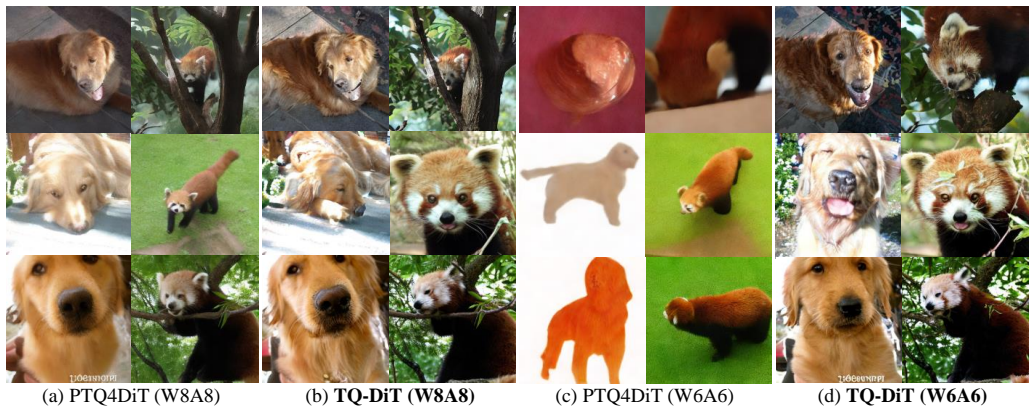
- [Figures 2 and 6] The distribution plots and sample images are descriptive; adding quantitative evaluation (e.g., distributional distance or per-pixel metrics) would strengthen the claimed sharper and fine-detail improvements.
Circularity Check
No significant circularity; central results are external FID/IS comparisons against full precision and cited baselines.
full rationale
The paper's load-bearing claims are empirical: Tables I and II report FID, sFID, and IS on ImageNet 256x256 for TQ-DiT versus full precision and three external baselines (Q-Diffusion, PTQD, PTQ4DiT), and Table III reports an ablation study on the same external FID metric. None of these quantities is defined in terms of the optimized objective. The HO/TGQ objective in Eq. (17) minimizes a Hessian-guided surrogate quantization error, but the reported FID is computed independently from generated images and full-precision reference statistics, so the result is not a disguised refit. The method components are explicitly attributed to prior external work (MRQ to PTQ4ViT [15], HO/FIM ideas to BRECQ [13]), and the paper contains no self-citations and no invoked 'uniqueness theorem' from the authors. The weakest point, the dropped first-order Taylor term in Eqs. (13)-(15), is an unvalidated approximation and a correctness risk rather than a circular step: the paper does not define its success metric in terms of that term, nor does it fit a parameter and then relabel that fit as a prediction. Therefore no circularity is present.
Assumptions & free parameters
free parameters (5)
- G (number of timestep groups) =
10
- n (calibration samples per group) =
32
- R (Hessian-guided optimization iterations) =
3
- Number of MRQ regions for softmax and GELU =
2
- Softmax region boundary s1 =
optimized per group
assumptions (5)
- domain assumption Gradient term in Taylor expansion is negligible because the model is trained to convergence.
- domain assumption True Hessian can be replaced by diagonal Fisher information matrix without changing which quantization parameters are optimal.
- ad hoc to paper Contiguous equal-length timestep groups capture the relevant temporal variation in activation distributions.
- domain assumption A calibration set of 320 ImageNet samples is representative of activations during generation.
- domain assumption MRQ validated on ViT classification transfers to generative DiT tasks.
Cite this review
Pith. "Pith review of TQ-DiT: Efficient Time-Aware Quantization for Diffusion Transformers." pith.science (2026). https://pith.science/paper/UD232AUR
@misc{pith2026250204056,
  author       = {Pith},
  title        = {Pith review of: TQ-DiT: Efficient Time-Aware Quantization for Diffusion Transformers},
  year         = {2026},
  howpublished = {\url{https://pith.science/paper/UD232AUR}},
  note         = {Machine review of arXiv:2502.04056}
}
read the original abstract
Diffusion transformers (DiTs) combine transformer architectures with diffusion models. However, their computational complexity imposes significant limitations on real-time applications and sustainability of AI systems. In this study, we aim to enhance the computational efficiency through model quantization, which represents the weights and activation values with lower precision. Multi-region quantization (MRQ) is introduced to address the asymmetric distribution of network values in DiT blocks by allocating two scaling parameters to sub-regions. Additionally, time-grouping quantization (TGQ) is proposed to reduce quantization error caused by temporal variation in activations. The experimental results show that the proposed algorithm achieves performance comparable to the original full-precision model with only a 0.29 increase in FID at W8A8. Furthermore, it outperforms other baselines at W6A6, thereby confirming its suitability for low-bit quantization. These results highlight the potential of our method to enable efficient real-time generative models.
Figures


Figures from the paper (2 more)

Reference graph
Works this paper leans on
-
[1]
Diffusion models: A comprehensive survey of methods and applications,
L. Yang, Z. Zhang, Y . Song, S. Hong, R. Xu, Y . Zhao, W. Zhang, B. Cui, and M.-H. Yang, “Diffusion models: A comprehensive survey of methods and applications,” ACM Comput. Surv. , vol. 56, no. 4, pp. 1–39, 2023
2023
-
[2]
Diffusion models beat gans on image synthesis,
P. Dhariwal and A. Nichol, “Diffusion models beat gans on image synthesis,” in Proc. NeurIPS, Virtual Event, Dec. 2021
work page 2021
-
[3]
High-resolution image synthesis with latent diffusion models,
R. Rombach, A. Blattmann, D. Lorenz, P. Esser, and B. Ommer, “High-resolution image synthesis with latent diffusion models,” in Proc. IEEE/CVF CVPR, New Orleans, US, June 2022
work page 2022
-
[4]
An image is worth 16x16 words: Transformers for image recognition at scale,
A. Dosovitskiy, L. Beyer, A. Kolesnikov, D. Weissenborn, X. Zhai, T. Unterthiner, M. Dehghani, M. Minderer, G. Heigold, S. Gelly, J. Uszkoreit, and N. Houlsby, “An image is worth 16x16 words: Transformers for image recognition at scale,” in Proc. ICLR , Vienna, Austria, May 2021
work page 2021
-
[5]
End-to-end object detection with transformers,
N. Carion, F. Massa, G. Synnaeve, N. Usunier, A. Kirillov, and S. Zagoruyko, “End-to-end object detection with transformers,” in Proc. ECCV, Virtual Event, Aug. 2020
work page 2020
-
[6]
Scalable diffusion models with transformers,
W. Peebles and S. Xie, “Scalable diffusion models with transformers,” in Proc. ICCV, Paris, France, Oct. 2023
work page 2023
-
[7]
Video generation models as world simulators,
T. Brooks, B. Peebles, C. Holmes, W. DePue, Y . Guo, L. Jing, D. Schnurr, J. Taylor, T. Luhman, E. Luhman, C. Ng, R. Wang, and A. Ramesh, “Video generation models as world simulators,” 2024
2024
-
[8]
Masked diffusion trans- former is a strong image synthesizer,
S. Gao, P. Zhou, M.-M. Cheng, and S. Yan, “Masked diffusion trans- former is a strong image synthesizer,” in Proc. ICCV, Paris, France, Oct. 2023
work page 2023
Show all 32 references
-
[9]
Pixart-alpha: Fast training of diffusion transformer for photorealistic text-to-image synthesis,
J. Chen, J. Yu, C. Ge, L. Yao, E. Xie, Y . Wu et al. , “Pixart-alpha: Fast training of diffusion transformer for photorealistic text-to-image synthesis,” arXiv preprint arXiv:2310.00426 , 2023
2023 arXiv
-
[10]
A review of green artificial intelligence: Towards a more sustainable future,
V . Bol ´on-Canedo, L. Mor ´an-Fern´andez, B. Cancela, and A. Alonso- Betanzos, “A review of green artificial intelligence: Towards a more sustainable future,” Neurocomputing, vol. 599, p. 128096, 2024
2024
-
[11]
Sustainable ai: Environmental implications, challenges and opportunities,
C.-J. Wu, R. Raghavendra, U. Gupta, B. Acun, N. Ardalani, K. Maeng, G. Chang, F. Aga, J. Huang, C. Baiet al., “Sustainable ai: Environmental implications, challenges and opportunities,” inProc. MLSys, Santa Clara, US, Aug. 2022
2022
-
[12]
Quantization and training of neural networks for efficient integer-arithmetic-only inference,
B. Jacob, S. Kligys, B. Chen, M. Zhu, M. Tang, A. Howard, H. Adam, and D. Kalenichenko, “Quantization and training of neural networks for efficient integer-arithmetic-only inference,” in Proc. IEEE/CVF CVPR , Salt Lake City, US, June 2018
2018
-
[13]
Brecq: Pushing the limit of post-training quantization by block reconstruction,
Y . Li, R. Gong, X. Tan, Y . Yang, P. Hu, Q. Zhang, F. Yu, W. Wang, and S. Gu, “Brecq: Pushing the limit of post-training quantization by block reconstruction,” in Proc. ICLR, Virtual Event, May 2021
2021
-
[14]
Up or down? adaptive rounding for post-training quantization,
M. Nagel, R. A. Amjad, M. Van Baalen, C. Louizos, and T. Blankevoort, “Up or down? adaptive rounding for post-training quantization,” in Proc. ICML, Virtual Event, July 2020
2020
-
[15]
Ptq4vit: Post-training quantization for vision transformers with twin uniform quantization,
Z. Yuan, C. Xue, Y . Chen, Q. Wu, and G. Sun, “Ptq4vit: Post-training quantization for vision transformers with twin uniform quantization,” in Proc. ECCV, Tel Aviv, Israel, Oct. 2022
2022
-
[16]
Ptq4dit: Post-training quantization for diffusion transformers,
J. Wu, H. Wang, Y . Shang, M. Shah, and Y . Yan, “Ptq4dit: Post-training quantization for diffusion transformers,” arXiv preprint arXiv:2405.16005, 2024
2024 arXiv
-
[17]
Ai-based energy consumption modeling of 5g base stations: an energy efficient approach,
F. Ayaz and M. Nekovee, “Ai-based energy consumption modeling of 5g base stations: an energy efficient approach,” in IET 6G 2024 , London, UK, June 2024
2024
-
[18]
Generative joint source-channel coding for semantic image transmission,
E. Erdemir, T.-Y . Tung, P. L. Dragotti, and D. G¨und¨uz, “Generative joint source-channel coding for semantic image transmission,” JSAC, vol. 41, no. 8, pp. 2645–2657, 2023
2023
-
[19]
Vision, enabling technologies, and scenarios for a 6g-enabled internet of verticals (6g-iov),
M. Nekovee and F. Ayaz, “Vision, enabling technologies, and scenarios for a 6g-enabled internet of verticals (6g-iov),” Future Internet, vol. 15, no. 2, p. 57, 2023
2023
-
[20]
Denoising diffusion probabilistic models,
J. Ho, A. Jain, and P. Abbeel, “Denoising diffusion probabilistic models,” in Proc. NeurIPS, Virtual Event, Dec. 2020
2020
-
[21]
A white paper on neural network quantization,
M. Nagel, M. Fournarakis, R. A. Amjad, Y . Bondarenko, M. Van Baalen, and T. Blankevoort, “A white paper on neural network quantization,” arXiv preprint arXiv:2106.08295 , 2021
2021 arXiv
-
[22]
Ptqd: Accurate post-training quantization for diffusion models,
Y . He, L. Liu, J. Liu, W. Wu, H. Zhou, and B. Zhuang, “Ptqd: Accurate post-training quantization for diffusion models,” in Proc. NeurIPS, New Orleans, US, Dec. 2023
2023
-
[23]
Smoothquant: Accurate and efficient post-training quantization for large language models,
G. Xiao, J. Lin, M. Seznec, H. Wu, J. Demouth, and S. Han, “Smoothquant: Accurate and efficient post-training quantization for large language models,” in Proc. ICML, Honolulu, US, July 2023
2023
-
[24]
Gpt3.int8(): 8-bit matrix multiplication for transformers at scale,
T. Dettmers, M. Lewis, Y . Belkada, and L. Zettlemoyer, “Gpt3.int8(): 8-bit matrix multiplication for transformers at scale,” in Proc. NeurIPS, New Orleans, US, Dec. 2022
2022
-
[25]
Q-diffusion: Quantizing diffusion models,
X. Li, Y . Liu, L. Lian, H. Yang, Z. Dong, D. Kang, S. Zhang, and K. Keutzer, “Q-diffusion: Quantizing diffusion models,” in Proc. ICCV, Paris, France, Dec. 2023
2023
-
[26]
Chainnet: A customized graph neural network model for loss-aware edge ai service deployment,
Z. Niu, M. Roveri, and G. Casale, “Chainnet: A customized graph neural network model for loss-aware edge ai service deployment,” in Proc. IEEE/IFIP DSN, Brisbane, Australia, June 2024
2024
-
[27]
Low-bit quanti- zation of neural networks for efficient inference,
Y . Choukroun, E. Kravchik, F. Yang, and P. Kisilev, “Low-bit quanti- zation of neural networks for efficient inference,” in Proc. IEEE/CVF ICCV Workshops, Seoul, Korea, Oct. 2019
2019
-
[28]
Post-training quantization for vision transformer,
Z. Liu, Y . Wang, K. Han, W. Zhang, S. Ma, and W. Gao, “Post-training quantization for vision transformer,” in Proc. NeurIPS , Virtual Event, Dec. 2021
2021
-
[29]
Gans trained by a two time-scale update rule converge to a local nash equilibrium,
M. Heusel, H. Ramsauer, T. Unterthiner, B. Nessler, and S. Hochreiter, “Gans trained by a two time-scale update rule converge to a local nash equilibrium,” in Proc. NeurIPS, Long Beach, US, Dec. 2017
2017
-
[30]
Generating images with sparse representations,
C. Nash, J. Menick, S. Dieleman, and P. W. Battaglia, “Generating images with sparse representations,” arXiv preprint arXiv:2103.03841 , 2021
2021 arXiv
-
[31]
Improved techniques for training gans,
T. Salimans, I. Goodfellow, W. Zaremba, V . Cheung, A. Radford, X. Chen, and X. Chen, “Improved techniques for training gans,” in Proc. NeurIPS, Barcelona, Spain, 2016
2016
-
[32]
Imagenet large scale visual recognition challenge,
O. Russakovsky, J. Deng, H. Su, J. Krause, S. Satheesh, S. Ma, Z. Huang, A. Karpathy, A. Khosla, M. Bernstein et al., “Imagenet large scale visual recognition challenge,” IJCV, vol. 115, pp. 211–252, 2015
2015
Reviewed August 8, 2026 · model on record in the stance chip above.
Discussion (0). Continue with ORCID to comment.