REVIEW 3 major objections 3 minor 4 cited by
Lattice perspectives on doubly heavy tetraquarks
T0 review · 3 major / 3 minor · reviewed 2026-08-08 · deepseek-v4-flash
Pith's one-line read Lattice QCD now predicts a family of doubly heavy tetraquarks: the $T_{bb}$ states are bound, while the $T_{cc}$ appears as a virtual bound state at non-physical quark masses.
desk verdict Solid review of doubly heavy tetraquark lattice results; the abstract overstates the Tcc virtual-state claim relative to the paper's own left-hand-cut caveat. read the letter →
The pith
A machine-rendered reading of the paper's core claim, the machinery that carries it, and where it could break.
The reading
What carries the argument
The load-bearing tool is the finite-volume quantization condition, which converts a few precisely measured finite-volume energy levels into infinite-volume scattering phase shifts; from those, an effective range expansion yields the scattering length and effective range, and the pole condition $p\cot\delta = -\sqrt{-p^2}$ decides whether the near-threshold state is real, virtual, or resonant. On the spectroscopy side, the generalized eigenvalue problem (GEVP) applied to a matrix of correlators built from di-meson and diquark-antidiquark interpolating operators extracts the needed energy levels, with distillation providing the all-to-all propagators that make momentum-projected operators practical. The potential-based alternative identifies a lattice correlation function with a two-body wave function to define a local potential, which is then inserted into a Schr\"odinger equation. The review's methodological core is the interplay between these two routes, plus the warning that the $D^*\to D\pi$ left-hand cut can break the analyticity assumptions behind the standard quantization condition.
What would settle it
A lattice calculation at physical light-quark masses that includes the $DD\pi$ three-particle channel, or an equivalent treatment of the left-hand cut, and recomputes the $T_{cc}^{ud}$ pole would settle it: if the pole becomes a real bound state below threshold, the virtual-state conclusion is an artifact of the truncated formalism; if it remains virtual, the review's interpretation survives.
Extended reading notes
Core claim
On the paper's own terms, lattice QCD has evolved from studying inter-meson potentials to performing full scattering analyses of doubly heavy tetraquarks. The established result is a family prediction: the $I(J^P)=0(1^+)$ $T_{bb}^{ud}$ and $T_{bb}^{us}$ are deeply enough bound that their ground states can be read off directly from lattice correlation functions, with binding energies in the range roughly $-190$ to $-70$ MeV and $-100$ to $-40$ MeV respectively across studies. For the experimentally observed $T_{cc}^{ud}$, which is bound by only about $0.3$ MeV in nature, the lattice cannot yet work at physical light-quark masses with full control; instead, scattering analyses at slightly heavier light quarks and slightly off physical charm masses produce scattering parameters whose pole is a virtual bound state, with the expectation that the pole trajectory crosses threshold as parameters move toward physical values. The review treats the $T_{bc}^{ud}$ channels as the open frontier, where recent studies hint at shallow bound states but do not yet agree.
Load-bearing premise
The load-bearing premise is that the finite-volume energy levels used for the $T_{cc}^{ud}$ conclusion can be read with the standard two-particle scattering formalism, even though the nearby decay $D^*\to D\pi$ creates a non-analyticity (the left-hand cut) that the formalism assumes away.
Editorial extensions
If this is right
- If the lattice results are right, the $J^P=1^+$ $T_{bb}^{ud}$ and $T_{bb}^{us}$ tetraquarks are stable under QCD, with binding energies that grow as the heavy quarks become heavier and the light diquark becomes lighter.
- The $T_{cc}^{ud}$ is not ruled out as a real bound state at the physical point; the lattice data place it on a pole trajectory that becomes a virtual state at the masses studied, so experiment and theory can be connected by tracking that trajectory.
- The $T_{bc}^{ud}$ channels become the next test: a deep analysis of $DB$ and $DB^*$ scattering should settle whether the $0(1^+)$ and $0(0^+)$ candidates are shallow bound states.
- A robust scattering formalism that includes the nearby $DD\pi$ channel will be required before the $T_{cc}^{ud}$ binding energy can be quoted at physical quark masses.
- The lattice mass-dependence scans act as constraints on phenomenological models: any model that reproduces the binding-energy pattern across quark masses is credible, and any that does not is excluded.
Reading between the lines
- Editorial inference: if the left-hand cut is treated properly, the $T_{cc}^{ud}$ virtual-state conclusion could shift; the standard two-particle quantization analysis of the current data is the assumption most likely to change.
- Editorial inference: the same finite-volume machinery, once validated on doubly heavy tetraquarks, is a direct template for accessing the deuteron and other multi-hadron systems that suffer from the same left-hand-cut problem.
- Editorial inference: the contradictory trial-state overlap results for the $T_{bb}$ structure suggest that compositeness should be inferred from scattering parameters via a Weinberg-type criterion rather than from operator overlaps, and the current scattering data are not yet precise enough to decide between molecular and compact.
- Editorial inference: a concrete testable extension would be a coordinated multi-ensemble study at physical light-quark masses and multiple lattice spacings for $T_{bc}$, which would either confirm the shallow-bound-state hints or show them to be lattice artifacts.
Editorial analysis
A structured set of objections, weighed in public.
Referee Report
Summary. This manuscript is a review of lattice QCD studies of doubly heavy tetraquarks, covering the methodological toolkit (correlators, effective masses, GEVP, static-potential and HALQCD approaches, heavy-quark actions), a chronological survey from early static-potential work through recent scattering analyses, and a summary of current physics status. The headline claims are that the J^P=1+ T_bb^{ud} and T_bb^{us} are firmly predicted as QCD bound states, that recent studies approaching the J^P=1+ T_cc^{ud} find it to be a virtual bound state at slightly non-physical input quark masses, and that the T_bc channels are an active and less settled frontier. The review includes comprehensive tables of lattice results and discusses the left-hand-cut problem for the Tcc scattering analysis.
Significance. If its status claims hold, this review will be a valuable reference for the lattice and hadron-spectroscopy communities. Its strengths are the explicit treatment of systematic uncertainties, the candid reporting of conflicting lattice results (for example the Tbb binding-energy range from -189(13) MeV to -83(10) MeV), the pedagogical derivation of the finite-volume scattering recipe, and the presence of comprehensive summary tables. The manuscript makes no new lattice calculation or model-dependent derivation, so its contribution is evaluative and synoptic. That evaluation is mostly careful, but the central Tcc virtual-state claim is made in the abstract and in Sec. 5.1.1 while Sec. 5.3 itself identifies a limitation that directly affects the validity of the analysis on which that claim is based. The Tbb bound-state claim is not similarly affected because it is supported by multiple independent spectrum and potential calculations.
major comments (3)
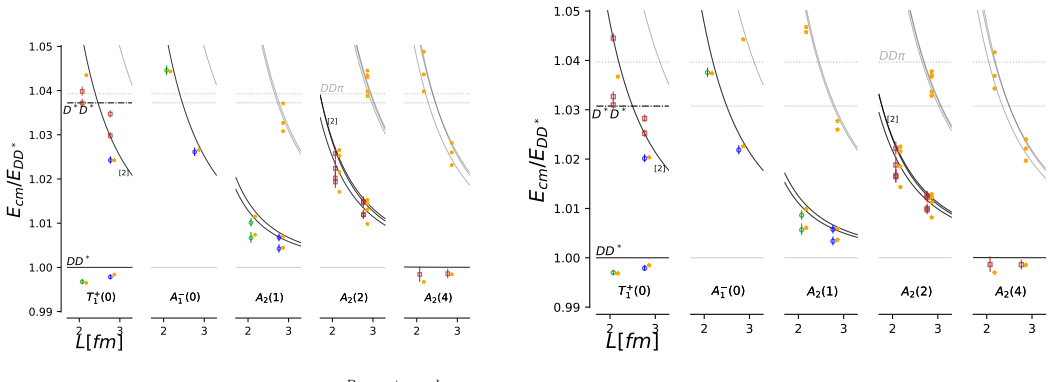
- [Abstract; Sec. 5.1.1; Sec. 5.3] The abstract and Sec. 5.1.1 state that recent lattice studies find the T_cc^{ud} to be a virtual bound state at non-physical masses, and Table 5.2 lists the result of [68] as a virtual bound state. This conclusion rests on converting finite-volume energies into p cot(delta) via the Luescher quantization condition (Eqs. 3.8-3.9) and fitting the effective range expansion (Eq. 3.11). Sec. 5.3 states that the nearby D* -> D pi left-hand cut produces a non-analyticity, that the derivation of the Luescher formula relies on analyticity assumptions on the phase shifts, and that a three-particle DD pi treatment is ultimately required. The manuscript therefore contains the evidence that its headline Tcc claim is provisional. Since this is one of the two central status claims of the review, the abstract and the corresponding summary sentences should either be qualified (for example, 'within the standard two-particle Luescher/ERE analysis') or supported by a citation to a quantitative check showing that the ERE fit of [68] is stable despite the left-hand cut.
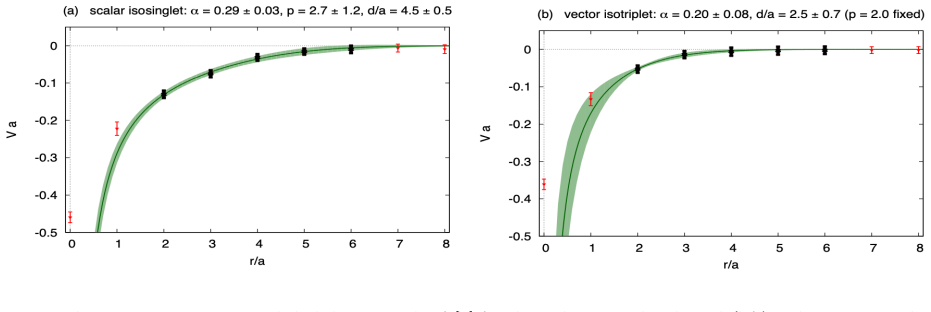
- [Sec. 4.5.1; Table 5.2] The plural wording 'studies ... find it to be a virtual bound state' overstates the consistency of the cited lattice results. The spectrum-based study [68] does find a virtual bound state for its two charm-mass choices at m_pi = 280 MeV, but the HALQCD study [147] quoted in the same section and in Table 5.2 gives scattering parameters whose interpretation changes between virtual and shallow bound states depending on the pion-mass rescaling of the potential ansatz, with binding energies whose asymmetric errors span zero (for example -59(+53,-99) MeV for the lattice-m_pi case). The review should state explicitly which studies support the virtual-state interpretation and how the conflict with [147] is assessed.
- [Abstract; Sec. 4.5.1] The phrase 'slightly non-physical input quark masses' in the abstract mischaracterizes the simulation parameters of [68], which is the primary basis of the Tcc claim. That study uses m_pi = 280 MeV, which is more than twice the physical pion mass, with charm-quark masses slightly below and slightly above the physical spin-averaged mass. The abstract should be more precise, for example 'at m_pi = 280 MeV and charm masses near the physical value', so that readers do not infer that the calculation sits close to the physical light-quark point.
minor comments (3)
- [Sec. 3.2.5; Sec. 3.2.6] The upper bound on the heavy-quark mass usable with Wilson-type and Domain Wall actions is quoted inconsistently: Sec. 3.2.5 gives m_Q <~ 3.4 or 4.5 GeV, while Sec. 3.2.6 gives m_Q <~ 3.4(4.5) GeV or 2.2(2.9) GeV for the Wilson-type and Domain Wall (brackets) actions. Please harmonize the notation and clarify which lattice spacings correspond to which values.
- [Eq. (4.1)] In the discussion of the potential-model Schroedinger equation used in [3], the text describes mu as 'the energy of a heavy quark'; in the two-body Hamiltonian it should be the reduced mass of the two-meson system. Please correct this terminology.
- [Sec. 5.1.3] There is a typographical error in 'ansäetze'; the intended word is 'Ansätze'. In addition, the caption of Fig. 3.1 contains a grammatically awkward sequence ('From center to right: In sequence, the free, bound and resonant state scenarios') that should be rephrased.
Circularity Check
No circularity: the review compiles independent lattice results; the Tcc caveat in Sec. 5.3 is a correctness risk, not a circular reduction.
full rationale
This is a review article with no new derivations or fitted predictions of its own. The Tbb status claim is grounded in multiple independent spectrum and potential calculations ([3], [4], [69], [41], [140], [152], [162]), so the author's own works ([4], [78], [133], [41]) are corroborating, not load-bearing. The Tcc virtual-state conclusion is inherited from [68], whose ERE fit to p cot δ does convert finite-volume energies into scattering parameters; but the review does not perform that fit, and it explicitly discloses the key vulnerability: in Sec. 5.3 it states that the Lüscher quantization condition 'builds upon assumptions on analyticity properties of the phase shifts' and that 'ultimately one needs to include the three-particle channel DDπ in some way.' That admission is a limitation of the underlying external analysis, not a self-referential reduction: the review's claim is not defined in terms of its own inputs, nor is any Eq. X identical to Eq. Y by construction. Potential-fit ansätze and HALQCD derivative expansions are presented with their model-dependence flagged rather than hidden. No self-citation is invoked to forbid alternatives or to supply a uniqueness theorem. The finding is therefore no significant circularity.
Assumptions & free parameters
assumptions (5)
- domain assumption Lüscher finite-volume quantization condition and effective range expansion are valid for the extracted finite-volume energy levels.
- domain assumption Ground-state energy from a lattice correlator with exponential volume dependence signals a QCD bound state.
- domain assumption The lattice results reviewed have controlled systematic uncertainties, including chiral extrapolation, discretization, and finite-volume effects.
- domain assumption NRQCD and effective relativistic heavy quark actions provide reliable valence heavy quarks within their parameter windows.
- domain assumption Isospin-symmetric light quarks and no QED are adequate; isospin breaking is negligible except for the very shallow Tcc.
Cite this review
Pith. "Pith review of Lattice perspectives on doubly heavy tetraquarks." pith.science (2026). https://pith.science/paper/IN4HEQKZ
@misc{pith2026250204701,
  author       = {Pith},
  title        = {Pith review of: Lattice perspectives on doubly heavy tetraquarks},
  year         = {2026},
  howpublished = {\url{https://pith.science/paper/IN4HEQKZ}},
  note         = {Machine review of arXiv:2502.04701}
}
abstract
Doubly heavy tetraquarks have emerged as new probes to study the heavy hadron spectrum. With the experimental observation of the $J^P=1^+$ $T_{cc}^+$, they pose a unique opportunity to bring together efforts in experiment, phenomenology, and lattice QCD. In lattice calculations they are accessible as ground states, unlike hidden flavor tetraquarks, and this enables accurate determinations of the scattering parameters alongside the binding energies of these tetraquarks. Today, lattice calculations firmly predict $J^P=1^+$ $T_{bb}^{ud}$ and $T_{bb}^{us}$ as QCD bound states, while recent studies approaching the $J^P=1^+$ $T_{cc}^{ud}$ find it to be a virtual bound state at slightly non-physical input quark masses. Studies of the $J^P=1^+$ $T_{bc}^{ud}$ are ongoing and a new focus area. In light of these developments the evolution of this field until this point is reviewed. Emphasis is put on the methods in lattice spectroscopy that enable a robust evaluation of the lattice studies gathered. They are further reviewed towards their limitations and achievements. Current challenges and opportunities are discussed, including possibilities to approach the left-hand cut in the scattering analysis of the charm candidates and towards understanding the structure of those including two bottom quarks.
Figures


Figures from the paper (26 more)






Forward citations
Cited by 4 Pith papers
-
Analytic decomposition of two-body electroweak processes with left-hand cuts
An on-shell decomposition of 2+J o2 electroweak amplitudes isolates OPE poles, logs, and triangle singularities, leaving only smooth short-distance functions.
-
Diffusion Monte Carlo study of deuteron-like fully light hexaquarks
Within the AL1 constituent-quark model, compact uuuddd hexaquarks lie well above baryon–baryon thresholds while dibaryon-like states are near-threshold molecular candidates, one deuteron-like but unbound by ~12 MeV.
-
Investigating the two-pion exchange of the double charm $DD^*$ chiral interactions and $T_{cc}$
In this chiral EFT calculation the I=0 DD* two-pion-exchange potential is repulsive, and its near-cancellation with attractive contact and one-pion terms provides the weak binding of Tcc.
-
Triply heavy tetraquarks $\bar{b}c\bar{q}c$ and $\bar{c}b\bar{q}b$ in a constituent quark model
A constituent quark model predicts dozens of narrow tetraquark resonances in the mixed beauty-charm systems \bar{b}c\bar{q}c and \bar{c}b\bar{q}b.
Reference graph
Works this paper leans on
-
[68]
M. Padmanath, S. Prelovsek, Signature of a Doubly Charm Tetraquark Pole in DD* Scattering on the Lattice, Phys. Rev. Lett. 129 (3) (2022) 032002.arXiv:2202.10110, doi:10.1103/PhysRevLett.129.032002
arXiv 2022
-
[147]
Y. Lyu, S. Aoki, T. Doi, T. Hatsuda, Y. Ikeda, J. Meng, Doubly Charmed Tetraquark Tcc+ from Lattice QCD near Physical Point, Phys. Rev. Lett. 131 (16) (2023) 161901.arXiv:2302.04505, doi:10.1103/PhysRevLett. 131.161901
arXiv 2023
-
[1]
Aaij, et al., Observation of an exotic narrow doubly charmed tetraquark, Nature Phys
R. Aaij, et al., Observation of an exotic narrow doubly charmed tetraquark, Nature Phys. 18 (7) (2022) 751–754. arXiv:2109.01038, doi:10.1038/s41567-022-01614-y
arXiv 2022
-
[2]
Aaij, et al., Study of the doubly charmed tetraquarkT + cc, Nature Commun
R. Aaij, et al., Study of the doubly charmed tetraquarkT + cc, Nature Commun. 13 (1) (2022) 3351.arXiv:2109. 01056, doi:10.1038/s41467-022-30206-w
- [3]
-
[4]
A. Francis, R. J. Hudspith, R. Lewis, K. Maltman, Lattice Prediction for Deeply Bound Doubly Heavy Tetraquarks, Phys. Rev. Lett. 118 (14) (2017) 142001.arXiv:1607.05214, doi:10.1103/PhysRevLett.118.142001
arXiv 2017
-
[5]
D. G. Richards, D. K. Sinclair, D. W. Sivers, Lattice QCD simulation of meson exchange forces, Phys. Rev. D42 (1990) 3191–3196. doi:10.1103/PhysRevD.42.3191
-
[6]
Richard, Exotic hadrons: review and perspectives, Few Body Syst
J.-M. Richard, Exotic hadrons: review and perspectives, Few Body Syst. 57 (12) (2016) 1185–1212.arXiv:1606. 08593, doi:10.1007/s00601-016-1159-0
Show all 193 references
-
[7]
Esposito, A
A. Esposito, A. Pilloni, A. D. Polosa, Multiquark Resonances, Phys. Rept. 668 (2017) 1–97.arXiv:1611.07920, doi:10.1016/j.physrep.2016.11.002
2017 arXiv
-
[8]
A. Ali, J. S. Lange, S. Stone, Exotics: Heavy Pentaquarks and Tetraquarks, Prog. Part. Nucl. Phys. 97 (2017) 123–198. arXiv:1706.00610, doi:10.1016/j.ppnp.2017.08.003
2017 arXiv
-
[9]
Karliner, J
M. Karliner, J. L. Rosner, T. Skwarnicki, Multiquark States, Ann. Rev. Nucl. Part. Sci. 68 (2018) 17–44.arXiv: 1711.10626, doi:10.1146/annurev-nucl-101917-020902
2018 arXiv
-
[10]
Altmannshofer, et al., The Belle II Physics Book, PTEP 2019 (12) (2019) 123C01, [Erratum: PTEP 2020, 029201 (2020)]
W. Altmannshofer, et al., The Belle II Physics Book, PTEP 2019 (12) (2019) 123C01, [Erratum: PTEP 2020, 029201 (2020)]. arXiv:1808.10567, doi:10.1093/ptep/ptz106
2019
-
[11]
Cerri, et al., Report from Working Group 4: Opportunities in Flavour Physics at the HL-LHC and HE-LHC, CERN Yellow Rep
A. Cerri, et al., Report from Working Group 4: Opportunities in Flavour Physics at the HL-LHC and HE-LHC, CERN Yellow Rep. Monogr. 7 (2019) 867–1158.arXiv:1812.07638, doi:10.23731/CYRM-2019-007.867
2019 arXiv
-
[12]
H.-X. Chen, W. Chen, X. Liu, Y.-R. Liu, S.-L. Zhu, An updated review of the new hadron states, Rept. Prog. Phys. 86 (2) (2023) 026201.arXiv:2204.02649, doi:10.1088/1361-6633/aca3b6
2023 arXiv
-
[13]
Mai, U.-G
M. Mai, U.-G. Meißner, C. Urbach, Towards a theory of hadron resonances, Phys. Rept. 1001 (2023) 1–66.arXiv: 2206.01477, doi:10.1016/j.physrep.2022.11.005
2023 arXiv
-
[14]
Yasui, Heavy Flavors and Exotic Hadrons, Lect
S. Yasui, Heavy Flavors and Exotic Hadrons, Lect. Notes Phys. 999 (2022) 213–277. doi:10.1007/ 978-3-030-95491-8_6
2022
-
[15]
R. L. Workman, et al., Review of Particle Physics, PTEP 2022 (2022) 083C01.doi:10.1093/ptep/ptac097
2022 doi
-
[16]
Gross, et al., 50 Years of Quantum Chromodynamics, Eur
F. Gross, et al., 50 Years of Quantum Chromodynamics, Eur. Phys. J. C 83 (2023) 1125.arXiv:2212.11107, doi:10.1140/epjc/s10052-023-11949-2. 55
2023 arXiv
-
[17]
Brambilla, et al., Substructure of Multiquark Hadrons (Snowmass 2021 White Paper) (3 2022).arXiv:2203
N. Brambilla, et al., Substructure of Multiquark Hadrons (Snowmass 2021 White Paper) (3 2022).arXiv:2203. 16583
2021
-
[18]
Bicudo, Tetraquarks and pentaquarks in lattice QCD with light and heavy quarks, Phys
P. Bicudo, Tetraquarks and pentaquarks in lattice QCD with light and heavy quarks, Phys. Rept. 1039 (2023) 1–49. arXiv:2212.07793, doi:10.1016/j.physrep.2023.10.001
2023 arXiv
-
[19]
Bulava, et al., Hadron Spectroscopy with Lattice QCD, in: Snowmass 2021, 2022.arXiv:2203.03230
J. Bulava, et al., Hadron Spectroscopy with Lattice QCD, in: Snowmass 2021, 2022.arXiv:2203.03230
2021 arXiv
-
[20]
Montvay, G
I. Montvay, G. Munster, Quantum fields on a lattice, Cambridge Monographs on Mathematical Physics, Cambridge University Press, 1997.doi:10.1017/CBO9780511470783
1997 doi
-
[21]
Luscher, Advanced lattice QCD, in: Les Houches Summer School in Theoretical Physics, Session 68: Probing the Standard Model of Particle Interactions, 1998, pp
M. Luscher, Advanced lattice QCD, in: Les Houches Summer School in Theoretical Physics, Session 68: Probing the Standard Model of Particle Interactions, 1998, pp. 229–280.arXiv:hep-lat/9802029
1998 arXiv
-
[22]
DeGrand, C
T. DeGrand, C. E. Detar, Lattice methods for quantum chromodynamics, New Jersey, USA: World Scientific (2006) 345 p (2006)
2006
-
[23]
Gattringer, C
C. Gattringer, C. B. Lang, Quantum chromodynamics on the lattice, Lect. Notes Phys. 788 (2010) 1–343.doi: 10.1007/978-3-642-01850-3
2010 doi
-
[24]
S. K. Choi, et al., Observation of a narrow charmonium-like state in exclusiveB± → K ±π+π−J/ψ decays, Phys. Rev. Lett. 91 (2003) 262001.arXiv:hep-ex/0309032, doi:10.1103/PhysRevLett.91.262001
2003 arXiv
-
[25]
URL https://www.nikhef.nl/~pkoppenb/hadrons//Masses.pdft
LHCb collaboration, New hadrons observed at LHC (2023). URL https://www.nikhef.nl/~pkoppenb/hadrons//Masses.pdft
2023
-
[26]
Gershon, Exotic hadron naming convention (6 2022).arXiv:2206.15233, doi:10.17181/CERN.7XZO.HPH7
T. Gershon, Exotic hadron naming convention (6 2022).arXiv:2206.15233, doi:10.17181/CERN.7XZO.HPH7
2022 arXiv
-
[27]
D. B. Lichtenberg, L. J. Tassie, Baryon Mass Splitting in a Boson-Fermion Model, Phys. Rev. 155 (1967) 1601–1606. doi:10.1103/PhysRev.155.1601
1967 doi
-
[28]
arXiv:hep-ph/0409065, doi:10.1016/j.physrep.2004.11.005
R.L.Jaffe, Exotica, Phys.Rept.409(2005)1–45. arXiv:hep-ph/0409065, doi:10.1016/j.physrep.2004.11.005
2005 arXiv
-
[29]
Karliner, J
M. Karliner, J. L. Rosner, Discovery of doubly-charmedΞcc baryon implies a stable (bb¯u ¯d) tetraquark, Phys. Rev. Lett. 119 (20) (2017) 202001.arXiv:1707.07666, doi:10.1103/PhysRevLett.119.202001
2017 arXiv
-
[30]
E. J. Eichten, C. Quigg, Heavy-quark symmetry implies stable heavy tetraquark mesonsQiQj ¯qk ¯ql, Phys. Rev. Lett. 119 (20) (2017) 202002.arXiv:1707.09575, doi:10.1103/PhysRevLett.119.202002
2017 arXiv
-
[31]
Cheng, The strangest lifetime: A bizarre story of τ (Ω0 c) (11 2021)
H.-Y. Cheng, The strangest lifetime: A bizarre story of τ (Ω0 c) (11 2021). arXiv:2111.09566, doi:10.1016/j. scib.2021.11.025
2021 arXiv
-
[32]
Prelovsek, L
S. Prelovsek, L. Leskovec, Evidence for X(3872) from DD* scattering on the lattice, Phys. Rev. Lett. 111 (2013) 192001. arXiv:1307.5172, doi:10.1103/PhysRevLett.111.192001
2013 arXiv
-
[33]
H. Li, C. Shi, Y. Chen, M. Gong, J. Liang, Z. Liu, W. Sun,X(3872) Relevant D ¯D∗ Scattering in Nf = 2 Lattice QCD (2 2024). arXiv:2402.14541
2024 arXiv
-
[34]
Tews, et al., Nuclear Forces for Precision Nuclear Physics: A Collection of Perspectives, Few Body Syst
I. Tews, et al., Nuclear Forces for Precision Nuclear Physics: A Collection of Perspectives, Few Body Syst. 63 (4) (2022) 67. arXiv:2202.01105, doi:10.1007/s00601-022-01749-x
2022 arXiv
-
[35]
S. Aoki, T. Hatsuda, N. Ishii, Theoretical Foundation of the Nuclear Force in QCD and its applications to Central and Tensor Forces in Quenched Lattice QCD Simulations, Prog. Theor. Phys. 123 (2010) 89–128.arXiv:0909.5585, doi:10.1143/PTP.123.89
2010 arXiv
-
[36]
Luscher, Volume Dependence of the Energy Spectrum in Massive Quantum Field Theories
M. Luscher, Volume Dependence of the Energy Spectrum in Massive Quantum Field Theories. 1. Stable Particle States, Commun. Math. Phys. 104 (1986) 177.doi:10.1007/BF01211589. 56
1986 doi
-
[37]
Luscher, Volume Dependence of the Energy Spectrum in Massive Quantum Field Theories
M. Luscher, Volume Dependence of the Energy Spectrum in Massive Quantum Field Theories. 2. Scattering States, Commun. Math. Phys. 105 (1986) 153–188.doi:10.1007/BF01211097
1986 doi
-
[38]
P. Guo, J. Dudek, R. Edwards, A. P. Szczepaniak, Coupled-channel scattering on a torus, Phys. Rev. D 88 (1) (2013) 014501. arXiv:1211.0929, doi:10.1103/PhysRevD.88.014501
2013 arXiv
-
[39]
Michael, Adjoint Sources in Lattice Gauge Theory, Nucl
C. Michael, Adjoint Sources in Lattice Gauge Theory, Nucl. Phys. B 259 (1985) 58–76. doi:10.1016/ 0550-3213(85)90297-4
1985
-
[40]
Blossier, M
B. Blossier, M. Della Morte, G. von Hippel, T. Mendes, R. Sommer, On the generalized eigenvalue method for ener- gies and matrix elements in lattice field theory, JHEP 04 (2009) 094.arXiv:0902.1265, doi:10.1088/1126-6708/ 2009/04/094
2009 arXiv
-
[41]
R. J. Hudspith, D. Mohler, Exotic tetraquark states with two b¯ quarks and JP=0+ and 1+ Bs states in a nonperturbatively tuned lattice NRQCD setup, Phys. Rev. D 107 (11) (2023) 114510.arXiv:2303.17295, doi: 10.1103/PhysRevD.107.114510
2023 arXiv
-
[42]
H. B. Meyer, Transport Properties of the Quark-Gluon Plasma: A Lattice QCD Perspective, Eur. Phys. J. A 47 (2011) 86. arXiv:1104.3708, doi:10.1140/epja/i2011-11086-3
2011 arXiv
-
[43]
Cuniberti, E
G. Cuniberti, E. De Micheli, G. A. Viano, Reconstructing the thermal Green functions at real times from those at imaginary times, Commun. Math. Phys. 216 (2001) 59–83. arXiv:cond-mat/0109175, doi:10.1007/ s002200000324
2001 arXiv
-
[44]
M. T. Hansen, H. B. Meyer, D. Robaina, From deep inelastic scattering to heavy-flavor semileptonic decays: Total rates into multihadron final states from lattice QCD, Phys. Rev. D 96 (9) (2017) 094513.arXiv:1704.08993, doi:10.1103/PhysRevD.96.094513
2017 arXiv
-
[45]
Bulava, M
J. Bulava, M. T. Hansen, Scattering amplitudes from finite-volume spectral functions, Phys. Rev. D 100 (3) (2019) 034521. arXiv:1903.11735, doi:10.1103/PhysRevD.100.034521
2019 arXiv
-
[46]
Gambino, S
P. Gambino, S. Hashimoto, Inclusive Semileptonic Decays from Lattice QCD, Phys. Rev. Lett. 125 (3) (2020) 032001. arXiv:2005.13730, doi:10.1103/PhysRevLett.125.032001
2020 arXiv
-
[47]
Evangelista, R
A. Evangelista, R. Frezzotti, N. Tantalo, G. Gagliardi, F. Sanfilippo, S. Simula, V. Lubicz, Inclusive hadronic decay rate of the τ lepton from lattice QCD, Phys. Rev. D 108 (7) (2023) 074513. arXiv:2308.03125, doi: 10.1103/PhysRevD.108.074513
2023 arXiv
-
[48]
Alexandrou, et al., Inclusive hadronic decay rate of theτ lepton from lattice QCD: the¯us flavour channel and the Cabibbo angle (3 2024).arXiv:2403.05404
C. Alexandrou, et al., Inclusive hadronic decay rate of theτ lepton from lattice QCD: the¯us flavour channel and the Cabibbo angle (3 2024).arXiv:2403.05404
2024 arXiv
-
[49]
Maiani, M
L. Maiani, M. Testa, Final state interactions from Euclidean correlation functions, Phys. Lett. B 245 (1990) 585–590. doi:10.1016/0370-2693(90)90695-3
1990 doi
-
[50]
Bruno, M
M. Bruno, M. T. Hansen, Variations on the Maiani-Testa approach and the inverse problem, JHEP 06 (2021) 043. arXiv:2012.11488, doi:10.1007/JHEP06(2021)043
2021 arXiv
-
[51]
Morningstar, J
C. Morningstar, J. Bulava, B. Fahy, J. Fallica, A. Hanlon, B. Hoerz, K. Juge, C. H. Wong, Excited-state energies and scattering phase shifts from lattice QCD with the stochastic LapH method, in: 12th Conference on the Intersections of Particle and Nuclear Physics, 2015.arXiv:1...
2015 arXiv
-
[52]
Francis, J
A. Francis, J. R. Green, P. M. Junnarkar, C. Miao, T. D. Rae, H. Wittig, Lattice QCD study of theH dibaryon using hexaquark and two-baryon interpolators, Phys. Rev. D 99 (7) (2019) 074505. arXiv:1805.03966, doi: 10.1103/PhysRevD.99.074505. 57
2019 arXiv
-
[53]
R. A. Briceno, Two-particle multichannel systems in a finite volume with arbitrary spin, Phys. Rev. D 89 (7) (2014) 074507. arXiv:1401.3312, doi:10.1103/PhysRevD.89.074507
2014 arXiv
-
[54]
R. A. Briceno, J. J. Dudek, R. D. Young, Scattering processes and resonances from lattice QCD, Rev. Mod. Phys. 90 (2) (2018) 025001.arXiv:1706.06223, doi:10.1103/RevModPhys.90.025001
2018 arXiv
-
[55]
Berkowitz, 1D Quantum Mechanics Example of the Luescher Formalism (2023)
E. Berkowitz, 1D Quantum Mechanics Example of the Luescher Formalism (2023). URL https://github.com/evanberkowitz/qm-luescher-example/blob/master/1D%20Quantum%20Mechanics% 20Example%20of%20the%20Luescher%20Formalism.ipynb
2023
-
[56]
Reifman, B
A. Reifman, B. S. DeWitt, R. G. Newton, Relations between bound-state problems and scattering theory, Phys. Rev. 101 (1956) 877–879.doi:10.1103/PhysRev.101.877
1956 doi
-
[57]
B. S. DeWitt, Transition from discrete to continuous spectra, Phys. Rev. 103 (1956) 1565–1571.doi:10.1103/ PhysRev.103.1565
1956
-
[58]
Luscher, Two particle states on a torus and their relation to the scattering matrix, Nucl
M. Luscher, Two particle states on a torus and their relation to the scattering matrix, Nucl. Phys. B 354 (1991) 531–578. doi:10.1016/0550-3213(91)90366-6
1991 doi
-
[59]
Luscher, U
M. Luscher, U. Wolff, How to Calculate the Elastic Scattering Matrix in Two-dimensional Quantum Field Theories by Numerical Simulation, Nucl. Phys. B 339 (1990) 222–252.doi:10.1016/0550-3213(90)90540-T
1990 doi
-
[60]
Rummukainen, S
K. Rummukainen, S. A. Gottlieb, Resonance scattering phase shifts on a nonrest frame lattice, Nucl. Phys. B 450 (1995) 397–436. arXiv:hep-lat/9503028, doi:10.1016/0550-3213(95)00313-H
1995 arXiv
-
[61]
Lellouch, M
L. Lellouch, M. Luscher, Weak transition matrix elements from finite volume correlation functions, Commun. Math. Phys. 219 (2001) 31–44.arXiv:hep-lat/0003023, doi:10.1007/s002200100410
2001 arXiv
-
[62]
Gockeler, R
M. Gockeler, R. Horsley, M. Lage, U. G. Meissner, P. E. L. Rakow, A. Rusetsky, G. Schierholz, J. M. Zanotti, Scattering phases for meson and baryon resonances on general moving-frame lattices, Phys. Rev. D 86 (2012) 094513. arXiv:1206.4141, doi:10.1103/PhysRevD.86.094513
2012 arXiv
-
[63]
C. h. Kim, C. T. Sachrajda, S. R. Sharpe, Finite-volume effects for two-hadron states in moving frames, Nucl. Phys. B 727 (2005) 218–243.arXiv:hep-lat/0507006, doi:10.1016/j.nuclphysb.2005.08.029
2005 arXiv
-
[64]
M. T. Hansen, S. R. Sharpe, Multiple-channel generalization of Lellouch-Luscher formula, Phys. Rev. D 86 (2012) 016007. arXiv:1204.0826, doi:10.1103/PhysRevD.86.016007
2012 arXiv
-
[65]
R. A. Briceño, M. T. Hansen, A. Walker-Loud, Multichannel 1→ 2 transition amplitudes in a finite volume, Phys. Rev. D 91 (3) (2015) 034501.arXiv:1406.5965, doi:10.1103/PhysRevD.91.034501
2015 arXiv
-
[66]
R. A. Briceno, J. J. Dudek, R. G. Edwards, D. J. Wilson, Isoscalarππ, KK, ηηscattering and theσ, f0, f2 mesons from QCD, Phys. Rev. D 97 (5) (2018) 054513.arXiv:1708.06667, doi:10.1103/PhysRevD.97.054513
2018 arXiv
-
[67]
Friman, J
B. Friman, J. Knoll, Introduction to the physics of hot and dense hadronic matter (2000). URL http://theory.gsi.de/~knoll/Lecture-notes/
2000
-
[69]
Leskovec, S
L. Leskovec, S. Meinel, M. Pflaumer, M. Wagner, Lattice QCD investigation of a doubly-bottom¯b¯bud tetraquark with quantum numbersI(J P ) = 0(1 +), Phys. Rev. D 100 (1) (2019) 014503.arXiv:1904.04197, doi:10.1103/ PhysRevD.100.014503
2019 arXiv
-
[70]
Boyle, A
P. Boyle, A. Yamaguchi, G. Cossu, A. Portelli, Grid: A next generation data parallel C++ QCD library (12 2015). arXiv:1512.03487. 58
2015 arXiv
-
[71]
Lehner, et al., GRID Python Toolkit (2000)
C. Lehner, et al., GRID Python Toolkit (2000). URL https://github.com/lehner/gpt
2000
-
[72]
Gauge Link Utility (GLU) by R. J. Hudspith. URL https://github.com/RJHudspith/GLU/
-
[73]
Alexandrou, J
C. Alexandrou, J. Finkenrath, T. Leontiou, S. Meinel, M. Pflaumer, M. Wagner, Shallow Bound States and Hints for Broad Resonances with Quark Content b¯c¯ud in B-D¯ and B*-D¯ Scattering from Lattice QCD, Phys. Rev. Lett. 132 (15) (2024) 151902.arXiv:2312.02925, doi:10.1103/Phys...
2024 arXiv
-
[74]
Peardon, J
M. Peardon, J. Bulava, J. Foley, C. Morningstar, J. Dudek, R. G. Edwards, B. Joo, H.-W. Lin, D. G. Richards, K. J. Juge, A Novel quark-field creation operator construction for hadronic physics in lattice QCD, Phys. Rev. D 80 (2009) 054506. arXiv:0905.2160, doi:10.1103/PhysRevD...
2009 arXiv
-
[75]
Morningstar, M
C. Morningstar, M. J. Peardon, Analytic smearing of SU(3) link variables in lattice QCD, Phys. Rev. D 69 (2004) 054501. arXiv:hep-lat/0311018, doi:10.1103/PhysRevD.69.054501
2004 arXiv
-
[76]
Morningstar, J
C. Morningstar, J. Bulava, J. Foley, K. J. Juge, D. Lenkner, M. Peardon, C. H. Wong, Improved stochastic estimation of quark propagation with Laplacian Heaviside smearing in lattice QCD, Phys. Rev. D 83 (2011) 114505. arXiv:1104.3870, doi:10.1103/PhysRevD.83.114505
2011 arXiv
-
[77]
G. K. C. Cheung, C. E. Thomas, J. J. Dudek, R. G. Edwards, Tetraquark operators in lattice QCD and exotic flavour states in the charm sector, JHEP 11 (2017) 033.arXiv:1709.01417, doi:10.1007/JHEP11(2017)033
2017 arXiv
-
[78]
R. J. Hudspith, B. Colquhoun, A. Francis, R. Lewis, K. Maltman, A lattice investigation of exotic tetraquark channels, Phys. Rev. D 102 (2020) 114506.arXiv:2006.14294, doi:10.1103/PhysRevD.102.114506
2020 arXiv
-
[79]
M. S. Cook, H. R. Fiebig, A Lattice study of interaction mechanisms in a heavy light meson meson system (2002). arXiv:hep-lat/0210054
2002 arXiv
-
[80]
Meinel, M
S. Meinel, M. Pflaumer, M. Wagner, Search for¯b¯bus and ¯b¯cud tetraquark bound states using lattice QCD, Phys. Rev. D 106 (3) (2022) 034507.arXiv:2205.13982, doi:10.1103/PhysRevD.106.034507
2022 arXiv
-
[81]
Parisi, The Strategy for Computing the Hadronic Mass Spectrum, Phys
G. Parisi, The Strategy for Computing the Hadronic Mass Spectrum, Phys. Rept. 103 (1984) 203–211. doi: 10.1016/0370-1573(84)90081-4
1984 doi
-
[82]
G. P. Lepage, The Analysis of Algorithms for Lattice Field Theory, in: Theoretical Advanced Study Institute in Elementary Particle Physics, 1989
1989
-
[83]
Bruno, M
M. Bruno, M. Cè, A. Francis, P. Fritzsch, J. R. Green, M. T. Hansen, A. Rago, Exploiting stochastic locality in lattice QCD: hadronic observables and their uncertainties, JHEP 11 (2023) 167. arXiv:2307.15674, doi: 10.1007/JHEP11(2023)167
2023 arXiv
-
[84]
M. L. Wagman, M. J. Savage, Statistics of baryon correlation functions in lattice QCD, Phys. Rev. D 96 (11) (2017) 114508. arXiv:1611.07643, doi:10.1103/PhysRevD.96.114508
2017 arXiv
-
[85]
M. L. Wagman, M. J. Savage, Taming the Signal-to-Noise Problem in Lattice QCD by Phase Reweighting (4 2017). arXiv:1704.07356
2017 arXiv
-
[86]
Bruno, et al., Simulation of QCD with Nf = 2 + 1 flavors of non-perturbatively improved Wilson fermions, JHEP 02 (2015) 043.arXiv:1411.3982, doi:10.1007/JHEP02(2015)043
M. Bruno, et al., Simulation of QCD with Nf = 2 + 1 flavors of non-perturbatively improved Wilson fermions, JHEP 02 (2015) 043.arXiv:1411.3982, doi:10.1007/JHEP02(2015)043
2015 arXiv
-
[87]
G. M. von Hippel, B. Jäger, T. D. Rae, H. Wittig, The Shape of Covariantly Smeared Sources in Lattice QCD, JHEP 09 (2013) 014.arXiv:1306.1440, doi:10.1007/JHEP09(2013)014. 59
2013 arXiv
-
[88]
Wurtz, R
M. Wurtz, R. Lewis, R. M. Woloshyn, Free-form smearing for bottomonium and B meson spectroscopy, Phys. Rev. D92 (5) (2015) 054504.arXiv:1505.04410, doi:10.1103/PhysRevD.92.054504
2015 arXiv
-
[89]
Blossier, A
B. Blossier, A. Gérardin, Density distributions in the B meson, Phys. Rev. D 94 (7) (2016) 074504. arXiv: 1604.02891, doi:10.1103/PhysRevD.94.074504
2016 arXiv
-
[90]
Francis, R
A. Francis, R. J. Hudspith, R. Lewis, K. Maltman, More on heavy tetraquarks in lattice QCD at almost physical pion mass - slides and proceedings, EPJ Web Conf. 175 (2018) 05023.arXiv:1711.03380, doi:10.1051/epjconf/ 201817505023
2018 arXiv
-
[91]
S. R. Beane, W. Detmold, K. Orginos, M. J. Savage, Nuclear Physics from Lattice QCD, Prog. Part. Nucl. Phys. 66 (2011) 1–40. arXiv:1004.2935, doi:10.1016/j.ppnp.2010.08.002
2011 arXiv
-
[92]
Pennanen, C
P. Pennanen, C. Michael, A. M. Green, Interactions of heavy light mesons, Nucl. Phys. Proc. Suppl. 83 (2000) 200–202. arXiv:hep-lat/9908032, doi:10.1016/S0920-5632(00)91622-0
2000 arXiv
-
[93]
Wagner, Forces between static-light mesons, PoS LATTICE2010 (2010) 162.arXiv:1008.1538
M. Wagner, Forces between static-light mesons, PoS LATTICE2010 (2010) 162.arXiv:1008.1538
2010 arXiv
-
[94]
G. Bali, M. Hetzenegger, Static-light meson-meson potentials, PoS LATTICE2010 (2010) 142.arXiv:1011.0571
2010 arXiv
-
[95]
Hasenfratz, F
A. Hasenfratz, F. Knechtli, Flavor symmetry and the static potential with hypercubic blocking, Phys. Rev. D 64 (2001) 034504. arXiv:hep-lat/0103029, doi:10.1103/PhysRevD.64.034504
2001 arXiv
-
[96]
Ishii, S
N. Ishii, S. Aoki, T. Hatsuda, The Nuclear Force from Lattice QCD, Phys. Rev. Lett. 99 (2007) 022001.arXiv: nucl-th/0611096, doi:10.1103/PhysRevLett.99.022001
2007 arXiv
-
[97]
Ishii, S
N. Ishii, S. Aoki, T. Doi, T. Hatsuda, Y. Ikeda, T. Inoue, K. Murano, H. Nemura, K. Sasaki, Hadron–hadron interactions from imaginary-time Nambu–Bethe–Salpeter wave function on the lattice, Phys. Lett. B 712 (2012) 437–441. arXiv:1203.3642, doi:10.1016/j.physletb.2012.04.076
2012 arXiv
-
[98]
Ukawa, Computational cost of full QCD simulations experienced by CP-PACS and JLQCD Collaborations, Nucl
A. Ukawa, Computational cost of full QCD simulations experienced by CP-PACS and JLQCD Collaborations, Nucl. Phys. B Proc. Suppl. 106 (2002) 195–196.doi:10.1016/S0920-5632(01)01662-0
2002 doi
-
[99]
B. A. Thacker, G. P. Lepage, Heavy quark bound states in lattice QCD, Phys. Rev. D43 (1991) 196–208.doi: 10.1103/PhysRevD.43.196
1991 doi
-
[100]
G. P. Lepage, L. Magnea, C. Nakhleh, U. Magnea, K. Hornbostel, Improved nonrelativistic QCD for heavy quark physics, Phys. Rev. D46 (1992) 4052–4067.arXiv:hep-lat/9205007, doi:10.1103/PhysRevD.46.4052
1992 arXiv
-
[101]
C. T. H. Davies, K. Hornbostel, A. Langnau, G. P. Lepage, A. Lidsey, J. Shigemitsu, J. H. Sloan, Precision Upsilon spectroscopy from nonrelativistic lattice QCD, Phys. Rev. D50 (1994) 6963–6977.arXiv:hep-lat/9406017, doi:10.1103/PhysRevD.50.6963
1994 arXiv
-
[102]
Francis and J
Thread-parallel Fermion propagator contraction code written by A. Francis and J. Hudspith. URL https://github.com/RJHudspith/Contractual_Obligations
-
[103]
R. J. Hudspith, A. Francis, R. Lewis, K. Maltman, Heavy and light spectroscopy near the physical point, Part I: Charm and bottom baryons, PoS LATTICE2016 (2017) 133.doi:10.22323/1.256.0133
2017 doi
-
[104]
Z. S. Brown, W. Detmold, S. Meinel, K. Orginos, Charmed bottom baryon spectroscopy from lattice QCD, Phys. Rev. D90 (9) (2014) 094507.arXiv:1409.0497, doi:10.1103/PhysRevD.90.094507
2014 arXiv
-
[105]
A. X. El-Khadra, A. S. Kronfeld, P. B. Mackenzie, Massive fermions in lattice gauge theory, Phys. Rev. D 55 (1997) 3933–3957. arXiv:hep-lat/9604004, doi:10.1103/PhysRevD.55.3933
1997 arXiv
-
[106]
Sheikholeslami, R
B. Sheikholeslami, R. Wohlert, Improved Continuum Limit Lattice Action for QCD with Wilson Fermions, Nucl. Phys. B259 (1985) 572.doi:10.1016/0550-3213(85)90002-1. 60
1985 doi
-
[107]
S. Aoki, Y. Kuramashi, S.-i. Tominaga, Relativistic heavy quarks on the lattice, Prog. Theor. Phys. 109 (2003) 383–413. arXiv:hep-lat/0107009, doi:10.1143/PTP.109.383
2003 arXiv
-
[108]
N. H. Christ, M. Li, H.-W. Lin, Relativistic Heavy Quark Effective Action, Phys. Rev. D 76 (2007) 074505.arXiv: hep-lat/0608006, doi:10.1103/PhysRevD.76.074505
2007 arXiv
-
[109]
M. B. Oktay, A. S. Kronfeld, New lattice action for heavy quarks, Phys. Rev. D 78 (2008) 014504.arXiv:0803.0523, doi:10.1103/PhysRevD.78.014504
2008 arXiv
-
[110]
H.-W. Lin, N. Christ, Non-perturbatively Determined Relativistic Heavy Quark Action, Phys. Rev. D 76 (2007) 074506. arXiv:hep-lat/0608005, doi:10.1103/PhysRevD.76.074506
2007 arXiv
-
[111]
Namekawa, et al., Charm quark system at the physical point of 2+1 flavor lattice QCD, Phys
Y. Namekawa, et al., Charm quark system at the physical point of 2+1 flavor lattice QCD, Phys. Rev. D 84 (2011) 074505. arXiv:1104.4600, doi:10.1103/PhysRevD.84.074505
2011 arXiv
-
[112]
R. J. Hudspith, D. Mohler, Fully nonperturbative charm-quark tuning using machine learning, Phys. Rev. D 106 (3) (2022) 034508. arXiv:2112.01997, doi:10.1103/PhysRevD.106.034508
2022 arXiv
-
[113]
Michael, P
C. Michael, P. Pennanen, Two heavy - light mesons on a lattice, Phys. Rev. D60 (1999) 054012.arXiv:hep-lat/ 9901007, doi:10.1103/PhysRevD.60.054012
1999 doi
-
[114]
Mihaly, H
A. Mihaly, H. R. Fiebig, H. Markum, K. Rabitsch, Interactions between heavy - light mesons in lattice QCD, Phys. Rev. D55 (1997) 3077–3081.doi:10.1103/PhysRevD.55.3077
1997 doi
-
[115]
arXiv:hep-lat/9804003, doi:10.1103/PhysRevC.57.3384
A.M.Green, P.Pennanen, AnInterquarkpotentialmodelformultiquarksystems, Phys.Rev.C57(1998)3384–3391. arXiv:hep-lat/9804003, doi:10.1103/PhysRevC.57.3384
1998 arXiv
-
[116]
Stewart, R
C. Stewart, R. Koniuk, Hadronic molecules in lattice QCD, Phys. Rev. D57 (1998) 5581–5585.arXiv:hep-lat/ 9803003, doi:10.1103/PhysRevD.57.5581
1998 doi
-
[117]
Bicudo, A
P. Bicudo, A. Peters, S. Velten, M. Wagner, Importance of meson-meson and of diquark-antidiquark creation operators for a¯b¯bud tetraquark (1 2021). arXiv:2101.00723
2021 arXiv
-
[118]
Z. S. Brown, K. Orginos, Tetraquark bound states in the heavy-light heavy-light system, Phys. Rev. D86 (2012) 114506. arXiv:1210.1953, doi:10.1103/PhysRevD.86.114506
2012 arXiv
-
[119]
Detmold, K
W. Detmold, K. Orginos, M. J. Savage, BB Potentials in Quenched Lattice QCD, Phys. Rev. D76 (2007) 114503. arXiv:hep-lat/0703009, doi:10.1103/PhysRevD.76.114503
2007 arXiv
-
[120]
T. Doi, T. T. Takahashi, H. Suganuma, Meson-meson and meson-baryon interactions in lattice QCD, AIP Conf. Proc. 842 (1) (2006) 246–248.arXiv:hep-lat/0601008, doi:10.1063/1.2220239
2006 arXiv
-
[121]
Wagner, Static-static-light-light tetraquarks in lattice QCD, Acta Phys
M. Wagner, Static-static-light-light tetraquarks in lattice QCD, Acta Phys. Polon. Supp. 4 (2011) 747–752.arXiv: 1103.5147, doi:10.5506/APhysPolBSupp.4.747
2011 arXiv
-
[122]
G. Bali, M. Hetzenegger, Potentials between pairs of static-light mesons, PoS LATTICE2011 (2011) 123.arXiv: 1111.2222
2011 arXiv
-
[123]
A. L. Guerrieri, M. Papinutto, A. Pilloni, A. D. Polosa, N. Tantalo, Flavored tetraquark spectroscopy, PoS LAT- TICE2014 (2015) 106. arXiv:1411.2247
2015 arXiv
-
[124]
Ikeda, B
Y. Ikeda, B. Charron, S. Aoki, T. Doi, T. Hatsuda, T. Inoue, N. Ishii, K. Murano, H. Nemura, K. Sasaki, Charmed tetraquarks Tcc and Tcs from dynamical lattice QCD simulations, Phys. Lett. B729 (2014) 85–90.arXiv:1311.6214, doi:10.1016/j.physletb.2014.01.002
2014 arXiv
-
[125]
Aoki, et al., 2+1 Flavor Lattice QCD toward the Physical Point, Phys
S. Aoki, et al., 2+1 Flavor Lattice QCD toward the Physical Point, Phys. Rev. D79 (2009) 034503. arXiv: 0807.1661, doi:10.1103/PhysRevD.79.034503. 61
2009 arXiv
-
[126]
Namekawa, et al., Charmed baryons at the physical point in 2+1 flavor lattice QCD, Phys
Y. Namekawa, et al., Charmed baryons at the physical point in 2+1 flavor lattice QCD, Phys. Rev. D87 (9) (2013) 094512. arXiv:1301.4743, doi:10.1103/PhysRevD.87.094512
2013 arXiv
-
[127]
Bicudo, K
P. Bicudo, K. Cichy, A. Peters, B. Wagenbach, M. Wagner, Evidence for the existence of ud¯b¯b and the non- existence of ss¯b¯b and cc¯b¯b tetraquarks from lattice QCD, Phys. Rev. D92 (1) (2015) 014507.arXiv:1505.00613, doi:10.1103/PhysRevD.92.014507
2015 arXiv
-
[128]
Bicudo, K
P. Bicudo, K. Cichy, A. Peters, M. Wagner, BB interactions with static bottom quarks from Lattice QCD, Phys. Rev. D93 (3) (2016) 034501.arXiv:1510.03441, doi:10.1103/PhysRevD.93.034501
2016 arXiv
-
[129]
Lewis, R
R. Lewis, R. M. Woloshyn, O(1 / M**3) effects for heavy - light mesons in lattice NRQCD, Phys. Rev. D58 (1998) 074506. arXiv:hep-lat/9803004, doi:10.1103/PhysRevD.58.074506
1998 arXiv
-
[130]
Lewis, R
R. Lewis, R. M. Woloshyn, Bottom baryons from a dynamical lattice QCD simulation, Phys. Rev. D79 (2009) 014502. arXiv:0806.4783, doi:10.1103/PhysRevD.79.014502
2009 arXiv
-
[131]
Bicudo, J
P. Bicudo, J. Scheunert, M. Wagner, Including heavy spin effects in the prediction of a¯b¯bud tetraquark with lattice QCD potentials, Phys. Rev. D 95 (3) (2017) 034502.arXiv:1612.02758, doi:10.1103/PhysRevD.95.034502
2017 arXiv
-
[132]
Bicudo, M
P. Bicudo, M. Cardoso, A. Peters, M. Pflaumer, M. Wagner,ud¯b¯b tetraquark resonances with lattice QCD potentials and the Born-Oppenheimer approximation, Phys. Rev. D 96 (5) (2017) 054510.arXiv:1704.02383, doi:10.1103/ PhysRevD.96.054510
2017 arXiv
-
[133]
Francis, R
A. Francis, R. J. Hudspith, R. Lewis, K. Maltman, Evidence for charm-bottom tetraquarks and the mass dependence of heavy-light tetraquark states from lattice QCD, Phys. Rev. D 99 (5) (2019) 054505.arXiv:1810.10550, doi: 10.1103/PhysRevD.99.054505
2019 arXiv
-
[134]
Junnarkar, N
P. Junnarkar, N. Mathur, M. Padmanath, Study of doubly heavy tetraquarks in Lattice QCD, Phys. Rev. D 99 (3) (2019) 034507. arXiv:1810.12285, doi:10.1103/PhysRevD.99.034507
2019 arXiv
-
[135]
Bazavov, et al., Lattice QCD Ensembles with Four Flavors of Highly Improved Staggered Quarks, Phys
A. Bazavov, et al., Lattice QCD Ensembles with Four Flavors of Highly Improved Staggered Quarks, Phys. Rev. D 87 (5) (2013) 054505.arXiv:1212.4768, doi:10.1103/PhysRevD.87.054505
2013 arXiv
-
[136]
Presented at internal HadSpec meetings
Nilmani Mathur private communication. Presented at internal HadSpec meetings
-
[137]
Hughes, E
C. Hughes, E. Eichten, C. T. H. Davies, Searching for beauty-fully bound tetraquarks using lattice nonrelativistic QCD, Phys. Rev. D 97 (5) (2018) 054505.arXiv:1710.03236, doi:10.1103/PhysRevD.97.054505
2018 arXiv
-
[138]
B. Assi, M. L. Wagman, Tetraquarks made of sufficiently heavy quarks are bound in QCD (11 2023).arXiv: 2311.01498
2023 arXiv
-
[139]
Colquhoun, A
B. Colquhoun, A. Francis, R. J. Hudspith, R. Lewis, K. Maltman, W. G. Parrott, Improved analysis of strong- interaction-stable doubly-bottom tetraquarks on the lattice (7 2024).arXiv:2407.08816
2024 arXiv
-
[140]
Mohanta, S
P. Mohanta, S. Basak, Construction ofbb¯u ¯d tetraquark states on lattice with NRQCD bottom and HISQ up and down quarks, Phys. Rev. D 102 (9) (2020) 094516.arXiv:2008.11146, doi:10.1103/PhysRevD.102.094516
2020 arXiv
-
[141]
Pflaumer, L
M. Pflaumer, L. Leskovec, S. Meinel, M. Wagner, Existence and Non-Existence of Doubly Heavy Tetraquark Bound States, PoS LATTICE2021 (2022) 392.arXiv:2108.10704, doi:10.22323/1.396.0392
2022 arXiv
-
[142]
G. S. Bali, E. E. Scholz, J. Simeth, W. Söldner, Lattice simulations withNf = 2 + 1improved Wilson fermions at a fixed strange quark mass, Phys. Rev. D 94 (7) (2016) 074501.arXiv:1606.09039, doi:10.1103/PhysRevD.94. 074501
2016 arXiv
-
[143]
Bruno, T
M. Bruno, T. Korzec, S. Schaefer, Setting the scale for the CLS2 + 1flavor ensembles, Phys. Rev. D 95 (7) (2017) 074504. arXiv:1608.08900, doi:10.1103/PhysRevD.95.074504. 62
2017 arXiv
-
[144]
Piemonte, S
S. Piemonte, S. Collins, D. Mohler, M. Padmanath, S. Prelovsek, Charmonium resonances with J P C = 1 −− and 3−− from ¯DD scattering on the lattice, Phys. Rev. D 100 (7) (2019) 074505. arXiv:1905.03506, doi: 10.1103/PhysRevD.100.074505
2019 arXiv
-
[145]
E.Ortiz-Pacheco, S.Collins, L.Leskovec, M.Padmanath, S.Prelovsek, Doublycharmedtetraquark: isospinchannels and diquark-antidiquark interpolators (12 2023).arXiv:2312.13441, doi:10.22323/1.453.0052
2023 arXiv
-
[146]
S. Chen, C. Shi, Y. Chen, M. Gong, Z. Liu, W. Sun, R. Zhang, Tcc+(3875) relevant DD* scattering from Nf=2 lattice QCD, Phys. Lett. B 833 (2022) 137391.arXiv:2206.06185, doi:10.1016/j.physletb.2022.137391
2022 arXiv
-
[148]
K. I. Ishikawa, N. Ishizuka, Y. Kuramashi, Y. Nakamura, Y. Namekawa, Y. Taniguchi, N. Ukita, T. Yamazaki, T. Yoshie, 2+1 Flavor QCD Simulation on a964 Lattice, PoS LATTICE2015 (2016) 075. arXiv:1511.09222, doi:10.22323/1.251.0075
2016 arXiv
-
[149]
Namekawa, Charm physics byNf = 2 + 1Iwasaki gauge and the six stout smearedO(a)-improved Wilson quark actions on a964 lattice, PoS LATTICE2016 (2017) 125.doi:10.22323/1.256.0125
Y. Namekawa, Charm physics byNf = 2 + 1Iwasaki gauge and the six stout smearedO(a)-improved Wilson quark actions on a964 lattice, PoS LATTICE2016 (2017) 125.doi:10.22323/1.256.0125
2017 doi
-
[150]
Colquhoun, A
B. Colquhoun, A. Francis, R. J. Hudspith, R. Lewis, K. Maltman, Investigating exotic heavy-light tetraquarks with 2+1 flavour lattice QCD, PoS LATTICE2021 (2022) 144.doi:10.22323/1.396.0144
2022 doi
-
[151]
Colquhoun, A
B. Colquhoun, A. Francis, R. Hudspith, R. Lewis, K. Maltman, Ruling out some predictions of deeply-bound light- heavy tetraquarks using lattice QCD, Rev. Mex. Fis. Suppl. 3 (3) (2022) 0308044.doi:10.31349/SuplRevMexFis. 3.0308044
2022 doi
-
[152]
T. Aoki, S. Aoki, T. Inoue, Lattice study on a tetraquark state Tbb in the HAL QCD method, Phys. Rev. D 108 (5) (2023) 054502. arXiv:2306.03565, doi:10.1103/PhysRevD.108.054502
2023 arXiv
-
[153]
Padmanath, A
M. Padmanath, A. Radhakrishnan, N. Mathur, Bound Isoscalar Axial-Vector bcu¯d¯ Tetraquark Tbc from Lattice QCD Using Two-Meson and Diquark-Antidiquark Variational Basis, Phys. Rev. Lett. 132 (20) (2024) 201902. arXiv:2307.14128, doi:10.1103/PhysRevLett.132.201902
2024 arXiv
-
[154]
Radhakrishnan, M
A. Radhakrishnan, M. Padmanath, N. Mathur, Study of isoscalar scalarbc¯u ¯d tetraquark Tbc from lattice QCD (4 2024). arXiv:2404.08109
2024 arXiv
-
[155]
Bietenholz, The Evolution of Lattice Field Theory: a Statistical Study, PoS LATTICE2021 (2022) 079.arXiv: 2110.01821, doi:10.22323/1.396.0079
W. Bietenholz, The Evolution of Lattice Field Theory: a Statistical Study, PoS LATTICE2021 (2022) 079.arXiv: 2110.01821, doi:10.22323/1.396.0079
2022 arXiv
-
[156]
Francis, R
A. Francis, R. J. Hudspith, R. Lewis, K. Maltman, Heavy and light spectroscopy near the physical point, Part II: Tetraquarks, PoS LATTICE2016 (2016) 132.doi:10.22323/1.256.0132
2016 doi
-
[157]
Peters, P
A. Peters, P. Bicudo, L. Leskovec, S. Meinel, M. Wagner, Lattice QCD study of heavy-heavy-light-light tetraquark candidates, PoS LATTICE2016 (2016) 104.arXiv:1609.00181, doi:10.22323/1.256.0104
2016 arXiv
-
[158]
Peters, P
A. Peters, P. Bicudo, M. Wagner,b¯bu ¯d four-quark systems in the Born-Oppenheimer approximation: prospects and challenges, EPJ Web Conf. 175 (2018) 14018.arXiv:1709.03306, doi:10.1051/epjconf/201817514018
2018 arXiv
-
[159]
Pflaumer, L
M. Pflaumer, L. Leskovec, S. Meinel, M. Wagner, Investigation of Doubly Heavy Tetraquark Systems using Lattice QCD, in: Asia-Pacific Symposium for Lattice Field Theory, 2020.arXiv:2009.10538
2020 arXiv
-
[160]
Wagner, C
M. Wagner, C. Alexandrou, J. Finkenrath, T. Leontiou, S. Meinel, M. Pflaumer, Lattice QCD study of antiheavy- antiheavy-light-light tetraquarks based on correlation functions with scattering interpolating operators both at the source and at the sink, PoS LATTICE2022 (2023) 270...
2023 arXiv
-
[161]
Pflaumer, C
M. Pflaumer, C. Alexandrou, J. Finkenrath, T. Leontiou, S. Meinel, M. Wagner, Antiheavy-antiheavy-light-light four-quark bound states, PoS LATTICE2022 (2023) 075.arXiv:2211.00951, doi:10.22323/1.430.0075
2023 arXiv
-
[162]
Alexandrou, J
C. Alexandrou, J. Finkenrath, T. Leontiou, S. Meinel, M. Pflaumer, M. Wagner,¯b¯bud and ¯b¯bus tetraquarks from lattice QCD using symmetric correlation matrices with both local and scattering interpolating operators (4 2024). arXiv:2404.03588
2024 arXiv
-
[163]
Bicudo, J
P. Bicudo, J. Scheunert, M. Wagner, Including heavy spin effects in a lattice QCD study of static-static-light-light tetraquarks, PoS LATTICE2016 (2016) 103.arXiv:1609.00548, doi:10.22323/1.256.0103
2016 arXiv
-
[164]
Pflaumer, P
M. Pflaumer, P. Bicudo, M. Cardoso, A. Peters, M. Wagner,¯b¯bud tetraquark resonances in the Born-Oppenheimer approximation using lattice QCD potentials, PoS Confinement2018 (2019) 123.arXiv:1811.04724, doi:10.22323/ 1.336.0123
2019 arXiv
-
[165]
Hoffmann, A
J. Hoffmann, A. Zimermmane-Santos, M. Wagner, Inclusion of heavy spin effects in theud¯b¯b I(J P )=0(1−) four- quark channel in the Born-Oppenheimer approximation, PoS LATTICE2022 (2023) 262.arXiv:2211.15765, doi: 10.22323/1.430.0262
2023 arXiv
-
[166]
Mueller, P
L. Mueller, P. Bicudo, M. Krstic Marinkovic, M. Wagner, Antistatic-antistatic-light-light potentials from lattice QCD, 2023. arXiv:2312.17060
2023 arXiv
-
[167]
Junnarkar, M
P. Junnarkar, M. Padmanath, N. Mathur, Heavy light tetraquarks from Lattice QCD, EPJ Web Conf. 175 (2018) 05014. arXiv:1712.08400, doi:10.1051/epjconf/201817505014
2018 arXiv
-
[168]
Mathur, M
N. Mathur, M. Padmanath,¯b¯c q1q2 four-quark states from Lattice QCD, PoS LATTICE2021 (2022) 443.arXiv: 2111.01147, doi:10.22323/1.396.0443
2022 arXiv
-
[169]
Collins, A
S. Collins, A. Nefediev, M. Padmanath, S. Prelovsek, Towards the quark mass dependence ofT + cc from lattice QCD (2 2024). arXiv:2402.14715
2024 arXiv
-
[170]
Zhang, J
J. Zhang, J. Green, Tcc tetraquark and the continuum limit with clover fermions - unpublished, PoS LATTICE2023 (2023) 058
2023
-
[171]
J.Baeza-Ballesteros, P.Hernandez, F.Romero-Lopez, Progressinmeson-mesonscatteringatlargeNc-unpublished, PoS LATTICE2023 (2023) 059
2023
-
[172]
Padmanath, Heavy baryon spectroscopy from lattice QCD (5 2019).arXiv:1905.10168
M. Padmanath, Heavy baryon spectroscopy from lattice QCD (5 2019).arXiv:1905.10168
2019 arXiv
-
[173]
Weinberg, Evidence That the Deuteron Is Not an Elementary Particle, Phys
S. Weinberg, Evidence That the Deuteron Is Not an Elementary Particle, Phys. Rev. 137 (1965) B672–B678. doi:10.1103/PhysRev.137.B672
1965 doi
-
[174]
van Kolck, Weinberg’s Compositeness, Symmetry 14 (2022) 1884
U. van Kolck, Weinberg’s Compositeness, Symmetry 14 (2022) 1884. arXiv:2209.08432, doi:10.3390/ sym14091884
2022 arXiv
-
[175]
Li, F.-K
Y. Li, F.-K. Guo, J.-Y. Pang, J.-J. Wu, Generalization of Weinberg’s compositeness relations, Phys. Rev. D 105 (7) (2022) L071502. arXiv:2110.02766, doi:10.1103/PhysRevD.105.L071502
2022 arXiv
-
[176]
M.-L. Du, A. Filin, V. Baru, X.-K. Dong, E. Epelbaum, F.-K. Guo, C. Hanhart, A. Nefediev, J. Nieves, Q. Wang, Role of Left-Hand Cut Contributions on Pole Extractions from Lattice Data: Case Study for Tcc(3875)+, Phys. Rev. Lett. 131 (13) (2023) 131903.arXiv:2303.09441, doi:10....
2023 arXiv
-
[177]
M. T. Hansen, F. Romero-López, S. R. Sharpe, IncorporatingDDπ effects and left-hand cuts in lattice QCD studies of the Tcc(3875)+ (1 2024). arXiv:2401.06609
2024 arXiv
-
[178]
L. Meng, V. Baru, E. Epelbaum, A. A. Filin, A. M. Gasparyan, Solving the left-hand cut problem in lattice QCD: Tcc(3875)+ from finite volume energy levels (12 2023).arXiv:2312.01930. 64
2023 arXiv
-
[179]
M.-L. Du, V. Baru, X.-K. Dong, A. Filin, F.-K. Guo, C. Hanhart, A. Nefediev, J. Nieves, Q. Wang, Coupled- channel approach to Tcc+ including three-body effects, Phys. Rev. D 105 (1) (2022) 014024.arXiv:2110.13765, doi:10.1103/PhysRevD.105.014024
2022 arXiv
-
[180]
A. B. a. Raposo, M. T. Hansen, Finite-volume scattering on the left-hand cut (11 2023).arXiv:2311.18793
2023 arXiv
-
[181]
Bubna, H.-W
R. Bubna, H.-W. Hammer, F. Müller, J.-Y. Pang, A. Rusetsky, J.-J. Wu, Lüscher equation with long-range forces (2 2024). arXiv:2402.12985
2024 arXiv
-
[182]
M. Hess, F. Karsch, E. Laermann, I. Wetzorke, Diquark masses from lattice QCD, Phys. Rev. D58 (1998) 111502. arXiv:hep-lat/9804023, doi:10.1103/PhysRevD.58.111502
1998 arXiv
-
[183]
Y. Bi, H. Cai, Y. Chen, M. Gong, Z. Liu, H.-X. Qiao, Y.-B. Yang, Diquark mass differences from unquenched lattice QCD, Chin. Phys. C 40 (7) (2016) 073106.arXiv:1510.07354, doi:10.1088/1674-1137/40/7/073106
2016 arXiv
-
[184]
Babich, N
R. Babich, N. Garron, C. Hoelbling, J. Howard, L. Lellouch, C. Rebbi, Diquark correlations in baryons on the lattice with overlap quarks, Phys. Rev. D76 (2007) 074021.arXiv:hep-lat/0701023, doi:10.1103/PhysRevD.76.074021
2007 arXiv
-
[185]
K. B. Teo, J. W. Negele, The Definition and lattice measurement of hadron wave functions, Nucl. Phys. Proc. Suppl. 34 (1994) 390–392. doi:10.1016/0920-5632(94)90399-9
1994 doi
-
[186]
J. W. Negele, Hadron structure in lattice QCD: Exploring the gluon wave functional, in: Excited nucleons and hadronic structure. Proceedings, Conference, NSTAR 2000, Newport News, USA, February 16-19, 2000, 2000, pp. 368–377. arXiv:hep-lat/0007026
2000 arXiv
-
[187]
Alexandrou, P
C. Alexandrou, P. de Forcrand, A. Tsapalis, Probing hadron wave functions in lattice QCD, Phys. Rev. D66 (2002) 094503. arXiv:hep-lat/0206026, doi:10.1103/PhysRevD.66.094503
2002 arXiv
-
[188]
Alexandrou, P
C. Alexandrou, P. de Forcrand, B. Lucini, Searching for diquarks in hadrons, PoS LAT2005 (2006) 053.arXiv: hep-lat/0509113, doi:10.22323/1.020.0053
2006 arXiv
-
[189]
Alexandrou, P
C. Alexandrou, P. de Forcrand, B. Lucini, Evidence for diquarks in lattice QCD, Phys. Rev. Lett. 97 (2006) 222002. arXiv:hep-lat/0609004, doi:10.1103/PhysRevLett.97.222002
2006 arXiv
-
[190]
Orginos, Diquark properties from lattice QCD, PoS LAT2005 (2006) 054
K. Orginos, Diquark properties from lattice QCD, PoS LAT2005 (2006) 054. arXiv:hep-lat/0510082, doi: 10.22323/1.020.0054
2006 arXiv
-
[191]
Green, J
J. Green, J. Negele, M. Engelhardt, P. Varilly, Spatial diquark correlations in a hadron, PoS LATTICE2010 (2010)
2010
-
[192]
arXiv:1012.2353, doi:10.22323/1.105.0140
-
[193]
Francis, P
A. Francis, P. de Forcrand, R. Lewis, K. Maltman, Diquark properties from full QCD lattice simulations, JHEP 05 (2022) 062. arXiv:2106.09080, doi:10.1007/JHEP05(2022)062. 65
2022 arXiv
Reviewed August 8, 2026 · model on record in the stance chip above.
Discussion (0). Continue with ORCID to comment.