REVIEW 4 major objections 5 minor 34 references
Benchmarking Quantum Reinforcement Learning
T0 review · 4 major / 5 minor · reviewed 2026-08-08 · deepseek-v4-flash
Pith's one-line read Most quantum reinforcement learning agents do not actually depend on quantum effects.
desk verdict A useful, honestly-caveated QRL benchmark with a headline quantum-reliance claim that overreaches for FE-QRL because the replica test rests on an approximation the paper itself concedes is not the QBM free energy. read the letter →
The pith
A machine-rendered reading of the paper's core claim, the machinery that carries it, and where it could break.
The reading
What carries the argument
The machinery that carries the argument is a benchmark of gridworld environments plus two designed quantumness probes. For PQC-QRL, the probe is an entanglement ablation: removing the entangling block from the hardware-efficient ansatz yields a linearly separable, classically simulable circuit, and a second variant re-encodes the full state on each qubit to avoid confounded information loss. For FE-QRL, the probe is Suzuki-Trotter replica stacking, which converts the transverse-field quantum Boltzmann Hamiltonian into a classical Ising model of one higher dimension with r replicas; if quantum effects matter, increasing r should improve the free-energy approximation and training performance. The absence of such an effect is what lets the authors conclude that the Q in these QRL agents is not doing much work.
What would settle it
Train the FE-QRL agent on a fixed gridworld with replica counts 1, 10, and 100 while re-optimizing hyperparameters at each count: a clear performance increase with replica count would refute the claim that quantum free-energy effects are irrelevant. Similarly, on a larger gridworld where the entangled QDQN clearly beats the linearly separable B ansatz, the entanglement-independence conclusion would fall.
Extended reading notes
Core claim
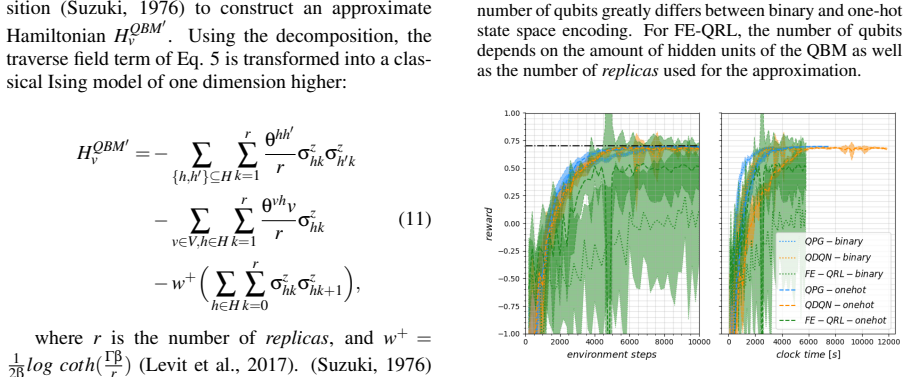
On the paper's own terms, the central discovery is that the quantum features supposedly driving QRL show little measurable effect. For PQC-QRL, the entangled hardware-efficient ansatz is compared with two entanglement-free, linearly separable variants; the variant that re-encodes the whole state on every qubit matches the entangled QDQN almost exactly and trails QPG only modestly, so the authors conclude that performance does not mainly rely on entanglement. For FE-QRL, performance is tested with 1, 5, and 10 Trotter replicas; since the classical single-replica Boltzmann machine performs as well as the higher-replica quantum approximations and no replica-count trend appears, the authors find no evidence that quantum free-energy effects drive learning. The overall statement is that most QRL approaches may not greatly rely on their quantum components, and the best-performing algorithm in the benchmark, AA-QRL, is in its evaluated form quantum-inspired rather than genuinely quantum.
Load-bearing premise
The paper's quantumness test assumes the replica-stacked classical Hamiltonian is a faithful stand-in for the quantum Boltzmann machine's free energy, so that adding replicas should improve performance if quantum effects truly matter; it also assumes the entanglement-free ansatz removes entanglement without also discarding state information.
Editorial extensions
If this is right
- A classically simulable, entanglement-free circuit can match the QDQN agent on the tested gridworlds, so circuit depth and qubit count are not the bottleneck for these tasks.
- The FE-QRL family shows no replica-count scaling, implying that its reported strengths are better attributed to hyperparameters than to quantum transverse-field effects.
- AA-QRL outperforms the other classes on these gridworlds while requiring only two qubits per action register and no entanglement analysis, because it is currently a quantum-inspired algorithm.
- Binary state encoding is more favorable than one-hot encoding for PQC-QRL on qubit scaling, while FE-QRL's qubit count is encoding-independent but its trainable parameters grow with visible nodes.
- On the largest frozen-lake gridworld, QDQN degrades and FE-QRL fails to scale, so none of the quantum approaches currently offers a scalable practical advantage on larger discrete tasks.
Reading between the lines
- If the entanglement-independence result generalizes, a concrete testable surrogate for QDQN on discrete tasks is a single-qubit data-re-uploading circuit with repeated state encoding; comparing them on larger grids would directly probe the paper's conclusion.
- The replica-stacking test is only decisive if the approximate Hamiltonian faithfully represents the QBM free energy; since Suzuki's convergence statement concerns ground states, a stronger test would measure how replica count affects free-energy estimates on a system where exact values are computable.
- The benchmark's rankings might change if noise, full wall-clock time including classical optimization, and continuous state spaces were included; the paper lists noise resilience as future work.
- A natural extension is to treat the quantumness probes themselves as hyperparameters and search over entanglement and replica count per environment, which would reveal whether any gridworld regime favors genuine quantum components.
Editorial analysis
A structured set of objections, weighed in public.
Referee Report
Summary. This paper proposes a comparative benchmark for three families of quantum reinforcement learning algorithms—PQC-based QPG and QDQN, free-energy QBM-based FE-QRL, and amplitude-amplification AA-QRL—on gridworld environments. It introduces five metrics (performance, sample efficiency, circuit executions, quantum clock time, and qubit scaling) and evaluates the role of quantum components through an entanglement-removal ablation for PQC-QRL and a replica-count experiment for FE-QRL. Results show AA-QRL achieving the best performance, QPG/QDQN behaving similarly on small instances, FE-QRL scaling poorly, and only mild performance degradation when entanglement is removed. The paper concludes that most QRL approaches may not greatly rely on their quantum components, and it releases code and data for reproduction.
Significance. The benchmark itself and the code release are valuable: the paper unifies three otherwise fragmented QRL streams under common environments and metrics, and it directly tackles the important question of whether observed QRL performance depends on quantum effects. A credible negative result would be a significant cautionary contribution to the field. However, the evidence for the negative conclusion is uneven. The PQC entanglement ablation is limited to one environment and one hyperparameter configuration, and the FE-QRL replica experiment tests a classical Suzuki-Trotter surrogate whose relationship to the QBM free energy is explicitly disclaimed in Section 3.3. As a result, the benchmark infrastructure is more convincing than the headline claim.
major comments (4)
- [Section 3.3, Eq. (11), Fig. 7] The FE-QRL 'quantumness' test does not test the quantum QBM. The training objective in Eqs. (5)-(8) is the free energy F(s,a) of the transverse-field Hamiltonian H^QBM_v, but the replica experiment varies r in the classical surrogate H^QBM'_v of Eq. (11), optimized by simulated annealing. The text itself states that Suzuki's result concerns ground states and 'does not imply <H_QBM> ~ <H_QBM'>'. Consequently, the absence of replica-count correlation in Fig. 7 shows only that this classical surrogate with the chosen fixed hyperparameters does not improve with r; it does not bear on whether the genuine thermal QBM, or its quantum properties, would help. The Discussion's claim that 'most QRL approaches may not greatly rely on their quantum components' therefore overreaches for FE-QRL. The authors should either estimate F(s,a) for the actual QBM (e.g., by exact diagonalization for the small systems considered) or explicitly restrict the conclusion to the classical surrogate.
- [Section 4, Fig. 6] The entanglement ablation for PQC-QRL is performed on a single 4x4 frozen lake environment with 10 runs per ansatz, and the comparison between the full ansatz and ansatz B is reported without statistical tests or additional environment and hyperparameter variation. Moreover, ansatz B changes the information-encoding strategy at the same time as removing entangling gates (each qubit receives the full state over layers), so the procedure does not isolate entanglement from representational capacity. The statement that 'the performance of the quantum algorithm does not seem to mainly rely on entanglement' is therefore stronger than the evidence supports; it should be qualified as a preliminary observation or backed by further ablations on multiple environments with matched encoding schemes and multiple seeds.
- [Section 3 (intro), Section 5] No classical RL baselines are included, although the paper's central conclusion is about whether QRL relies on quantum components. Comparisons among QRL agents alone cannot establish that the quantum components are unimportant; a classically simulable or classical neural-network agent trained with comparable resources would be needed to anchor the claim. The manuscript explicitly scopes out classical comparison, but the Discussion should not generalize beyond 'within this benchmark, the tested quantum variants perform similarly to their classically simulable surrogates.' Adding at least DQN/PG and classical DBM baselines, or substantially narrowing the wording, is necessary for the headline conclusion.
- [Section 4, FE-QRL hyperparameters, Fig. 7] The FE-QRL experiments use one fixed hyperparameter set (beta=2.0, Gamma=0.506, a single learning-rate schedule) across environments and replica counts, despite the text acknowledging that 'slight modification lead to strong fluctuations in performance.' Fig. 7 itself shows the one-hot classical DBM performing poorly with these hyperparameters while the binary DBM performs comparably to the replica-stacked models. This makes the observed lack of replica-count correlation difficult to attribute to the absence of quantum effects rather than to hyperparameter mismatch. A per-condition hyperparameter search, or at least a sensitivity analysis, is required before interpreting the replica result as evidence about quantumness.
minor comments (5)
- [Eq. (5)] The visible variables are introduced as v in {0,1} in Eq. (4), but after Eq. (5) the text says v in {-1,+1}; the mapping between the two encodings should be stated explicitly.
- [Eq. (11)] The replica index ranges are inconsistent as written: the first two sums run over k=1..r while the transverse-field term runs over k=0..r; the boundary condition (e.g., sigma_{h,r+1}=sigma_{h,1}) should be specified.
- [Section 2.3] The text contains typographical issues such as '2 m possible eigenstates' (should be 2^m) and 'T D(0)' (should be TD(0)); these should be cleaned up.
- [Section 3.2 / Section 4] The definition of quantum clock time relies on assumptions about gate times, measurement times, and shot counts, but these assumptions are introduced in Section 4 rather than in the metrics section; collecting them in Section 3.2 would make the metric reproducible.
- [Figure 3] Figure 3's caption is not self-contained: it should state what is plotted on each axis and which encoding and qubit-count settings are shown, since the text refers to it when discussing qubit scaling.
Circularity Check
No circularity: the benchmark conclusions rest on direct empirical comparisons, not on definitions, fitted predictions, or load-bearing self-citations.
full rationale
The paper is an empirical benchmark rather than a derivation, and its central claim that most QRL approaches may not greatly rely on their quantum components is supported by direct ablations and comparative experiments. For PQC-QRL, the comparison of the Skolik et al. ansatz with entanglement removed (Fig. 6) is an experimental control, not a quantity fitted from the outcome. For FE-QRL, the replica-count experiment (Fig. 7) tests a stated hypothesis about whether increasing replicas improves performance; the observed null result is an empirical finding, not an identity. Section 3.3 explicitly flags that Suzuki's result applies to ground states and 'does not imply <H_QBM> ~ <H_QBM'>', which is a limitation of the surrogate-based control condition rather than a circular step. The self-citations (e.g., Kruse et al. 2023, 2024; Coelho et al. 2024; Drăgan et al. 2022) are used as related work and prior ansatz-design evaluations that the paper explicitly says are beyond its scope; they are not load-bearing supports for the benchmark conclusions. The benchmark environments, metrics, and released code are independent contributions. No load-bearing claim reduces by construction to its inputs, and the paper does not rename a known result or import a uniqueness theorem from the authors' prior work.
Assumptions & free parameters
free parameters (7)
- FE-QRL inverse temperature beta =
2.0
- FE-QRL transverse field Gamma =
0.506
- QPG learning rates =
theta/lambda=0.025, w=0.1
- QDQN learning rates and discount =
theta/lambda=0.01, w=0.01, gamma=0.95
- AA-QRL Grover iteration scale k =
not reported in text
- PQC-QRL number of layers =
5
- FE-QRL replicas in main runs =
5
assumptions (6)
- domain assumption An MDP with discrete state and action spaces is the right abstraction for comparing all QRL classes.
- domain assumption Q(s,a) = -F(s,a) with the QBM free energy is a valid Q-function approximation.
- domain assumption The Suzuki-Trotter replica Hamiltonian H_QBM' approximates the QBM H_QBM for the purpose of computing free energy and gradients.
- domain assumption Removing entangling gates while keeping parameter count and information encoding similar isolates the contribution of entanglement to PQC-QRL performance.
- domain assumption State-vector simulation and the assumed gate times (30 ns single-qubit, 300 ns two-qubit, 300 ns measurement, 1000 shots) reflect relative quantum clock time.
- ad hoc to paper Higher replica count should improve FE-QRL training performance if the method relies on genuinely quantum properties.
Cite this review
Pith. "Pith review of Benchmarking Quantum Reinforcement Learning." pith.science (2026). https://pith.science/paper/WQ53TLBZ
@misc{pith2026250204909,
  author       = {Pith},
  title        = {Pith review of: Benchmarking Quantum Reinforcement Learning},
  year         = {2026},
  howpublished = {\url{https://pith.science/paper/WQ53TLBZ}},
  note         = {Machine review of arXiv:2502.04909}
}
read the original abstract
Quantum Reinforcement Learning (QRL) has emerged as a promising research field, leveraging the principles of quantum mechanics to enhance the performance of reinforcement learning (RL) algorithms. However, despite its growing interest, QRL still faces significant challenges. It is still uncertain if QRL can show any advantage over classical RL beyond artificial problem formulations. Additionally, it is not yet clear which streams of QRL research show the greatest potential. The lack of a unified benchmark and the need to evaluate the reliance on quantum principles of QRL approaches are pressing questions. This work aims to address these challenges by providing a comprehensive comparison of three major QRL classes: Parameterized Quantum Circuit based QRL (PQC-QRL) (with one policy gradient (QPG) and one Q-Learning (QDQN) algorithm), Free Energy based QRL (FE-QRL), and Amplitude Amplification based QRL (AA-QRL). We introduce a set of metrics to evaluate the QRL algorithms on the widely applicable benchmark of gridworld games. Our results provide a detailed analysis of the strengths and weaknesses of the QRL classes, shedding light on the role of quantum principles in QRL and paving the way for future research in this field.
Figures


Figures from the paper (4 more)


Reference graph
Works this paper leans on
-
[1]
write newline
" write newline "" before.all 'output.state := FUNCTION fin.entry add.period write newline FUNCTION new.block output.state before.all = 'skip after.block 'output.state := if FUNCTION new.sentence output.state after.block = 'skip output.state before.all = 'skip after.sentence 'output.state := if if FUNCTION not #0 #1 if FUNCTION and 'skip pop #0 if FUNCTIO...
-
[2]
Abbas, A., Sutter, D., Zoufal, C., Lucchi, A., Figalli, A., and Woerner, S. (2021). The power of quantum neural networks. Nature Computational Science , 1(6):403--409
2021
-
[3]
Ackley, D. H., Hinton, G. E., and Sejnowski, T. J. (1985). A learning algorithm for boltzmann machines. Cognitive science , 9(1):147--169
work page 1985
-
[4]
Amin, M. H. (2015). Searching for quantum speedup in quasistatic quantum annealers. Physical Review A , 92(5):052323
work page 2015
-
[5]
H., Andriyash, E., Rolfe, J., Kulchytskyy, B., and Melko, R
Amin, M. H., Andriyash, E., Rolfe, J., Kulchytskyy, B., and Melko, R. (2018). Quantum boltzmann machine. Physical Review X , 8(2):0541
work page 2018
-
[6]
Babaeizadeh, M., Frosio, I., Tyree, S., Clemons, J., and Kautz, J. (2016). Reinforcement learning through asynchronous advantage actor-critic on a gpu. arXiv preprint arXiv:1611.06256
arXiv 2016
-
[7]
S., Holmes, Z., Cincio, L., and Cerezo, M
Bermejo, P., Braccia, P., Rudolph, M. S., Holmes, Z., Cincio, L., and Cerezo, M. (2024). Quantum convolutional neural networks are (effectively) classically simulable. arXiv preprint arXiv:2408.12739
arXiv 2024
-
[8]
Bowles, J., Ahmed, S., and Schuld, M. (2024). Better than classical? the subtle art of benchmarking quantum machine learning models. arXiv preprint arXiv:2403.07059
arXiv 2024
Show all 34 references
-
[9]
Y.-C., Yang, C.-H
Chen, S. Y.-C., Yang, C.-H. H., Qi, J., Chen, P.-Y., Ma, X., and Goan, H.-S. (2020). Variational quantum circuits for deep reinforcement learning. IEEE access , 8:141007--141024
2020
-
[10]
Coelho, R., Sequeira, A., and Paulo Santos, L. (2024). Vqc-based reinforcement learning with data re-uploading: performance and trainability. Quantum Machine Intelligence , 6(2):53
2024
-
[11]
S., and Ronagh, P
Crawford, D., Levit, A., Ghadermarzy, N., Oberoi, J. S., and Ronagh, P. (2018). Reinforcement learning using quantum boltzmann machines. Quantum Information & Computation
2018
-
[12]
Dong, D., Chen, C., Chu, J., and Tarn, T.-J. (2010). Robust quantum-inspired reinforcement learning for robot navigation. IEEE/ASME transactions on mechatronics , 17(1):86--97
2010
-
[13]
Dong, D., Chen, C., Li, H., and Tarn, T.-J. (2008). Quantum reinforcement learning. IEEE Transactions on Systems, Man, and Cybernetics, Part B (Cybernetics) , 38(5):1207--1220
2008
-
[14]
B., and Lorenz, J
Dr a gan, T.-A., Monnet, M., Mendl, C. B., and Lorenz, J. M. (2022). Quantum reinforcement learning for solving a stochastic frozen lake environment and the impact of quantum architecture choices. arXiv preprint arXiv:2212.07932
2022 arXiv
-
[15]
Hu, Y., Tang, F., Chen, J., and Wang, W. (2021). Quantum-enhanced reinforcement learning for control: A preliminary study. Control Theory and Technology , 19:455--464
2021
-
[16]
Jerbi, S., Gyurik, C., Marshall, S., Briegel, H., and Dunjko, V. (2021a). Parametrized quantum policies for reinforcement learning. Advances in Neural Information Processing Systems , 34:28362--28375
2021
-
[17]
M., Poulsen Nautrup , H., Briegel, H
Jerbi, S., Trenkwalder, L. M., Poulsen Nautrup , H., Briegel, H. J., and Dunjko, V. (2021b). Quantum enhancements for deep reinforcement learning in large spaces. PRX Quantum , 2(1)
2021
-
[18]
Kappen, H. J. (2020). Learning quantum models from quantum or classical data. Journal of Physics A: Mathematical and Theoretical , 53(21):214001
2020
-
[19]
Kruse, G., Coehlo, R., Rosskopf, A., Wille, R., and Lorenz, J. M. (2024). Hamiltonian-based quantum reinforcement learning for neural combinatorial optimization. arXiv preprint arXiv:2405.07790
2024 arXiv
-
[20]
Kruse, G., Dragan, T.-A., Wille, R., and Lorenz, J. M. (2023). Variational quantum circuit design for quantum reinforcement learning on continuous environments. arXiv preprint arXiv:2312.13798
2023 arXiv
-
[21]
J., Cincio, L., McClean, J
Larocca, M., Thanasilp, S., Wang, S., Sharma, K., Biamonte, J., Coles, P. J., Cincio, L., McClean, J. R., Holmes, Z., and Cerezo, M. (2024). A review of barren plateaus in variational quantum computing. arXiv preprint arXiv:2405.00781
2024 arXiv
-
[22]
S., Zahedinejad, E., and Ronagh, P
Levit, A., Crawford, D., Ghadermarzy, N., Oberoi, J. S., Zahedinejad, E., and Ronagh, P. (2017). Free energy-based reinforcement learning using a quantum processor. arXiv preprint arXiv:1706.00074
2017 arXiv
-
[23]
Matsuda, Y., Nishimori, H., and Katzgraber, H. G. (2009). Ground-state statistics from annealing algorithms: quantum versus classical approaches. New Journal of Physics , 11(7):073021
2009
-
[24]
D., Plinge, A., and Mutschler, C
Meyer, N., Ufrecht, C., Periyasamy, M., Scherer, D. D., Plinge, A., and Mutschler, C. (2022). A survey on quantum reinforcement learning. arXiv preprint arXiv:2211.03464
2022 arXiv
-
[25]
Meyer, N., Ufrecht, C., Yammine, G., Kontes, G., Mutschler, C., and Scherer, D. D. (2025). Benchmarking quantum reinforcement learning. arXiv preprint arXiv:2501.15893
2025
-
[26]
M \"u ller, T., Roch, C., Schmid, K., and Altmann, P. (2021). Towards multi-agent reinforcement learning using quantum boltzmann machines. arXiv preprint arXiv:2109.10900
2021 arXiv
-
[27]
Neumann, N. M. P., de Heer, P. B. U. L., and Phillipson, F. (2023). Quantum reinforcement learning - comparing quantum annealing and gate-based quantum computing with classical deep reinforcement learning. Quantum Information Processing , 22(2)
2023
-
[28]
and Hinton, G
Sallans, B. and Hinton, G. E. (2004). Reinforcement learning with factored states and actions. The Journal of Machine Learning Research , 5:1063--1088
2004
-
[29]
Skolik, A., Jerbi, S., and Dunjko, V. (2022). Quantum agents in the gym: a variational quantum algorithm for deep q-learning. Quantum , 6:720
2022
-
[30]
Skolik, A., Mangini, S., B \"a ck, T., Macchiavello, C., and Dunjko, V. (2023). Robustness of quantum reinforcement learning under hardware errors. EPJ Quantum Technology , 10(1):1--43
2023
-
[31]
Sutton, R. S. (1990). Integrated architectures for learning, planning, and reacting based on approximating dynamic programming. In Machine learning proceedings 1990 , pages 216--224. Elsevier
1990
-
[32]
Suzuki, M. (1976). Relationship between d-dimensional quantal spin systems and (d+ 1)-dimensional ising systems: Equivalence, critical exponents and systematic approximants of the partition function and spin correlations. Progress of theoretical physics , 56(5):1454--1469
1976
-
[33]
U., De Cola, G., Deleu, T., Goulao, M., Kallinteris, A., Krimmel, M., KG, A., et al
Towers, M., Kwiatkowski, A., Terry, J., Balis, J. U., De Cola, G., Deleu, T., Goulao, M., Kallinteris, A., Krimmel, M., KG, A., et al. (2024). Gymnasium: A standard interface for reinforcement learning environments. arXiv preprint arXiv:2407.17032
2024 arXiv
-
[34]
C., Albash, T., Marvian, M., Lidar, D., and Zanardi, P
Venuti, L. C., Albash, T., Marvian, M., Lidar, D., and Zanardi, P. (2017). Relaxation versus adiabatic quantum steady-state preparation. Physical Review A , 95(4):042302
2017
Reviewed August 8, 2026 · model on record in the stance chip above.
Discussion (0). Continue with ORCID to comment.