REVIEW 3 major objections 5 minor 15 references
Segment Geometry Optimization and Prototype Studies of a Multi-Coincidence GAGG Solar Neutrino Detector
T0 review · 3 major / 5 minor · reviewed 2026-08-08 · deepseek-v4-flash
Pith's one-line read Segmented GAGG crystals can split solar neutrino captures into spatially separated pulses.
desk verdict Solid prototype measurements, but the zero-delay spatial-separation claim lacks experimental validation and the simulation metric is incomplete. read the letter →
The pith
A machine-rendered reading of the paper's core claim, the machinery that carries it, and where it could break.
The reading
What carries the argument
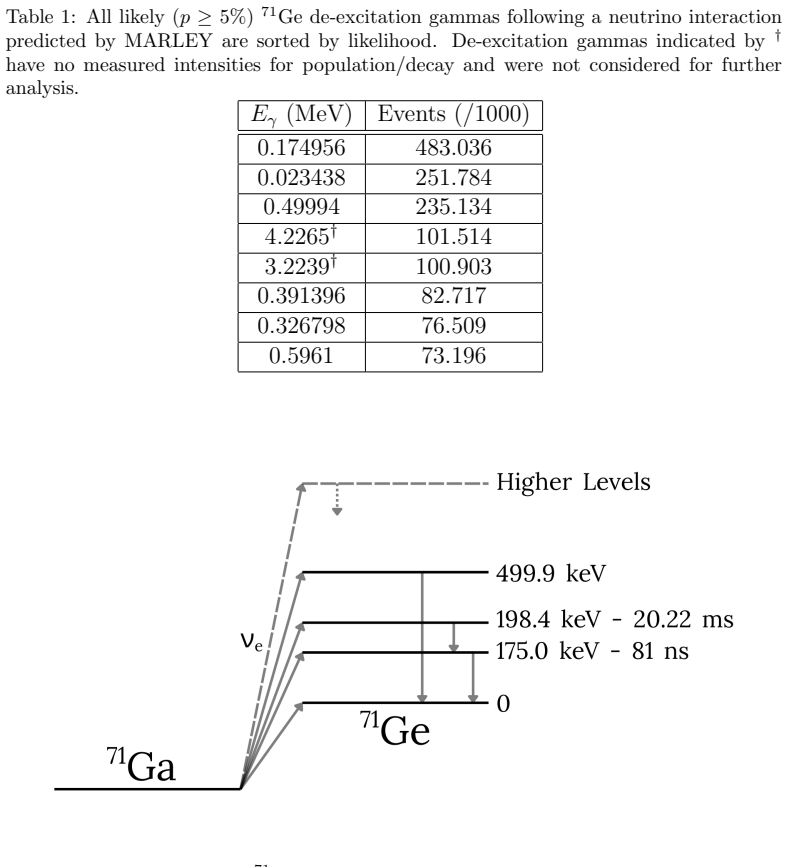
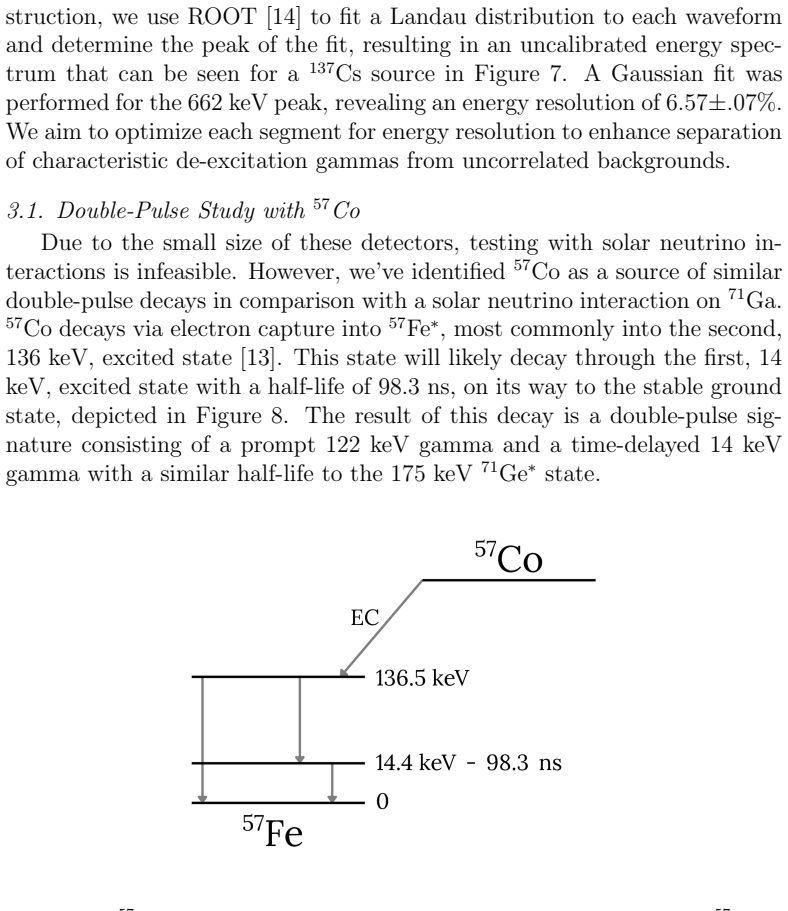
The load-bearing quantity is the capture ratio, $R = P_{\mathrm{prompt}}/P_{\mathrm{delayed}}$, computed from simulation: the probability that the prompt particle deposits its full energy in the originating GAGG segment divided by the probability that the delayed gamma is absorbed there. For the electron-plus-175 keV signature this ratio is favorable only for very small cubes, around $2.5$ mm; for the 23 keV-plus-175 keV signature it stays above 1 for all tested segment sizes; and for the electron-plus-500 keV signature it exceeds 1 even at $d = 8$ mm. The prototype side of the argument is carried by two optically isolated GAGG segments on opposite faces of a ${}^{57}\mathrm{Co}$ source, with a software trigger on the delayed 14 keV peak; an exponential fit to the inter-pulse delay histogram gives the half-life that validates the double-pulse readout.
What would settle it
Expose a real segmented GAGG array to a calibrated source or reaction that emits a prompt electron and a roughly 500 keV gamma with no time delay, and compare the measured fraction of events with the two pulses in different segments to the simulated capture ratio. If the measured spatial-separation fraction is no better than random coincidence, the purely geometric identification of the third signature fails.
Extended reading notes
Core claim
The central claim is that optically isolating small GAGG crystals into segments lets a detector dissect multi-coincidence solar neutrino interactions on ${}^{71}\mathrm{Ga}$ by turning a timing problem into a geometry problem. When a neutrino converts ${}^{71}\mathrm{Ga}$ to excited ${}^{71}\mathrm{Ge}^{*}$, the de-excitation gammas produce three signatures: a conversion electron followed by a 175 keV gamma delayed by the 81 ns first-excited-state lifetime; a 23 keV prompt gamma followed by that same delayed 175 keV gamma; and a conversion electron followed by a 500 keV gamma with no significant delay. The authors use a low-energy neutrino event generator and a radiation-transport simulation to choose cube, rod, or plate segment sizes so the prompt particle is likely to be captured in the segment where the interaction occurred while the delayed gamma escapes to a neighboring segment. Prototype GAGG segments coupled to silicon photomultipliers reach $6.57 \pm 0.07\%$ energy resolution at 662 keV and, with two segments reading opposite faces of a ${}^{57}\mathrm{Co}$ source, measure the intermediate-state half-life as $98.47 \pm 0.97$ ns, consistent with the accepted $98.3 \pm 0.3$ ns.
Load-bearing premise
The load-bearing premise is that the third signature, a prompt electron followed by a 500 keV gamma with no significant time delay, can be identified purely by which segment the two pulses arrive in; this case is studied only in simulation, since the prototype test used ${}^{57}\mathrm{Co}$, whose two gammas are separated by the 98 ns half-life of the intermediate state.
Editorial extensions
If this is right
- Together, the three simulated signatures cover nearly three quarters of the ${}^{71}\mathrm{Ga}$ charged-current interaction signal, so a detector built around them would keep most of the signal while discarding much of the background.
- The capture-ratio simulations provide explicit segment-size guidance: roughly $2.5$ mm cubes for the electron-plus-175 keV channel, with rods and plates also viable when the delayed gamma is 500 keV.
- The ${}^{57}\mathrm{Co}$ result demonstrates that double pulses with half-lives near 100 ns can be detected in separate optically isolated segments, validating the time-delayed readout scheme.
- Sub-7% energy resolution at 662 keV means individual segments can resolve the characteristic 23, 175, and 500 keV gamma lines and reject uncorrelated events.
Reading between the lines
- A direct test of the third signature with a prompt electron/gamma source having no time delay would settle whether spatial-only separation is enough; this is the natural next experiment.
- The 23 keV-plus-175 keV channel, with both energies characteristic and a capture ratio above 1 in all tested geometries, may prove the cleanest background-rejection channel, and a dedicated low-energy gamma calibration could quantify that advantage.
- The 80 ns cross-talk dead time observed in the prototype sets a practical speed limit for double-pulse readout in adjacent segments; reducing it could extend the method to faster cascades than the 100 ns-scale decays demonstrated here.
Editorial analysis
A structured set of objections, weighed in public.
Referee Report
Summary. The paper proposes a segmented GAGG scintillator detector for detecting solar neutrino interactions on 71Ga via the multi-coincidence signature of a prompt conversion electron (or 23 keV gamma) and a delayed de-excitation gamma from 71Ge*. It uses MARLEY + Geant4 to optimize segment geometry (cubes, rods, plates) by maximizing the ratio of prompt to delayed capture in the origin segment for three signatures. Prototype 7x7x7 mm GAGG/SiPM segments achieve 6.57 +/- 0.07% energy resolution at 662 keV and, using a 57Co source, measure the half-life of the 14 keV 57Fe state as 98.47 +/- 0.97 ns (accepted 98.3 +/- 0.3 ns), demonstrating detection of temporally separated double pulses. The authors conclude that segmentation could provide reliable spatial separation for the non-delayed 500 keV gamma signature.
Significance. If the optimization were fully validated, the paper would provide a useful path toward a compact, segmented GAGG detector for space-based solar neutrino measurement. The prototype results are credible and nicely cross-checked: the energy resolution is consistent with good light collection, and the measured 57Co half-life agrees with the accepted value, validating the double-pulse analysis method. The paper is honest about the early stage of the work, and the MARLEY/Geant4 framework is a reasonable starting point. However, the simulation-based geometry claim currently lacks the joint efficiency and uncertainty information needed to support the central 'reliable spatial separation' conclusion for the non-delayed signature.
major comments (3)
- [Section 2, Figures 4-6] The 'capture ratio' plotted in Figures 4-6 only compares whether the prompt and delayed particles deposit energy in the origin segment; it does not compute the probability that the delayed gamma escapes the origin segment and is actually detected in a neighboring segment. For a spatial-separation detector, the relevant quantity is the joint efficiency P(prompt captured in origin AND delayed detected in any other segment). The plotted ratio can be greater than one even when most delayed gammas are lost entirely, so the conclusion in Section 4 that 'reliable spatial separation ... may be achievable' is not directly supported by the simulation. Please report the full event-level coincidence efficiency, not just the per-segment capture ratio.
- [Section 2, gamma capture threshold] The gamma capture criterion 'EDEP > Ei/10' is ad hoc and is the main driver of the capture ratios shown in Figures 4-6. No justification is given for this threshold, no dependence on the threshold choice is shown, and the simulation results are reported as point estimates without statistical uncertainties. Since the spectra in Table 1 are based on 1000 events, the statistical error is non-negligible, especially at the ratio approximately 1 crossing points that determine optimal segment sizes. The authors should either add uncertainties and a threshold-dependence study or justify the threshold using the measured energy resolution of the prototype detectors.
- [Section 3.1, Figure 12] The sentence 'Double pulses that occur before 80 ns deviate from the fit likely because of cross talk' shows that the prototype cannot reliably resolve pulses separated by less than about 80 ns. The third 71Ge signature (prompt electron + 500 keV gamma) is described in Section 2 as having pulses 'not significantly delayed in time,' which places it exactly in the unvalidated sub-80 ns regime. The 57Co demonstration, with its 98 ns half-life and 80-1150 ns fit range, validates only delayed-coincidence capability, not the zero-delay spatial-only case. The paper should either test with a prompt coincidence source (e.g., 22Na or a calibrated pulser) or explicitly restrict the claim to delayed coincidences and state that the zero-delay case remains an unvalidated target for future work.
minor comments (5)
- [Table 1 caption] Please specify whether 'Events (/1000)' refers to events per 1000 incoming neutrinos (as stated for Figure 1) or per 1000 charged-current interactions producing 71Ge*; the text currently uses both phrasings.
- [Figure 3 caption] The caption does not mention that the simulated array dimensions are X = Y = Z = 10 m; this information appears only in the text and should be included in the caption for clarity.
- [Equation (2)] Please clarify in the text that t in Equation (2) is the time difference between the starts of the two pulses and that the fit is applied to the histogram of these time differences; the current wording is a bit terse.
- [Reference [4]] The claim of a ~50 ns decay time for fast GAGG coupled to a PMT would be stronger if supported by a peer-reviewed reference in addition to the Master's thesis cited as reference [4].
- [Abstract] The abstract states 'sub 7% energy resolution @ 137Cs' without noting that this value (6.57 +/- 0.07%) is for the high light-yield crystal; please indicate that the quoted resolution is for a single prototype segment.
Circularity Check
No significant circularity: the main results are external-simulation-based and prototype-validated against accepted nuclear data.
full rationale
The paper's derivation chain is self-contained and does not reduce to its own inputs. The three 71Ge de-excitation signatures are generated by MARLEY, an external nuclear-event generator, with level lifetimes taken from published nuclear data sheets, and the capture-ratio optimization is a Geant4 simulation with no fitted parameters being relabeled as predictions. The prototype studies provide independent measurements: the 6.57 ± 0.07% energy resolution at 662 keV is a direct calibration measurement, and the 57Co double-pulse half-life of 98.47 ± 0.97 ns is compared against the accepted value of 98.3 ± 0.3 ns, providing an external benchmark rather than a circular check. The only self-citation is reference [4], the first author's thesis, cited for the background claim that a fast-decay GAGG variant can achieve a ~50 ns decay time; this is not load-bearing for the segmentation optimization, the prototype construction, or the double-pulse analysis. The acknowledged limitation that double pulses before 80 ns deviate from the exponential fit and that the zero-delay 500 keV signature is only simulated is a completeness/correctness concern, not a circularity concern. No equation or fitted quantity is defined in terms of the claimed result, and no load-bearing argument relies on an unverified self-citation.
Assumptions & free parameters
free parameters (4)
- Electron capture threshold =
10 keV
- Gamma capture threshold =
10% of incident energy (E_dep > E_i/10)
- Half-life fit range =
80 to 1150 ns
- 3 sigma voltage windows =
From calibration spectra
assumptions (5)
- domain assumption MARLEY, designed for 40Ar, can be repurposed for 71Ga with Bahcall Gamow-Teller factors and produce valid conversion electron and de-excitation gamma distributions.
- domain assumption Nuclear level energies, half-lives and decay branches for 71Ge from Ref. [3] are correct.
- domain assumption The solar neutrino spectrum from Ref. [7] is the appropriate input for a solar neutrino detector.
- domain assumption The fast-decay GAGG variant has a scintillation decay time of about 50 ns, from Ref. [4].
- domain assumption Requiring an excited 71Ge state suppresses CC neutrino backgrounds by about 90% as claimed in Ref. [2].
Cite this review
Pith. "Pith review of Segment Geometry Optimization and Prototype Studies of a Multi-Coincidence GAGG Solar Neutrino Detector." pith.science (2026). https://pith.science/paper/KI3TZY3F
@misc{pith2026250205095,
  author       = {Pith},
  title        = {Pith review of: Segment Geometry Optimization and Prototype Studies of a Multi-Coincidence GAGG Solar Neutrino Detector},
  year         = {2026},
  howpublished = {\url{https://pith.science/paper/KI3TZY3F}},
  note         = {Machine review of arXiv:2502.05095}
}
abstract
A GAGG detector capable of dissecting a multi-coincidence solar neutrino interaction on ${}^{71}$Ga is under development for potential space-based applications. We identify three distinct detection signatures when ${}^{71}$Ge$^*$ is produced, two of which are significantly delayed in time and could be detected within a single large GAGG volume. Further optimizations can be made by optically isolating smaller segments of GAGG to maximize the probability of a spatial separation between the prompt/delayed signals. We construct and test prototype GAGG detectors capable of sub 7% energy resolution @ ${}^{137}$Cs and reliable detection of spatially-separated ${}^{57}$Co double-pulse decays.
Figures


Figures from the paper (9 more)




Reference graph
Works this paper leans on
-
[1]
N. Solomey, J. Folkerts, H. Meyer, et al., Concept for a space-based near- solar neutrino detector, Nuclear Instruments and Methods in Physics Research Section A: Accelerators, Spectrometers, Detectors and As- sociated Equipment 1049 (2023) 168064. doi:10.1016/j.nima.2023. 168064. URL http://dx.doi.org/10.1016/j.nima.2023.168064
-
[2]
J. Folkerts, N. Solomey, B. Hartsock, et al., Method to reduce noise for measurement of 7be and 8b solar neutrinos on gallium-71, Nuclear Instruments and Methods in Physics Research Section A: Accelerators, Spectrometers, Detectors and Associated Equipment 1072 (2025) 170116. doi:https://doi.org/10.1016/j.nima.2024.170116. URL https://www.sciencedirect.co...
arXiv 2025
-
[3]
K. Abusaleem, B. Singh, Nuclear data sheets for a = 71, Nuclear Data Sheets 112 (1) (2011) 133–273. doi:https: //doi.org/10.1016/j.nds.2010.12.002. URL https://www.sciencedirect.com/science/article/pii/ S0090375210001213
-
[4]
B. B. Hartsock, Advancements in voxelated technology for reactor anti-neutrino and space-based solar neutrino detection, Master’s thesis, 13 Wichita State University (May 2024). URL https://soar.wichita.edu/items/ 66a66e0e-0e53-44bc-9e96-84925b24c13b
work page 2024
-
[5]
S. Gardiner, Simulating low-energy neutrino interactions with marley, Computer Physics Communications 269 (2021) 108123. doi:https://doi.org/10.1016/j.cpc.2021.108123. URL https://www.sciencedirect.com/science/article/pii/ S0010465521002356
-
[6]
J. N. Bahcall, Gallium solar neutrino experiments: Absorption cross sections, neutrino spectra, and predicted event rates, Phys. Rev. C 56 (1997) 3391–3409. doi:10.1103/PhysRevC.56.3391. URL https://link.aps.org/doi/10.1103/PhysRevC.56.3391
-
[7]
Bahcall, Software and data for solar neutrino research (Oct 2005)
J. Bahcall, Software and data for solar neutrino research (Oct 2005). URL https://www.sns.ias.edu/~jnb/
work page 2005
-
[8]
M. Iva¸ scu, N. M˘ arginean, D. Bucurescu, et al., Lifetime measurements in 71Ge and a new interacting boson-fermion model interpretation, Phys. Rev. C 60 (1999) 024302. doi:10.1103/PhysRevC.60.024302. URL https://link.aps.org/doi/10.1103/PhysRevC.60.024302
Show all 15 references
-
[9]
L. Taff, J. Van Klinken, Nuclear halflives observed with delayed coincident summing, Nuclear Instruments and Methods 151 (1) (1978) 189–199. doi:https://doi.org/10.1016/0029-554X(78)90487-1 . URL https://www.sciencedirect.com/science/article/pii/ 0029554X78904871
1978 doi
-
[10]
Allison, K
J. Allison, K. Amako, J. Apostolakis, et al., Geant4 developments and applications, IEEE Transactions on Nuclear Science 53 (1) (2006) 270–
2006
-
[11]
Agostinelli, J
S. Agostinelli, J. Allison, K. Amako, et al., Geant4—a simulation toolkit, Nucl. Instr. and Meth. in Phys. Res. Sect. A 506 (3) (2003) 250–303. doi:https://doi.org/10.1016/S0168-9002(03)01368-8 . URL https://www.sciencedirect.com/science/article/pii/ S0168900203013688
2003 doi
-
[12]
Allison, K
J. Allison, K. Amako, J. Apostolakis, et al., Recent developments in geant4, Nucl. Instr. and Meth. in Phys. Res. Sect. A 835 (2016) 14 186–225. doi:https://doi.org/10.1016/j.nima.2016.06.125. URL https://www.sciencedirect.com/science/article/pii/ S0168900216306957
2016 doi
-
[13]
Bhat, Nuclear data sheets for a = 57, Nuclear Data Sheets 85 (3) (1998) 415–536
M. Bhat, Nuclear data sheets for a = 57, Nuclear Data Sheets 85 (3) (1998) 415–536. doi:https://doi.org/10.1006/ndsh.1998.0021. URL https://www.sciencedirect.com/science/article/pii/ S0090375298900217
1998
-
[14]
R. Brun, F. Rademakers, P. Canal, et al., root-project/root: v6.18/02 (Jun. 2020). doi:10.5281/zenodo.3895860. URL https://doi.org/10.5281/zenodo.3895860 15
2020 doi
-
[278]
doi:10.1109/TNS.2006.869826
2006
Reviewed August 8, 2026 · model on record in the stance chip above.
Discussion (0). Continue with ORCID to comment.