REVIEW 4 major objections 5 minor 103 references
Design of a Piezoelectric Wind Energy Harvester for Bacterial Disinfection of Drinking Water
T0 review · 4 major / 5 minor · reviewed 2026-08-08 · deepseek-v4-flash
Pith's one-line read A wind-driven galloping harvester is claimed to disinfect E. coli water with a 0.1 V applied potential.
desk verdict Plausible galloping-harvester shape comparison, but the water-disinfection claim lacks a sham control and sits below the paper's own field threshold. read the letter →
The pith
A machine-rendered reading of the paper's core claim, the machinery that carries it, and where it could break.
The reading
What carries the argument
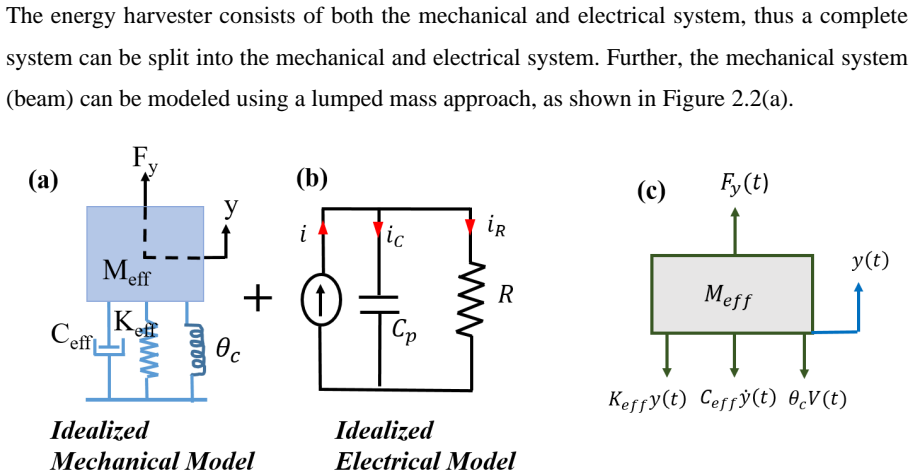
The central mechanism is the galloping of a cantilevered bluff body: wind over an asymmetric cross-section creates a transverse aerodynamic force, modeled with quasi-steady empirical coefficients $a_1$ and $a_3$ in a lumped-parameter electromechanical system (mechanical force balance plus Kirchhoff's current law). The paper's key design modification is the curve-shaped attachment on the bluff body, which increases lift and thus voltage. The disinfection side relies on copper oxide nanowires grown on the coaxial center electrode, which act as field concentrators: the paper's electrostatic simulation ($\mathbf{E}=-\nabla V$) of a single nanowire under 0.1 V applied potential yields 14,000 V/m at the tip, the locally enhanced electric field treatment (LEEFT) that electroporates bacteria.
What would settle it
Run the same 25-minute disinfection experiment with the wind harvester's electric leads disconnected while keeping the copper electrode and nanowires in the water; if colony counts still drop to the same extent, the electric field is not the operative mechanism. Alternatively, measure the electric field at the nanowire tip with a calibrated micro-probe or numerical model of the full electrode array, and compare it against the 1–10 kV/cm threshold the paper cites.
Extended reading notes
Core claim
The paper's central claim is that a galloping-based piezoelectric wind energy harvester can disinfect bacteria-laden drinking water without any external power supply. It asserts, on the basis of both experiment and simulation, that attaching curve-shaped bodies to the bluff body raises the harvester's output above that of circular, triangular, square, or Y-shaped attachments, giving about 25 V RMS and 0.105 mW at 4 m/s. The thesis then claims that when this output is connected to an 85 kΩ bacterial water load, the delivered 0.1 V is amplified at CuO nanowire tips on the center electrode to a local electric field of about 14,000 V/m, sufficient to electroporate E. coli by the locally enhanced electric field treatment (LEEFT) mechanism. Complete disinfection is reported after 25 minutes of supply, with a log inactivation efficiency of 2.33 and no disinfection by-products.
Load-bearing premise
The central claim collapses if a simulated local field of 14,000 V/m, produced from 0.1 V applied across bacterial water, is not actually lethal to E. coli; the paper itself cites the lethal threshold as 1–10 kV/cm, which is 7 to 70 times higher.
Editorial extensions
If this is right
- A small cantilever harvester can produce usable disinfection voltage (around 25 V open-circuit) from a modest 4 m/s wind, well within natural breezes.
- Curve-shaped attachments outperform plain cylinders and other attachment shapes, so bluff-body geometry is a design lever for output power.
- With nanowire-modified electrodes, an applied potential of only 0.1 V is claimed sufficient for bacterial inactivation, implying very low energy consumption per liter.
- The process is by-product-free and self-powered, making it a candidate for water storage tanks in off-grid or remote settings.
- The 2.33 log reduction after 25 minutes is a starting point; longer exposure or multiple harvesters would be needed for higher inactivation levels.
Reading between the lines
- The paper's own cited electroporation threshold (1–10 kV/cm) is 7 to 70 times higher than the simulated 14,000 V/m; closing this gap would require either a revised threshold for this geometry or another disinfection pathway, such as copper-ion release.
- No sham experiment with the electric leads disconnected is reported, so copper ion toxicity or mechanical disturbance of the nanowires cannot be excluded as contributors to the observed CFU reduction.
- The nanowires are reported to break during sampling; coating them with polydopamine, as the paper suggests for future work, would determine whether electrode stability limits long-term use.
- In a field deployment, intermittent and direction-changing wind would cut duty cycle; combining the harvester with a storage capacitor or yaw mechanism would be a testable extension the thesis leaves implicit.
Editorial analysis
A structured set of objections, weighed in public.
Referee Report
Summary. This thesis-style manuscript develops a lumped-parameter, quasi-steady model of a galloping piezoelectric wind energy harvester with various bluff-body attachments (circular, triangular, square, Y-shaped, curve-shaped). It reports numerical and experimental comparisons showing the curve-shaped attachment yields the highest output (about 25 V open-circuit, 0.105 mW at 4 m/s). The harvested electrical output is then applied to a copper tube filled with E. coli-contaminated water, using a CuO-nanowire-modified coaxial center electrode. The manuscript claims that the enhanced electric field near the nanowire tips reaches 14,000 V/m at 0.1 V applied across the bacterial water (85 kOhm resistance), and that 'complete bacterial disinfection' is achieved in 25 minutes with a log inactivation efficiency of 2.33. The stated aims are a low-cost, byproduct-free, portable water disinfection device for off-grid drinking-water treatment.
Significance. If substantiated, the disinfection claim would be significant: a wind-powered, self-contained water disinfection system requiring only 0.1 V and sub-microwatt power would be a notable advance for point-of-use treatment in resource-limited settings. The harvester shape-comparison section is a strength: it presents a plausible lumped-parameter model, CFD pressure/velocity fields, and experimental voltage/power data for five attachment shapes, including repeatability and load-resistance sweeps. However, the central disinfection claim rests on two unverified assumptions: that a simulated 14,000 V/m local field is sufficient to electroporate E. coli, and that the observed CFU decline is caused by the electric field rather than by copper-ion toxicity or natural die-off. The manuscript also contains an internal contradiction between 'complete disinfection' and a 2.33-log inactivation. These issues are load-bearing for the application claim, and the evidence as presented does not support the conclusion that the harvester output, rather than the copper electrode, is responsible for the observed bacterial removal.
major comments (4)
- [§4.3.2 and §4.3.3] The paper states in §4.3.2 that an electric field of 1 to 10 kV/cm (100,000 to 1,000,000 V/m) is required for bacterial degradation, but the electrostatic simulation in Fig. 4.7 reports only 14,000 V/m (0.14 kV/cm) at the nanowire tip under the 0.1 V supply. This is 7 to 70 times lower than the stated threshold. The conclusion that the nanowire-enhanced field is 'enough electric field for bacterial degradation' is therefore unsupported. The authors need to either provide a corrected simulation (e.g., with multiple nanowires, a mesh-convergence study, and a realistic geometry) or present direct experimental evidence of electroporation at this field strength.
- [§4.3.3] No sham or no-voltage control is reported for the disinfection experiments. The disinfection cell is a copper tube with a CuO/Cu2O-nanowire-coated copper center electrode, and copper ions are bactericidal. Over 25 minutes in dilute aqueous solution, copper-ion toxicity plus natural die-off could plausibly account for the observed ~2-log CFU decline without any contribution from the harvester. Without a zero-voltage control using the same electrode, water, and sampling procedure, the claim that electricity caused the disinfection is not established.
- [§4.3.3 and §4.4] There is an internal contradiction in the reported end point. §4.3.3 states that 'no viable bacterial cell is seen after 25 minutes of treatment,' while the log inactivation efficiency is reported as 2.33. A 2.33-log reduction corresponds to roughly 0.5% survivors (about 10^5 CFU/mL from a starting concentration of 2x10^7 CFU/mL), not complete disinfection. The authors must reconcile these statements: either the 25-minute plates were sterile and the log inactivation is underestimated, or the plates had countable colonies and the phrase 'complete disinfection' is inaccurate.
- [§2.2 and Table 2.2] The aerodynamic force coefficients a1 and a3 are central inputs to the model and are claimed to be obtained experimentally in a static test, but no details of that static test are provided: no description of the experimental setup, the force measurement procedure, the raw CFy-versus-alpha curves, or the uncertainty in the fitted coefficients. Because these coefficients are different for each attachment shape and directly determine the predicted output ranking, the reported agreement between simulation and experiment in Chapter 3 is partly a calibration check rather than an independent validation. The authors should present the static-test data and error bars for the fitted coefficients, or explicitly discuss the calibration nature of the comparison.
minor comments (5)
- [Chapter 4 TOC and body] The section numbering in Chapter 4 is duplicated: '4.3.2 Electric field enhancement' appears twice, followed by '4.3.2 Bacterial disinfection.' Renumber the sections sequentially.
- [§4.2] Equation citation is inconsistent: the text refers to 'equation (11)' for the log inactivation efficiency, but in Chapter 4 the equations are numbered starting at (19), and the log inactivation formula is actually equation (20).
- [Figure 3.6] The figure caption and the text in §3.3 describe the frequency plots inconsistently: the text says subplots (a) and (b) are for the curve-attachment harvester at 1.5 and 3.5 m/s, and (c) and (d) for the plain cylinder, but the caption lists the opposite order. Please correct the mismatch.
- [Throughout] There are several typos and grammatical issues, including 'attachements' in Figure 3.1 labels, 'activatio n efficiency' in Chapter 1, 'PDVF' instead of PVDF, and '100 µml' instead of '100 µL' in §4.2. A thorough language edit is needed.
- [Figures 4.6 and 4.10] The SEM images lack scale bars and the XRD pattern lacks indexed peak labels on the plot itself. Adding scale bars and axis labels would improve the readability of the microstructural evidence.
Circularity Check
No circularity found: the harvester model uses independently measured mechanical and aerodynamic inputs, the shape comparison is experimentally anchored, and the disinfection simulation is not fitted to the biological outcome.
full rationale
The paper's central harvester prediction is not equivalent to its inputs by construction. The lumped-parameter model (Eqs. 1-2) is solved with mechanical parameters obtained from free-decay tests (damping ratio, natural frequency) and with aerodynamic coefficients a1 and a3 obtained from static force tests, as stated: 'The empirical coefficients a1 and a3 are achieved by curve fitting of CFy versus alpha curve. The plot of CFy versus alpha curve is obtained experimentally in a static test with varying angle of attack.' These are inputs, not fits to the output voltage, so the numerical-experimental voltage comparison is a consistency check rather than a circular prediction. The shape ranking is likewise anchored by direct experimental voltage measurements at the same wind speed, and the simulation independently reproduces that ranking. The disinfection chain is also not circular: a 0.1 V applied potential, a measured 85 kOhm water resistance, and an electrostatic simulation give 14,000 V/m at a single nanowire tip; the CFU reduction is then measured experimentally. The electrostatic field calculation is not fitted to the disinfection outcome. The self-citations [57] and [61] merely note that the chapters are adapted from the author's own publications and are not load-bearing evidence for any stated claim. The paper's real weaknesses - absence of a sham or no-voltage control, possible bactericidal effect of copper ions, the simulated field being 7-70 times below the cited electroporation threshold, and the inconsistency between 'no viable bacterial cell' and a 2.33 log inactivation - are correctness and experimental-design concerns, not circularity. Therefore the derivation chain is self-contained with respect to circularity; the appropriate finding is no significant circularity.
Assumptions & free parameters
free parameters (3)
- Galloping force coefficients a1 and a3 per bluff-body shape =
a1: 2.9, 0.9, 2.09, 1.5, 2.17, 2.29; a3: -178, -1628, -1268, -1552, -913, -726 (Table 2.2)
- Electromechanical coupling coefficient theta_c =
2.24 x 10^-5 N/V
- Effective damping C and stiffness K =
C=0.0059 N/(m/s), K=6.8359 N/m
assumptions (4)
- domain assumption Quasi-steady, uniform wind and harvester always facing the flow.
- domain assumption Cubic polynomial form of the galloping force coefficient C_Fy (Eq. 14) applies to every tested shape, including the plain circular cylinder.
- ad hoc to paper A simulated local field of 14,000 V/m at nanowire tips is sufficient to electroporate E. coli.
- ad hoc to paper The observed CFU reduction is caused by the applied electric field, not by copper ion release or sampling artifacts.
Cite this review
Pith. "Pith review of Design of a Piezoelectric Wind Energy Harvester for Bacterial Disinfection of Drinking Water." pith.science (2026). https://pith.science/paper/R2H7DVGH
@misc{pith2026250205103,
  author       = {Pith},
  title        = {Pith review of: Design of a Piezoelectric Wind Energy Harvester for Bacterial Disinfection of Drinking Water},
  year         = {2026},
  howpublished = {\url{https://pith.science/paper/R2H7DVGH}},
  note         = {Machine review of arXiv:2502.05103}
}
read the original abstract
In this thesis, a piezoelectric wind energy harvester is proposed for bacterial disinfection of drinking water. A mathematical model of a piezoelectric wind energy harvester is developed to predict the electrical energy from the wind induced vibration based on the galloping phenomenon. Structure of a piezoelectric wind energy harvester is a cantilever piezolaminated elastic beam with a bluff body attached to the free end. Linear time invariant and lumped parameter approach is considered to model the structure. In order to improve the performance of the harvester, bluff body is modified by attaching different attachment in the form of circular-shaped, triangular-shaped, square-shaped, Y-shaped, and curve-shaped. Bacterial disinfection of drinking water is performed using the electrical output of the piezoelectric wind energy harvester. Energy harvester with a curve-shaped attachment to a bluff body is used for this application because it provides enhanced electrical output as compared to other shaped harvesters. It has been found both numerically and experimentally that the harvester with a curve-shaped attachment to the bluff body provides the best electrical output.
Figures


Figures from the paper (23 more)




Reference graph
Works this paper leans on
-
[1]
Energy harvesting vibration sources for microsystems applications,
S. P. Beeby, M. J. Tudor, and N. M. White, “Energy harvesting vibration sources for microsystems applications,” Meas Sci Technol, vol. 17, no. 12, 2006, doi: 10.1088/0957- 0233/17/12/R01
doi:10.1088/0957- 2006
-
[2]
Energy harvesting in wireless sensor networks: A comprehensive review,
F. K. Shaikh and S. Zeadally, “Energy harvesting in wireless sensor networks: A comprehensive review,” Renewable and Sustainable Energy Reviews, vol. 55, pp. 1041– 1054, 2016, doi: 10.1016/j.rser.2015.11.010
-
[3]
A comprehensive review on vibration energy harvesting: Modelling and realization,
C. Wei and X. Jing, “A comprehensive review on vibration energy harvesting: Modelling and realization,” Renewable and Sustainable Energy Reviews , vol. 74, no. December 2016, pp. 1–18, 2017, doi: 10.1016/j.rser.2017.01.073
-
[4]
Portable wind energy harvesters for low -power applications: A survey,
S. Nabavi and L. Zhang, “Portable wind energy harvesters for low -power applications: A survey,” Sensors (Switzerland), vol. 16, no. 7, 2016, doi: 10.3390/s16071101
-
[5]
Energy harvesting for structural health monitoring sensor networks,
C. R. Farrar, G. Park, T. Rosing, M. D. Todd, and W. Hodgkiss, “Energy harvesting for structural health monitoring sensor networks,” Structural Health Monitoring 2007: Quantification, Validation, and Implementation - Proceedings of the 6th International Workshop on Structural Health Monitoring, IWSHM 2007, vol. 2, no. 1, pp. 1773–1780, 2007, doi: 10.1061/...
-
[6]
A review of vibration -based MEMS piezoelectric energy harvesters,
S. Saadon and O. Sidek, “A review of vibration -based MEMS piezoelectric energy harvesters,” Energy Convers Manag , vol. 52, no. 1, pp. 500 –504, 2011, doi: 10.1016/j.enconman.2010.07.024
-
[7]
C. Klinger, T. Michael, and D. Bettge, “Fatigue cracks in railway bridge hangers due to wind induced vibrations - Failure analysis, measures and remaining service life estimation,” Eng Fail Anal , vol. 43, pp. 232 –252, 2014, doi: 10.1016/j.engfailanal.2014.02.019
-
[8]
Perforated Pzt -Polymer Composites For Piezoelectric Transducer Applications,
L. E. Cross, R. E. Newnham, and W. A. Schulze, “Perforated Pzt -Polymer Composites For Piezoelectric Transducer Applications,” Ferroelectrics, vol. 41, no. 1, pp. 197–205, 1982, doi: 10.1080/00150198208210624
Show all 103 references
-
[9]
PHYSIC AL REVIEW B VOLUME 5, NUMB ER 4 Piezoelectricity,
R. M. Martin, “PHYSIC AL REVIEW B VOLUME 5, NUMB ER 4 Piezoelectricity,” Phys. Rev., vol. 5, no. February, p. 1607, 1972
1972
-
[10]
Fabrication and performance of a power generation device based on stacked piezoelectric energy - harvesting units for pavements,
C. Wang, S. Wang, Q. J. Li, X. Wang, Z. Gao, and L. Zhang, “Fabrication and performance of a power generation device based on stacked piezoelectric energy - harvesting units for pavements,” Energy Convers Manag , vol. 163, no. February, pp. 196–207, 2018, doi: 10.1016/j.enconm...
2018 doi
-
[11]
MEMS power generator with transverse mode thin film PZT,
Y. B. Jeon, R. Sood, J. H. Jeong, and S. G. Kim, “MEMS power generator with transverse mode thin film PZT,” Sens Actuators A Phys, vol. 122, no. 1 SPEC. ISS., pp. 16–22, 2005, doi: 10.1016/j.sna.2004.12.032
2005 doi
-
[12]
A model for the energy harvesting performance of shear mode piezoelectric cantilever,
L. Zhou et al. , “A model for the energy harvesting performance of shear mode piezoelectric cantilever,” Sens Actuators A Phys , vol. 179, pp. 185 –192, 2012, doi: 10.1016/j.sna.2012.02.041. 55
2012 doi
-
[13]
Vortex dynamics in the cylinder wake,
C. H. K. Williamson, “Vortex dynamics in the cylinder wake,” Annu Rev Fluid Mech, vol. 28, pp. 477–539, 1996, doi: 10.1146/annurev.fl.28.010196.002401
1996
-
[14]
Coupling of structure and wake oscillators in vortex -induced vibrations,
M. L. Facchinetti, E. de Langre, and F. Biolley, “Coupling of structure and wake oscillators in vortex -induced vibrations,” J Fluids Struct , vol. 19, no. 2, pp. 123 –140, 2004, doi: 10.1016/j.jfluidstructs.2003.12.004
2004 doi
-
[15]
A numerical study of vortex shedding from flat plates with square leading and trailing edges,
R. Nakayama, Y. Nakamura, and O. Shigehira, “A numerical study of vortex shedding from flat plates with square leading and trailing edges,” J Fluid Mech, vol. 236, no. 445, pp. 445–460, 1992, doi: 10.1017/S0022112092001472
1992 doi
-
[16]
Galloping stability of triangular cross - sectional bodies: A systematic approach,
G. Alonso, J. Meseguer, and I. Pérez -Grande, “Galloping stability of triangular cross - sectional bodies: A systematic approach,” Journal of Wind Engineering and Industrial Aerodynamics, vol. 95, no. 9–11, pp. 928–940, 2007, doi: 10.1016/j.jweia.2007.01.012
2007 doi
-
[17]
An analysis on the dependence on cross section geometry of galloping stability of two -dimensional bodies having either biconvex or rhomboidal cross sections,
G. Alonso, E. Valero, and J. Meseguer, “An analysis on the dependence on cross section geometry of galloping stability of two -dimensional bodies having either biconvex or rhomboidal cross sections,” European Journal of Mechanics, B/Fluids , vol. 28, no. 2, pp. 328–334, 2009, ...
2009 doi
-
[18]
Dynamic loads on transmission line structures due to galloping conductors,
M. A. Baenziger, W. D. James, B. Wouters, and L. Li, “Dynamic loads on transmission line structures due to galloping conductors,” IEEE Transactions on Power Delivery, vol. 9, no. 1, pp. 40–49, 1994, doi: 10.1109/61.277678
1994 doi
-
[19]
Investigation on Galloping of D-Shape Iced 6-Bundle Conductors in Transmission Tower Line,
M. Cai, X. Yang, H. Huang, and L. Zhou, “Investigation on Galloping of D-Shape Iced 6-Bundle Conductors in Transmission Tower Line,” KSCE Journal of Civil Engineering, vol. 24, no. 6, pp. 1799–1809, 2020, doi: 10.1007/s12205-020-0595-z
2020 doi
-
[20]
Transmission Line Vibration Due to Sleet,
J. P. DEN HARTOG, “Transmission Line Vibration Due to Sleet,” Transactions of the American Institute of Electrical Engineers , vol. 51, no. 4, pp. 1074 –1076, 1932, doi: 10.1109/T-AIEE.1932.5056223
1932
-
[21]
Piezoaeroelastic modeling and analysis of a generator wing with continuous and segmented electrodes,
C. De Marqui, A. Erturk, and D. J. Inman, “Piezoaeroelastic modeling and analysis of a generator wing with continuous and segmented electrodes,” J Intell Mater Syst Struct , vol. 21, no. 10, pp. 983–993, 2010, doi: 10.1177/1045389X10372261
2010 doi
-
[22]
Flutter and limit cycle oscillations of two-dimensional panels in three-dimensional axial flow,
D. M. Tang, H. Yamamoto, and E. H. Dowell, “Flutter and limit cycle oscillations of two-dimensional panels in three-dimensional axial flow,” J Fluids Struct, vol. 17, no. 2, pp. 225–242, 2003, doi: 10.1016/S0889-9746(02)00121-4
2003 doi
-
[23]
Experimental evidence of transient growth of energy before airfoil flutter,
P. Hémon, E. de Langre, and P. Schmid, “Experimental evidence of transient growth of energy before airfoil flutter,” J Fluids Struct , vol. 22, no. 3, pp. 391 –400, 2006, doi: 10.1016/j.jfluidstructs.2005.11.005
2006 doi
-
[24]
Harvesting ambient wind energy with an inverted piezoelectric flag,
S. Orrego et al., “Harvesting ambient wind energy with an inverted piezoelectric flag,” Appl Energy, vol. 194, pp. 212–222, 2017, doi: 10.1016/j.apenergy.2017.03.016
2017 doi
-
[25]
Ambient wind energy harvesting using cross -flow fluttering,
S. Li, J. Yuan, and H. Lipson, “Ambient wind energy harvesting using cross -flow fluttering,” J Appl Phys, vol. 109, no. 2, pp. 1–4, 2011, doi: 10.1063/1.3525045. 56
2011 doi
-
[26]
Numerical and experimental investigation of piezoelectric energy harvester based on flag -flutter,
M. Eugeni et al. , “Numerical and experimental investigation of piezoelectric energy harvester based on flag -flutter,” Aerosp Sci Technol , vol. 97, p. 105634, 2020, doi: 10.1016/j.ast.2019.105634
2020
-
[27]
Study on wake - galloping employing full aeroelastic twin cable model,
S. Tokoro, H. Komatsu, M. Nakasu, K. Mizuguchi, and A. Kasuga, “Study on wake - galloping employing full aeroelastic twin cable model,” Journal of Wind Engineering and Industrial Aerodynamics, vol. 88, no. 2–3, pp. 247–261, 2000, doi: 10.1016/S0167- 6105(00)00052-0
-
[28]
Experimental validation of a novel piezoelectric energy harvesting system employing wake galloping phenomenon for a broad wind spectrum,
M. Usman, A. Hanif, I. H. Kim, and H. J. Jung, “Experimental validation of a novel piezoelectric energy harvesting system employing wake galloping phenomenon for a broad wind spectrum,” Energy, vol. 153, pp. 882 –889, 2018, doi: 10.1016/j.energy.2018.04.109
2018 doi
-
[29]
Experimental investigation of aerodynamic energy harvester with different interference cylinder cross -sections,
L. B. Zhang, H. L. Dai, A. Abdelkefi, and L. Wang, “Experimental investigation of aerodynamic energy harvester with different interference cylinder cross -sections,” Energy, vol. 167, pp. 970–981, 2019, doi: 10.1016/j.energy.2018.11.059
2019 doi
-
[30]
Efficiency investigation on energy harvesting from airflows in HVAC system based on galloping of isosceles triangle sectioned bluff bodies,
J. Wang, L. Tang, L. Zhao, and Z. Zhang, “Efficiency investigation on energy harvesting from airflows in HVAC system based on galloping of isosceles triangle sectioned bluff bodies,” Energy, vol. 172, pp. 1066–1078, 2019, doi: 10.1016/j.energy.2019.02.002
2019 doi
-
[31]
Thermopower of metals,
D. G. J. Blatt, P. A. Schroeder, C. L. Foiles, “Thermopower of metals,” Thermopower of metals, p. 5, 1976
1976
-
[32]
A review on the role of materials science in solar cells,
N. Asim et al., “A review on the role of materials science in solar cells,” Renewable and Sustainable Energy Reviews , vol. 16, no. 8, pp. 5834 –5847, 2012, doi: 10.1016/j.rser.2012.06.004
2012 doi
-
[33]
Piezoelectricity, its history and applications,
W. P. Mason, “Piezoelectricity, its history and applications,” Journal of the Acoustical Society of America, vol. 70, no. 6, pp. 1561–1566, 1981, doi: 10.1121/1.387221
1981 doi
-
[34]
Flexible triboelectric generator,
F. R. Fan, Z. Q. Tian, and Z. Lin Wang, “Flexible triboelectric generator,” Nano Energy, vol. 1, no. 2, pp. 328–334, 2012, doi: 10.1016/j.nanoen.2012.01.004
2012 doi
-
[35]
Pyroelectric materials and devices for energy harvesting applications,
C. R. Bowen, J. Taylor, E. Leboulbar, D. Zabek, A. Chauhan, and R. Vaish, “Pyroelectric materials and devices for energy harvesting applications,” Energy Environ Sci, vol. 7, no. 12, pp. 3836–3856, 2014, doi: 10.1039/c4ee01759e
2014 doi
-
[36]
Design and performance of a centimetre - scale shrouded wind turbine for energy harvesting,
D. A. Howey, A. Bansal, and A. S. Holmes, “Design and performance of a centimetre - scale shrouded wind turbine for energy harvesting,” Smart Mater Struct, vol. 20, no. 8, 2011, doi: 10.1088/0964-1726/20/8/085021
2011 doi
-
[37]
Experimental investigation and performance modeling of centimeter -scale micro -wind turbine energy harvesters,
M. Y. Zakaria, D. A. Pereira, and M. R. Hajj, “Experimental investigation and performance modeling of centimeter -scale micro -wind turbine energy harvesters,” Journal of Wind Engineering and Industrial Aerodynamics , vol. 147, pp. 58–65, 2015, doi: 10.1016/j.jweia.2015.09.009
2015 doi
-
[38]
Modeling of electric energy harvesting using piezoelectric windmill,
S. Priya, “Modeling of electric energy harvesting using piezoelectric windmill,” Appl Phys Lett, vol. 87, no. 18, pp. 1–3, 2005, doi: 10.1063/1.2119410. 57
2005 doi
-
[39]
Rotational piezoelectric wind energy harvesting using impact-induced resonance,
Y. Yang, Q. Shen, J. Jin, Y. Wang, W. Qian, and D. Yuan, “Rotational piezoelectric wind energy harvesting using impact-induced resonance,” Appl Phys Lett, vol. 105, no. 5, pp. 0–4, 2014, doi: 10.1063/1.4887481
2014 doi
-
[40]
Fluttering energy harvesters in the wind: A review,
J. M. McCarthy, S. Watkins, A. Deivasigamani, and S. J. John, “Fluttering energy harvesters in the wind: A review,” J Sound Vib , vol. 361, pp. 355 –377, 2016, doi: 10.1016/j.jsv.2015.09.043
2016 doi
-
[41]
A novel miniature wind generator for wireless sensing applications,
D. Zhu, S. Beeby, J. Tudor, N. White, and N. Harris, “A novel miniature wind generator for wireless sensing applications,” Proceedings of IEEE Sensors, vol. 1, pp. 1415–1418, 2010, doi: 10.1109/ICSENS.2010.5690505
2010
-
[42]
Experimental study on piezoelectric energy harvesting from vortex-induced vibrations and wake -induced vibrations,
M. Zhang and J. Wang, “Experimental study on piezoelectric energy harvesting from vortex-induced vibrations and wake -induced vibrations,” J Sens, vol. 2016, 2016, doi: 10.1155/2016/2673292
2016 doi
-
[43]
Theoretical modeling and nonlinear analysis of piezoelectric energy harvesting from vortex -induced vibrations,
H. L. Dai, A. Abdelkefi, and L. Wang, “Theoretical modeling and nonlinear analysis of piezoelectric energy harvesting from vortex -induced vibrations,” J Intell Mater Syst Struct, vol. 25, no. 14, pp. 1861–1874, 2014, doi: 10.1177/1045389X14538329
2014 doi
-
[44]
A novel self -tuning wind energy harvester with a slidable bluff body using vortex-induced vibration,
W. Sun and J. Seok, “A novel self -tuning wind energy harvester with a slidable bluff body using vortex-induced vibration,” Energy Convers Manag, vol. 205, no. January, p. 112472, 2020, doi: 10.1016/j.enconman.2020.112472
2020
-
[45]
Design and experimental analysis of broadband energy harvesting from vortex-induced vibrations,
L. B. Zhang, A. Abdelkefi, H. L. Dai, R. Naseer, and L. Wang, “Design and experimental analysis of broadband energy harvesting from vortex-induced vibrations,” J Sound Vib, vol. 408, pp. 210–219, 2017, doi: 10.1016/j.jsv.2017.07.029
2017 doi
-
[46]
Fluid-flow-induced flutter of a flag,
M. Argentina and L. Mahadevan, “Fluid-flow-induced flutter of a flag,” Proc Natl Acad Sci U S A, vol. 102, no. 6, pp. 1829–1834, 2005, doi: 10.1073/pnas.0408383102
2005 doi
-
[47]
Piezoelectric energy harvesting from transverse galloping of bluff bodies,
A. Abdelkefi, M. R. Hajj, and A. H. Nayfeh, “Piezoelectric energy harvesting from transverse galloping of bluff bodies,” Smart Mater Struct , vol. 22, no. 1, 2013, doi: 10.1088/0964-1726/22/1/015014
2013 doi
-
[48]
Harvesting wind energy using a galloping piezoelectric beam,
J. Sirohi and R. Mahadik, “Harvesting wind energy using a galloping piezoelectric beam,” Journal of Vibration and Acoustics, Transactions of the ASME , vol. 134, no. 1, pp. 1–8, 2012, doi: 10.1115/1.4004674
2012 doi
-
[49]
Equivalent circuit representation and analysis of galloping -based wind energy harvesting,
L. Tang, L. Zhao, Y. Yang, and E. Lefeuvre, “Equivalent circuit representation and analysis of galloping -based wind energy harvesting,” IEEE/ASME Transactions on Mechatronics, vol. 20, no. 2, pp. 834–844, 2015, doi: 10.1109/TMECH.2014.2308182
2015
-
[51]
Modeling and nonlinear analysis of piezoelectric energy harvesting from transverse galloping,
A. Abdelkefi, Z. Yan, and M. R. Hajj, “Modeling and nonlinear analysis of piezoelectric energy harvesting from transverse galloping,” Smart Mater Struct, vol. 22, no. 2, 2013, doi: 10.1088/0964-1726/22/2/025016. 58
2013 doi
-
[52]
A finite element model to analyze the dynamic characteristics of galloping based piezoelectric energy harvester,
R. C. Dash, D. K. Maiti, and B. N. Singh, “A finite element model to analyze the dynamic characteristics of galloping based piezoelectric energy harvester,” Mechanics of Advanced Materials and Structures , vol. 0, no. 0, pp. 1 –14, 2021, doi: 10.1080/15376494.2021.1921316
2021
-
[53]
Phenomena and modelling of flow -induced vibrations of bluff bodies,
G. Parkinson, “Phenomena and modelling of flow -induced vibrations of bluff bodies,” Progress in Aerospace Sciences, vol. 26, no. 2, pp. 169–224, 1989, doi: 10.1016/0376- 0421(89)90008-0
1989 doi
-
[54]
Transverse galloping at low Reynolds numbers,
A. Barrero-Gil, A. Sanz-Andrés, and M. Roura, “Transverse galloping at low Reynolds numbers,” J Fluids Struct , vol. 25, no. 7, pp. 1236 –1242, 2009, doi: 10.1016/j.jfluidstructs.2009.07.001
2009 doi
-
[55]
On the aeroelastic instability of bluff cylinders,
C. Scruton and D. E. J. Walshe, “On the aeroelastic instability of bluff cylinders,” Journal of Applied Mechanics, Transactions ASME , vol. 29, no. 1, pp. 215 –216, 1960, doi: 10.1115/1.3636467
1960 doi
-
[56]
A parametric study of the galloping stability of two - dimensional triangular cross -section bodies,
G. Alonso and J. Meseguer, “A parametric study of the galloping stability of two - dimensional triangular cross -section bodies,” Journal of Wind Engineering and Industrial Aerodynamics , vol. 94, no. 4, pp. 241 –253, 2006, doi: 10.1016/j.jweia.2006.01.009
2006 doi
-
[57]
Enhancing the Performance of Piezoelectric Wind Energy Harvester Using Curve-Shaped Attachments on the Bluff Body,
P. Poudel et al., “Enhancing the Performance of Piezoelectric Wind Energy Harvester Using Curve-Shaped Attachments on the Bluff Body,” Global Challenges, vol. 7, no. 4, Apr. 2023, doi: 10.1002/gch2.202100140
2023 doi
-
[58]
Experimental investigation on the efficiency of circular cylinder -based wind energy harvester with different rod-shaped attachments,
G. Hu, K. T. Tse, M. Wei, R. Naseer, A. Abdelkefi, and K. C. S. Kwok, “Experimental investigation on the efficiency of circular cylinder -based wind energy harvester with different rod-shaped attachments,” Appl Energy, vol. 226, no. May, pp. 682–689, 2018, doi: 10.1016/j.apene...
2018 doi
-
[59]
High-performance piezoelectric wind energy harvester with Y-shaped attachments,
J. Wang, S. Zhou, Z. Zhang, and D. Yurchenko, “High-performance piezoelectric wind energy harvester with Y-shaped attachments,” Energy Convers Manag, vol. 181, 2019, doi: 10.1016/j.enconman.2018.12.034
2019 doi
-
[60]
Performance enhancement of wind energy harvester utilizing wake flow induced by double upstream flat -plates,
F. R. Liu et al., “Performance enhancement of wind energy harvester utilizing wake flow induced by double upstream flat -plates,” Appl Energy , vol. 257, 2020, doi: 10.1016/j.apenergy.2019.114034
2020
-
[61]
The Bacterial Disinfection of Water Using a Galloping Piezoelectric Wind Energy Harvester,
P. Poudel et al., “The Bacterial Disinfection of Water Using a Galloping Piezoelectric Wind Energy Harvester,” Energies (Basel) , vol. 15, no. 17, Sep. 2022, doi: 10.3390/en15176133
2022 doi
-
[62]
National trends in drinking water quality violations,
M. Allaire, H. Wu, and U. Lall, “National trends in drinking water quality violations,” Proc Natl Acad Sci U S A , vol. 115, no. 9, pp. 2078 –2083, 2018, doi: 10.1073/pnas.1719805115
2018 doi
-
[63]
Science and technology for water purification in the coming decades,
P. W. Bohn, M. Elimelech, J. G. Georgiadis, B. J. Mariñas, A. M. Mayes, and A. M. Mayes, “Science and technology for water purification in the coming decades,” Nanoscience and Technology: A Collection of Reviews from Nature Journals, vol. 452, no. March, pp. 337–346, 2009, doi...
2009 doi
-
[64]
Dirty Water : Estimated Deaths from Water -Related Diseases 2000 - 2020,
P. H. Gleick, “Dirty Water : Estimated Deaths from Water -Related Diseases 2000 - 2020,” Pacific Institute Research Report, pp. 1–12, 2002
2000
-
[65]
Safer water, better health,
A. Prüss-Üstün, R. Bos, F. Gore, and J. Bartram, “Safer water, better health,” World Health Organization, p. 53, 2008
2008
-
[66]
Progress on household drinking water, sanitation and hygiene, 2000-2017,
UNICEF & WHO, “Progress on household drinking water, sanitation and hygiene, 2000-2017,” Unicef/Who, p. 140, 2019
2000
-
[67]
Decentralized systems for potable water and the potential of membrane technology,
M. Peter-Varbanets, C. Zurbrügg, C. Swartz, and W. Pronk, “Decentralized systems for potable water and the potential of membrane technology,” Water Res, vol. 43, no. 2, pp. 245–265, 2009, doi: 10.1016/j.watres.2008.10.030
2009 doi
-
[68]
Chlorination, Chlorination By -products, and,
T. C. Chalmers and I. F. Angelillo, “Chlorination, Chlorination By -products, and,” Am J Public Health, vol. 82, no. 7, pp. 955–963, 1992
1992
-
[69]
Disinfection by -products formation and precursors transformation during chlorination and chloramination of highly-polluted source water: Significance of ammonia,
C. Tian, R. Liu, H. Liu, and J. Qu, “Disinfection by -products formation and precursors transformation during chlorination and chloramination of highly-polluted source water: Significance of ammonia,” Water Res , vol. 47, no. 15, pp. 5901 –5910, 2013, doi: 10.1016/j.watres.2013.07.013
2013 doi
-
[70]
Reactions of chlorine with inorganic and organic compounds during water treatment-Kinetics and mechanisms: A critical review,
M. Deborde and U. von Gunten, “Reactions of chlorine with inorganic and organic compounds during water treatment-Kinetics and mechanisms: A critical review,” Water Res, vol. 42, no. 1–2, pp. 13–51, 2008, doi: 10.1016/j.watres.2007.07.025
2008 doi
-
[71]
Credibility of polymeric and ceramic membrane filtration in the removal of bacteria and virus from water: A review,
K. P. Goswami and G. Pugazhenthi, “Credibility of polymeric and ceramic membrane filtration in the removal of bacteria and virus from water: A review,” J Environ Manage, vol. 268, no. March, p. 110583, 2020, doi: 10.1016/j.jenvman.2020.110583
2020
-
[72]
Pre -coagulation coupled with sponge - membrane filtration for organic matter removal and membrane fouling control during drinking water treatment,
L. Deng, H. H. Ngo, W. Guo, and H. Zhang, “Pre -coagulation coupled with sponge - membrane filtration for organic matter removal and membrane fouling control during drinking water treatment,” Water Res , vol. 157, pp. 155 –166, 2019, doi: 10.1016/j.watres.2019.03.052
2019 doi
-
[73]
Photodegradation characteristics of PPCPs in water with UV treatment,
I. Kim and H. Tanaka, “Photodegradation characteristics of PPCPs in water with UV treatment,” Environ Int , vol. 35, no. 5, pp. 793 –802, 2009, doi: 10.1016/j.envint.2009.01.003
2009 doi
-
[74]
Removal of antibiotic resistance genes and control of horizontal transfer risk by UV, chlorination and UV/chlorination treatments of drinking water,
T. Zhang et al. , “Removal of antibiotic resistance genes and control of horizontal transfer risk by UV, chlorination and UV/chlorination treatments of drinking water,” Chemical Engineering Journal , vol. 358, pp. 589 –597, 2019, doi: 10.1016/j.cej.2018.09.218
2019 doi
-
[75]
Chang, P
Y. Chang, P. Kwan, and G. Pierson, Dynamic energy consumption of advanced water and wastewater treatment technologies. 2006
2006
-
[76]
Bacterial decontamination of liquids with pulsed electric fields,
K. H. Schoenbach, R. P. Joshi, R. H. Stark, F. C. Dobbs, and S. J. Beebe, “Bacterial decontamination of liquids with pulsed electric fields,” IEEE Transactions on Dielectrics and Electrical Insulation , vol. 7, no. 5, pp. 637 –645, 2000, doi: 10.1109/94.879359. 60
-
[77]
Bacterial inactivation of liquid food and water using high -intensity alternate electric field,
P. Peng et al. , “Bacterial inactivation of liquid food and water using high -intensity alternate electric field,” J Food Process Eng , vol. 40, no. 4, 2017, doi: 10.1111/jfpe.12504
2017 doi
-
[78]
Disinfection of water using pulsed power technique: Effect of system parameters and kinetic study,
R. K. Singh, V. Babu, L. Philip, and S. Ramanujam, “Disinfection of water using pulsed power technique: Effect of system parameters and kinetic study,” Chemical Engineering Journal, vol. 284, pp. 1184–1195, 2016, doi: 10.1016/j.cej.2015.09.019
2016 doi
-
[79]
Locally enhanced electric field treatment (LEEFT) for water disinfection,
J. Zhou, T. Wang, C. Yu, and X. Xie, “Locally enhanced electric field treatment (LEEFT) for water disinfection,” Front Environ Sci Eng , vol. 14, no. 5, 2020, doi: 10.1007/s11783-020-1253-x
2020 doi
-
[80]
An electroporation device with microbead -enhanced electric field for bacterial inactivation,
S. Pudasaini, A. T. K. Perera, S. S. U. Ahmed, Y. B. Chong, S. H. Ng, and C. Yang, “An electroporation device with microbead -enhanced electric field for bacterial inactivation,” Inventions, vol. 5, no. 1, pp. 1–11, 2020, doi: 10.3390/inventions5010002
2020 doi
-
[81]
Cell Transport Prompts the Performance of Low -Voltage Electroporation for Cell Inactivation,
Z. Y. Huo et al. , “Cell Transport Prompts the Performance of Low -Voltage Electroporation for Cell Inactivation,” Sci Rep , vol. 8, no. 1, pp. 1 –10, 2018, doi: 10.1038/s41598-018-34027-0
2018 doi
-
[82]
Continuous flow microfluidic cell inactivation with the use of insulating micropillars for multiple electroporation zones,
S. Pudasaini, A. T. K. Perera, D. Das, S. H. Ng, and C. Yang, “Continuous flow microfluidic cell inactivation with the use of insulating micropillars for multiple electroporation zones,” Electrophoresis, vol. 40, no. 18–19, pp. 2522–2529, 2019, doi: 10.1002/elps.201900150
2019 doi
-
[83]
Development of nanowire -modified electrodes applied in the locally enhanced electric field treatment (LEEFT) for water disinfection,
J. Zhou, C. Yu, T. Wang, and X. Xie, “Development of nanowire -modified electrodes applied in the locally enhanced electric field treatment (LEEFT) for water disinfection,” J Mater Chem A Mater , vol. 8, no. 25, pp. 12262 –12277, 2020, doi: 10.1039/d0ta03750h
2020 doi
-
[84]
Rationally designed tubular coaxial -electrode copper ionization cells (CECICs) harnessing non -uniform electric field for efficient water disinfection,
J. Zhou, T. Wang, and X. Xie, “Rationally designed tubular coaxial -electrode copper ionization cells (CECICs) harnessing non -uniform electric field for efficient water disinfection,” Environ Int , vol. 128, no. March, pp. 30 –36, 2019, doi: 10.1016/j.envint.2019.03.072
2019 doi
-
[85]
High -performance composite photocatalytic membrane based on titanium dioxide nanowire/graphene oxide for water treatment,
Z. Yu, H. Zeng, X. Min, and X. Zhu, “High -performance composite photocatalytic membrane based on titanium dioxide nanowire/graphene oxide for water treatment,” J Appl Polym Sci, vol. 137, no. 12, pp. 2–14, 2020, doi: 10.1002/app.48488
2020 doi
-
[86]
Emerging investigator series: Locally enhanced electric field treatment (LEEFT) with nanowire-modified electrodes for water disinfection in pipes,
J. Zhou, T. Wang, W. Chen, B. Lin, and X. Xie, “Emerging investigator series: Locally enhanced electric field treatment (LEEFT) with nanowire-modified electrodes for water disinfection in pipes,” Environ Sci Nano , vol. 7, no. 2, pp. 397 –403, 2020, doi: 10.1039/c9en00875f
2020 doi
-
[87]
Elevating the stability of nanowire electrodes by thin polydopamine coating for low -voltage electroporation - disinfection of pathogens in water,
Z. Y. Huo, H. Liu, C. Yu, Y. H. Wu, H. Y. Hu, and X. Xie, “Elevating the stability of nanowire electrodes by thin polydopamine coating for low -voltage electroporation - disinfection of pathogens in water,” Chemical Engineering Journal, vol. 369, no. March, pp. 1005–1013, 2019...
2019 doi
-
[88]
Static electricity powered copper oxide nanowire microbicidal electroporation for water disinfection,
C. Liu et al. , “Static electricity powered copper oxide nanowire microbicidal electroporation for water disinfection,” Nano Lett, vol. 14, no. 10, pp. 5603–5608, 2014, doi: 10.1021/nl5020958. 61
2014 doi
-
[89]
Rapid bacterial disinfection using low frequency piezocatalysis effect,
S. Kumar, M. Sharma, A. Kumar, S. Powar, and R. Vaish, “Rapid bacterial disinfection using low frequency piezocatalysis effect,” Journal of Industrial and Engineering Chemistry, vol. 77, pp. 355–364, 2019, doi: 10.1016/j.jiec.2019.04.058
2019 doi
-
[90]
TriboPump: A Low-Cost, Hand-Powered Water Disinfection System,
W. Ding et al., “TriboPump: A Low-Cost, Hand-Powered Water Disinfection System,” Adv Energy Mater, vol. 9, no. 27, pp. 1–8, 2019, doi: 10.1002/aenm.201901320
2019 doi
-
[91]
Triboelectrification induced self-powered microbial disinfection using nanowire-enhanced localized electric field,
Z. Y. Huo et al., “Triboelectrification induced self-powered microbial disinfection using nanowire-enhanced localized electric field,” Nat Commun , vol. 12, no. 1, pp. 1 –11, 2021, doi: 10.1038/s41467-021-24028-5
2021 doi
-
[92]
Comparative study of tip cross -sections for efficient galloping energy harvesting,
Y. Yang, L. Zhao, and L. Tang, “Comparative study of tip cross -sections for efficient galloping energy harvesting,” Appl Phys Lett , vol. 102, no. 6, 2013, doi: 10.1063/1.4792737
2013 doi
-
[93]
Enhanced performance of piezoelectric wind energy harvester by a curved plate,
C. F. Zhou, H. X. Zou, K. X. Wei, and J. G. Liu, “Enhanced performance of piezoelectric wind energy harvester by a curved plate,” Smart Mater Struct, vol. 28, no. 12, 2019, doi: 10.1088/1361-665X/ab525a
2019 doi
-
[94]
Performance improvement of aeroelastic energy harvesters with two symmetrical fin-shaped rods,
L. Ding, L. Yang, Z. Yang, L. Zhang, C. Wu, and B. Yan, “Performance improvement of aeroelastic energy harvesters with two symmetrical fin-shaped rods,” Journal of Wind Engineering and Industrial Aerodynamics , vol. 196, no. September 2019, p. 104051, 2020, doi: 10.1016/j.jwei...
2019
-
[95]
Rapid determination of the electroporation threshold for bacteria inactivation using a lab-on-a-chip platform,
T. Wang, H. Chen, C. Yu, and X. Xie, “Rapid determination of the electroporation threshold for bacteria inactivation using a lab-on-a-chip platform,” Environ Int, vol. 132, no. April, p. 105040, 2019, doi: 10.1016/j.envint.2019.105040
2019
-
[96]
Investigations on silver sulfide,
C. Wagner, “Investigations on silver sulfide,” J Chem Phys, vol. 21, no. 10, pp. 1819 – 1827, 1953, doi: 10.1063/1.1698670
1953 doi
-
[97]
Formation of CuO nanowires on Cu foil,
C. H. Xu, C. H. Woo, and S. Q. Shi, “Formation of CuO nanowires on Cu foil,” Chem Phys Lett, vol. 399, no. 1–3, pp. 62–66, 2004, doi: 10.1016/j.cplett.2004.10.005
2004 doi
-
[98]
Low -voltage alternating current powered polydopamine -protected copper phosphide nanowire for electroporation-disinfection in water,
Z. Y. Huo et al. , “Low -voltage alternating current powered polydopamine -protected copper phosphide nanowire for electroporation-disinfection in water,” J Mater Chem A Mater, vol. 7, no. 13, pp. 7347–7354, 2019, doi: 10.1039/C8TA10942G
2019 doi
-
[99]
Electroporation-based applications in biotechnology,
T. Kotnik, W. Frey, M. Sack, S. Haberl Meglič, M. Peterka, and D. Miklavčič, “Electroporation-based applications in biotechnology,” Trends Biotechnol, vol. 33, no. 8, pp. 480–488, 2015, doi: 10.1016/j.tibtech.2015.06.002
2015 doi
-
[100]
Locally Enhanced Electric Field Treatment (LEEFT) promotes the performance of ozonation for bacteria inactivation by disrupting the cell membrane,
X. Xie, J. Zhou, and T. Wang, “Locally Enhanced Electric Field Treatment (LEEFT) promotes the performance of ozonation for bacteria inactivation by disrupting the cell membrane,” Environ Sci Technol , vol. 54, no. 21, pp. 14017 –14025, 2020, doi: 10.1021/acs.est.0c03968
2020 doi
-
[101]
Smartphone-powered efficient water disinfection at the point of use,
J. Zhou, F. Yang, Y. Huang, W. Ding, and X. Xie, “Smartphone-powered efficient water disinfection at the point of use,” NPJ Clean Water , vol. 3, no. 1, 2020, doi: 10.1038/s41545-020-00089-9. 62 List of Publications
2020 doi
-
[102]
(2022) Power Optimization of a Wind Turbine Using Genetic Algorithm
Poudel P., Kumar R., Narain V., Jain S.C. (2022) Power Optimization of a Wind Turbine Using Genetic Algorithm. Machines, Mechanism and Robotics, Lecture Notes in Mechanical Engineering. Springer, Singapore. https://doi.org/10.1007/978 -981-16-0550- 5_171
2022 doi
-
[103]
The Bacterial Disinfection of Water Using a Galloping Piezoelectric Wind Energy Harvester
Poudel, P.; Sharma, S.; Ansari, M.N.M.; Kumar, P.; Ibrahim, S.M.; Vaish , R.; Kumar, R.; Thomas, P. The Bacterial Disinfection of Water Using a Galloping Piezoelectric Wind Energy Harvester. Energies 2022
2022
-
[104]
Enhancing the performance of a piezoelectric wind energy harvester using curved-shaped attachments on the bluff body
Poudel, P.; Sharma, S.; Ansari, M.N.M.; Bowen, C.; Ibrahim, S.M.; Vaish, R.; Kumar, R.; Thomas, P. Enhancing the performance of a piezoelectric wind energy harvester using curved-shaped attachments on the bluff body. Global Challenges 2022
2022
Reviewed August 8, 2026 · model on record in the stance chip above.
Discussion (0). Continue with ORCID to comment.