REVIEW 4 major objections 8 minor 134 references
Viscoelasticity reduces the droplet size in mucosalivary film fragmentation during intense respiratory events
T0 review · 4 major / 8 minor · reviewed 2026-08-08 · deepseek-v4-flash
Pith's one-line read Adding polymer elasticity to the airway fluid shifts cough droplets from around 20 µm to around 10 µm by making the pre-rupture bags thinner.
desk verdict A credible, well-executed study showing viscoelasticity can shift expelled droplet sizes down in a cough-machine geometry, but the droplet-size evidence rests on a single-point PDA measurement and the simulation support is partly tuned; worth reviewing, not yet conclusive. read the letter →
The pith
A machine-rendered reading of the paper's core claim, the machinery that carries it, and where it could break.
The reading
What carries the argument
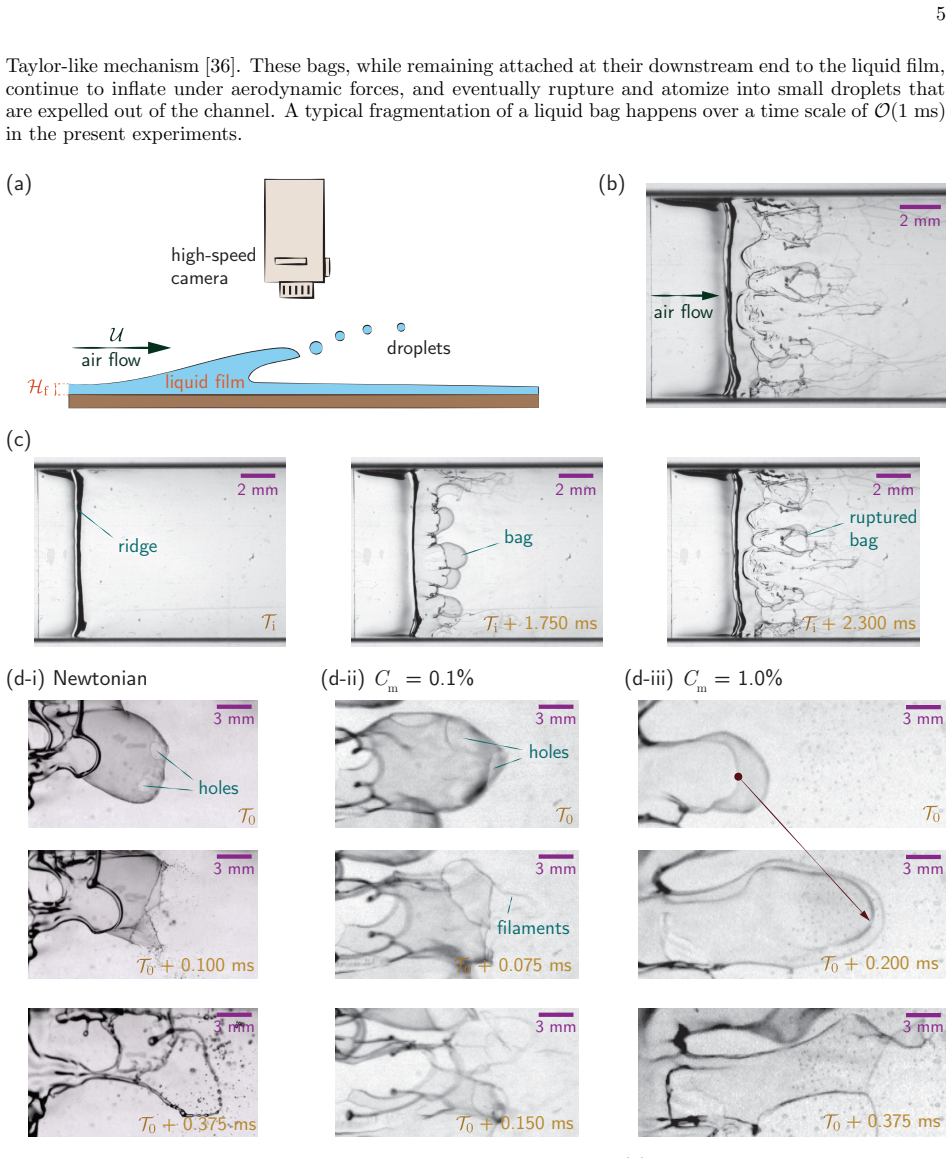
The central object is the inflated liquid bag: a thin sheet of liquid stretched between a rim and the still-intact film by aerodynamic pressure, which eventually pops through nucleated holes whose rims retract and shed droplets. Bag size just before rupture sets sheet thickness, and sheet thickness sets the droplet size produced by rim retraction; the paper uses the bag-inflation scaling $L\sim T^2$ to connect longer bag lifetime to larger bag size. Viscoelasticity enters through the Oldroyd-B constitutive model with polymer relaxation time $\lambda$ and elastoinertial number $\Pi$, and the uniformity of thinning is quantified by the mean-squared deviation $\hat{\sigma}^2$ of the local sheet thickness about its minimum: larger Weissenberg number lowers $\hat{\sigma}^2$, meaning bags thin more evenly and survive longer. This chain of objects—bag, hole, Taylor-Culick rim, thickness variance—carries the argument.
What would settle it
Measure the complete droplet-size distribution, including the large-droplet fraction, at the channel exit and at several downstream positions for water and for the polymer solutions; if the mean diameter including all droplets does not decrease with polymer concentration, the central claim fails. Alternatively, a three-dimensional simulation of viscoelastic bag rupture that resolves hole growth without mesh-limited breakup and yields equal or larger droplets at nonzero Weissenberg number would refute the thickness-controlled mechanism.
Extended reading notes
Core claim
The paper claims that viscoelastic liquids and Newtonian liquids fragment by the same bag-mediated route in this shear-driven setup, and that the only difference—larger, longer-lived bags in the viscoelastic case—is enough to shift the droplet-size distribution. The proposed mechanism is a chain: polymer relaxation stretches the bag in a more spatially uniform way, so the bag reaches a greater size before the first hole appears; a larger bag of the same liquid volume is a thinner sheet; and when holes open and the bounding rims retract in the Taylor-Culick fashion, thinner sheets emit smaller droplets. The experiments support each link by showing that bag length, width, and lifetime grow with polymer concentration, that the sheet-thickness profile becomes more uniform in Oldroyd-B simulations at higher Weissenberg number, and that the measured mean droplet diameter decreases with polymer concentration before rising again at concentrations where shear thinning appears. The paper presents this as the mechanism by which mucosalivary viscoelasticity controls the expelled aerosol size distribution.
Load-bearing premise
The load-bearing premise is that the single-point droplet measurement 15 cm downstream samples Newtonian and viscoelastic fluids with the same bias, so that the recorded shift toward smaller mean diameters reflects a real change in atomization rather than a change in how many large droplets fall out of the puff before they are counted.
Editorial extensions
If this is right
- Mucus viscoelasticity should be treated as a first-order input to respiratory aerosol size predictions, alongside surface tension and viscosity.
- A modest elastic response can produce droplets near 10 µm at low Ohnesorge number, matching sizes that Newtonian fluids reach only at much higher viscosity.
- The non-monotonic behavior at higher polymer concentration suggests that shear thinning or other high-concentration rheology can partially undo the elastic size reduction.
- Mitigation strategies that modify airway-lining fluid properties would be expected to change the airborne small-droplet fraction rather than only the total amount of expelled liquid.
- Bag-mediated atomization models for Newtonian sheets should be extended to include a relaxation time to capture elongated bag shapes and downstream droplet sizes.
Reading between the lines
- The droplet statistics come from a single measurement point 15 cm downstream that preferentially captures small airborne droplets; the size reduction could be partly an artifact if viscoelasticity causes more large droplets to fall out before reaching that point, a bias the paper acknowledges but does not quantify.
- A natural extension is to measure the full size distribution at multiple downstream stations or at the channel exit, which would separate true size reduction from differential settling of large droplets.
- The same chain—elastic stretching, thinner bags, smaller rim-retraction droplets—should apply to other sheared viscoelastic films, for example sea-spray generation or industrial atomization of polymer solutions, where analogous large-bag structures are observed.
- Real mucus contains mucin networks, salts, and surfactants, so dilute polyethylene-oxide solutions isolate only the elasticity; how mucin-specific rheology, including strain hardening and heterogeneity, shifts the droplet spectrum remains open.
Editorial analysis
A structured set of objections, weighed in public.
Referee Report
Summary. The manuscript investigates how polymer-induced viscoelasticity modifies the shear-driven fragmentation of a thin liquid film in a model 'cough machine' (a 30 cm rectangular channel with a 1 mm film sheared by a pulsed 30 m/s airflow). Experiments with PEO solutions (Cm = 0.05-1.00% by mass) show that fragmentation still occurs through the bag-breakup mode, but the bags are longer, wider, and longer-lived than for a Newtonian liquid (Fig. 3). Phase-Doppler anemometry at 15 cm downstream of the channel exit reports a decrease of the mean droplet diameter from about 20 µm (pure water) to about 10 µm for Cm = 0.10-0.20%, a slight reversal at Cm = 0.50% (attributed to shear thinning), and no droplet detections at Cm = 1.00% (filament-dominated expulsion). The proposed mechanism is that viscoelasticity produces thinner and more uniformly thick bag sheets, so that rim retraction at rupture generates smaller droplets. Axisymmetric Oldroyd-B/volume-of-fluid simulations (Basilisk) of a droplet in an impulsively started airflow, run at Wi = 1 with a trial-and-error-selected elastoinertial number Π = 0.001, show more uniform bag thinning quantified by the mean-squared deviation σ̂² of the thickness profile and are presented as numerical support for this mechanism.
Significance. If the main claim holds, the paper provides a clean experimental demonstration in a regime (bag breakup of a sheared film in a confined geometry) where most prior work on viscoelastic atomization concerned higher-Weber-number modes and generally reported droplet-size increases with polymer concentration. The cough-machine geometry makes the result directly relevant to bioaerosol generation. Strengths: (i) the bag size and lifetime data (Fig. 3) come from direct high-speed imaging and are robust to the PDA sampling criticism; (ii) the fluid characterization (shear rheology, surface tension, capillary-thinning relaxation times; Fig. 1 and Table I) is careful and reproducible; (iii) the simulations use a well-established code (Basilisk) with the log-conformation formulation, and the σ̂² metric is a sensible quantifier of thinning uniformity; (iv) the authors are transparent about the PDA sampling bias, the trial-and-error choice of Π, and the shear-thinning complications at high Cm.
major comments (4)
- [Section II.A and Section III.C; Fig. 4] The central quantitative claim that viscoelasticity reduces the expelled droplet size rests on PDA distributions measured at a single point, 15 cm downstream of the channel exit along the centerline. As the authors acknowledge in Section II.A, this location preferentially samples droplets that remain airborne while larger droplets fall out ballistically; what is not demonstrated is that the sampled fraction is independent of polymer concentration. Section III.A reports rim-retraction droplets larger than 200 µm for all cases, and for Cm = 1.00% the expelled liquid is mostly filaments with no PDA detections (Section III.C), showing that the partition of expelled mass between the PDA-detectable and the sedimenting populations changes qualitatively with Cm. If, in the 0.05-0.20% range, increasing Cm also shifts more volume into the large-droplet or ligament fraction, the measured decrease of the mean diameter at 15 cm would reflect preferential removal of the large fraction rather than an intrinsic reduction of the droplet sizes generated at rupture. This is exactly the assumption invoked in Section III.C to reconcile the present trend with the opposite trend reported in earlier viscoelastic atomization studies; it should be tested rather than assumed. I request a quantitative assessment of the sampling bias, for instance high-speed imaging of the droplet field near the channel exit with size statistics for both populations, a mass-flux-weighted comparison, or PDA measurements at multiple downstream positions, for at least one Boger case and the Newtonian baseline.
- [Section IV.B; Figs. 6 and 7] The numerical support for the proposed mechanism is weaker than presented because the simulation parameters are not consistent with the measured rheology. The manuscript states that Π = 0.001 was 'decided after some trial-and-error iterations to best showcase the viscoelastic response of the liquid'. More importantly, an estimate from the characterization data conflicts with that choice: using the polymer viscosity ηp = ηN − ηs (Table I) and the measured relaxation times, the Oldroyd-B modulus G = ηp/λ equals roughly 1.2-6.6 Pa over the concentration range, so Π = G/(ρlU²) ≈ 1-8 × 10⁻⁶ at U = 30 m/s, i.e., two to three orders of magnitude below the simulated value of 10⁻³. Since the paper itself notes that 'too low a value' of Π yields a Newtonian-like response, a simulation at the physically estimated Π would probably not reproduce the strongly viscoelastic thinning reported in Fig. 7b. The Wi comparison is less clear-cut (using the film timescale of Section III.B gives Wi ≈ 0.4, while the droplet radius implicit in We_d = 7.5 Γρ of Section IV.A gives Wi ≈ 10-20), but the Π mismatch is robust to the choice of length scale. The simulations should either adopt rheology-based dimensionless parameters or be explicitly presented as qualitative illustrations, with a sensitivity study over Π spanning the estimated range, and the statement of 'complete agreement with our experimental findings' should be correspondingly qualified.
- [Section III.B, Section III.C, and Conclusions] The mechanism advanced in the conclusions, namely that 'thinner bags of comparatively more uniform thickness' produce smaller droplets, has no direct experimental measurement of bag thickness at rupture. The experiments connect polymer concentration to bag length, width, and lifetime (Fig. 3) and to PDA droplet size (Fig. 4), but the intermediate step, the sheet thickness, is inferred rather than measured. This inference is not forced by volume conservation, because the bags remain attached to the liquid film while inflating (Fig. 2a), so their volume is not fixed and larger Lb and Wb do not strictly imply a smaller thickness. The only direct evidence for a thinner and more uniform sheet comes from the simulations whose parameters are questioned in the preceding comment. The authors should measure or estimate the bag thickness for at least one viscoelastic and one Newtonian case (for example by transmitted-light intensity or a calibrated optical method), or explicitly state that the thickness reduction is an inference supported only qualitatively by the simulations and by the capillary-thinning filament data of Fig. 1d.
- [Section III.B and Section III.C] The proposed causal chain (higher Cm → larger bags → thinner sheets → smaller droplets) is not monotonic at the upper end of the explored concentration range. At Cm = 1.00% the bags are the largest (Figs. 3a-3b), yet no droplets are detected by the PDA (Section III.C), and at Cm = 0.50% the mean droplet diameter increases relative to Cm = 0.20% (Fig. 4a) while the bags remain larger than in the dilute cases. The paper attributes both departures to shear thinning, but the shear-rate dependence in the atomization range is not measured (Fig. 1c) and no mechanistic account of the reversal is given. The central claim as stated in the abstract and the conclusions is therefore established only for the dilute Boger regime (Cm ≤ 0.20%); the manuscript should either explicitly limit its conclusions to that regime or provide a quantitative explanation of the shear-thinning crossover.
minor comments (8)
- [Section III.C, Fig. 4a] The mean diameters in Fig. 4a are shown without uncertainty intervals or sample counts; please report the number of validated PDA samples per concentration and add percentile or bootstrap intervals as in Fig. 4b.
- [Section III.B] The printed formula for the bag lifetime scale, τf = Hf sqrt(Γρ/U), is dimensionally inconsistent; presumably the intended expression is τf = Hf sqrt(Γρ)/U (as in Ref. 48), and the formula should be corrected.
- [Fig. 7b] The color code in Fig. 7b is not decoded in the caption; please list the Wi values corresponding to each curve.
- [Section III.C] The attribution of the Cm = 0.50% reversal of the mean droplet diameter to shear thinning is plausible but untested, since the viscosity curves in Fig. 1c do not reach the shear-rate range of the atomization event and no shear-thinning inelastic control fluid is included; the text could note explicitly that the high-shear viscosity in the relevant range is unknown.
- [Section II.B and Section V] Because the polymeric solutions have γ = 62 mN/m while the pure-water baseline has γ = 72 mN/m, the film Weber number differs between baseline and polymeric cases (We_f ≈ 17 vs ≈ 15); a sentence acknowledging this small variation would clarify the comparison with the Newtonian data of Kant et al.
- [Section IV.A, Eq. (7)] The normalization of σ̂² shown in Fig. 7b is not specified; please state whether it is normalized by the droplet radius squared or by another reference length.
- [Fig. 3d] The solid line in Fig. 3d indicates Lb ~ Tb²; please state whether this is a fit to the data or the theoretical law of Ref. 48 with the constant taken from theory.
- [Section III.A, Fig. 2] The panel labels of Fig. 2 are inconsistent between the caption (which lists both b-i/ii/iii and d-i/ii/iii) and the text (which refers to 'figure 2b-iii' for the arrow); please harmonize the panel labels and the arrow reference.
Circularity Check
No significant circularity: the central droplet-size finding is experimentally independent, and the simulation's trial-and-error parameter is a regime choice rather than a fit of the claimed result.
full rationale
The central conclusion that increasing polymer concentration shifts the expelled droplet size distribution to smaller diameters is based on direct PDA measurements (Fig. 4), which are independent of the simulations and of the authors' prior Newtonian study. The numerical part is used to illustrate a mechanism: in Oldroyd-B simulations, higher Wi gives more uniform bag thinning, leading to thinner bags and, through the known thickness-to-droplet-size relation, smaller drops. The elastoinertial number Pi is admittedly chosen by trial-and-error to 'best showcase the viscoelastic response' (Sec. IV.B), but this is a regime selection (too low Pi is Newtonian-like, too high Pi suppresses deformation), not a fitting of the droplet-size outcome; the decrease of the uniformity metric sigma-hat^2 with Wi is an emergent model result. Citations to Kant et al. [36] provide the Newtonian baseline and bag-breakup mechanism from a separate experimental study, and are not used as an unverified axiom. The acknowledged single-point PDA sampling bias at 15 cm (Sec. II.A) is a genuine experimental limitation for comparing Newtonian and viscoelastic sprays, but it is a validity concern, not a circular derivation. No fitted parameter is renamed as a prediction, and no equation reduces to its own input; hence there is no significant circularity, only minor caveats that do not affect the independent experimental claim.
Assumptions & free parameters
free parameters (2)
- Elastoinertial number Pi =
0.001
- Weissenberg number Wi =
1.00
assumptions (5)
- domain assumption Oldroyd-B model adequately represents the PEO solutions used in the experiments.
- domain assumption An axisymmetric droplet in an impulsively started uniform air flow is a faithful surrogate for the sheared film bags in the confined cough-machine channel.
- domain assumption Droplet size produced during bag rupture is set by local liquid sheet thickness, with thinner sheets yielding smaller droplets.
- domain assumption PEO solutions at low concentrations are representative of mucosalivary fluid viscoelasticity.
- domain assumption PDA sampling at 15 cm downstream centerline captures the aerosol population relevant to the claim, despite preferential detection of small droplets.
Cite this review
Pith. "Pith review of Viscoelasticity reduces the droplet size in mucosalivary film fragmentation during intense respiratory events." pith.science (2026). https://pith.science/paper/ZV2HH6DQ
@misc{pith2026250205105,
  author       = {Pith},
  title        = {Pith review of: Viscoelasticity reduces the droplet size in mucosalivary film fragmentation during intense respiratory events},
  year         = {2026},
  howpublished = {\url{https://pith.science/paper/ZV2HH6DQ}},
  note         = {Machine review of arXiv:2502.05105}
}
read the original abstract
We examine the fundamental fluid dynamical mechanisms dictating the generation of bioaerosols in the human trachea during intense respiratory events such as coughing and sneezing, with an emphasis on the role played by the mucosalivary fluid viscoelasticity. An experimental investigation of the shear-induced fragmentation of a mucosalivary-mimetic fluid in a confined geometry reveals that viscoelastic liquids undergo atomization in a manner akin to Newtonian liquids -- via the formation of bag-like structures -- which ultimately rupture through the appearance of retracting holes on the bag surface. Droplets are produced via the unstable retraction of liquid rims bounding these holes. However, in comparison to Newtonian liquids, viscoelastic bags inflate to larger sizes -- implying thinner sheets and, consequently smaller droplets upon rupture. Numerical simulations support that the smaller droplets can be attributed to the thinner sheets, with a more uniform thickness, for viscoelastic bags prior to rupture. Hence, we highlight the role of the viscoelasticity in determining the thickness of the intermediate bag-like structures, which, in turn, govern the droplet size distribution of the expelled aerosol.
Figures


Figures from the paper (4 more)


Reference graph
Works this paper leans on
-
[1]
X. Xie, Y. Li, H. Sun, and L. Liu, Exhaled droplets due to talking and coughing, J. R. Soc. Interface (2009)
2009
-
[2]
Bourouiba, E
L. Bourouiba, E. Dehandschoewercker, and J. W. M. Bush, Violent expiratory events: on coughing and sneezing, J. Fluid Mech. 745, 537 (2014)
2014
-
[3]
B. E. Scharfman, A. H. Techet, J. W. M. Bush, and L. Bourouiba, Visualization of sneeze ejecta: steps of fluid fragmentation leading to respiratory droplets, Exp. Fluids 57, 1 (2016)
2016
-
[4]
Abkarian, S
M. Abkarian, S. Mendez, N. Xue, F. Yang, and H. A. Stone, Speech can produce jet-like transport relevant to asymptomatic spreading of virus, Proc. Natl. Acad. Sci. 117, 25237 (2020)
2020
-
[5]
Bourouiba, The fluid dynamics of disease transmission, Annu
L. Bourouiba, The fluid dynamics of disease transmission, Annu. Rev. Fluid Mech. 53, 473 (2021). 14
2021
-
[6]
Bourrianne, N
P. Bourrianne, N. Xue, J. Nunes, M. Abkarian, and H. A. Stone, Quantifying the effect of a mask on expiratory flows, Phys. Rev. Fluids 6, 110511 (2021)
2021
-
[7]
Bourrianne, P
P. Bourrianne, P. R. Kaneelil, M. Abkarian, and H. A. Stone, Air flows in opera, Phys. Rev. Appl. 18, 024042 (2022)
2022
-
[8]
A. L. Nord, P. Dosset, P. Slangen, and M. Abkarian, Digital in-line holography to explore saliva aerosolization mechanisms in speech, J. Aerosol Sci. 175, 106282 (2024)
2024
Show all 134 references
-
[9]
W. F. Wells and M. W. Wells, Air-borne infection, J. Am. Med. Assoc. 107, 1698 (1936)
1936
-
[10]
R. M. Jones and L. M. Brosseau, Aerosol transmission of infectious disease, J. Occup. Environ. Med. 57, 501 (2015)
2015
-
[11]
Fiegel, R
J. Fiegel, R. Clarke, and D. A. Edwards, Airborne infectious disease and the suppression of pulmonary bioaerosols, Drug Discov. Today 11, 51 (2006)
2006
-
[12]
Bourouiba, A sneeze, New Engl
L. Bourouiba, A sneeze, New Engl. J. Med. 375, e15 (2016)
2016
-
[13]
Abkarian and H
M. Abkarian and H. A. Stone, Stretching and break-up of saliva filaments during speech: a route for pathogen aerosolization and its potential mitigation, Phys. Rev. Fluids 5, 102301 (2020)
2020
-
[14]
M. L. P¨ ohlker, C. P¨ ohlker, O. O. Kr¨ uger, J.-D. F¨ orster, T. Berkemeier, W. Elbert, J. Fr¨ ohlich-Nowoisky, U. P¨ oschl, G. Bagheri, E. Bodenschatz, J. A. Huffman, S. Scheithauer, and E. Mikhailov, Respiratory aerosols and droplets in the transmission of infectious disea...
2023
-
[15]
B. T. Gidreta and H. Kim, Effects of physical property changes of expelled respiratory liquid on atomization morphology, J. Fluid Mech. 960, A10 (2023)
2023
-
[16]
Bourouiba, Turbulent gas clouds and respiratory pathogen emissions: potential implications for reducing transmission of COVID-19, J
L. Bourouiba, Turbulent gas clouds and respiratory pathogen emissions: potential implications for reducing transmission of COVID-19, J. Am. Med. Assoc. 323, 1837 (2020)
2020
-
[17]
Mittal, R
R. Mittal, R. Ni, and J.-H. Seo, The flow physics of COVID-19, J. Fluid Mech. 894, F2 (2020)
2020
-
[18]
G. A. Somsen, C. van Rijn, S. Kooij, R. A. Bem, and D. Bonn, Small droplet aerosols in poorly ventilated spaces and SARS-CoV-2 transmission, Lancet Respir. Med. 8, 658 (2020)
2020
-
[19]
C. C. Wang, K. A. Prather, J. Sznitman, J. L. Jimenez, S. S. Lakdawala, Z. Tufekci, and L. C. Marr, Airborne transmission of respiratory viruses, Science 373, eabd9149 (2021)
2021
-
[20]
R. Yang, C. S. Ng, K. L. Chong, R. Verzicco, and D. Lohse, Do increased flow rates in displacement ventilation always lead to better results?, J. Fluid Mech. 932, A3 (2022)
2022
-
[21]
R. E. Stockwell, E. L. Ballard, P. O’Rourke, L. D. Knibbs, L. Morawska, and S. C. Bell, Indoor hospital air and the impact of ventilation on bioaerosols: a systematic review, J. Hosp. Infect. 103, 175 (2019)
2019
-
[22]
Morawska, J
L. Morawska, J. W. Tang, W. Bahnfleth, P. M. Bluyssen, A. Boerstra, G. Buonanno, J. Cao, S. Dancer, A. Floto, F. Franchimon, C. Haworth, J. Hogeling, C. Isaxon, J. L. Jimenez, J. Kurnitski, Y. Li, M. Loomans, G. Marks, L. C. Marr, L. Mazzarella, A. K. Melikov, S. Miller, D. K....
2020
-
[23]
Morawska, J
L. Morawska, J. Allen, W. Bahnfleth, P. M. Bluyssen, A. Boerstra, G. Buonanno, J. Cao, S. J. Dancer, A. Floto, F. Franchimon, T. Greenhalgh, C. Haworth, J. Hogeling, C. Isaxon, J. L. Jimenez, J. Kurnitski, Y. Li, M. Loomans, G. Marks, L. C. Marr, L. Mazzarella, A. K. Melikov, ...
2021
-
[24]
C. S. Ng, K. L. Chong, R. Yang, M. Li, R. Verzicco, and D. Lohse, Growth of respiratory droplets in cold and humid air, Phys. Rev. Fluids 6, 054303 (2021)
2021
-
[25]
K. L. Chong, C. S. Ng, N. Hori, R. Yang, R. Verzicco, and D. Lohse, Extended lifetime of respiratory droplets in a turbulent vapor puff and its implications on airborne disease transmission, Phys. Rev. Lett. 126, 034502 (2021)
2021
-
[26]
W. F. Wells, On air-borne infection. Study II. Droplets and droplet nuclei, Am. J. Epidemiol. 20, 611 (1934)
1934
-
[27]
J. P. Duguid, The size and the duration of air-carriage of respiratory droplets and droplet-nuclei, Epidemiol. Infect. 44, 471 (1946)
1946
-
[28]
R. G. Loudon and R. M. Roberts, Relation between the airborne diameters of respiratory droplets and the diameter of the stains left after recovery, Nature 213, 95 (1967)
1967
-
[29]
C. Y. H. Chao, M. P. Wan, L. Morawska, G. R. Johnson, Z. D. Ristovski, M. Hargreaves, K. Mengersen, S. Cor- bett, Y. Li, X. Xie, and D. Katoshevski, Characterization of expiration air jets and droplet size distributions immediately at the mouth opening, J. Aerosol Sci. 40, 122 (2009)
2009
-
[30]
D. A. Edwards, J. C. Man, P. Brand, J. P. Katstra, K. Sommerer, H. A. Stone, E. Nardell, and G. Scheuch, Inhaling to mitigate exhaled bioaerosols, Proc. Natl. Acad. Sci. 101, 17383 (2004)
2004
-
[31]
Wei and Y
J. Wei and Y. Li, Airborne spread of infectious agents in the indoor environment, Am. J. Infect. Control 44, S102 (2016)
2016
-
[32]
G. R. Johnson and L. Morawska, The mechanism of breath aerosol formation, J. Aerosol Med. Pulm. Drug Deliv. 22, 229 (2009)
2009
-
[33]
Vasudevan and C
M. Vasudevan and C. F. Lange, Property dependence of onset of instability in viscoelastic respiratory fluids, Int. J. Eng. Sci. 43, 1292 (2005). 15
2005
-
[34]
J. A. Moriarty and J. B. Grotberg, Flow-induced instabilities of a mucus–serous bilayer, J. Fluid Mech. 397, 1 (1999)
1999
-
[35]
L. Morawska, Droplet fate in indoor environments, or can we prevent the spread of infection?, in Indoor Air 2005: Proceedings of the 10th International Conference on Indoor Air Quality and Climate (Tsinghua University Press, 2005) pp. 9–23
2005
-
[36]
P. Kant, C. Pairetti, Y. Saade, S. Popinet, S. Zaleski, and D. Lohse, Bag-mediated film atomization in a cough machine, Phys. Rev. Fluids 8, 074802 (2023)
2023
-
[37]
M. King, G. Brock, and C. Lundell, Clearance of mucus by simulated cough, J. Appl. Physiol. 58, 1776 (1985)
1985
-
[38]
S. W. Clarke, J. G. Jones, and D. R. Oliver, Resistance to two-phase gas-liquid flow in airways., J. Appl. Physiol. 29, 464 (1970)
1970
-
[39]
Marcotte and S
F. Marcotte and S. Zaleski, Density contrast matters for drop fragmentation thresholds at low Ohnesorge number, Phys. Rev. Fluids 4, 103604 (2019)
2019
-
[40]
Pairetti, R
C. Pairetti, R. Villiers, and S. Zaleski, On shear layer atomization within closed channels: Numerical simulations of a cough-replicating experiment, Comput. Fluids 231, 105125 (2021)
2021
-
[41]
Kulkarni, C
Y. Kulkarni, C. Pairetti, R. Villiers, S. Popinet, and S. Zaleski, The atomizing pulsed jet, J. Fluid Mech. 1009, A35 (2025)
2025
-
[42]
N. Shen, Y. Kulkarni, T. Jamin, S. Popinet, S. Zaleski, and L. Bourouiba, Fragmentation from inertial detach- ment of a sessile droplet: implications for pathogen transport, J. Fluid Mech. 1002, A6 (2025)
2025
-
[43]
C. A. Evrensel, M. R. U. Khan, S. Elli, and P. E. Krumpe, Viscous airflow through a rigid tube with a compliant lining: a simple model for the air-mucus interaction in pulmonary airways, J. Biomed. Eng. 115, 262 (1993)
1993
-
[44]
B. Bake, P. Larsson, G. Ljungkvist, E. Ljungstr¨ om, and A.-C. Olin, Exhaled particles and small airways, Respir. Res. 20, 8 (2019)
2019
-
[45]
D. C. Blanchard, The electrification of the atmosphere by particles from bubbles in the sea, Prog. Oceanogr. 1, 73 (1963)
1963
-
[46]
P. J. Basser, T. A. McMahon, and P. Griffith, The mechanism of mucus clearance in cough, J. Biomech. Eng. 111, 288 (1989)
1989
-
[47]
Bremond and E
N. Bremond and E. Villermaux, Bursting thin liquid films, J. Fluid Mech. 524, 121 (2005)
2005
-
[48]
Villermaux and B
E. Villermaux and B. Bossa, Single-drop fragmentation determines size distribution of raindrops, Nat. Phys. 5, 697 (2009)
2009
-
[49]
Vledouts, J
A. Vledouts, J. Quinard, N. Vandenberghe, and E. Villermaux, Explosive fragmentation of liquid shells, J. Fluid Mech. 788, 246 (2016)
2016
-
[50]
Villermaux, Fragmentation versus cohesion, J
E. Villermaux, Fragmentation versus cohesion, J. Fluid Mech. 898, P1 (2020)
2020
-
[51]
Jalaal and K
M. Jalaal and K. Mehravaran, Fragmentation of falling liquid droplets in bag breakup mode, Int. J. Multiphase Fl. 47, 115 (2012)
2012
-
[52]
J. O. Hinze, Fundamentals of the hydrodynamic mechanism of splitting in dispersion processes, AIChE J. 1, 289 (1955)
1955
-
[53]
T. G. Theofanous, Aerobreakup of Newtonian and viscoelastic liquids, Annu. Rev. Fluid Mech. 43, 661 (2011)
2011
-
[54]
I. M. Jackiw and N. Ashgriz, On aerodynamic droplet breakup, J. Fluid Mech. 913, A33 (2021)
2021
-
[55]
N. K. Chandra, S. Sharma, S. Basu, and A. Kumar, Aerodynamic bag breakup of a polymeric droplet, Phys. Rev. Fluids 9, 113303 (2024)
2024
-
[56]
D. R. Guildenbecher, C. L´ opez-Rivera, and P. E. Sojka, Secondary atomization, Exp. Fluids 46, 371 (2009)
2009
-
[57]
Zhao, H.-F
H. Zhao, H.-F. Liu, W.-F. Li, and J.-L. Xu, Morphological classification of low viscosity drop bag breakup in a continuous air jet stream, Phys. Fluids 22, 114103 (2010)
2010
-
[58]
S. A. Krzeczkowski, Measurement of liquid droplet disintegration mechanisms, Int. J. Multiphase Fl. 6, 227 (1980)
1980
-
[59]
L. P. Hsiang and G. M. Faeth, Near-limit drop deformation and secondary breakup, Int. J. Multiphase Fl. 18, 635 (1992)
1992
-
[60]
Varkevisser, S
T. Varkevisser, S. Kooij, E. Villermaux, and D. Bonn, Effect of high wind speeds on droplet formation in sprays, J. Fluid Mech. 1000, A86 (2024)
2024
-
[61]
Veron, C
F. Veron, C. Hopkins, E. L. Harrison, and J. A. Mueller, Sea spray spume droplet production in high wind speeds, Geophys. Res. Lett. 39 (2012)
2012
-
[62]
Troitskaya, A
Y. Troitskaya, A. Kandaurov, O. Ermakova, D. Kozlov, D. Sergeev, and S. Zilitinkevich, Bag-breakup fragmen- tation as the dominant mechanism of sea-spray production in high winds, Sci.Rep. 7, 1614 (2017)
2017
-
[63]
Villermaux, X
E. Villermaux, X. Wang, and L. Deike, Bubbles spray aerosols: Certitudes and mysteries, PNAS Nexus 1, 1 (2022)
2022
-
[64]
Deike, Mass transfer at the ocean-atmosphere interface: The role of wave breaking, droplets, and bubbles, Annu
L. Deike, Mass transfer at the ocean-atmosphere interface: The role of wave breaking, droplets, and bubbles, Annu. Rev. Fluid Mech. 54, 191 (2022)
2022
-
[65]
E. P. Vejerano and L. C. Marr, Physico-chemical characteristics of evaporating respiratory fluid droplets, J. R. Soc. Interface 15, 20170939 (2018)
2018
-
[66]
Bastola, P
R. Bastola, P. M. Young, and S. C. Das, Simulation of respiratory tract lining fluid for in vitro dissolution study, Expert Opin. Drug Deliv. 18, 1091 (2021). 16
2021
-
[67]
Seyfert, J
C. Seyfert, J. Rodr ´ ıguez-Rodr ´ ıguez, D. Lohse, and A. Marin, Stability of respiratory-like droplets under evapo- ration, Phys. Rev. Fluids 7, 023603 (2022)
2022
-
[68]
Anwarul Hasan, C
M. Anwarul Hasan, C. F. Lange, and M. L. King, Effect of artificial mucus properties on the characteristics of airborne bioaerosol droplets generated during simulated coughing, J. Non-Newton. Fluid Mech. 165, 1431 (2010)
2010
-
[69]
Hamed, D
R. Hamed, D. M. Schenck, and J. Fiegel, Surface rheological properties alter aerosol formation from mucus mimetic surfaces, Soft Matter 16, 7823 (2020)
2020
-
[70]
Rodr ´ ıguez-Hakim, L
M. Rodr ´ ıguez-Hakim, L. R¨ az, and J. Vermant, Variations in human saliva viscoelasticity affect aerosolization propensity, Soft Matter 18, 2528 (2022)
2022
-
[71]
J. W. Hoyt, J. J. Taylor, and C. D. Runge, The structure of jets of water and polymer solution in air, J. Fluid Mech. 63, 635 (1974)
1974
-
[72]
Haessig, M
C. Haessig, M. Habibi, and U. Sen, Tunable self-emulsification via viscoelastic control of Marangoni-driven interfacial instabilities, arXiv:2504.11021 (2025)
2025 arXiv
-
[73]
J. D. Wilcox, R. K. June, H. A. Brown Jr., and R. C. Kelley Jr., The retardation of drop breakup in high-velocity airstreams by polymeric modifiers, J. Appl. Polym. Sci. 5, 1 (1961)
1961
-
[74]
N. K. Chandra, S. Sharma, S. Basu, and A. Kumar, Shock-induced aerobreakup of a polymeric droplet, J. Fluid Mech. 965, A1 (2023)
2023
-
[75]
Clasen, J
C. Clasen, J. Eggers, M. A. Fontelos, J. Li, and G. H. McKinley, The beads-on-string structure of viscoelastic threads, J. Fluid Mech. 556, 283 (2006)
2006
-
[76]
P. P. Bhat, S. Appathurai, M. T. Harris, M. Pasquali, G. H. McKinley, and O. A. Basaran, Formation of beads-on-a-string structures during break-up of viscoelastic filaments, Nat. Phys. 6, 625 (2010)
2010
-
[77]
Keshavarz, E
B. Keshavarz, E. C. Houze, J. R. Moore, M. R. Koerner, and G. H. McKinley, Ligament mediated fragmentation of viscoelastic liquids, Phys. Rev. Lett. 117, 154502 (2016)
2016
-
[78]
U. Sen, D. Lohse, and M. Jalaal, Elastocapillary Worthington jets, arXiv:2207.07928 (2022)
2022 arXiv
-
[79]
Albrecht, N
H.-E. Albrecht, N. Damaschke, M. Borys, and C. Tropea, Laser Doppler and phase Doppler measurement tech- niques (Springer Science & Business Media, 2013)
2013
-
[80]
H. H. Qiu and M. Sommerfeld, A reliable method for determining the measurement volume size and particle mass fluxes using phase-Doppler anemometry, Exp. Fluids 13, 393 (1992)
1992
-
[81]
Zussman, A
E. Zussman, A. Yarin, and R. Nagler, Age- and flow-dependency of salivary viscoelasticity, J. Dent. Res. 86, 281 (2007)
2007
-
[82]
S. K. Lai, Y.-Y. Wang, D. Wirtz, and J. Hanes, Micro- and macrorheology of mucus, Adv. Drug Deliv. Rev. 61, 86 (2009)
2009
-
[83]
S. J. Haward, J. A. Odell, M. Berry, and T. Hall, Extensional rheology of human saliva, Rheol. Acta 50, 869 (2011)
2011
-
[84]
C. E. Wagner and G. H. McKinley, Age-dependent capillary thinning dynamics of physically-associated salivary mucin networks, J. Rheol. 61, 1309 (2017)
2017
-
[85]
J. D. Berry, M. J. Neeson, R. R. Dagastine, D. Y. C. Chan, and R. F. Tabor, Measurement of surface and interfacial tension using pendant drop tensiometry, J. Colloid Interface Sci. 454, 226 (2015)
2015
-
[86]
C. E. Stauffer, The measurement of surface tension by the pendant drop technique, J. Phys. Chem. 69, 1933 (1965)
1965
-
[87]
F. K. Hansen and G. Rødsrud, Surface tension by pendant drop: I. a fast standard instrument using computer image analysis, J. Colloid Interface Sci. 141, 1 (1991)
1991
-
[88]
D. F. James, Boger fluids, Annu. Rev. Fluid Mech. 41, 129 (2009)
2009
-
[89]
Deblais, K
A. Deblais, K. P. Velikov, and D. Bonn, Pearling instabilities of a viscoelastic thread, Phys. Rev. Lett. 120, 194501 (2018)
2018
-
[90]
Deblais, M
A. Deblais, M. A. Herrada, J. Eggers, and D. Bonn, Self-similarity in the breakup of very dilute viscoelastic solutions, J. Fluid Mech. 904, R2 (2020)
2020
-
[91]
Eggers, M
J. Eggers, M. A. Herrada, and J. H. Snoeijer, Self-similar breakup of polymeric threads as described by the Oldroyd-B model, J. Fluid Mech. 887, A19 (2020)
2020
-
[92]
U. Sen, C. Datt, T. Segers, H. Wijshoff, J. H. Snoeijer, M. Versluis, and D. Lohse, The retraction of jetted slender viscoelastic filaments, J. Fluid Mech. 929, A25 (2021)
2021
-
[93]
D. W. Bousfield, R. Keunings, G. Marrucci, and M. M. Denn, Nonlinear analysis of the surface tension driven breakup of viscoelastic filaments, J. Non-Newton. Fluid Mech. 21, 79 (1986)
1986
-
[94]
S. L. Anna and G. H. McKinley, Elasto-capillary thinning and breakup of model elastic liquids, J. Rheol. 45, 115 (2001)
2001
-
[95]
Scardovelli and S
R. Scardovelli and S. Zaleski, Direct numerical simulation of free-surface and interfacial flow, Annu. Rev. Fluid Mech. 31, 567 (1999)
1999
-
[96]
Hoepffner, R
J. Hoepffner, R. Blumenthal, and S. Zaleski, Self-similar wave produced by local perturbation of the Kelvin- Helmholtz shear-layer instability, Phys. Rev. Lett. 106, 104502 (2011)
2011
-
[97]
Lohse and E
D. Lohse and E. Villermaux, Double threshold behavior for breakup of liquid sheets, Proc. Natl. Acad. Sci. 117, 18912 (2020)
2020
-
[98]
G. I. Taylor and D. H. Michael, On making holes in a sheet of fluid, J. Fluid Mech. 58, 625 (1973). 17
1973
-
[99]
Villermaux, Fragmentation, Annu
E. Villermaux, Fragmentation, Annu. Rev. Fluid Mech. 39, 419 (2007)
2007
-
[100]
A. L. Klein, D. Kurilovich, H. Lhuissier, O. O. Versolato, D. Lohse, E. Villermaux, and H. Gelderblom, Drop fragmentation by laser-pulse impact, J Fluid Mech. 893, A7 (2020)
2020
-
[101]
M. S. Bazzi and M. S. Carvalho, Effect of viscoelasticity on liquid sheet rupture, J. Non-Newton. Fluid Mech. 264, 107 (2019)
2019
-
[102]
Savva and J
N. Savva and J. W. M. Bush, Viscous sheet retraction, J. Fluid Mech. 626, 211 (2009)
2009
-
[103]
Lhuissier and E
H. Lhuissier and E. Villermaux, Bursting bubble aerosols, J. Fluid Mech. 696, 5 (2012)
2012
-
[104]
Sanjay, U
V. Sanjay, U. Sen, P. Kant, and D. Lohse, Taylor–Culick retractions and the influence of the surroundings, J. Fluid Mech. 948, A14 (2022)
2022
-
[105]
G. Y. Park and G. M. Harrison, Effects of elasticity on the spraying of a non-Newtonian fluid, At. Sprays 18, 243 (2008)
2008
-
[106]
Christanti and L
Y. Christanti and L. M. Walker, Quantifying air atomization of viscoelastic fluids through fluid relaxation times, At. Sprays 16, 777 (2006)
2006
-
[107]
J. C. Thompson and J. P. Rothstein, The atomization of viscoelastic fluids in flat-fan and hollow-cone spray nozzles, J. Non-Newton. Fluid Mech. 147, 11 (2007)
2007
-
[108]
A. M. Karim, W. J. Suszynski, W. B. Griffith, S. Pujari, L. F. Francis, and M. S. Carvalho, Effect of viscoelasticity on stability of liquid curtain, J. Non-Newton. Fluid Mech. 257, 83 (2018)
2018
-
[109]
Gaillard, R
A. Gaillard, R. Sijs, and D. Bonn, What determines the drop size in sprays of polymer solutions?, J. Non-Newton. Fluid Mech. 305, 104813 (2022)
2022
-
[110]
I. M. Jackiw and N. Ashgriz, Prediction of the droplet size distribution in aerodynamic droplet breakup, J. Fluid Mech. 940, A17 (2022)
2022
-
[111]
Keshavarz, V
B. Keshavarz, V. Sharma, E. C. Houze, M. R. Koerner, J. R. Moore, P. M. Cotts, P. Threlfall-Holmes, and G. H. McKinley, Studying the effects of elongational properties on atomization of weakly viscoelastic solutions using Rayleigh Ohnesorge Jetting Extensional Rheometry (ROJER...
2015
-
[112]
Eggers, Universal pinching of 3D axisymmetric free-surface flow, Phys
J. Eggers, Universal pinching of 3D axisymmetric free-surface flow, Phys. Rev. Lett. 71, 3458 (1993)
1993
-
[113]
D. T. Papageorgiou, On the breakup of viscous liquid threads, Physics of Fluids 7, 1529 (1995)
1995
-
[114]
Ting and J
L. Ting and J. B. Keller, Slender jets and thin sheets with surface tension, SIAM J. Appl. Math. 50, 1533 (1990)
1990
-
[115]
Amarouchene, D
Y. Amarouchene, D. Bonn, J. Meunier, and H. Kellay, Inhibition of finite-time singularity during droplet fission of a polymeric fluid, Phys. Rev. Lett. 86, 3558 (2001)
2001
-
[116]
Marmottant and E
P. Marmottant and E. Villermaux, Fragmentation of stretched liquid ligaments, Phys. Fluids 16, 2732 (2004)
2004
-
[117]
Reyssat, F
´E. Reyssat, F. Chevy, A.-L. Biance, L. Petitjean, and D. Qu´ er´ e, Shape and instability of free-falling liquid globules, Europhys. Lett. 80, 34005 (2007)
2007
-
[118]
Kulkarni and P
V. Kulkarni and P. E. Sojka, Bag breakup of low viscosity drops in the presence of a continuous air jet, Phys. Fluids 26, 072103 (2014)
2014
-
[119]
L. P. Hsiang and G. M. Faeth, Drop deformation and breakup due to shock wave and steady disturbances, Int. J. Multiphase Fl. 21, 545 (1995)
1995
-
[120]
R. B. Bird, C. F. Curtiss, R. C. Armstrong, and O. Hassager, Dynamics of Polymeric Liquids (John Wiley & Sons, 1987)
1987
-
[121]
J. G. Oldroyd, On the formulation of rheological equations of state, Proc. R. Soc. Lond. A 200, 523 (1950)
1950
-
[122]
A. K. Dixit, A. Oratis, K. Zinelis, D. Lohse, and V. Sanjay, Viscoelastic Worthington jets and droplets produced by bursting bubbles, J. Fluid Mech. 1010, A2 (2025)
2025
-
[123]
J. B. Bell, P. Colella, and H. M. Glaz, A second-order projection method for the incompressible navier-stokes equations, J. Comput. Phys. 85, 257 (1989)
1989
-
[124]
Popinet, A quadtree-adaptive multigrid solver for the Serre–Green–Naghdi equations, J
S. Popinet, A quadtree-adaptive multigrid solver for the Serre–Green–Naghdi equations, J. Comput. Phys. 302, 336 (2015)
2015
-
[125]
Saade, D
Y. Saade, D. Lohse, and D. Fuster, A multigrid solver for the coupled pressure-temperature equations in an all-Mach solver with VoF, J. Comput. Phys. 476, 111865 (2023)
2023
-
[126]
Fattal and R
R. Fattal and R. Kupferman, Constitutive laws for the matrix-logarithm of the conformation tensor, J. Non- Newton. Fluid Mech. 123, 281 (2004)
2004
-
[127]
Fattal and R
R. Fattal and R. Kupferman, Time-dependent simulation of viscoelastic flows at high Weissenberg number using the log-conformation representation, J. Non-Newton. Fluid Mech. 126, 23 (2005)
2005
-
[128]
J. M. L´ opez-Herrera, S. Popinet, and A. A. Castrej´ on-Pita, An adaptive solver for viscoelastic incompressible two-phase problems applied to the study of the splashing of weakly viscoelastic droplets, J. Non-Newton. Fluid Mech. 264, 144 (2019)
2019
-
[129]
J. U. Brackbill, D. B. Kothe, and C. Zemach, A continuum method for modeling surface tension, J. Comput. Phys. 100, 335 (1992)
1992
-
[130]
Popinet, An accurate adaptive solver for surface-tension-driven interfacial flows, J
S. Popinet, An accurate adaptive solver for surface-tension-driven interfacial flows, J. Comput. Phys. 228, 5838 (2009)
2009
-
[131]
Popinet, Gerris: a tree-based adaptive solver for the incompressible Euler equations in complex geometries, J
S. Popinet, Gerris: a tree-based adaptive solver for the incompressible Euler equations in complex geometries, J. Comput. Phys. 190, 572 (2003)
2003
-
[132]
Squire, Investigation of the instability of a moving liquid film, Br
H. Squire, Investigation of the instability of a moving liquid film, Br. J. Appl. Phys. 4, 167 (1953). 18
1953
-
[133]
Bremond, C
N. Bremond, C. Clanet, and E. Villermaux, Atomization of undulating liquid sheets, J. Fluid Mech. 585, 421 (2007)
2007
-
[134]
J. Wang, M. Alipour, G. Soligo, A. Roccon, M. De Paoli, F. Picano, and A. Soldati, Short-range exposure to airborne virus transmission and current guidelines, Proc. Natl. Acad. Sci. 118, e2105279118 (2021)
2021
Reviewed August 8, 2026 · model on record in the stance chip above.
Discussion (0). Continue with ORCID to comment.