REVIEW 3 major objections 4 minor 12 references
Imitation Learning from a Single Temporally Misaligned Video
T0 review · 3 major / 4 minor · reviewed 2026-08-08 · deepseek-v4-flash
Pith's one-line read Two sequences match, even under temporal misalignment, when one covers all of the other's subgoals in order; the paper builds a dense reward, ORCA, on that ordered-coverage criterion and shows it outperforms frame-level matching baselines.
desk verdict ORCA's ordered-coverage reward is a real idea and the Meta-world results hold up, but the Humanoid headline is misreported and the comparison is confounded. read the letter →
The pith
A machine-rendered reading of the paper's core claim, the machinery that carries it, and where it could break.
The reading
What carries the argument
The ordered coverage matrix $C_{t,j}$ with recurrence $C_{t,j} = \max\{C_{t-1,j}, C_{t,j-1}\exp(-\lambda d(o_t,\tilde{o}_j))\}$, where $d$ is a visual distance between frames and $\lambda$ a temperature set to 1; coverage of a later subgoal can never exceed coverage of earlier ones, and the final reward $C_{t,\tilde{T}-1}\exp(-\lambda d(o_t,\tilde{o}_{\tilde{T}}))$ requires the agent to have covered all earlier subgoals and currently occupy the last one. This mechanism turns the non-Markovian requirement of ordered progress into a per-timestep scalar computed by dynamic programming in $O(T\tilde{T})$ time, the same order as any frame-distance-based baseline.
What would settle it
Take any task from the paper and make two adjacent subgoals visually indistinguishable to the chosen encoder, for example by blurring or recoloring the object that distinguishes them; if an agent that skips the second subgoal earns the same cumulative ORCA reward as one that covers both, the ordered-coverage guarantee fails because the P_{t,j} term no longer separates subgoals.
Extended reading notes
Core claim
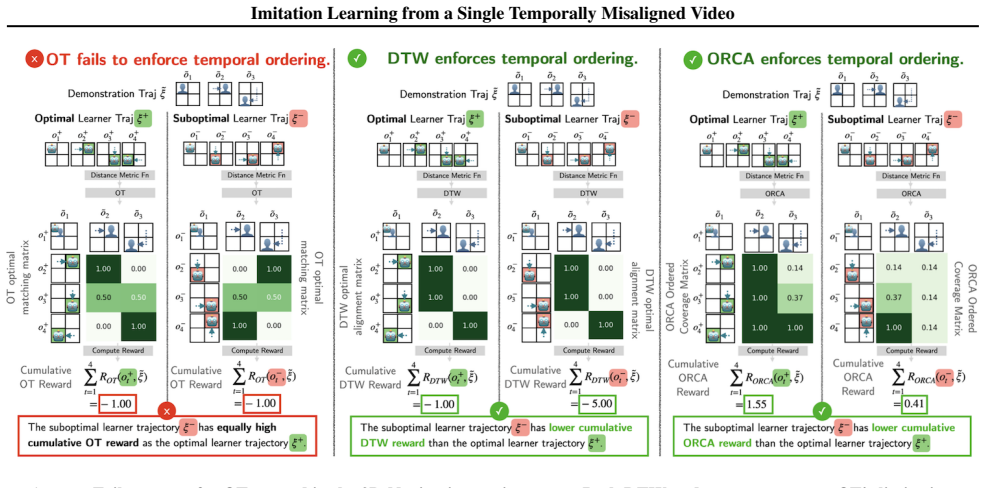
ORCA (ORdered Coverage Alignment) defines ordered coverage between a learner trajectory and a demonstration as the probability that the learner has covered each demonstration frame as a subgoal in the correct order. The coverage matrix $C_{t,j}$ is computed by dynamic programming as $C_{t,j} = \max\{C_{t-1,j}, C_{t,j-1}P_{t,j}\}$, where $P_{t,j} = \exp(-\lambda d(o_t, \tilde{o}_j))$ estimates the probability that the learner occupies subgoal $j$ at time $t$. The per-timestep reward is $C_{t,\tilde{T}-1}P_{t,\tilde{T}}$: the probability that all prior subgoals are covered and the learner currently occupies the final subgoal. The paper proves that this reward strictly prefers an in-order trajectory over an out-of-order one and a trajectory that progresses to the next subgoal over one that stalls, thereby satisfying the two desiderata of subgoal ordering and subgoal coverage; it also gives counterexamples showing optimal transport, dynamic time warping, and TemporalOT each violate one of these desiderata on misaligned demonstrations. Empirically, ORCA-trained policies outperform all frame-level matching baselines on Meta-world and Humanoid tasks with temporally misaligned demonstrations.
Load-bearing premise
ORCA assumes that the probability a learner occupies a demonstration subgoal is read off from a fixed visual similarity score, exp(-lambda d(o_t, o_tilde_j)), so if the visual encoder cannot tell two subgoals apart, the reward has no signal.
Editorial extensions
If this is right
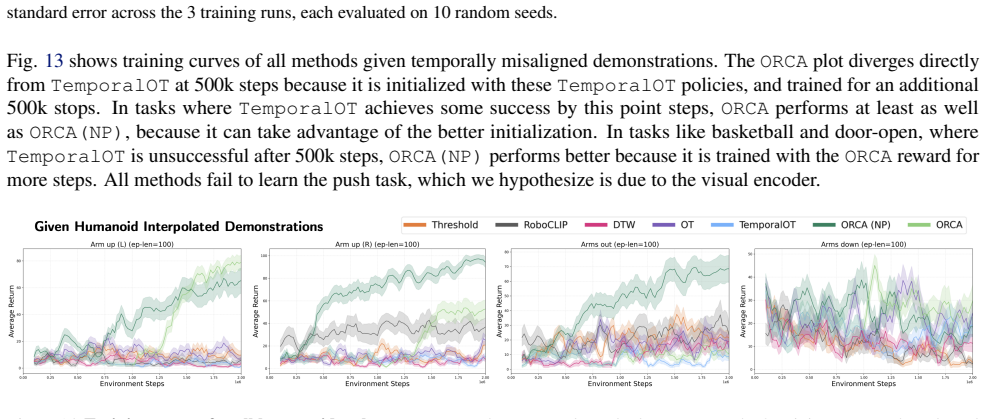
- Agents trained with ORCA outperform the best frame-level matching algorithms on temporally misaligned demonstrations, improving average normalized returns from 0.11 to 0.50 on Meta-world and average returns from 6.55 to 43.3 on Humanoid-v4.
- ORCA remains robust as temporal misalignment increases, whereas TemporalOT's performance degrades sharply with any degree of misalignment.
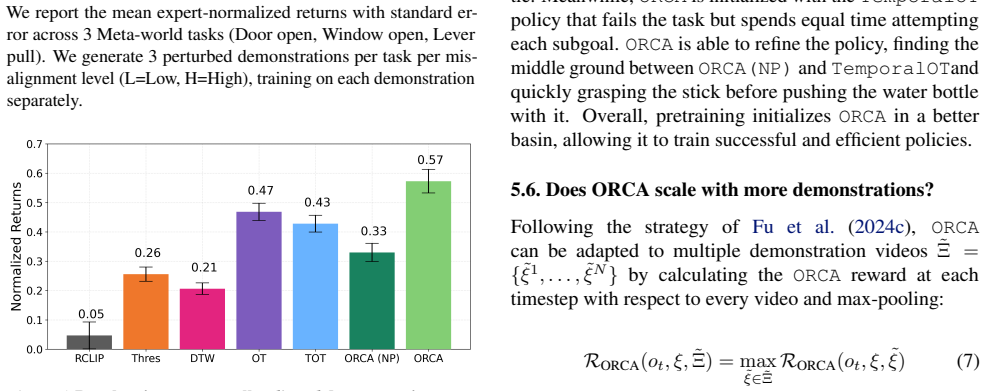
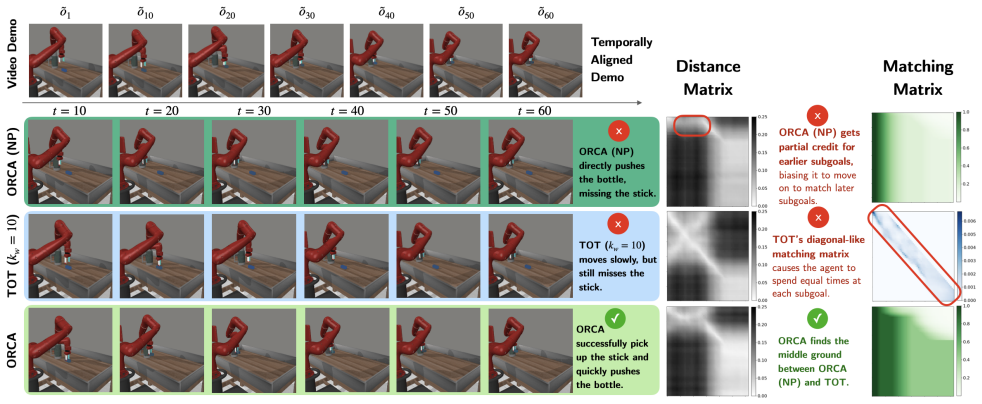
- With temporally aligned demonstrations, pretraining on TemporalOT rewards then refining with ORCA gives the best performance (0.57 average normalized return), showing that the ordered-coverage objective improves even over a well-matched frame-level initialization.
- ORCA scales to multiple demonstrations by max-pooling rewards across videos, and performance improves as more demonstrations are added, including demonstrations with different speeds.
- ORCA works with image-conditioned policies as well as state-based ones, and its runtime is comparable to or faster than the strongest frame-level baselines.
Reading between the lines
- Because the recurrence only needs pairwise frame similarities, the same ordered-coverage reward could be applied to any discretized goal sequence beyond video frames, such as text subgoals or keypoint trajectories, which the authors note as future work.
- ORCA's success is bounded by the quality of the visual distance metric; on tasks where subgoals are visually confusable, such as the paper's Push failure, a learned or online-finetuned distance function is a direct extension that could recover the signal.
- The counterexamples for OT, DTW, and TemporalOT imply that any frame-level matching reward lacking monotone ordered coverage must have a local minimum where the agent stalls or skips subgoals, framing the design space for future sequence-matching reward functions.
- Since the reward is per-timestep and dense, it could be combined with other auxiliary rewards or shaped toward sparse task completion signals without changing the ordered-coverage structure.
Editorial analysis
A structured set of objections, weighed in public.
Referee Report
Summary. The paper studies imitation learning from a single video demonstration under temporal misalignment, arguing that frame-level distribution-matching rewards (OT, DTW, TemporalOT) fail to enforce subgoal ordering and full coverage. It proposes ORCA, a dense reward that recursively computes the probability that the learner has covered all demonstration frames in the correct order, and proves two propositions showing that ORCA rewards progress and ordering in a stylized sense. Experiments on Meta-world and Humanoid-v4 report that ORCA achieves 4.5x and 6.6x improvements over frame-level baselines, with additional studies on misalignment levels, multiple demonstrations, image-conditioned policies, and visual encoders.
Significance. If the empirical claims held, ORCA would be a valuable, simple, non-learned reward function for single-video imitation under temporal misalignment. The paper has clear strengths: the reward is defined by a transparent dynamic program rather than a fitted network; the theoretical propositions articulate concrete failure modes of OT and DTW; the implementation is released; and the experiments include several useful ablations, including varying misalignment, multiple demonstrations, image-based policies, and encoder choices. However, the headline Humanoid result is numerically misreported and confounded by an extra privileged stability reward and a task-specific visual metric, so the current evidence does not support the strongest claims. The Meta-world results are more credible and, together with the analysis, justify a major revision rather than rejection.
major comments (3)
- [Abstract, Sec. 1, Table 4 (App. C)] The abstract and Sec. 1 state a 6.6x Humanoid improvement over the best frame-level matching algorithms. Table 4 shows that the best frame-level baseline by average return is OT at 14.67, not TemporalOT at 6.55; ORCA's 43.28 is a 2.95x improvement and ORCA(NP)'s 62.68 is a 4.27x improvement. The stated 6.6x ratio compares ORCA only to TemporalOT, so the headline claim should be revised to compare against the actual best frame-level baseline.
- [Sec. 5.1, App. B.3.2, Eq. (33), App. B.5] The Humanoid experiments do not isolate the ORCA reward. Eq. (33) defines the final reward as R = c(phi(o_t)) * R_ORCA + lambda * R_stability, where R_stability = exp(-(h_torso - 1.3)^2) - c_ctrl uses privileged torso height and the environment control cost, and c(.) is an autoencoder-derived confidence score. The OT, DTW, and TemporalOT descriptions in App. B.5 include no analogous terms, so ORCA receives dense task shaping that the baselines do not. In addition, the Humanoid distance function is a joint-position predictor fine-tuned on 9,038 privileged-state samples (Apps. B.3.2, B.3.3), whereas Sec. 5.1 states that all approaches use a pretrained ResNet50 with cosine similarity; this discrepancy must be resolved and the comparison rerun with identical reward components.
- [Sec. 5.1 vs App. B.3.2] The paper says the Humanoid success metric uses privileged states 'which no approaches have access to', yet Eq. (33) gives ORCA's reward direct access to h_torso and c_ctrl through R_stability. This is a contradiction, and it means ORCA is evaluated with a privileged reward even if the visual metric were held fixed. Please either justify this design choice or remove the stability term from the comparison.
minor comments (4)
- [Algorithm 1] The boundary conditions for C_{0,j} and C_{t,0} are not defined, although the nested loop recomputes the first row and first column after their initialization; please specify these boundaries or restrict the loop to t >= 2 and j >= 2.
- [Secs. 5.2 and 5.5] Both sections refer to 'Table 4.3', but the Meta-world misaligned-demonstration results are in Table 1; please correct the table references.
- [Sec. 4.1, Eq. (5)] The quantity P(G_{t,j}) is introduced as a probability but is only defined up to proportionality as exp(-lambda * d). Since no normalization is supplied, it is effectively a similarity score; please either normalize it explicitly or avoid the probabilistic terminology.
- [App. B.1 vs Sec. 5.1] App. B.1 states that all baselines except RoboCLIP use the same Humanoid distance function, while Sec. 5.1 says all approaches use a pretrained ResNet50 with cosine similarity; please state unambiguously which distance is used by each baseline in the Humanoid experiments.
Circularity Check
No significant circularity: ORCA's reward is defined, not fitted, and the main results are external empirical comparisons.
full rationale
The ORCA reward is constructed via the DP recurrence in Eq. (5) and Eq. (6) with temperature lambda=1 (Appendix B.5), and no parameter is fitted to the reported returns; the ordered-coverage recursion is a definition rather than a fitted predictor. Propositions 4.1 and 4.2 are direct consequences of this definition, but the paper does not use them to derive its empirical headline; the empirical claims are measured on Meta-world and Humanoid against independent baselines. The Meta-world ORCA is pretrained on TemporalOT for half of training, but ORCA(NP), trained without that initialization, achieves 0.49 average normalized return versus 0.50 for ORCA, so the result is not forced by the baseline checkpoint; in Humanoid, ORCA(NP) (62.68) is actually higher than ORCA (43.28). The Humanoid final reward in Eq. (33) includes a privileged stability bonus and a fine-tuned visual metric not used by the baselines, which is a comparison confound and correctness risk rather than circular reasoning, since those terms are additional supervision and not fitted equivalents of the claimed output. The self-citations present (e.g., Swamy et al. 2021, Kedia et al. 2025) are background references and are not load-bearing for ORCA's construction or evaluation. The paper is self-contained against external benchmarks, so the appropriate circularity finding is none.
Assumptions & free parameters
free parameters (4)
- temperature lambda =
1
- context window cw =
3
- TemporalOT mask window km =
10 for aligned demos, about ceil(|xi|/10) for misaligned demos
- Humanoid confidence spread k_sigma and stability reward weight lambda =
k_sigma=2; lambda not reported
assumptions (4)
- domain assumption The task is a strict sequence-matching problem: all subgoals must be completed in the demonstrated order.
- ad hoc to paper Probability of occupying a subgoal is proportional to exp(-lambda * distance) with a fixed lambda.
- domain assumption A pretrained or environment-fine-tuned visual encoder provides a valid distance between frames.
- ad hoc to paper Humanoid experiments assume access to a stability reward and a trained joint-position predictor.
Cite this review
Pith. "Pith review of Imitation Learning from a Single Temporally Misaligned Video." pith.science (2026). https://pith.science/paper/YCXPCD4W
@misc{pith2026250205397,
  author       = {Pith},
  title        = {Pith review of: Imitation Learning from a Single Temporally Misaligned Video},
  year         = {2026},
  howpublished = {\url{https://pith.science/paper/YCXPCD4W}},
  note         = {Machine review of arXiv:2502.05397}
}
abstract
We examine the problem of learning sequential tasks from a single visual demonstration. A key challenge arises when demonstrations are temporally misaligned due to variations in timing, differences in embodiment, or inconsistencies in execution. Existing approaches treat imitation as a distribution-matching problem, aligning individual frames between the agent and the demonstration. However, we show that such frame-level matching fails to enforce temporal ordering or ensure consistent progress. Our key insight is that matching should instead be defined at the level of sequences. We propose that perfect matching occurs when one sequence successfully covers all the subgoals in the same order as the other sequence. We present ORCA (ORdered Coverage Alignment), a dense per-timestep reward function that measures the probability of the agent covering demonstration frames in the correct order. On temporally misaligned demonstrations, we show that agents trained with the ORCA reward achieve $4.5$x improvement ($0.11 \rightarrow 0.50$ average normalized returns) for Meta-world tasks and $6.6$x improvement ($6.55 \rightarrow 43.3$ average returns) for Humanoid-v4 tasks compared to the best frame-level matching algorithms. We also provide empirical analysis showing that ORCA is robust to varying levels of temporal misalignment. Our code is available at https://github.com/portal-cornell/orca/
Figures


Figures from the paper (16 more)






Reference graph
Works this paper leans on
-
[1]
Context embedding: We use the context embedding-based cost matrix proposed in (Fu et al., 2024c), which can be interpreted as a diagonal smoothing kernel. Specifically, the distance between two frames is expressed as the average distance over the next cw learner and demonstration frames (where cw refers to the context window): dwindow(oL i , oD j ) = 1 cw...
-
[2]
Low" level of misalignment and the other 3 as having “High
Timestep in agent state: By nature of the sequence-following task, the reward at a given time step depends on the states visited by the learner in previous time steps. Thus, if the policy or value estimator cannot observe the entire trajectory, then 18 Imitation Learning from a Single Temporally Misaligned Video Figure 10. Visual Demonstrations of the tas...
work page 2023
-
[5]
URL https://openreview.net/forum? id=N0I2RtD8je. Sakoe, H. and Chiba, S. Dynamic programming algorithm optimization for spoken word recognition. IEEE Trans- actions on Acoustics, Speech, and Signal Processing, 26 (1):43–49, 1978. doi: 10.1109/TASSP.1978.1163055. Sontakke, S., Zhang, J., Arnold, S., Pertsch, K., Bıyık, E., Sadigh, D., Finn, C., and Itti, L...
arXiv 1978
-
[7]
Todorov, E., Erez, T., and Tassa, Y
URL https://openreview.net/forum? id=CTlUHIKF71. Todorov, E., Erez, T., and Tassa, Y . Mujoco: A physics engine for model-based control. In 2012 IEEE/RSJ Inter- national Conference on Intelligent Robots and Systems, pp. 5026–5033, 2012. doi: 10.1109/IROS.2012.6386109. Torabi, F., Warnell, G., and Stone, P. Genera- tive adversarial imitation from observati...
arXiv 2012
-
[9]
Yu, T., Quillen, D., He, Z., Julian, R., Hausman, K., Finn, C., and Levine, S
URL https://openreview.net/forum? id=L5HKN-IsdSE. Yu, T., Quillen, D., He, Z., Julian, R., Hausman, K., Finn, C., and Levine, S. Meta-world: A benchmark and evaluation for multi-task and meta reinforcement learning. In Kael- bling, L. P., Kragic, D., and Sugiura, K. (eds.),Proceed- ings of the Conference on Robot Learning, volume 100 of Proceedings of Mac...
-
[1100]
URL https:// proceedings.mlr.press/v100/yu20a.html
PMLR, 30 Oct–01 Nov 2020. URL https:// proceedings.mlr.press/v100/yu20a.html. Zhai, X., Mustafa, B., Kolesnikov, A., and Beyer, L. Sig- moid loss for language image pre-training. In Proceed- ings of the IEEE/CVF International Conference on Com- puter Vision (ICCV), pp. 11975–11986, October 2023. Ziebart, B. D., Maas, A. L., Bagnell, J. A., Dey, A. K., et ...
work page 2024
-
[2017]
cc/paper_files/paper/2017/file/ ba3866600c3540f67c1e9575e213be0a-Paper
URL https://proceedings.neurips. cc/paper_files/paper/2017/file/ ba3866600c3540f67c1e9575e213be0a-Paper. pdf. Eschmann, J. Reward function design in reinforcement learning. Reinforcement Learning Algorithms: Analysis and Applications, pp. 25–33, 2021. Foundation, F. Humanoid-v4, 2024. URL https: //gymnasium.farama.org/environments/ mujoco/humanoid/. Frey,...
work page 2017
-
[2019]
Xiao, H., Herman, M., Wagner, J., Ziesche, S., Etesami, J., and Linh, T
URL http://www.cs.utexas.edu/ users/ai-lab?ICML19a-torabi. Xiao, H., Herman, M., Wagner, J., Ziesche, S., Etesami, J., and Linh, T. H. Wasserstein adversarial imitation learning, 2019. URL https://arxiv.org/abs/ 1906.08113. Xie, S., Sun, C., Huang, J., Tu, Z., and Murphy, K. Re- thinking spatiotemporal feature learning: Speed-accuracy trade-offs in video ...
arXiv 2019
Show all 12 references
-
[2021]
Deng, J., Dong, W., Socher, R., Li, L.-J., Li, K., and Fei-Fei, L
URL https://openreview.net/forum? id=TtYSU29zgR. Deng, J., Dong, W., Socher, R., Li, L.-J., Li, K., and Fei-Fei, L. Imagenet: A large-scale hierarchical image database. In 2009 IEEE conference on computer vision and pattern recognition, pp. 248–255. Ieee, 2009. Duan, Y ., Andr...
2009
-
[2023]
Fu, L., Huang, H., Datta, G., Chen, L
doi: 10.15607/RSS.2023.XIX.054. Fu, L., Huang, H., Datta, G., Chen, L. Y ., Panitch, W. C.-H., Liu, F., Li, H., and Goldberg, K. In-context imitation learning via next-token prediction, 2024a. URL https: //arxiv.org/abs/2408.15980. Fu, Y ., Zhang, H., Wu, D., Xu, W., and Boule...
2023 arXiv
-
[2024]
Luo, Y ., zhengyao jiang, Cohen, S., Grefenstette, E., and Deisenroth, M
URL https://openreview.net/forum? id=pPJTQYOpNI. Luo, Y ., zhengyao jiang, Cohen, S., Grefenstette, E., and Deisenroth, M. P. Optimal transport for offline imita- tion learning. In The Eleventh International Confer- ence on Learning Representations, 2023. URL https: //openrevi...
2023 arXiv
-
[6045]
Swamy, G., Choudhury, S., Bagnell, J
PMLR, 2019. Swamy, G., Choudhury, S., Bagnell, J. A., and Wu, S. Of moments and matching: A game-theoretic framework for closing the imitation gap. In International Conference on Machine Learning, pp. 10022–10032. PMLR, 2021. Tian, T., Xu, C., Tomizuka, M., Malik, J., and Bajc...
2019
Reviewed August 8, 2026 · model on record in the stance chip above.
Discussion (0). Continue with ORCID to comment.