REVIEW 3 major objections 5 minor 1 cited by
Data-driven Low-rank Approximation for Electron-hole Kernel and Acceleration of Time-dependent GW Calculations
T0 review · 3 major / 5 minor · reviewed 2026-08-08 · deepseek-v4-flash
Pith's one-line read The electron-hole interaction kernel that controls exciton dynamics in time-dependent GW can be compressed to roughly 5% of its singular values while preserving absorption, harmonic generation, and excited-state populations, and this…
desk verdict A genuinely useful low-rank split of the BSE kernel (diagonal plus low-rank off-diagonal) that is well demonstrated for two 2D semiconductors, but the generality claims outrun the evidence. read the letter →
The pith
A machine-rendered reading of the paper's core claim, the machinery that carries it, and where it could break.
The reading
What carries the argument
The central object is the two-particle electron-hole (BSE) kernel $K^Q_{n_1 n_2 k, n_3 n_4 k'}$ written in a Bloch electron-hole-pair basis, which is the interaction that controls both equilibrium excitons and the time-dependent COHSEX self-energy in TD-aGW. The machinery is a split SVD: the diagonal-in-$k$ block $K_0^{\mathrm{diag}}$ (same pair and same $k$ before and after the interaction) is retained exactly because it is nearly full rank, while the off-diagonal block $K_0^{\mathrm{off}}$ is compressed as $\tilde U_0 \tilde M_0 \tilde V_0^T$ by keeping only the $z$ largest singular values. In the time propagation, the density matrix is first projected onto the singular-vector subspace via $\tilde V_0^T \rho(t)$, then mapped back through the time-independent factor $\tilde S_0 = \tilde U_0 \tilde M_0$, which lowers the per-step cost of the self-energy update. A channel-wise variant performs the SVD separately for each band-to-band transition channel, scaling better with the number of bands and lending itself to parallelization.
What would settle it
Calculate the singular-value spectrum of the off-diagonal electron-hole kernel for a weakly bound three-dimensional semiconductor, such as bulk silicon or gallium arsenide, on progressively denser $k$-grids; if the number of singular values needed to reach $R^2=0.98$ grows proportionally with the number of $k$-points rather than saturating, the rank-saturation claim is false.
Extended reading notes
Core claim
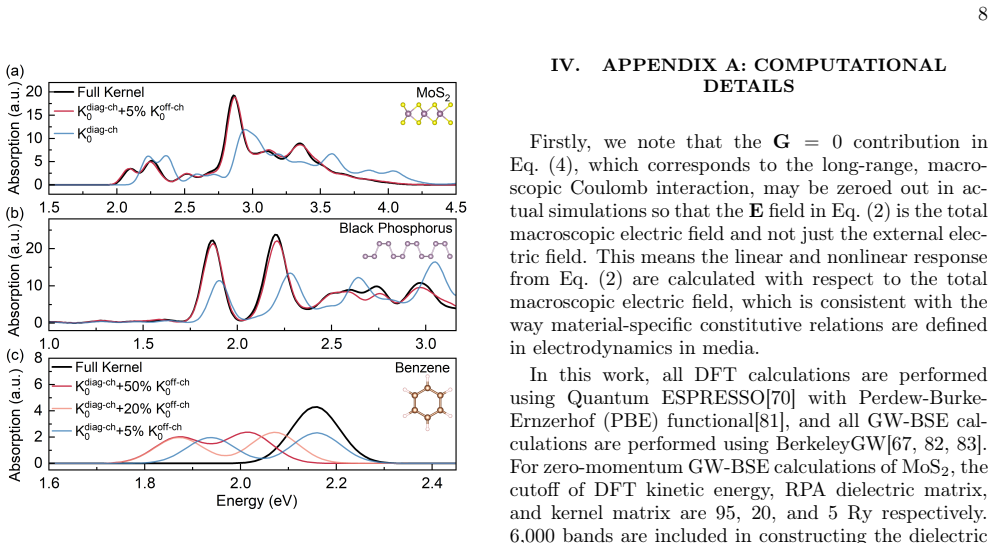
The paper discovers that the electron-hole interaction kernel $K_0$ of a crystal has a split-rank structure: its diagonal-in-$k$ part $K_0^{\mathrm{diag}}$ is nearly full-rank but occupies only a tiny fraction of the matrix, while the off-diagonal part $K_0^{\mathrm{off}}$ has rapidly decaying singular values. This follows from the localization of excitonic effects in momentum space: the direct screened interaction is concentrated near $k=k'$, and the exchange interaction is nearly constant along the relevant channels. The paper therefore approximates the kernel as $\tilde K_0 = K_0^{\mathrm{diag}} + \tilde U_0 \tilde M_0 \tilde V_0^T$ (Eq. 6), keeping about 5% of the singular values of $K_0^{\mathrm{off}}$, and shows by explicit TD-aGW simulation of monolayer MoS2 that this compressed kernel reproduces the linear absorption spectrum to within 0.04 eV of the first exciton peak, as well as SHG, THG, HHG, and conduction-band occupations, while reducing the cost of the self-energy update from $O(N_b^4 N_k^2)$ to $O(N_b^2 N_k z)$ per time step and giving a tenfold speedup. The same compression reproduces EELS for finite-momentum excitons with $R^2 \approx 0.91$ and works for black phosphorus, but fails for a benzene molecule, which lacks crystal momentum localization.
Load-bearing premise
The load-bearing premise is that the part of the electron-hole interaction that connects different crystal momenta is low-rank in essentially all crystalline solids because excitonic effects stay localized in momentum space, and the paper demonstrates this on only two strongly bound two-dimensional semiconductors.
Editorial extensions
If this is right
- Dense-k-grid GW-BSE and TD-aGW calculations become computationally practical, because the number of singular values needed for fixed accuracy saturates as the grid grows, so the compression ratio improves with grid density.
- Parameter sweeps over field frequency, polarization angle, and field strength, which are needed to interpret ultrafast spectroscopy experiments, become tractable at first-principles accuracy.
- Linear absorption, SHG, THG, HHG, and time-dependent occupations are all reproduced with roughly 5% of the off-diagonal kernel's singular values, with an order-of-magnitude speedup.
- The compressed finite-momentum kernel reproduces electron energy-loss spectra with $R^2$ around 0.91 at 5% truncation, so scattering observables beyond zero-momentum absorption are accessible.
- Because the approximation is not extrapolative, it avoids the time-accumulated errors of machine-learning dynamics predictors and needs no training data.
Reading between the lines
- A natural stress test would apply the same compression to weakly bound three-dimensional semiconductors or metals, where excitonic wavefunctions are less valley-localized; failure of rank saturation there would bound the method to strongly bound excitonic materials.
- The training-free, field-agnostic nature of the compression suggests it could be combined with nonuniform k-grid sampling that also exploits valley localization, attacking the same dense-grid bottleneck from a complementary direction.
- The systematic blueshift seen at aggressive truncation indicates the compressed kernel behaves like weakened screening; a calibration curve of peak shift versus retained rank could serve as a built-in accuracy diagnostic during parameter sweeps.
Editorial analysis
A structured set of objections, weighed in public.
Referee Report
Summary. The paper proposes an SVD-based low-rank approximation of the electron-hole kernel for time-dependent adiabatic GW (TD-aGW) and GW-BSE calculations. The key idea is to split the zero-momentum kernel K0 into a part diagonal in k (Kdiag) and an off-diagonal part Koff, then approximate Koff by a truncated SVD, giving Eq. (6). The authors show for monolayer MoS2 that retaining about 5% of the singular values of Koff reproduces linear absorption, SHG, THG, HHG, and the time-dependent conduction-band occupation from the full-kernel TD-aGW, with an order-of-magnitude speedup. They further demonstrate channel-wise SVD compression for GW-BSE absorption in MoS2 and black phosphorus and for finite-momentum EELS in MoS2, while noting that the same strategy fails for a benzene molecule because of missing periodicity. The central quantitative claim is that the kernel can be compressed by at least 95% and that the retained rank saturates as the k-grid grows, making dense-grid and parameter-sweep TD-aGW calculations feasible.
Significance. The method is physically motivated, free of supervised training, and avoids time-accumulated extrapolation errors that plague operator-learning approaches. The validation is reasonably broad for the materials studied: linear and nonlinear optical spectra, occupation dynamics, HHG, and finite-momentum EELS are all reproduced at 5% rank truncation for MoS2, with an additional absorption test for black phosphorus. If the claimed low-rank property of Koff holds for a wide class of crystalline solids, the approach would significantly lower the cost of BSE and TD-aGW calculations on dense k-grids and enable parameter sweeps. The simplicity of the SVD construction and the physical interpretation in terms of momentum-localized excitonic effects are strengths. However, the currently demonstrated evidence base is limited to two strongly excitonic 2D semiconductors, and the compression metric as stated in the abstract and conclusions is a rank fraction rather than the actual memory footprint of the factored kernel, so the quantitative claims need refinement before the broader promises of the paper are fully supported.
major comments (3)
- [Abstract, §II.B, Eq. (6), and §II.C] The '95% compression' claim in the abstract and the 'compression rate' used in Fig. 2(f) and the conclusion count only the retained singular-value ratio z/(Nb^2 Nk). For the factored form in Eq. (6), storing U and V (or equivalently U M and V) requires about 2 Nb^2 Nk z entries, so a rank fraction of 5% corresponds to an actual storage fraction of roughly 10% of the off-diagonal part. The speedup statement in §II.C correctly includes the factor of 2 in 'Nb^2 Nk/(2z)', but the storage/compression terminology is applied inconsistently to the rank fraction. Please restate the compression claims in terms of actual memory use, or explicitly define 'compression' as the retained rank fraction and avoid conflating it with storage reduction.
- [Abstract, §I, Conclusion, and Fig. 5] The manuscript presents the method as a 'general framework' for 'most crystalline solids,' yet the supporting demonstrations are limited to monolayer MoS2 and black phosphorus, both 2D semiconductors with strong exciton binding energies and momentum-localized exciton wavefunctions. The physical argument in Appendix B that the direct and exchange matrix elements decay with |q| does not by itself establish low-rankness in systems with weakly bound, delocalized Wannier excitons (e.g., bulk GaAs or Si), and the benzene result in Fig. 5(c) shows that the mechanism is not universal. Because the generality claim is load-bearing for the paper's advertised impact, I request either a demonstration on a 3D semiconductor with a weakly bound exciton or a firm narrowing of the claim to materials whose excitonic effects are shown to be momentum-localized.
- [Fig. 2(f), §II.B, and Conclusion] The saturation of the retained rank z with increasing k-grid size, which underlies the claim that extremely dense k-grids are computationally feasible, is demonstrated only for monolayer MoS2 and only for channel-wise SVD of Koff-ch0 rather than the global SVD used in the TD-aGW acceleration in §II.C. A similar convergence test for black phosphorus or another system would materially strengthen the conclusion that z becomes independent of Nk in the large-Nk limit. Without such evidence, the statement in the Conclusion that this property 'ensures computational feasibility even for dense k-grids' is an extrapolation from a single material.
minor comments (5)
- [§II.C and Fig. 3 caption] The electric-field pulse is written as 'E(t) = E0 · sin2 (πtTpulse) · sin(ωt)' in §II.C; this should be 'sin^2(π t / T_pulse)' or an equivalent unambiguous expression, and the missing division and superscript should be corrected.
- [Fig. 3 caption and §II.C] The field amplitude is given in 'V/cm^2' in the Fig. 3 caption and in the text; the correct unit for an electric field is V/cm (or V/m), so this is a typographical error.
- [Throughout the manuscript] There are several typographical errors: 'electro-hole' in the Fig. 6 inset, 'dynamcis' in the Conclusion, 'ad the main observable' in Appendix D, and 'dirving' in §II.C. These should be corrected.
- [Fig. 2(f) and §II.B] The label 'z' in Fig. 2(f) is used for the number of preserved singular values, but the caption does not explicitly define whether these are global or channel-wise; the text says 'average minimum number of z' but the figure labels compression rates. Clarify the definition of z and the relationship between the global SVD of Eq. (6) and the channel-wise SVD of Eq. (7) in the caption and around Eq. (7).
- [§II.B, definition of R²] The definition of R² on page 5 should specify the range of the sum (over all matrix elements of the channel or of the full kernel) and should say 'exact and reconstructed matrix elements' rather than 'real and predicted values' to avoid confusion with statistical fitting notation.
Circularity Check
No significant circularity: the low-rank kernel approximation is validated against independent full-kernel TD-aGW spectra, and the compression level is set by kernel reconstruction rather than by the benchmark observables.
full rationale
The paper's central claim is that the electron-hole kernel K0 can be replaced by Kdiag + U-tilde M-tilde V-tilde^T (Eq. 6), with the off-diagonal part approximated by a truncated SVD. This is a standard low-rank approximation of a well-defined first-principles object: K0 is explicitly constructed from the screened and bare Coulomb matrix elements in Eqs. (4)-(5), and the truncation rank z is chosen by measuring the reconstruction accuracy R2 of the kernel itself (Section II B), not by fitting any spectrum or observable. The subsequent benchmarks—linear absorption, SHG, THG, HHG, occupations, and EELS—are all compared against full-kernel TD-aGW or full BSE calculations that use the untruncated K0. Because the target observables are not used to select z or any other parameter, the validation is not statistically forced. The paper does cite prior work by the same group for the TD-aGW formalism and for excitonic localization, but those citations support the underlying physical framework and are not used to smuggle in the low-rank ansatz; the low-rank structure is demonstrated directly via SVD analysis and kernel matrix plots in this paper. The broad claim that the method applies to 'most crystalline solids' is supported only by monolayer MoS2 and black phosphorus, and the paper itself discloses the benzene failure; this is an extrapolation or generality concern, not a circular derivation. No step in the derivation reduces to its own input by construction, and no fitted physical constant or target observable is renamed as a prediction. The modest score reflects the presence of several self-citations and the self-referential choice of kernel reconstruction accuracy as the compression criterion, neither of which is load-bearing for the main spectral predictions.
Assumptions & free parameters
free parameters (2)
- Truncation rank z =
Not a single number; chosen as the smallest z such that the reconstructed kernel satisfies R2 = 0.98.
- Reconstruction accuracy threshold R2 =
0.98
assumptions (4)
- domain assumption The static COHSEX approximation for the non-equilibrium self-energy is valid for TD-aGW.
- domain assumption The electron-hole kernel K is exactly the BSE kernel in the static limit, and the TD-aGW dynamics depend only on this kernel.
- ad hoc to paper The off-diagonal part of the electron-hole kernel is low rank because excitonic effects are localized in momentum space.
- domain assumption Density-functional theory (PBE functional) and plane-wave basis produce Kohn-Sham states accurate enough for the kernel and spectra.
Cite this review
Pith. "Pith review of Data-driven Low-rank Approximation for Electron-hole Kernel and Acceleration of Time-dependent GW Calculations." pith.science (2026). https://pith.science/paper/KHB7ZUNX
@misc{pith2026250205635,
  author       = {Pith},
  title        = {Pith review of: Data-driven Low-rank Approximation for Electron-hole Kernel and Acceleration of Time-dependent GW Calculations},
  year         = {2026},
  howpublished = {\url{https://pith.science/paper/KHB7ZUNX}},
  note         = {Machine review of arXiv:2502.05635}
}
read the original abstract
Many-body electron-hole interactions are essential for understanding non-linear optical processes and ultrafast spectroscopy of materials. Recent first principles approaches based on nonequilibrium Green's function formalisms, such as the time-dependent adiabatic GW (TD-aGW) approach, can predict the nonequilibrium dynamics of excited states including electron-hole interactions. However, the high dimensionality of the electron-hole kernel poses significant computational challenges for scalability. Here, we develop a data-driven low-rank approximation for the electron-hole kernel, leveraging localized excitonic effects in the Hilbert space of crystalline systems. Through singular value decomposition (SVD) analysis, we show that the subspace of non-zero singular values, containing the key information of the electron-hole kernel, retains a small size even as the k-grid grows, ensuring computational feasibility with extremely dense k-grids for converged calculations. Utilizing this low-rank property, we achieve at least 95% compression of the kernel and an order-of-magnitude speedup of TD-aGW calculations. Our method, rooted in physical interpretability, outperforms existing machine learning approaches by avoiding intensive training processes and eliminating time-accumulated errors, providing a general framework for high-throughput, nonequilibrium simulation of light-driven dynamics in materials.
Figures


Figures from the paper (5 more)



Forward citations
Cited by 1 Pith paper
-
MBFormer: A General Transformer-based Learning Paradigm for Many-body Interactions in Real Materials
MBFormer maps DFT mean-field states to GW quasiparticle energies and BSE exciton properties, achieving 0.16 eV and 0.20 eV MAE on held-out 2D materials and extrapolating from coarse to fine k-grids.
Reference graph
Works this paper leans on
-
[1]
(f) The minimum number of z (preserved singular values) for reconstructingK0 starting from different k-grids of 12 × 12 × 1, 24 × 24 × 1, 36 × 36 × 1, and 48 × 48 × 1
The mean truncation ratios for the SVD of the Koff-ch 0 are 12%, 14%, and 2% respec- tively. (f) The minimum number of z (preserved singular values) for reconstructingK0 starting from different k-grids of 12 × 12 × 1, 24 × 24 × 1, 36 × 36 × 1, and 48 × 48 × 1. The reconstruction accuracy ranges fromR2 =0.80 to 0.98, represented by different colors. The bl...
-
[2]
Real-time probing of electron dynamics us- ing attosecond time-resolved spectroscopy,
Krupa Ramasesha, Stephen R Leone, and Daniel M Neumark, “Real-time probing of electron dynamics us- ing attosecond time-resolved spectroscopy,” Annual Re- view of Physical Chemistry67, 41–63 (2016)
2016
-
[3]
The simulation length is 100 fs with a time stepof dt = 0.1 fs
and calculations [7]: E(t) = E0 · sin2 (πtTpulse) · sin(ωt) , where the electric field amplitudeE0 is 2.36 × 10⁷ V/cm2, Tpulse is 100 fs, andω is the incident pulse frequency. The simulation length is 100 fs with a time stepof dt = 0.1 fs. Fig.4(a-c)showsthetime-dependent occupation P k ρnnk(t)/Nk of the first conduction band c1 in monolayer MoS2 with exc...
-
[4]
kernel matrix elements plotted over k and q = k − k′ for selected channels. Fig. 6 (a) and (b) depict the direct Kernel for a diago- nal channel (v1, c1) → (v1, c1) and off-diagonal chan- nel (v1, c1) → (v2, c2), respectively. These electron- hole pairs are purely composed of valence-to-conduction transitions, which make up the equilibrium BSE Hamil- toni...
-
[5]
Time-resolved arpes studies of quantum materials,
Fabio Boschini, Marta Zonno, and Andrea Damascelli, “Time-resolved arpes studies of quantum materials,” Reviews of Modern Physics96, 015003 (2024)
2024
-
[6]
What will it take to observe processes in’real time’?
Stephen R Leone, C William McCurdy, Joachim Burgdörfer, Lorenz S Cederbaum, Zenghu Chang, Nirit Dudovich, Johannes Feist, Chris H Greene, Misha Ivanov, Reinhard Kienberger,et al., “What will it take to observe processes in’real time’?” Nature Photonics 8, 162–166 (2014)
2014
-
[7]
, where the time- dependent current is calculated by J(t) = Tr( ρ(t)v) and v is the velocity operator. Fig. 4 (d) shows the logarithmic magnitude of the HHG spectrum with an incident pulse frequency ofω = 0.35 eV. The HHG cal- culation using 5% truncated kernel agrees well with the ground truth. The 0.1% truncation can only reproduce the intensity of the ...
-
[8]
High- harmonic generation from an atomically thin semicon- ductor,
Hanzhe Liu, Yilei Li, Yong Sing You, Shambhu Ghimire, Tony F Heinz, and David A Reis, “High- harmonic generation from an atomically thin semicon- ductor,” Nature Physics13, 262–265 (2017)
2017
Show all 96 references
-
[9]
Carrier dynamics in semiconductors studied with time-resolved terahertz spectroscopy,
Ronald Ulbricht, Euan Hendry, Jie Shan, Tony F Heinz, and Mischa Bonn, “Carrier dynamics in semiconductors studied with time-resolved terahertz spectroscopy,” Re- views of Modern Physics83, 543–586 (2011)
2011
-
[10]
Experimental measurement of the intrinsic excitonic wave function,
Michael KL Man, Julien Madéo, Chakradhar Sahoo, Kaichen Xie, Marshall Campbell, Vivek Pareek, Arka Karmakar, E Laine Wong, Abdullah Al-Mahboob, Nicholas S Chan,et al., “Experimental measurement of the intrinsic excitonic wave function,” Science Advances 7, eabg0192 (2021)
2021
-
[11]
Photo-induced superconductivity,
Andrea Cavalleri, “Photo-induced superconductivity,” Contemporary Physics 59, 31–46 (2018)
2018
-
[12]
Many-body enhancement of high-harmonic generation in monolayer mos2,
Victor Chang Lee, Lun Yue, Mette B Gaarde, Yang-hao Chan, and Diana Y Qiu, “Many-body enhancement of high-harmonic generation in monolayer mos2,” Nature Communications 15, 6228 (2024)
2024
-
[14]
Giant self-driven exciton-floquet sig- natures in time-resolved photoemission spectroscopy of mos2 from time-dependent gw approach,
Y-H Chan, Diana Y Qiu, Felipe H da Jornada, and Steven G Louie, “Giant self-driven exciton-floquet sig- natures in time-resolved photoemission spectroscopy of mos2 from time-dependent gw approach,” Proceedings of the National Academy of Sciences120, e2301957120 (2023)
2023
-
[15]
Real-time gw: Toward an ab initio description of the ultrafast carrier and exciton dynamics in two- 12 dimensional materials,
Enrico Perfetto, Yaroslav Pavlyukh, and Gianluca Ste- fanucci, “Real-time gw: Toward an ab initio description of the ultrafast carrier and exciton dynamics in two- 12 dimensional materials,” Physical Review Letters 128, 016801 (2022)
2022
-
[16]
Directly visual- izing the momentum-forbidden dark excitons and their dynamics in atomically thin semiconductors,
Julien Madéo, Michael KL Man, Chakradhar Sahoo, Marshall Campbell, Vivek Pareek, E Laine Wong, Ab- dullah Al-Mahboob, Nicholas S Chan, Arka Karmakar, Bala Murali Krishna Mariserla,et al., “Directly visual- izing the momentum-forbidden dark excitons and their dynamics in atomic...
2020
-
[17]
Exciton-driven renormalization of quasiparticle band structure in monolayer mos 2,
Yi Lin, Yang-hao Chan, Woojoo Lee, Li-Syuan Lu, Zhenglu Li, Wen-Hao Chang, Chih-Kang Shih, Robert A Kaindl, Steven G Louie, and Alessandra Lan- zara, “Exciton-driven renormalization of quasiparticle band structure in monolayer mos 2,” Physical Review B 106, L081117 (2022)
2022
-
[18]
Real- time approach to the optical properties of solids and nanostructures: Time-dependent bethe-salpeter equa- tion,
Claudio Attaccalite, M Grüning, and A Marini, “Real- time approach to the optical properties of solids and nanostructures: Time-dependent bethe-salpeter equa- tion,” Physical Review B—Condensed Matter and Ma- terials Physics 84, 245110 (2011)
2011
-
[19]
Nonequilibrium bethe-salpeter equation for transient photoabsorption spectroscopy,
E Perfetto, D Sangalli, A Marini, and G Stefanucci, “Nonequilibrium bethe-salpeter equation for transient photoabsorption spectroscopy,” Physical Review B92, 205304 (2015)
2015
-
[20]
Data-driven compression ofelectron-phononinteractions,
Yao Luo, Dhruv Desai, Benjamin K Chang, Jinsoo Park, and Marco Bernardi, “Data-driven compression ofelectron-phononinteractions,” PhysicalReviewX 14, 021023 (2024)
2024
-
[21]
Time- dependent density functional theory,
Miguel AL Marques and Eberhard KU Gross, “Time- dependent density functional theory,” Annu. Rev. Phys. Chem. 55, 427–455 (2004)
2004
-
[22]
Excitonic effects in solids described by time-dependent density-functional theory,
Lucia Reining, Valerio Olevano, Angel Rubio, and Gio- vanni Onida, “Excitonic effects in solids described by time-dependent density-functional theory,” Physical re- view letters 88, 066404 (2002)
2002
-
[23]
Double excitations in finite systems,
Pina Romaniello, Davide Sangalli, JA Berger, Francesco Sottile, Luca G Molinari, Lucia Reining, and Giovanni Onida, “Double excitations in finite systems,” The Journal of Chemical Physics130 (2009)
2009
-
[24]
Excitons and carriers in transient absorp- tion and time-resolved arpes spectroscopy: An ab initio approach,
D Sangalli, “Excitons and carriers in transient absorp- tion and time-resolved arpes spectroscopy: An ab initio approach,” Physical Review Materials5, 083803 (2021)
2021
-
[25]
Compressing the four-index two-electron repulsion integral matrix using the resolution-of-the-identity approximation combined with the rank factorization approximation,
Buu Q Pham and Mark S Gordon, “Compressing the four-index two-electron repulsion integral matrix using the resolution-of-the-identity approximation combined with the rank factorization approximation,” Journal of Chemical Theory and Computation 15, 2254–2264 (2019)
2019
-
[26]
Compression of the elec- tron repulsion integral tensor in tensor hypercontrac- tion format with cubic scaling cost,
Jianfeng Lu and Lexing Ying, “Compression of the elec- tron repulsion integral tensor in tensor hypercontrac- tion format with cubic scaling cost,” Journal of Com- putational Physics 302, 329–335 (2015)
2015
-
[27]
Low rank approximation in g 0 w 0 calculations,
MeiYue Shao, Lin Lin, Chao Yang, Fang Liu, Felipe H Da Jornada, Jack Deslippe, and Steven G Louie, “Low rank approximation in g 0 w 0 calculations,” Science China Mathematics 59, 1593–1612 (2016)
2016
-
[28]
Dis- crete lehmann representation of imaginary time green’s functions,
Jason Kaye, Kun Chen, and Olivier Parcollet, “Dis- crete lehmann representation of imaginary time green’s functions,” Phys. Rev. B105, 235115 (2022)
2022
-
[29]
Robust and variational fitting,
Brett I Dunlap, “Robust and variational fitting,” Phys- ical Chemistry Chemical Physics2, 2113–2116 (2000)
2000
-
[30]
Representing individual electronic states for machine learning gw band structures of 2d materials,
Nikolaj Rørbæk Knøsgaard and Kristian Sommer Thygesen, “Representing individual electronic states for machine learning gw band structures of 2d materials,” Nature Communications 13, 468 (2022)
2022
-
[31]
Static subspace approximation for the evaluation of g 0 w 0 quasiparticle energies within a sum-over-bands approach,
Mauro Del Ben, Felipe H da Jornada, Gabriel Antonius, Tonatiuh Rangel, Steven G Louie, Jack Deslippe, and Andrew Canning, “Static subspace approximation for the evaluation of g 0 w 0 quasiparticle energies within a sum-over-bands approach,” Physical Review B 99, 125128 (2019)
2019
-
[32]
Machine learning-based compression of quantum many body physics: Pca and autoencoder representation of the vertex function,
Jiawei Zang, Matija Medvidović, Dominik Kiese, Domenico Di Sante, Anirvan M Sengupta, and An- drew J Millis, “Machine learning-based compression of quantum many body physics: Pca and autoencoder representation of the vertex function,” arXiv preprint arXiv:2403.15372 (2024)
2024 arXiv
-
[33]
Compressing green’s function using intermediate representation between imaginary- time and real-frequency domains,
Hiroshi Shinaoka, Junya Otsuki, Masayuki Ohzeki, and Kazuyoshi Yoshimi, “Compressing green’s function using intermediate representation between imaginary- time and real-frequency domains,” Phys. Rev. B 96, 035147 (2017)
2017
-
[34]
Spectral operator representations,
Austin Zadoks, Antimo Marrazzo, and Nicola Marzari, “Spectral operator representations,” arXiv preprint arXiv:2403.01514 (2024)
2024 arXiv
-
[35]
Deep-learning density functional perturbation the- ory,
He Li, Zechen Tang, Jingheng Fu, Wen-Han Dong, Ni- anlong Zou, Xiaoxun Gong, Wenhui Duan, and Yong Xu, “Deep-learning density functional perturbation the- ory,” Physical Review Letters132, 096401 (2024)
2024
-
[36]
Unsuper- vised representation learning of kohn–sham states and consequences for downstream predictions of many-body effects,
Bowen Hou, Jinyuan Wu, and Diana Y Qiu, “Unsuper- vised representation learning of kohn–sham states and consequences for downstream predictions of many-body effects,” Nature Communications15, 9481 (2024)
2024
-
[37]
Varia- tional autoencoder reconstruction of complex many- body physics,
Ilia A Luchnikov, Alexander Ryzhov, Pieter-Jan Stas, Sergey N Filippov, and Henni Ouerdane, “Varia- tional autoencoder reconstruction of complex many- body physics,” Entropy21, 1091 (2019)
2019
-
[38]
E (3)-equivariant graph neural networks for data-efficient and accurate interatomic potentials,
Simon Batzner, Albert Musaelian, Lixin Sun, Mario Geiger, Jonathan P Mailoa, Mordechai Kornbluth, Nicola Molinari, Tess E Smidt, and Boris Kozinsky, “E (3)-equivariant graph neural networks for data-efficient and accurate interatomic potentials,” Nature communi- cations 13, 24...
2022
-
[39]
Tensor field networks: Rotation-and translation- equivariant neural networks for 3d point clouds,
Nathaniel Thomas, Tess Smidt, Steven Kearnes, Lu- sann Yang, Li Li, Kai Kohlhoff, and Patrick Ri- ley, “Tensor field networks: Rotation-and translation- equivariant neural networks for 3d point clouds,” arXiv preprint arXiv:1802.08219 (2018)
2018 arXiv
-
[40]
Ana- lyzing and predicting non-equilibrium many-body dy- namics via dynamic mode decomposition,
Jia Yin, Yang-hao Chan, Felipe H da Jornada, Di- ana Y Qiu, Chao Yang, and Steven G Louie, “Ana- lyzing and predicting non-equilibrium many-body dy- namics via dynamic mode decomposition,” Journal of Computational Physics 477, 111909 (2023)
2023
-
[41]
Deep learning-enhanced variational monte carlo method for quantum many- body physics,
Li Yang, Zhaoqi Leng, Guangyuan Yu, Ankit Patel, Wen-Jun Hu, and Han Pu, “Deep learning-enhanced variational monte carlo method for quantum many- body physics,” Physical Review Research 2, 012039 (2020)
2020
-
[42]
Neural-network quantum states for many-body physics,
Matija Medvidović and Javier Robledo Moreno, “Neural-network quantum states for many-body physics,” arXiv preprint arXiv:2402.11014 (2024)
2024 arXiv
-
[43]
Boltzmann generators: Sampling equilibrium states of many-body systems with deep learning,
Frank Noé, Simon Olsson, Jonas Köhler, and Hao Wu, “Boltzmann generators: Sampling equilibrium states of many-body systems with deep learning,” Science365, eaaw1147 (2019)
2019
-
[44]
How to use neural networks to investigate quantum many-body physics,
Juan Carrasquilla and Giacomo Torlai, “How to use neural networks to investigate quantum many-body physics,” PRX Quantum2, 040201 (2021)
2021
-
[45]
Fourier neural opera- tor for parametric partial differential equations,
Zongyi Li, Nikola Kovachki, Kamyar Azizzadenesheli, Burigede Liu, Kaushik Bhattacharya, Andrew Stu- art, and Anima Anandkumar, “Fourier neural opera- tor for parametric partial differential equations,” arXiv preprint arXiv:2010.08895 (2020)
2020 arXiv
-
[46]
Dynamic mode decomposition of nonequilib- rium electron-phonon dynamics: accelerating the first- principles real-time boltzmann equation,
Ivan Maliyov, Jia Yin, Jia Yao, Chao Yang, and Marco Bernardi, “Dynamic mode decomposition of nonequilib- rium electron-phonon dynamics: accelerating the first- principles real-time boltzmann equation,” npj Compu- tational Materials 10, 123 (2024)
2024
-
[47]
Dynamic mode decomposition for extrapolating nonequilibrium green’s-function dynamics,
Cian C Reeves, Jia Yin, Yuanran Zhu, Khaled Z Ibrahim, Chao Yang, and Vojtěch Vlček, “Dynamic mode decomposition for extrapolating nonequilibrium green’s-function dynamics,” Physical Review B 107, 075107 (2023)
2023
-
[48]
Probabilistic forecast of nonlinear dynam- ical systems with uncertainty quantification,
Mengyang Gu, Yizi Lin, Victor Chang Lee, and Di- ana Y Qiu, “Probabilistic forecast of nonlinear dynam- ical systems with uncertainty quantification,” Physica D: Nonlinear Phenomena457, 133938 (2024)
2024
-
[49]
Learning nonlinear oper- 13 ators via deeponet based on the universal approxima- tion theorem of operators,
Lu Lu, Pengzhan Jin, Guofei Pang, Zhongqiang Zhang, and George Em Karniadakis, “Learning nonlinear oper- 13 ators via deeponet based on the universal approxima- tion theorem of operators,” Nature machine intelligence 3, 218–229 (2021)
2021
-
[50]
Performance of wave function and green’s functions based methods for non equilibrium many-body dynamics,
Cian C Reeves, Gaurav Harsha, Avijit Shee, Yuan- ran Zhu, Chao Yang, K Birgitta Whaley, Dominika Zgid, and Vojtech Vlcek, “Performance of wave function and green’s functions based methods for non equilibrium many-body dynamics,” arXiv preprint arXiv:2405.08814 (2024)
2024 arXiv
-
[51]
Neural operator: Learn- ing maps between function spaces with applications to pdes,
Nikola Kovachki, Zongyi Li, Burigede Liu, Kamyar Azizzadenesheli, Kaushik Bhattacharya, Andrew Stu- art, and Anima Anandkumar, “Neural operator: Learn- ing maps between function spaces with applications to pdes,” Journal of Machine Learning Research24, 1–97 (2023)
2023
-
[52]
Neural operator: Graph ker- nel network for partial differential equations,
Zongyi Li, Nikola Kovachki, Kamyar Azizzadenesheli, Burigede Liu, Kaushik Bhattacharya, Andrew Stuart, and Anima Anandkumar, “Neural operator: Graph ker- nel network for partial differential equations,” arXiv preprint arXiv:2003.03485 (2020)
2020 arXiv
-
[53]
Transformer for partial differential equations’ operator learning,
Zijie Li, Kazem Meidani, and Amir Barati Farimani, “Transformer for partial differential equations’ operator learning,” arXiv preprint arXiv:2205.13671 (2022)
2022 arXiv
-
[54]
Predicting nonequilibrium green’s function dynamics and photoemission spectra via nonlinear integral operator learning,
Yuanran Zhu, Jia Yin, Cian C Reeves, Chao Yang, and Vojtech Vlcek, “Predicting nonequilibrium green’s function dynamics and photoemission spectra via nonlinear integral operator learning,” arXiv preprint arXiv:2407.09773 (2024)
2024 arXiv
-
[55]
Green’s function methods in equilibrium and nonequilibrium problems,
LP Kadanoff, G Baym, and Quantum Statistical Me- chanics, “Green’s function methods in equilibrium and nonequilibrium problems,” Frontiers in Physics (Ben- jamin, New York, 1962) (1962)
1962
-
[56]
Steven L Brunton and J Nathan Kutz,Data-driven sci- ence and engineering: Machine learning, dynamical sys- tems, and control (Cambridge University Press, 2022)
2022
-
[57]
Opening the black box of deep neural networks via information,
Ravid Shwartz-Ziv and Naftali Tishby, “Opening the black box of deep neural networks via information,” arXiv preprint arXiv:1703.00810 (2017)
2017 arXiv
-
[58]
25 (Springer Science & Business Media, 2005)
Dietrich Kremp, Manfred Schlanges, and Wolf-Dietrich Kraeft, Quantum statistics of nonideal plasmas , Vol. 25 (Springer Science & Business Media, 2005)
2005
-
[59]
Leo P Kadanoff,Quantum statistical mechanics (CRC Press, 2018)
2018
-
[60]
Dielectric constant with local field ef- fects included,
Nathan Wiser, “Dielectric constant with local field ef- fects included,” Physical Review129, 62 (1963)
1963
-
[61]
New method for calculating the one- particle green’s function with application to the electron-gas problem,
Lars Hedin, “New method for calculating the one- particle green’s function with application to the electron-gas problem,” Physical Review 139, A796 (1965)
1965
-
[62]
Effects of electron- electron and electron-phonon interactions on the one- electron states of solids,
Lars Hedin and Stig Lundqvist, “Effects of electron- electron and electron-phonon interactions on the one- electron states of solids,” inSolid state physics , Vol. 23 (Elsevier, 1970) pp. 1–181
1970
-
[63]
Electron cor- relation in semiconductors and insulators: Band gaps and quasiparticle energies,
Mark S Hybertsen and Steven G Louie, “Electron cor- relation in semiconductors and insulators: Band gaps and quasiparticle energies,” Physical Review B34, 5390 (1986)
1986
-
[64]
Quantumtheoryofthedielectriccon- stant in real solids,
StephenLAdler,“Quantumtheoryofthedielectriccon- stant in real solids,” Physical Review126, 413 (1962)
1962
-
[65]
Electron-hole excitations and optical spectra from first principles,
Michael Rohlfing and Steven G Louie, “Electron-hole excitations and optical spectra from first principles,” Physical Review B62, 4927 (2000)
2000
-
[66]
Ground state of the electron gas by a stochastic method,
David M Ceperley and Berni J Alder, “Ground state of the electron gas by a stochastic method,” Physical review letters 45, 566 (1980)
1980
-
[67]
Nonlinearopticalsus- ceptibilities of semiconductors: Results with a length- gauge analysis,
ClaudioAversaandJohnESipe,“Nonlinearopticalsus- ceptibilities of semiconductors: Results with a length- gauge analysis,” Physical Review B52, 14636 (1995)
1995
-
[68]
Semiconductor optics in length gauge: A general numerical approach,
Kuljit S Virk and JE Sipe, “Semiconductor optics in length gauge: A general numerical approach,” Physical Review B—Condensed Matter and Materials Physics 76, 035213 (2007)
2007
-
[69]
Solution of the bethe-salpeter equation without empty electronic states: Application to the absorption spectra of bulk systems,
Dario Rocca, Yuan Ping, Ralph Gebauer, and Giu- lia Galli, “Solution of the bethe-salpeter equation without empty electronic states: Application to the absorption spectra of bulk systems,” Physical Re- view B—Condensed Matter and Materials Physics85, 045116 (2012)
2012
-
[70]
Quantum espresso: a modular and open-source software project for quantum simula- tions of materials,
Paolo Giannozzi, Stefano Baroni, Nicola Bonini, Mat- teo Calandra, Roberto Car, Carlo Cavazzoni, Davide Ceresoli, Guido L Chiarotti, Matteo Cococcioni, Is- maila Dabo, Andrea Dal Corso, Stefano de Giron- coli, Stefano Fabris, Guido Fratesi, Ralph Gebauer, Uwe Gerstmann, Christ...
2009
-
[71]
Ab initio calculation of excitonic ef- fects in the optical spectra of semiconductors,
Stefan Albrecht, Lucia Reining, Rodolfo Del Sole, and Giovanni Onida, “Ab initio calculation of excitonic ef- fects in the optical spectra of semiconductors,” Physical review letters 80, 4510 (1998)
1998
-
[72]
Berkeleygw: A massively parallel computer package for the calculation of the quasiparticle and optical properties of materials and nanostructures,
Jack Deslippe, Georgy Samsonidze, David A. Strubbe, Manish Jain, Marvin L. Cohen, and Steven G. Louie, “Berkeleygw: A massively parallel computer package for the calculation of the quasiparticle and optical properties of materials and nanostructures,” Computer Physics Communic...
2012
-
[74]
Application of the green’s functions method to the study of the optical properties of semi- conductors,
Giancarlo Strinati, “Application of the green’s functions method to the study of the optical properties of semi- conductors,” La Rivista del Nuovo Cimento (1978-1999) 11, 1–86 (1988)
1988
-
[75]
Quasiparticle and excitonic properties of monolayer1T ′ wte2 within many-body perturbation theory,
Jinyuan Wu, Bowen Hou, Wenxin Li, Yu He, and Diana Y. Qiu, “Quasiparticle and excitonic properties of monolayer1T ′ wte2 within many-body perturbation theory,” Phys. Rev. B110, 075133 (2024)
2024
-
[76]
Self-consistent equa- tions including exchange and correlation effects,
Walter Kohn and Lu Jeu Sham, “Self-consistent equa- tions including exchange and correlation effects,” Phys- ical review 140, A1133 (1965)
1965
-
[77]
Importance of 14 nonuniform brillouin zone sampling for ab initio bethe- salpeter equation calculations of exciton binding en- ergies in crystalline solids,
Antonios M Alvertis, Aurélie Champagne, Mauro Del Ben, Felipe H da Jornada, Diana Y Qiu, Ma- rina R Filip, and Jeffrey B Neaton, “Importance of 14 nonuniform brillouin zone sampling for ab initio bethe- salpeter equation calculations of exciton binding en- ergies in crystallin...
2023
-
[78]
Exchange-driven intermixing of bulk and topological surface states by chiral excitons inbi2se3,
Bowen Hou, Dan Wang, Bradford A. Barker, and Di- ana Y. Qiu, “Exchange-driven intermixing of bulk and topological surface states by chiral excitons inbi2se3,” Phys. Rev. Lett.130, 216402 (2023)
2023
-
[79]
Di- rect observation of the layer-dependent electronic struc- ture in phosphorene,
Likai Li, Jonghwan Kim, Chenhao Jin, Guo Jun Ye, Diana Y Qiu, Felipe H Da Jornada, Zhiwen Shi, Long Chen, Zuocheng Zhang, Fangyuan Yang, et al. , “Di- rect observation of the layer-dependent electronic struc- ture in phosphorene,” Nature nanotechnology12, 21–25 (2017)
2017
-
[80]
Solving the bethe-salpeter equation on a subspace: Approximations and consequences for low- dimensional materials,
Diana Y. Qiu, Felipe H. da Jornada, and Steven G. Louie, “Solving the bethe-salpeter equation on a subspace: Approximations and consequences for low- dimensional materials,” Phys. Rev. B 103, 045117 (2021)
2021
-
[81]
Screening and many-body effects in two- dimensional crystals: Monolayer mos2,
Diana Y. Qiu, Felipe H. da Jornada, and Steven G. Louie, “Screening and many-body effects in two- dimensional crystals: Monolayer mos2,” Phys. Rev. B 93, 235435 (2016)
2016
-
[82]
Optical spectrum of mos 2: many-body effects and diversity of exciton states,
Diana Y Qiu, Felipe H Da Jornada, and Steven G Louie, “Optical spectrum of mos 2: many-body effects and diversity of exciton states,” Physical review letters 111, 216805 (2013)
2013
-
[83]
Gate switchable transport and opti- cal anisotropy in 90 twisted bilayer black phosphorus,
Ting Cao, Zhenglu Li, Diana Y Qiu, and Steven G Louie, “Gate switchable transport and opti- cal anisotropy in 90 twisted bilayer black phosphorus,” Nano letters 16, 5542–5546 (2016)
2016
-
[84]
Environmental screening effects in 2d materials: renor- malization of the bandgap, electronic structure, and op- tical spectra of few-layer black phosphorus,
DianaYQiu, FelipeHdaJornada, andStevenGLouie, “Environmental screening effects in 2d materials: renor- malization of the bandgap, electronic structure, and op- tical spectra of few-layer black phosphorus,” Nano let- ters 17, 4706–4712 (2017)
2017
-
[85]
Semiconductor optics in length gauge: A general numerical approach,
Kuljit S. Virk and J. E. Sipe, “Semiconductor optics in length gauge: A general numerical approach,” Phys. Rev. B 76, 035213 (2007)
2007
-
[86]
Generalized gradient approximation made sim- ple,
John P. Perdew, Kieron Burke, and Matthias Ernz- erhof, “Generalized gradient approximation made sim- ple,” Phys. Rev. Lett.77, 3865–3868 (1996)
1996
-
[87]
Electron cor- relation in semiconductors and insulators: Band gaps andquasiparticleenergies,
Mark S. Hybertsen and Steven G. Louie, “Electron cor- relation in semiconductors and insulators: Band gaps andquasiparticleenergies,” Phys.Rev.B 34,5390–5413 (1986)
1986
-
[88]
Electron-hole excitations and optical spectra from first principles,
Michael Rohlfing and Steven G. Louie, “Electron-hole excitations and optical spectra from first principles,” Phys. Rev. B62, 4927–4944 (2000)
2000
-
[89]
and corresponds to the irreducible response func- tion to the external macroscopic electromagnetic field [90, 91]. The solutions of the BSE can therefore be uti- lized to calculate the imaginary part of the macroscopic transverse dielectric function via Fermi’s golden rule in ...
-
[90]
Dy- namics of berry-phase polarization in time-dependent electric fields,
Ivo Souza, Jorge Íñiguez, and David Vanderbilt, “Dy- namics of berry-phase polarization in time-dependent electric fields,” Phys. Rev. B69, 085106 (2004)
2004
-
[91]
Maximally lo- calized generalized wannier functions for composite en- ergy bands,
Nicola Marzari and David Vanderbilt, “Maximally lo- calized generalized wannier functions for composite en- ergy bands,” Phys. Rev. B56, 12847–12865 (1997)
1997
-
[92]
Giant exciton-enhanced shift cur- rents and direct current conduction with subbandgap photo excitations produced by many-electron interac- tions,
Yang-Hao Chan, Diana Y Qiu, Felipe H da Jornada, and Steven G Louie, “Giant exciton-enhanced shift cur- rents and direct current conduction with subbandgap photo excitations produced by many-electron interac- tions,” ProceedingsoftheNationalAcademyofSciences 118, e1906938118 (2021)
2021
-
[93]
Berkeleygw: A massively parallel computer package for the calculation of the quasiparticle and optical properties of materials and nanostructures,
Jack Deslippe, Georgy Samsonidze, David A Strubbe, Manish Jain, Marvin L Cohen, and Steven G Louie, “Berkeleygw: A massively parallel computer package for the calculation of the quasiparticle and optical properties of materials and nanostructures,” Computer Physics Communicati...
2012
-
[94]
Signatures of dimensionality and symmetry in exciton band structure: Consequences for exciton dynamics and transport,
Diana Y Qiu, Galit Cohen, Dana Novichkova, and Sivan Refaely-Abramson, “Signatures of dimensionality and symmetry in exciton band structure: Consequences for exciton dynamics and transport,” Nano letters21, 7644–7650 (2021)
2021
-
[95]
Electromagnetic properties of insulators. i,
Vinay Ambegaokar and Walter Kohn, “Electromagnetic properties of insulators. i,” Physical Review 117, 423 (1960)
1960
-
[96]
Excitondispersion from first principles,
MatteoGattiandFrancescoSottile,“Excitondispersion from first principles,” Physical Review B—Condensed Matter and Materials Physics88, 155113 (2013)
2013
-
[97]
Electron energy-loss spectroscopy in the tem,
Ray F Egerton, “Electron energy-loss spectroscopy in the tem,” Reports on Progress in Physics 72, 016502 (2008)
2008
-
[98]
Hans Kuzmany, Solid-state spectroscopy: an introduc- tion (Springer Science & Business Media, 2009)
2009
Reviewed August 8, 2026 · model on record in the stance chip above.
Discussion (0). Continue with ORCID to comment.