REVIEW 5 major objections 4 minor 52 references
The impact of allocation strategies in subset learning on the expressive power of neural networks
T0 review · 5 major / 4 minor · reviewed 2026-08-08 · deepseek-v4-flash
Pith's one-line read A fixed budget of learnable weights can be maximally expressive or completely useless depending only on how the weights are spread across rows and columns.
desk verdict A clean benchmark and solid linear results, but the main maximality theorem for recurrent weights has a real, likely repairable proof gap. read the letter →
The pith
A machine-rendered reading of the paper's core claim, the machinery that carries it, and where it could break.
The reading
What carries the argument
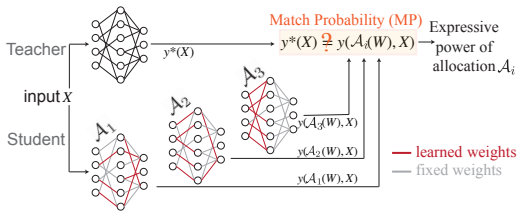
The machinery is the student-teacher match probability MP(A,m), defined as the probability that a student whose learnable positions are fixed by allocation A and whose other weights are random can exactly match the teacher's outputs on m samples. The proof engine is Lemma 3.3, which rewrites the degree-T polynomial matching equations as a linear-quadratic system in the recurrent weights W and auxiliary variables F; when whole rows or columns of W are frozen, the auxiliary equations become linear. Counting the ranks of these linear systems with Kronecker products (the tensor product operation that turns matrix equations into ordinary linear systems) shows when F is forced to a unique value, after which the learnable blocks in W are determined by square linear systems.
What would settle it
Take a small linear recurrent network satisfying the hypotheses of Theorem 3.5, form the coefficient matrices of equations (B.5) and (B.6) from the proof, and compute the rank of the stacked system: if the rank is less than $nTb$, the unique-solution step fails and a maximal allocation could still miss the teacher on a set of positive probability.
Extended reading notes
Core claim
On the paper's own terms, the discovery is that in a linear recurrent network, learning the recurrent matrix W with r = dm learnable weights is maximal whenever each active row of W contains exactly Tb learnable weights, or each active column contains exactly Td learnable weights, and no allocation with any row above Tb or any column above Td can match the teacher. This structure turns a system of high-degree polynomial equations into a forced linear system, so a student with only r learnable weights reproduces all m teacher outputs with probability 1. The same block-counting logic gives exact conditions for the decoder (m weights per row), the encoder (no row above Tm and no column above Td), and intermediate feedforward layers (no row above m and no column above d).
Load-bearing premise
The maximality proof adds up the number of independent equations in two separate linear systems and assumes no equation is shared between them; if the two systems overlap, the unique-solution argument collapses.
Editorial extensions
If this is right
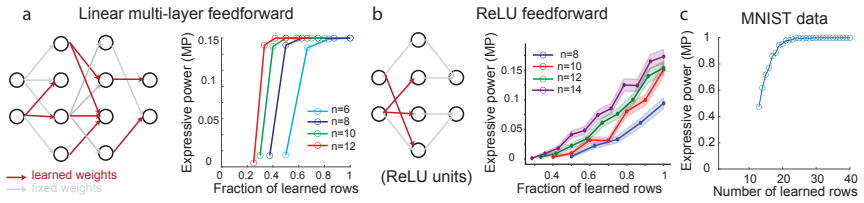
- A fixed budget r that concentrates too many learnable weights in one row or column makes the student unable to match the teacher at all, whereas the same budget spread one block per row or column succeeds with probability 1.
- The decoder result is rigid: in a linear RNN readout, every row must have exactly m learnable weights, so moving a single weight between rows flips the match probability from 1 to 0.
- For recurrent connections, maximality is reached at the minimal allowed number of active rows, r/(Tb), so the transition from zero to full expressivity is sharp at that threshold.
- In linear feedforward networks, the same row and column conditions hold per layer, with all allocations that violate them being minimal.
- If the paper's conjecture about random polynomial systems is right, larger networks should make even suboptimal allocations approach match probability 1, so resource constraints become less damaging as model size grows.
Reading between the lines
- A testable prediction follows for neuroscience: if the brain has a fixed budget of synaptic changes, behavioral competence should show near-threshold transitions as the fraction of modified neurons crosses a row or column bound, rather than smooth improvement.
- The row and column bounds could give a first-order estimate for parameter-efficient fine-tuning: when a constrained update fits data exactly, it should be visible as a square linear system after the same auxiliary-variable reduction used here.
- Because match probability only asks whether a solution exists, not whether gradient descent finds it, the practical gain from spreading weights may be smaller than the theory suggests; the gap between exact solvability and trainability is a natural next benchmark.
- A concrete extension of the paper's conjecture would hold r fixed and vary only the number of rows used by the allocation: match probability should increase monotonically with the row count in nonlinear networks as well.
Editorial analysis
A structured set of objections, weighed in public.
Referee Report
Summary. This paper studies subset learning: given a network and a fixed budget r of learnable weights, which allocation of those weights maximizes expressive power? The authors define a teacher–student benchmark, match probability, and evaluate it at m = r/d so that the number of output constraints equals the number of learnable weights. They prove exact maximal/minimal allocation conditions for a linear estimator, for the encoder, decoder, and recurrent weights of linear RNNs, and for intermediate layers of linear feedforward networks. For allocations that fall between the extremes they propose heuristic principles, which are extended to shallow ReLU networks and tested numerically. The central claim is that spreading the same number of learnable weights over more rows or columns generally increases expressive power.
Significance. If the proofs are completed, this is a valuable new benchmark for subset-learning expressivity. The paper cleanly separates the counting/existence question from optimization, and it makes falsifiable predictions: allocations satisfying Theorem 3.5 should reach match probability 1, while allocations violating Theorem 3.4 should have match probability 0. The numerical experiments and included code strengthen the empirical part. The main theorems, however, depend on appendix arguments that are not yet rigorous; in particular, the proof of Theorem 3.5 has two unproven linear-algebra steps, and the encoder/feedforward theorems rest on an informal lemma. The results are plausible and likely fixable, but the manuscript in its current form does not fully support the central maximality claim.
major comments (5)
- [Theorem B.6 (proof of Theorem 3.5)] The proof computes ranks dm and nTb−dm for Equations (B.5) and (B.6) and concludes that the two systems jointly give nTb linearly independent equations in the nTb entries of F. This conclusion requires that the row spaces of the two systems have trivial intersection; individual rank computations do not imply this. The same unsupported step appears in Theorem B.9. Since the uniqueness of F is the first load-bearing step of the maximality proof, Theorem 3.5 is not established by the argument given.
- [Theorem B.6, step after Eq. (B.3)] Once F is fixed, the proof substitutes it into W_TOP gB(F) = F_TOP and asserts that each learned row is solvable because there are Tb equations and Tb variables per row. Solvability of a square linear system is not guaranteed by equal dimensions: the Tb×Tb submatrix of gB(F) selected by the learned columns must be shown invertible, or the right-hand side must be shown to lie in its column space. No such generic-invertibility argument is provided. The analogous step in Theorem B.9 has the same gap.
- [Lemma B.12] The second direction of Lemma B.12 is not written as a rigorous proof. It uses an induction on the number of distinct entries, but invokes 'uncorrelated' in places that require genuine independence, and it discusses probability-zero events without a measure-theoretic justification. This lemma is the foundation for Theorem B.14 (Theorem 3.2) and Theorem C.1 (Theorem 4.1), so the encoder and feedforward classifications are currently conditional on an unproved statement.
- [Theorem B.14 / Lemma B.13] Lemma B.13 shows that correlations between entries of powers of W are either zero or tend to zero as n→∞, whereas Theorem 3.2 is a fixed-n statement asserting MP equal to 0 or 1. Applying Lemma B.12 requires the entries of U_i to be uncorrelated at finite n, which has not been shown. Either a finite-n argument or an explicitly asymptotic reformulation of Theorem 3.2 is needed.
- [Theorem B.5 (first part of Theorem 3.4)] In the reduction from a row with ri>Tb learnable weights to a smaller allocation, the proof solves for the remaining Tb learnable weights by inverting the selected Tb×Tb submatrix of gB(F*). Invertibility of this submatrix is asserted without proof, and the relation between the constants in the original and reduced allocations is not specified. The claim that every solvable instance of A yields a solvable instance of A2 therefore does not follow as written.
minor comments (4)
- [Theorem 4.1] The phrase 'follows one of the following' should likely be 'satisfies both of the following'; under the literal OR reading, an allocation with no row exceeding m but one column exceeding d would be claimed maximal, which contradicts the proof in Theorem C.1.
- [Theorem 3.5] The theorem statement should explicitly note that condition 1 requires r to be divisible by Tb, and condition 2 requires r to be divisible by Td, for the respective clause to be applicable.
- [Appendix E.1] The choice of the number of fsolve initializations is described as based on a manually observed threshold; this is acceptable as a heuristic, but it should be labeled as such in the main text.
- [Definition 2.2] The complement of an allocation is written as an overline on A, which is easy to confuse with a closure; a more explicit symbol such as A^c would improve readability.
Circularity Check
No circularity: the derivation chain is self-contained against an external benchmark; the appendix rank-sum gap is a proof flaw, not a circular step.
full rationale
The paper's central benchmark, match probability, is an external probability over random teacher weights, fixed weights, and samples; maximality is not defined as the paper's allocation conditions but as MP=1. The theorems are derived by exhibiting solutions to linear or polynomial systems (e.g., Lemma 3.3 proves equivalence of matching with equations (B.1)-(B.2), and Theorem B.6 attempts a constructive rank argument), rather than by assuming the conclusion. Heuristic principles for suboptimal allocations are explicitly labeled conjectures and are tested numerically, not fitted and then reported as predictions. The only self-citations (e.g., Kim et al. 2023 in the neuroscience motivation and Appendix F) are motivational and not used to establish any theorem. The appendix does contain a genuine proof gap: Theorem B.6/B.9 infer joint linear independence of two equation blocks from individual rank computations without proving the row spaces intersect trivially, and the later 'Tb equations, Tb variables' solvability claim needs an invertibility argument. This is a technical correctness concern, not circular reasoning, since no load-bearing step reduces to its own input by construction.
Assumptions & free parameters
assumptions (6)
- domain assumption Weights, teacher weights, and samples are drawn from continuous uncorrelated distributions such that matrices are invertible and diagonalizable with probability 1.
- domain assumption Any m samples and any m teacher output vectors are linearly independent.
- ad hoc to paper The benchmark is evaluated only at m = r/d, so the number of output constraints equals the number of learnable weights.
- standard math For polynomial systems with Gaussian coefficients, zero-measure sets imply unsolvability with fewer than dm variables.
- ad hoc to paper The two linear subsystems in F (equations B.5 and B.6) have disjoint row spaces, so their ranks add to nTb.
- ad hoc to paper Lemma B.12: stacked outer-product matrices form a basis almost surely under the stated row and column occurrence bounds.
Cite this review
Pith. "Pith review of The impact of allocation strategies in subset learning on the expressive power of neural networks." pith.science (2026). https://pith.science/paper/KWETOWKZ
@misc{pith2026250206300,
  author       = {Pith},
  title        = {Pith review of: The impact of allocation strategies in subset learning on the expressive power of neural networks},
  year         = {2026},
  howpublished = {\url{https://pith.science/paper/KWETOWKZ}},
  note         = {Machine review of arXiv:2502.06300}
}
read the original abstract
In traditional machine learning, models are defined by a set of parameters, which are optimized to perform specific tasks. In neural networks, these parameters correspond to the synaptic weights. However, in reality, it is often infeasible to control or update all weights. This challenge is not limited to artificial networks but extends to biological networks, such as the brain, where the extent of distributed synaptic weight modification during learning remains unclear. Motivated by these insights, we theoretically investigate how different allocations of a fixed number of learnable weights influence the capacity of neural networks. Using a teacher-student setup, we introduce a benchmark to quantify the expressivity associated with each allocation. We establish conditions under which allocations have maximal or minimal expressive power in linear recurrent neural networks and linear multi-layer feedforward networks. For suboptimal allocations, we propose heuristic principles to estimate their expressivity. These principles extend to shallow ReLU networks as well. Finally, we validate our theoretical findings with empirical experiments. Our results emphasize the critical role of strategically distributing learnable weights across the network, showing that a more widespread allocation generally enhances the network's expressive power.
Figures

Reference graph
Works this paper leans on
-
[1]
Thirst regulates motivated behavior through modulation of brainwide neural population dynamics
William E Allen, Michael Z Chen, Nandini Pichamoorthy, Rebecca H Tien, Marius Pachitariu, Liqun Luo, and Karl Deisseroth. Thirst regulates motivated behavior through modulation of brainwide neural population dynamics. Science, 364 0 (6437): 0 eaav3932, 2019
work page 2019
-
[2]
Level sets and extrema of random processes and fields
Jean-Marc Azas and Mario Wschebor. Level sets and extrema of random processes and fields. Level Sets and Extrema of Random Processes and Fields, 01 2009. doi:10.1002/9780470434642
-
[3]
Recurrent neural networks as versatile tools of neuroscience research
Omri Barak. Recurrent neural networks as versatile tools of neuroscience research. Current opinion in neurobiology, 46: 0 1--6, 2017
work page 2017
-
[4]
A map of anticipatory activity in mouse motor cortex
Tsai-Wen Chen, Nuo Li, Kayvon Daie, and Karel Svoboda. A map of anticipatory activity in mouse motor cortex. Neuron, 94 0 (4): 0 866--879, 2017
work page 2017
-
[5]
On the expressive power of deep learning: A tensor analysis, 2016
Nadav Cohen, Or Sharir, and Amnon Shashua. On the expressive power of deep learning: A tensor analysis, 2016. URL https://arxiv.org/abs/1509.05009
arXiv 2016
-
[6]
Capacity and trainability in recurrent neural networks, 2017
Jasmine Collins, Jascha Sohl-Dickstein, and David Sussillo. Capacity and trainability in recurrent neural networks, 2017. URL https://arxiv.org/abs/1611.09913
arXiv 2017
-
[7]
Thomas M Cover. Geometrical and statistical properties of systems of linear inequalities with applications in pattern recognition. IEEE transactions on electronic computers, 0 (3): 0 326--334, 1965
work page 1965
-
[8]
George V. Cybenko. Approximation by superpositions of a sigmoidal function. Mathematics of Control, Signals and Systems, 2: 0 303--314, 1989. URL https://api.semanticscholar.org/CorpusID:3958369
work page 1989
Show all 52 references
-
[9]
Targeted photostimulation uncovers circuit motifs supporting short-term memory
Kayvon Daie, Karel Svoboda, and Shaul Druckmann. Targeted photostimulation uncovers circuit motifs supporting short-term memory. Nature neuroscience, 24 0 (2): 0 259--265, 2021
2021
-
[10]
Finding structure in time
Jeffrey L Elman. Finding structure in time. Cognitive science, 14 0 (2): 0 179--211, 1990
1990
-
[11]
Elsayed, Ian Goodfellow, and Jascha Sohl-Dickstein
Gamaleldin F. Elsayed, Ian Goodfellow, and Jascha Sohl-Dickstein. Adversarial reprogramming of neural networks, 2018. URL https://arxiv.org/abs/1806.11146
2018 arXiv
-
[12]
Adversarial reprogramming revisited, 2022
Matthias Englert and Ranko Lazic. Adversarial reprogramming revisited, 2022. URL https://arxiv.org/abs/2206.03466
2022 arXiv
-
[13]
Connectivity underlying motor cortex activity during naturalistic goal-directed behavior
Arseny Finkelstein, Kayvon Daie, Marton Rozsa, Ran Darshan, and Karel Svoboda. Connectivity underlying motor cortex activity during naturalistic goal-directed behavior. bioRxiv, pages 2023--11, 2023
2023
-
[14]
The lottery ticket hypothesis: Finding sparse, trainable neural networks, 2019
Jonathan Frankle and Michael Carbin. The lottery ticket hypothesis: Finding sparse, trainable neural networks, 2019. URL https://arxiv.org/abs/1803.03635
2019 arXiv
-
[15]
Three unfinished works on the optimal storage capacity of networks
E Gardner and B Derrida. Three unfinished works on the optimal storage capacity of networks. Journal of Physics A: Mathematical and General, 22 0 (12): 0 1983, jun 1989. doi:10.1088/0305-4470/22/12/004. URL https://dx.doi.org/10.1088/0305-4470/22/12/004
1983 doi
-
[16]
The expressive power of tuning only the normalization layers, 2023
Angeliki Giannou, Shashank Rajput, and Dimitris Papailiopoulos. The expressive power of tuning only the normalization layers, 2023. URL https://arxiv.org/abs/2302.07937
2023 arXiv
-
[17]
Rush, and Yoon Kim
Demi Guo, Alexander M. Rush, and Yoon Kim. Parameter-efficient transfer learning with diff pruning, 2021. URL https://arxiv.org/abs/2012.07463
2021 arXiv
-
[18]
Labelling and optical erasure of synaptic memory traces in the motor cortex
Akiko Hayashi-Takagi, Sho Yagishita, Mayumi Nakamura, Fukutoshi Shirai, Yi I Wu, Amanda L Loshbaugh, Brian Kuhlman, Klaus M Hahn, and Haruo Kasai. Labelling and optical erasure of synaptic memory traces in the motor cortex. Nature, 525 0 (7569): 0 333--338, 2015
2015
-
[19]
Heij, A.C.M
C. Heij, A.C.M. Ran, and F. van Schagen. Introduction to Mathematical Systems Theory: Linear Systems, Identification and Control. Birkh \"a user Basel, 2006. ISBN 9783764375492. URL https://books.google.co.il/books?id=NJ_5Enwpk58C
2006
-
[20]
Neural networks and physical systems with emergent collective computational abilities
John J Hopfield. Neural networks and physical systems with emergent collective computational abilities. Proceedings of the national academy of sciences, 79 0 (8): 0 2554--2558, 1982
1982
-
[21]
Horn and Charles R
Roger A. Horn and Charles R. Johnson. Topics in Matrix Analysis. Cambridge University Press, 1991
1991
-
[22]
Multilayer feedforward networks are universal approximators
Kurt Hornik, Maxwell Stinchcombe, and Halbert White. Multilayer feedforward networks are universal approximators. Neural Networks, 2 0 (5): 0 359--366, 1989. ISSN 0893-6080. doi:https://doi.org/10.1016/0893-6080(89)90020-8. URL https://www.sciencedirect.com/science/article/pii...
1989
-
[23]
The next generation of approaches to investigate the link between synaptic plasticity and learning
Yann Humeau and Daniel Choquet. The next generation of approaches to investigate the link between synaptic plasticity and learning. Nature neuroscience, 22 0 (10): 0 1536--1543, 2019
2019
-
[24]
Bci learning phenomena can be explained by gradient-based optimization
Peter C Humphreys, Kayvon Daie, Karel Svoboda, Matthew Botvinick, and Timothy P Lillicrap. Bci learning phenomena can be explained by gradient-based optimization. bioRxiv, pages 2022--12, 2022
2022
-
[25]
Joshi, Cristian Bodnar, Simon V
Chaitanya K. Joshi, Cristian Bodnar, Simon V. Mathis, Taco Cohen, and Pietro Liò. On the expressive power of geometric graph neural networks, 2024. URL https://arxiv.org/abs/2301.09308
2024 arXiv
-
[26]
Expressive power of recurrent neural networks, 2018
Valentin Khrulkov, Alexander Novikov, and Ivan Oseledets. Expressive power of recurrent neural networks, 2018. URL https://arxiv.org/abs/1711.00811
2018 arXiv
-
[27]
Kim, Arseny Finkelstein, Carson C
Christopher M. Kim, Arseny Finkelstein, Carson C. Chow, Karel Svoboda, and Ran Darshan. Distributing task-related neural activity across a cortical network through task-independent connections. Nature Communications, 14 0 (1): 0 2851, May 2023. ISSN 2041-1723. doi:10.1038/s414...
2023 doi
-
[28]
Kingma and Jimmy Ba
Diederik P. Kingma and Jimmy Ba. Adam: A method for stochastic optimization, 2017. URL https://arxiv.org/abs/1412.6980
2017 arXiv
-
[29]
Proving the lottery ticket hypothesis: Pruning is all you need, 2020
Eran Malach, Gilad Yehudai, Shai Shalev-Shwartz, and Ohad Shamir. Proving the lottery ticket hypothesis: Pruning is all you need, 2020. URL https://arxiv.org/abs/2002.00585
2020 arXiv
-
[30]
Packnet: Adding multiple tasks to a single network by iterative pruning, 2018
Arun Mallya and Svetlana Lazebnik. Packnet: Adding multiple tasks to a single network by iterative pruning, 2018. URL https://arxiv.org/abs/1711.05769
2018 arXiv
-
[31]
Piggyback: Adapting a single network to multiple tasks by learning to mask weights, 2018
Arun Mallya, Dillon Davis, and Svetlana Lazebnik. Piggyback: Adapting a single network to multiple tasks by learning to mask weights, 2018. URL https://arxiv.org/abs/1801.06519
2018 arXiv
-
[32]
Cortical layer--specific critical dynamics triggering perception
James H Marshel, Yoon Seok Kim, Timothy A Machado, Sean Quirin, Brandon Benson, Jonathan Kadmon, Cephra Raja, Adelaida Chibukhchyan, Charu Ramakrishnan, Masatoshi Inoue, et al. Cortical layer--specific critical dynamics triggering perception. Science, 365 0 (6453): 0 eaaw5202, 2019
2019
-
[33]
Synaptic plasticity and memory: an evaluation of the hypothesis
Stephen J Martin, Paul D Grimwood, and Richard GM Morris. Synaptic plasticity and memory: an evaluation of the hypothesis. Annual review of neuroscience, 23 0 (1): 0 649--711, 2000
2000
-
[34]
On the number of linear regions of deep neural networks, 2014
Guido Montúfar, Razvan Pascanu, Kyunghyun Cho, and Yoshua Bengio. On the number of linear regions of deep neural networks, 2014. URL https://arxiv.org/abs/1402.1869
2014 arXiv
-
[35]
Partial observation can induce mechanistic mismatches in data-constrained models of neural dynamics
William Qian, Jacob A Zavatone-Veth, Benjamin S Ruben, and Cengiz Pehlevan. Partial observation can induce mechanistic mismatches in data-constrained models of neural dynamics. bioRxiv, pages 2024--05, 2024
2024
-
[36]
On the expressive power of deep neural networks, 2017
Maithra Raghu, Ben Poole, Jon Kleinberg, Surya Ganguli, and Jascha Sohl-Dickstein. On the expressive power of deep neural networks, 2017. URL https://arxiv.org/abs/1606.05336
2017 arXiv
-
[37]
Targeted activation of hippocampal place cells drives memory-guided spatial behavior
Nick TM Robinson, Lucie AL Descamps, Lloyd E Russell, Moritz O Buchholz, Brendan A Bicknell, Georgy K Antonov, Joanna YN Lau, Rebecca Nutbrown, Christoph Schmidt-Hieber, and Michael H \"a usser. Targeted activation of hippocampal place cells drives memory-guided spatial behavi...
2020
-
[38]
An analytical theory of curriculum learning in teacher-student networks
Luca Saglietti, Stefano Mannelli, and Andrew Saxe. An analytical theory of curriculum learning in teacher-student networks. Advances in Neural Information Processing Systems, 35: 0 21113--21127, 2022
2022
-
[39]
Saxe, James L
Andrew M. Saxe, James L. McClelland, and Surya Ganguli. Exact solutions to the nonlinear dynamics of learning in deep linear neural networks, 2014. URL https://arxiv.org/abs/1312.6120
2014 arXiv
-
[40]
Overcoming catastrophic forgetting with hard attention to the task, 2018
Joan Serrà, Dídac Surís, Marius Miron, and Alexandros Karatzoglou. Overcoming catastrophic forgetting with hard attention to the task, 2018. URL https://arxiv.org/abs/1801.01423
2018 arXiv
-
[41]
Siegelmann and E.D
H.T. Siegelmann and E.D. Sontag. On the computational power of neural nets. Journal of Computer and System Sciences, 50 0 (1): 0 132--150, 1995. ISSN 0022-0000. doi:https://doi.org/10.1006/jcss.1995.1013. URL https://www.sciencedirect.com/science/article/pii/S0022000085710136
1995
-
[42]
Mathematical problems for the next century
Steve Smale. Mathematical problems for the next century. The Mathematical Intelligencer, 20 0 (2a): 0 7--15, Mar 1998. ISSN 0343-6993. doi:10.1007/BF03025291. URL https://doi.org/10.1007/BF03025291
1998 doi
-
[43]
Distributed coding of choice, action and engagement across the mouse brain
Nicholas A Steinmetz, Peter Zatka-Haas, Matteo Carandini, and Kenneth D Harris. Distributed coding of choice, action and engagement across the mouse brain. Nature, 576 0 (7786): 0 266--273, 2019
2019
-
[44]
Concentration for the zero set of large random polynomial systems, 2024
Eliran Subag. Concentration for the zero set of large random polynomial systems, 2024. URL https://arxiv.org/abs/2303.11924
2024 arXiv
-
[45]
Training neural networks with fixed sparse masks, 2021
Yi-Lin Sung, Varun Nair, and Colin Raffel. Training neural networks with fixed sparse masks, 2021. URL https://arxiv.org/abs/2111.09839
2021 arXiv
-
[46]
Spdf: sparse pre-training and dense fine-tuning for large language models
Vithursan Thangarasa, Abhay Gupta, William Marshall, Tianda Li, Kevin Leong, Dennis DeCoste, Sean Lie, and Shreyas Saxena. Spdf: sparse pre-training and dense fine-tuning for large language models. In Proceedings of the Thirty-Ninth Conference on Uncertainty in Artificial Inte...
2023
-
[47]
Optical interrogation of multi-scale neuronal plasticity underlying behavioral learning
Shinichiro Tsutsumi and Akiko Hayashi-Takagi. Optical interrogation of multi-scale neuronal plasticity underlying behavioral learning. Current Opinion in Neurobiology, 67: 0 8--15, 2021
2021
-
[48]
A comprehensive survey of continual learning: Theory, method and application, 2024
Liyuan Wang, Xingxing Zhang, Hang Su, and Jun Zhu. A comprehensive survey of continual learning: Theory, method and application, 2024. URL https://arxiv.org/abs/2302.00487
2024 arXiv
-
[49]
Supermasks in superposition, 2020
Mitchell Wortsman, Vivek Ramanujan, Rosanne Liu, Aniruddha Kembhavi, Mohammad Rastegari, Jason Yosinski, and Ali Farhadi. Supermasks in superposition, 2020. URL https://arxiv.org/abs/2006.14769
2020 arXiv
-
[50]
Adahessian: An adaptive second order optimizer for machine learning
Zhewei Yao, Amir Gholami, Sheng Shen, Kurt Keutzer, and Michael W Mahoney. Adahessian: An adaptive second order optimizer for machine learning. AAAI (Accepted), 2021
2021
-
[51]
Bitfit: Simple parameter-efficient fine-tuning for transformer-based masked language-models, 2022
Elad Ben Zaken, Shauli Ravfogel, and Yoav Goldberg. Bitfit: Simple parameter-efficient fine-tuning for transformer-based masked language-models, 2022. URL https://arxiv.org/abs/2106.10199
2022
-
[52]
The expressive power of low-rank adaptation, 2024
Yuchen Zeng and Kangwook Lee. The expressive power of low-rank adaptation, 2024. URL https://arxiv.org/abs/2310.17513
2024 arXiv
Reviewed August 8, 2026 · model on record in the stance chip above.
Discussion (0). Continue with ORCID to comment.