REVIEW 4 minor 124 references
Mapping luminous and dark matter in the Universe
T0 review · 0 major / 4 minor · reviewed 2026-08-08 · deepseek-v4-flash
Pith's one-line read A forecast that baryonic clumping uncertainty can be overcome before Stage IV surveys, turning luminous matter into a probe of AGN feedback and gas physics.
desk verdict A clear, honest vision essay that correctly identifies the baryon modeling bottleneck, but the optimistic timeline rests on an assumption the essay itself flags as unproven. read the letter →
The pith
A machine-rendered reading of the paper's core claim, the machinery that carries it, and where it could break.
The reading
What carries the argument
The load-bearing mechanism is the one-parameter description of baryonic feedback: at intermediate scales ($k\sim1\,h\,\mathrm{Mpc}^{-1}$), the fractional suppression of the matter power spectrum is strongly correlated, with almost no scatter, with the baryon fraction in halos of mass $M_{500,\mathrm{c}}=10^{14}M_\odot$; an empirical fit with one free parameter describes the simulation library, and effective field theory independently predicts that a single parameter suffices at those scales. At smaller scales, the essay relies on baryonification, a post-processing of dark-matter-only $N$-body simulations that displaces particles to mimic feedback with a few free parameters calibrated to simulations and observations. Together these tools convert baryonic feedback from an unknown systematic into a parameterized, calibratable component of the analysis.
What would settle it
Take a Stage IV cosmic shear measurement and jointly fit it with kSZ, tSZ, X-ray, and fast-radio-burst data using a one-parameter baryonification model; if no single parameter value fits all probes at the percent level, the central forecast is falsified. A cheaper near-term version is to compute the scatter in the matter power spectrum at $k\simeq1\,h\,\mathrm{Mpc}^{-1}$ after fixing the baryon fraction in $10^{14}M_\odot$ halos and check whether that scatter exceeds the Stage IV error budget.
Extended reading notes
Core claim
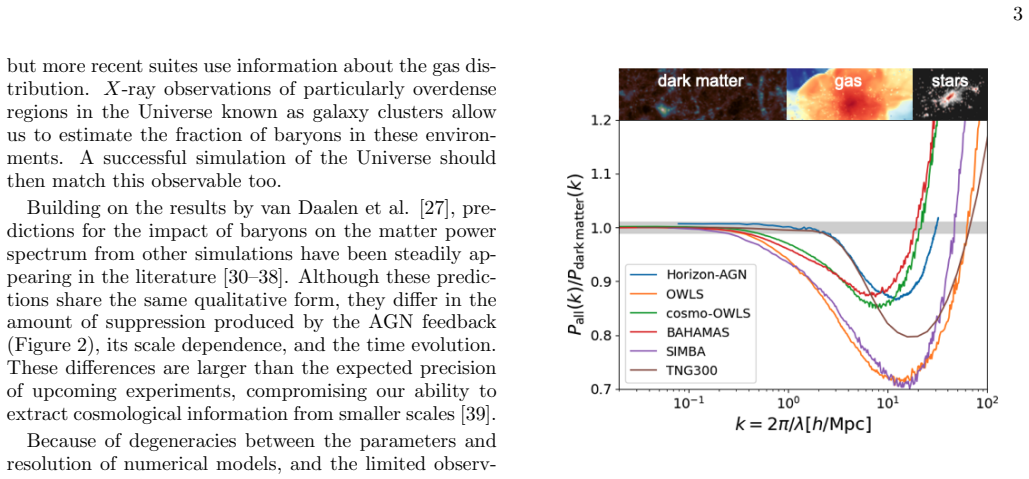
The paper argues that the same baryonic processes that ruin dark-matter-only predictions—gas cooling, star formation, supernovae, and especially AGN feedback—are now becoming predictable enough to be modeled, marginalized, and measured. Hydrodynamical simulations show AGN feedback suppresses the matter power spectrum by about 10% at $k\simeq1\,h\,\mathrm{Mpc}^{-1}$ and 30% at $k\simeq10\,h\,\mathrm{Mpc}^{-1}$, but libraries of simulations collapse onto a nearly scatter-free relation between the suppression at intermediate scales and the baryon fraction in $10^{14}M_\odot$ halos. The essay's proposal is that a single parameter at intermediate scales, and a few parameters inside baryonification models at smaller scales, can describe this physics well enough for Stage IV surveys. On that basis, it forecasts that baryonic uncertainty will be overcome before the data arrive, and that cross-correlating weak lensing with kSZ, tSZ, X-ray, and fast-radio-burst probes will constrain the physics of black holes, galaxies, and gas across cosmic time.
Load-bearing premise
The forecast stands or falls on the premise that the way gas and stars push matter around can be summarized by one parameter at intermediate scales and a few parameters at smaller scales; if faithfully modeling them requires many more numbers, the claimed timeline for beating the systematic fails.
Editorial extensions
If this is right
- If baryonic feedback is one-parameter at intermediate scales, Stage IV weak lensing surveys can marginalize over it without losing their ability to distinguish dark-energy models.
- The same parameter that describes the suppression of the power spectrum can be measured from cross-correlations of lensing with kSZ, tSZ, X-ray, and fast radio bursts, turning a systematic into a science signal.
- A failure of strong-feedback simulations to match joint lensing and kSZ/tSZ data would support an astrophysical resolution of the S8 tension rather than new physics.
- Model-independent reconstruction of the matter power spectrum from Stage IV cosmic shear becomes feasible because the baryonic contribution is no longer an unknown 10–30% envelope.
- Joint modeling will give new constraints on AGN duty cycles, the stellar-to-halo mass relation, and the gas content of low-mass halos.
Reading between the lines
- Beyond the essay: if the one-parameter relation holds, baryonification emulators could become a standard analysis stage for every Stage IV weak lensing pipeline, with the feedback parameter jointly fit with cosmology rather than fixed by priors.
- Beyond the essay: cross-correlating FRB dispersion measures with lensing might supply an independent, selection-free calibration of the gas fraction that breaks degeneracies the CMB probes cannot.
- Beyond the essay: the one-parameter compression could be tested now, before Stage IV, by checking whether current kSZ and X-ray cross-correlations prefer feedback parameters consistent with the simulation-library relation.
- If the single-parameter assumption fails at redshifts where lensing sensitivity peaks, the essay's timeline would shift to relying on higher-dimensional baryonification models; the forecast is empirically fragile in a specific, testable way.
Editorial analysis
A structured set of objections, weighed in public.
Referee Report
Summary. This essay by Chisari provides a concise review of the current status and near-term prospects for modelling the clustering of baryons in cosmological weak lensing analyses. It summarizes the 10-30% theoretical uncertainty in the matter power spectrum from baryonic feedback, describes simulation libraries and analytic tools (EFTofLSS, halo model, baryonification), and surveys complementary probes (X-ray, kSZ, tSZ, FRBs, spectral distortions, higher-order statistics) that can jointly constrain baryonic and cosmological parameters. The central forecast is that the baryonic modeling limitation can be overcome before Stage IV survey data arrive, while also flagging the open question of whether one-parameter feedback descriptions remain adequate.
Significance. If this forecast is correct, the essay identifies a timely and important path: joint modeling of luminous and dark matter will not only remove a dominant systematic for Stage IV cosmic shear but will also turn weak lensing into a probe of AGN feedback and gas physics. The essay is well-grounded in the cited literature, including 2024 results, and it is appropriately hedged in its speculative moments; the strongest example is the explicit question in Section "Modeling the clustering of baryons" about whether a single parameter can encapsulate baryon distributions. The paper contains no original derivations, but as a perspective essay it serves its purpose: it is a useful, readable synthesis and roadmap for a broad physics audience.
minor comments (4)
- [Concluding remarks] The sentence "we will test the consistency of their models, we will test the consistency of their models" contains a duplicated phrase; remove the repetition.
- [Where do baryons live?] The statement that "Almost 80% of the matter in the Universe is dark" is not accurate for the Planck 2018 cosmological parameters quoted in reference [3]; the dark matter fraction of the matter density is approximately 84%. Please revise to "roughly 85%" or provide an explicit calculation.
- [Footnote 28] The citation placeholder "[ ? ]" in footnote 28 is unresolved; supply the intended reference or delete the bracketed placeholder.
- [Abstract and Section "Modeling the clustering of baryons"] Given the body's own list of reasons why more freedom may be required (multiple mechanisms, cosmology dependence, nontrivial redshift evolution), the abstract's forecast that the limitation will be overcome before Stage IV data arrive could be read as more definite than the supporting discussion warrants. Consider making the conditionality of this forecast explicit, as the body already does.
Circularity Check
No significant circularity: the Essay is a review and forecast, not a derivation; its cited results are external and its central claims are explicitly caveated.
full rationale
The paper is an Essay/review that surveys existing work on baryonic feedback and its impact on matter clustering. It makes no new derivation, fits no parameters, and offers no prediction that is equivalent by construction to its inputs. The central claim—that baryonic uncertainty might be overcome before Stage IV data—is presented as a forecast supported by citations to independent external studies (e.g., van Daalen et al. [35], Lewandowski et al. [52], Bigwood et al. [60], Tröster et al. [90]). The one-parameter empirical relation is quoted from prior external work, not derived or reused as a self-contained prediction. The author's own self-citations are to prior papers in the field and are not load-bearing for any formal result; they are contextual references. The Essay explicitly flags the fragility of the single-parameter assumption: 'Can we really encapsulate the distribution of baryons in the Universe with a single parameter?' and notes possible cosmology dependence, redshift evolution requiring additional freedom, and tensions among kSZ, tSZ, and X-ray measurements. These caveats further demonstrate that the review is not circularly defending a fitted result. No circularity score above 0 is warranted.
Assumptions & free parameters
assumptions (2)
- domain assumption The Universe is statistically homogeneous and isotropic on large scales, and the density contrast can be treated linearly on those scales.
- domain assumption N-body simulations applying Newtonian gravity are a sufficient approximation for small cosmological volumes.
Cite this review
Pith. "Pith review of Mapping luminous and dark matter in the Universe." pith.science (2026). https://pith.science/paper/OK3VMIN4
@misc{pith2026250206644,
  author       = {Pith},
  title        = {Pith review of: Mapping luminous and dark matter in the Universe},
  year         = {2026},
  howpublished = {\url{https://pith.science/paper/OK3VMIN4}},
  note         = {Machine review of arXiv:2502.06644}
}
abstract
Our standard model of the Universe predicts the distribution of dark matter to $1\%$ at the scales needed for upcoming experiments, yet our predictions for how the luminous matter -- which has interactions besides gravity -- is distributed remain highly uncertain. Understanding how much gas and stars there are in the Universe and where they preferentially live is challenging, and the uncertainty affects how well we can understand the cosmological model itself. For example, it compromises our ability to tell apart different models for dark energy, the mysterious force driving the accelerated expansion of the Universe. In this Essay, I will touch upon many recent developments that suggest we will be able to overcome this limitation before data from new experiments become available. More excitingly, I will describe how our efforts to model luminous and dark matter jointly will create new possibilities for constraining the physics of supermassive black holes, galaxies, and gas over time.
Figures


Reference graph
Works this paper leans on
-
[1]
A. Albrecht, G. Bernstein, R. Cahn, W. L. Freedman, J. Hewitt, W. Hu, J. Huth, M. Kamionkowski, E. W. Kolb, L. Knox, et al. , Report of the Dark Energy Task Force, arXiv e-prints , astro-ph/0609591 (2006)
arXiv 2006
-
[2]
Bartelmann, TOPICAL REVIEW Gravitational lensing, Classical and Quantum Gravity 27, 233001 (2010)
M. Bartelmann, TOPICAL REVIEW Gravitational lensing, Classical and Quantum Gravity 27, 233001 (2010)
2010
-
[3]
Aghanim, Y
Planck Collaboration, N. Aghanim, Y. Akrami, M. Ash- down, J. Aumont, C. Baccigalupi, M. Ballardini, A. J. Banday, R. B. Barreiro, N. Bartolo, et al. , Planck 2018 results. VI. Cosmological parameters, A&A 641, A6 (2020)
2020
-
[4]
Bertone and T
G. Bertone and T. M. P. Tait, A new era in the search for dark matter, Nature 562, 51 (2018)
2018
-
[5]
Heymans, T
C. Heymans, T. Tr¨ oster, M. Asgari, C. Blake, H. Hilde- brandt, B. Joachimi, K. Kuijken, C.-A. Lin, A. G. S´ anchez, J. L. van den Busch,et al., KiDS-1000 Cosmol- ogy: Multi-probe weak gravitational lensing and spec- troscopic galaxy clustering constraints, A&A 646, A140 (2021)
2021
-
[6]
Amon and G
A. Amon and G. Efstathiou, A non-linear solution to the S8 tension?, MNRAS 516, 5355 (2022)
2022
-
[7]
Preston, A
C. Preston, A. Amon, and G. Efstathiou, A non-linear solution to the S 8 tension - II. Analysis of DES Year 3 cosmic shear, MNRAS 525, 5554 (2023)
2023
-
[8]
Di Valentino, L
E. Di Valentino, L. A. Anchordoqui, ¨O. Akarsu, Y. Ali- Haimoud, L. Amendola, N. Arendse, M. Asgari, M. Bal- lardini, S. Basilakos, E. Battistelli, et al. , Cosmology Intertwined III: f σ8 and S 8, Astroparticle Physics 131, 102604 (2021)
2021
Show all 124 references
- [9]
-
[10]
Ivezi´ c, S
ˇZ. Ivezi´ c, S. M. Kahn, J. A. Tyson, B. Abel, E. Acosta, R. Allsman, D. Alonso, Y. AlSayyad, S. F. Anderson, J. Andrew, et al., LSST: From Science Drivers to Refer- ence Design and Anticipated Data Products, ApJ 873, 111 (2019)
2019
-
[11]
Spergel, N
D. Spergel, N. Gehrels, J. Breckinridge, M. Don- ahue, A. Dressler, B. S. Gaudi, T. Greene, O. Guyon, C. Hirata, J. Kalirai, et al. , Wide-Field InfraRed Survey Telescope-Astrophysics Focused Telescope As- sets WFIRST-AFTA Final Report, arXiv e-prints , arXiv:1305.5422 (2013)
2013 arXiv
-
[12]
D. H. Weinberg, M. J. Mortonson, D. J. Eisenstein, C. Hirata, A. G. Riess, and E. Rozo, Observational probes of cosmic acceleration, Phys. Rep. 530, 87 (2013)
2013
-
[13]
Di Valentino, O
E. Di Valentino, O. Mena, S. Pan, L. Visinelli, W. Yang, 7 A. Melchiorri, D. F. Mota, A. G. Riess, and J. Silk, In the realm of the hubble tension—a review of solutions *, Classical and Quantum Gravity 38, 153001 (2021)
2021
-
[14]
Semboloni, H
E. Semboloni, H. Hoekstra, J. Schaye, M. P. van Daalen, and I. G. McCarthy, Quantifying the effect of baryon physics on weak lensing tomography, MNRAS417, 2020 (2011)
2011
-
[15]
Eifler, E
T. Eifler, E. Krause, S. Dodelson, A. R. Zentner, A. P. Hearin, and N. Y. Gnedin, Accounting for baryonic ef- fects in cosmic shear tomography: determining a min- imal set of nuisance parameters using PCA, MNRAS 454, 2451 (2015)
2015
-
[16]
Dubois, C
Y. Dubois, C. Pichon, C. Welker, D. Le Borgne, J. De- vriendt, C. Laigle, S. Codis, D. Pogosyan, S. Arnouts, K. Benabed, et al. , Dancing in the dark: galactic prop- erties trace spin swings along the cosmic web, MNRAS 444, 1453 (2014)
2014
-
[17]
Ma and E
C.-P. Ma and E. Bertschinger, Cosmological Perturba- tion Theory in the Synchronous and Conformal Newto- nian Gauges, ApJ 455, 7 (1995)
1995
-
[18]
N. E. Chisari and M. Zaldarriaga, Connection be- tween Newtonian simulations and general relativity, Phys. Rev. D 83, 123505 (2011)
2011
-
[19]
Hahn and A
O. Hahn and A. Paranjape, General relativistic screen- ing in cosmological simulations, Phys. Rev. D 94, 083511 (2016)
2016
-
[20]
Schneider, R
A. Schneider, R. Teyssier, D. Potter, J. Stadel, J. Onions, D. S. Reed, R. E. Smith, V. Springel, F. R. Pearce, and R. Scoccimarro, Matter power spectrum and the challenge of percent accuracy, J. Cosmology As- tropart. Phys. 2016, 047 (2016)
2016
-
[21]
Huterer and M
D. Huterer and M. Takada, Calibrating the nonlinear matter power spectrum: Requirements for future weak lensing surveys, Astroparticle Physics 23, 369 (2005)
2005
-
[22]
Kormendy and D
J. Kormendy and D. Richstone, Inward Bound—The Search For Supermassive Black Holes In Galactic Nu- clei, ARA&A 33, 581 (1995)
1995
-
[23]
White, Baryons and weak lensing power spectra, As- troparticle Physics 22, 211 (2004)
M. White, Baryons and weak lensing power spectra, As- troparticle Physics 22, 211 (2004)
2004
-
[24]
Y. P. Jing, P. Zhang, W. P. Lin, L. Gao, and V. Springel, The Influence of Baryons on the Clustering of Matter and Weak-Lensing Surveys, ApJ 640, L119 (2006)
2006
-
[25]
Levine and N
R. Levine and N. Y. Gnedin, Active Galactic Nucleus Outflows and the Matter Power Spectrum, ApJ 649, L57 (2006)
2006
-
[26]
Guillet, R
T. Guillet, R. Teyssier, and S. Colombi, The effect of baryons on the variance and the skewness of the mass distribution in the Universe at small scales, MNRAS 405, 525 (2010)
2010
-
[27]
M. P. van Daalen, J. Schaye, C. M. Booth, and C. Dalla Vecchia, The effects of galaxy formation on the matter power spectrum: a challenge for precision cosmology, MNRAS 415, 3649 (2011)
2011
-
[28]
Simulations in small volumes tend also to be affected by lack of convergence or missing large scale power [ ? ]
-
[29]
Kugel, J
R. Kugel, J. Schaye, M. Schaller, J. C. Helly, J. Braspenning, W. Elbers, C. S. Frenk, I. G. Mc- Carthy, J. Kwan, J. Salcido, et al. , FLAMINGO: cal- ibrating large cosmological hydrodynamical simulations with machine learning, MNRAS 526, 6103 (2023)
2023
-
[30]
Vogelsberger, S
M. Vogelsberger, S. Genel, V. Springel, P. Torrey, D. Si- jacki, D. Xu, G. Snyder, S. Bird, D. Nelson, and L. Hern- quist, Properties of galaxies reproduced by a hydrody- namic simulation, Nature 509, 177 (2014)
2014
-
[31]
W. A. Hellwing, M. Schaller, C. S. Frenk, T. Theuns, J. Schaye, R. G. Bower, and R. A. Crain, The effect of baryons on redshift space distortions and cosmic density and velocity fields in the EAGLE simulation, MNRAS 461, L11 (2016)
2016
-
[32]
Springel, R
V. Springel, R. Pakmor, A. Pillepich, R. Weinberger, D. Nelson, L. Hernquist, M. Vogelsberger, S. Genel, P. Torrey, F. Marinacci, et al., First results from the Il- lustrisTNG simulations: matter and galaxy clustering, MNRAS 475, 676 (2018)
2018
-
[33]
N. E. Chisari, M. L. A. Richardson, J. Devriendt, Y. Dubois, A. Schneider, A. M. C. Le Brun, R. S. Beckmann, S. Peirani, A. Slyz, and C. Pichon, The im- pact of baryons on the matter power spectrum from the Horizon-AGN cosmological hydrodynamical simulation, MNRAS 480, 3962 (2018)
2018
-
[34]
Huang, T
H.-J. Huang, T. Eifler, R. Mandelbaum, and S. Dodel- son, Modelling baryonic physics in future weak lensing surveys, MNRAS 488, 1652 (2019)
2019
-
[35]
M. P. van Daalen, I. G. McCarthy, and J. Schaye, Ex- ploring the effects of galaxy formation on matter clus- tering through a library of simulation power spectra, MNRAS 491, 2424 (2020)
2020
-
[36]
Schaye, R
J. Schaye, R. Kugel, M. Schaller, J. C. Helly, J. Braspenning, W. Elbers, I. G. McCarthy, M. P. van Daalen, B. Vandenbroucke, C. S. Frenk, et al. , The FLAMINGO project: cosmological hydrodynami- cal simulations for large-scale structure and galaxy clus- ter surveys, MNRAS 526...
2023
-
[37]
A. M. Delgado, D. Angl´ es-Alc´ azar, L. Thiele, S. Pandey, K. Lehman, R. S. Somerville, M. Ntampaka, S. Genel, F. Villaescusa-Navarro, and L. Hernquist, Predicting the impact of feedback on matter clustering with ma- chine learning in CAMELS, MNRAS 526, 5306 (2023)
2023
-
[38]
Pakmor, V
R. Pakmor, V. Springel, J. P. Coles, T. Guillet, C. Pfrommer, S. Bose, M. Barrera, A. M. Delgado, F. Ferlito, C. Frenk, et al. , The MillenniumTNG Project: the hydrodynamical full physics simulation and a first look at its galaxy clusters, MNRAS 524, 2539 (2023)
2023
-
[39]
N. E. Chisari, A. J. Mead, S. Joudaki, P. G. Ferreira, A. Schneider, J. Mohr, T. Tr¨ oster, D. Alonso, I. G. Mc- Carthy, S. Martin-Alvarez, et al. , Modelling baryonic feedback for survey cosmology, The Open Journal of Astrophysics 2, 4 (2019)
2019
-
[40]
Roca-F` abrega, J.-H
S. Roca-F` abrega, J.-H. Kim, J. R. Primack, M. Jung, A. Genina, L. Hausammann, H. Kim, A. Lupi, K. Nagamine, J. W. Powell, et al. , The AGORA High- resolution Galaxy Simulations Comparison Project. IV. Halo and Galaxy Mass Assembly in a Cosmological Zoom-in Simulation at z ≤ ...
2024
-
[41]
I. G. McCarthy, J. Schaye, S. Bird, and A. M. C. Le Brun, The BAHAMAS project: calibrated hydrody- namical simulations for large-scale structure cosmology, MNRAS 465, 2936 (2017)
2017
-
[42]
Villaescusa-Navarro, C
F. Villaescusa-Navarro, C. Hahn, E. Massara, A. Baner- jee, A. M. Delgado, D. K. Ramanah, T. Charnock, E. Giusarma, Y. Li, E. Allys, et al. , The Quijote Simu- lations, ApJS 250, 2 (2020)
2020
-
[43]
Villaescusa-Navarro, D
F. Villaescusa-Navarro, D. Angl´ es-Alc´ azar, S. Genel, D. N. Spergel, R. S. Somerville, R. Dave, A. Pillepich, L. Hernquist, D. Nelson, P. Torrey,et al., The CAMELS Project: Cosmology and Astrophysics with Machine- learning Simulations, ApJ 915, 71 (2021). 8
2021
-
[44]
Salcido, I
J. Salcido, I. G. McCarthy, J. Kwan, A. Upadhye, and A. S. Font, SP(k) - a hydrodynamical simulation-based model for the impact of baryon physics on the non-linear matter power spectrum, MNRAS 523, 2247 (2023)
2023
-
[45]
Baumann, A
D. Baumann, A. Nicolis, L. Senatore, and M. Zaldar- riaga, Cosmological non-linearities as an effective fluid, J. Cosmology Astropart. Phys. 2012, 051 (2012)
2012
-
[46]
Seljak, Analytic model for galaxy and dark matter clustering, MNRAS 318, 203 (2000)
U. Seljak, Analytic model for galaxy and dark matter clustering, MNRAS 318, 203 (2000)
2000
-
[47]
Cooray and R
A. Cooray and R. Sheth, Halo models of large scale structure, Phys. Rep. 372, 1 (2002)
2002
-
[48]
Schneider and R
A. Schneider and R. Teyssier, A new method to quantify the effects of baryons on the matter power spectrum, J. Cosmology Astropart. Phys. 2015, 049 (2015)
2015
-
[49]
Schneider, R
A. Schneider, R. Teyssier, J. Stadel, N. E. Chisari, A. M. C. Le Brun, A. Amara, and A. Refregier, Quanti- fying baryon effects on the matter power spectrum and the weak lensing shear correlation, J. Cosmology As- tropart. Phys. 2019, 020 (2019)
2019
-
[50]
Aric` o, R
G. Aric` o, R. E. Angulo, S. Contreras, L. Ondaro-Mallea, M. Pellejero-Iba˜ nez, and M. Zennaro, The BACCO sim- ulation project: a baryonification emulator with neural networks, MNRAS 506, 4070 (2021)
2021
-
[51]
Anbajagane, S
D. Anbajagane, S. Pandey, and C. Chang, Map-level baryonification: Efficient modelling of higher-order cor- relations in the weak lensing and thermal Sunyaev- Zeldovich fields, arXiv e-prints , arXiv:2409.03822 (2024)
2024 arXiv
-
[52]
Lewandowski, A
M. Lewandowski, A. Perko, and L. Senatore, Analytic prediction of baryonic effects from the EFT of large scale structures, J. Cosmology Astropart. Phys. 2015, 019 (2015)
2015
-
[53]
Maraio, A
A. Maraio, A. Hall, and A. Taylor, Mitigating baryon feedback bias in cosmic shear through a theoretical error covariance in the matter power spectrum, arXiv e-prints , arXiv:2410.12500 (2024)
2024 arXiv
-
[54]
D. P. L. Bragan¸ ca, M. Lewandowski, D. Sekera, L. Sena- tore, and R. Sgier, Baryonic effects in the Effective Field Theory of Large-Scale Structure and an analytic recipe for lensing in CMB-S4, J. Cosmology Astropart. Phys. 2021, 074 (2021)
2021
-
[55]
Mohammed, D
I. Mohammed, D. Martizzi, R. Teyssier, and A. Amara, Baryonic effects on weak-lensing two-point statistics and its cosmological implications, arXiv e-prints , arXiv:1410.6826 (2014)
2014 arXiv
-
[56]
Joudaki, C
S. Joudaki, C. Blake, A. Johnson, A. Amon, M. Asgari, A. Choi, T. Erben, K. Glazebrook, J. Harnois-D´ eraps, C. Heymans, et al. , KiDS-450 + 2dFLenS: Cosmologi- cal parameter constraints from weak gravitational lens- ing tomography and overlapping redshift-space galaxy cluster...
2018
-
[57]
Kokron, J
N. Kokron, J. DeRose, S.-F. Chen, M. White, and R. H. Wechsler, The cosmology dependence of galaxy cluster- ing and lensing from a hybrid N-body-perturbation the- ory model, MNRAS 505, 1422 (2021)
2021
-
[58]
M. S. S. L. Oei, M. J. Hardcastle, R. Timmerman, A. R. D. J. G. I. B. Gast, A. Botteon, A. C. Rodriguez, D. Stern, G. Calistro Rivera, R. J. van Weeren, H. J. A. R¨ ottgering,et al. , Black hole jets on the scale of the cosmic web, Nature 633, 537 (2024)
2024
-
[59]
P. R. S., E. Krause, K. Dolag, K. Benabed, T. Eifler, E. Ay¸ coberry, and Y. Dubois, Impact of cosmology de- pendence of baryonic feedback in weak lensing, arXiv e-prints , arXiv:2410.21980 (2024)
2024 arXiv
-
[60]
Bigwood, A
L. Bigwood, A. Amon, A. Schneider, J. Salcido, I. G. McCarthy, C. Preston, D. Sanchez, D. Sijacki, E. Schaan, S. Ferraro, et al. , Weak lensing combined with the kinetic Sunyaev-Zel’dovich effect: a study of baryonic feedback, MNRAS 534, 655 (2024)
2024
-
[61]
Johnston, N
H. Johnston, N. E. Chisari, S. Joudaki, R. Reis- chke, B. St¨ olzner, A. Loureiro, C. Mahony, S. Unruh, A. H. Wright, M. Asgari, et al. , 6x2pt: Forecasting gains from joint weak lensing and galaxy clustering analyses with spectroscopic-photometric galaxy cross- correlations, ...
2024 arXiv
-
[62]
Fedeli, The clustering of baryonic matter
C. Fedeli, The clustering of baryonic matter. I: a halo- model approach, J. Cosmology Astropart. Phys. 2014, 028 (2014)
2014
-
[63]
Fedeli, E
C. Fedeli, E. Semboloni, M. Velliscig, M. V. Daalen, J. Schaye, and H. Hoekstra, The clustering of baryonic matter. II: halo model and hydrodynamic simulations, J. Cosmology Astropart. Phys. 2014, 028 (2014)
2014
-
[64]
A. J. Mead, J. A. Peacock, C. Heymans, S. Joudaki, and A. F. Heavens, An accurate halo model for fitting non- linear cosmological power spectra and baryonic feedback models, MNRAS 454, 1958 (2015)
2015
-
[65]
A. J. Mead, S. Brieden, T. Tr¨ oster, and C. Heymans, HMCODE-2020: improved modelling of non-linear cos- mological power spectra with baryonic feedback, MN- RAS 502, 1401 (2021)
2021
-
[66]
P. S. Behroozi, C. Conroy, and R. H. Wechsler, A Com- prehensive Analysis of Uncertainties Affecting the Stel- lar Mass-Halo Mass Relation for 0 ¡ z ¡ 4, ApJ 717, 379 (2010)
2010
-
[67]
B. P. Moster, T. Naab, and S. D. M. White, Galac- tic star formation and accretion histories from match- ing galaxies to dark matter haloes, MNRAS 428, 3121 (2013)
2013
-
[68]
Zu and R
Y. Zu and R. Mandelbaum, Mapping stellar content to dark matter haloes using galaxy clustering and galaxy- galaxy lensing in the SDSS DR7, MNRAS 454, 1161 (2015)
2015
-
[69]
Dvornik, C
A. Dvornik, C. Heymans, M. Asgari, C. Mahony, B. Joachimi, M. Bilicki, E. Chisari, H. Hildebrandt, H. Hoekstra, H. Johnston, et al. , KiDS-1000: Com- bined halo-model cosmology constraints from galaxy abundance, galaxy clustering, and galaxy-galaxy lens- ing, A&A 675, A189 (2023)
2023
-
[70]
A. J. Mead and L. Verde, Including beyond-linear halo bias in halo models, MNRAS 503, 3095 (2021)
2021
-
[71]
S. N. B. Debackere, J. Schaye, and H. Hoekstra, The impact of the observed baryon distribution in haloes on the total matter power spectrum, MNRAS 492, 2285 (2020)
2020
-
[72]
E. M. Salazar, E. Rozo, R. Garc ´ ıa, N. Kokron, S. Ad- hikari, B. Diemer, and C. Osinga, Dynamics-based halo model for large scale structure, arXiv e-prints , arXiv:2406.04054 (2024)
2024 arXiv
-
[73]
M. L. van Loon and M. P. van Daalen, The contribution of massive haloes to the matter power spectrum in the presence of AGN feedback, MNRAS 528, 4623 (2024)
2024
-
[74]
Eckert, M
D. Eckert, M. Gaspari, F. Gastaldello, A. M. C. Le Brun, and E. O’Sullivan, Feedback from Active Galactic Nuclei in Galaxy Groups, Universe 7, 142 (2021)
2021
-
[75]
M. Sun, G. M. Voit, M. Donahue, C. Jones, W. Forman, and A. Vikhlinin, Chandra Studies of the X-Ray Gas Properties of Galaxy Groups, ApJ 693, 1142 (2009)
2009
-
[76]
Marini, P
I. Marini, P. Popesso, G. Lamer, K. Dolag, V. Biffi, 9 S. Vladutescu-Zopp, A. Dev, V. Toptun, E. Bulbul, J. Comparat, et al., Detecting galaxy groups populating the local Universe in the eROSITA era, A&A 689, A7 (2024)
2024
-
[77]
Kluge, J
M. Kluge, J. Comparat, A. Liu, F. Balzer, E. Bulbul, J. Ider Chitham, V. Ghirardini, C. Garrel, Y. E. Bahar, E. Artis, et al., The SRG/eROSITA All-Sky Survey. Op- tical identification and properties of galaxy clusters and groups in the western galactic hemisphere, A&A 688, A210 (2024)
2024
-
[78]
Akino, D
D. Akino, D. Eckert, N. Okabe, M. Sereno, K. Umetsu, M. Oguri, F. Gastaldello, I. N. Chiu, S. Ettori, A. E. Evrard, et al. , HSC-XXL: Baryon budget of the 136 XXL groups and clusters, PASJ 74, 175 (2022)
2022
-
[79]
Grandis, G
S. Grandis, G. Aric` o, A. Schneider, and L. Linke, De- termining the baryon impact on the matter power spec- trum with galaxy clusters, MNRAS 528, 4379 (2024)
2024
-
[80]
Eckert, F
D. Eckert, F. Gastaldello, E. O’Sullivan, A. Finoguenov, M. Brienza, and X-GAP Collaboration, Galaxy Groups as the Ultimate Probe of AGN Feedback, Galaxies 12, 24 (2024)
2024
-
[81]
Popesso, I
P. Popesso, I. Marini, K. Dolag, G. Lamer, B. Csizi, V. Biffi, A. Robothan, M. Bravo, A. Biviano, S. Vladutesku-Zopp, et al. , Average X-ray properties of galaxy groups. From Milky Way-like halos to massive clusters, arXiv e-prints , arXiv:2411.17120 (2024)
2024
-
[82]
R. A. Sunyaev and Y. B. Zeldovich, The Observations of Relic Radiation as a Test of the Nature of X-Ray Radiation from the Clusters of Galaxies, Comments on Astrophysics and Space Physics 4, 173 (1972)
1972
-
[83]
R. A. Sunyaev and Y. B. Zeldovich, The velocity of clus- ters of galaxies relative to the microwave background - The possibility of its measurement., MNRAS 190, 413 (1980)
1980
-
[84]
J. P. Ostriker and E. T. Vishniac, Generation of Mi- crowave Background Fluctuations from Nonlinear Per- turbations at the ERA of Galaxy Formation, ApJ 306, L51 (1986)
1986
-
[85]
Amodeo, N
S. Amodeo, N. Battaglia, E. Schaan, S. Ferraro, E. Moser, S. Aiola, J. E. Austermann, J. A. Beall, R. Bean, D. T. Becker, et al. , Atacama Cosmology Telescope: Modeling the gas thermodynamics in BOSS CMASS galaxies from kinematic and thermal Sunyaev- Zel’dovich measurements, P...
2021
-
[86]
Schneider, S
A. Schneider, S. K. Giri, S. Amodeo, and A. Refregier, Constraining baryonic feedback and cosmology with weak-lensing, X-ray, and kinematic Sunyaev-Zeldovich observations, MNRAS 514, 3802 (2022)
2022
-
[87]
I. G. McCarthy, A. Amon, J. Schaye, E. Schaan, R. E. Angulo, J. Salcido, M. Schaller, L. Bigwood, W. Elbers, R. Kugel, et al., FLAMINGO: combining kinetic SZ ef- fect and galaxy-galaxy lensing measurements to gauge the impact of feedback on large-scale structure, arXiv e-print...
2024 arXiv
-
[88]
P. Ade, J. Aguirre, Z. Ahmed, S. Aiola, A. Ali, D. Alonso, M. A. Alvarez, K. Arnold, P. Ashton, J. Austermann, et al. , The Simons Observatory: sci- ence goals and forecasts, J. Cosmology Astropart. Phys. 2019, 056 (2019)
2019
-
[89]
Battaglia, S
N. Battaglia, S. Ferraro, E. Schaan, and D. N. Spergel, Future constraints on halo thermodynamics from com- bined Sunyaev-Zel’dovich measurements, J. Cosmology Astropart. Phys. 2017, 040 (2017)
2017
-
[90]
Tr¨ oster, A
T. Tr¨ oster, A. J. Mead, C. Heymans, Z. Yan, D. Alonso, M. Asgari, M. Bilicki, A. Dvornik, H. Hildebrandt, B. Joachimi, et al. , Joint constraints on cosmology and the impact of baryon feedback: Combining KiDS-1000 lensing with the thermal Sunyaev-Zeldovich effect from Planck...
2022
-
[91]
S´ anchez, Y
J. S´ anchez, Y. Omori, C. Chang, L. E. Bleem, T. Crawford, A. Drlica-Wagner, S. Raghunathan, G. Zacharegkas, T. M. C. Abbott, M. Aguena, et al. , Mapping gas around massive galaxies: cross-correlation of DES Y3 galaxies and Compton-y maps from SPT and Planck, MNRAS 522, 3163 (2023)
2023
-
[92]
Grayson, E
S. Grayson, E. Scannapieco, and R. Dav´ e, Distin- guishing Active Galactic Nuclei Feedback Models with the Thermal Sunyaev-Zel’dovich Effect, ApJ 957, 17 (2023)
2023
-
[93]
I. G. McCarthy, J. Salcido, J. Schaye, J. Kwan, W. El- bers, R. Kugel, M. Schaller, J. C. Helly, J. Braspenning, C. S. Frenk, et al., The FLAMINGO project: revisiting the S8 tension and the role of baryonic physics, MNRAS 526, 5494 (2023)
2023
-
[94]
Ferreira, D
T. Ferreira, D. Alonso, C. Garcia-Garcia, and N. E. Chisari, X-Ray-Cosmic-Shear Cross-Correlations: First Detection and Constraints on Baryonic Effects, Phys. Rev. Lett. 133, 051001 (2024)
2024
-
[95]
E. T. Lau, ´A. Bogd´ an, D. Nagai, N. Cappelluti, and M. Shirasaki, Cosmology and Astrophysics with the Dif- fuse eRASS1 X-ray Angular Power Spectrum, arXiv e- prints , arXiv:2410.22397 (2024)
2024 arXiv
-
[96]
This begs the question of whether our current models for these ob- servables are accurate enough in light of the upcoming generation of experiments
showed that the X-ray emission from AGN them- selves must be accounted for, and that including non- thermal contributions to the tSZ signal also brings the model into better agreement with the data. This begs the question of whether our current models for these ob- servables a...
2014
-
[97]
La Posta, D
A. La Posta, D. Alonso, N. E. Chisari, T. Ferreira, and C. Garc ´ ıa-Garc ´ ıa,X + y: insights on gas thermo- dynamics from the combination of X-ray and thermal Sunyaev-Zel’dovich data cross-correlated with cosmic shear, arXiv e-prints , arXiv:2412.12081 (2024)
2024
-
[98]
D. R. Lorimer, A decade of fast radio bursts, Nature Astronomy 2, 860 (2018)
2018
-
[99]
Macquart, Probing the Universe’s baryons with fast radio bursts, Nature Astronomy 2, 836 (2018)
J.-P. Macquart, Probing the Universe’s baryons with fast radio bursts, Nature Astronomy 2, 836 (2018)
2018
-
[100]
J. P. Macquart, J. X. Prochaska, M. McQuinn, K. W. Bannister, S. Bhandari, C. K. Day, A. T. Deller, R. D. Ekers, C. W. James, L. Marnoch, et al. , A census of baryons in the Universe from localized fast radio bursts, Nature 581, 391 (2020)
2020
-
[101]
Reischke, D
R. Reischke, D. Neumann, K. A. Bertmann, S. Hagstotz, and H. Hildebrandt, Calibrating baryonic feedback with weak lensing and fast radio bursts, arXiv e-prints , arXiv:2309.09766 (2023)
2023 arXiv
-
[102]
B. Jego, D. Alonso, C. Garc ´ ıa-Garc ´ ıa, and J. Ruiz- Zapatero, Constraining the physics of star formation from CIB-cosmic shear cross-correlations, MNRAS 520, 583 (2023)
2023
-
[103]
Z. Yan, A. S. Maniyar, and L. van Waerbeke, The star formation, dust, and abundance of galaxies with unWISE-CIB cross-correlations, J. Cosmology As- tropart. Phys. 2024, 058 (2024)
2024
-
[104]
A. M. Hopkins and J. F. Beacom, On the Normalization of the Cosmic Star Formation History, ApJ 651, 142 (2006)
2006
-
[105]
P. S. Behroozi, R. H. Wechsler, and C. Conroy, The Average Star Formation Histories of Galaxies in Dark Matter Halos from z = 0-8, ApJ 770, 57 (2013)
2013
-
[106]
Madau and M
P. Madau and M. Dickinson, Cosmic Star-Formation History, ARA&A 52, 415 (2014). 10
2014
-
[107]
Dubois, S
Y. Dubois, S. Peirani, C. Pichon, J. Devriendt, R. Gavazzi, C. Welker, and M. Volonteri, The HORIZON-AGN simulation: morphological diversity of galaxies promoted by AGN feedback, MNRAS 463, 3948 (2016)
2016
-
[108]
M. S. Rosito, S. E. Pedrosa, P. B. Tissera, N. E. Chisari, R. Dom ´ ınguez-Tenreiro, Y. Dubois, S. Peirani, J. De- vriendt, C. Pichon, and A. Slyz, The role of AGN feedback in the structure, kinematics, and evolution of ETGs in Horizon simulations, A&A 652, A44 (2021)
2021
-
[109]
Byrne, C.-A
L. Byrne, C.-A. Faucher-Gigu` ere, S. Wellons, P. F. Hopkins, D. Angl´ es-Alc´ azar, I. Sultan, N. Wijers, J. Moreno, and S. Ponnada, Effects of Multichannel Active Galactic Nuclei Feedback in FIRE Cosmological Simulations of Massive Galaxies, ApJ 973, 149 (2024), arXiv:2310.1...
2024 arXiv
-
[110]
Preston, A
C. Preston, A. Amon, and G. Efstathiou, Reconstruct- ing the matter power spectrum with future cosmic shear surveys, MNRAS 533, 621 (2024)
2024
-
[111]
J. C. Broxterman and K. Kuijken, First Step Towards Matter Power Spectrum Reconstruction with Stage-III Weak Gravitational Lensing Surveys, arXiv e-prints , arXiv:2409.13404 (2024)
2024 arXiv
-
[112]
X. Yang, J. M. Kratochvil, K. Huffenberger, Z. Haiman, and M. May, Baryon impact on weak lensing peaks and power spectrum: Low-bias statistics and self-calibration in future surveys, Phys. Rev. D 87, 023511 (2013)
2013
-
[113]
Semboloni, H
E. Semboloni, H. Hoekstra, and J. Schaye, Effect of baryonic feedback on two- and three-point shear statis- tics: prospects for detection and improved modelling, MNRAS 434, 148 (2013)
2013
-
[114]
Paillas, C
E. Paillas, C. D. P. Lagos, N. Padilla, P. Tissera, J. Helly, and M. Schaller, Baryon effects on void statis- tics in the EAGLE simulation, MNRAS 470, 4434 (2017)
2017
-
[115]
A. J. Weiss, A. Schneider, R. Sgier, T. Kacprzak, A. Amara, and A. Refregier, Effects of baryons on weak lensing peak statistics, J. Cosmology Astropart. Phys. 2019, 011 (2019)
2019
-
[116]
Asgari, T
M. Asgari, T. Tr¨ oster, C. Heymans, H. Hildebrandt, J. L. van den Busch, A. H. Wright, A. Choi, T. Erben, B. Joachimi, S. Joudaki, et al., KiDS+VIKING-450 and DES-Y1 combined: Mitigating baryon feedback uncer- tainty with COSEBIs, A&A 634, A127 (2020)
2020
-
[117]
Foreman, W
S. Foreman, W. Coulton, F. Villaescusa-Navarro, and A. Barreira, Baryonic effects on the matter bispectrum, MNRAS 498, 2887 (2020)
2020
-
[118]
Grand´ on and E
D. Grand´ on and E. Sellentin, Stage IV baryonic feed- back correction for non-Gaussianity inference, arXiv e- prints , arXiv:2407.20448 (2024)
2024 arXiv
-
[119]
Srinivasan, D
S. Srinivasan, D. B. Thomas, and P. L. Taylor, Cosmo- logical gravity on all scales IV: 3x2pt Fisher forecasts for pixelised phenomenological modified gravity, arXiv e-prints , arXiv:2409.06569 (2024)
2024 arXiv
-
[120]
J. C. Broxterman, M. Schaller, J. Schaye, H. Hoek- stra, K. Kuijken, J. C. Helly, R. Kugel, J. Braspenning, W. Elbers, C. S. Frenk, J. Kwan, I. G. McCarthy, J. Sal- cido, M. P. van Daalen, and B. Vandenbroucke, The FLAMINGO project: baryonic impact on weak gravi- tational lens...
2024
-
[121]
Saha and S
B. Saha and S. Bose, Quantifying the impact of AGN feedback on the large-scale matter distribution us- ing two- and three-point statistics, arXiv e-prints , arXiv:2410.05376 (2024)
2024 arXiv
-
[122]
Porqueres, A
N. Porqueres, A. Heavens, D. Mortlock, G. Lavaux, and T. L. Makinen, Field-level inference of cosmic shear with intrinsic alignments and baryons, arXiv e-prints , arXiv:2304.04785 (2023)
2023 arXiv
-
[123]
J. C. Hill, N. Battaglia, J. Chluba, S. Ferraro, E. Schaan, and D. N. Spergel, Taking the Universe’s Temperature with Spectral Distortions of the Cosmic Microwave Background, Phys. Rev. Lett. 115, 261301 (2015), arXiv:1507.01583 [astro-ph.CO]
2015 arXiv
-
[124]
Thiele, D
L. Thiele, D. Wadekar, J. C. Hill, N. Battaglia, J. Chluba, F. Villaescusa-Navarro, L. Hernquist, M. Vogelsberger, D. Angl´ es-Alc´ azar, and F. Marinacci, Percent-level constraints on baryonic feedback with spectral distortion measurements, Phys. Rev. D 105, 083505 (2022)
2022
Reviewed August 8, 2026 · model on record in the stance chip above.
Discussion (0). Continue with ORCID to comment.