REVIEW 3 major objections 4 minor 70 references
Enhancing Performance of Explainable AI Models with Constrained Concept Refinement
T0 review · 3 major / 4 minor · reviewed 2026-08-08 · deepseek-v4-flash
Pith's one-line read Constrained Concept Refinement provably removes the accuracy cost of interpretable-by-design models while keeping embeddings close to their human-meaningful starting points.
desk verdict A genuine new constrained concept-refinement method with a first convergence guarantee, but the headline theorem has an unstated square-dimension assumption and the proof does not cover the deployed classifier. read the letter →
The pith
A machine-rendered reading of the paper's core claim, the machinery that carries it, and where it could break.
The reading
What carries the argument
The load-bearing object is the surrogate estimator $\tilde{f}_D(x,r) = \sum_{i \in S} \langle d_i, x\rangle r_i$ with $S$ the indices of the top-$k$ largest values of $|\langle d_i, x\rangle|$, which Lemma 3.1 shows is exactly the IP-OMP estimator when $D = D^*$ is column-orthogonal. This surrogate makes the loss differentiable almost surely along the trajectory and turns concept refinement into projected gradient descent on the query-feature matrix $D$ within the ball $\|\Delta D\|_{1,2} \le \rho$. The proof tracks an auxiliary vector $\hat{d}_i = d_i^{(0)} + (\beta_i - x^\top d_i^{(0)}/\|x\|_2^2)\,x$ for each column, which aligns the gradient direction with the error $d_i - d_i^*$ and makes the projection step contract the error. For images, the same mechanism is realized with CLIP embeddings, a concept-dispersion step that enforces near-orthogonality, hard thresholding $HT_\lambda$, and per-iteration normalization and projection.
What would settle it
Generate data from the paper's model with a full-rank orthonormal $D^*$, perturb each column by an independent vector of norm $\epsilon$, and run CCR and vanilla IP-OMP with identical sparsity $k$. If the squared-loss gap $L(f_{D+\Delta}) - L(f_{D^*})$ does not scale as $\Omega(\epsilon^2\|x\|^2)$ for small $\epsilon$, or if the projected-gradient iterates with $m = \Omega(n^6/(\sigma^2 k^5))$ fail to drive the column-wise error toward zero, then Theorem 2.6 or Theorem 3.4 would be contradicted.
Extended reading notes
Core claim
The central claim is that the accuracy-interpretability trade-off in concept-based explainable AI can be eliminated by refining concept embeddings inside a constraint set rather than by adding black-box modules. The paper first establishes a negative result (Theorem 2.6): for column-orthogonal ground-truth concepts $D^*$ and $k$-sparse inputs, any deviation $\epsilon$ in the query-feature matrix forces a loss gap of order $\Omega(\epsilon^2\|x\|_2^2)$. It then proves the positive result (Theorem 3.4): with $m = \Omega(n^6/(\sigma^2 k^5))$ samples, a full-rank column-orthogonal $D^*$, and initial error at most $\gamma/(8\sqrt{k}\Gamma)$, the CCR update (gradient step plus projection onto $\|\Delta D\|_{1,2} \le \rho$) satisfies $\|D(t+1)-D^*\|_{1,2} \le \tau \|D(t)-D^*\|_{1,2}$ and $L_m(\tilde{f}_{D(t)}) \le \frac{k\sum_h \|x_h\|_2^2}{m}\|D(t)-D^*\|_{1,2}^2$, hence zero loss and progressively better interpretability. In the deployed image-classification version, the squared-loss surrogate is replaced by hard-thresholded CLIP inner products and a linear classifier trained with cross-entropy, and the same constrained update beats the two strong baselines on CIFAR-10/100, ImageNet, and Places365.
Load-bearing premise
The convergence proof assumes the surrogate estimator (a top-$k$ linear combination with the true coefficients $\beta_i = \langle d_i^*, x\rangle$) faithfully represents the actual IP-OMP predictor, so if the surrogate stops tracking the real estimator when $D$ moves away from $D^*$, the zero-loss guarantee does not apply to the deployed cross-entropy version of the algorithm.
Editorial extensions
If this is right
- Even small errors in CLIP or human-supplied concept embeddings measurably hurt prediction, so refining embeddings is a necessary step for interpretable-by-design models, not an optional extra.
- With enough samples, CCR reaches zero training loss while the concept matrix converges linearly to the ground-truth concepts, giving provable accuracy and provable interpretability at the same time.
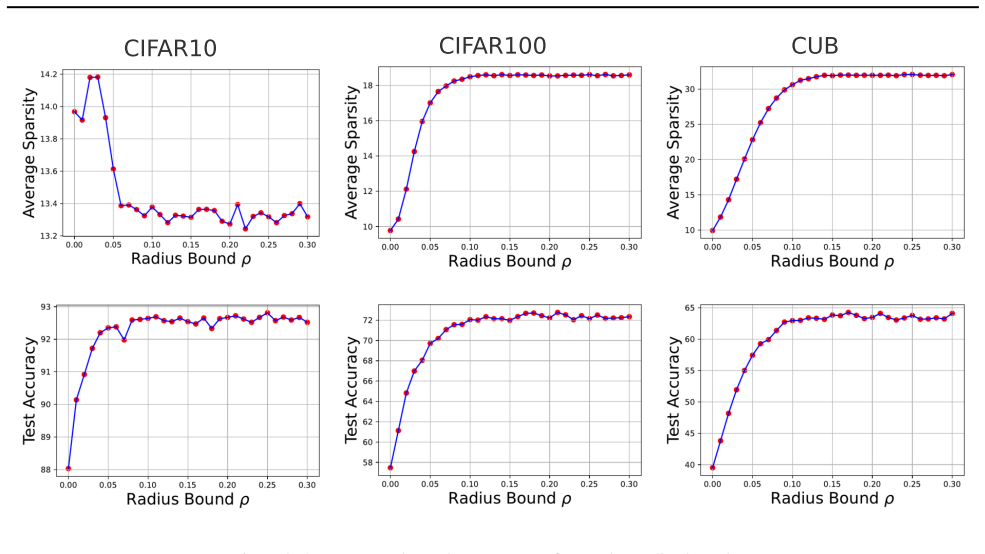
- The radius $\rho$ is a tunable dial between interpretability and accuracy: $\rho = 0$ reproduces IP-OMP, while a modest $\rho$ (0.1 in the experiments) improves accuracy across CIFAR-10/100, ImageNet, and Places365.
- CCR reduces the training cost of interpretable image classification on ImageNet from tens of hours to about two hours, roughly a tenfold speedup over CLIP-IP-OMP and lf-CBM at similar or better accuracy.
Reading between the lines
- If the surrogate-to-real-estimator fidelity is the fragile link, the most direct testable extension is to replace the top-$k$ surrogate with task-driven or unrolled dictionary learning (alternatives the paper cites) and check whether the convergence still holds; the paper does not establish this.
- The full-rank assumption suggests CCR's theoretical guarantees operate in the complete-dictionary regime; on highly overcomplete concept sets the column-wise contraction may be partial, so performance gains would likely be smaller than on benchmarks where concepts nearly span the feature space.
- The empirical version swaps squared loss for cross-entropy, so the theorem does not literally cover the deployed model; if the linear-convergence behavior persists there, it would indicate a broader alignment mechanism than the proof captures.
Editorial analysis
A structured set of objections, weighed in public.
Referee Report
Summary. This paper studies the effect of deviations between observed concept embeddings D and ground-truth latent query features D* in interpretable-by-design models based on Information Pursuit / OMP. It proves a worst-case lower bound (Theorem 2.6) showing that small column-wise perturbations of D can cause a non-vanishing squared-loss gap, and proposes Constrained Concept Refinement (CCR): constrained projected gradient descent on a differentiable surrogate f̃ of the IP-OMP estimator. Under a generative model with column-orthogonal D* and sparse x=D*β, Theorems 3.3 and 3.4 claim linear convergence of the surrogate loss and, with multiple samples, contraction of D(t) toward D*. The paper then instantiates CCR as Algorithm 2 for image classification with CLIP embeddings, hard thresholding, a learned linear layer and cross-entropy loss, reporting accuracy improvements over CLIP-IP-OMP and lf-CBM on CIFAR-10/100, ImageNet and Places365 with roughly an order of magnitude lower runtime. A repository link and ablations are provided.
Significance. If the theoretical guarantees held for the deployed method, this would be a valuable contribution: Theorem 2.6 gives a clean, self-contained lower-bound construction, and Theorem 3.4 is proved in detail with explicit sample complexity and contraction rate. The empirical evaluation is extensive, the runtime comparison is concrete, and the release of code and ablations of the dispersion/projection steps strengthens reproducibility. However, the gap between the analyzed surrogate (squared population loss with oracle access to β_i or r_i) and the deployed Algorithm 2 (cross-entropy on labels, hard thresholding, learned linear layer), together with the missing d=n condition in Theorem 3.4, means the current manuscript does not substantiate the abstract's claim that 'our algorithm' provably achieves zero loss in the setting where it is evaluated.
major comments (3)
- [Theorem 3.4 and Lemma C.6 (Appendix C.4.7).] Theorem 3.4 is stated for a 'fixed full-rank column-orthogonal D*' with no assumption d=n, but the proof of Lemma C.6 relies on d=n ('we recall that d = n in the full-rank and orthogonal setting'). When d>n, D* is full column rank but not square, every x_h=D* β_h lies in the n-dimensional column space of D*, and the d×d matrix (1/m)∑_{h∈Q_i} x_h x_h^T has rank at most n; its d-th smallest eigenvalue is zero, so the lower bound in Lemma C.6 cannot hold. Components of d_i−d*_i orthogonal to range(D*) are annihilated by the gradient term x_h x_h^T(d_i−d*_i), so the claimed contraction ∥D(t+1)−D*∥_{1,2}≤τ∥D(t)−D*∥_{1,2} is impossible in general. This is not merely technical: the empirical deployment uses CLIP embeddings of dimension much larger than the number of concepts, and the paper's own Appendix D.1 treats n<d as the 'rank-deficient' setting. The theorem statement and Assumption 3.2 must either require d=n explicitly or provide a different argument for the non-square case.
- [Section 3 (Eqs. (4)-(6)) and Algorithm 2.] The convergence guarantees are proved for the differentiable surrogate f̃ of Eq. (4) using squared population loss whose gradient in Eq. (5) requires the true coefficients β_i=⟨d*_i,x⟩ (or exact query responses r_i), whereas the deployed Algorithm 2 replaces the sparse code and prediction with hard-thresholded CLIP scores s_i=HT_λ(D^T x_i), trains a linear layer L with cross-entropy on labels, and never observes r_i or β_i. Section 3 itself notes that cross-entropy is 'a more common choice' but provides no argument that any of Theorems 3.3-3.4 transfers to this surrogate. Consequently the abstract's claim that 'our algorithm' is rigorously proved to achieve zero loss is accurate only for Algorithm 1 in a generative setting with an oracle, not for the algorithm whose empirical performance is reported. Either the analysis must be extended to the deployed loss and thresholding operation, or the claims must be explicitly scoped to the theoretical surrogate.
- [Section 3.1 and Appendix D.1.] The interpretability guarantee in Theorem 3.4 is recovery of D* in the square orthonormal case; the paper's practical interpretability argument rests on the heuristic assumption that a small ℓ2 radius around CLIP embeddings preserves human-meaningful concepts. No experiment measures human agreement with the learned concepts, and the ACED values in Table 1 only measure distance from initialization, not semantic validity. If the authors want to claim that CCR 'preserves interpretability' in the empirical setting, a human-study or concept-alignment metric is needed; otherwise interpretability should be described as inherited from CLIP-IP-OMP's framework.
minor comments (4)
- [Throughout the manuscript.] There are several typographical errors, including 'expainable' in the Introduction, 'suppose that that' in Theorem 3.3, and 'rank defficient' in Figure 4; these should be corrected.
- [Appendix C.4.7, Lemma C.6.] The concentration displays in Eqs. (24)-(25) mix σ and σ² and are hard to verify; please restate the normalized bound from Theorem C.7 before multiplying by |Q_i|, so that the reader can check the final sample-complexity condition.
- [Appendix D.2, Algorithm 3.] The dispersion factor r is not reported or discussed in the experiments; since Figure 6 shows that removing dispersion affects sparsity, please specify the value of r used for each benchmark.
- [References.] The reference for Vaswani is incomplete; please provide the full author list and publication venue.
Circularity Check
No load-bearing circularity: the theoretical claims are self-contained proofs under an explicit generative model; only minor, non-load-bearing self-citations appear.
full rationale
The derivation chain is not circular. The main guarantees (Theorems 2.6, 3.3, 3.4) are proved from the stated generative model (Assumptions 2.3 and 3.2) using explicit lemmas (C.1–C.8), with no fitted parameter reused as a prediction and no external benchmark value imported into the proof. The surrogate f̃ in Eq. (4) is not fitted: it is the algebraic form of the IP-OMP estimator under column-orthogonality (Lemmas 3.1, C.1, C.2), and the proof demonstrates convergence of gradient descent on that surrogate. Self-citations to Liang et al. (2022, 2024) are motivational or stylistic ('proof strategy similar to Lemma 3.1 in (Liang et al., 2022)'), and the relevant proof is reproduced in full, so they are not load-bearing. Flagged limitations, weighed here as non-circularity: the paper explicitly states that if D* is not full-rank, deviations orthogonal to its column space 'cannot be eliminated by Equation (5)' (Section 3), and the proof of Lemma C.6 invokes an unstated squareness condition ('we recall that d = n in the full-rank and orthogonal setting'), which is a correctness and assumption gap for d > n, not a circular reduction. Similarly, the paper acknowledges that Algorithm 2's cross-entropy, hard-thresholding, and normalization are modifications not covered by Theorem 3.4; this is a transfer gap, not circularity. Empirical comparisons use external baselines CLIP-IP-OMP and lf-CBM. Overall, the central derivation does not reduce to its inputs.
Assumptions & free parameters
free parameters (5)
- ρ (correction radius) =
0.1 fixed for all image experiments
- λ (hard-threshold parameter) =
not reported per dataset
- ηD, ηL (learning rates) =
not reported
- dispersion factor r =
not reported
- ρ (initial error bound in theory) =
≤ γ/(8√kΓ)
assumptions (7)
- domain assumption Assumption 2.3: y=⟨x,z⟩ and q_i=⟨v_i,z⟩ with z~N(0,I_d).
- domain assumption Assumption 3.2: x=D*β with column-orthogonal D*, support drawn uniformly, β_i zero-mean with γ≤|β_i|≤Γ.
- domain assumption D* is full-rank (d=n) in Theorem 3.4.
- ad hoc to paper Surrogate estimator f̃ (Eq. 4) behaves like the actual IP-OMP estimator f_D.
- ad hoc to paper The update in Eq. (5) can access the true population loss or the coefficients β_i=⟨d*_i,x⟩.
- domain assumption CLIP embeddings (after dispersion) retain human-meaningful concept semantics within radius ρ.
- standard math Standard concentration inequalities (Vershynin Thm C.7, Chernoff Thm C.8).
Cite this review
Pith. "Pith review of Enhancing Performance of Explainable AI Models with Constrained Concept Refinement." pith.science (2026). https://pith.science/paper/H3M6B5WE
@misc{pith2026250206775,
  author       = {Pith},
  title        = {Pith review of: Enhancing Performance of Explainable AI Models with Constrained Concept Refinement},
  year         = {2026},
  howpublished = {\url{https://pith.science/paper/H3M6B5WE}},
  note         = {Machine review of arXiv:2502.06775}
}
read the original abstract
The trade-off between accuracy and interpretability has long been a challenge in machine learning (ML). This tension is particularly significant for emerging interpretable-by-design methods, which aim to redesign ML algorithms for trustworthy interpretability but often sacrifice accuracy in the process. In this paper, we address this gap by investigating the impact of deviations in concept representations-an essential component of interpretable models-on prediction performance and propose a novel framework to mitigate these effects. The framework builds on the principle of optimizing concept embeddings under constraints that preserve interpretability. Using a generative model as a test-bed, we rigorously prove that our algorithm achieves zero loss while progressively enhancing the interpretability of the resulting model. Additionally, we evaluate the practical performance of our proposed framework in generating explainable predictions for image classification tasks across various benchmarks. Compared to existing explainable methods, our approach not only improves prediction accuracy while preserving model interpretability across various large-scale benchmarks but also achieves this with significantly lower computational cost.
Figures


Figures from the paper (25 more)




Reference graph
Works this paper leans on
-
[1]
write newline
" write newline "" before.all 'output.state := FUNCTION n.dashify 't := "" t empty not t #1 #1 substring "-" = t #1 #2 substring "--" = not "--" * t #2 global.max substring 't := t #1 #1 substring "-" = "-" * t #2 global.max substring 't := while if t #1 #1 substring * t #2 global.max substring 't := if while FUNCTION format.date year duplicate empty "emp...
-
[2]
Sanity checks for saliency maps
Adebayo, J., Gilmer, J., Muelly, M., Goodfellow, I., Hardt, M., and Kim, B. Sanity checks for saliency maps. Advances in neural information processing systems, 31, 2018
2018
-
[3]
Learning sparsely used overcomplete dictionaries via alternating minimization
Agarwal, A., Anandkumar, A., Jain, P., and Netrapalli, P. Learning sparsely used overcomplete dictionaries via alternating minimization. SIAM Journal on Optimization, 26 0 (4): 0 2775--2799, 2016
work page 2016
-
[4]
K-svd: An algorithm for designing overcomplete dictionaries for sparse representation
Aharon, M., Elad, M., and Bruckstein, A. K-svd: An algorithm for designing overcomplete dictionaries for sparse representation. IEEE Transactions on signal processing, 54 0 (11): 0 4311--4322, 2006
work page 2006
-
[5]
Anderson, T. W., Anderson, T. W., Anderson, T. W., and Anderson, T. W. An introduction to multivariate statistical analysis, volume 2. Wiley New York, 1958
work page 1958
-
[6]
Simple, efficient, and neural algorithms for sparse coding
Arora, S., Ge, R., Ma, T., and Moitra, A. Simple, efficient, and neural algorithms for sparse coding. In Conference on learning theory, pp.\ 113--149. PMLR, 2015
work page 2015
-
[7]
How to explain individual classification decisions
Baehrens, D., Schroeter, T., Harmeling, S., Kawanabe, M., Hansen, K., and M \"u ller, K.-R. How to explain individual classification decisions. The Journal of Machine Learning Research, 11: 0 1803--1831, 2010
work page 2010
-
[8]
Barrag \'a n-Montero, A., Javaid, U., Vald \'e s, G., Nguyen, D., Desbordes, P., Macq, B., Willems, S., Vandewinckele, L., Holmstr \"o m, M., L \"o fman, F., et al. Artificial intelligence and machine learning for medical imaging: A technology review. Physica Medica, 83: 0 242--256, 2021
work page 2021
Show all 70 references
-
[9]
What, indeed, is an achievable provable guarantee for learning-enabled safety-critical systems
Bensalem, S., Cheng, C.-H., Huang, W., Huang, X., Wu, C., and Zhao, X. What, indeed, is an achievable provable guarantee for learning-enabled safety-critical systems. In International Conference on Bridging the Gap between AI and Reality, pp.\ 55--76. Springer, 2023
2023
-
[10]
Language models are few-shot learners
Brown, T., Mann, B., Ryder, N., Subbiah, M., Kaplan, J., Dhariwal, P., Neelakantan, A., Shyam, P., Sastry, G., Askell, A., et al. Language models are few-shot learners. Advances in Neural Information Processing Systems, 33: 0 1877--1901, 2020
1901
-
[11]
Semantic bottleneck for computer vision tasks
Bucher, M., Herbin, S., and Jurie, F. Semantic bottleneck for computer vision tasks. In Computer Vision--ACCV 2018: 14th Asian Conference on Computer Vision, Perth, Australia, December 2--6, 2018, Revised Selected Papers, Part II 14, pp.\ 695--712. Springer, 2019
2018
-
[12]
D., Vidal, R., and Geman, D
Chattopadhyay, A., Slocum, S., Haeffele, B. D., Vidal, R., and Geman, D. Interpretable by design: Learning predictors by composing interpretable queries. IEEE Transactions on Pattern Analysis and Machine Intelligence, 45 0 (6): 0 7430--7443, 2022
2022
-
[13]
Chattopadhyay, A., Chan, K. H. R., Haeffele, B. D., Geman, D., and Vidal, R. Variational information pursuit for interpretable predictions. arXiv preprint arXiv:2302.02876, 2023
2023 arXiv
-
[14]
Information maximization perspective of orthogonal matching pursuit with applications to explainable ai
Chattopadhyay, A., Pilgrim, R., and Vidal, R. Information maximization perspective of orthogonal matching pursuit with applications to explainable ai. Advances in Neural Information Processing Systems, 36, 2024
2024
-
[15]
F., Phan, V
Chowdhury, T. F., Phan, V. M. H., Liao, K., To, M.-S., Xie, Y., van den Hengel, A., Verjans, J. W., and Liao, Z. Adacbm: An adaptive concept bottleneck model for explainable and accurate diagnosis. In International Conference on Medical Image Computing and Computer-Assisted In...
2024
-
[16]
R., Oksuz, I., Puyol-Ant \'o n, E., Ruijsink, B., King, A
Clough, J. R., Oksuz, I., Puyol-Ant \'o n, E., Ruijsink, B., King, A. P., and Schnabel, J. A. Global and local interpretability for cardiac mri classification. In International Conference on Medical Image Computing and Computer-Assisted Intervention, pp.\ 656--664. Springer, 2019
2019
-
[17]
Imagenet: A large-scale hierarchical image database
Deng, J., Dong, W., Socher, R., Li, L.-J., Li, K., and Fei-Fei, L. Imagenet: A large-scale hierarchical image database. In 2009 IEEE conference on computer vision and pattern recognition, pp.\ 248--255. Ieee, 2009
2009
-
[18]
Dutta, S., Wei, H., van der Laan, L., and Alaa, A. M. Estimating uncertainty in multimodal foundation models using public internet data. arXiv preprint arXiv:2310.09926, 2023
2023 arXiv
-
[19]
Rethinking domain adaptation and generalization in the era of clip
Feng, R., Yu, T., Jin, X., Yu, X., Xiao, L., and Chen, Z. Rethinking domain adaptation and generalization in the era of clip. In 2024 IEEE International Conference on Image Processing (ICIP), pp.\ 2585--2591. IEEE, 2024
2024
-
[20]
Can we constrain concept bottleneck models to learn semantically meaningful input features? arXiv preprint arXiv:2402.00912, 2024
Furby, J., Cunnington, D., Braines, D., and Preece, A. Can we constrain concept bottleneck models to learn semantically meaningful input features? arXiv preprint arXiv:2402.00912, 2024
2024 arXiv
-
[21]
and Jedynak, B
Geman, D. and Jedynak, B. An active testing model for tracking roads in satellite images. IEEE Transactions on Pattern Analysis and Machine Intelligence, 18 0 (1): 0 1--14, 1996
1996
-
[22]
Interpretation of neural networks is fragile
Ghorbani, A., Abid, A., and Zou, J. Interpretation of neural networks is fragile. In Proceedings of the AAAI conference on artificial intelligence, volume 33, pp.\ 3681--3688, 2019
2019
-
[23]
W., Gast, J., Ruiz, I
Gondal, M. W., Gast, J., Ruiz, I. A., Droste, R., Macri, T., Kumar, S., and Staudigl, L. Domain aligned clip for few-shot classification. In Proceedings of the IEEE/CVF Winter Conference on Applications of Computer Vision, pp.\ 5721--5730, 2024
2024
-
[24]
Regression concept vectors for bidirectional explanations in histopathology
Graziani, M., Andrearczyk, V., and M \"u ller, H. Regression concept vectors for bidirectional explanations in histopathology. In Understanding and Interpreting Machine Learning in Medical Image Computing Applications: First International Workshops, MLCN 2018, DLF 2018, and iM...
2018
-
[25]
Identifying implicit social biases in vision-language models
Hamidieh, K., Zhang, H., Gerych, W., Hartvigsen, T., and Ghassemi, M. Identifying implicit social biases in vision-language models. In Proceedings of the AAAI/ACM Conference on AI, Ethics, and Society, volume 7, pp.\ 547--561, 2024
2024
-
[26]
The elements of statistical learning: data mining, inference, and prediction, 2009
Hastie, T. The elements of statistical learning: data mining, inference, and prediction, 2009
2009
-
[27]
Probabilistic concept bottleneck models
Kim, E., Jung, D., Park, S., Kim, S., and Yoon, S. Probabilistic concept bottleneck models. arXiv preprint arXiv:2306.01574, 2023
2023 arXiv
-
[28]
u tt, K. T., D \
Kindermans, P.-J., Hooker, S., Adebayo, J., Alber, M., Sch \"u tt, K. T., D \"a hne, S., Erhan, D., and Kim, B. The (un) reliability of saliency methods. Explainable AI: Interpreting, explaining and visualizing deep learning, pp.\ 267--280, 2019
2019
-
[29]
W., Nguyen, T., Tang, Y
Koh, P. W., Nguyen, T., Tang, Y. S., Mussmann, S., Pierson, E., Kim, B., and Liang, P. Concept bottleneck models. In International conference on machine learning, pp.\ 5338--5348. PMLR, 2020
2020
-
[30]
A., Levie, R., Bruna, J., and Kutyniok, G
Kolek, S., Nguyen, D. A., Levie, R., Bruna, J., and Kutyniok, G. A rate-distortion framework for explaining black-box model decisions. In International Workshop on Extending Explainable AI Beyond Deep Models and Classifiers, pp.\ 91--115. Springer, 2020
2020
-
[31]
Learning multiple layers of features from tiny images
Krizhevsky, A., Hinton, G., et al. Learning multiple layers of features from tiny images. 2009
2009
-
[32]
H., Nickisch, H., and Harmeling, S
Lampert, C. H., Nickisch, H., and Harmeling, S. Learning to detect unseen object classes by between-class attribute transfer. In 2009 IEEE conference on computer vision and pattern recognition, pp.\ 951--958. IEEE, 2009
2009
-
[33]
Deep learning
LeCun, Y., Bengio, Y., and Hinton, G. Deep learning. nature, 521 0 (7553): 0 436--444, 2015
2015
-
[34]
Liang, G., Zhang, G., Fattahi, S., and Zhang, R. Y. Simple alternating minimization provably solves complete dictionary learning. arXiv preprint arXiv:2210.12816, 2022
2022 arXiv
-
[35]
Personalized dictionary learning for heterogeneous datasets
Liang, G., Shi, N., Al Kontar, R., and Fattahi, S. Personalized dictionary learning for heterogeneous datasets. Advances in Neural Information Processing Systems, 36, 2024
2024
-
[36]
Task-driven dictionary learning
Mairal, J., Bach, F., and Ponce, J. Task-driven dictionary learning. IEEE transactions on pattern analysis and machine intelligence, 34 0 (4): 0 791--804, 2011
2011
-
[37]
Understanding approximate and unrolled dictionary learning for pattern recovery
Mal \'e zieux, B., Moreau, T., and Kowalski, M. Understanding approximate and unrolled dictionary learning for pattern recovery. arXiv preprint arXiv:2106.06338, 2021
2021 arXiv
-
[38]
Interpretability is in the mind of the beholder: A causal framework for human-interpretable representation learning
Marconato, E., Passerini, A., and Teso, S. Interpretability is in the mind of the beholder: A causal framework for human-interpretable representation learning. Entropy, 25 0 (12): 0 1574, 2023
2023
-
[39]
Do concept bottleneck models learn as intended? arXiv preprint arXiv:2105.04289, 2021
Margeloiu, A., Ashman, M., Bhatt, U., Chen, Y., Jamnik, M., and Weller, A. Do concept bottleneck models learn as intended? arXiv preprint arXiv:2105.04289, 2021
2021 arXiv
-
[40]
and Raghavan, P
Motwani, R. and Raghavan, P. Randomized algorithms. ACM Computing Surveys (CSUR), 28 0 (1): 0 33--37, 1996
1996
-
[41]
M., and Weng, T.-W
Oikarinen, T., Das, S., Nguyen, L. M., and Weng, T.-W. Label-free concept bottleneck models. arXiv preprint arXiv:2304.06129, 2023
2023 arXiv
-
[42]
Olshausen, B. A. and Field, D. J. Sparse coding with an overcomplete basis set: A strategy employed by v1? Vision research, 37 0 (23): 0 3311--3325, 1997
1997
-
[43]
C., Rezaiifar, R., and Krishnaprasad, P
Pati, Y. C., Rezaiifar, R., and Krishnaprasad, P. S. Orthogonal matching pursuit: Recursive function approximation with applications to wavelet decomposition. In Proceedings of 27th Asilomar conference on signals, systems and computers, pp.\ 40--44. IEEE, 1993
1993
-
[44]
Quinlan, J. R. Induction of decision trees. Machine learning, 1: 0 81--106, 1986
1986
-
[45]
W., Hallacy, C., Ramesh, A., Goh, G., Agarwal, S., Sastry, G., Askell, A., Mishkin, P., Clark, J., et al
Radford, A., Kim, J. W., Hallacy, C., Ramesh, A., Goh, G., Agarwal, S., Sastry, G., Askell, A., Mishkin, P., Clark, J., et al. Learning transferable visual models from natural language supervision. In International conference on machine learning, pp.\ 8748--8763. PMLR, 2021
2021
-
[46]
Unveiling glitches: A deep dive into image encoding bugs within clip
Ranjan, A., Wen, D., and Bhat, K. Unveiling glitches: A deep dive into image encoding bugs within clip. arXiv preprint arXiv:2407.00592, 2024
2024 arXiv
-
[47]
Analysis of fast structured dictionary learning
Ravishankar, S., Ma, A., and Needell, D. Analysis of fast structured dictionary learning. Information and Inference: A Journal of the IMA, 9 0 (4): 0 785--811, 2020
2020
-
[48]
Stop explaining black box machine learning models for high stakes decisions and use interpretable models instead
Rudin, C. Stop explaining black box machine learning models for high stakes decisions and use interpretable models instead. Nature machine intelligence, 1 0 (5): 0 206--215, 2019
2019
-
[49]
and Nakamura, K
Sawada, Y. and Nakamura, K. Concept bottleneck model with additional unsupervised concepts. IEEE Access, 10: 0 41758--41765, 2022
2022
-
[50]
R., Cogswell, M., Das, A., Vedantam, R., Parikh, D., and Batra, D
Selvaraju, R. R., Cogswell, M., Das, A., Vedantam, R., Parikh, D., and Batra, D. Grad-cam: Visual explanations from deep networks via gradient-based localization. In Proceedings of the IEEE international conference on computer vision, pp.\ 618--626, 2017
2017
-
[51]
Investigating the limitation of clip models: The worst-performing categories
Shao, J.-J., Shi, J.-X., Yang, X.-W., Guo, L.-Z., and Li, Y.-F. Investigating the limitation of clip models: The worst-performing categories. arXiv preprint arXiv:2310.03324, 2023
2023 arXiv
-
[52]
Learning important features through propagating activation differences
Shrikumar, A., Greenside, P., and Kundaje, A. Learning important features through propagating activation differences. In International conference on machine learning, pp.\ 3145--3153. PMlR, 2017
2017
-
[53]
Deep inside convolutional networks: Visualising image classification models and saliency maps
Simonyan, K., Vedaldi, A., and Zisserman, A. Deep inside convolutional networks: Visualising image classification models and saliency maps. arXiv preprint arXiv:1312.6034, 2013
2013 arXiv
-
[54]
Fooling lime and shap: Adversarial attacks on post hoc explanation methods
Slack, D., Hilgard, S., Jia, E., Singh, S., and Lakkaraju, H. Fooling lime and shap: Adversarial attacks on post hoc explanation methods. In Proceedings of the AAAI/ACM Conference on AI, Ethics, and Society, pp.\ 180--186, 2020
2020
-
[55]
Smoothgrad: removing noise by adding noise
Smilkov, D., Thorat, N., Kim, B., Vi \'e gas, F., and Wattenberg, M. Smoothgrad: removing noise by adding noise. arXiv preprint arXiv:1706.03825, 2017
2017 arXiv
-
[56]
Fooling network interpretation in image classification
Subramanya, A., Pillai, V., and Pirsiavash, H. Fooling network interpretation in image classification. In Proceedings of the IEEE/CVF international conference on computer vision, pp.\ 2020--2029, 2019
2020
-
[57]
Complete dictionary recovery over the sphere i: Overview and the geometric picture
Sun, J., Qu, Q., and Wright, J. Complete dictionary recovery over the sphere i: Overview and the geometric picture. IEEE Transactions on Information Theory, 63 0 (2): 0 853--884, 2016
2016
-
[58]
and Ba, D
Tolooshams, B. and Ba, D. Stable and interpretable unrolled dictionary learning. arXiv preprint arXiv:2106.00058, 2021
2021 arXiv
-
[59]
Tropp, J. A. Greed is good: Algorithmic results for sparse approximation. IEEE Transactions on Information theory, 50 0 (10): 0 2231--2242, 2004
2004
-
[60]
Attention is all you need
Vaswani, A. Attention is all you need. Advances in Neural Information Processing Systems, 2017
2017
-
[61]
High-dimensional probability: An introduction with applications in data science, volume 47
Vershynin, R. High-dimensional probability: An introduction with applications in data science, volume 47. Cambridge university press, 2018
2018
-
[62]
The caltech-ucsd birds-200-2011 dataset
Wah, C., Branson, S., Welinder, P., Perona, P., and Belongie, S. The caltech-ucsd birds-200-2011 dataset. 2011
2011
-
[63]
and Kang, G
Wang, Y. and Kang, G. Attention head purification: A new perspective to harness clip for domain generalization. arXiv preprint arXiv:2412.07226, 2024
2024 arXiv
-
[64]
Watson, D. S. Conceptual challenges for interpretable machine learning. Synthese, 200 0 (2): 0 65, 2022
2022
-
[65]
Neural-symbolic vqa: Disentangling reasoning from vision and language understanding
Yi, K., Wu, J., Gan, C., Torralba, A., Kohli, P., and Tenenbaum, J. Neural-symbolic vqa: Disentangling reasoning from vision and language understanding. Advances in neural information processing systems, 31, 2018
2018
-
[66]
Post-hoc concept bottleneck models
Yuksekgonul, M., Wang, M., and Zou, J. Post-hoc concept bottleneck models. arXiv preprint arXiv:2205.15480, 2022
2022 arXiv
-
[67]
E., Barbiero, P., Ciravegna, G., Marra, G., Giannini, F., Diligenti, M., Precioso, F., Melacci, S., Weller, A., Lio, P., et al
Zarlenga, M. E., Barbiero, P., Ciravegna, G., Marra, G., Giannini, F., Diligenti, M., Precioso, F., Melacci, S., Weller, A., Lio, P., et al. Concept embedding models. In NeurIPS 2022-36th Conference on Neural Information Processing Systems, 2022
2022
-
[68]
Zeiler, M. D. and Fergus, R. Visualizing and understanding convolutional networks. In Computer Vision--ECCV 2014: 13th European Conference, Zurich, Switzerland, September 6-12, 2014, Proceedings, Part I 13, pp.\ 818--833. Springer, 2014
2014
-
[69]
Places: A 10 million image database for scene recognition
Zhou, B., Lapedriza, A., Khosla, A., Oliva, A., and Torralba, A. Places: A 10 million image database for scene recognition. IEEE transactions on pattern analysis and machine intelligence, 40 0 (6): 0 1452--1464, 2017
2017
-
[70]
Interpretable basis decomposition for visual explanation
Zhou, B., Sun, Y., Bau, D., and Torralba, A. Interpretable basis decomposition for visual explanation. In Proceedings of the European Conference on Computer Vision (ECCV), pp.\ 119--134, 2018
2018
Reviewed August 8, 2026 · model on record in the stance chip above.
Discussion (0). Continue with ORCID to comment.