REVIEW 4 major objections 4 minor 1 cited by
Outsourced diffusion sampling: Efficient posterior inference in latent spaces of generative models
T0 review · 4 major / 4 minor · reviewed 2026-08-08 · deepseek-v4-flash
Pith's one-line read The paper claims that intractable posterior sampling over data can be replaced by diffusion sampling over a pretrained generator's noise variable, with the generator itself carrying samples back to data space.
desk verdict The core pullback idea is correct and well-packaged; the finite-time TB bias and a few evaluation choices keep this from being a clean accept. read the letter →
The pith
A machine-rendered reading of the paper's core claim, the machinery that carries it, and where it could break.
The reading
What carries the argument
The load-bearing objects are Proposition 3.1's pullback identity and the trajectory balance objective. The identity says the data-space posterior is the pushforward of the noise-space posterior, so a correct noise-space sampler automatically yields correct data-space samples through $f$. The trajectory balance objective, $\mathcal{L}_{\mathrm{TB}}(\tau;y,\phi)=\left(\log \frac{Z_\phi(y)p_\phi^F(\tau|y)}{R(z_1|y)p_B(\tau|z_1)}\right)^2$, matches the distribution over denoising trajectories defined by the trained sampler against the fixed noising kernel weighted by the target density $R(z_1|y)=p(z_1)r(f(z_1),y)$; when it is zero on every trajectory in the continuous-time limit, the sampler's terminal marginal is the target. The objective is off-policy, so the reward function only needs to be queried, not differentiated, and exploration can be biased toward high-reward regions via replay buffers.
What would settle it
Take a low-dimensional prior with an exactly computable posterior, train the outsourced diffusion sampler for an increasing number of steps, and compare its samples against the true pullback posterior with a two-sample test or estimated KL divergence; if the divergence does not decrease toward zero, or if a test reward concentrates on latent directions the sampler is architecturally prevented from representing, then the method is sampling an approximation rather than the claimed posterior.
Extended reading notes
Core claim
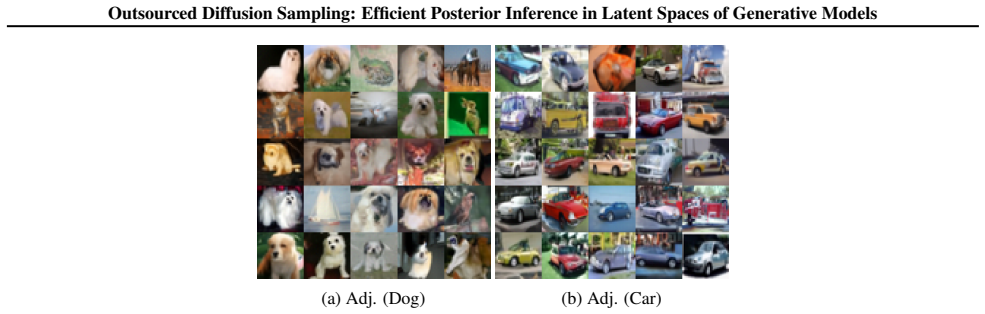
The central claim is a pullback identity (Proposition 3.1): if $z'$ is sampled with density proportional to $p(z)r(f(z),y)$, then $x'=f(z')$ is distributed with density proportional to $p(x)r(x,y)$. The paper argues this turns an intractable data-space posterior into a tractable noise-space sampling target, without ever computing the pushforward density and without requiring $f$ to be injective or smooth. The proposed outsourced diffusion sampler trains a diffusion model on that noise-space target using the trajectory balance objective (Eq. 4), with the prior density $p(z)$ and the constraint evaluated through $f$ as the only required queries. In experiments with unconditional CIFAR-10 generators, the NVAE and StyleGAN3 face generators, Stable Diffusion 3, and a protein backbone flow model, the method produces conditional samples with higher reward and competitive diversity relative to latent HMC and, where applicable, adjoint matching.
Load-bearing premise
The practical advantage rests on the empirical claim that the noise-space posterior is smoother and easier to sample than the data-space posterior, together with the assumption that off-policy trajectory balance training converges to the target within a practical compute budget; in the NVAE experiment there is also the approximation that the first four latent levels capture all reward-relevant variation.
Editorial extensions
If this is right
- Any prior expressible as a deterministic transformation of Gaussian noise — VAE, hierarchical VAE, GAN, normalizing flow, continuous normalizing flow, or diffusion/latent diffusion — can be conditioned on a constraint by training one noise-space sampler, with no change to the algorithm.
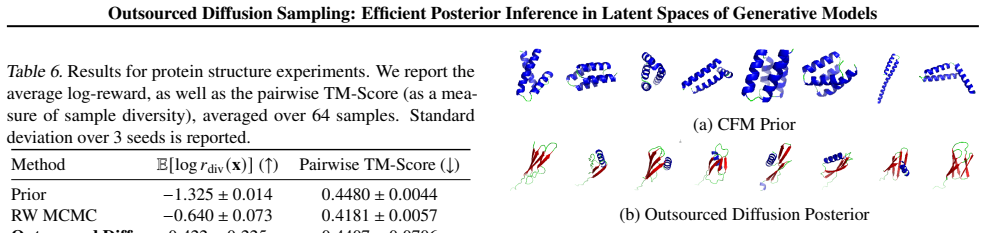
- Because only queries of $r(f(z),y)$ are needed, the method applies to constraints whose gradients are unavailable or undefined, such as the discrete secondary-structure diversity reward in the protein experiment.
- Conditioning the diffusion sampler on $y$ amortizes the cost over the constraint variable: after training, posterior samples for a new $y$ are generated by a fast neural SDE rollout rather than by MCMC.
- A distilled one-step version of the trained sampler matches or improves on the multi-step sampler's FID in the CIFAR-10 experiment, so the posterior inference cost can be reduced to a single network evaluation.
- The method avoids the bias that the paper reports for naive adjoint matching on flow models trained with minibatch optimal transport couplings or non-Gaussian sources.
Reading between the lines
- If the smoothness observation generalizes, the same pullback recipe could turn any high-dimensional inverse problem with an expressive pretrained generator into a lower-dimensional variational problem, potentially reducing the training compute needed for reward fine-tuning; this is an extension the paper motivates but does not test.
- Because the target $R(z|y)$ factorizes as prior times reward through $f$, one trained noise-space sampler could be reused across many reward functions for the same prior by multiplying rewards during training, a compositional property the paper leaves implicit.
- For non-injective generators, the pullback posterior places mass on every noise preimage of a data point; the paper's mode-mixing results suggest this latent-space spread may act as a useful regularizer, but a direct comparison of output diversity against an exact data-space posterior would be needed to confirm it.
- A natural stress test is to apply the method to a latent diffusion prior where the omitted high-level latents carry reward-relevant information; the NVAE experiment restricts to the first four latent levels, so a mismatch would show up as reward that the sampler cannot reach.
Editorial analysis
A structured set of objections, weighed in public.
Referee Report
Summary. The paper proposes "outsourced diffusion sampling" for posterior inference under generative models that are deterministic transformations x=f_theta(z) of a Gaussian noise variable. For a constraint r(x,y), the posterior p(x|y) proportional to p(x)r(x,y) is pulled back to the noise space: Proposition 3.1 states that if z' is drawn from a density proportional to p(z)r(f(z),y), then f(z') is distributed as the desired posterior. The paper trains a diffusion sampler in z-space using the trajectory balance objective (Eq. 4), treating R(z|y)=p(z)r(f(z),y) as an unnormalized target, and transforms samples by f. It demonstrates the approach on CIFAR-10 class-conditional generation with SN-GAN and flow-matching priors, FFHQ text-conditioned generation with StyleGAN3 and NVAE priors, reward-aligned text-to-image generation with Stable Diffusion 3, and protein secondary-structure diversification with FoldFlow 2, plus a one-step distillation variant. The exposition includes the noise-outsourcing lemma (Prop. 2.1), a proof of Prop. 3.1, and an appendix showing that relative trajectory balance is recovered as a special case.
Significance. Proposition 3.1 is proved in the appendix and gives a clean, correct reduction: posterior sampling in data space is exactly equivalent to sampling the pullback target R(z|y) when the noise-space sampler is exact. The framework is genuinely model-agnostic, works with black-box non-differentiable constraints, and is demonstrated across four application domains with large pretrained priors; the code is provided. The Appendix A.1 connection between the proposed objective and RTB is a useful unifying observation. If the exactness caveats raised below are addressed, this would be a broadly applicable amortized inference recipe. At present, however, the central claim of sampling fidelity is weakened by an unquantified bias in the trajectory-balance training objective and by experiment-specific approximations (latent truncation, best-checkpoint selection) that are not flagged in the main text.
major comments (4)
- [§4.2, Eq. (4)] The trajectory-balance objective in Eq. (4) has an irreducible minimum for the finite-time VP-SDE backward policy used in all experiments (Appendix B.1), because the forward path measure starts from p(z0)=N(0,I), while the target path measure R(z1|y)p_B(tau|z1) has initial marginal q(z0)=Z^{-1}∫R(z1|y)p_B(z0|z1) dz1, which is generally not N(0,I) for a nontrivial reward r. Consequently no policy can drive L_TB to zero on all trajectories, and the global optimum of Eq. (4) is a biased approximation of R(z|y), not an exact sampler. The paper reports no quantitative comparison of the learned z-marginal against R(z|y) (Tables 3-6 only report reward, FID, and diversity), so the magnitude of this bias is unknown. Please add such a diagnostic, e.g., effective sample size or sliced-Wasserstein distance between samples and R/Z on held-out z, or modify the objective so that the initial marginal of the target path measure matches the sampler's initial distribution.
- [§5.2 and Appendix B.3] The NVAE experiment samples noise only for the first 4 of 36 latent groups (z in R^{4x20x8x8}), setting or ignoring the remaining latents. This makes the target a conditional distribution given the omitted latent levels, not the full posterior p(x|y); the main text does not flag this as an approximation and labels the outputs 'posterior samples.' The HMC baseline targets the same truncated distribution, so the comparison is internally fair, but the claim of posterior inference under an HVAE prior is not established. Please quantify the effect of the omitted latents (e.g., by measuring reward sensitivity to those levels or by marginalizing them in a tractable toy setting) or explicitly reframe the experiment as conditional sampling from a truncated latent posterior.
- [§5.4 and Appendix B.5] The protein experiment selects the model checkpoint with the highest diversity score during training ('we evaluate the model achieving the highest diversity score during training'; Appendix B.5 saves models every 100 iterations and selects the best by reward). This is a form of selection on the evaluation metric: the reported outcome is the best of many checkpoints, not the performance of a fixed training procedure, and the random-walk MCMC baseline is not given the same selection. With only 3 seeds and large standard deviations (reward 0.422±0.225, pairwise TM-score 0.4407±0.0706), the claim that outsourced diffusion 'samples diverse protein structures ... more frequently than the baselines' is not supported as stated. Report performance at a pre-specified checkpoint or budget with a validation protocol, and report all training curves.
- [Tables 3-5] The main comparison tables report point estimates without error bars or numbers of seeds. In Table 3, for example, the I-CFM reward difference between latent HMC (-2.80) and outsourced diffusion (-3.35) and the SN-GAN FID differences could easily be within run-to-run noise. Since the paper's headline claims are comparative ('comparing favorably with other inference methods'), single-run differences of this size are not informative. Add repeated-seed statistics (mean±std over at least 3 seeds) for Tables 3-5, or state clearly when a result is a single run.
minor comments (4)
- [Abstract and §5.1] The abstract and §1 claim the method 'compares favorably with other inference methods'; in Table 3, adjoint matching achieves better FID (19.45 vs 34.28) and reward (-3.09 vs -3.35) on the same I-CFM prior. Suggest qualifying the claim, e.g., 'competitive across settings, with advantages where gradients are unavailable.'
- [§2, Prop. 2.1] Proposition 2.1 states the Gaussian noise-outsourcing lemma, but no proof or precise citation is given for the Gaussian-specific extension; since this is foundational for the paper's framing, include a proof sketch or a specific reference.
- [Abstract and Figs. 1-2] The claim that noise-space posteriors are 'smoother' than data-space posteriors is supported only by illustrative marginal plots; consider adding a quantitative measure (e.g., effective dimension or mode count) or stating it explicitly as a motivating heuristic.
- [Typos and copyediting] Typos and copyediting: 'classifer-free guidance' in the Figure 29/32/35/38 captions, 'Furthemore' in Appendix C.1, 'CMF posterior' should be 'CFM posterior' in Appendix C.1, 'University of Tront' in the Krizhevsky reference, and 'Maching Learning' in the Song et al. (2023) reference.
Circularity Check
No circular derivation is present: Prop. 3.1 is proved from measure theory, the TB objective is prior work, and the only self-citation is a non-load-bearing appendix connection to RTB.
full rationale
The central derivation is self-contained and not circular. Proposition 3.1 is a standard measure-theoretic pushforward identity proved directly in Appendix A.2; the pullback posterior R(z|y)=p(z)r(f(z),y) is defined exactly as the density whose pushforward under f is proportional to p(x)r(x,y), so no fitted quantity is relabelled as a prediction. The training objective (Eq. 4) is the trajectory-balance loss from prior work (Malkin et al. 2022; Lahlou et al. 2023; Sendera et al. 2024; Berner et al. 2025), and the paper's exactness claim is explicitly asymptotic ('in the continuous-time limit'), not derived from the present experiments. The only overlapping-author citation that could raise a self-citation flag is Appendix A.1, which shows that autoregressive outsourced sampling under a diffusion prior recovers the relative trajectory balance objective of Venkatraman et al. (2024); this is presented as a connection and is not load-bearing for Prop. 3.1 or for the main experiments, which compare against external baselines (HMC, adjoint matching, CFG, DPS, RTB). No fitted constant is renamed as a prediction and no uniqueness theorem is imported to forbid alternatives. Two non-circular limitations should be noted. First, with the fixed 25-step VP-SDE backward policy (Appendix B.1), the target path measure's initial marginal is generally not the fixed N(0,I) of Eq. (3), so the TB loss in Eq. (4) may have an irreducible minimum and the learned sampler can be biased; this is an approximation and correctness concern, not a circularity. Second, the NVAE experiment samples only the first 4 latent levels (Appendix B.3), so it targets an approximate posterior; again an approximation, not a circular step. The score of 2 reflects only the minor, non-load-bearing self-citation in Appendix A.1.
Assumptions & free parameters
free parameters (2)
- Reward inverse temperature beta =
4 (CIFAR), 100 (FFHQ), 30 (SD3), 400 (protein)
- NVAE latent truncation level =
4 latent groups out of 36
assumptions (4)
- standard math Noise outsourcing lemma for Gaussians (Prop 2.1): any generative model with marginally Gaussian latents can be written as a deterministic function of a higher-dimensional Gaussian noise variable.
- standard math Measure-theoretic pullback of posteriors (Prop 3.1): sampling z from the pulled-back density and pushing forward through f yields the exact data-space posterior.
- domain assumption Trajectory balance objective is asymptotically consistent for diffusion samplers in the continuous-time limit.
- domain assumption The constraint function r(x, y) is positive, finite, and queryable as a black box, so log r is well-defined and finite for the z-space target.
Cite this review
Pith. "Pith review of Outsourced diffusion sampling: Efficient posterior inference in latent spaces of generative models." pith.science (2026). https://pith.science/paper/TJTCOVKD
@misc{pith2026250206999,
  author       = {Pith},
  title        = {Pith review of: Outsourced diffusion sampling: Efficient posterior inference in latent spaces of generative models},
  year         = {2026},
  howpublished = {\url{https://pith.science/paper/TJTCOVKD}},
  note         = {Machine review of arXiv:2502.06999}
}
abstract
Any well-behaved generative model over a variable $\mathbf{x}$ can be expressed as a deterministic transformation of an exogenous ('outsourced') Gaussian noise variable $\mathbf{z}$: $\mathbf{x}=f_\theta(\mathbf{z})$. In such a model (\eg, a VAE, GAN, or continuous-time flow-based model), sampling of the target variable $\mathbf{x} \sim p_\theta(\mathbf{x})$ is straightforward, but sampling from a posterior distribution of the form $p(\mathbf{x}\mid\mathbf{y}) \propto p_\theta(\mathbf{x})r(\mathbf{x},\mathbf{y})$, where $r$ is a constraint function depending on an auxiliary variable $\mathbf{y}$, is generally intractable. We propose to amortize the cost of sampling from such posterior distributions with diffusion models that sample a distribution in the noise space ($\mathbf{z}$). These diffusion samplers are trained by reinforcement learning algorithms to enforce that the transformed samples $f_\theta(\mathbf{z})$ are distributed according to the posterior in the data space ($\mathbf{x}$). For many models and constraints, the posterior in noise space is smoother than in data space, making it more suitable for amortized inference. Our method enables conditional sampling under unconditional GAN, (H)VAE, and flow-based priors, comparing favorably with other inference methods. We demonstrate the proposed outsourced diffusion sampling in several experiments with large pretrained prior models: conditional image generation, reinforcement learning with human feedback, and protein structure generation.
Figures


Figures from the paper (18 more)



Forward citations
Cited by 1 Pith paper
-
Na\"ive PAINE: Lightweight Text-to-Image Generation Improvement with Prompt Evaluation
A lightweight predictor ranks initial noises by expected human-preference score for a prompt, selecting the best few for diffusion generation and reporting prompt difficulty.
Reference graph
Works this paper leans on
-
[5]
Alias-free generative adver- sarial networks
Karras, T., Aittala, M., Laine, S., H ¨ark¨onen, E., Hellsten, J., Lehtinen, J., and Aila, T. Alias-free generative adver- sarial networks. Neural Information Processing Systems (NeurIPS), 2021a. Karras, T., Laine, S., and Aila, T. A Style-Based Generator Architecture for Generative Adversarial Networks . IEEE Transactions on Pattern Analysis & Machine In...
arXiv 1939
-
[6]
Phillips, D. and Cipcigan, F. MetaGFN: Exploring dis- tant modes with adapted metadynamics for continuous GFlowNets. arXiv preprint arXiv:2408.15905,
-
[7]
Tzen, B. and Raginsky, M. Neural stochastic differential equations: Deep latent Gaussian models in the diffusion limit. arXiv preprint arXiv:1905.09883,
arXiv 1905
-
[8]
Uehara, M., Zhao, Y ., Black, K., Hajiramezanali, E., Scalia, G., Diamant, N. L., Tseng, A. M., Biancalani, T., and Levine, S. Fine-tuning of continuous-time diffusion models as entropy-regularized control. arXiv preprint arXiv:2402.15194,
-
[10]
or using approximations specialized for constraints arising from linear inverse problems (Kawar et al., 2021; Kadkhodaie & Simoncelli, 2021; Song et al., 2022; Chung et al., 2023). Posterior estimation can also be achieved through stochastic optimization (Graikos et al., 2022; Mardani et al.,
work page 2021
-
[11]
Methods related to sequential Monte Carlo, which treat a modification to the denoising transition kernel as a proposal, have also been proposed (Doucet et al., 2022; Dou & Song, 2024; Chen et al., 2025). Amortized methods. Because generation proceeds in a long sequence of sampling steps, and the modes of the posterior are not known a priori, these methods...
work page 2022
-
[12]
Outsourcing noise in diffusion models
and relative trajectory balance (Venkatraman et al., 2024). Outsourcing noise in diffusion models. Generation of data x= x0 is modeled as a Markov process x𝑇→···→ x1→ x0, where x𝑇∼N( 0,𝐼𝑑data) and the transition from x𝑡 to x𝑡−1 is conditionally spherical-Gaussian. Via the reparametrization trick, the trajectory of latent variables can be expressed as a fu...
work page 2024
-
[13]
SD 1.5 RLHF results, averaged across prompts Sampler E[log𝑟(x, y)](↑) CLIP diversity(↑) Prior -0.17 0.18 DDPO 1.37 0.09 DPOK 1.23 0.13 RTB 1.4 0.11 Outsourced Diff. 1.26 0.14 B.5. Protein Structure Prediction The specific form of the constraint function𝑟div(x) (which can also be thought of as a reward) is adapted from (Huguet et al., 2024). It is a monoto...
work page 2024
Show all 18 references
-
[18]
Outsourced Diffusion
We found this to improve numerical stability in the diffusion training. Outsourced Diffusion. In the outsourced diffusion experiments, an inverse temperature of𝛽= 400.0 was used to allow for improvement in this sparse reward setting. The diffusion sampler used 20 sampling step...
2020
-
[32]
To fine-tune flow matching models with a classifier, we use adjoint matching following the approach described in Domingo-Enrich et al
Adjoint Matching. To fine-tune flow matching models with a classifier, we use adjoint matching following the approach described in Domingo-Enrich et al. (2024). Due to the unavailability of the open source code at this time, we made our own implementation which we found works ...
2024
-
[64]
Classifier-Free Guidance. Since SD3 is trained as both an unconditional and conditional model, we can use CFG to approximately sample from lowered temperature conditional distribution: ˆv𝜃(x𝑡, y)=(1+𝑤)v𝜃(x𝑡, y)− 𝑤v𝜃(x𝑡) (8) Increasing the guidance scale 𝑤 generally guides the ...
2024
-
[2004]
Theory and Method Details A.1
13 Outsourced Diffusion Sampling: Efficient Posterior Inference in Latent Spaces of Generative Models A. Theory and Method Details A.1. Outsourced Sampling for Diffusion Priors We describe posterior sampling, outsourced posterior inference and diffusion sampling when the prior...
2023
-
[2011]
doi: 10.1201/b10905
ISBN 9780429138508. doi: 10.1201/b10905. URL http://dx.doi.org/10. 1201/b10905. Bugallo, M. F., Elvira, V ., Martino, L., Luengo, D., Miguez, J., and Djuric, P. M. Adaptive importance sampling: The past, the present, and the future. IEEE Signal Processing Magazine, 34(4):60–79,
-
[2015]
This architecture is naturally well-suited for latent spaces structured as image feature maps
for the diffusion model. This architecture is naturally well-suited for latent spaces structured as image feature maps. However, for other types of latent representations, we found that simply reshaping them into𝐻×𝑊×𝐶 feature maps and treating them as images yielded surprising...
2024
-
[2019]
and Salimans, T
Ho, J. and Salimans, T. Classifier-free diffusion guidance. arXiv preprint arXiv:2207.12598,
-
[2021]
Domingo-Enrich, C., Drozdzal, M., Karrer, B., and Chen, R. T. Q. Adjoint matching: Fine-tuning flow and diffusion generative models with memoryless stochastic optimal control. arXiv preprint arXiv:2409.08861,
-
[2023]
For methods where it is applicable, we also report the estimated ELBO
and diffusion fine-tuning with RTB (Venkatraman et al., 2024). For methods where it is applicable, we also report the estimated ELBO. Model Sampler E[log𝑝(y| x)](↑) FID(↓) ELBO(↑) I-CFM Prior −5.88 84 .79 −24.04 DPS −2.22 84 .96 - RTB −4.20 90 .77 −147.69 Latent HMC −2.80 46 ....
2024
-
[2024]
URL https://openreview
ISSN 2835-8856. URL https://openreview. net/forum?id=oYIjw37pTP. Berner, J., Richter, L., Sendera, M., Rector-Brooks, J., and Malkin, N. From discrete-time policies to continuous- time diffusion samplers: Asymptotic equivalences and faster training. arXiv preprint arXiv:2501.06148,
Reviewed August 8, 2026 · model on record in the stance chip above.
Discussion (0). Continue with ORCID to comment.