REVIEW 5 major objections 7 minor 62 references
MPFBench: A Large Scale Dataset for SciML of Multi-Phase-Flows: Droplet and Bubble Dynamics
T0 review · 5 major / 7 minor · reviewed 2026-08-08 · deepseek-v4-flash
Pith's one-line read MPF-Bench offers 11,000 bubble and droplet simulations, over a million snapshots, and shows neural operators trained on a subset can track transient multiphase dynamics, with CNO best at fine interfacial detail.
desk verdict A genuinely large, well-validated multiphase dataset is undermined by a wall-touching 2D bubble initial condition that invalidates the reported ML comparisons. read the letter →
The pith
A machine-rendered reading of the paper's core claim, the machinery that carries it, and where it could break.
The reading
What carries the argument
The load-bearing object is the dataset itself, produced by the authors' in-house CUDA Lattice Boltzmann solver, which couples the D2Q9 (2D) or D3Q19 (3D) hydrodynamic equations to a conservative Allen–Cahn phase-field interface tracking equation (Geier et al., 2015; Fakhari et al., 2019). The phase-field variable $\phi$ marks the two fluids with a diffuse interface of thickness $\xi$, and each simulation is parameterized by four dimensionless inputs — density ratio $\rho^*$, viscosity ratio $\mu^*$, Reynolds number $Re$, and Bond number $Bo$ — sampled uniformly over their ranges, with outputs stored as 101 snapshots of concentration $c$, velocity components, pressure $p$, and density $\rho$. The evaluation protocol repackages these snapshots into six tasks (S1–S6) that vary input sequence length and prediction horizon, which is what allows the same raw data to serve as a benchmark for sequence-to-field and sequence-to-sequence SciML learning.
What would settle it
Run the same solver on parameter combinations absent from the four validation cases — for example, high density ratio ($\rho^* = 1000$) with low Bond number ($Bo = 10$), or high Reynolds number at high viscosity ratio — and compare interface evolution, breakup time, and terminal rise or fall velocity against an independent high-fidelity method such as volume-of-fluid, front tracking, or direct experiment. If the solver's error is large or non-uniform across the parameter space, the dataset's claim to uniform ground truth fails in those regimes; a trained CNO that reproduces the solver's output but diverges from the independent reference would likewise show the benchmark certifies imitation of the simulator rather than physical accuracy.
Extended reading notes
Core claim
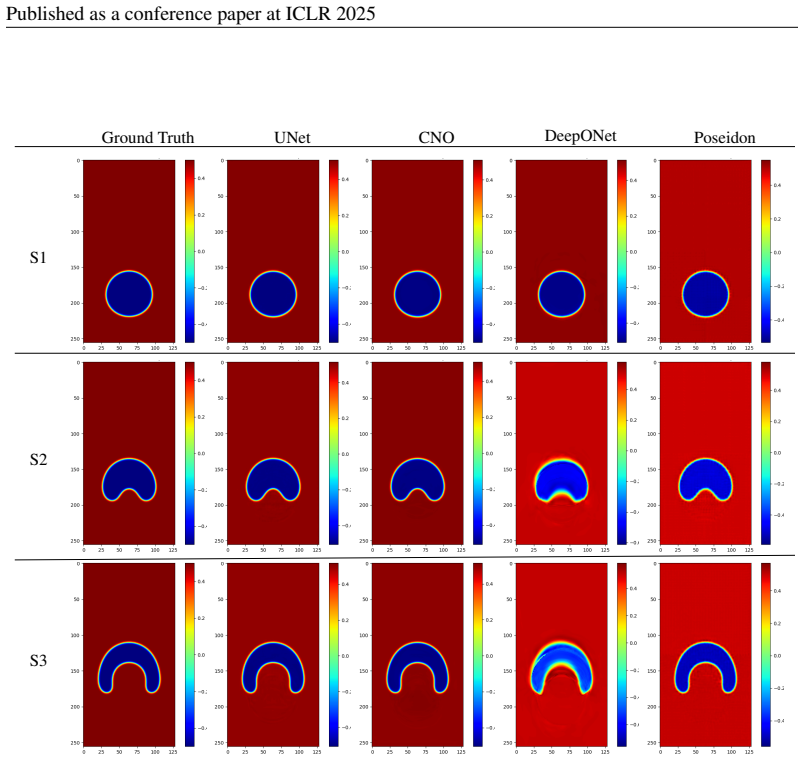
The paper's central claim is that a well-validated Lattice Boltzmann phase-field framework can generate a multiphase dataset — 10,000 2D plus 1,000 3D simulations with up to 101 snapshots each of interface indicator, velocity, pressure, and density — that is two orders of magnitude larger in snapshot count than any prior public multiphase dataset, and that neural operators trained on a subset of it can predict transient dynamics. On the 2D bubble subset, sequence-to-field and sequence-to-sequence tasks S1–S6 show that every tested model improves as more temporal context is fed in, and that the Convolutional Neural Operator (CNO) achieves the lowest concentration-field error and the most faithful reproduction of fine interface structure, including post-breakup satellite bubbles. The paper also finds that Poseidon, a foundation model pretrained on single-phase PDEs, underperforms its randomly initialized transformer counterpart scOT, which it interprets as evidence that single-phase pretraining does not transfer to sharp-interface multiphase physics and that foundation models for such flows must be trained on multiphase data.
Load-bearing premise
The load-bearing premise is that the in-house Lattice Boltzmann phase-field solver produces physically accurate ground truth across the whole sampled parameter space — density ratio $\rho^* \in [10, 1000]$, viscosity ratio $\mu^* \in [1, 100]$, Bond number $Bo \in [10, 500]$, Reynolds number $Re \in [10, 1000]$ — and at the chosen grid resolutions, even though Appendix A.3 validates the solver on only four canonical cases (capillary wave decay, single bubble rise, falling droplet breakup, and Rayleigh–Taylor instability).
Editorial extensions
If this is right
- Neural operators trained on MPF-Bench subsets can serve as surrogate time-steppers for rising bubbles, predicting concentration, velocity, and pressure fields several snapshots ahead from a short observed history, with accuracy improving as the input sequence lengthens.
- The Convolutional Neural Operator's consistently lowest concentration-field error identifies convolutional architectures as the strongest of the evaluated classes for sharp-interface multiphase emulation, including post-breakup satellite-bubble formation.
- The poor transfer of the single-phase-pretrained Poseidon model implies that multiphase foundation models will need in-domain pretraining data, which is exactly what benchmarks like MPF-Bench are built to supply.
- With density ratio 10–1000, viscosity ratio 1–100, Bond number 10–500, and Reynolds number 10–1000, the dataset spans deformation, oscillation, and breakup regimes, giving the community a shared evaluation set two orders of magnitude larger than prior public multiphase datasets.
Reading between the lines
- The paper trains on 1,000 of the 10,000 2D bubble samples with a fixed input sequence length; a natural extension is to train on the full set and evaluate autoregressive rollouts over the complete 100-snapshot trajectory, which the paper lists as future work given single-GPU memory limits.
- Because Appendix A.3 validates the solver on only four canonical cases, an independent check — comparing the LBM ground truth against a volume-of-fluid or front-tracking reference on randomly sampled parameter combinations across the full $\rho^*$–$\mu^*$–$Bo$–$Re$ ranges — would determine how much of the dataset's claimed coverage is certified physics rather than simulator output.
- The 3D portion (1,000 simulations) carries less statistical weight than the 2D portion; a future release with matched 2D/3D parameter coverage would let the community measure whether dynamics learned in 2D transfer to 3D bubble and droplet flows.
- One passage in Section 3.3, the metadata-format description, contains an author note instructing that parts of the text be drafted by paraphrasing the FlowBench documentation with AI assistance; the tensor shapes in Table 3 are the authoritative specification, and the surrounding prose should be read with that drafting history in mind.
Editorial analysis
A structured set of objections, weighed in public.
Referee Report
Summary. MPF-Bench is a dataset paper describing 11,000 lattice Boltzmann simulations (10,000 in 2D and 1,000 in 3D) of rising bubbles and falling droplets, with more than one million time snapshots and randomized dimensionless parameters (density ratio, viscosity ratio, Bond number, Reynolds number). The paper validates an in-house phase-field LBM solver on four benchmarks (Prosperetti capillary waves, Bhaga-Weber bubble shapes, Jalaal falling droplets, and Rayleigh-Taylor instability) and then evaluates six SciML models (UNet, DeepONet, FNO, CNO, scOT, and Poseidon) on a 1,000-sample subset of the 2D bubble dataset under six sequence-to-field and sequence-to-sequence protocols (S1-S6). The authors report that CNO best captures interfacial details and that the single-phase-pretrained foundation model Poseidon transfers poorly to multiphase flows.
Significance. If the dataset is sound, MPF-Bench is a valuable community resource: it is substantially larger than BubbleML in snapshot count, covers a wide parameter range, and the solver is checked against established analytical, experimental, and numerical benchmarks. The inclusion of six baseline models, the public dataset on HuggingFace, and the training code on GitHub are also strengths that support reproducibility. However, several load-bearing issues in the current manuscript, especially the 2D bubble initial condition, the resolution inconsistency, and the overclaimed temporal-context result, mean that the paper's main empirical claims as written are not yet established.
major comments (5)
- [Sec. 3.1] Section 3.1 states that the 2D bubble has initial diameter D0=128 and center (64,64) in a [256,512] domain, so the interface is tangent to the free-slip side wall at x=0 and to the periodic bottom boundary at y=0. Because no wetting or contact-angle boundary condition is specified for the phase-field variable at the free-slip wall, this setup is not a freely rising bubble; it is a wall-touching bubble that is also mirrored across the periodic boundary. Since every 2D bubble simulation (5,000 samples) and all S1-S6 baselines use this initial condition, the paper's main empirical claims about capturing bubble rise dynamics are called into question. This setup also differs from the validated bubble-rise case in Appendix A.3.2, where the bubble is centered at (L0/2,L0/2) with diameter L0/5 and has clearance from all boundaries. Please either correct the initial condition and regenerate the affected data, or add the missing boundary condition and explicitly reframe the results as wall-bounded bubble dynamics.
- [Sec. 3.3 vs Sec. 3.5] Section 3.3 says the 2D datasets are published at the original LBM resolution 256x512, but Section 3.5 states that every S1-S6 array has spatial shape 256x256 (H and W fixed at 256x256). These statements are inconsistent. If the ML arrays were padded, cropped, or downsampled from the 256x512 simulation fields, that transformation must be documented because it changes both the metadata contract and the meaning of the reported errors; if they are truly 256x512, Section 3.5 is wrong. Please report the exact stored shapes and reconcile the two sections.
- [Sec. 4, Tables 5-6] Section 4 claims that "all model predictions improve as more time snapshots are incorporated," but the S4-S6 rows of Table 6 show the opposite trend for the sequence-to-sequence tasks: UNet's concentration MSE rises from 3.27e-2 (S4) to 7.34e-2 (S6), FNO's from 1.16e-2 to 4.24e-2, and CNO's from 1.74e-2 to 3.78e-2. The same growth appears in several velocity and pressure channels. The conclusion in Section 5 that feeding more time snapshots leads to more accurate trajectory prediction is therefore not supported for the sequence-to-sequence setting; please restrict the claim to the sequence-to-field tasks or provide a separate analysis of error accumulation.
- [Appendix A.3] Appendix A.3 validates the solver on the Prosperetti capillary wave, Bhaga-Weber bubble shapes, the Jalaal falling droplet, and the Rayleigh-Taylor instability, but these cases cover only a small subset of the dataset's parameter box. The rising-bubble validation reaches rho*=1000 and mu*=100 but only up to Bo=243, the falling-droplet case is at rho*=10 and a single Eo=288, and the capillary and Rayleigh-Taylor cases are at low density ratios; the dataset samples rho* in [10,1000], mu* in [1,100], Bo in [10,500], and Re in [10,1000] at resolutions 256x512 and 128x256x128. No grid-convergence study or validation at extreme points of this box is reported, so treating the generated fields as ground truth over the full sampled range is an extrapolation. Please add targeted validation runs and/or a resolution study at representative extreme parameters.
- [Sec. 4, Tables 5-6] Tables 5 and 6 report a single point estimate for each model and scenario, without standard deviations across random seeds or any trivial baseline such as copying the last input frame. Some of the reported model differences are small relative to the error magnitudes (e.g., S5 concentration MSE 1.72e-2 for CNO versus 2.33e-2 for FNO), so the ranking claims may be within run-to-run variability; without repeated-seed statistics the model comparison is not statistically grounded. Adding a persistence baseline is also necessary to interpret whether absolute errors of order 1e-2 in the concentration field support the claim that the models "capture transient dynamics."
minor comments (7)
- [Sec. 3.3] Section 3.3 (immediately after Fig. 3) contains unedited drafting notes, including "We might have 3D results (perhaps 1000 or 2000 samples)" and "use chatgpt for paraphrasing from Flowbench + edit for two-phase flows"; these should be removed and the metadata text completed before publication.
- [Sec. 3.3 / Table 3] The number of temporal snapshots is inconsistent: Sections 3.3 and 3.4 say 100 time steps, while Table 3 lists 101 time steps for 2D and 51 for 3D; please make the count consistent and update the total snapshot count accordingly.
- [Table 4] Table 4 contains duplicate parameter rows with contradictory difficulty labels, e.g., "High High Low Low" is labeled both Easy and Moderate and "Low Low High High" is labeled both Challenging and Easy; this should be corrected.
- [Sec. 3.4, Table 2] In Section 3.4, case B2 is described as having "the same high Reynolds number" as B1, but Table 2 lists Re=500 for B1 and Re=10 for B2; the description should match the table.
- [Sec. 4 / B.2] Section 4 refers to training and validation loss curves for "two representative models," while Appendix B.2 says "four representative models" and Figure 15 plots four models; please align the text and figure.
- [Sec. 3.4, Table 2] Several figure cross-references in Section 3.4 appear as unresolved "??Fig??" placeholders, and Table 2 uses ambiguous notation such as "103" for powers of ten; please fix the cross-references and typeset these entries as 10^3, 10^2, and so on.
- [Reproducibility] The GitHub and HuggingFace links are given only as bare words ("GitHub" and "2Dbubble/mpf paper dataset") with no URLs; please provide working links in the final version.
Circularity Check
No circular derivation: dataset validity rests on external benchmarks and ML evaluation uses held-out splits.
full rationale
The paper's central claims are (i) MPF-Bench is large and generated by a validated LBM framework, and (ii) SciML baselines learn the resulting dynamics. Neither claim reduces to its inputs. The solver's accuracy is supported by four independent benchmarks in Appendix A.3: the Prosperetti capillary-wave analytical solution, the Bhaga & Weber bubble-rise experiments and Gumulya FVM data, the Jalaal & Mehravaran VOF falling-droplet comparison, and the Ren/Zu Rayleigh-Taylor reference data. These are external to the fitted parameters of the paper, so the 'well-validated' claim does not rest on self-citation. The ML experiments are standard supervised time-series forecasting on held-out test splits (800/200) from the same parameter family; this tests interpolation of the solver's outputs and is the normal meaning of a benchmark, not a definitional tautology. The minor self-citations (Tali et al. FlowBench, Rabeh et al.) are contextual and are not load-bearing. The stated limitations (limited 3D samples, field magnitude disparities, GPU-memory-limited time steps) and the internal editing artifacts (e.g., the draft bullet 'use chatgpt for paraphrasing' and the 256x256 vs 256x512 resolution mismatch between Sec. 3.5 and Sec. 3.3) are quality/correctness concerns, not circularity. Even the skeptic's wall-tangent initial-condition concern, if valid, would undermine physical fidelity of the data, but it would not make the ML benchmark circular, since the models are evaluated against the same solver's outputs. No equation or fitted parameter is renamed as a prediction; no uniqueness or ansatz is imported from the authors' prior work to force the dataset's design.
Assumptions & free parameters
free parameters (3)
- Interface thickness xi (lattice units) =
4 or 5 lattice units, chosen by hand
- Mobility parameter / Peclet number =
Pe=25 for bubble rise, Pe=5 for falling droplet, Pe=744 for Rayleigh-Taylor
- SciML model hyperparameters =
e.g., learning rate 5e-4, FNO 64 modes, CNO 4 layers, Poseidon depth [4,4,4,4]
assumptions (4)
- standard math The LBM phase-field model (conservative Allen-Cahn, D2Q9/D3Q19) converges via Chapman-Enskog to the incompressible two-phase Navier-Stokes equations with surface tension.
- domain assumption The validation cases (Prosperetti capillary wave, Bhaga-Weber bubble shapes, Jalaal falling droplet, and Rayleigh-Taylor instability) are correct and representative benchmarks for the targeted physics.
- domain assumption 2D simulations at 256x512 resolution capture the qualitative breakup and deformation physics used for the ML benchmark tasks.
- domain assumption Uniform random sampling of dimensionless parameters over the stated ranges yields a representative and balanced distribution of difficulty for training and evaluation.
Cite this review
Pith. "Pith review of MPFBench: A Large Scale Dataset for SciML of Multi-Phase-Flows: Droplet and Bubble Dynamics." pith.science (2026). https://pith.science/paper/FIL6NSXB
@misc{pith2026250207080,
  author       = {Pith},
  title        = {Pith review of: MPFBench: A Large Scale Dataset for SciML of Multi-Phase-Flows: Droplet and Bubble Dynamics},
  year         = {2026},
  howpublished = {\url{https://pith.science/paper/FIL6NSXB}},
  note         = {Machine review of arXiv:2502.07080}
}
read the original abstract
Multiphase fluid dynamics, such as falling droplets and rising bubbles, are critical to many industrial applications. However, simulating these phenomena efficiently is challenging due to the complexity of instabilities, wave patterns, and bubble breakup. This paper investigates the potential of scientific machine learning (SciML) to model these dynamics using neural operators and foundation models. We apply sequence-to-sequence techniques on a comprehensive dataset generated from 11,000 simulations, comprising 1 million time snapshots, produced with a well-validated Lattice Boltzmann method (LBM) framework. The results demonstrate the ability of machine learning models to capture transient dynamics and intricate fluid interactions, paving the way for more accurate and computationally efficient SciML-based solvers for multiphase applications.
Figures


Figures from the paper (11 more)



Reference graph
Works this paper leans on
-
[1]
write newline
" write newline "" before.all 'output.state := FUNCTION n.dashify 't := "" t empty not t #1 #1 substring "-" = t #1 #2 substring "--" = not "--" * t #2 global.max substring 't := t #1 #1 substring "-" = "-" * t #2 global.max substring 't := while if t #1 #1 substring * t #2 global.max substring 't := if while FUNCTION format.date year duplicate empty "emp...
-
[2]
Ala S Al-Dogail and Rahul N Gajbhiye. Effects of density, viscosity and surface tension on flow regimes and pressure drop of two-phase flow in horizontal pipes. Journal of Petroleum Science and Engineering, 205: 0 108719, 2021
work page 2021
-
[3]
Benchmark computations of diffuse interface models for two-dimensional bubble dynamics
Sebastian Aland and Axel Voigt. Benchmark computations of diffuse interface models for two-dimensional bubble dynamics. International Journal for Numerical Methods in Fluids, 69 0 (3): 0 747--761, 2012
work page 2012
-
[4]
Samuel M. Allen and John W. Cahn. Mechanisms of phase transformations within the miscibility gap of Fe-rich Fe-Al alloys . Acta Metallurgica, 24 0 (5): 0 425--437, may 1976. ISSN 00016160. doi:10.1016/0001-6160(76)90063-8. URL https://linkinghub.elsevier.com/retrieve/pii/0001616076900638
arXiv 1976
-
[5]
Single bubble rising dynamics for moderate reynolds number using lattice boltzmann method
Luz Amaya-Bower and Taehun Lee. Single bubble rising dynamics for moderate reynolds number using lattice boltzmann method. Computers & Fluids, 39 0 (7): 0 1191--1207, 2010. ISSN 0045-7930. doi:https://doi.org/10.1016/j.compfluid.2010.03.003. URL https://www.sciencedirect.com/science/article/pii/S004579301000054X
-
[6]
Shelley L Anna, Nathalie Bontoux, and Howard A Stone. Formation of dispersions using “flow focusing” in microchannels. Applied physics letters, 82 0 (3): 0 364--366, 2003
work page 2003
-
[7]
The paraview guide: a parallel visualization application
Utkarsh Ayachit. The paraview guide: a parallel visualization application. Kitware, Inc., 2015
work page 2015
-
[9]
D. Bhaga and M. E. Weber. Bubbles in viscous liquids: shapes, wakes and velocities. Journal of Fluid Mechanics, 105: 0 61–85, 1981 b . doi:10.1017/S002211208100311X
Show all 62 references
-
[10]
An optimized artificial neural network unifying model for steady-state liquid holdup estimation in two-phase gas--liquid flow
Majdi Chaari, Abdennour C Seibi, Jalel Ben Hmida, and Afef Fekih. An optimized artificial neural network unifying model for steady-state liquid holdup estimation in two-phase gas--liquid flow. Journal of Fluids Engineering, 140 0 (10): 0 101301, 2018
2018
-
[11]
A conservative phase field method for solving incompressible two-phase flows
Pao-Hsiung Chiu and Yan-Ting Lin. A conservative phase field method for solving incompressible two-phase flows . Journal of Computational Physics, 230 0 (1): 0 185--204, jan 2011. ISSN 00219991. doi:10.1016/j.jcp.2010.09.021. URL http://dx.doi.org/10.1016/j.jcp.2010.09.021 htt...
2011 doi
-
[12]
Drop formation in a co-flowing ambient fluid
Carsten Cramer, Peter Fischer, and Erich J Windhab. Drop formation in a co-flowing ambient fluid. Chemical Engineering Science, 59 0 (15): 0 3045--3058, 2004
2004
-
[13]
Spelt, and Chang Shu
Hang Ding, Peter D.M. Spelt, and Chang Shu. Diffuse interface model for incompressible two-phase flows with large density ratios . Journal of Computational Physics, 226 0 (2): 0 2078--2095, oct 2007. ISSN 00219991. doi:10.1016/j.jcp.2007.06.028. URL https://linkinghub.elsevier...
2007 doi
-
[14]
Physics of liquid jets
Jens Eggers and Emmanuel Villermaux. Physics of liquid jets. Reports on progress in physics, 71 0 (3): 0 036601, 2008
2008
-
[15]
Investigation of deformation and breakup of a moving droplet by the method of lattice boltzmann equations
Abbas Fakhari and Mohammad Hassan Rahimian. Investigation of deformation and breakup of a moving droplet by the method of lattice boltzmann equations. International journal for numerical methods in fluids, 64 0 (8): 0 827--849, 2010
2010
-
[16]
A simple phase-field model for interface tracking in three dimensions
Abbas Fakhari, Martin Geier, and Diogo Bolster. A simple phase-field model for interface tracking in three dimensions . Computers & Mathematics with Applications, 78 0 (4): 0 1154--1165, aug 2019. ISSN 08981221. doi:10.1016/j.camwa.2016.08.021. URL http://dx.doi.org/10.1016/j....
2019 doi
-
[17]
Conservative phase-field lattice Boltzmann model for interface tracking equation
Martin Geier, Abbas Fakhari, and Taehun Lee. Conservative phase-field lattice Boltzmann model for interface tracking equation . Physical Review E, 91 0 (6): 0 063309, jun 2015. ISSN 1539-3755. doi:10.1103/PhysRevE.91.063309. URL https://link.aps.org/doi/10.1103/PhysRevE.91.063309
2015 doi
-
[18]
Joshi, Ranjeet P
Monica Gumulya, Jyeshtharaj B. Joshi, Ranjeet P. Utikar, Geoffrey M. Evans, and Vishnu Pareek. Bubbles in viscous liquids: Time dependent behaviour and wake characteristics. Chemical Engineering Science, 144: 0 298--309, 2016. ISSN 0009-2509. doi:https://doi.org/10.1016/j.ces....
2016 doi
-
[19]
Discrete lattice effects on the forcing term in the lattice Boltzmann method
Zhaoli Guo, Chuguang Zheng, and Baochang Shi. Discrete lattice effects on the forcing term in the lattice Boltzmann method . Physical Review E, 65 0 (4): 0 046308, apr 2002. ISSN 1063-651X. doi:10.1103/PhysRevE.65.046308. URL https://link.aps.org/doi/10.1103/PhysRevE.65.046308
2002 doi
-
[20]
Microfluidic platforms for lab-on-a-chip applications
Stefan Haeberle and Roland Zengerle. Microfluidic platforms for lab-on-a-chip applications. Lab on a Chip, 7 0 (9): 0 1094--1110, 2007
2007
-
[21]
Bubble ML : A multiphase multiphysics dataset and benchmarks for machine learning
Sheikh Md Shakeel Hassan, Arthur Feeney, Akash Dhruv, Jihoon Kim, Youngjoon Suh, Jaiyoung Ryu, Yoonjin Won, and Aparna Chandramowlishwaran. Bubble ML : A multiphase multiphysics dataset and benchmarks for machine learning. In Thirty-seventh Conference on Neural Information Pro...
2023
-
[22]
Poseidon: Efficient foundation models for pdes, 2024
Maximilian Herde, Bogdan Raonić, Tobias Rohner, Roger Käppeli, Roberto Molinaro, Emmanuel de Bézenac, and Siddhartha Mishra. Poseidon: Efficient foundation models for pdes, 2024
2024
-
[23]
Microbubbles in ultrasound-triggered drug and gene delivery
Sophie Hernot and Alexander L Klibanov. Microbubbles in ultrasound-triggered drug and gene delivery. Advanced drug delivery reviews, 60 0 (10): 0 1153--1166, 2008
2008
-
[24]
Numerical simulation of bubble rising in viscous liquid
Jinsong Hua and Jing Lou. Numerical simulation of bubble rising in viscous liquid. Journal of Computational Physics, 222 0 (2): 0 769--795, 2007. ISSN 0021-9991. doi:https://doi.org/10.1016/j.jcp.2006.08.008. URL https://www.sciencedirect.com/science/article/pii/S0021999106003949
2007 doi
-
[25]
Sukop, and Xi Yun Lu
Haibo Huang, Michael C. Sukop, and Xi Yun Lu. Multiphase Lattice Boltzmann Methods: Theory and Application . John Wiley & Sons, Ltd, jul 2015. ISBN 9781118971338. doi:10.1002/9781118971451. URL http://doi.wiley.com/10.1002/9781118971451
2015 doi
-
[26]
Quantitative benchmark computations of two-dimensional bubble dynamics
Shu-Ren Hysing, Stefan Turek, Dmitri Kuzmin, Nicola Parolini, Erik Burman, Sashikumaar Ganesan, and Lutz Tobiska. Quantitative benchmark computations of two-dimensional bubble dynamics. International Journal for Numerical Methods in Fluids, 60 0 (11): 0 1259--1288, 2009
2009
-
[27]
Calculation of Two-Phase Navier-Stokes Flows Using Phase-Field Modeling
David Jacqmin. Calculation of Two-Phase Navier-Stokes Flows Using Phase-Field Modeling . Journal of Computational Physics, 155 0 (1): 0 96--127, oct 1999. ISSN 00219991. doi:10.1006/jcph.1999.6332. URL https://linkinghub.elsevier.com/retrieve/pii/S0021999199963325
1999
-
[28]
Contact-line dynamics of a diffuse fluid interface
DAVID JACQMIN. Contact-line dynamics of a diffuse fluid interface . Journal of Fluid Mechanics, 402: 0 57--88, jan 2000. ISSN 0022-1120. doi:10.1017/S0022112099006874. URL https://www.cambridge.org/core/product/identifier/S0022112099006874/type/journal_article
2000 doi
-
[29]
Jalaal and K
M. Jalaal and K. Mehravaran. Fragmentation of falling liquid droplets in bag breakup mode. International Journal of Multiphase Flow, 47: 0 115--132, 2012. ISSN 0301-9322. doi:https://doi.org/10.1016/j.ijmultiphaseflow.2012.07.011. URL https://www.sciencedirect.com/science/arti...
2012 doi
-
[30]
Didier Jamet, David Torres, and J. U. Brackbill. On the theory and computation of surface tension: The elimination of parasitic currents through energy conservation in the second-gradient method . Journal of Computational Physics, 182 0 (1): 0 262--276, oct 2002. ISSN 00219991...
2002
-
[31]
Kevrekidis, Lu Lu, Paris Perdikaris, Sifan Wang, and Liu Yang
George Em Karniadakis, Ioannis G. Kevrekidis, Lu Lu, Paris Perdikaris, Sifan Wang, and Liu Yang. Physics-informed machine learning. Nature Reviews Physics, 3 0 (6): 0 422--440, 2021. ISSN 25225820. doi:10.1038/s42254-021-00314-5. URL https://doi.org/10.1038/s42254-021-00314-5
2021 doi
-
[32]
Khanwale, Kumar Saurabh, Masado Ishii, Hari Sundar, James A
Makrand A. Khanwale, Kumar Saurabh, Masado Ishii, Hari Sundar, James A. Rossmanith, and Baskar Ganapathysubramanian. A projection-based, semi-implicit time-stepping approach for the cahn-hilliard navier-stokes equations on adaptive octree meshes. Journal of Computational Physi...
2023
-
[33]
The Lattice Boltzmann Method , volume 58 of Graduate Texts in Physics
Timm Kr \" u ger, Halim Kusumaatmaja, Alexandr Kuzmin, Orest Shardt, Goncalo Silva, and Erlend Magnus Viggen. The Lattice Boltzmann Method , volume 58 of Graduate Texts in Physics. Springer International Publishing, 2017. ISBN 978-3-319-44647-9. doi:10.1007/978-3-319-44649-3. ...
2017 doi
-
[34]
Q. Li, K. H. Luo, Y. J. Gao, and Y. L. He. Additional interfacial force in lattice Boltzmann models for incompressible multiphase flows . Physical Review E, 85 0 (2): 0 026704, feb 2012. ISSN 1539-3755. doi:10.1103/PhysRevE.85.026704. URL https://link.aps.org/doi/10.1103/PhysR...
2012 doi
-
[35]
Fourier neural operator for parametric partial differential equations, 2021
Zongyi Li, Nikola Kovachki, Kamyar Azizzadenesheli, Burigede Liu, Kaushik Bhattacharya, Andrew Stuart, and Anima Anandkumar. Fourier neural operator for parametric partial differential equations, 2021
2021
-
[36]
Enhanced droplet formation in a t-junction microchannel using electric field: A lattice boltzmann study
Zhaomiao Liu, Fanming Cai, Yan Pang, Yanlin Ren, Nan Zheng, Rui Chen, and Siyu Zhao. Enhanced droplet formation in a t-junction microchannel using electric field: A lattice boltzmann study. Physics of Fluids, 34 0 (8), 2022
2022
-
[37]
Learning nonlinear operators via deeponet based on the universal approximation theorem of operators
Lu Lu, Pengzhan Jin, Guofei Pang, Zhongqiang Zhang, and George Em Karniadakis. Learning nonlinear operators via deeponet based on the universal approximation theorem of operators. Nature Machine Intelligence, 3: 0 218--–229, 2021
2021
-
[38]
A pinn-based level-set formulation for reconstruction of bubble dynamics
R \^o mulo M Silva, Mal \'u Grave, and Alvaro LGA Coutinho. A pinn-based level-set formulation for reconstruction of bubble dynamics. Archive of Applied Mechanics, pp.\ 1--16, 2024
2024
-
[39]
Microfluidic lab-on-a-chip platforms: requirements, characteristics and applications
Daniel Mark, Stefan Haeberle, G \"u nter Roth, Felix Von Stetten, and Roland Zengerle. Microfluidic lab-on-a-chip platforms: requirements, characteristics and applications. Microfluidics based microsystems: fundamentals and applications, pp.\ 305--376, 2010
2010
-
[40]
Oliver Penrose and Paul C. Fife. Thermodynamically consistent models of phase-field type for the kinetic of phase transitions . Physica D: Nonlinear Phenomena, 43 0 (1): 0 44--62, may 1990. ISSN 01672789. doi:10.1016/0167-2789(90)90015-H. URL https://linkinghub.elsevier.com/re...
1990
-
[41]
Motion of two superposed viscous fluids
Andrea Prosperetti. Motion of two superposed viscous fluids. Physics of Fluids, 24 0 (7): 0 1217 – 1223, 1981. doi:10.1063/1.863522. URL https://www.scopus.com/inward/record.uri?eid=2-s2.0-0019376759&doi=10.1063 Cited by: 149
1981 doi
-
[42]
Modeling and simulations of high-density two-phase flows using projection-based cahn-hilliard navier-stokes equations
Ali Rabeh, Makrand A Khanwale, Jonghyun Lee, and Baskar Ganapathysubramanian. Modeling and simulations of high-density two-phase flows using projection-based cahn-hilliard navier-stokes equations. arXiv preprint arXiv:2406.17933, 2024
2024 arXiv
-
[43]
Physics-informed neural networks: A deep learning framework for solving forward and inverse problems involving nonlinear partial differential equations
Maziar Raissi, Paris Perdikaris, and George E Karniadakis. Physics-informed neural networks: A deep learning framework for solving forward and inverse problems involving nonlinear partial differential equations. Journal of Computational physics, 378: 0 686--707, 2019
2019
-
[44]
Convolutional neural operators for robust and accurate learning of pdes, 2023
Bogdan Raonić, Roberto Molinaro, Tim De Ryck, Tobias Rohner, Francesca Bartolucci, Rima Alaifari, Siddhartha Mishra, and Emmanuel de Bézenac. Convolutional neural operators for robust and accurate learning of pdes, 2023
2023
-
[45]
Challenges in training pinns: A loss landscape perspective
Pratik Rathore, Weimu Lei, Zachary Frangella, Lu Lu, and Madeleine Udell. Challenges in training pinns: A loss landscape perspective. arXiv preprint arXiv:2402.01868, 2024
2024 arXiv
-
[46]
Sukop, and Haibao Hu
Feng Ren, Baowei Song, Michael C. Sukop, and Haibao Hu. Improved lattice boltzmann modeling of binary flow based on the conservative allen-cahn equation. Phys. Rev. E, 94: 0 023311, Aug 2016. doi:10.1103/PhysRevE.94.023311. URL https://link.aps.org/doi/10.1103/PhysRevE.94.023311
2016 doi
-
[47]
U-net: Convolutional networks for biomedical image segmentation
Olaf Ronneberger, Philipp Fischer, and Thomas Brox. U-net: Convolutional networks for biomedical image segmentation. In Medical image computing and computer-assisted intervention--MICCAI 2015: 18th international conference, Munich, Germany, October 5-9, 2015, proceedings, part...
2015
-
[48]
Multiphase flow in microfluidics: From droplets and bubbles to the encapsulated structures
Amirmohammad Sattari, Pedram Hanafizadeh, and Mina Hoorfar. Multiphase flow in microfluidics: From droplets and bubbles to the encapsulated structures. Advances in Colloid and Interface Science, 282: 0 102208, 2020
2020
-
[49]
A modular microfluid system with an integrated micromixer
Norbert Schwesinger, Thomas Frank, and Helmut Wurmus. A modular microfluid system with an integrated micromixer. Journal of Micromechanics and Microengineering, 6 0 (1): 0 99, 1996
1996
-
[50]
Droplet impingement on a surface at low reynolds numbers
Drue Seksinsky and Jeffrey S Marshall. Droplet impingement on a surface at low reynolds numbers. Journal of Fluids Engineering, 143 0 (2): 0 021304, 2021
2021
-
[51]
Role of atwood number on flow morphology of a planar shock-accelerated square bubble: A numerical study
Satyvir Singh. Role of atwood number on flow morphology of a planar shock-accelerated square bubble: A numerical study. Physics of Fluids, 32 0 (12), 2020
2020
-
[52]
Chaotic mixer for microchannels
Abraham D Stroock, Stephan KW Dertinger, Armand Ajdari, Igor Mezic, Howard A Stone, and George M Whitesides. Chaotic mixer for microchannels. Science, 295 0 (5555): 0 647--651, 2002
2002
-
[53]
Sukop and Daniel T
Michael C. Sukop and Daniel T. Thorne. Lattice boltzmann modeling: An introduction for geoscientists and engineers . Springer Berlin Heidelberg, 2006. ISBN 3540279814. doi:10.1007/978-3-540-27982-2. URL http://link.springer.com/10.1007/978-3-540-27982-2
2006 doi
-
[54]
Flowbench: A large scale benchmark for flow simulation over complex geometries
Ronak Tali, Ali Rabeh, Cheng-Hau Yang, Mehdi Shadkhah, Samundra Karki, Abhisek Upadhyaya, Suriya Dhakshinamoorthy, Marjan Saadati, Soumik Sarkar, Adarsh Krishnamurthy, et al. Flowbench: A large scale benchmark for flow simulation over complex geometries. arXiv preprint arXiv:2...
2024 arXiv
-
[55]
Dynamic pattern formation in a vesicle-generating microfluidic device
Todd Thorsen, Richard W Roberts, Frances H Arnold, and Stephen R Quake. Dynamic pattern formation in a vesicle-generating microfluidic device. Physical review letters, 86 0 (18): 0 4163, 2001
2001
-
[56]
Formation of droplets and mixing in multiphase microfluidics at low values of the reynolds and the capillary numbers
Joshua D Tice, Helen Song, Adam D Lyon, and Rustem F Ismagilov. Formation of droplets and mixing in multiphase microfluidics at low values of the reynolds and the capillary numbers. Langmuir, 19 0 (22): 0 9127--9133, 2003
2003
-
[57]
Microconfined equiviscous droplet deformation: Comparison of experimental and numerical results
Anja Vananroye, Pieter JA Janssen, Patrick D Anderson, Peter Van Puyvelde, and Paula Moldenaers. Microconfined equiviscous droplet deformation: Comparison of experimental and numerical results. Physics of Fluids, 20 0 (1), 2008
2008
-
[58]
Droplet impact on suspended metallic meshes: Effects of wettability, reynolds and weber numbers
Konstantinos Vontas, Cristina Boscariol, Manolia Andredaki, Anastasios Georgoulas, Cyril Crua, Jens Honor \'e Walther, and Marco Marengo. Droplet impact on suspended metallic meshes: Effects of wettability, reynolds and weber numbers. Fluids, 5 0 (2): 0 81, 2020
2020
-
[59]
Droplet deformation and breakup in shear flow of air
Zhikun Xu, Tianyou Wang, and Zhizhao Che. Droplet deformation and breakup in shear flow of air. Physics of Fluids, 32 0 (5), 2020
2020
-
[60]
Y. Y. Yan and Y. Q. Zu. A lattice Boltzmann method for incompressible two-phase flows on partial wetting surface with large density ratio . Journal of Computational Physics, 227 0 (1): 0 763--775, nov 2007. ISSN 10902716. doi:10.1016/j.jcp.2007.08.010. URL https://linkinghub.e...
2007 doi
-
[61]
A fast and practical adaptive finite difference method for the conservative allen–cahn model in two-phase flow system
Junxiang Yang, Darae Jeong, and Junseok Kim. A fast and practical adaptive finite difference method for the conservative allen–cahn model in two-phase flow system. International Journal of Multiphase Flow, 137: 0 103561, 2021. ISSN 0301-9322. doi:https://doi.org/10.1016/j.ijmu...
2021
-
[62]
H. Z. Yuan, Z. Chen, C. Shu, Y. Wang, X. D. Niu, and S. Shu. A free energy-based surface tension force model for simulation of multiphase flows by level-set method . Journal of Computational Physics, 345: 0 404--426, 2017. ISSN 10902716. doi:10.1016/j.jcp.2017.05.020
2017 doi
-
[63]
Y. Q. Zu and S. He. Phase-field-based lattice boltzmann model for incompressible binary fluid systems with density and viscosity contrasts. Phys. Rev. E, 87: 0 043301, Apr 2013. doi:10.1103/PhysRevE.87.043301. URL https://link.aps.org/doi/10.1103/PhysRevE.87.043301
2013 doi
Reviewed August 8, 2026 · model on record in the stance chip above.
Discussion (0). Continue with ORCID to comment.