REVIEW 2 major objections 7 minor 46 references
Joint Metric Space Embedding by Unbalanced OT with Gromov-Wasserstein Marginal Penalization
T0 review · 2 major / 7 minor · reviewed 2026-08-08 · deepseek-v4-flash
Pith's one-line read This paper proposes an unsupervised method to align two heterogeneous datasets in a common metric space via unbalanced optimal transport with Gromov–Wasserstein marginal penalization, and proves convergence to the embedded Wasserstein…
desk verdict Solid theoretical contribution on unbalanced OT with GW marginal penalization, but the numerical section rests on an unproven relaxation gap that should be addressed before the numbers are taken at face value. read the letter →
The pith
A machine-rendered reading of the paper's core claim, the machinery that carries it, and where it could break.
The reading
What carries the argument
The central object is the functional $EW_\lambda$ in (3): $EW_\lambda(X_1,X_2)=\inf_{\pi\in\mathcal{P}(Z\times Z)}\left(\int_{Z\times Z} d_Z^2(z,z')\,d\pi(z,z')+\lambda\sum_{i=1}^2 GW^2(X_i,(Z,d_Z,P_{i\#}\pi))\right)^{1/2}$. The first term is an ordinary transport cost between the two embedded marginals; each Gromov–Wasserstein term pulls its marginal toward an isometric copy of its source space. The paper rewrites this as a quadratic, multi-marginal, unbalanced optimal transport problem over a 4-plan $\alpha\in\mathcal{P}(X_1\times Z_1\times Z_2\times X_2)$ and relaxes it to the bilinear objective $F_\lambda(\alpha_1,\alpha_2)$; Algorithm 1 alternates multi-marginal Sinkhorn steps in the two factors. This fixed-support discretization is what allows the method to run in arbitrary metric spaces rather than only Euclidean ones.
What would settle it
One concrete check: on a small discrete pair of metric spaces, compute the true quadratic minimum of (9) by exhaustive enumeration and run Algorithm 1 from several random initializations; if the final objectives differ or stay above the enumerated minimum, the bi-convex relaxation is not reliably solving the original problem.
Extended reading notes
Core claim
The paper's central claim is that the functional $EW_\lambda$ in (3) — an unbalanced optimal transport cost with Gromov–Wasserstein marginal penalization — is a well-posed relaxation of the embedded Wasserstein distance $EW$. Proposition 3.3 proves that a minimizer exists for every $\lambda>0$. Proposition 3.4 shows that any sequence of minimizers with $\lambda_n\to\infty$ has a weakly convergent subsequence whose limit realizes $EW$ through isometries whenever the source spaces admit isometric embeddings into the reference space; Proposition 3.5 covers the non-isometric case, where the limit marginals are Gromov–Wasserstein approximations; Proposition 3.6 gives the $\lambda\to0$ limit as a fixed-support Gromov–Wasserstein barycenter. Proposition 3.7 establishes the equivalence between this formulation and the 4-plan quadratic problem (9), which is the basis of the numerical method.
Load-bearing premise
The numerical results assume that the alternating Sinkhorn updates on the relaxed problem land near the true quadratic optimum; the paper proves neither that the two factors converge to the same plan nor that the relaxation gap is small.
Editorial extensions
If this is right
- For any compact reference space and any $\lambda>0$, the optimization problem is well-posed: $EW_\lambda$ has a minimizer, so the method does not rely on an external feasibility argument.
- As $\lambda$ grows, the alignments approach the exact embedded Wasserstein alignment whenever the source spaces can be isometrically embedded; when they cannot, the limit marginals are the best Gromov–Wasserstein approximations available in the reference space.
- Because the support of the embedded measures is fixed in advance, the method works for arbitrary metric spaces such as spheres, tori, and the Wasserstein space of Gaussians, not only Euclidean space.
- As $\lambda\to0$, the limit is a fixed-support Gromov–Wasserstein barycenter, connecting joint embedding to metric-measure-space barycenter computation.
- The same objective, with free supports and fixed weights, reduces to joint multidimensional scaling, so the framework covers both fixed-support and free-support joint embeddings in one model.
Reading between the lines
- The convergence guarantees apply to minimizers, not to whatever point the alternating Sinkhorn solver reaches; a natural stress test is to run Algorithm 1 from several initializations on a small instance and compare the final objective with the true quadratic minimum found by enumeration.
- Because the marginal-penalization idea does not depend on there being exactly two sources, a chained Wasserstein term between consecutive embeddings is a direct way to extend the model to several datasets; the paper notes the multi-marginal Sinkhorn step scales linearly in the number of spaces.
- Replacing the fixed grid by optimized free supports would remove the current restriction to low-dimensional reference grids and would connect the approach to free-support non-Euclidean barycenter solvers.
Editorial analysis
A structured set of objections, weighed in public.
Referee Report
Summary. The paper introduces a new unsupervised alignment framework for two metric-measure spaces into a fixed compact metric space (Z, dZ). The proposed functional EW_lambda combines a Wasserstein cost on the joint embedding with Gromov-Wasserstein penalty terms on the marginals. The authors prove existence of minimizers (Proposition 3.3), characterize the limits as the penalization parameter tends to infinity (Propositions 3.4 and 3.5) and to zero (Proposition 3.6), and reformulate the problem as a quadratic multi-marginal unbalanced optimal transport problem (9). A bi-convex relaxation (10) is solved numerically by block-coordinate descent with an entropic multi-marginal Sinkhorn scheme, and experiments are reported for Euclidean and non-Euclidean target spaces, including shape embedding, single-cell feature alignment, and Gaussian mixture alignment.
Significance. If the theoretical results are correct, the paper provides a principled extension of Wasserstein Procrustes and JMDS to arbitrary compact metric spaces, with rigorous links between a computable relaxation and the embedded Wasserstein distance. The existence and lambda-limit proofs in Appendix A use standard compactness and lower semicontinuity arguments and are largely coherent; the derivation of the embedded Wasserstein distance as the infinite-penalization limit is a genuine theoretical contribution. The numerical experiments cover diverse settings, and the authors provide a public code repository. However, the significance of the paper as a computational method depends on the unresolved gap between the quadratic problem (9) and the bilinear relaxation (10) actually solved by Algorithm 1, which is not analyzed in the manuscript.
major comments (2)
- [Section 4, Eq. (10) and Algorithm 1] The numerical viability of the method is the paper's third stated contribution, but it rests on an unproven equivalence between the quadratic problem (9) and the bilinear relaxation (10) as actually solved. Equation (10) is only a lower bound on (9), and the text observes only that a bi-convex minimizer with alpha1 = alpha2 solves the original problem; it does not show that the alternating Sinkhorn updates in Algorithm 1 converge to such a coupled solution, nor does it bound the gap between the objective of the computed 4-plan and EW_lambda. Block-coordinate descent on a bilinear objective can stall at saddle points or cycles with alpha1 != alpha2, and each Sinkhorn step solves an epsilon-regularized linear subproblem, adding an unquantified perturbation. Consequently, the values and comparisons reported in Section 6 (Tables 1-2, Figures 4-7) are not certified as approximate minima of EW_lambda; they could be minima of a strictly looser problem. I consider this load-bearing because the abstract and contribution list explicitly present the bi-convex relaxation as the computational route to the model.
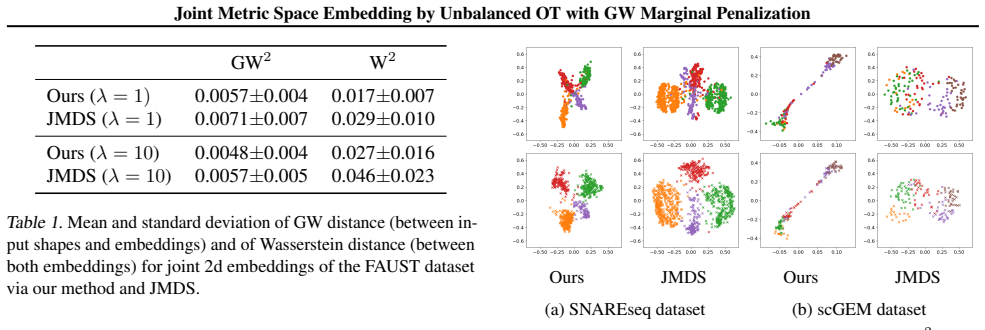
- [Section 5 and Section 6.1] The quantitative comparison with JMDS is not fully controlled. JMDS optimizes free supports in Euclidean space under fixed uniform weights, while EW_lambda fixes the grid Z and optimizes weights; moreover, in the figures the two methods use different values of lambda and epsilon (e.g., Figure 4 and Figure 5 use lambda = 100 for the proposed method and lambda = 10 for JMDS). The statement in Section 6.1 that 'we here achieve better joint embeddings than JMDS' is therefore a claim about the particular discretizations and regularizations, not a clean comparison of the underlying objectives. The paper should either match the hyperparameters and computational budgets more carefully, or explicitly state that the comparison is between a fixed-support weight-optimization formulation and a free-support formulation under their respective recommended settings.
minor comments (7)
- [Proposition 3.7] The statement of Proposition 3.7 is not well-formed as printed: it reads 'If α solves (3), then its projections (3) are solutions of (3).' The first occurrence should refer to the 4-plan problem (9), and the second to the projections defined in (8). The mislabelled references should be corrected.
- [Section 4, first paragraph] The sentence 'the computation of EWλ in (3) requires the solution of a quadratic optimization problem' should refer to the reformulation (9), not to the original functional (3).
- [Proof of Proposition 3.4] The display 'EWλn = ∫ d^2 + λ ∑ GW^2' omits the square root from the definition in (3); the chain of inequalities that follows is harder to follow as a result, and the notation should be made consistent.
- [Proof of Proposition 3.2] There are typographical errors: 'we we show' and 'isometies' should read 'we show' and 'isometries'.
- [Section 5 and Table 2] There are small typos: 'JMSD' should be 'JMDS' in Section 5, and 'KKN-Acc' in Table 2 should be 'KNN-Acc'.
- [Figure 12 caption] The notation |Z| = 15^2, 20^2, 60^2 is ambiguous; it should state explicitly that these are 15×15, 20×20, and 60×60 grids, respectively.
- [Figure 4 caption and text] The text refers to the 'Swiss role' in one place; this should be 'Swiss roll'.
Circularity Check
No significant circularity: the convergence theorems are proven from compactness and lower semi-continuity, and the numerical relaxation is explicitly labeled a lower bound.
full rationale
The central theoretical results are self-contained rather than definitionally forced. EWλ in (3) is a genuinely penalized variant of EW in (2), and Propositions 3.3–3.6 establish existence and λ→∞/λ→0 limits using weak compactness of P(Z×Z), joint weak lower semi-continuity of the Wasserstein term, and lower semi-continuity of the GW marginal terms; the key estimate EWλ ≤ EW in (14) is an inequality to be proved, not an equality by construction, and the reverse bound is obtained from lower semi-continuity. The equivalent 4-plan reformulation (9) and the bi-convex relaxation (10) are explicitly identified: 'By construction, the minimizers of (4) constitute a lower bound to the original, quadratic problem (3)', and Proposition 3.7 only relates exact minimizers of the original and relaxed problems. The paper nowhere claims that the Sinkhorn iterates certify a minimum of EWλ; the lack of a convergence or gap bound for Algorithm 1 is an unproven numerical assumption, which is a correctness risk rather than a circular step. Self-citations to Beier et al. (2022) for the multi-marginal Sinkhorn scheme and to Beier & Beinert (2025, Lem. I.1) for GW lower semi-continuity are technical building blocks; the lemma's assumptions are weak convergence on compact metric spaces and do not include the paper's convergence conclusions, and the same lower semi-continuity argument is essentially developed in Proposition 3.3. No fitted parameter is renamed as a prediction, and no uniqueness or existence theorem is imported solely from the authors' prior work to force the choice of model. Therefore no circular step can be exhibited.
Assumptions & free parameters
free parameters (4)
- lambda (GW penalization weight) =
1, 10, 100, 1000 in experiments; grid-searched in Section 6.2
- epsilon (entropic regularization) =
10^-3 or 4*10^-4
- Target space grid Z =
15x15 to 60x60 grids
- r^2 (GMM variance scale) =
chosen per dataset
assumptions (5)
- standard math Xi and Z are compact metric spaces and measures are Borel probability measures.
- standard math Wasserstein and GW distances are jointly weakly lower semicontinuous.
- domain assumption GW(X,Y)=0 implies a measure-preserving isometry between the supports.
- standard math Gluing lemma for couplings.
- domain assumption Lemma I.1 of Beier and Beinert 2025 on stability of GW barycenters.
Cite this review
Pith. "Pith review of Joint Metric Space Embedding by Unbalanced OT with Gromov-Wasserstein Marginal Penalization." pith.science (2026). https://pith.science/paper/E3YKYHJ5
@misc{pith2026250207510,
  author       = {Pith},
  title        = {Pith review of: Joint Metric Space Embedding by Unbalanced OT with Gromov-Wasserstein Marginal Penalization},
  year         = {2026},
  howpublished = {\url{https://pith.science/paper/E3YKYHJ5}},
  note         = {Machine review of arXiv:2502.07510}
}
read the original abstract
We propose a new approach for unsupervised alignment of heterogeneous datasets, which maps data from two different domains without any known correspondences to a common metric space. Our method is based on an unbalanced optimal transport problem with Gromov-Wasserstein marginal penalization. It can be seen as a counterpart to the recently introduced joint multidimensional scaling method. We prove that there exists a minimizer of our functional and that for penalization parameters going to infinity, the corresponding sequence of minimizers converges to a minimizer of the so-called embedded Wasserstein distance. Our model can be reformulated as a quadratic, multi-marginal, unbalanced optimal transport problem, for which a bi-convex relaxation admits a numerical solver via block-coordinate descent. We provide numerical examples for joint embeddings in Euclidean as well as non-Euclidean spaces.
Figures


Figures from the paper (10 more)




Reference graph
Works this paper leans on
-
[1]
write newline
" write newline "" before.all 'output.state := FUNCTION n.dashify 't := "" t empty not t #1 #1 substring "-" = t #1 #2 substring "--" = not "--" * t #2 global.max substring 't := t #1 #1 substring "-" = "-" * t #2 global.max substring 't := while if t #1 #1 substring * t #2 global.max substring 't := if while FUNCTION format.date year duplicate empty "emp...
-
[2]
Z., B \'e rar, M., Gasso, G., and Rakotomamonjy, A
Alaya, M. Z., B \'e rar, M., Gasso, G., and Rakotomamonjy, A. Theoretical guarantees for bridging metric measure embedding and optimal transport. Neurocomputing, 468: 0 416--430, 2022
work page 2022
-
[3]
Alvarez-Melis, D., Jegelka, S., and Jaakkola, T. S. Towards optimal transport with global invariances. In International Conference on Artificial Intelligence and Statistics (AISTATS), volume 89 of Proceedings of Machine Learning Research, pp.\ 1870--1879. PMLR, 2019
work page 2019
-
[4]
Gradient Flows in Metric Spaces and in the Space of Probability Measures
Ambrosio, L., Gigli, N., and Savar\'e, G. Gradient Flows in Metric Spaces and in the Space of Probability Measures. Birkh\"auser, Basel, 2005
work page 2005
-
[5]
Amodio, M. and Krishnaswamy, S. MAGAN : Aligning biological manifolds. In International Conference on Machine Learning (ICML), pp.\ 215--223. PMLR, 2018
work page 2018
-
[6]
Beier, F. and Beinert, R. Tangential fixpoint iterations for Gromov -- Wasserstein barycenters. SIAM J. Imaging Sci., 18 0 (2): 0 1058--1100, 2025
work page 2025
-
[7]
Unbalanced multi-marginal optimal transport
Beier, F., von Lindheim, J., Neumayer, S., and Steidl, G. Unbalanced multi-marginal optimal transport. J. Math. Imaging Vision, 65: 0 394--413, 2022
work page 2022
-
[8]
Multi-marginal G romov-- W asserstein transport and barycentres
Beier, F., Beinert, R., and Steidl, G. Multi-marginal G romov-- W asserstein transport and barycentres . Inf. Inference, 12 0 (4): 0 2753--2781, 10 2023. ISSN 2049-8772
work page 2023
Show all 46 references
-
[9]
Bogachev, V. I. Weak convergence of measures. Number 234 in Mathematical Surveys and Monographs. American Mathematical Society, Providence, RI, 2018
2018
-
[10]
Bogo, F., Romero, J., Loper, M., and Black, M. J. FAUST : Dataset and evaluation for 3D mesh registration. In IEEE Conference on Computer Vision and Pattern Recognition (CVPR). IEEE, June 2014
2014
-
[11]
Unsupervised topological alignment for single-cell multi-omics integration
Cao, K., Bai, X., Hong, Y., and Wan, L. Unsupervised topological alignment for single-cell multi-omics integration. Bioinformatics, 36 0 (1): 0 i48--i56, 2020
2020
-
[12]
Manifold alignment for heterogeneous single-cell multi-omics data integration using Pamona
Cao, K., Hong, Y., and Wan, L. Manifold alignment for heterogeneous single-cell multi-omics data integration using Pamona . Bioinformatics, 38 0 (1): 0 211--219, 2022
2022
-
[13]
Carroll, J. D. and Arabie, P. Multidimensional scaling. In Birnbaum, M. H. (ed.), Measurement, Judgment and Decision Making, pp.\ 179--250. Elsevier, 1998
1998
-
[14]
Unsupervised manifold alignment with joint multidimensional scaling
Chen, D., Fan, B., Oliver, C., and Borgwardt, K. Unsupervised manifold alignment with joint multidimensional scaling. In International Conference on Learning Representations (ICLR). OpenReview, 2023
2023
-
[15]
B., and Zhang, K
Chen, S., Lake, B. B., and Zhang, K. High-throughput sequencing of the transcriptome and chromatin accessibility in the same cell. Nat. Biotechnol., 37: 0 1452--1457, 2019
2019
-
[16]
F., Courtois, E
Cheow, L. F., Courtois, E. T., Tan, Y., Viswanathan, R., Xing, Q., Tan, R. Z., Tan, D. S. W., Robson, P., Loh, Y.-H., Quake, S. R., and Burkholder, W. F. Single-cell multimodal profiling reveals cellular epigenetic heterogeneity. Nat. Methods, 13: 0 833--836, 2016
2016
-
[17]
A., Needham, T., and Weighill, T
Clark, R. A., Needham, T., and Weighill, T. Generalized dimension reduction using semi-relaxed G romov- W asserstein distance. In AAAI Conference on Artificial Intelligence (AAAI), volume 39, pp.\ 16082--16090. AAAI Press, 2025
2025
-
[18]
Generalized unsupervised manifold alignment
Cui, Z., Chang, H., Shan, S., and Chen, X. Generalized unsupervised manifold alignment. In Advances in Neural Information Processing Systems (NeurIPS), volume 27. Curran Associates, Inc., 2014
2014
-
[19]
and Avis, D
Cuturi, M. and Avis, D. Ground metric learning. JMLR, 15 0 (1): 0 533--564, 2014
2014
-
[20]
S., and Singh, R
Demetci, P., Santorella, R., Sandstede, B., Noble, W. S., and Singh, R. SCOT : single-cell multi-omics alignment with optimal transport. J. Comput. Biol., 29 0 (1): 0 3--18, 2022
2022
-
[21]
Neuc- MDS : Non- E uclidean multidimensional scaling through bilinear forms
Deng, C., Gao, J., Lu, K., Luo, F., Sun, H., and Xin, C. Neuc- MDS : Non- E uclidean multidimensional scaling through bilinear forms. In Advances on Neural Information Processing Systems (NeurIPS), volume 38. Curran Associates, Inc., 2024
2024
-
[22]
Dijkstra, E. W. A note on two problems in connexion with graphs. Numer. Math., 1: 0 269--271, 1959
1959
-
[23]
Statistical optimal transport via factored couplings
Forrow, A., H \"u tter, J.-C., Nitzan, M., Rigollet, P., Schiebinger, G., and Weed, J. Statistical optimal transport via factored couplings. In International Conference on Artificial Intelligence and Statistics (AISTATS), Proceedings of Machine Learning Research, pp.\ 2454--24...
2019
-
[24]
Unsupervised alignment of embeddings with W asserstein procrustes
Grave, E., Joulin, A., and Berthet, Q. Unsupervised alignment of embeddings with W asserstein procrustes. In Chaudhuri, K. and Sugiyama, M. (eds.), International Conference on Artificial Intelligence and Statistics (AISTATS), volume 89 of Proceedings of Machine Learning Resear...
2019
-
[25]
J., Hastie, T., d’Enza, A
Greenacre, M., Groenen, P. J., Hastie, T., d’Enza, A. I., Markos, A., and Tuzhilina, E. Principal component analysis. Nat. Rev. Methods Primers, 2 0 (1): 0 100, 2022
2022
-
[26]
Ground metric learning on graphs
Heitz, M., Bonneel, N., Coeurjolly, D., Cuturi, M., and Peyr \'e , G. Ground metric learning on graphs. J. Math. Imaging Vision, 63: 0 89--107, 2021
2021
-
[27]
P., Welling, M., et al
Kingma, D. P., Welling, M., et al. An introduction to variational autoencoders. Found. Trends Theor. Comput. Sci., 12 0 (4): 0 307--392, 2019
2019
-
[28]
Liu, J., Huang, Y., Singh, R., Vert, J.-P., and Noble, W. S. Jointly embedding multiple single-cell omics measurements. In 19th International Workshop on Algorithms in Bioinformatics (WABI 2019), volume 143 of Leibniz International Proceedings in Informatics (LIPIcs), pp.\ 10:...
2019
-
[29]
UMAP : Uniform manifold approximation and projection
McInnes, L., Healy, J., Saul, N., and Gro berger, L. UMAP : Uniform manifold approximation and projection. J. Open Source Softw., 3 0 (29), 2018
2018
-
[30]
G romov-- W asserstein distances and the metric approach to object matching
M \'e moli, F. G romov-- W asserstein distances and the metric approach to object matching. Found. Comput. Math., 11 0 (4): 0 417--487, 2011
2011
-
[31]
Mordukhovich, B. S. and Nam, N. M. Convex analysis and beyond. Springer, 2022
2022
-
[32]
Topology
Munkres, J. Topology. Featured Titles for Topology. Prentice Hall, Upper Saddle River, 2000
2000
-
[33]
and Cuturi, M
Paty, F.-P. and Cuturi, M. Subspace robust W asserstein distances. In International Conference on Machine Learning (ICML), pp.\ 5072--5081. PMLR, 2019
2019
-
[34]
Scikit-learn: Machine learning in P ython
Pedregosa, F., Varoquaux, G., Gramfort, A., Michel, V., Thirion, B., Grisel, O., Blondel, M., Prettenhofer, P., Weiss, R., Dubourg, V., et al. Scikit-learn: Machine learning in P ython. JMLR, 12: 0 2825--2830, 2011
2011
-
[35]
G romov-- W asserstein averaging of kernel and distance matrices
Peyr\'e, G., Cuturi, M., and Solomon, J. G romov-- W asserstein averaging of kernel and distance matrices. In Balcan, M. F. and Weinberger, K. Q. (eds.), International Conference on Machine Learning (ICML), volume 48 of Proceedings of Machine Learning Research, pp.\ 2664--2672...
2016
-
[36]
Roweis, S. T. and Saul, L. K. Nonlinear dimensionality reduction by locally linear embedding. Science, 290 0 (5500): 0 2323--2326, 2000
2000
-
[37]
Gromov -- Wasserstein -like distances in the Gaussian mixture models space
Salmona, A., Desolneux, A., and Delon, J. Gromov -- Wasserstein -like distances in the Gaussian mixture models space. TMLR, 2024
2024
-
[38]
On the geometry of metric measure spaces
Sturm, K.-T. On the geometry of metric measure spaces . Acta Mathematica, 196 0 (1): 0 65 -- 131, 2006
2006
-
[39]
The space of spaces: curvature bounds and gradient flows on the space of metric measure spaces, volume 290 of Memoirs of the American Mathematical Society
Sturm, K.-T. The space of spaces: curvature bounds and gradient flows on the space of metric measure spaces, volume 290 of Memoirs of the American Mathematical Society. American Mathematical Society, Providence, 2023
2023
-
[40]
The unbalanced G romov-- W asserstein distance: Conic formulation and relaxation
Séjourné, T., Vialard, F.-X., and Peyr\'e, G. The unbalanced G romov-- W asserstein distance: Conic formulation and relaxation. In Ranzato, M., Beygelzimer, A., Dauphin, Y., Liang, P., and Vaughan, J. W. (eds.), Advances in Neural Information Processing Systems (NeurIPS), volu...
2021
-
[41]
Distributional reduction: Unifying dimensionality reduction and clustering with G romov- W asserstein
Van Assel, H., Vincent-Cuaz, C., Courty, N., Flamary, R., Frossard, P., and Vayer, T. Distributional reduction: Unifying dimensionality reduction and clustering with G romov- W asserstein. arXiv preprint arXiv:2402.02239, 2024
2024 arXiv
-
[42]
and Hinton, G
Van der Maaten, L. and Hinton, G. Visualizing data using t- SNE . JMLR, 9 0 (86): 0 2579--2605, 2008
2008
-
[43]
Fused Gromov -- Wasserstein distance for structured objects
Vayer, T., Chapel, L., Flamary, R., Tavenard, R., and Courty, N. Fused Gromov -- Wasserstein distance for structured objects. Algorithms, 13 0 (9): 0 212, 2020 a
2020
-
[44]
Co-optimal transport
Vayer, T., Redko, I., Flamary, R., and Courty, N. Co-optimal transport. In Larochelle, H., Ranzato, M., Hadsell, R., Balcan, M., and Lin, H. (eds.), Advances in Neural Information Processing Systems (NeurIPS), volume 33 of Advances in Neural Information Processing Systems, pp....
2020
-
[45]
Topics in optimal transportation
Villani, C. Topics in optimal transportation. Number 58 in Graduate Studies in Mathematics. American Mathematical Society, Procidence, 2003
2003
-
[46]
Fashion-MNIST : A novel image dataset for benchmarking machine learning algorithms
Xiao, H., Rasul, K., and Vollgraf, R. Fashion-MNIST : A novel image dataset for benchmarking machine learning algorithms. arXiv preprint arXiv:1708.07747, 2017
2017 arXiv
Reviewed August 8, 2026 · model on record in the stance chip above.
Discussion (0). Continue with ORCID to comment.