REVIEW 3 major objections 3 minor 70 references
Evidence for similar collectivity of high transverse momentum particles in pPb and PbPb collisions
T0 review · 3 major / 3 minor · reviewed 2026-08-08 · deepseek-v4-flash
Pith's one-line read High-momentum flow matches in proton-lead and lead-lead
desk verdict The high-pT v2{4} measurement is solid and new; the central 'similarity' claim needs a quantitative compatibility test before the paper is fully convincing. read the letter →
The pith
A machine-rendered reading of the paper's core claim, the machinery that carries it, and where it could break.
The reading
What carries the argument
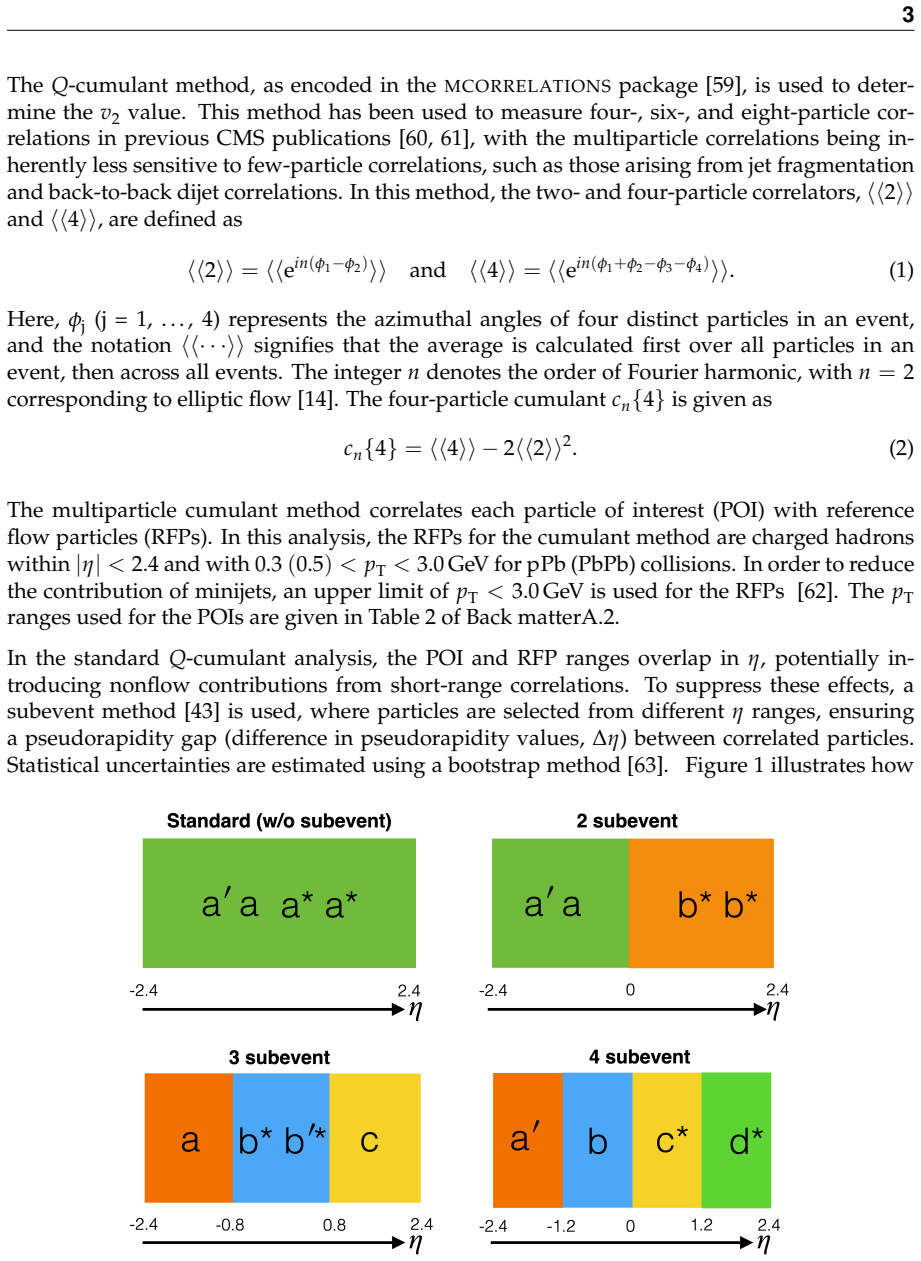
The central tool is the four-particle cumulant $v_2\{4\}$ computed with a subevent method: particles are divided into four distinct pseudorapidity intervals, and the cumulant is built from correlators such as $d_n\{4\}_{4\mathrm{sub}} = \langle\langle 4 \rangle\rangle_{a'|b|c^*|d^*} - \langle\langle 2 \rangle\rangle_{a'|c^*} \langle\langle 2 \rangle\rangle_{b|d^*} - \langle\langle 2 \rangle\rangle_{a'|d^*} \langle\langle 2 \rangle\rangle_{b|c^*}$, which suppresses short-range jet correlations because no two correlated particles share a subevent. The same analysis with two and three subevents shows a progressive reduction of the negative nonflow contribution, and a generator-level control simulation (Ref. [56]) yields $d_2\{4\}$ consistent with zero after four-subevent separation. This establishes that the remaining positive $v_2\{4\}$ at high $p_{\mathrm{T}}$ in data is not produced by the same nonflow mechanisms present in the simulation.
What would settle it
Run the same four-subevent cumulant analysis on an event generator with realistic jet fragmentation but no collective flow; if the resulting $d_2\{4\}$ at $p_{\mathrm{T}} > 8$ GeV is as negative as the data, the reported signal could be entirely nonflow. Conversely, if a high-multiplicity proton-proton sample measured with the same technique shows a vanishing high-$p_{\mathrm{T}}$ $v_2\{4\}$, the proposed common origin across systems would be contradicted.
Extended reading notes
Core claim
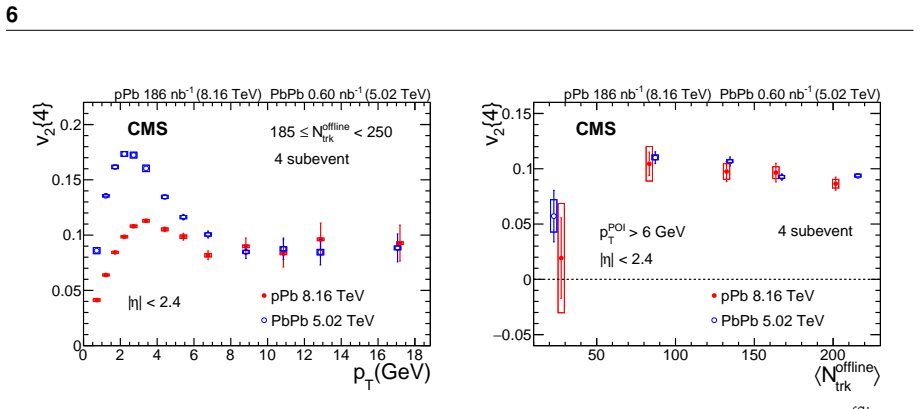
Using four-particle cumulants with subevents separated in pseudorapidity, the paper finds significant positive $v_2\{4\}$ values in high-multiplicity pPb collisions that persist up to $p_{\mathrm{T}} \sim 17$ GeV, in contrast to the standard (no-subevent) $v_2\{4\}$ which turns negative above about 10 GeV. At $p_{\mathrm{T}} > 8$ GeV the pPb and PbPb $v_2\{4\}$ values agree within uncertainties at comparable multiplicities, and the multiplicity dependence for $p_{\mathrm{T}} > 6$ GeV is also similar. The authors argue this similarity is unexpected: high-$p_{\mathrm{T}}$ partons are not thermalized, so the expected mechanism is path-length-dependent energy loss, which should be stronger in the larger PbPb system, and previous template-fit $v_2\{2\}$ measurements gave smaller values. They therefore suggest a common origin for high-$p_{\mathrm{T}}$ multi-particle collectivity in the two systems, possibly rooted in initial-state transverse-momentum asymmetries rather than final-state geometry.
Load-bearing premise
The whole interpretation rests on the four-subevent procedure removing all jet-related 'nonflow' correlations, so that the remaining positive $v_2$ at high $p_{\mathrm{T}}$ is genuine collective behavior rather than a residual effect of jet fragmentation.
Editorial extensions
If this is right
- At high $p_{\mathrm{T}}$ (above 8 GeV), $v_2\{4\}$ is positive and similar in pPb and PbPb, so a large lenticular overlap geometry is not required to produce elliptic anisotropy of fast particles.
- Prior template-fit $v_2\{2\}$ results are lower than the four-subevent $v_2\{4\}$; the implied over-subtraction of nonflow in the template method would need to be revisited.
- The similarity points to a common mechanism for high-$p_{\mathrm{T}}$ collectivity across small and large systems, with initial-state transverse-momentum asymmetries named as one candidate.
- Multi-particle cumulants with subevent separation are validated as a data-driven way to remove jet-related correlations in small collision systems.
Reading between the lines
- If the common-origin interpretation is right, the same four-subevent analysis should reveal a nonzero high-$p_{\mathrm{T}}$ $v_2\{4\}$ in high-multiplicity proton-proton collisions, a prediction the paper does not make explicitly.
- The near equality of $v_2\{4\}$ at fixed multiplicity across systems could reflect a universal scaling of collective response with final-state charged-particle density; comparing the same observable in pp, pPb, and PbPb at identical center-of-mass energy would test that scaling.
- A natural extension is to apply the four-subevent cumulant to triangular flow $v_3$ and to identified hadrons at high $p_{\mathrm{T}}$; if the common mechanism is initial-state momentum anisotropy, $v_3$ should behave differently from $v_2$, since it is more sensitive to geometry fluctuations.
Editorial analysis
A structured set of objections, weighed in public.
Referee Report
Summary. This paper reports CMS measurements of charged-hadron elliptic anisotropy v2{4} in pPb collisions at sqrt(s_NN)=8.16 TeV and PbPb collisions at 5.02 TeV, using the Q-cumulant method with two-, three-, and four-subevent partitions to suppress nonflow. Differential results are given as a function of POI pT for the multiplicity range 185 <= Noffline_trk < 250, together with a comparison of pPb and PbPb and a multiplicity dependence for pT > 6 GeV. The central observation is that four-subevent v2{4} remains significantly positive up to pT approximately 17 GeV in both systems and has similar magnitude in pPb and PbPb at the same Noffline multiplicity bin, which the authors interpret as evidence for a common origin of high-pT multiparticle collectivity. The supporting material includes a HIJING-based nonflow control, systematic studies, and a HEPData record.
Significance. If the result holds, it extends the case for collective behavior in small systems to the hard-scattering regime and provides a strong constraint on energy-loss and initial-state models. The analysis has concrete strengths: established cumulant formulas, bootstrap uncertainties, a data-driven subevent approach, an independent HIJING control, and public data tables. The remaining concerns are about how the similarity and nonflow-removal claims are demonstrated rather than about the underlying method.
major comments (3)
- [Fig. 3 (left and right), Fig. 5, and Summary] The central claim that v2{4} values in pPb and PbPb are 'similar' or 'very similar' is supported only by visual inspection. No chi-square, p-value, or confidence interval on the pPb-PbPb difference is reported for the pT > 8 GeV bins or for the multiplicity dependence. Because the novelty of the paper is this similarity, a quantitative compatibility test that includes both statistical and systematic uncertainties should be provided, using the tabulated values in HEPData.
- [Table 1; Fig. 5] The multiplicity matching underlying the comparison is not as clean as stated. For the 185 <= Noffline_trk < 250 bin, Table 1 gives <Noffline_trk> = 202 and <Ncorrected_trk> = 245 +/- 10 for pPb, versus 216 and 368 +/- 16 for PbPb. The two systems are matched in raw offline multiplicity, but their corrected charged-particle multiplicities differ by about 50%. Since the abstract and summary describe the comparison as 'at comparable charged particle multiplicities,' the paper should either use corrected multiplicity matching or explicitly state that the matching is in Noffline_trk only, and discuss how the remaining multiplicity difference affects the similarity claim.
- [Appendix A.3, Fig. 4] The HIJING nonflow control is internally inconsistent as written. The text first says the comparison uses 'HIJING simulations in 100 <= Ngen_trk < 200' with data '185 <= Noffline_trk < 250'; the figure caption says the HIJING points are for '60 <= Ngen_trk < 120' compared with data in '60 <= Noffline_trk < 120' and '185 <= Noffline_trk < 250'; and the figure legend appears to show 100 <= Ngen_trk < 200. Only one of these can be correct. If the control is at 60-120, it does not test the 185-250 range used for the main result; if it is at 100-200, the caption and text need correction. Moreover, the text states that the reduction of d2{4} is smaller in data than in HIJING, so the conclusion that nonflow is 'completely removed' in data at high multiplicity needs to be justified more carefully.
minor comments (3)
- [Fig. 5, Abstract, Summary] Figure 5 and its caption use pT > 6 GeV for the multiplicity dependence, while the abstract and summary state the high-pT similarity for pT > 8 GeV; please clarify whether the multiplicity comparison is meant to represent the pT > 8 GeV claim or an additional result.
- [Appendix A.3, Fig. 4 caption] The figure caption describes 'closed green diamonds' while the text says 'filled points'; the marker description should be made consistent.
- [Systematic uncertainties paragraph] The statement that systematic uncertainty sources are 'added in quadrature' would be clearer if the individual sources were enumerated with their estimated magnitudes, as is customary for a measurement of this type.
Circularity Check
No circularity: v2{4} is a direct four-particle cumulant measurement, the nonflow control uses independent HIJING simulations without collectivity, and the pPb–PbPb similarity claim is not produced by any fitted parameter or self-citation chain.
full rationale
The central observable, v2{4}, is obtained directly from four-particle cumulants via standard definitions (Eqs. 1–8); no parameter is fitted to the reported pPb or PbPb v2{4} values, and no quantity entering the measurement is defined in terms of the final similarity claim. The nonflow-suppression argument in Appendix A.3 uses generator-level HIJING events, which contain no collective flow, and shows that the four-subevent d2{4} is consistent with zero at high pT; this is an independent control simulation, not a re-use of the data being reported. The subevent cumulant equations are standard algebraic relations from the cited methodological literature, and the paper does not invoke a uniqueness theorem or an unverified self-citation to force its interpretation. The self-citations to previous CMS analyses (e.g., Refs. [19,20,22,60,61]) are for trigger/track selections and for previously established correlation techniques, not for the physical conclusion of pPb–PbPb similarity. The absence of an explicit chi-square or p-value for the cross-system comparison is a legitimate concern about statistical strength, but that is a correctness/evidence issue rather than circularity: the comparison is a direct measurement-to-measurement comparison, not a fit or a derived quantity built from the claim itself.
Assumptions & free parameters
assumptions (4)
- standard math The Q-cumulant expressions in Eqs. (1) to (8) correctly define the four-particle cumulant v2{4}.
- domain assumption Separating particles into different pseudorapidity subevents removes nonflow correlations while preserving genuine flow.
- domain assumption Reference flow particles restricted to pT < 3 GeV reduce contributions from minijets.
- domain assumption Tracking efficiency and acceptance corrections from HIJING and HYDJET Monte Carlo are accurate.
Cite this review
Pith. "Pith review of Evidence for similar collectivity of high transverse momentum particles in pPb and PbPb collisions." pith.science (2026). https://pith.science/paper/EKEHBDUH
@misc{pith2026250207525,
  author       = {Pith},
  title        = {Pith review of: Evidence for similar collectivity of high transverse momentum particles in pPb and PbPb collisions},
  year         = {2026},
  howpublished = {\url{https://pith.science/paper/EKEHBDUH}},
  note         = {Machine review of arXiv:2502.07525}
}
abstract
Charged hadron elliptic anisotropies ($v_2$) are presented over a wide transverse momentum ($p_\text{T}$) range for proton-lead (pPb) and lead-lead (PbPb) collisions at nucleon-nucleon center-of-mass energies of 8.16 and 5.02 TeV, respectively. The data were recorded by the CMS experiment and correspond to integrated luminosities of 186 nb$^{-1}$ and 0.607 nb$^{-1}$ for the pPb and PbPb systems, respectively. A four-particle cumulant analysis is performed using subevents separated in pseudorapidity to effectively suppress non-collective effects. At high $p_\text{T}$ ($p_\text{T}$ $\gt$ 8 GeV), significant positive $v_2$ values are observed that are similar between pPb and PbPb collisions at comparable charged particle multiplicities. This observation suggests a common origin for the multi-particle collectivity for high-$p_\text{T}$ particles in the two systems.
Figures

Figures from the paper (2 more)


Reference graph
Works this paper leans on
-
[1]
STAR Collaboration, “Distributions of charged hadrons associated with high transverse momentum particles in pp and Au+Au collisions at √sNN = 200 GeV”, Phys. Rev. Lett. 95 (2005) 152301, doi:10.1103/PhysRevLett.95.152301, arXiv:nucl-ex/0501016
arXiv 2005
-
[2]
Long-range rapidity correlations and jet production in high energy nuclear collisions
STAR Collaboration, “Long-range rapidity correlations and jet production in high energy nuclear collisions”, Phys. Rev. C 80 (2009) 064912, doi:10.1103/PhysRevC.80.064912, arXiv:0909.0191
arXiv 2009
-
[3]
PHOBOS Collaboration, “High transverse momentum triggered correlations over a large pseudorapidity acceptance in Au+Au collisions at √sNN = 200 GeV”, Phys. Rev. Lett. 104 (2010) 062301, doi:10.1103/PhysRevLett.104.062301, arXiv:0903.2811. 8
work page Pith review arXiv 2010
-
[4]
CMS Collaboration, “Long-range and short-range dihadron angular correlations in central PbPb collisions at √sNN = 2.76 TeV”, JHEP 07 (2011) 076, doi:10.1007/JHEP07(2011)076, arXiv:1105.2438
arXiv 2011
-
[5]
CMS Collaboration, “Centrality dependence of dihadron correlations and azimuthal anisotropy harmonics in PbPb collisions at √sNN = 2.76 TeV”, Eur. Phys. J. C 72 (2012) 2012, doi:10.1140/epjc/s10052-012-2012-3 , arXiv:1201.3158
arXiv 2012
-
[6]
Elliptic flow of charged particles in PbPb collisions at √sNN = 2.76 TeV
ALICE Collaboration, “Elliptic flow of charged particles in PbPb collisions at √sNN = 2.76 TeV”, Phys. Rev. Lett. 105 (2010) 252302, doi:10.1103/PhysRevLett.105.252302, arXiv:1011.3914
arXiv 2010
-
[7]
ATLAS Collaboration, “Measurement of the azimuthal anisotropy for charged particle production in √sNN = 2.76 TeV lead-lead collisions with the ATLAS detector”, Phys. Rev. C 86 (2012) 014907, doi:10.1103/PhysRevC.86.014907, arXiv:1203.3087
arXiv 2012
-
[8]
CMS Collaboration, “Measurement of the elliptic anisotropy of charged particles produced in PbPb collisions at √sNN = 2.76 TeV”, Phys. Rev. C 87 (2013) 014902, doi:10.1103/PhysRevC.87.014902, arXiv:1204.1409
arXiv 2013
Show all 70 references
-
[9]
Studies of azimuthal dihadron correlations in ultra-central PbPb collisions at √sNN = 2.76 TeV
CMS Collaboration, “Studies of azimuthal dihadron correlations in ultra-central PbPb collisions at √sNN = 2.76 TeV”, JHEP 02 (2014) 088, doi:10.1007/JHEP02(2014)088, arXiv:1312.1845
2014 arXiv
-
[10]
Overview of high-density QCD studies with the CMS experiment at the LHC
CMS Collaboration, “Overview of high-density QCD studies with the CMS experiment at the LHC”, Phys. Rept. 1115 (2025) 219–367, doi:10.1016/j.physrep.2024.11.007, arXiv:2405.10785
2025 arXiv
-
[11]
Anisotropy as a signature of transverse collective flow
J.-Y. Ollitrault, “Anisotropy as a signature of transverse collective flow”, Phys. Rev. D 46 (1992) 229, doi:10.1103/PhysRevD.46.229
1992 doi
-
[12]
Collective flow and viscosity in relativistic heavy-ion collisions
U. Heinz and R. Snellings, “Collective flow and viscosity in relativistic heavy-ion collisions”, Ann. Rev. Nucl. Part. Sci. 63 (2013) 123, doi:10.1146/annurev-nucl-102212-170540 , arXiv:1301.2826
2013 arXiv
-
[13]
Hydrodynamic modeling of heavy-ion collisions
C. Gale, S. Jeon, and B. Schenke, “Hydrodynamic modeling of heavy-ion collisions”, Int. J. Mod. Phys. A 28 (2013) 1340011, doi:10.1142/S0217751X13400113, arXiv:1301.5893
2013 arXiv
-
[14]
Elliptic and triangular flow in event-by-event D = 3 + 1 viscous hydrodynamics
B. Schenke, S. Jeon, and C. Gale, “Elliptic and triangular flow in event-by-event D = 3 + 1 viscous hydrodynamics”, Phys. Rev. Lett. 106 (2011) 042301, doi:10.1103/PhysRevLett.106.042301, arXiv:1009.3244
2011 arXiv
-
[15]
Hydrodynamic elliptic and triangular flow in Pb-Pb collisions at √sNN = 2.76 TeV
Z. Qiu, C. Shen, and U. Heinz, “Hydrodynamic elliptic and triangular flow in Pb-Pb collisions at √sNN = 2.76 TeV”, Phys. Lett. B 707 (2012) 151, doi:10.1016/j.physletb.2011.12.041, arXiv:1110.3033
2012 arXiv
-
[16]
Observation of long-range, near-side angular correlations in proton-proton collisions at the LHC
CMS Collaboration, “Observation of long-range, near-side angular correlations in proton-proton collisions at the LHC”, JHEP 09 (2010) 091, doi:10.1007/JHEP09(2010)091, arXiv:1009.4122
2010 arXiv
-
[17]
Observation of long-range elliptic azimuthal anisotropies in√s = 13 and 2.76 TeV pp collisions with the ATLAS detector
ATLAS Collaboration, “Observation of long-range elliptic azimuthal anisotropies in√s = 13 and 2.76 TeV pp collisions with the ATLAS detector”, Phys. Rev. Lett. 116 (2016) 172301, doi:10.1103/PhysRevLett.116.172301, arXiv:1509.04776. References 9
2016 arXiv
-
[18]
Measurement of long-range near-side two-particle angular correlations in pp collisions at √s = 13 TeV
CMS Collaboration, “Measurement of long-range near-side two-particle angular correlations in pp collisions at √s = 13 TeV”, Phys. Rev. Lett. 116 (2016) 172302, doi:10.1103/PhysRevLett.116.172302, arXiv:1510.03068
2016 arXiv
-
[19]
Evidence for collectivity in pp collisions at the LHC
CMS Collaboration, “Evidence for collectivity in pp collisions at the LHC”, Phys. Lett. B 765 (2017) 193, doi:10.1016/j.physletb.2016.12.009, arXiv:1606.06198
2017 arXiv
-
[20]
Multiplicity and transverse momentum dependence of two- and four-particle correlations in pPb and PbPb collisions
CMS Collaboration, “Multiplicity and transverse momentum dependence of two- and four-particle correlations in pPb and PbPb collisions”, Phys. Lett. B 724 (2013) 213, doi:10.1016/j.physletb.2013.06.028, arXiv:1305.0609
2013 arXiv
-
[21]
Observation of long-range, near-side angular correlations in proton-lead collisions at the LHC
CMS Collaboration, “Observation of long-range, near-side angular correlations in proton-lead collisions at the LHC”, Phys. Lett. B 718 (2013) 795, doi:10.1016/j.physletb.2012.11.025, arXiv:1210.5482
2013 arXiv
-
[22]
Evidence for collective multiparticle correlations in p-Pb collisions
CMS Collaboration, “Evidence for collective multiparticle correlations in p-Pb collisions”, Phys. Rev. Lett. 115 (2015) 012301, doi:10.1103/PhysRevLett.115.012301, arXiv:1502.05382
2015 arXiv
-
[23]
Long-range angular correlations on the near and away side in p-Pb collisions at √sNN = 5.02 TeV
ALICE Collaboration, “Long-range angular correlations on the near and away side in p-Pb collisions at √sNN = 5.02 TeV”, Phys. Lett. B 719 (2013) 29, doi:10.1016/j.physletb.2013.01.012, arXiv:1212.2001
2013 arXiv
-
[24]
Observation of associated near-side and away-side long-range correlations in √sNN = 5.02 TeV proton-lead collisions with the ATLAS detector
ATLAS Collaboration, “Observation of associated near-side and away-side long-range correlations in √sNN = 5.02 TeV proton-lead collisions with the ATLAS detector”, Phys. Rev. Lett. 110 (2013) 182302, doi:10.1103/PhysRevLett.110.182302, arXiv:1212.5198
2013 arXiv
-
[25]
Measurements of long-range near-side angular correlations in√sNN = 5 TeV proton-lead collisions in the forward region
LHCb Collaboration, “Measurements of long-range near-side angular correlations in√sNN = 5 TeV proton-lead collisions in the forward region”, Phys. Lett. B 762 (2016) 473, doi:10.1016/j.physletb.2016.09.064, arXiv:1512.00439
2016 arXiv
-
[26]
Measurement of long-range angular correlation and quadrupole anisotropy of pions and (anti)protons in central d+Au collisions at √sNN = 200 GeV
PHENIX Collaboration, “Measurement of long-range angular correlation and quadrupole anisotropy of pions and (anti)protons in central d+Au collisions at √sNN = 200 GeV”, Phys. Rev. Lett. 114 (2015) 192301, doi:10.1103/PhysRevLett.114.192301, arXiv:1404.7461
2015
-
[27]
Long-range pseudorapidity dihadron correlations in d+Au collisions at √sNN = 200 GeV
STAR Collaboration, “Long-range pseudorapidity dihadron correlations in d+Au collisions at √sNN = 200 GeV”, Phys. Lett. B 747 (2015) 265, doi:10.1016/j.physletb.2015.05.075, arXiv:1502.07652
2015 arXiv
-
[28]
Measurements of elliptic and triangular flow in high-multiplicity 3He+Au collisions at √sNN = 200 GeV
PHENIX Collaboration, “Measurements of elliptic and triangular flow in high-multiplicity 3He+Au collisions at √sNN = 200 GeV”, Phys. Rev. Lett. 115 (2015) 142301, doi:10.1103/PhysRevLett.115.142301, arXiv:1507.06273
2015
-
[29]
Small system collectivity in relativistic hadronic and nuclear collisions
J. L. Nagle and W. A. Zajc, “Small system collectivity in relativistic hadronic and nuclear collisions”, Ann. Rev. Nucl. Part. Sci. 68 (2018) 211, doi:10.1146/annurev-nucl-101916-123209 , arXiv:1801.03477
2018 arXiv
-
[30]
Novel collective phenomena in high-energy proton-proton and proton-nucleus collisions
K. Dusling, W. Li, and B. Schenke, “Novel collective phenomena in high-energy proton-proton and proton-nucleus collisions”, Int. J. Mod. Phys. E 25 (2016) 1630002, doi:10.1142/S0218301316300022, arXiv:1509.07939. 10
2016 arXiv
-
[31]
Recombination of shower partons at high pT in heavy ion collisions
R. C. Hwa and C. B. Yang, “Recombination of shower partons at high pT in heavy ion collisions”, Phys. Rev. C 70 (2004) 024905, doi:10.1103/PhysRevC.70.024905, arXiv:nucl-th/0401001
2004 arXiv
-
[32]
Large parton densities and high- pT physics in heavy-ion collisions
C. Marquet, “Large parton densities and high- pT physics in heavy-ion collisions”, PoS High-pT physics09 (2009) 039, doi:10.22323/1.080.0039, arXiv:0906.3184
2009 arXiv
-
[33]
Azimuthal anisotropy of charged particles at high transverse momenta in Pb-Pb collisions at √sNN = 2.76 TeV
CMS Collaboration, “Azimuthal anisotropy of charged particles at high transverse momenta in Pb-Pb collisions at √sNN = 2.76 TeV”, Phys. Rev. Lett. 109 (2012) 022301, doi:10.1103/PhysRevLett.109.022301, arXiv:1204.1850
2012 arXiv
-
[34]
Azimuthal anisotropy of charged particles with transverse momentum up to 100 GeV /c in PbPb collisions at √sNN = 5.02 TeV
CMS Collaboration, “Azimuthal anisotropy of charged particles with transverse momentum up to 100 GeV /c in PbPb collisions at √sNN = 5.02 TeV”, Phys. Lett. B 776 (2018) 195, doi:10.1016/j.physletb.2017.11.041, arXiv:1702.00630
2018 arXiv
-
[35]
Study of azimuthal anisotropy of high- pT charged particles in Au Au collisions at √sNN = 200 GeV with RHIC-PHENIX
PHENIX Collaboration, “Study of azimuthal anisotropy of high- pT charged particles in Au Au collisions at √sNN = 200 GeV with RHIC-PHENIX”, MDPI Proc. 10 (2019) 42, doi:10.3390/proceedings2019010042
2019 doi
-
[36]
Azimuthal anisotropy of charged and identified high pT hadrons in Au+Au collisions at RHIC
STAR Collaboration, “Azimuthal anisotropy of charged and identified high pT hadrons in Au+Au collisions at RHIC”, Nucl. Phys. A 715 (2003) 737, doi:10.1016/S0375-9474(02)01477-X, arXiv:nucl-ex/0210027
2003 arXiv
-
[37]
Evidence for transverse momentum and pseudorapidity dependent event plane fluctuations in PbPb and pPb collisions
CMS Collaboration, “Evidence for transverse momentum and pseudorapidity dependent event plane fluctuations in PbPb and pPb collisions”, Phys. Rev. C 92 (2015) 034911, doi:10.1103/PhysRevC.92.034911, arXiv:1503.01692
2015 arXiv
-
[38]
Transverse momentum and process dependent azimuthal anisotropies in √sNN = 8.16 TeV p+Pb collisions with the ATLAS detector
ATLAS Collaboration, “Transverse momentum and process dependent azimuthal anisotropies in √sNN = 8.16 TeV p+Pb collisions with the ATLAS detector”, Eur. Phys. J. C 80 (2020) 73, doi:10.1140/epjc/s10052-020-7624-4 , arXiv:1910.13978
2020 arXiv
-
[39]
Azimuthal anisotropy of jet particles in p-Pb and Pb-Pb collisions at √sNN = 5.02 TeV
ALICE Collaboration, “Azimuthal anisotropy of jet particles in p-Pb and Pb-Pb collisions at √sNN = 5.02 TeV”, JHEP 08 (2024) 234, doi:10.1007/JHEP08(2024)234, arXiv:2212.12609
2024 arXiv
-
[40]
CMS luminosity measurement using 2016 proton-nucleus collisions at nucleon-nucleon center-of-mass energy of 8.16 TeV
CMS Collaboration, “CMS luminosity measurement using 2016 proton-nucleus collisions at nucleon-nucleon center-of-mass energy of 8.16 TeV”, CMS Physics Analysis Summary CMS-PAS-LUM-17-002, 2018
2016
-
[41]
CMS luminosity measurement using nucleus-nucleus collisions at√sNN = 5.02 TeV in 2018
CMS Collaboration, “CMS luminosity measurement using nucleus-nucleus collisions at√sNN = 5.02 TeV in 2018”, CMS Physics Analysis Summary CMS-PAS-LUM-18-001, 2022
2018
-
[42]
Flow analysis with cumulants: Direct calculations
A. Bilandzic, R. Snellings, and S. Voloshin, “Flow analysis with cumulants: Direct calculations”, Phys. Rev. C 83 (2011) 044913, doi:10.1103/PhysRevC.83.044913, arXiv:1010.0233
2011 arXiv
-
[43]
Systematic procedure for analyzing cumulants at any order
P . Di Francesco, M. Guilbaud, M. Luzum, and J.-Y. Ollitrault, “Systematic procedure for analyzing cumulants at any order”, Phys. Rev. C 95 (2017) 044911, doi:10.1103/PhysRevC.95.044911, arXiv:1612.05634
2017 arXiv
-
[44]
Revealing long-range multiparticle collectivity in small collision systems via subevent cumulants
J. Jia, M. Zhou, and A. Trzupek, “Revealing long-range multiparticle collectivity in small collision systems via subevent cumulants”, Phys. Rev. C 96 (2017) 034906, doi:10.1103/PhysRevC.96.034906, arXiv:1701.03830
2017 arXiv
-
[45]
HEPData record for this analysis
“HEPData record for this analysis”, 2025. doi:10.17182/hepdata.156174. References 11
2025 doi
-
[46]
The CMS experiment at the CERN LHC
CMS Collaboration, “The CMS experiment at the CERN LHC”, JINST 3 (2008) S08004, doi:10.1088/1748-0221/3/08/S08004
2008 doi
-
[47]
Development of the CMS detector for the CERN LHC Run 3
CMS Collaboration, “Development of the CMS detector for the CERN LHC Run 3”, JINST 19 (2024) P05064, doi:10.1088/1748-0221/19/05/P05064
2024 doi
-
[48]
Description and performance of track and primary-vertex reconstruction with the CMS tracker
CMS Collaboration, “Description and performance of track and primary-vertex reconstruction with the CMS tracker”, JINST 9 (2014) P10009, doi:10.1088/1748-0221/9/10/P10009, arXiv:1405.6569
2014 arXiv
-
[49]
Strategies and performance of the CMS silicon tracker alignment during LHC Run 2
CMS Collaboration, “Strategies and performance of the CMS silicon tracker alignment during LHC Run 2”, Nucl. Instrum. Meth. A 1037 (2022) 166795, doi:10.1016/j.nima.2022.166795, arXiv:2111.08757
2022
-
[50]
ECAL 2016 refined calibration and Run2 summary plots
CMS Collaboration, “ECAL 2016 refined calibration and Run2 summary plots”, CMS Detector Performance Summary CMS-DP-2020-021, 2020
2016
-
[51]
Heavy ion studies with CMS HF calorimeter
J. Damgov et al., “Heavy ion studies with CMS HF calorimeter”, Technical Report CMS-NOTE-2001-055, CERN, Geneva, 2001
2001
-
[52]
Electron and photon reconstruction and identification with the CMS experiment at the CERN LHC
CMS Collaboration, “Electron and photon reconstruction and identification with the CMS experiment at the CERN LHC”, JINST 16 (2021) P05014, doi:10.1088/1748-0221/16/05/P05014, arXiv:2012.06888
2021 arXiv
-
[53]
Performance of the CMS muon detector and muon reconstruction with proton-proton collisions at √s = 13 TeV
CMS Collaboration, “Performance of the CMS muon detector and muon reconstruction with proton-proton collisions at √s = 13 TeV”, JINST 13 (2018) P06015, doi:10.1088/1748-0221/13/06/P06015, arXiv:1804.04528
2018 arXiv
-
[54]
Performance of the CMS Level-1 trigger in proton-proton collisions at √s = 13 TeV
CMS Collaboration, “Performance of the CMS Level-1 trigger in proton-proton collisions at √s = 13 TeV”, JINST 15 (2020) P10017, doi:10.1088/1748-0221/15/10/P10017, arXiv:2006.10165
2020 arXiv
-
[55]
The CMS trigger system
CMS Collaboration, “The CMS trigger system”, JINST 12 (2017) 01020, doi:10.1088/1748-0221/12/01/P01020, arXiv:1609.02366
2017 arXiv
-
[56]
HIJING 1.0: A Monte Carlo program for parton and particle production in high energy hadronic and nuclear collisions
M. Gyulassy and X.-N. Wang, “HIJING 1.0: A Monte Carlo program for parton and particle production in high energy hadronic and nuclear collisions”, Comput. Phys. Commun. 83 (1994) 307, doi:10.1016/0010-4655(94)90057-4, arXiv:nucl-th/9502021
1994 arXiv
-
[57]
A model of jet quenching in ultrarelativistic heavy ion collisions and high-pT hadron spectra at RHIC
I. P . Lokhtin and A. M. Snigirev, “A model of jet quenching in ultrarelativistic heavy ion collisions and high-pT hadron spectra at RHIC”, Eur. Phys. J. C 45 (2006) 211, doi:10.1140/epjc/s2005-02426-3, arXiv:hep-ph/0506189
2006 arXiv
-
[58]
GEANT4–a simulation toolkit
GEANT4 Collaboration, “GEANT4–a simulation toolkit”, Nucl. Instrum. Meth. A 506 (2003) 250, doi:10.1016/S0168-9002(03)01368-8
2003 doi
-
[59]
Generic framework for anisotropic flow analyses with multiparticle azimuthal correlations
A. Bilandzic et al., “Generic framework for anisotropic flow analyses with multiparticle azimuthal correlations”, Phys. Rev. C 89 (2014) 064904, doi:10.1103/PhysRevC.89.064904, arXiv:1312.3572
2014 arXiv
-
[60]
Multiparticle correlation studies in pPb collisions at √sNN = 8.16 TeV
CMS Collaboration, “Multiparticle correlation studies in pPb collisions at √sNN = 8.16 TeV”, Phys. Rev. C 101 (2020) 014912, doi:10.1103/PhysRevC.101.014912, arXiv:1904.11519. 12
2020 arXiv
-
[61]
Pseudorapidity and transverse momentum dependence of flow harmonics in pPb and PbPb collisions
CMS Collaboration, “Pseudorapidity and transverse momentum dependence of flow harmonics in pPb and PbPb collisions”, Phys. Rev. C 98 (2018) 044902, doi:10.1103/PhysRevC.98.044902, arXiv:1710.07864
2018 arXiv
-
[62]
Studying minijets via the pT dependence of two-particle correlation in azimuthal angle φ
X.-N. Wang, “Studying minijets via the pT dependence of two-particle correlation in azimuthal angle φ”, Phys. Rev. D 47 (1993) 2754, doi:10.1103/PhysRevD.47.2754, arXiv:hep-ph/9306215
1993 arXiv
-
[63]
Bootstrap methods: Another look at the jackknife
B. Efron, “Bootstrap methods: Another look at the jackknife”, Annals Statist. 7 (1979) 1, doi:10.1214/aos/1176344552
1979
-
[64]
Systematic errors: Facts and fictions
R. Barlow, “Systematic errors: Facts and fictions”, in Conference on Advanced Statistical T echniques in Particle Physics, p. 134. 2002. arXiv:hep-ex/0207026
2002 arXiv
-
[65]
Energy dependence and fluctuations of anisotropic flow in Pb-Pb collisions at √sNN = 5.02 and 2.76 TeV
ALICE Collaboration, “Energy dependence and fluctuations of anisotropic flow in Pb-Pb collisions at √sNN = 5.02 and 2.76 TeV”, JHEP 07 (2018) 103, doi:10.1007/JHEP07(2018)103, arXiv:1804.02944
2018 arXiv
-
[66]
K0 S and Λ production in Pb-Pb collisions at √sNN = 2.76 TeV
ALICE Collaboration, “ K0 S and Λ production in Pb-Pb collisions at √sNN = 2.76 TeV”, Phys. Rev. Lett. 111 (2013) 222301, doi:10.1103/PhysRevLett.111.222301, arXiv:1307.5530
2013 arXiv
-
[67]
Charged-particle nuclear modification factors in PbPb and pPb collisions at √sNN = 5.02 TeV
CMS Collaboration, “Charged-particle nuclear modification factors in PbPb and pPb collisions at √sNN = 5.02 TeV”, JHEP 04 (2017) 039, doi:10.1007/JHEP04(2017)039, arXiv:1611.01664
2017 arXiv
-
[68]
Centrality categorization for Rp(d)+ A in high-energy collisions
PHENIX Collaboration, “Centrality categorization for Rp(d)+ A in high-energy collisions”, Phys. Rev. C 90 (2014) 034902, doi:10.1103/PhysRevC.90.034902, arXiv:1310.4793
2014
-
[69]
Effect of event selection on jetlike correlation measurement in d+Au collisions at √sNN = 200 GeV
STAR Collaboration, “Effect of event selection on jetlike correlation measurement in d+Au collisions at √sNN = 200 GeV”, Phys. Lett. B 743 (2015) 333, doi:10.1016/j.physletb.2015.02.068, arXiv:1412.8437
2015 arXiv
-
[70]
Azimuthal anisotropy at high transverse momentum in p-p and p-A collisions
I. Soudi and A. Majumder, “Azimuthal anisotropy at high transverse momentum in p-p and p-A collisions”, Phys. Lett. B 859 (2024) 139105, doi:10.1016/j.physletb.2024.139105, arXiv:2308.14702. 13 A Back matter A.1 Mapping between Noffline trk and Ncorrected trk in pPb and PbPb c...
2024
Reviewed August 8, 2026 · model on record in the stance chip above.
Discussion (0). Continue with ORCID to comment.