REVIEW 4 major objections 7 minor 1 cited by
SEMU: Singular Value Decomposition for Efficient Machine Unlearning
T0 review · 4 major / 7 minor · reviewed 2026-08-08 · deepseek-v4-flash
Pith's one-line read Machine unlearning can work by altering under 1% of a model's weights.
desk verdict A simple, well-engineered SVD-based subspace method that looks strong for classification unlearning, but the flagship generative efficiency claim is unreported and contradicted by the paper's own rank-selection rule. read the letter →
The pith
A machine-rendered reading of the paper's core claim, the machinery that carries it, and where it could break.
The reading
What carries the argument
The central object is a low-rank subspace of each weight matrix, written $S^r_{A,B} = \{A X B^T : X \in \mathbb{R}^{r\times r}\}$, whose orthogonal projection under the Frobenius inner product is $p_{A,B}(X)=A(A^T X B)B^T$. The construction first takes the per-layer gradient $G_i$ of the forgetting loss on the forget set, projects out its component parallel to the layer weights to get $G^{\perp A_i}$, then applies truncated SVD $G^{\perp A_i} = U_i \Sigma_i V_i^T$. The top $r$ singular directions define the basis in which the update $A_i + U_{i,r} R_i V_{i,r}^T$ lives, and $r$ is selected so that the normalized cumulative squared singular values $e_k = \sum_{j=1}^k \sigma_j^2 / \sum_j \sigma_j^2$ first reaches the threshold $\gamma$. The paper's Theorem 4.1 states that this truncated SVD gives the closest rank-$r$ approximation to the gradient in the Frobenius metric, which is what licenses using these directions as the critical ones; the trainable $r\times r$ matrix $R_i$ is then where all forgetting happens.
What would settle it
Train a ResNet-18 on CIFAR-10, use SEMU with $\gamma=1.0$ and no remaining dataset to unlearn one class, then run membership-inference attacks on forget-set samples: if the unlearned model still identifies those samples at rates close to the original model, the claimed erasure has not happened. A second check is to measure the retained-test accuracy after the update: if it drops far below the retrain baseline, the subspace has not actually protected the other knowledge.
Extended reading notes
Core claim
SEMU's central claim is that, for each linear layer $A_i$ of a pretrained network, the directions of the weight space that matter for forgetting are exactly the top singular vectors of the forget-set gradient, after the component parallel to the current weights is removed. The paper represents each layer as $A_i + U_{i,r} R_i V^T_{i,r}$, where $U_{i,r}$ and $V_{i,r}$ come from a truncated SVD of the projected gradient $G^{\perp A_i} = G_i - \frac{\langle G_i, A_i\rangle}{\|A_i\|^2} A_i$, and $R_i$ is an $r\times r$ matrix that is the only trainable part, initialized to zero. The rank $r$ is chosen per layer by an explained-variance threshold $\gamma\in[0,1]$ over the squared singular values. The paper argues that this disentangles each layer into a subspace tied to the forget batch and a complementary subspace left untouched, so unlearning can be achieved by optimizing the standard random-labeling or generation losses on only these small $R_i$ blocks, and that the remaining dataset can be dropped entirely ($\alpha=\beta=0$ in the paper's loss). Experiments on ResNet-18 and VGG-16 with CIFAR-10/100 and on DDPM and Stable Diffusion with CIFAR-10 and Imagenette are reported as supporting the claim.
Load-bearing premise
The load-bearing premise is that the top singular directions of the forget-set gradient (after removing the part parallel to the weights) point exactly where an unlearning update must go, so that training inside that subspace erases the target data and leaves everything else alone.
Editorial extensions
If this is right
- Unlearning a class, a concept, or randomly selected samples can be done by retraining under 1% of the model's parameters, which should cut the compute and instability associated with full or half-network fine-tuning.
- Because no remaining dataset is needed in the standard configuration, SEMU offers a route to data deletion when the original training data is withheld for privacy reasons.
- The small testing-accuracy gap to the retrain baseline reported in the tables implies that the unlearned model stays close to the original except on the target data.
- The same subspace update applies to classifier-free-guidance DDPMs and to Stable Diffusion, including nudity-concept removal measured on I2P prompts, so the mechanism is not tied to a single architecture.
- Giving SEMU a small replay subset of the remaining dataset improves unlearning accuracy and sample quality, indicating the method can trade data efficiency against stability.
Reading between the lines
- If the forget-set gradient truly concentrates in a low-rank subspace, sequential unlearning requests could be composed by adding further low-rank corrections in the same per-layer bases, letting a model forget multiple items over time without revisiting old ones; the paper does not test this.
- The mechanism applies to any model whose layers are linear maps, so the natural next target is transformer attention and MLP projections in LLMs; success there would depend on whether the forgetting gradient for language data is as low-rank as it is on vision benchmarks.
- One testable extension is to compare SEMU's chosen subspace against the null space of the retained-data loss: if the two overlap, the claim that forgetting does not disturb other knowledge would be directly measurable.
Editorial analysis
A structured set of objections, weighed in public.
Referee Report
Summary. The paper introduces SEMU, a machine unlearning method that reparameterizes each layer of a pretrained model as A_i + U_{i,r} R_i V_{i,r}^T, where U and V are truncated singular vectors of the forget-set gradient (after projecting out the component parallel to the layer weights) and only the small r-by-r matrix R_i is trained. The method is intended to require neither the remaining dataset nor modification of more than a tiny fraction of model parameters, while achieving unlearning performance competitive with methods such as SalUn, ESD, and FMN. Experiments cover random and class-wise forgetting on CIFAR-10/CIFAR-100 with ResNet-18 and VGG-16, class forgetting on DDPM and Stable Diffusion on Imagenette, and NSFW concept unlearning on Stable Diffusion. The classification results show that SEMU approaches retrain accuracy on several metrics while training sub-1% of parameters; the generative results are mixed, with SEMU generally behind SalUn and ESD in unlearning accuracy and FID, and with trainable-parameter counts not reported for Stable Diffusion.
Significance. The core proposal is relevant and timely: a parameter-efficient, remaining-dataset-free unlearning scheme would be practically valuable for large generative models, especially under privacy constraints. The method's dependence on a single interpretable hyperparameter (explained-variance threshold gamma) and its reliance on only the forget-set gradient are appealing. The classification experiments are reasonably thorough and the reported TParams values (0.23%–1.44%) support the parameter-efficiency claim in that setting. The paper also includes machine-readable pseudocode and a reproducibility statement. However, the central claim as stated in the title and abstract—'efficient' and 'altering less than 1% of the model's parameters'—is not established for the flagship generative experiments, and the theoretical justification (Theorem 4.1) addresses low-rank approximation, not whether the chosen subspace is sufficient for unlearning. The significance of the contribution therefore depends on closing this gap or qualifying the claims.
major comments (4)
- [§5.2, Table 7; Eq. (12)-(13)] The parameter-efficiency claim for Stable Diffusion is unsupported and likely inconsistent with the method as specified. With gamma = 1.0 for cross-attention layers, Eq. (12) selects r as the number of nonzero singular values of G_perp, which for a generic dense gradient is the full rank of the layer. The trainable block R_i is then r-by-r, so for a square projection layer it contains as many parameters as the original layer; preserving the original rank is not a low-rank approximation. Table 7 reports no TParams for Stable Diffusion, so the fraction of updated parameters is unknown, while the abstract and conclusion claim 'altering less than 1% of the model's parameters.' This is a load-bearing gap: the method's stated advantage over SalUn and ESD is parameter efficiency, and that advantage is unverified in the largest-scale experiment. Please report TParams for Stable Diffusion and, if gamma = 1.0 makes some layers fully trainable, state so explicitly and re-evaluate the 'low-rank' description in §5.2.
- [Table 6 (DDPM); §5.2] Even the DDPM results do not support the '<1%' claim: SEMU uses 1.2% trainable parameters without the remaining set, 1.5% with a subset, and 1.8% with the full remaining dataset, all exceeding 1%. Moreover, SEMU's UA of 95.60 (no remaining set) is below SalUn's 99.20, and its FID of 16.93 is substantially worse than SalUn's 11.21 and Retrain's 11.69. Given that the paper's central contribution is parameter-efficient unlearning while remaining competitive, these numbers undercut the claim unless the efficiency advantage is large enough to offset the accuracy and FID losses. Please provide a direct comparison of the efficiency-versus-utility trade-off, and avoid the absolute '<1%' phrasing in the abstract unless it is limited to the classification experiments.
- [§4.2, Theorem 4.1; Limitations] Theorem 4.1 states that truncated SVD gives the best low-rank approximation of the gradient matrix G, but the unlearning update (13) is not justified by this theorem. The theorem does not imply that updating inside the top singular subspace of the gradient will erase the forget set while preserving unrelated knowledge. The Limitations section explicitly acknowledges that SEMU does not constrain changes in directions crucial to downstream tasks, which may hurt performance. This is not a fatal flaw, but it means the paper's theoretical grounding is weaker than claimed ('theoretically grounded method' in §4). I recommend either adding an empirical analysis of how the chosen subspace relates to unlearning success (e.g., by varying gamma and reporting TParams versus UA/FID), or softening the theoretical claim.
- [§5.1, §5.2; Tables 1-7] The experimental protocol selects gamma by grid search on the same metrics used for the final comparison ('we run grid search to find the best parameter gamma ... and report the best performing model'). This is a form of test-set selection and can inflate the reported results. Please clarify whether the reported numbers are the best over a small grid or the result of predefined, held-out model selection, and report the chosen gamma values for each dataset. Without this, the reader cannot assess how much of SEMU's apparent competitiveness comes from selection on the test metrics.
minor comments (7)
- [Abstract / Conclusions] The phrase 'altering less than 1% of the model's parameters' is contradicted by Table 6 (1.2%, 1.5%, 1.8%) and is unquantified for Table 7; please qualify the claim to the classification setting or to layers where the bound actually holds.
- [Figure 2 caption] The caption contains a typo: 'unaltered adn' should read 'unaltered and'.
- [§1, contributions] 'Our contributions ca be summarized as follows' should read 'can be summarized.'
- [Tables 1-3, headings] The header says 'weights' but the text says 'weigths' in several table captions; please standardize spelling.
- [Tables 1-4] The symbol 'SEM Uremain' appears inconsistently as 'SEMUremain' in tables and text; unify the notation.
- [§6, Image Generation] The reference to 'Fig. G.1 and Fig. G.1' repeats the same figure; one of the two references is likely to a different figure.
- [Table 7] FID values are missing for SEMU on Church, Garbage Truck, and Parachute; the caption notes this is due to FID biasing, but please disclose the number of generated images used and the criterion for omission, since the reported average FID is computed over a reduced set.
Circularity Check
No circular derivation: SEMU's subspace construction is defined from forget-set gradients and validated on external metrics; gamma tuning and the '<1%' claim are correctness concerns, not circularity.
full rationale
The paper's derivation chain is not circular. SEMU defines the update subspace by SVD of the forget-set gradient (Eqs. 7 and 13), selects rank by explained variance (Eq. 12), and trains only the r by r matrix R_i. These are constructive algorithmic choices; the claimed efficiency is a measured quantity (TParams), not an input. Theorem 4.1 is the standard Eckart-Young-Mirsky theorem from Horn and Johnson, cited externally and restated in Appendix B; it supports the low-rank approximation of G but does not by itself establish unlearning quality, so the paper overstates its theoretical grounding but does not circularly assume the conclusion. The unlearning losses (Eqs. 17 and 18) do align with the reported UA metric by design, but the paper also evaluates RA, TA, MIA, and FID and compares against baselines, so the central validation is not forced by construction. No load-bearing self-citations appear; the prior SVD method (Kodge et al.) is cited for contrast. The main weaknesses are non-circular: gamma is chosen by grid search on the same reported metrics (Sec. 5.1); Stable Diffusion uses gamma = 1.0, where Eq. 12 yields r equal to the nonzero-singular-value count, contradicting the claim that this is still a low-rank decomposition (Sec. 5.2); and the '<1%' parameter claim is not reported for Stable Diffusion (Table 7) while DDPM shows 1.2-1.8% (Table 6). These are empirical, completeness, and selection-bias concerns, not circular reasoning.
Assumptions & free parameters
free parameters (3)
- explained variance threshold gamma =
0.6-0.95 grid search in classification; 0.9-0.95 for DDPM; 1.0 for Stable Diffusion cross-attention layers
- remaining dataset weights alpha and beta =
0 when no remaining dataset is used; unspecified nonzero values in SEMUremain variants
- training hyperparameters (learning rate, epochs, iterations, batch size) =
not reported
assumptions (4)
- standard math Truncated SVD gives the optimal rank-r approximation in Frobenius norm (Eckart-Young-Mirsky).
- domain assumption Neural network layers can be treated as linear operators whose weight matrices are reshaped for SVD, and convolutions and linear layers can be processed this way.
- ad hoc to paper The top singular subspace of the forget-set gradient is a sufficient subspace for unlearning, i.e., optimizing the unlearning loss inside it erases target data without destroying unrelated capabilities.
- domain assumption UA, RA, TA, MIA, and FID are adequate proxies for whether unlearning has occurred and whether the model is preserved.
Cite this review
Pith. "Pith review of SEMU: Singular Value Decomposition for Efficient Machine Unlearning." pith.science (2026). https://pith.science/paper/KO3OTVFB
@misc{pith2026250207587,
  author       = {Pith},
  title        = {Pith review of: SEMU: Singular Value Decomposition for Efficient Machine Unlearning},
  year         = {2026},
  howpublished = {\url{https://pith.science/paper/KO3OTVFB}},
  note         = {Machine review of arXiv:2502.07587}
}
read the original abstract
While the capabilities of generative foundational models have advanced rapidly in recent years, methods to prevent harmful and unsafe behaviors remain underdeveloped. Among the pressing challenges in AI safety, machine unlearning (MU) has become increasingly critical to meet upcoming safety regulations. Most existing MU approaches focus on altering the most significant parameters of the model. However, these methods often require fine-tuning substantial portions of the model, resulting in high computational costs and training instabilities, which are typically mitigated by access to the original training dataset. In this work, we address these limitations by leveraging Singular Value Decomposition (SVD) to create a compact, low-dimensional projection that enables the selective forgetting of specific data points. We propose Singular Value Decomposition for Efficient Machine Unlearning (SEMU), a novel approach designed to optimize MU in two key aspects. First, SEMU minimizes the number of model parameters that need to be modified, effectively removing unwanted knowledge while making only minimal changes to the model's weights. Second, SEMU eliminates the dependency on the original training dataset, preserving the model's previously acquired knowledge without additional data requirements. Extensive experiments demonstrate that SEMU achieves competitive performance while significantly improving efficiency in terms of both data usage and the number of modified parameters.
Figures


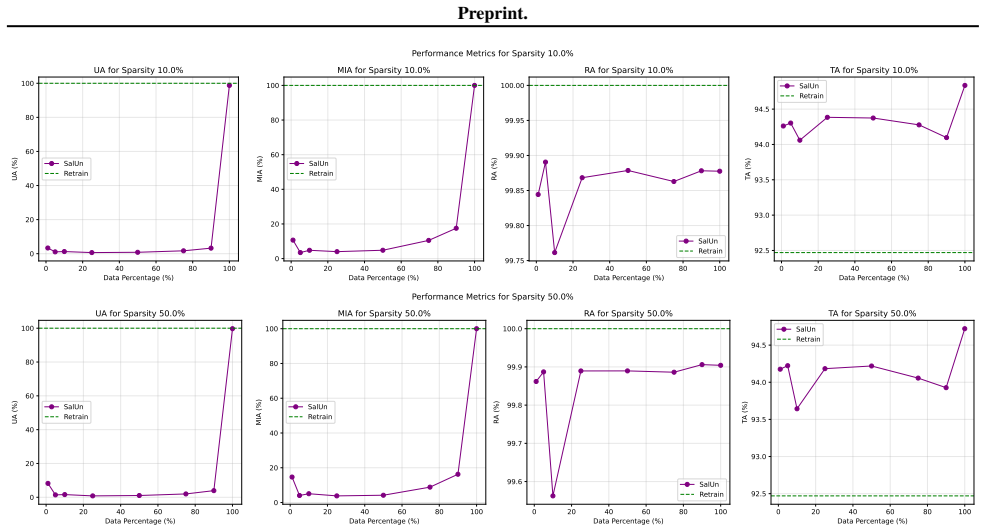
Figures from the paper (3 more)


Forward citations
Cited by 1 Pith paper
-
UnHype: CLIP-Guided Hypernetworks for Dynamic LoRA Unlearning
UnHype generates concept-specific LoRA unlearning weights on the fly from CLIP text embeddings by training a hypernetwork to follow the gradient of an unlearning loss, enabling single- and multi-concept erasure in dif...
Reference graph
Works this paper leans on
-
[1]
write newline
" write newline "" before.all 'output.state := FUNCTION n.dashify 't := "" t empty not t #1 #1 substring "-" = t #1 #2 substring "--" = not "--" * t #2 global.max substring 't := t #1 #1 substring "-" = "-" * t #2 global.max substring 't := while if t #1 #1 substring * t #2 global.max substring 't := if while FUNCTION format.date year duplicate empty "emp...
-
[2]
Gradient Surgery for One-shot Unlearning on Generative Model
Bae, S., Kim, S., Jung, H., and Lim, W. Gradient surgery for one-shot unlearning on generative model. ICML Workshop on Generative AI & Law, Jun 2023. URL https://arxiv.org/abs/2307.04550
work page Pith review arXiv 2023
-
[3]
A., Jia, H., Travers, A., Zhang, B., Lie, D., and Papernot, N
Bourtoule, L., Chandrasekaran, V., Choquette-Choo, C. A., Jia, H., Travers, A., Zhang, B., Lie, D., and Papernot, N. Machine unlearning. In 2021 IEEE Symposium on Security and Privacy (SP), pp.\ 141--159. IEEE, 2021
2021
-
[5]
Boundary Unlearning: Rapid Forgetting of Deep Networks via Shifting the Decision Boundary
Chen, M., Gao, W., Liu, G., Peng, K., and Wang, C. Boundary Unlearning: Rapid Forgetting of Deep Networks via Shifting the Decision Boundary . In 2023 IEEE/CVF Conference on Computer Vision and Pattern Recognition (CVPR), pp.\ 7766--7775, Los Alamitos, CA, USA, June 2023 b . IEEE Computer Society. doi:10.1109/CVPR52729.2023.00750. URL https://doi.ieeecomp...
arXiv 2023
-
[6]
Chen, R., Yang, J., Xiong, H., Bai, J., Hu, T., Hao, J., FENG, Y., Zhou, J. T., Wu, J., and Liu, Z. Fast model debias with machine unlearning. In Thirty-seventh Conference on Neural Information Processing Systems, 2023 c . URL https://openreview.net/forum?id=BL9Pc7xsdX
work page 2023
-
[7]
Chourasia, R. and Shah, N. Forget unlearning: towards true data-deletion in machine learning. In Proceedings of the 40th International Conference on Machine Learning, ICML'23. JMLR.org, 2023
work page 2023
-
[8]
Chundawat, V. S., Tarun, A. K., Mandal, M., and Kankanhalli, M. Zero-shot machine unlearning. IEEE Transactions on Information Forensics and Security, 18: 0 2345--2354, 2023. doi:10.1109/TIFS.2023.3265506
arXiv 2023
-
[9]
Fan, C., Liu, J., Zhang, Y., Wong, E., Wei, D., and Liu, S. Salun: Empowering machine unlearning via gradient-based weight saliency in both image classification and generation. arXiv preprint arXiv:2310.12508, 2023
arXiv 2023
Show all 31 references
-
[10]
Salun: Empowering machine unlearning via gradient-based weight saliency in both image classification and generation
Fan, C., Liu, J., Zhang, Y., Wong, E., Wei, D., and Liu, S. Salun: Empowering machine unlearning via gradient-based weight saliency in both image classification and generation. In The Twelfth International Conference on Learning Representations, 2024. URL https://openreview.ne...
2024
-
[11]
Erasing concepts from diffusion models
Gandikota, R., Materzynska, J., Fiotto-Kaufman, J., and Bau, D. Erasing concepts from diffusion models. In Proceedings of the IEEE/CVF International Conference on Computer Vision, pp.\ 2426--2436, 2023
2023
-
[12]
Eternal sunshine of the spotless net: Selective forgetting in deep networks
Golatkar, A., Achille, A., and Soatto, S. Eternal sunshine of the spotless net: Selective forgetting in deep networks. In Proceedings of the IEEE/CVF Conference on Computer Vision and Pattern Recognition, pp.\ 9304--9312, 2020
2020
-
[13]
Denoising diffusion probabilistic models
Ho, J., Jain, A., and Abbeel, P. Denoising diffusion probabilistic models. Advances in neural information processing systems, 33: 0 6840--6851, 2020
2020
-
[14]
Horn, R. A. and Johnson, C. R. Matrix analysis. Cambridge university press, 2012
2012
-
[15]
and Gugger, S
Howard, J. and Gugger, S. Fastai: a layered api for deep learning. Information, 11 0 (2): 0 108, 2020
2020
-
[16]
A., Chaudhuri, K., and Zou, J
Izzo, Z., Smart, M. A., Chaudhuri, K., and Zou, J. Approximate data deletion from machine learning models. In International Conference on Artificial Intelligence and Statistics, pp.\ 2008--2016. PMLR, 2021
2008
-
[17]
Model sparsity can simplify machine unlearning
Jia, J., Liu, J., Ram, P., Yao, Y., Liu, G., Liu, Y., Sharma, P., and Liu, S. Model sparsity can simplify machine unlearning. In Thirty-seventh Conference on Neural Information Processing Systems, 2023. URL https://openreview.net/forum?id=0jZH883i34
2023
-
[18]
Deep unlearning: Fast and efficient gradient-free class forgetting
Kodge, S., Saha, G., and Roy, K. Deep unlearning: Fast and efficient gradient-free class forgetting. Transactions on Machine Learning Research, 2024. ISSN 2835-8856. URL https://openreview.net/forum?id=BmI5p6wBi0
2024
-
[19]
and Chaudhuri, K
Kong, Z. and Chaudhuri, K. Data Redaction from Conditional Generative Models . In 2024 IEEE Conference on Secure and Trustworthy Machine Learning (SaTML), pp.\ 569--591, Los Alamitos, CA, USA, April 2024. IEEE Computer Society. doi:10.1109/SaTML59370.2024.00035. URL https://do...
2024
-
[20]
Towards unbounded machine unlearning
Kurmanji, M., Triantafillou, P., Hayes, J., and Triantafillou, E. Towards unbounded machine unlearning. In Thirty-seventh Conference on Neural Information Processing Systems, 2023. URL https://openreview.net/forum?id=OveBaTtUAT
2023
-
[21]
Machine unlearning for image-to-image generative models
Li, G., Hsu, H., Chen, C.-F., and Marculescu, R. Machine unlearning for image-to-image generative models. In The Twelfth International Conference on Learning Representations, 2024. URL https://openreview.net/forum?id=9hjVoPWPnh
2024
-
[22]
Feature unlearning for pre-trained gans and vaes
Moon, S., Cho, S., and Kim, D. Feature unlearning for pre-trained gans and vaes. Proceedings of the AAAI Conference on Artificial Intelligence, 38 0 (19): 0 21420--21428, Mar. 2024. doi:10.1609/aaai.v38i19.30138. URL https://ojs.aaai.org/index.php/AAAI/article/view/30138
2024 doi
-
[23]
Descent-to-delete: Gradient-based methods for machine unlearning
Neel, S., Roth, A., and Sharifi-Malvajerdi, S. Descent-to-delete: Gradient-based methods for machine unlearning. In Feldman, V., Ligett, K., and Sabato, S. (eds.), Proceedings of the 32nd International Conference on Algorithmic Learning Theory, volume 132 of Proceedings of Mac...
2021
-
[24]
High-resolution image synthesis with latent diffusion models
Rombach, R., Blattmann, A., Lorenz, D., Esser, P., and Ommer, B. High-resolution image synthesis with latent diffusion models. In Proceedings of the IEEE/CVF conference on computer vision and pattern recognition, pp.\ 10684--10695, 2022
2022
-
[25]
Safe latent diffusion: Mitigating inappropriate degeneration in diffusion models
Schramowski, P., Brack, M., Deiseroth, B., and Kersting, K. Safe latent diffusion: Mitigating inappropriate degeneration in diffusion models. In Proceedings of the IEEE/CVF Conference on Computer Vision and Pattern Recognition, pp.\ 22522--22531, 2023
2023
-
[26]
Sekhari, A., Acharya, J., Kamath, G., and Suresh, A. T. Remember what you want to forget: Algorithms for machine unlearning. Advances in Neural Information Processing Systems, 34: 0 18075--18086, 2021
2021
-
[27]
Forget vectors at play: Universal input perturbations driving machine unlearning in image classification, 2025
Sun, C., Wang, R., Zhang, Y., Jia, J., Liu, J., Liu, G., Liu, S., and Yan, Y. Forget vectors at play: Universal input perturbations driving machine unlearning in image classification, 2025. URL https://arxiv.org/abs/2412.16780
2025 arXiv
-
[28]
Generative adversarial networks unlearning, 2023
Sun, H., Zhu, T., Chang, W., and Zhou, W. Generative adversarial networks unlearning, 2023. URL https://arxiv.org/abs/2308.09881
2023 arXiv
-
[29]
K., Chundawat, V
Tarun, A. K., Chundawat, V. S., Mandal, M., and Kankanhalli, M. Deep regression unlearning. In Krause, A., Brunskill, E., Cho, K., Engelhardt, B., Sabato, S., and Scarlett, J. (eds.), Proceedings of the 40th International Conference on Machine Learning, volume 202 of Proceedin...
2023
-
[30]
Unrolling SGD: Understanding Factors Influencing Machine Unlearning
Thudi, A., Deza, G., Chandrasekaran, V., and Papernot, N. Unrolling SGD: Understanding Factors Influencing Machine Unlearning . In 2022 IEEE 7th European Symposium on Security and Privacy (EuroS&P), pp.\ 303--319, Los Alamitos, CA, USA, June 2022. IEEE Computer Society. doi:10...
2022
-
[31]
Machine unlearning of features and labels
Warnecke, A., Pirch, L., Wressnegger, C., and Rieck, K. Machine unlearning of features and labels. arXiv preprint arXiv:2108.11577, 2021
2021 arXiv
-
[32]
Forget-me-not: Learning to forget in text-to-image diffusion models
Zhang, G., Wang, K., Xu, X., Wang, Z., and Shi, H. Forget-me-not: Learning to forget in text-to-image diffusion models. In Proceedings of the IEEE/CVF Conference on Computer Vision and Pattern Recognition, pp.\ 1755--1764, 2024
2024
Reviewed August 8, 2026 · model on record in the stance chip above.
Discussion (0). Continue with ORCID to comment.