REVIEW 3 major objections 6 minor 1 cited by
Limits on the existence of totally reflective exotic compact objects with current and future gravitational-wave detectors
T0 review · 3 major / 6 minor · reviewed 2026-08-08 · deepseek-v4-flash
Pith's one-line read This paper argues that the spins of 104 gravitational-wave-detected compact objects cap the fraction of totally reflecting exotic compact objects in the merging population at 71 percent (90% credibility), because such horizonless objects…
desk verdict A clean, reproducible population-level ECO bound from resolved CBC spins, but the headline 71%/59% limit is a marginal bound over a log-uniform epsilon prior, not a pointwise statement over the stated range. read the letter →
The pith
A machine-rendered reading of the paper's core claim, the machinery that carries it, and where it could break.
The reading
What carries the argument
The load-bearing ingredient is the ergoregion-instability critical spin, $\chi_{\rm crit}(\epsilon) = \pi(1+q)/(m\,|\log_{10}\epsilon|)$ with $q=1$ (polar) or $q=2$ (axial) and $m=2$, which acts as a sharp upper cap on the spin of any totally reflecting ECO. Above this spin the object rapidly sheds angular momentum through gravitational radiation until it approaches $\chi_{\rm crit}$, so the population model redistributes any ECO formed above the cap into a Gaussian pile-up near $\chi_{\rm crit}$. This cap, inserted into a hierarchical Bayesian mixture of black holes and ECOs that share a common $\beta$ distribution of formation spins, is what turns the observed spin distribution into a bound on the ECO fraction.
What would settle it
Detecting a single horizonless compact object with a measured spin above the critical value $\chi_{\rm crit}(\epsilon)$ for its inferred compactness (for example, a totally reflecting surface with $\epsilon \approx 10^{-10}$ forbids spins above about 0.2) would falsify the premise that such objects cannot exist with high spins, which is the physical input behind the population limits. Conversely, with enough events, the predicted pile-up of ECO spins just below $\chi_{\rm crit}$ should appear if a substantial ECO fraction exists; its absence at the predicted location would contradict the model's spin distribution.
Extended reading notes
Core claim
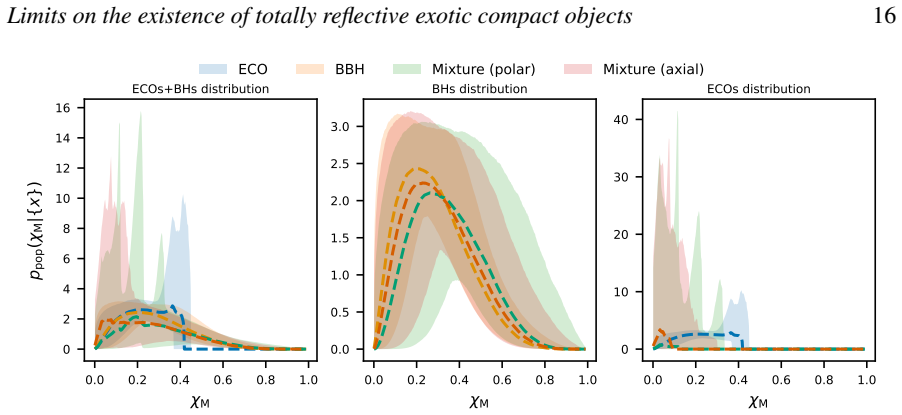
The central claim is that totally reflective ECOs, defined by a surface at $r = r_+(1+\epsilon)$ and reflectivity $|\mathcal{R}|^2 = 1$, are limited to a minority fraction of the observed compact-binary-coalescence population. The argument rests on the analytic critical spin $\chi_{\rm crit}(\epsilon) = \pi(1+q)/(m\,|\log_{10}\epsilon|)$ for the $l=m=2$ ergoregion instability: ECOs with spin above $\chi_{\rm crit}$ spin down to roughly $\chi_{\rm crit}$ on cosmologically short timescales, so a population containing such ECOs must have a dearth of fast-spinning members. Fitting a mixture model with a $\beta$-distributed formation spin common to ECOs and black holes to 104 objects from GWTC-3 yields 90% upper limits $f_{\rm ECO} < 0.71$ (polar) and $f_{\rm ECO} < 0.59$ (axial) for $\epsilon \in [10^{-42}, 10^{-3}]$, and $f_{\rm ECO} < 0.28/0.25$ for $\epsilon < 10^{-30}$. The limits are driven by GW190517_055101 and GW191109_010717, whose primary spins exceed the maximum critical spin the model allows, and they are roughly twice as strong as those obtained from the non-detection of a stochastic gravitational-wave background from ECO spin loss. For the future, the paper predicts that with about 200 binary detections from the Einstein Telescope—roughly a day of observing—the ECO fraction can be constrained below 20%.
Load-bearing premise
The constraints assume that ECOs and black holes are formed with spins drawn from a single common beta distribution; if ECOs form with systematically different spins (for example, lower ones), the upper limits on the ECO fraction would be weakened or invalidated.
Editorial extensions
If this is right
- The limits imply that, at 90% credibility, any theory in which more than about 70% of detected binary black hole mergers are totally reflective ECOs with $\epsilon$ down to $10^{-42}$ is disfavored by the GWTC-3 spin data.
- GW190517_055101 and GW191109_010717 are effectively identified as black holes, since their spins exceed the maximum allowed for ECOs; subsequent fast-spinning detections will sharpen the constraint.
- Spin-population limits on ECOs are about twice as tight as those from the non-detection of the stochastic gravitational-wave background, establishing the spin distribution as the more sensitive current probe of horizonless objects.
- With next-generation detectors, roughly one day of Einstein Telescope observations (about 200 detections) should reduce the 90% upper limit on the ECO fraction to below 20%, and to a few percent if the underlying binary black hole population is high-spin.
- The method is not limited to the specific reflectivity model: any model that imposes an upper spin cap on compact objects can be tested with the same mixture-population analysis.
Reading between the lines
- If ECOs form through channels that systematically damp their spins (for example, accretion or tidal locking), the shared-beta-distribution assumption would be violated and the quoted limits could substantially weaken; the paper's own caveat makes this the main open point.
- The same spin-cap logic transfers directly to superradiance-induced spin-down from ultralight bosons, suggesting a unified population-level probe of both horizon-scale and beyond-Standard-Model physics.
- A testable extension would be to search for the predicted pile-up of ECO spins near $\chi_{\rm crit}$ with the higher-SNR, higher-statistics O4/O5 event sets, turning the current upper limit into a targeted detection test.
- The forecast that one day of Einstein Telescope data beats years of current observations indicates that the spin-distribution approach could become the strongest robust test of horizonless compact objects before the end of the decade.
Editorial analysis
A structured set of objections, weighed in public.
Referee Report
Summary. The paper proposes a hierarchical Bayesian population model in which a fraction fECO of compact binaries are totally reflective exotic compact objects. Using the ergoregion-instability critical spin chi_crit(epsilon), ECOs with formation spin above chi_crit are assumed to spin down to a Gaussian distribution centered on chi_crit, while BH formation spins and ECO formation spins are drawn from a common beta distribution. Applying this model to 52 CBCs from GWTC-3 (104 compact objects), the authors report 90% credible upper limits fECO < 71% (polar) and < 59% (axial) after marginalizing over a log-uniform prior on epsilon in [10^-42, 10^-3], tighter limits of 28% and 25% for epsilon < 10^-30, and projections for the Einstein Telescope using simulated low-spin and high-spin BBH populations. The constraints are driven primarily by the high measured spins of GW190517_055101 and GW191109_010717.
Significance. If the result holds, this is one of the first resolved-CBC population limits on the abundance of totally reflective ECOs using the ergoregion instability, and it is complementary to stochastic-background, ringdown, and echo searches. The hierarchical Bayesian framework is standard, the use of public GWTC-3 posterior samples and injection-based selection effects is appropriate, and the ET forecast provides a useful quantitative projection. The main limitation is that the headline constraints are conditional on the assumed common formation-spin distribution for BHs and ECOs and on the log-uniform prior for epsilon, so the advertised numbers are model- and prior-dependent rather than pointwise statements in epsilon.
major comments (3)
- [Sec. 2, Eq. (1)] Equation (1) writes chi_crit = pi(1+q)/(m |log10 epsilon|), but the numerical values quoted in Table 2 (chi_crit in [0.03, 0.45] for polar and [0.05, 0.68] for axial perturbations over epsilon in [10^-42, 10^-3]) and shown in Fig. 1 correspond to the natural logarithm, |ln epsilon|, not |log10 epsilon|. As written, Eq. (1) overestimates chi_crit by a factor of ln(10) ~ 2.303 and prevents a reader from reproducing the subsequent analysis. Please correct the base of the logarithm, or if the original reference uses natural log, define it explicitly in the text.
- [Abstract; Sec. 4.2, Eq. (25) and Fig. 6] The headline limits fECO < 71% (polar) and < 59% (axial) are 90% credible bounds on fECO after marginalizing over the log-uniform prior on epsilon given in Table 2, and the ultracompact limits are similarly obtained under the prior restricted to epsilon < 10^-30. These are not pointwise statements that hold for every epsilon in [10^-42, 10^-3]; the joint posterior in the left panel of Fig. 6 shows that larger fECO becomes allowed as epsilon approaches 10^-3. The abstract and conclusions should state explicitly that the limits are marginalized over a log-uniform prior on epsilon, or alternatively report conditional upper limits at fixed epsilon values so that the prior-averaged nature of the constraint is transparent. As written, the phrase 'if ECOs have epsilon in [10^-42, 10^-3]' overstates the uniformity of the bound.
- [Sec. 3.1, Eq. (7); Sec. 6] The constraints rely on the assumption that ECOs and BHs are formed with spins drawn from the same beta distribution (Eq. 7). The paper acknowledges in Sec. 3 that this is a simplistic assumption, but the conclusion section does not restate it. If ECO formation produces systematically lower spins than BH formation, the reported fECO upper limits could be substantially weakened. Please add an explicit caveat in the conclusions that the constraints are conditional on this common formation-spin assumption.
minor comments (6)
- [Sec. 4.1, Eq. (24)] The denominator in Eq. (24) should be fECO p(chi_M | ECO, Lambda) + (1 - fECO) p(chi_M | BH, Lambda), not the unweighted sum p(chi_M | ECO, Lambda) + p(chi_M | BH, Lambda). As written, the per-event ECO probabilities reported in Table 1 are not correctly normalized; this does not affect the main fECO upper limits but should be corrected.
- [Sec. 3.1] The word 'marginilize' should be 'marginalize'.
- [Abstract] The notation 'epsilon in [10^-42 - 10^-3]' is ambiguous; please use '10^-42 to 10^-3' or an en dash.
- [Fig. 6] In the right panel, the axis label 'f UL ECO' should be typeset as fECO^UL, and the caption should state explicitly that the curve is computed with a truncated log-uniform prior on epsilon below the indicated threshold.
- [Table 3] The header 'BBH vs log10B' is confusing; clarify that the entries are log10 Bayes factors in favor of the BBH model relative to the listed model.
- [Sec. 4.2] The phrase 'fastly spinning' should be 'rapidly spinning'.
Circularity Check
The inference is self-contained: fECO limits are derived from a hierarchical fit of independent LVK spin measurements to a model whose ECO spin cap chi_crit is an external analytic result; no central prediction reduces to an input by construction.
full rationale
The central derivation chain is not circular. The ECO critical spin chi_crit(eps) is taken from Eq. (1), attributed to the prior analytic calculation of Ref. [38]; it is a parameter-free theoretical input with stated assumptions and does not encode the observed spin data or fECO, so the self-citation (Maggio is a co-author) is not load-bearing in a way that forces the result. The observed spin magnitudes are independent LVK posterior samples from GWTC-2.1 and GWTC-3, and the fECO upper limits follow from a genuine hierarchical Bayesian likelihood with selection effects (Eqs. (20)-(21), (25)), not from reinserting the fitted quantity. The paper explicitly flags its two main modeling assumptions: the common beta formation-spin distribution for BHs and ECOs (Eq. (7), 'could be similar') and the independence of mass/spin/redshift distributions ('we make this simplistic assumption'); these are limitations and prior assumptions, not circular reductions. The only in-sample element is the per-event ECO probability in Eq. (24), which uses the hierarchical posterior computed from the same events; the paper itself states that formally the event should be excluded and argues the effect is negligible. This caveat affects a secondary classification table, not the headline fECO limits, which are driven by the high-spin measurements of GW190517_055101 and GW191109_010717. The forecast section is a standard self-consistent injection study with simulated BBH populations and does not present a physical prediction that reduces to its inputs. The skeptical concern about the log-uniform prior on epsilon is a Bayesian prior-marginalization interpretation issue, not a circularity. Overall, no step in the derivation is equivalent to its own inputs by construction.
Assumptions & free parameters
free parameters (4)
- sigma =
prior U[0.005, 0.5]
- fECO =
inferred, 90% upper limit 0.71 (polar) / 0.59 (axial)
- alpha, beta (formation spin beta distribution) =
inferred with priors U[1.1, 10]
- epsilon (through chi_crit) =
prior LU[10^-42, 10^-3]
assumptions (5)
- domain assumption ECOs and BHs are formed with the same spin distribution, a beta distribution with shared alpha and beta (Eq. 7).
- domain assumption The ergoregion critical spin formula chi_crit(eps) = pi(1+q)/(m |log10 eps|) from Ref. [38] is valid for perfectly reflecting ECOs with l=m=2.
- domain assumption The ergoregion instability triggers and spins the ECO down to chi approximately chi_crit on timescales that are not cosmologically relevant, for all formation spins above chi_crit.
- domain assumption The mass and redshift distributions are independent of the spin distribution and of the nature of the objects; mass and redshift parameters are fixed to canonical values from Ref. [17].
- ad hoc to paper A Gaussian distribution N(chi_crit, sigma) adequately describes the final ECO spin after the spin-down, with the same sigma for all ECOs.
Cite this review
Pith. "Pith review of Limits on the existence of totally reflective exotic compact objects with current and future gravitational-wave detectors." pith.science (2026). https://pith.science/paper/B7NZJYGL
@misc{pith2026250207675,
  author       = {Pith},
  title        = {Pith review of: Limits on the existence of totally reflective exotic compact objects with current and future gravitational-wave detectors},
  year         = {2026},
  howpublished = {\url{https://pith.science/paper/B7NZJYGL}},
  note         = {Machine review of arXiv:2502.07675}
}
abstract
Exotic compact objects (ECOs) are a theorized class of compact objects that solve the paradoxes of black holes by replacing the event horizon with a physical surface located at $r=r_+(1+\epsilon)$ from the would-be horizon at $r_+$. Spinning horizonless objects are prone to the ergoregion instability, which would prevent their existence if their spin is higher than a critical threshold. In this paper, we set upper limits on the existence of a population of merging ECOs from the spin distribution of the population of compact binary coalescences (CBCs) detected by the LIGO, Virgo and KAGRA collaboration. Using spin measurements from 104 compact objects, we find that if ECOs have $\epsilon \in [10^{-42}-10^{-3}]$ and their surface is totally reflective, the population of CBCs cannot be composed (at 90% credible level) by more than 71% (59%) of ECOs for polar (axial) perturbations. If we restrict the ECOs to be ultracompact ($\epsilon<10^{-30}$), at 90% credible level, ECOs cannot compose more than 28% and 25% of the CBC population for polar and axial perturbations. The constraints from current data are a factor of two more precise than the ones obtained from a non-detection of a stochastic GW background due to spin loss. We also study how next generation gravitational-wave detectors, such as the Einstein Telescope, can constrain the ECO population. We find that 1 day of data taking would be enough to constrain the fraction of ECOs to be lower than 20% for $\epsilon \in [10^{-42}-10^{-3}]$.
Figures


Figures from the paper (7 more)




Forward citations
Cited by 1 Pith paper
-
Assessing the Impact of Instrumental Requirements on the Scientific Performance of the Einstein Telescope
Degrading the Einstein Telescope's sensitivity in specific frequency bands hurts different science goals in predictable ways, but the mission remains scientifically strong even in the worst modelled cases.
Reference graph
Works this paper leans on
-
[1]
Detection of the Schwarzschild precession in the orbit of the star S2 near the Galactic centre massive black hole,
R. Abuter et al., “Detection of the Schwarzschild precession in the orbit of the star S2 near the Galactic centre massive black hole,” Astron. Astrophys., vol. 636, p. L5, 2020
2020
-
[2]
bounce-and-amplify
Ergoregion instability for totally reflective exotic compact objects ECO models are constructed by replacing the BH horizon located at r = r+ with a perfectly reflecting surface at r = r+(1 +ϵ) where ϵ > 0 and ϵ≪ 1. Scalar, vector (electromagnetic) and tensor (gravitational) perturbations can be trapped between the ECO’s surface and the photon-sphere barr...
-
[3]
If an ECO is subjected to the ergoregion instability, it spins down to a value of χ∼ χcrit emitting a weak GW signal detectable as a stochastic background
Population and statical modelling In the previous section, we have discussed that, for a given compactness, reflective ECOs display a critical spin above which the ergoregion instability is triggered. If an ECO is subjected to the ergoregion instability, it spins down to a value of χ∼ χcrit emitting a weak GW signal detectable as a stochastic background. ...
-
[4]
Constraints from the LIGO, Virgo, KAGRA third Observing run We exploit the latest CBC sources reported during the third observing run, O3, to inspect for non-trivial structures due to the ECOs’ presence in the spin distribution of the population of compact objects. 4.1. Data and common statistical tools We consider all the confident CBC detections with a ...
-
[5]
low spin
Projections for next-generation GW detectors In 2035+, we expect next-Generation GW detectors such as the Einstein Telescope [68, 69, 70] and Cosmic Explorer [71, 72] to become operative. The enhanced sensitivity of the GW detectors will provide us with thousands of GWs detected from CBCs with high signal-to- noise ratios (SNRs) per year. We study how nex...
-
[6]
posterior samples
Discussion and conclusions This work aimed to find imprints of ECOs on the spin distribution of a population of coalescing compact binary objects with GW measurements, assuming that (possibly part of) the objects are perfectly reflecting exotic black-hole mimickers, which are prone to the ergoregion instability. So far, ECOs have mostly been probed by stu...
-
[7]
First M87 Event Horizon Telescope Results. V . Physical Origin of the Asymmetric Ring,
K. Akiyama et al., “First M87 Event Horizon Telescope Results. V . Physical Origin of the Asymmetric Ring,” Astrophys. J. Lett., vol. 875, no. 1, p. L5, 2019
2019
-
[8]
First Sagittarius A* Event Horizon Telescope Results. VI. Testing the Black Hole Metric,
K. Akiyama et al., “First Sagittarius A* Event Horizon Telescope Results. VI. Testing the Black Hole Metric,” Astrophys. J. Lett., vol. 930, no. 2, p. L17, 2022
2022
Show all 100 references
-
[9]
Tests of general relativity with GW150914,
B. P. Abbott et al. , “Tests of general relativity with GW150914,” Phys. Rev. Lett. , vol. 116, no. 22, p. 221101, 2016. [Erratum: Phys.Rev.Lett. 121, 129902 (2018)]
2018
-
[10]
Tests of General Relativity with the Binary Black Hole Signals from the LIGO-Virgo Catalog GWTC-1,
B. P. Abbott et al., “Tests of General Relativity with the Binary Black Hole Signals from the LIGO-Virgo Catalog GWTC-1,” Phys. Rev. D, vol. 100, no. 10, p. 104036, 2019
2019
-
[11]
Tests of general relativity with binary black holes from the second LIGO-Virgo gravitational-wave transient catalog,
R. Abbott et al. , “Tests of general relativity with binary black holes from the second LIGO-Virgo gravitational-wave transient catalog,”Phys. Rev. D, vol. 103, no. 12, p. 122002, 2021
2021
-
[12]
Tests of General Relativity with GWTC-3,
R. Abbott et al., “Tests of General Relativity with GWTC-3,” 12 2021
2021
-
[13]
Black hole explosions?,
S. W. Hawking, “Black hole explosions?,” Natur, vol. 248, pp. 30–31, Mar. 1974
1974
-
[14]
The information paradox: a pedagogical introduction,
S. D. Mathur, “The information paradox: a pedagogical introduction,” Classical and Quantum Gravity , vol. 26, p. 224001, Oct. 2009
2009
-
[15]
Advanced LIGO,
J. Aasi et al., “Advanced LIGO,” Class. Quant. Grav., vol. 32, p. 074001, 2015
2015
-
[16]
Advanced Virgo: a second-generation interferometric gravitational wave detector,
F. Acernese et al., “Advanced Virgo: a second-generation interferometric gravitational wave detector,” Class. Quant. Grav., vol. 32, no. 2, p. 024001, 2015
2015
-
[17]
Interferometer design of the KAGRA gravitational wave detector,
Y . Aso, Y . Michimura, K. Somiya, M. Ando, O. Miyakawa, T. Sekiguchi, D. Tatsumi, and H. Yamamoto, “Interferometer design of the KAGRA gravitational wave detector,” Phys. Rev. D , vol. 88, no. 4, p. 043007, 2013
2013
-
[18]
GWTC-1: A Gravitational-Wave Transient Catalog of Compact Binary Mergers Observed by LIGO and Virgo during the First and Second Observing Runs,
B. P. Abbott et al. , “GWTC-1: A Gravitational-Wave Transient Catalog of Compact Binary Mergers Observed by LIGO and Virgo during the First and Second Observing Runs,” Phys. Rev. X, vol. 9, no. 3, p. 031040, 2019
2019
-
[19]
GWTC-2: Compact Binary Coalescences Observed by LIGO and Virgo During the First Half of the Third Observing Run,
R. Abbott et al., “GWTC-2: Compact Binary Coalescences Observed by LIGO and Virgo During the First Half of the Third Observing Run,” Phys. Rev. X, vol. 11, p. 021053, 2021
2021
-
[20]
GWTC-2.1: Deep extended catalog of compact binary coalescences observed by LIGO and Virgo during the first half of the third observing run,
R. Abbott et al., “GWTC-2.1: Deep extended catalog of compact binary coalescences observed by LIGO and Virgo during the first half of the third observing run,”Phys. Rev. D, vol. 109, no. 2, p. 022001, 2024
2024
-
[21]
GWTC-3: Compact Binary Coalescences Observed by LIGO and Virgo during the Second Part of the Third Observing Run,
R. Abbott et al. , “GWTC-3: Compact Binary Coalescences Observed by LIGO and Virgo during the Second Part of the Third Observing Run,” Phys. Rev. X, vol. 13, no. 4, p. 041039, 2023
2023
-
[22]
Population of Merging Compact Binaries Inferred Using Gravitational Waves through GWTC-3,
R. Abbott et al., “Population of Merging Compact Binaries Inferred Using Gravitational Waves through GWTC-3,” Phys. Rev. X, vol. 13, no. 1, p. 011048, 2023
2023
-
[23]
GW190814: Gravitational Waves from the Coalescence of a 23 Solar Mass Black Hole with a 2.6 Solar Mass Compact Object,
R. Abbott, T. D. Abbott, S. Abraham, F. Acernese, K. Ackley, C. Adams, R. X. Adhikari, V . B. Adya, C. Affeldt, M. Agathos, and et al., “GW190814: Gravitational Waves from the Coalescence of a 23 Solar Mass Black Hole with a 2.6 Solar Mass Compact Object,” ApJL, vol. 896, p. L...
2020
-
[24]
GW190521: A Binary Black Hole Merger with a Total Mass of 150M⊙,
R. Abbott et al., “GW190521: A Binary Black Hole Merger with a Total Mass of 150M⊙,” Phys. Rev. Lett., vol. 125, no. 10, p. 101102, 2020. Limits on the existence of totally reflective exotic compact objects 27
2020
-
[25]
Properties and Astrophysical Implications of the 150 M ⊙ Binary Black Hole Merger GW190521,
R. Abbott, T. D. Abbott, S. Abraham, F. Acernese, K. Ackley, C. Adams, R. X. Adhikari, V . B. Adya, C. Affeldt, M. Agathos, and et al., “Properties and Astrophysical Implications of the 150 M ⊙ Binary Black Hole Merger GW190521,” ApJL, vol. 900, p. L13, Sept. 2020
2020
-
[26]
Hunting for dark particles with gravitational waves,
G. F. Giudice, M. McCullough, and A. Urbano, “Hunting for dark particles with gravitational waves,” JCAP, vol. 2016, p. 001, Oct. 2016
2016
-
[27]
Black hole mimickers: Regular versus singular behavior,
J. P. S. Lemos and O. B. Zaslavskii, “Black hole mimickers: Regular versus singular behavior,” Phys. Rev. D, vol. 78, p. 024040, 2008
2008
-
[28]
Ergoregion instability of ultracompact astrophysical objects,
V . Cardoso, P. Pani, M. Cadoni, and M. Cavaglia, “Ergoregion instability of ultracompact astrophysical objects,” Phys. Rev. D, vol. 77, p. 124044, 2008
2008
-
[29]
Testing the nature of dark compact objects: a status report,
V . Cardoso and P. Pani, “Testing the nature of dark compact objects: a status report,” Living Rev. Rel., vol. 22, no. 1, p. 4, 2019
2019
-
[30]
Testing the Nature of Dark Compact Objects with Gravitational Waves,
E. Maggio, P. Pani, and G. Raposo, “Testing the Nature of Dark Compact Objects with Gravitational Waves,” inHandbook of Gravitational Wave Astronomy, p. 29, 2021
2021
-
[31]
Tidal heating as a discriminator for horizons in extreme mass ratio inspirals,
S. Datta, R. Brito, S. Bose, P. Pani, and S. A. Hughes, “Tidal heating as a discriminator for horizons in extreme mass ratio inspirals,” Phys. Rev. D, vol. 101, no. 4, p. 044004, 2020
2020
-
[32]
Extreme mass-ratio inspirals around a spinning horizonless compact object,
E. Maggio, M. van de Meent, and P. Pani, “Extreme mass-ratio inspirals around a spinning horizonless compact object,” Phys. Rev. D, vol. 104, no. 10, p. 104026, 2021
2021
-
[33]
Toward establishing the presence or absence of horizons in coalescing binaries of compact objects by using their gravitational wave signals,
S. Mukherjee, S. Datta, S. Tiwari, K. S. Phukon, and S. Bose, “Toward establishing the presence or absence of horizons in coalescing binaries of compact objects by using their gravitational wave signals,” Phys. Rev. D, vol. 106, no. 10, p. 104032, 2022
2022
-
[34]
Testing strong-field gravity with tidal Love numbers,
V . Cardoso, E. Franzin, A. Maselli, P. Pani, and G. Raposo, “Testing strong-field gravity with tidal Love numbers,” Phys. Rev. D, vol. 95, no. 8, p. 084014, 2017. [Addendum: Phys.Rev.D 95, 089901 (2017)]
2017
-
[35]
Dynamical tidal Love numbers of Kerr-like compact objects,
S. Chakraborty, E. Maggio, M. Silvestrini, and P. Pani, “Dynamical tidal Love numbers of Kerr-like compact objects,” Phys. Rev. D, vol. 110, no. 8, p. 084042, 2024
2024
-
[36]
Is the gravitational-wave ringdown a probe of the event horizon?,
V . Cardoso, E. Franzin, and P. Pani, “Is the gravitational-wave ringdown a probe of the event horizon?,” Phys. Rev. Lett., vol. 116, no. 17, p. 171101, 2016. [Erratum: Phys.Rev.Lett. 117, 089902 (2016)]
2016
-
[37]
Gravitational-wave signatures of exotic compact objects and of quantum corrections at the horizon scale,
V . Cardoso, S. Hopper, C. F. B. Macedo, C. Palenzuela, and P. Pani, “Gravitational-wave signatures of exotic compact objects and of quantum corrections at the horizon scale,” Phys. Rev. D, vol. 94, no. 8, p. 084031, 2016
2016
-
[38]
How does a dark compact object ringdown?,
E. Maggio, L. Buoninfante, A. Mazumdar, and P. Pani, “How does a dark compact object ringdown?,” Phys. Rev. D, vol. 102, no. 6, p. 064053, 2020
2020
-
[39]
Ergosphere instability,
J. L. Friedman, “Ergosphere instability,” Commun. Math. Phys., vol. 63, no. 3, pp. 243–255, 1978
1978
-
[40]
Gravitational collapse: The role of general relativity,
R. Penrose, “Gravitational collapse: The role of general relativity,” Riv. Nuovo Cim., vol. 1, pp. 252–276, 1969
1969
-
[41]
Superradiance: New Frontiers in Black Hole Physics,
R. Brito, V . Cardoso, and P. Pani, “Superradiance: New Frontiers in Black Hole Physics,” Lect. Notes Phys., vol. 906, pp. pp.1–237, 2015
2015
-
[42]
Exotic compact objects and how to quench their ergoregion instability,
E. Maggio, P. Pani, and V . Ferrari, “Exotic compact objects and how to quench their ergoregion instability,” PhRvD, vol. 96, p. 104047, Nov. 2017
2017
-
[43]
Ergoregion instability of exotic compact objects: Electromagnetic and gravitational perturbations and the role of absorption,
E. Maggio, V . Cardoso, S. R. Dolan, and P. Pani, “Ergoregion instability of exotic compact objects: Electromagnetic and gravitational perturbations and the role of absorption,” PhRvD, vol. 99, p. 064007, Mar. 2019
2019
-
[44]
On the Ergoregion Instability,
N. Comins and B. F. Schutz, “On the Ergoregion Instability,” Proceedings of the Royal Society of London Series A, vol. 364, pp. 211–226, Dec. 1978
1978
-
[45]
Ergoregion instability revisited — a new and general method for numerical analysis of stability,
S. Yoshida and Y . Eriguchi, “Ergoregion instability revisited — a new and general method for numerical analysis of stability,” Monthly Notices of the Royal Astronomical Society , vol. 282, pp. 580–586, 09 1996
1996
-
[46]
The w-mode instability of ultracompact relativistic stars,
K. D. Kokkotas, J. Ruo ff, and N. Andersson, “The w-mode instability of ultracompact relativistic stars,” Phys. Rev. D, vol. 70, p. 043003, 2004
2004
-
[47]
On the ergoregion instability in rotating gravastars,
C. B. M. H. Chirenti and L. Rezzolla, “On the ergoregion instability in rotating gravastars,” Phys. Rev. D, vol. 78, p. 084011, 2008
2008
-
[48]
Instability of hyper-compact Kerr-like objects,
V . Cardoso, P. Pani, M. Cadoni, and M. Cavaglia, “Instability of hyper-compact Kerr-like objects,” Class. Limits on the existence of totally reflective exotic compact objects 28 Quant. Grav., vol. 25, p. 195010, 2008
2008
-
[49]
Gravitational instabilities of superspinars,
P. Pani, E. Barausse, E. Berti, and V . Cardoso, “Gravitational instabilities of superspinars,” Phys. Rev. D, vol. 82, p. 044009, 2010
2010
-
[50]
Searching for ultralight bosons within spin measurements of a population of binary black hole mergers,
K. K. Y . Ng, O. A. Hannuksela, S. Vitale, and T. G. F. Li, “Searching for ultralight bosons within spin measurements of a population of binary black hole mergers,” Phys. Rev. D, vol. 103, no. 6, p. 063010, 2021
2021
-
[51]
Constraints on Ultralight Scalar Bosons within Black Hole Spin Measurements from the LIGO-Virgo GWTC-2,
K. K. Y . Ng, S. Vitale, O. A. Hannuksela, and T. G. F. Li, “Constraints on Ultralight Scalar Bosons within Black Hole Spin Measurements from the LIGO-Virgo GWTC-2,” Phys. Rev. Lett. , vol. 126, no. 15, p. 151102, 2021
2021
-
[52]
Stochastic and resolvable gravitational waves from ultralight bosons,
R. Brito, S. Ghosh, E. Barausse, E. Berti, V . Cardoso, I. Dvorkin, A. Klein, and P. Pani, “Stochastic and resolvable gravitational waves from ultralight bosons,” Phys. Rev. Lett. , vol. 119, no. 13, p. 131101, 2017
2017
-
[53]
The stochastic gravitational-wave background in the absence of horizons,
E. Barausse, R. Brito, V . Cardoso, I. Dvorkin, and P. Pani, “The stochastic gravitational-wave background in the absence of horizons,” Class. Quant. Grav., vol. 35, no. 20, p. 20LT01, 2018
2018
-
[54]
Inferring the properties of a population of compact binaries in presence of selection effects,
S. Vitale, D. Gerosa, W. M. Farr, and S. R. Taylor, “Inferring the properties of a population of compact binaries in presence of selection effects,” 7 2020
2020
-
[55]
Extracting distribution parameters from multiple uncertain observations with selection biases,
I. Mandel, W. M. Farr, and J. R. Gair, “Extracting distribution parameters from multiple uncertain observations with selection biases,” Mon. Not. Roy. Astron. Soc., vol. 486, no. 1, pp. 1086–1093, 2019
2019
-
[56]
Measuring the binary black hole mass spectrum with an astrophysically motivated parameterization,
C. Talbot and E. Thrane, “Measuring the binary black hole mass spectrum with an astrophysically motivated parameterization,” Astrophys. J., vol. 856, no. 2, p. 173, 2018
2018
-
[57]
Planck 2015 results. XIII. Cosmological parameters,
P. A. R. Ade et al., “Planck 2015 results. XIII. Cosmological parameters,” Astron. Astrophys., vol. 594, p. A13, 2016
2015
-
[58]
Formation Channels of Single and Binary Stellar-Mass Black Holes,
M. Mapelli, “Formation Channels of Single and Binary Stellar-Mass Black Holes,” in Handbook of Gravitational Wave Astronomy(C. Bambi, S. Katsanevas, and K. D. Kokkotas, eds.), p. 16, 2021
2021
-
[59]
ICAROGW: A python package for inference of astrophysical population properties of noisy, heterogeneous and incomplete observations,
S. Mastrogiovanni, G. Pierra, S. Perri `es, D. Laghi, G. C. Santoro, A. Ghosh, R. Gray, C. Karathanasis, and K. Leyde, “ICAROGW: A python package for inference of astrophysical population properties of noisy, heterogeneous and incomplete observations,” 5 2023
2023
-
[60]
Quantum-Enhanced Advanced LIGO Detectors in the Era of Gravitational- Wave Astronomy,
M. Tse, H. Yu, N. Kijbunchoo, A. Fernandez-Galiana, P. Dupej, L. Barsotti, C. D. Blair, D. D. Brown, S. E. Dwyer, A. Effler, and et al., “Quantum-Enhanced Advanced LIGO Detectors in the Era of Gravitational- Wave Astronomy,”PhRvL, vol. 123, p. 231107, Dec. 2019
2019
-
[61]
Increasing the Astrophysical Reach of the Advanced Virgo Detector via the Application of Squeezed Vacuum States of Light,
F. Acernese, M. Agathos, L. Aiello, A. Allocca, A. Amato, S. Ansoldi, S. Antier, M. Ar `ene, N. Arnaud, S. Ascenzi, and et al., “Increasing the Astrophysical Reach of the Advanced Virgo Detector via the Application of Squeezed Vacuum States of Light,”PhRvL, vol. 123, p. 231108...
2019
-
[62]
Sensitivity and performance of the Advanced LIGO detectors in the third observing run,
A. Buikema, C. Cahillane, G. L. Mansell, C. D. Blair, R. Abbott, C. Adams, R. X. Adhikari, A. Ananyeva, S. Appert, K. Arai, and et al., “Sensitivity and performance of the Advanced LIGO detectors in the third observing run,” PhRvD, vol. 102, p. 062003, Sept. 2020
2020
-
[63]
Virgo Detector Characterization and Data Quality during the O3 run,
F. Acernese et al., “Virgo Detector Characterization and Data Quality during the O3 run,” 5 2022
2022
-
[64]
Modeling the gravitational wave signature of neutron star black hole coalescences,
J. E. Thompson, E. Fauchon-Jones, S. Khan, E. Nitoglia, F. Pannarale, T. Dietrich, and M. Hannam, “Modeling the gravitational wave signature of neutron star black hole coalescences,” Phys. Rev. D , vol. 101, no. 12, p. 124059, 2020
2020
-
[65]
Computationally efficient models for the dominant and subdominant harmonic modes of precessing binary black holes,
G. Pratten et al., “Computationally efficient models for the dominant and subdominant harmonic modes of precessing binary black holes,” Phys. Rev. D, vol. 103, no. 10, p. 104056, 2021
2021
-
[66]
Multipolar E ffective-One-Body Waveforms for Precessing Binary Black Holes: Construction and Validation,
S. Ossokine et al. , “Multipolar E ffective-One-Body Waveforms for Precessing Binary Black Holes: Construction and Validation,”Phys. Rev. D, vol. 102, no. 4, p. 044055, 2020
2020
-
[67]
Aligned-spin neutron-star–black-hole waveform model based on the e ffective-one-body approach and numerical-relativity simulations,
A. Matas et al., “Aligned-spin neutron-star–black-hole waveform model based on the e ffective-one-body approach and numerical-relativity simulations,” Phys. Rev. D, vol. 102, no. 4, p. 043023, 2020
2020
-
[68]
Black Hole Genealogy: Identifying Hierarchical Mergers with Gravitational Waves,
C. Kimball, C. Talbot, C. P. L. Berry, M. Carney, M. Zevin, E. Thrane, and V . Kalogera, “Black Hole Genealogy: Identifying Hierarchical Mergers with Gravitational Waves,” Astrophys. J., vol. 900, no. 2, p. 177, 2020
2020
-
[69]
No Evidence that the Majority of Black Holes in Binaries Have Zero Spin,
T. A. Callister, S. J. Miller, K. Chatziioannou, and W. M. Farr, “No Evidence that the Majority of Black Holes in Binaries Have Zero Spin,” Astrophys. J. Lett., vol. 937, no. 1, p. L13, 2022. Limits on the existence of totally reflective exotic compact objects 29
2022
-
[70]
Population properties of spinning black holes using the gravitational-wave transient catalog 3,
H. Tong, S. Galaudage, and E. Thrane, “Population properties of spinning black holes using the gravitational-wave transient catalog 3,”Phys. Rev. D, vol. 106, no. 10, p. 103019, 2022
2022
-
[71]
Which black hole formed first? Mass-ratio reversal in massive binary stars from gravitational-wave data,
M. Mould, D. Gerosa, F. S. Broekgaarden, and N. Steinle, “Which black hole formed first? Mass-ratio reversal in massive binary stars from gravitational-wave data,” Mon. Not. Roy. Astron. Soc. , vol. 517, no. 2, pp. 2738–2745, 2022
2022
-
[72]
Which Black Hole Is Spinning? Probing the Origin of Black Hole Spin with Gravitational Waves,
C. Adamcewicz, S. Galaudage, P. D. Lasky, and E. Thrane, “Which Black Hole Is Spinning? Probing the Origin of Black Hole Spin with Gravitational Waves,”Astrophys. J. Lett., vol. 964, no. 1, p. L6, 2024
2024
-
[73]
The Einstein Telescope: a third-generation gravitational wave observatory,
M. Punturo, M. Abernathy, F. Acernese, B. Allen, N. Andersson, K. Arun, F. Barone, B. Barr, M. Barsuglia, M. Beker, and et al., “The Einstein Telescope: a third-generation gravitational wave observatory,” CQGra, vol. 27, p. 194002, Oct. 2010
2010
-
[74]
Science case for the einstein telescope,
M. Maggiore, C. V . D. Broeck, N. Bartolo, E. Belgacem, D. Bertacca, M. A. Bizouard, M. Branchesi, S. Clesse, S. Fo ffa, J. Garc ´ıa-Bellido, S. Grimm, J. Harms, T. Hinderer, S. Matarrese, C. Palomba, M. Peloso, A. Ricciardone, and M. Sakellariadou, “Science case for the einst...
2020
-
[75]
Science with the Einstein Telescope: a comparison of di fferent designs,
M. Branchesi et al. , “Science with the Einstein Telescope: a comparison of di fferent designs,” JCAP, vol. 07, p. 068, 2023
2023
-
[76]
Gravitational wave detector with cosmological reach,
S. Dwyer, D. Sigg, S. W. Ballmer, L. Barsotti, N. Mavalvala, and M. Evans, “Gravitational wave detector with cosmological reach,” Phys. Rev. D, vol. 91, p. 082001, Apr 2015
2015
-
[77]
Cosmic Explorer: The U.S. Contribution to Gravitational-Wave Astronomy beyond LIGO,
D. Reitze et al. , “Cosmic Explorer: The U.S. Contribution to Gravitational-Wave Astronomy beyond LIGO,” Bull. Am. Astron. Soc., vol. 51, no. 7, p. 035, 2019
2019
-
[78]
Cosmic Star-Formation History,
P. Madau and M. Dickinson, “Cosmic Star-Formation History,” ARA&A, vol. 52, pp. 415–486, Aug. 2014
2014
-
[79]
GWFISH: A simulation software to evaluate parameter-estimation capabilities of gravitational-wave detector networks,
U. Dupletsa, J. Harms, B. Banerjee, M. Branchesi, B. Goncharov, A. Maselli, A. C. S. Oliveira, S. Ronchini, and J. Tissino, “GWFISH: A simulation software to evaluate parameter-estimation capabilities of gravitational-wave detector networks,”A&C, vol. 42, p. 100671, Jan. 2023
2023
-
[80]
Science with the Einstein Telescope: a comparison of di fferent designs,
M. Branchesi, M. Maggiore, D. Alonso, C. Badger, B. Banerjee, F. Beirnaert, E. Belgacem, S. Bhagwat, G. Boileau, S. Borhanian, and et al., “Science with the Einstein Telescope: a comparison of di fferent designs,” JCAP, vol. 2023, p. 068, July 2023
2023
-
[81]
Cosmology and Astrophysics with Standard Sirens and Galaxy Catalogs in View of Future Gravitational Wave Observations,
N. Borghi, M. Mancarella, M. Moresco, M. Tagliazucchi, F. Iacovelli, A. Cimatti, and M. Maggiore, “Cosmology and Astrophysics with Standard Sirens and Galaxy Catalogs in View of Future Gravitational Wave Observations,”arXiv, p. arXiv:2312.05302, Dec. 2023
2023 arXiv
-
[82]
Mock data challenge for the einstein gravitational-wave telescope,
T. Regimbau, T. Dent, W. Del Pozzo, S. Giampanis, T. G. F. Li, C. Robinson, C. Van Den Broeck, D. Meacher, C. Rodriguez, B. S. Sathyaprakash, and K. W ´ojcik, “Mock data challenge for the einstein gravitational-wave telescope,”Physical Review D, vol. 86, Dec. 2012
2012
-
[83]
Second einstein telescope mock science challenge: Detection of the gravitational-wave stochastic background from compact binary coalescences,
T. Regimbau, D. Meacher, and M. Coughlin, “Second einstein telescope mock science challenge: Detection of the gravitational-wave stochastic background from compact binary coalescences,”Physical Review D, vol. 89, Apr. 2014
2014
-
[84]
Quasinormal modes of slowly-spinning horizonless compact objects,
M. V . S. Saketh and E. Maggio, “Quasinormal modes of slowly-spinning horizonless compact objects,” Phys. Rev. D, vol. 110, no. 8, p. 084038, 2024
2024
-
[85]
Echoes from the abyss: Tentative evidence for planck-scale structure at black hole horizons,
J. Abedi, H. Dykaar, and N. Afshordi, “Echoes from the abyss: Tentative evidence for planck-scale structure at black hole horizons,” Physical Review D, vol. 96, Oct. 2017
2017
-
[86]
Black hole ringdown echoes and howls,
H. Nakano, N. Sago, H. Tagoshi, and T. Tanaka, “Black hole ringdown echoes and howls,”PTEP, vol. 2017, no. 7, p. 071E01, 2017
2017
-
[87]
Low significance of evidence for black hole echoes in gravitational wave data,
J. Westerweck, A. B. Nielsen, O. Fischer-Birnholtz, M. Cabero, C. Capano, T. Dent, B. Krishnan, G. Meadors, and A. H. Nitz, “Low significance of evidence for black hole echoes in gravitational wave data,” Physical Review D, vol. 97, June 2018
2018
-
[88]
Template-based Gravitational-Wave Echoes Search Using Bayesian Model Selection,
R. K. L. Lo, T. G. F. Li, and A. J. Weinstein, “Template-based Gravitational-Wave Echoes Search Using Bayesian Model Selection,” Phys. Rev. D, vol. 99, no. 8, p. 084052, 2019
2019
-
[89]
Analytical model for gravitational-wave echoes from spinning remnants,
E. Maggio, A. Testa, S. Bhagwat, and P. Pani, “Analytical model for gravitational-wave echoes from spinning remnants,” Phys. Rev. D, vol. 100, no. 6, p. 064056, 2019
2019
-
[90]
Constraints on the amplitude of gravitational wave echoes from black hole ringdown using minimal assumptions,
A. Miani, C. Lazzaro, G. A. Prodi, S. Tiwari, M. Drago, E. Milotti, and G. Vedovato, “Constraints on the amplitude of gravitational wave echoes from black hole ringdown using minimal assumptions,” Phys. Limits on the existence of totally reflective exotic compact objects 30 Re...
2023
-
[91]
Searching for gravitational wave echoes from black hole binary events in the third observing run of LIGO, Virgo, and KAGRA collaborations,
N. Uchikata, T. Narikawa, H. Nakano, N. Sago, H. Tagoshi, and T. Tanaka, “Searching for gravitational wave echoes from black hole binary events in the third observing run of LIGO, Virgo, and KAGRA collaborations,” Phys. Rev. D, vol. 108, no. 10, p. 104040, 2023
2023
-
[92]
Exploring Features in the Binary Black Hole Population,
V . Tiwari, “Exploring Features in the Binary Black Hole Population,”Astrophys. J., vol. 928, no. 2, p. 155, 2022
2022
-
[93]
Cosmic Cousins: Identification of a Subpopulation of Binary Black Holes Consistent with Isolated Binary Evolution,
J. Godfrey, B. Edelman, and B. Farr, “Cosmic Cousins: Identification of a Subpopulation of Binary Black Holes Consistent with Isolated Binary Evolution,” 4 2023
2023
-
[94]
Searching for binary black hole sub- populations in gravitational wave data using binned Gaussian processes,
A. Ray, I. Maga ˜na Hernandez, K. Breivik, and J. Creighton, “Searching for binary black hole sub- populations in gravitational wave data using binned Gaussian processes,” 4 2024
2024
-
[95]
The spin magnitude of stellar-mass binary black holes evolves with the mass: evidence from gravitational wave data,
G. Pierra, S. Mastrogiovanni, and S. Perri`es, “The spin magnitude of stellar-mass binary black holes evolves with the mass: evidence from gravitational wave data,” Astron. Astrophys., vol. 692, p. A80, 2024
2024
-
[96]
Cosmic Star Formation History,
P. Madau and M. Dickinson, “Cosmic Star Formation History,” Ann. Rev. Astron. Astrophys. , vol. 52, pp. 415–486, 2014
2014
-
[97]
BILBY-MCMC: an MCMC sampler for gravitational-wave inference,
G. Ashton and C. Talbot, “BILBY-MCMC: an MCMC sampler for gravitational-wave inference,” MNRAS, vol. 507, pp. 2037–2051, Oct. 2021
2021
-
[98]
¡tt¿emcee¡ /tt¿: The mcmc hammer,
D. Foreman-Mackey, D. W. Hogg, D. Lang, and J. Goodman, “¡tt¿emcee¡ /tt¿: The mcmc hammer,” Publications of the Astronomical Society of the Pacific, vol. 125, p. 306–312, Mar. 2013
2013
-
[99]
dynesty: a dynamic nested sampling package for estimating bayesian posteriors and evidences,
J. S. Speagle, “dynesty: a dynamic nested sampling package for estimating bayesian posteriors and evidences,” Monthly Notices of the Royal Astronomical Society, vol. 493, p. 3132–3158, Feb. 2020
2020
-
[100]
Bilby: A user-friendly bayesian inference library for gravitational-wave astronomy,
G. Ashton, M. H ¨ubner, P. D. Lasky, C. Talbot, K. Ackley, S. Biscoveanu, Q. Chu, A. Divakarla, P. J. Easter, B. Goncharov, F. H. Vivanco, J. Harms, M. E. Lower, G. D. Meadors, D. Melchor, E. Payne, M. D. Pitkin, J. Powell, N. Sarin, R. J. E. Smith, and E. Thrane, “Bilby: A us...
2019
Reviewed August 8, 2026 · model on record in the stance chip above.
Discussion (0). Continue with ORCID to comment.