REVIEW 3 major objections 3 minor 173 references
Searching for Hot Water World Candidates with CHEOPS: Refining the radii and analysing the internal structures and atmospheric lifetimes of TOI-238 b and TOI-1685 b
T0 review · 3 major / 3 minor · reviewed 2026-08-08 · deepseek-v4-flash
Pith's one-line read TOI-238 b lies inside the hot water world triangle of mass-radius space at the 1σ level, and its water-dominated atmosphere could have survived to the present age, whereas TOI-1685 b is consistent with a bare core.
desk verdict Solid CHEOPS follow-up and a useful new selection criterion, but the water-world claim for TOI-238 b rests on a heating efficiency that the paper's own models suggest is not constant. read the letter →
The pith
A machine-rendered reading of the paper's core claim, the machinery that carries it, and where it could break.
The reading
What carries the argument
The load-bearing object is the Hot Water World triangle: the region in the mass-radius plane between the most extended bare-core model (iron-free silicate) and the most compact planet that still fits a 1% hydrogen/helium envelope, evaluated at a fixed equilibrium temperature and intrinsic luminosity. Inside this region a pure H/He atmosphere is not a viable explanation, so the planet must hold heavier volatiles such as water. The argument is carried by three complementary tools: the mass-radius exclusion geometry; an analytical energy-limited escape formula with a heating efficiency parameter $\eta$ whose plausible range is 0.01–0.15 and whose value is calibrated to about 0.05 for water-rich atmospheres using hydrodynamic escape simulations; and a neural-network-accelerated interior-structure inversion that maps measured mass and radius onto posterior distributions for the mass fractions of an iron core, silicate mantle, and volatile envelope.
What would settle it
A high-precision near-infrared transmission spectrum of TOI-238 b would settle the matter: the paper's models predict water absorption bands exceeding 100 ppm in transit depth for water mass fractions of 0.1 and 0.5, while a nearly flat spectrum at the level of about 20 ppm would contradict a detectable water layer and leave the water-world claim unsupported.
Extended reading notes
Core claim
The paper's central discovery is that the mass-radius degeneracy for close-in planets can be partially lifted by evaporation physics, and that applying this criterion to two targets of the photometric follow-up programme separates them cleanly. The 'Hot Water World triangle' for a given equilibrium temperature is bounded below by the lowest-density bare core (an iron-free rocky composition) and above by the most compact planet that could still carry a 1% H/He envelope (a Mercury-like core); because H/He envelopes below roughly 1% mass fraction evaporate within a few million years under strong irradiation, no purely rocky or H/He-enveloped planet should occupy the triangle. TOI-238 b falls inside this exclusion zone, meaning its low mean density requires a volatile layer heavier than H/He; the evaporation modelling shows hydrogen would be lost in under 1.3 Myr while a steam atmosphere could persist to the present age, making it a hot water world candidate. TOI-1685 b, by contrast, lies below the iron-free bare-rock model, so its density is compatible with a bare, rocky core even though a water-rich envelope is also allowed by the interior and evaporation analysis.
Load-bearing premise
The conclusion that a water atmosphere survives on TOI-238 b rests on the assumed heating efficiency of X-ray and extreme-ultraviolet irradiation on steam atmospheres: if the time-averaged efficiency is below the calibrated value of about 0.05, or if the XUV absorption radius is more compact than assumed, a 50% water envelope would be completely lost and the planet could be a bare core.
Editorial extensions
If this is right
- TOI-238 b becomes a priority transmission-spectroscopy target: if its envelope holds water at mass fractions of 0.1–0.5, the paper's forward spectra predict water absorption bands with transit-depth variations of roughly 100 ppm or more.
- Any atmosphere detected on TOI-238 b must have a high mean molecular weight, because a solar-composition H/He envelope cannot survive longer than about a million years under the assumed stellar XUV history.
- TOI-1685 b should not be counted as a securely established water world in demographic samples, since its radius below the pure-silicate model makes a bare rocky interior the conservative interpretation.
- Only about ten well-characterised planets currently lie fully inside hot water world triangles at the $2\sigma$ level, so radius-refinement follow-up can substantially enlarge the set of planets that definitely require heavy volatiles.
- If many close-in planets are confirmed inside these triangles, it would support formation models in which planets migrate inward from beyond the ice line, which predict exactly such water-rich close-in worlds.
Reading between the lines
- The triangle criterion is a necessary-condition test rather than a water detector: a planet inside the triangle could also be explained by envelopes dominated by CO$_2$, CO, or CH$_4$, and the paper itself notes that only atmospheric follow-up can break that remaining degeneracy.
- The literature disagreement on TOI-238 b's radius shows how sensitive triangle membership is: with the smaller published radius the planet would lie outside the triangle entirely, so other candidate water worlds with conflicting radius measurements should be re-examined before being classified.
- If TOI-238 b does retain a steam atmosphere, it would provide a rare calibration point for energy-limited evaporation of water-rich envelopes, but the paper states that self-consistently coupling the hydrodynamic escape model into the evolution calculation is not currently possible, leaving the surviving-water conclusion tied to the assumed heating efficiency.
Editorial analysis
A structured set of objections, weighed in public.
Referee Report
Summary. The paper introduces 'Hot Water World triangles' in mass-radius space for close-in planets, where low-mass H/He envelopes are expected to be unstable and heavier volatiles are required, and it presents a demographic census of known planets in these regions. It then reports CHEOPS photometry of TOI-238 b and TOI-1685 b, jointly fitted with TESS photometry and published radial velocities. For TOI-238 b the derived radius is 1.559 +/- 0.047 R_Earth and mass 3.37 +/- 0.49 M_Earth, placing it inside its Hot Water World triangle at the 1 sigma level; the paper argues that a pure H/He atmosphere would be lost in 0.4-1.3 Myr, while a water-dominated atmosphere could survive to the current age, making TOI-238 b a hot water world candidate. For TOI-1685 b the derived radius is 1.421 +/- 0.060 R_Earth and mass 3.07 +/- 0.34 M_Earth, placing it below the pure-silicate bare-core model, so a bare core cannot be ruled out. The paper also presents interior structure modelling with plaNETic, atmospheric escape simulations with CHAIN, synthetic JWST spectra, and comparisons with the NGPPS formation population.
Significance. The photometric analysis is careful and addresses long-standing literature discrepancies, and the paper is explicit about many of its model limitations. If the water-world status of TOI-238 b is confirmed, the planet would be an important atmospheric follow-up target, and the Hot Water World triangle framework is a useful target-selection tool. Strengths include the use of public codes (chexoplanet, plaNETic, FastChem, BeAR), the provision of detrended light curves, a systematic treatment of interior-structure priors, and the direct statement that self-consistent coupling of the hydrodynamic escape model into the evolution calculation is not currently possible. However, the central claim that a water-dominated atmosphere survives depends on escape-model parameters that are not fully propagated, and one calibration input in the hydrodynamic simulations is inconsistent with the fitted orbit.
major comments (3)
- [§3.1.6] The CHAIN hydrodynamic simulations that motivate the adopted heating efficiency eta=0.05 are run for a semi-major axis a=0.02556 AU, whereas the joint fit in Table 3 gives a=0.02120 +/- 0.00038 AU for TOI-238 b. Because the orbital distance sets the incident XUV flux, this means the calibration is not performed for the actual planet. The derived heating efficiency should be re-evaluated at the fitted semi-major axis, or the sensitivity of the water-survival conclusion to this inconsistency should be quantified.
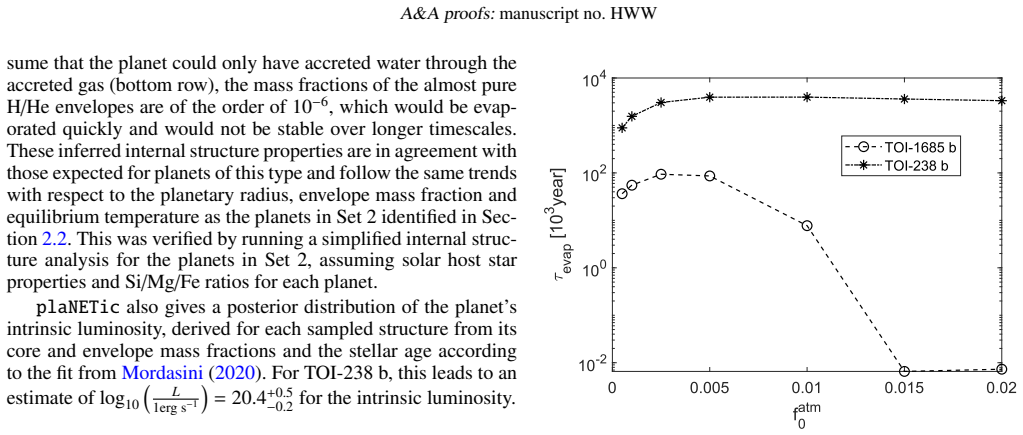
- [§3.1.5 and §3.1.6] The back-evolution that yields the required initial water fractions treats the envelope as pure H2O over the entire lifetime and keeps eta=0.05 constant. CHAIN's own Figure 10 shows that the escape rate is non-monotonic in water fraction: at Z=10-30% the atmosphere is lost faster than a pure H/He envelope, so an early H/He-rich phase would correspond to a substantially higher effective heating efficiency than eta=0.05. Since the paper states in Section 3.1.6 that self-consistent coupling is not currently possible, the conclusion that a water-dominated atmosphere 'would have survived' should be presented as conditional on this assumption, with a quantitative test (e.g., an early phase at eta=0.15 with a fast-rotator XUV history) rather than as the main result.
- [§2.1 and §4.1] The statement that TOI-238 b lies inside its Hot Water World triangle at the 1 sigma level treats the triangle boundaries as fixed. Section 4.1 reports that the upper boundary depends on the assumed intrinsic luminosity L_int=10^21 erg/s and shifts by up to 13-17% for L_int between 10^20 and 10^22 erg/s. This model-induced boundary uncertainty is comparable to the 3% radius precision and is not propagated into the membership claim. The paper should either quantify the boundary shift at the mass and equilibrium temperature of TOI-238 b or soften the 1 sigma membership statement accordingly.
minor comments (3)
- [Figure 8 caption] The caption states 'the luminosity of 10^21 erg/s/cm2'; the units should be erg/s, not erg/s/cm2.
- [Table 3] The row 'Impact parameter, b' appears twice in the TOI-238 b column; one duplicate entry should be removed.
- [§3.1.5, Eq. (1)] The tidal correction factor K is introduced but its numerical evaluation is never specified; please state explicitly how K is computed.
Circularity Check
No significant circularity: the CHEOPS radius measurements and the H/He evaporation lifetimes are derived from independent data and external evaporation models; the water-survival inference depends on a calibrated heating efficiency but does not reduce to its inputs by construction.
full rationale
The paper's central measurements (CHEOPS/TESS photometry, adopted RV semi-amplitudes, and stellar parameters) are independent of the models used for interpretation. The Hot Water World triangle boundaries are defined using BICEPS mass-radius models and the Owen & Wu (2017) evaporation criterion, both external to this work, and the claim that TOI-238 b lies in the triangle is a data-driven classification. The pure H/He lifetime calculation (0.4-1.3 Myr) uses the Kubyshkina et al. (2018) grid and MESA, not the triangle definition, so it is an independent check. The water-survival inference does use the energy-limited formula with η=0.05, which is calibrated to the authors' CHAIN hydrodynamic simulations of the present-day planet. However, this is a model calibration, not a circular reduction: the survival conclusion (required initial water fraction below 50%) is not equal to the calibrated present-day mass-loss rate, and the paper explicitly explores the full η=0.01-0.15 range and fast/slow rotator cases, showing the conclusion is conditional. The paper also states that self-consistent coupling of hydrodynamics into the evolution is not currently possible, an honest limitation. Self-citations to BICEPS, plaNETic, CHAIN, Mors, and NGPPS are numerous, but they support model inputs rather than substitute for the measurement, and no uniqueness theorem or definitional identity forces the central claim.
Assumptions & free parameters
free parameters (7)
- Heating efficiency eta for energy-limited water escape =
0.01 to 0.15; preferred 0.05
- Intrinsic luminosity L_int for HWW triangle BICEPS models =
1e21 erg/s (tests over 1e20 to 1e22 erg/s)
- H/He envelope mass fraction cutoff for triangle upper boundary =
1%
- Photospheric pressure P_photo for XUV absorption radius =
100 mbar
- Mean molecular weight mu for Reff in water escape =
1.3 mH
- Initial stellar rotation periods for XUV scenarios =
TOI-238 slow rotator 15 d at 150 Myr; TOI-1685 9.6 d at 150 Myr; fast rotator 1 d
- Water-poor interior prior envelope water fraction =
Gaussian mean 0.5%, sigma 0.25%
assumptions (8)
- domain assumption Close-in H/He envelopes with mass fractions below about 1% are evaporated within a few Myr (Owen & Wu 2017; Lopez 2017; Jin & Mordasini 2018; Kubyshkina & Vidotto 2021).
- domain assumption BICEPS mass-radius models correctly represent bare rocky cores, Earth-like and Mercury-like cores, 1% H/He envelopes, and steam envelopes at a given equilibrium temperature.
- domain assumption The energy-limited escape formula with constant heating efficiency captures water-rich atmospheric escape over the planet's lifetime.
- domain assumption Stellar XUV luminosity evolution is described by Mors and Johnstone et al. for slow and fast rotators.
- domain assumption The known exoplanet catalog used for the demographic study is complete enough for the quoted counts of planets inside the triangles.
- domain assumption The planets' orbital semi-major axes have not changed since disk dispersal.
- domain assumption Primordial water mass fractions above 50% are unlikely.
- domain assumption Interior model layering with iron core, silicate mantle, and volatile layer, with no water dissolution into the mantle, is adequate.
Cite this review
Pith. "Pith review of Searching for Hot Water World Candidates with CHEOPS: Refining the radii and analysing the internal structures and atmospheric lifetimes of TOI-238 b and TOI-1685 b." pith.science (2026). https://pith.science/paper/LIQF3Q64
@misc{pith2026250207887,
  author       = {Pith},
  title        = {Pith review of: Searching for Hot Water World Candidates with CHEOPS: Refining the radii and analysing the internal structures and atmospheric lifetimes of TOI-238 b and TOI-1685 b},
  year         = {2026},
  howpublished = {\url{https://pith.science/paper/LIQF3Q64}},
  note         = {Machine review of arXiv:2502.07887}
}
read the original abstract
Studying the composition of exoplanets is one of the most promising approaches to observationally constrain planet formation and evolution processes. However, this endeavour is complicated for small exoplanets by the fact that a wide range of compositions is compatible with their bulk properties. To overcome this issue, we identify triangular regions in the mass-radius space where part of this degeneracy is lifted for close-in planets, since low-mass H/He envelopes would not be stable due to high-energy stellar irradiation. Planets in these Hot Water World triangles need to contain at least some heavier volatiles and are therefore interesting targets for atmospheric follow-up observations. We perform a demographic study to show that only few well-characterised planets in these regions are currently known and introduce our CHEOPS GTO programme aimed at identifying more of these potential hot water worlds. Here, we present CHEOPS observations for the first two targets of our programme, TOI-238 b and TOI-1685 b. Combined with TESS photometry and published RVs, we use the precise radii and masses of both planets to study their location relative to the corresponding Hot Water World triangles, perform an interior structure analysis and study the lifetimes of H/He and water-dominated atmospheres under these conditions. We find that TOI-238 b lies, at the 1-sigma level, inside the corresponding triangle. While a pure H/He atmosphere would have evaporated after 0.4-1.3 Myr, it is likely that a water-dominated atmosphere would have survived until the current age of the system, which makes TOI-238 b a promising hot water world candidate. Conversely, TOI-1685 b lies below the mass-radius model for a pure silicate planet, meaning that even though a water-dominated atmosphere would be compatible both with our internal structure and evaporation analysis, we cannot rule out the planet to be a bare core.
Figures


Figures from the paper (12 more)




Reference graph
Works this paper leans on
-
[1]
, " * write output.state after.block = add.period write newline
ENTRY address archiveprefix author booktitle chapter edition editor howpublished institution eprint journal key month note number organization pages publisher school series title type volume year label extra.label sort.label short.list INTEGERS output.state before.all mid.sentence after.sentence after.block FUNCTION init.state.consts #0 'before.all := #1 ...
-
[2]
write newline
" write newline "" before.all 'output.state := FUNCTION n.dashify 't := "" t empty not t #1 #1 substring "-" = t #1 #2 substring "--" = not "--" * t #2 global.max substring 't := t #1 #1 substring "-" = "-" * t #2 global.max substring 't := while if t #1 #1 substring * t #2 global.max substring 't := if while FUNCTION word.in bbl.in " " * FUNCTION format....
-
[3]
2015, TensorFlow : Large-Scale Machine Learning on Heterogeneous Systems, software available from tensorflow.org
Abadi, M., Agarwal, A., Barham, P., et al. 2015, TensorFlow : Large-Scale Machine Learning on Heterogeneous Systems, software available from tensorflow.org
2015
-
[4]
2022, , 259, 35
Abdurro'uf , Accetta , K., Aerts , C., et al. 2022, , 259, 35
2022
-
[5]
2021, , 647, A53
Acu \ n a , L., Deleuil , M., Mousis , O., et al. 2021, , 647, A53
2021
-
[6]
G., et al
Adibekyan , V., Dorn , C., Sousa , S. G., et al. 2021, Science, 374, 330
2021
-
[7]
Z., Sousa , S
Adibekyan , V. Z., Sousa , S. G., Santos , N. C., et al. 2012, , 545, A32
2012
-
[8]
2016, , 591, A79
Alibert , Y. 2016, , 591, A79
2016
Show all 173 references
-
[9]
2005, , 434, 343
Alibert , Y., Mordasini , C., Benz , W., & Winisdoerffer , C. 2005, , 434, 343
2005
-
[10]
2014, in Exploring the Formation and Evolution of Planetary Systems, ed
Allard , F. 2014, in Exploring the Formation and Evolution of Planetary Systems, ed. M. Booth , B. C. Matthews , & J. R. Graham , Vol. 299, 271--272
2014
-
[11]
G., Delgado-Mena , E., Santos , N
Antoniadis-Karnavas , A., Sousa , S. G., Delgado-Mena , E., Santos , N. C., & Andreasen , D. T. 2024, , 690, A58
2024
-
[12]
Barnes , S. A. 2010, , 722, 222
2010
-
[13]
2020, , 889, 42
Baumeister , P., Padovan , S., Tosi , N., et al. 2020, , 889, 42
2020
-
[14]
& Tosi , N
Baumeister , P. & Tosi , N. 2023, , 676, A106
2023
-
[15]
2023, Exploring the existence and diversity of volatile-rich water worlds , JWST Proposal
Benneke , B., Mikal-Evans , T., Acuna , L., et al. 2023, Exploring the existence and diversity of volatile-rich water worlds , JWST Proposal. Cycle 2, ID. \#4098
2023
-
[16]
2024, arXiv e-prints, arXiv:2403.03325
Benneke , B., Roy , P.-A., Coulombe , L.-P., et al. 2024, arXiv e-prints, arXiv:2403.03325
2024 arXiv
-
[17]
2021, Experimental Astronomy, 51, 109
Benz , W., Broeg , C., Fortier , A., et al. 2021, Experimental Astronomy, 51, 109
2021
-
[18]
Blackwell , D. E. & Shallis , M. J. 1977, , 180, 177
1977
-
[19]
2021, , 650, A78
Bluhm , P., Pall \'e , E., Molaverdikhani , K., et al. 2021, , 650, A78
2021
-
[20]
G., et al
Bonfanti , A., Brady , M., Wilson , T. G., et al. 2024, , 682, A66
2024
-
[21]
J., et al
Bonfanti , A., Delrez , L., Hooton , M. J., et al. 2021, , 646, A157
2021
-
[22]
2016, , 585, A5
Bonfanti , A., Ortolani , S., & Nascimbeni , V. 2016, , 585, A5
2016
-
[23]
2015, , 575, A18
Bonfanti , A., Ortolani , S., Piotto , G., & Nascimbeni , V. 2015, , 575, A18
2015
-
[24]
S., Dumusque , X., Massa , A., et al
Bonomo , A. S., Dumusque , X., Massa , A., et al. 2023, , 677, A33
2023
-
[25]
A., & Morris , B
Brandeker , A., Patel , J. A., & Morris , B. M. 2024, PIPE: Extracting PSF photometry from CHEOPS data , Astrophysics Source Code Library, record ascl:2404.002
2024
-
[26]
L., Weiss , L
Brinkman , C. L., Weiss , L. M., Dai , F., et al. 2023, , 165, 88
2023
-
[27]
2017, , 850, 93
Brugger , B., Mousis , O., Deleuil , M., & Deschamps , F. 2017, , 850, 93
2017
-
[28]
Br \"u gger , N., Burn , R., Coleman , G. A. L., Alibert , Y., & Benz , W. 2020, , 640, A21
2020
-
[29]
2024, Nature Astronomy
Burn, R., Mordasini, C., Mishra, L., et al. 2024, Nature Astronomy
2024
-
[30]
A., Hooton , M
Burt , J. A., Hooton , M. J., Mamajek , E. E., et al. 2024, , 971, L12
2024
-
[31]
2022, , 663, A122
Caldiroli , A., Haardt , F., Gallo , E., et al. 2022, , 663, A122
2022
-
[32]
& Kurucz , R
Castelli , F. & Kurucz , R. L. 2003, in IAU Symposium, Vol. 210, Modelling of Stellar Atmospheres, ed. N. Piskunov , W. W. Weiss , & D. F. Gray , A20
2003
-
[33]
Castro-Gonz \'a lez , A., Demangeon , O. D. S., Lillo-Box , J., et al. 2023, , 675, A52
2023
-
[34]
& Stevenson , D
Chachan , Y. & Stevenson , D. J. 2018, , 854, 21
2018
-
[35]
& Rogers , L
Chen , H. & Rogers , L. A. 2016, , 831, 180
2016
-
[36]
2017, Astronomy & Astrophysics, 600, A30
Claret, A. 2017, Astronomy & Astrophysics, 600, A30
2017
-
[37]
2021, Research Notes of the AAS, 5, 13
Claret, A. 2021, Research Notes of the AAS, 5, 13
2021
-
[38]
& Menou , K
Cloutier , R. & Menou , K. 2020, , 159, 211
2020
-
[39]
W., Batalha , N
Dai , F., Howard , A. W., Batalha , N. M., et al. 2021, , 162, 62
2021
-
[40]
2020, , 642, A31
Damasso , M., Sozzetti , A., Lovis , C., et al. 2020, , 642, A31
2020
-
[41]
Demangeon , O. D. S., Zapatero Osorio , M. R., Alibert , Y., et al. 2021, , 653, A41
2021
-
[42]
2015, , 577, A83
Dorn , C., Khan , A., Heng , K., et al. 2015, , 577, A83
2015
-
[43]
& Lichtenberg , T
Dorn , C. & Lichtenberg , T. 2021, , 922, L4
2021
-
[44]
2017, , 597, A37
Dorn , C., Venturini , J., Khan , A., et al. 2017, , 597, A37
2017
-
[45]
A., Osborn , H
Egger , J. A., Osborn , H. P., Kubyshkina , D., et al. 2024, , 688, A223
2024
-
[46]
2023, European Physical Journal Plus, 138, 181
Emsenhuber , A., Mordasini , C., & Burn , R. 2023, European Physical Journal Plus, 138, 181
2023
-
[47]
2021 a , , 656, A69
Emsenhuber , A., Mordasini , C., Burn , R., et al. 2021 a , , 656, A69
2021
-
[48]
2021 b , , 656, A70
Emsenhuber , A., Mordasini , C., Burn , R., et al. 2021 b , , 656, A70
2021
-
[49]
Engle , S. G. & Guinan , E. F. 2023, , 954, L50
2023
-
[50]
V., Kulikov , Y
Erkaev , N. V., Kulikov , Y. N., Lammer , H., et al. 2007, , 472, 329
2007
-
[51]
2018, Research Notes of the American Astronomical Society, 2, 209
Espinoza , N. 2018, Research Notes of the American Astronomical Society, 2, 209
2018
-
[52]
J., King , G
Fern \'a ndez Fern \'a ndez , J., Wheatley , P. J., King , G. W., & Jenkins , J. S. 2024, , 527, 911
2024
-
[53]
J., Allen , N., et al
Fisher , C., Akin , C. J., Allen , N., et al. 2023, Constraining the Oxidation State of the Super-Earth TOI-1685 b , JWST Proposal. Cycle 2, ID. \#4195
2023
-
[54]
2021, The Journal of Open Source Software, 6, 3285
Foreman-Mackey , D., Luger , R., Agol , E., et al. 2021, The Journal of Open Source Software, 6, 3285
2021
-
[55]
E., Broeg , C., et al
Fortier , A., Simon , A. E., Broeg , C., et al. 2024, , 687, A302
2024
-
[56]
Fulton , B. J. & Petigura , E. A. 2018, , 156, 264
2018
-
[57]
J., Petigura , E
Fulton , B. J., Petigura , E. A., Howard , A. W., et al. 2017, , 154, 109
2017
-
[58]
Gaia Collaboration , Brown , A. G. A., Vallenari , A., et al. 2021, , 649, A1
2021
-
[59]
Gaia Collaboration , Vallenari , A., Brown , A. G. A., et al. 2022, arXiv e-prints, arXiv:2208.00211
2022 arXiv
-
[60]
Gaia Collaboration , Vallenari , A., Brown , A. G. A., et al. 2023, , 674, A1
2023
-
[61]
2023, , 672, A77
Garc \' a Mu \ n oz , A. 2023, , 672, A77
2023
-
[62]
2024, , 415, 116080
Garc \' a Mu \ n oz , A., Asensio Ramos , A., & Faure , A. 2024, , 415, 116080
2024
-
[63]
2021, , 907, L36
Garc \' a Mu \ n oz , A., Fossati , L., Youngblood , A., et al. 2021, , 907, L36
2021
-
[64]
2020, , 888, L21
Garc \' a Mu \ n oz , A., Youngblood , A., Fossati , L., et al. 2020, , 888, L21
2020
-
[65]
P., Mather , J
Gardner , J. P., Mather , J. C., Clampin , M., et al. 2006, , 123, 485
2006
-
[66]
Y., Persson , C
Georgieva , I. Y., Persson , C. M., Goffo , E., et al. 2023, , 674, A117
2023
-
[67]
& Schlichting , H
Gupta , A. & Schlichting , H. E. 2019, , 487, 24
2019
-
[68]
2022, , 513, 4015
Guzm \'a n-Mesa , A., Kitzmann , D., Mordasini , C., & Heng , K. 2022, , 513, 4015
2022
-
[69]
2024, , 681, A96
Haldemann , J., Dorn , C., Venturini , J., Alibert , Y., & Benz , W. 2024, , 681, A96
2024
-
[70]
2023, , 672, A180
Haldemann , J., Ksoll , V., Walter , D., et al. 2023, , 672, A180
2023
-
[71]
R., Millman, K
Harris, C. R., Millman, K. J., van der Walt, S. J., et al. 2020, Nature, 585, 357–362
2020
-
[72]
H., Fukui , A., et al
Hirano , T., Livingston , J. H., Fukui , A., et al. 2021, , 162, 161
2021
-
[73]
Ho , C. S. K., Rogers , J. G., Van Eylen , V., Owen , J. E., & Schlichting , H. E. 2024, , 531, 3698
2024
-
[74]
Ho , C. S. K. & Van Eylen , V. 2023, , 519, 4056
2023
-
[75]
& Madhusudhan , N
Holmberg , M. & Madhusudhan , N. 2024, , 683, L2
2024
-
[76]
Hunter, J. D. 2007, Computing in science & engineering, 9, 90
2007
-
[77]
Innes , H., Tsai , S.-M., & Pierrehumbert , R. T. 2023, , 953, 168
2023
-
[78]
E., Isella , A., et al
Izidoro , A., Schlichting , H. E., Isella , A., et al. 2022, , 939, L19
2022
-
[79]
& Mordasini , C
Jin , S. & Mordasini , C. 2018, , 853, 163
2018
-
[80]
2014, , 795, 65
Jin , S., Mordasini , C., Parmentier , V., et al. 2014, , 795, 65
2014
-
[81]
Johnstone , C. P. 2020, , 890, 79
2020
-
[82]
P., Bartel , M., & G \"u del , M
Johnstone , C. P., Bartel , M., & G \"u del , M. 2021, , 649, A96
2021
-
[83]
P., G \"u del , M., Lammer , H., & Kislyakova , K
Johnstone , C. P., G \"u del , M., Lammer , H., & Kislyakova , K. G. 2018, , 617, A107
2018
-
[84]
2011, Nature Geoscience, 4, 647
Kamland Collaboration , Gando , A., Gando , Y., et al. 2011, Nature Geoscience, 4, 647
2011
-
[85]
K., Cruz , K
Kiman , R., Faherty , J. K., Cruz , K. L., et al. 2021, , 161, 277
2021
-
[86]
S., Fegley , Bruce, J., Schaefer , L., & Ford , E
Kite , E. S., Fegley , Bruce, J., Schaefer , L., & Ford , E. B. 2020, , 891, 111
2020
-
[87]
2020, , 890, 174
Kitzmann , D., Heng , K., Oreshenko , M., et al. 2020, , 890, 174
2020
-
[88]
W., & Patzer , A
Kitzmann , D., Stock , J. W., & Patzer , A. B. C. 2024, , 527, 7263
2024
-
[89]
Kubyshkina , D., Fossati , L., & Erkaev , N. V. 2024 a , , 684, A26
2024
-
[90]
Kubyshkina , D., Fossati , L., & Erkaev , N. V. 2024 b , , 684, A26
2024
-
[91]
V., et al
Kubyshkina , D., Fossati , L., Erkaev , N. V., et al. 2018, , 619, A151
2018
-
[92]
& Vidotto , A
Kubyshkina , D. & Vidotto , A. A. 2021, , 504, 2034
2021
-
[93]
Kubyshkina , D. I. & Fossati , L. 2021, Research Notes of the American Astronomical Society, 5, 74
2021
-
[94]
Kurucz , R. L. 1993, SYNTHE spectrum synthesis programs and line data (Astrophysics Source Code Library)
1993
-
[95]
2021, , 501, 4148
Lacedelli , G., Malavolta , L., Borsato , L., et al. 2021, , 501, 4148
2021
-
[96]
G., Malavolta , L., et al
Lacedelli , G., Wilson , T. G., Malavolta , L., et al. 2022, , 511, 4551
2022
-
[97]
2003, , 598, L121
Lammer , H., Selsis , F., Ribas , I., et al. 2003, , 598, L121
2003
-
[98]
C., et al
Leleu , A., Alibert , Y., Hara , N. C., et al. 2021, , 649, A26
2021
-
[99]
B., Udry , S., et al
Leleu , A., Delisle , J. B., Udry , S., et al. 2023, , 669, A117
2023
-
[100]
2020, , 643, A94
Lendl , M., Csizmadia , S., Deline , A., et al. 2020, , 643, A94
2020
-
[101]
2021, , 649, A4
Lindegren , L., Bastian , U., Biermann , M., et al. 2021, , 649, A4
2021
-
[102]
Lopez , E. D. 2017, , 472, 245
2017
-
[103]
Lopez , E. D. & Fortney , J. J. 2014, , 792, 1
2014
-
[104]
2024, Nature Astronomy [ [arXiv] 2401.16394 ]
Luo , H., Dorn , C., & Deng , J. 2024, Nature Astronomy [ [arXiv] 2401.16394 ]
2024 arXiv
-
[105]
L., Changeat , Q., et al
Luque , R., Bean , J. L., Changeat , Q., et al. 2023, The First Atmospheric Study of a Bona Fide Water World , JWST Proposal. Cycle 2, ID. \#3263
2023
-
[106]
& Pall \'e , E
Luque , R. & Pall \'e , E. 2022, Science, 377, 1211
2022
-
[107]
I., Rigby , F., & Barrier , E
Madhusudhan , N., Moses , J. I., Rigby , F., & Barrier , E. 2023 a , Faraday Discussions, 245, 80
2023
-
[108]
2023 b , , 956, L13
Madhusudhan , N., Sarkar , S., Constantinou , S., et al. 2023 b , , 956, L13
2023
-
[109]
2020, , 644, A68
Maldonado , J., Micela , G., Baratella , M., et al. 2020, , 644, A68
2020
-
[110]
W., Feiden , G
Mann , A. W., Feiden , G. A., Gaidos , E., Boyajian , T., & von Braun , K. 2015, , 804, 64
2015
-
[111]
2017, , 835, 77
Marigo , P., Girardi , L., Bressan , A., et al. 2017, , 835, 77
2017
-
[112]
McKinney, W. et al. 2010, in Proceedings of the 9th Python in Science Conference, Vol. 445, Austin, TX, 51--56
2010
-
[113]
2020, , 639, A66
Michel , A., Haldemann , J., Mordasini , C., & Alibert , Y. 2020, , 639, A66
2020
-
[114]
2024, , 41, e030
Mistry , P., Prasad , A., Maity , M., et al. 2024, , 41, e030
2024
-
[115]
E., Stevenson , K
Moran , S. E., Stevenson , K. B., Sing , D. K., et al. 2023, , 948, L11
2023
-
[116]
2020, , 638, A52
Mordasini , C. 2020, , 638, A52
2020
-
[117]
2009, , 501, 1139
Mordasini , C., Alibert , Y., & Benz , W. 2009, , 501, 1139
2009
-
[118]
2023, , 680, A73
Nagel , E., Czesla , S., Kaminski , A., et al. 2023, , 680, A73
2023
-
[119]
C., Piette , A
Nixon , M. C., Piette , A. A. A., Kempton , E. M. R., et al. 2024, , 970, L28
2024
-
[120]
Osborne , H. L. M., Van Eylen , V., Goffo , E., et al. 2024, , 527, 11138
2024
-
[121]
F., Bouchy , F., & Helled , R
Otegi , J. F., Bouchy , F., & Helled , R. 2020, , 634, A43
2020
-
[122]
Owen , J. E. & Wu , Y. 2013, , 775, 105
2013
-
[123]
Owen , J. E. & Wu , Y. 2017, , 847, 29
2017
-
[124]
J., Baruteau , C., & Kley , W
Paardekooper , S. J., Baruteau , C., & Kley , W. 2011, , 410, 293
2011
-
[125]
2024, , 688, A59
Parc , L., Bouchy , F., Venturini , J., Dorn , C., & Helled , R. 2024, , 688, A59
2024
-
[126]
2024, , 527, 5693
Parviainen , H., Luque , R., & Palle , E. 2024, , 527, 5693
2024
-
[127]
A., Egger , J
Patel , J. A., Egger , J. A., Wilson , T. G., et al. 2023, , 679, A92
2023
-
[128]
B., et al
Paxton , B., Schwab , J., Bauer , E. B., et al. 2018, , 234, 34
2018
-
[129]
A., Rogers , J
Petigura , E. A., Rogers , J. G., Isaacson , H., et al. 2022, , 163, 179
2022
-
[130]
M., et al
Piaulet , C., Benneke , B., Almenara , J. M., et al. 2023, Nature Astronomy, 7, 206
2023
-
[131]
2024, , 974, L10
Piaulet-Ghorayeb , C., Benneke , B., Radica , M., et al. 2024, , 974, L10
2024
-
[132]
Pierrehumbert , R. T. 2023, , 944, 20
2023
-
[133]
2024, arXiv e-prints, arXiv:2410.18169
Piotto , G., Zingales , T., Borsato , L., et al. 2024, arXiv e-prints, arXiv:2410.18169
2024
-
[134]
& Valenti , J
Piskunov , N. & Valenti , J. A. 2017, , 597, A16
2017
-
[135]
S., Crossfield , I
Polanski , A. S., Crossfield , I. J. M., Burt , J. A., et al. 2021, , 162, 238
2021
-
[136]
2024, arXiv e-prints, arXiv:2406.05447
Rauer , H., Aerts , C., Cabrera , J., et al. 2024, arXiv e-prints, arXiv:2406.05447
2024 arXiv
-
[137]
E., Lambert , D
Reddy , B. E., Lambert , D. L., & Allende Prieto , C. 2006, , 367, 1329
2006
-
[138]
G., Schlichting , H
Rogers , J. G., Schlichting , H. E., & Owen , J. E. 2023, , 947, L19
2023
-
[139]
Rogers , L. A. & Seager , S. 2010, , 712, 974
2010
-
[140]
Salmon , S. J. A. J., Van Grootel , V., Buldgen , G., Dupret , M. A., & Eggenberger , P. 2021, , 646, A7
2021
-
[141]
C., Czesla , S., & Schmitt , J
Salz , M., Schneider , P. C., Czesla , S., & Schmitt , J. H. M. M. 2016, , 585, L2
2016
-
[142]
N., et al
Sanchis-Ojeda , R., Rappaport , S., Winn , J. N., et al. 2014, , 787, 47
2014
-
[143]
2020, , 499, 428
Schanche , N., H \'e brard , G., Collier Cameron , A., et al. 2020, , 499, 428
2020
-
[144]
2010, , 403, 1829
Sch \"o nrich , R., Binney , J., & Dehnen , W. 2010, , 403, 1829
2010
-
[145]
2008, , 316, 83
Scuflaire , R., Th \'e ado , S., Montalb \'a n , J., et al. 2008, , 316, 83
2008
-
[146]
A., & Militzer , B
Seager , S., Kuchner , M., Hier-Majumder , C. A., & Militzer , B. 2007, , 669, 1279
2007
-
[147]
I., Ionov , D
Shematovich , V. I., Ionov , D. E., & Lammer , H. 2014, , 571, A94
2014
-
[148]
F., Cutri , R
Skrutskie , M. F., Cutri , R. M., Stiening , R., et al. 2006, , 131, 1163
2006
-
[149]
G., Adibekyan , V., Delgado-Mena , E., et al
Sousa , S. G., Adibekyan , V., Delgado-Mena , E., et al. 2021, , 656, A53
2021
-
[150]
W., Kitzmann , D., & Patzer , A
Stock , J. W., Kitzmann , D., & Patzer , A. B. C. 2022, , 517, 4070
2022
-
[151]
W., Kitzmann , D., Patzer , A
Stock , J. W., Kitzmann , D., Patzer , A. B. C., & Sedlmayr , E. 2018, , 479, 865
2018
-
[152]
M., Gonz \'a lez Hern \'a ndez , J
Su \'a rez Mascare \ n o , A., Passegger , V. M., Gonz \'a lez Hern \'a ndez , J. I., et al. 2024, , 685, A56
2024
-
[153]
Tanaka , H., Takeuchi , T., & Ward , W. R. 2002, , 565, 1257
2002
-
[154]
R., Luque , R., et al
Teske , J., D \' az , M. R., Luque , R., et al. 2020, , 160, 96
2020
-
[155]
2015, , 574, A138
Thiabaud , A., Marboeuf , U., Alibert , Y., Leya , I., & Mezger , K. 2015, , 574, A138
2015
-
[156]
Triaud , A. H. M. J., de Wit , J., Klein , F., et al. 2023, Nature Astronomy [ [arXiv] 2310.14987 ]
2023 arXiv
-
[157]
2020, , 638, A41
Turbet , M., Bolmont , E., Ehrenreich , D., et al. 2020, , 638, A41
2020
-
[158]
T., Desch , S
Unterborn , C. T., Desch , S. J., Haldemann , J., et al. 2023, , 944, 42
2023
-
[159]
D., & O'Connell , R
Valencia , D., Sasselov , D. D., & O'Connell , R. J. 2007, , 665, 1413
2007
-
[160]
S., et al
Van Eylen , V., Agentoft , C., Lundkvist , M. S., et al. 2018, , 479, 4786
2018
-
[161]
2022, , 926, 150
Vazan , A., Sari , R., & Kessel , R. 2022, , 926, 150
2022
-
[162]
M., Haldemann , J., Ronco , M
Venturini , J., Guilera , O. M., Haldemann , J., Ronco , M. P., & Mordasini , C. 2020 a , , 643, L1
2020
-
[163]
M., Ronco , M
Venturini , J., Guilera , O. M., Ronco , M. P., & Mordasini , C. 2020 b , , 644, A174
2020
-
[164]
P., Guilera , O
Venturini , J., Ronco , M. P., Guilera , O. M., et al. 2024, , 686, L9
2024
-
[165]
E., et al
Virtanen, P., Gommers, R., Oliphant, T. E., et al. 2020, Nature Methods, 17, 261
2020
-
[166]
Ward , W. R. 1997, , 482, L211
1997
-
[167]
Waskom, M. L. 2021, Journal of Open Source Software, 6, 3021
2021
-
[168]
2024, arXiv e-prints, arXiv:2408.15123
Weiner Mansfield , M., Xue , Q., Zhang , M., et al. 2024, arXiv e-prints, arXiv:2408.15123
2024 arXiv
-
[169]
M., Dai , F., Huber , D., et al
Weiss , L. M., Dai , F., Huber , D., et al. 2021, , 161, 56
2021
-
[170]
L., Eisenhardt , P
Wright , E. L., Eisenhardt , P. R. M., Mainzer , A. K., et al. 2010, , 140, 1868
2010
-
[171]
Yelle , R. V. 2004, , 170, 167
2004
-
[172]
2022, , 934, 137
Yoshida , T., Terada , N., Ikoma , M., & Kuramoto , K. 2022, , 934, 137
2022
-
[173]
B., Sasselov , D
Zeng , L., Jacobsen , S. B., Sasselov , D. D., et al. 2019, Proceedings of the National Academy of Science, 116, 9723
2019
Reviewed August 8, 2026 · model on record in the stance chip above.
Discussion (0). Continue with ORCID to comment.