REVIEW 4 major objections 6 minor 32 references
Simulating Hawking radiation in quantum many-body systems: deviations from the thermal spectrum
T0 review · 4 major / 6 minor · reviewed 2026-08-08 · deepseek-v4-flash
Pith's one-line read The paper claims that the tunneling-method correction to the thermal Hawking spectrum shows up in a bosonic hopping-model simulation.
desk verdict Solid tunneling review plus a special-metric observation, but the numerical claim that a static hopping model sees backreaction corrections is not derived and looks like a lattice artifact. read the letter →
The pith
A machine-rendered reading of the paper's core claim, the machinery that carries it, and where it could break.
The reading
What carries the argument
The load-bearing object is the one-to-one map from two-dimensional static spacetimes to a bosonic hopping model, whose Hamiltonian is $H = \sum_n [-\kappa_n(\hat a_n^\dagger \hat a_{n-1} + \hat a_{n-1}^\dagger \hat a_n) - \mu \hat a_n^\dagger \hat a_n]$ with $\kappa_n$ fixed by the metric function. The argument's second ingredient is the tunneling emission probability $P \sim e^{-2\,\mathrm{Im}[S]}$, with the imaginary action computed by contour integration after switching to a coordinate system regular at the horizon and imposing energy conservation through $M\to M-E$. The key identity is $\mathrm{Im}[S] = 4\pi E(M-E/2)$ for $f(x)=1-x_+/x$, which turns the spectrum from a pure exponential into $\ln P \sim -E/T + 4\pi E^2$; the tanh metric instead gives a linear $\mathrm{Im}[S]$ and hence no correction. In the simulation, a particle starts at a site inside the horizon and the probability of finding it in an outer-region eigenstate is compared with these formulas.
What would settle it
Repeat the simulation for $f(x)=1-x_+/x$ at several $x_+$ values and fit the computed $\ln P(E)$; the claim predicts the coefficient of $E^2$ is exactly $4\pi$ and independent of $x_+$. A fit that gives a different coefficient, or a spectrum that collapses to the thermal line at higher $E$, would refute the claim.
Extended reading notes
Core claim
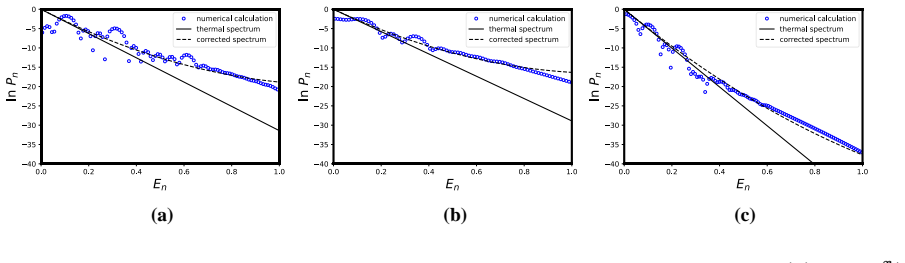
Starting from the massless scalar field equation in coordinates that remove the horizon singularity and discretizing with central differences, the paper maps the field evolution to a bosonic hopping Hamiltonian with site-dependent hopping parameter $\kappa_n = (f_n+f_{n-1})/(8d)$. The authors then apply the tunneling method, in which the Boltzmann factor is the imaginary part of the action for a shell of energy $E$ moving on a contracting-horizon background with the replacement $M\to M-E$. For the metric $f(x)=1-x_+/x$, the action evaluates to $\mathrm{Im}[S] = 4\pi E(M-E/2)$, giving $\ln P \sim -E/T + 4\pi E^2$, $T=1/(8\pi M)$. Their numerical solution of the hopping model on lattices of up to 1601 sites yields a log-probability versus energy curve that matches this corrected spectrum, while the same procedure with $f=\alpha\tanh(x-x_+)$ reproduces the thermal spectrum only, since that metric gives $\mathrm{Im}[S]=2\pi E/\alpha$ with no quadratic term.
Load-bearing premise
The numerical claim rests on assuming that the probability of finding the particle in an outer-region state of the lattice model equals the emission probability used in the tunneling calculation, and that the lattice energy $E$ is the same energy that appears in the tunneling formula; the paper inherits this identification from the earlier framework without proving it.
Editorial extensions
If this is right
- The same hopping-model framework can probe non-thermal, backreaction-induced features of Hawking radiation, not just the leading thermal law.
- The tanh metric is a degenerate case: because its temperature is mass-independent and its imaginary action stays linear, it cannot display the tunneling corrections, so earlier simulations using it set an upper bound on what the correspondence can show only if other metrics are tried.
- For the Schwarzschild-like metric, the quadratic term $4\pi E^2$ becomes visible only when the energy window extends beyond the small ranges used in earlier work (e.g. $0\le E\le 0.03$); the wider range $0\le E\le 1$ is what exposes the deviation.
- The authors suggest applying the same test to other static metric functions, including multiple horizons, and checking whether the 4d relation $\Delta S_{BH} = -2\,\mathrm{Im}[S]$ holds for exact 2d gravity realizations.
Reading between the lines
- Editorial inference: if the identification between lattice eigenvalues and tunneling energies survives scrutiny, the hopping model becomes a quantitative testbed for mass-loss corrections, allowing one to measure the replacement $M\to M-E$ directly from the spectrum.
- Editorial inference: the same method could be used to extract the emission spectrum for multi-horizon or extremal metrics, where the tunneling formula predicts different functional forms; the simulation would then act as an independent check of the contour-integral result.
- Editorial inference: a direct experimental realization of the hopping model with, for example, trapped ions could in principle observe the $E^2$ deviation, since the curvature dependence enters only through the site-dependent hopping parameter.
- Editorial inference: the paper's numerical comparison is at finite lattice spacing and finite size, so a convergence study against $d\to 0$ and $L\to\infty$ would be needed before claiming quantitative precision for the coefficient $4\pi$.
Editorial analysis
A structured set of objections, weighed in public.
Referee Report
Summary. This paper applies the recently proposed correspondence between two-dimensional curved-spacetime QFTs and quantum many-body hopping models to the question of non-thermal corrections to Hawking emission. The authors review the derivation of the site-dependent hopping Hamiltonian (2.14) from the massless Klein-Gordon equation, then re-derive the tunneling emission spectrum for two static metrics: f(x)=α tanh(x−x+) and f(x)=1−x+/x with x+=2M. They show analytically that the tanh metric yields an exactly thermal spectrum ln P ∼ −E/T with T=α/(4π), while the second metric yields the Parikh–Wilczek corrected spectrum ln P ∼ −E/T + 4πE^2 with T=1/(8πM). They report numerical simulations of the hopping model and claim that the numerical points reproduce the thermal spectrum for the tanh metric and the corrected spectrum for the 1−x+/x metric (Figs. 1 and 2). The analytical part is standard and the observation that the tanh choice is insensitive to the correction is useful; the numerical claim, however, is the central new result and is not established with the needed detail.
Significance. The analytical part is a correct and useful reminder that the metric function f=α tanh(x−x+) is a special case with no backreaction correction, and the corrected spectrum for the 1−x+/x choice is derived cleanly. If the numerical claim were fully established, it would be a notable step in analogue gravity: it would show that many-body simulations can probe not only the Hawking temperature but also the leading backreaction correction. The paper is honest about what is borrowed from Ref. [23], and the different parameter ranges in Fig. 2 give some indication of robustness. However, the paper provides no code, raw data, error bars, or a quantitative definition of the extracted P(E), and the conceptual link between the fixed-background lattice evolution and the backreacted tunneling formula is not derived. These are not cosmetic issues; they concern the central numerical result.
major comments (4)
- [§3, Figs. 1–2] The procedure for extracting P(E) from the simulation is not specified. The text only says that the probability is computed for eigenstates of the outer-region Hamiltonian; no formula connects P(E) to the time-evolved state, no normalization condition is stated, and no diagonalization or projection procedure is described. Without this, the curves in Figs. 1 and 2 cannot be reproduced or checked, and the statement “reasonable numerical accuracy” is unverifiable. The absence of raw data or error bars compounds this problem.
- [§2–§3, Eq. (2.14) vs. Eqs. (3.10)–(3.12)] The corrected spectrum is derived from a backreacting trajectory in which the horizon position is shifted by M→M−E′, i.e., a contracting horizon. The hopping Hamiltonian (2.14) used in the simulation is time-independent and has fixed x+; nothing in the evolution implements this horizon shift. The manuscript asserts, but does not derive, that the probability of finding the particle in an outer-region eigenstate of this fixed Hamiltonian equals the Parikh–Wilczek emission rate for the backreacted geometry, nor that the lattice eigenvalue E coincides with the energy in the tunneling formula. Since the E^2 term is specifically a backreaction effect, this missing argument is load-bearing; without it, the agreement in Fig. 1b could be a lattice artifact (band-edge or finite-size effect) rather than evidence for the tunneling correction.
- [Fig. 1b and Table 1] The dynamic range of the claimed thermal suppression is enormous. For M=15, T=1/(120π)≈2.65×10^-3, so the thermal factor e^{−E/T} at E=1 is of order 10^-164. The text gives no explanation of how the simulation computes or resolves probabilities over this range, nor how P(E) is normalized. A single-particle wavefunction overlap with an outer eigenstate is typically O(1/√N), not e^{−E/T}, so some nontrivial normalization or mode decomposition is required. The present description is insufficient to assess whether the numerical result is meaningful.
- [Eqs. (3.10)–(3.12)] The dimensions of M and E are not specified. In the metric f=1−x+/x with x+=2M, M is a length, whereas E is an energy (inverse length in units c=ℏ=1). The replacement M→M−E′ and the additive term 4πE^2 in (3.12) then mix different dimensions. If the authors intend dimensionless units or a special convention, it should be stated explicitly; otherwise the corrected exponent is not well defined. This does not affect the tanh calculation but matters for the central quantitative comparison.
minor comments (6)
- [Introduction] There are typos: “Adressing” should be “Addressing” and “emmision” should be “emission”.
- [Fig. 1 caption] The caption says “Full lines denote the thermal spectrum” but there are two panels and two lines in panel (b); please specify which line corresponds to which panel and which Hawking temperature.
- [§3, after Eq. (3.12)] The sentence “The upper bound for energy eigenvalues ... En≪O(1/d)” should define E_n and state whether the inequality is an asymptotic statement; the notation E_n versus E is inconsistent.
- [Table 1] The integration scheme for the Schrödinger equation is not described; a sentence on the numerical integrator and on accuracy checks (e.g., norm conservation) would improve reproducibility.
- [Section 4] The statement “By the tunneling method of [27], it is possible to derive the emission spectrum for any static black hole spacetime” is too broad; the method applies to the class of metrics where the x-integral has a simple pole, and multiple-horizon cases need separate treatment.
- [References] Reference [25] is an arXiv preprint; if it has been published by the time of resubmission, the published version should be cited.
Circularity Check
No significant circularity: the simulation is an independent cross-check with no fitted parameters and no self-citation chain.
full rationale
The paper contains no self-citations and fits no parameters to the target spectrum. The hopping Hamiltonian (2.14) is derived from the massless Klein-Gordon equation for the same metric function f that enters the tunneling action (3.6), so the agreement between the numerical P(E) and the corrected spectrum (3.12) is a non-trivial cross-check of two separate derivations sharing a common input, not a reduction of the output to the input. The paper explicitly notes that the corrected spectrum is 'just the calculation of [27] in 2d,' so no known result is being renamed as new. The only load-bearing assumption is the identification of the lattice eigenstate probability with the tunneling emission rate, inherited from [23]; the paper states 'we calculate the probability of finding a particle of energy E in the outer region where E is the positive eigenvalue of the Hamiltonian H' without deriving that this equals the Parikh-Wilczek emission probability. This is a support gap and a correctness risk, but it is not circular: the paper does not define the emission probability in terms of the lattice probability or vice versa, and the simulation is not constructed to reproduce the tunneling spectrum. The papers own limitation statements, such as 'we do not claim any originality here; rather, we closely follow the logic and notation of [23],' and the acknowledged finite-size and discretization errors, further confirm that the numerical results are presented as a consistency check rather than as a self-defined prediction. Therefore, no circular step is exhibited.
Assumptions & free parameters
free parameters (3)
- x+ (event horizon location, M = x+/2) =
30
- Energy range E in [0,1] =
[0,1]
- alpha for the tanh metric =
0.25
assumptions (3)
- domain assumption The map from 2d QFT to the bosonic hopping model is valid in the low-energy, slowly-varying limit.
- domain assumption The tunneling method with total mass conservation (M -> M - E) gives the correct emission spectrum.
- domain assumption The probability P(E) computed from the hopping model corresponds to the tunneling emission probability.
Cite this review
Pith. "Pith review of Simulating Hawking radiation in quantum many-body systems: deviations from the thermal spectrum." pith.science (2026). https://pith.science/paper/YTCHRQQL
@misc{pith2026250208199,
  author       = {Pith},
  title        = {Pith review of: Simulating Hawking radiation in quantum many-body systems: deviations from the thermal spectrum},
  year         = {2026},
  howpublished = {\url{https://pith.science/paper/YTCHRQQL}},
  note         = {Machine review of arXiv:2502.08199}
}
read the original abstract
We investigate a recently proposed one-to-one correspondence between quantum field theories in two-dimensional curved spacetime and quantum many-body systems, which enables the simulation of Hawking radiation in static background spacetimes. In particular, we demonstrate that deviations from the thermal spectrum, as predicted by the well-known tunneling method, can be observed in many-body simulations.
Figures

Reference graph
Works this paper leans on
-
[23]
Simulating quantum field theory in curved spacetime with quantum many-body systems,
R.-Q. Yang, H. Liu, S. Zhu, L. Luo, and R.-G. Cai, “Simulating quantum field theory in curved spacetime with quantum many-body systems,”Phys. Rev. Res.2 no. 2, (2020) 023107, arXiv:1906.01927 [gr-qc]
arXiv 2020
-
[1]
Particle Creation by Black Holes,
S. W. Hawking, “Particle Creation by Black Holes,”Commun. Math. Phys. 43 (1975) 199–220. [Erratum: Commun.Math.Phys. 46, 206 (1976)]
1975
-
[2]
Notes on black hole evaporation,
W. G. Unruh, “Notes on black hole evaporation,”Phys. Rev. D14 (1976) 870
work page 1976
-
[3]
Scalar particle production in Schwarzschild and Rindler metrics,
P. C. W. Davies, “Scalar particle production in Schwarzschild and Rindler metrics,”J. Phys. A 8 (1975) 609–616
work page 1975
-
[4]
Particle creation in expanding universes,
L. Parker, “Particle creation in expanding universes,”Phys. Rev. Lett.21 (1968) 562–564
work page 1968
-
[5]
Quantum fields in curved spacetime,
S. Hollands and R. M. Wald, “Quantum fields in curved spacetime,”Phys. Rept.574 (2015) 1–35, arXiv:1401.2026 [gr-qc]
arXiv 2015
-
[6]
Experimental black hole evaporation,
W. G. Unruh, “Experimental black hole evaporation,”Phys. Rev. Lett.46 (1981) 1351–1353
work page 1981
-
[7]
Sonic analog of black holes and the effects of high frequencies on black hole evaporation,
W. G. Unruh, “Sonic analog of black holes and the effects of high frequencies on black hole evaporation,” Phys. Rev. D51 (1995) 2827–2838, arXiv:gr-qc/9409008. 8
arXiv 1995
Show all 32 references
-
[8]
Black hole lasers,
S. Corley and T. Jacobson, “Black hole lasers,” Phys. Rev. D 59 (1999) 124011, arXiv:hep-th/9806203
1999 arXiv
-
[9]
Analog gravity from Bose-Einstein condensates,
C. Barcelo, S. Liberati, and M. Visser, “Analog gravity from Bose-Einstein condensates,”Class. Quant. Grav. 18 (2001) 1137, arXiv:gr-qc/0011026
2001 arXiv
-
[10]
Analog gravity from field theory normal modes?,
C. Barcelo, S. Liberati, and M. Visser, “Analog gravity from field theory normal modes?,”Class. Quant. Grav. 18 (2001) 3595–3610, arXiv:gr-qc/0104001
2001 arXiv
-
[11]
Gravity wave analogs of black holes,
R. Schutzhold and W. G. Unruh, “Gravity wave analogs of black holes,”Phys. Rev. D66 (2002) 044019, arXiv:gr-qc/0205099
2002 arXiv
-
[12]
‘Superresonance’ from a rotating acoustic black hole,
S. Basak and P. Majumdar, “‘Superresonance’ from a rotating acoustic black hole,”Class. Quant. Grav. 20 (2003) 3907–3914, arXiv:gr-qc/0203059
2003 arXiv
-
[13]
Gibbons-Hawking effect in the sonic de Sitter space- time of an expanding Bose-Einstein-condensed gas,
P. O. Fedichev and U. R. Fischer, “Gibbons-Hawking effect in the sonic de Sitter space- time of an expanding Bose-Einstein-condensed gas,” Phys. Rev. Lett. 91 (2003) 240407, arXiv:cond-mat/0304342
2003 arXiv
-
[14]
’Cosmological’ quasiparticle production in harmonically trapped superfluid gases,
P. O. Fedichev and U. R. Fischer, “’Cosmological’ quasiparticle production in harmonically trapped superfluid gases,”Phys. Rev. A69 (2004) 033602, arXiv:cond-mat/0303063
2004 arXiv
-
[15]
Probing semiclassical analog gravity in Bose- Einstein condensates with widely tunable interactions,
C. Barcelo, S. Liberati, and M. Visser, “Probing semiclassical analog gravity in Bose- Einstein condensates with widely tunable interactions,” Phys. Rev. A 68 (2003) 053613, arXiv:cond-mat/0307491
2003 arXiv
-
[16]
Quantum simulation of cosmic inflation in two-component Bose-Einstein condensates,
U. R. Fischer and R. Schutzhold, “Quantum simulation of cosmic inflation in two-component Bose-Einstein condensates,”Phys. Rev. A70 (2004) 063615, arXiv:cond-mat/0406470
2004 arXiv
-
[17]
Black holes in Bose-Einstein condensates,
L. J. Garay, J. R. Anglin, J. I. Cirac, and P. Zoller, “Black holes in Bose-Einstein condensates,” Phys. Rev. Lett.85 (2000) 4643–4647, arXiv:gr-qc/0002015
2000 arXiv
-
[18]
Mea- surement of stimulated Hawking emission in an analogue system,
S. Weinfurtner, E. W. Tedford, M. C. J. Penrice, W. G. Unruh, and G. A. Lawrence, “Mea- surement of stimulated Hawking emission in an analogue system,”Phys. Rev. Lett.106 (2011) 021302, arXiv:1008.1911 [gr-qc]
2011 arXiv
-
[19]
Observation of quantum Hawking radiation and its entanglement in an analogue black hole,
J. Steinhauer, “Observation of quantum Hawking radiation and its entanglement in an analogue black hole,”Nature Phys. 12 (2016) 959, arXiv:1510.00621 [gr-qc]
2016 arXiv
-
[20]
Observation of thermal Hawking radiation and its temperature in an analogue black hole,
J. R. Muñoz de Nova, K. Golubkov, V. I. Kolobov, and J. Steinhauer, “Observation of thermal Hawking radiation and its temperature in an analogue black hole,”Nature 569 no. 7758, (2019) 688–691, arXiv:1809.00913 [gr-qc]
2019 arXiv
-
[21]
Observation of Stim- ulated Hawking Radiation in an Optical Analogue,
J. Drori, Y. Rosenberg, D. Bermudez, Y. Silberberg, and U. Leonhardt, “Observation of Stim- ulated Hawking Radiation in an Optical Analogue,”Phys. Rev. Lett.122 no. 1, (2019) 010404, arXiv:1808.09244 [gr-qc]
2019 arXiv
-
[22]
Analogue gravity,
C. Barcelo, S. Liberati, and M. Visser, “Analogue gravity,” Living Rev. Rel. 8 (2005) 12, arXiv:gr-qc/0505065
2005 arXiv
-
[24]
The Hubbard Model: Introduction and Selected Rigorous Results,
H. Tasaki, “The Hubbard Model: Introduction and Selected Rigorous Results,”arXiv e-prints (Dec., 1995) cond–mat/9512169,arXiv:cond-mat/9512169 [cond-mat.str-el] . 9
1995
-
[25]
Simulation of the massless Dirac field in 1+1D curved spacetime,
Z. Liu, R.-Q. Yang, H. Fan, and J. Wang, “Simulation of the massless Dirac field in 1+1D curved spacetime,” arXiv:2411.15695 [gr-qc]
-
[26]
AdS/CFT correspondence with a three-dimensional black hole simulator,
A. Deger, M. D. Horner, and J. K. Pachos, “AdS/CFT correspondence with a three-dimensional black hole simulator,”Phys. Rev. B108 no. 15, (2023) 155124,arXiv:2211.15305 [hep-th]
2023 arXiv
-
[27]
Hawking radiation as tunneling,
M. K. Parikh and F. Wilczek, “Hawking radiation as tunneling,”Phys. Rev. Lett. 85 (2000) 5042–5045, arXiv:hep-th/9907001
2000 arXiv
-
[28]
Existence of steady-state black hole analogs in finite quasi-one-dimensional Bose-Einstein condensates,
C. C. H. Ribeiro, S.-S. Baak, and U. R. Fischer, “Existence of steady-state black hole analogs in finite quasi-one-dimensional Bose-Einstein condensates,”Phys. Rev. D105 no. 12, (2022) 124066, arXiv:2103.05015 [cond-mat.quant-gas]
2022 arXiv
-
[29]
Impact of trans-Planckian excitations on black-hole radiation in dipolar condensates,
C. C. H. Ribeiro and U. R. Fischer, “Impact of trans-Planckian excitations on black-hole radiation in dipolar condensates,”Phys. Rev. D107 no. 12, (2023) L121502,arXiv:2211.01243 [gr-qc]
2023 arXiv
-
[30]
Action Integrals and Partition Functions in Quantum Gravity,
G. W. Gibbons and S. W. Hawking, “Action Integrals and Partition Functions in Quantum Gravity,” Phys. Rev. D15 (1977) 2752–2756
1977
-
[31]
Some applications of a simple stationary line element for the Schwarzschild geometry,
P. Kraus and F. Wilczek, “Some applications of a simple stationary line element for the Schwarzschild geometry,”Mod. Phys. Lett. A9 (1994) 3713–3719, arXiv:gr-qc/9406042
1994 arXiv
-
[32]
Selfinteraction correction to black hole radiance,
P. Kraus and F. Wilczek, “Selfinteraction correction to black hole radiance,”Nucl. Phys. B433 (1995) 403–420, arXiv:gr-qc/9408003. 10
1995 arXiv
Reviewed August 8, 2026 · model on record in the stance chip above.
Discussion (0). Continue with ORCID to comment.