REVIEW 2 major objections 4 minor 32 references
Cartan Quantum Metrology
T0 review · 2 major / 4 minor · reviewed 2026-08-08 · deepseek-v4-flash
Pith's one-line read Two-qubit gate parameters: optimal probes hit the precision bound
desk verdict Solid central optimum for Cartan kernel metrology, but the headline tradeoff curve is plot-based and one determinant identity has a factor-four typo. read the letter →
The pith
A machine-rendered reading of the paper's core claim, the machinery that carries it, and where it could break.
The reading
What carries the argument
The technical engine is the Cartan (KAK) decomposition of SU(4), which rewrites any two-qubit gate as local single-qubit rotations around a diagonal kernel $U = e^{-i\sum_j \lambda_j \sigma_j\otimes\sigma_j}$, so that the entire entangling action is captured by three real parameters $\lambda_1,\lambda_2,\lambda_3$. The paper computes the quantum Fisher information matrix $Q$ for a pure two-qubit probe and the derived scalars $p = \operatorname{Tr}[Q^{-1}]$ (precision) and $s = 1/\det Q$ (sloppiness). The key identity is the matrix inequality $p \ge 3 s^{1/3}$ that any $3\times3$ symmetric positive matrix satisfies, with equality iff $Q$ is a scalar multiple of the identity; the paper finds probe states that achieve exactly $Q = 4\mathbb{1}$. The optimization is carried out by maximising $\det Q$ first as a product of two amplitude factors (giving the optimal-state families), then by switching to the Bell basis to express $p$ and $\det Q$ as simple rational functions of three amplitudes, whose stationary analysis yields the precision-sloppiness tradeoff curve.
What would settle it
A direct numerical search over the complete probe-state parameter space at a fixed $p$ that finds any state with $1/\det Q$ larger than the value given by Eq. (41) would falsify the claimed tradeoff; equivalently, finding a state with $p=3/4$ and $\det Q>64$ would falsify the claim that the bound is saturated.
Extended reading notes
Core claim
The central claim is that the Cartan kernel $U = \exp(-i\sum_j \lambda_j \sigma_j \otimes \sigma_j)$ of a generic two-qubit gate admits probe states for which the quantum Fisher information matrix is $Q = 4\mathbb{1}$, yielding $p = \operatorname{Tr}[Q^{-1}] = 3/4$ and $s = 1/\det Q = 1/64$. These values saturate the inequality $p \ge 3 s^{1/3}$ that holds for any $3\times3$ symmetric positive-definite matrix, so no model can do better at this level of sloppiness. In addition, the paper reports that the Uhlmann curvature vanishes for the model, which makes the Cramér–Rao bound asymptotically saturable. The optimal states are exactly those with amplitudes $(\alpha, \beta e^{i\phi}, \pm i\sqrt{1/2-\beta^2} e^{i\phi}, \pm i\sqrt{1/2-\alpha^2})$ (including a separable subset), and the paper shows that the same optimum is reached with and without entanglement. For suboptimal probes, the minimal sloppiness for a given precision is claimed to be given by the closed-form rational expression in Eq. (41).
Load-bearing premise
The assumed load-bearing premise is that the numerical maxima seen in the plots are the true global maxima for every value of the precision; if some other probe state gives a smaller sloppiness at the same precision, the reported tradeoff curve would be wrong.
Editorial extensions
If this is right
- Any two-qubit gate can be characterized with total variance at least $3/4$ per copy, and the family in Eqs. (29)-(30) attains this bound.
- Because $D=0$, the multiparameter Cramér–Rao bound is asymptotically achievable, so there is no penalty from measurement incompatibility when estimating the three Cartan parameters together.
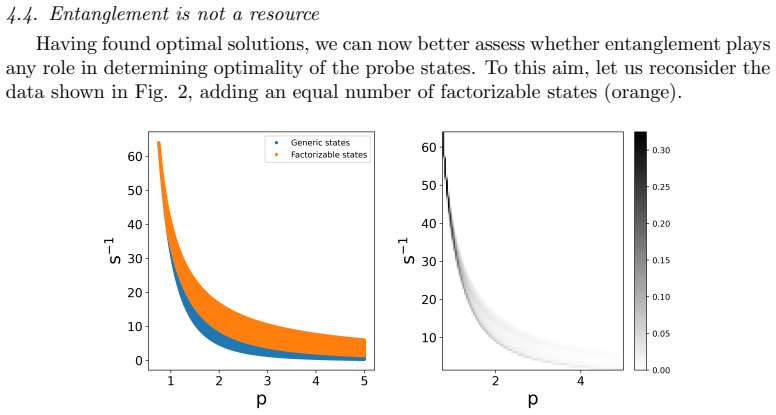
- Entanglement is not required for optimality: a set of separable product states already attains the same $p=3/4$ and $s=1/64$, simplifying practical implementations.
- For any desired precision level $p$, the tradeoff curve gives the minimum sloppiness that any probe can have, providing a benchmark for non-optimal estimation strategies.
- The optimal probes are robust to bit-flip and depolarizing noise on one channel for certain phase choices, with precision remaining comparable to the noiseless limit for all noise strengths in some cases.
Reading between the lines
- The saturation mechanism ($Q \propto \mathbb{1}$) is likely a general feature of estimation problems that are covariant under the parameter group; one could look for similar optimal states for other gates with a Cartan-type decomposition, such as multi-qubit or continuous-variable gates.
- Because the tradeoff curve is derived from a rational maximization, the paper's formula could be tested numerically over a fine grid of $p$; if a deviation appears, the true curve may have a piecewise form determined by different branches of the amplitude space.
- The robustness analysis is limited to two noise models and a few probe classes; one could extend it to correlated noise or to the case where noise acts after the gate, where the optimality conditions may change.
- The claim that entanglement is not a resource suggests that in experiments, simple product states can achieve the quantum limit; a direct experimental test with separable states would validate the no-entanglement requirement.
Signed reviews
Editorial analysis
A structured set of objections, weighed in public.
Referee Report
Summary. The paper considers the joint estimation of the three Cartan parameters λ1, λ2, λ3 of a two-qubit gate U = exp(−iΣλj σj ⊗ σj). For pure two-qubit probes it derives the quantum Fisher information matrix and the Uhlmann curvature, identifies probe families (Eqs. (29)–(30)) that give Q = 4I, hence p = Tr[Q−1] = 3/4 and s = 1/Det[Q] = 1/64, and shows that these states saturate the inequality p ≥ 3 s^{1/3}. The paper further claims D = 0, an exact precision–sloppiness tradeoff Eq. (50), and numerically studies the robustness of selected optima under bit-flip and depolarizing noise.
Significance. If correct, the main result is a clean, parameter-free benchmark: for every Cartan kernel there exists a family of pure probes, including separable states, that simultaneously minimizes the trace bound and the sloppiness and makes the multiparameter CRB asymptotically achievable. The QFIM is derived from first principles and the optimality argument in Section 4.2 is closed-form rather than numerical; these are genuine strengths. However, the additional tradeoff Eq. (50), one of the stated results, rests on an internally inconsistent determinant formula and on plot-based identification of a global maximum. Until this is repaired, the paper's strongest new claim is not established.
major comments (2)
- [§4.5, Eq. (38)] Equation (38) is internally inconsistent with Eq. (36). Substituting the optimal amplitudes b = c = d = 1/2 from Eq. (39) into Eq. (36) gives Q = 4I, hence Det[Q] = 64 and 1/s = 64. Substituting the same amplitudes into Eq. (38) gives 1/s = 16384 (1/4)^2 (1/64) = 16, i.e. s = 1/16. The same discrepancy appears if Eq. (38) is transformed back to the computational basis and compared with Eq. (26), which yields 1/s = 64 for the corresponding optimal state. Since Eq. (40) is obtained from Eq. (38), the tradeoff curve Eq. (41) and its final form Eq. (50) are not supported by the manuscript as written.
- [§4.5, Eqs. (40)–(41)] The derivation of the claimed precision–sloppiness tradeoff is not a global optimization. The text states that the graphs in Fig. 5 show three maxima and that substituting 'a maximum' into Eq. (40) gives Eq. (41), but no proof is provided that the selected stationary point is the global maximizer of 1/s over the feasible (b, c) domain for every p in [3/4, ∞). The p-domain is unbounded, the objective is a rational function, and multiple candidate maxima are visible in the panels; numerical identification at p = 0.76, 1, 2.5, 20 does not establish the claimed exact curve. This issue is independent of the factor error in Eq. (38) and must be fixed by an analytic argument or by downgrading the claim.
minor comments (4)
- [§4.1] The statement that D = 0 following Eq. (24) should be clarified: because the generators σj ⊗ σj commute, D = 0 holds for every pure probe state, not only for the optimized states. The later summary 'For these probes, quantum incompatibility vanishes' is correct but obscures the fact that incompatibility is absent already at the level of the model.
- [§4.2, Eq. (29)] The verbal characterization of the separable class ('first qubit being in a superposition of 0 and 1 with equal probability, and the second one being either |1⟩ or |0⟩') applies to only two of the four listed vectors; in the first and fourth vectors it is the second qubit that is in superposition while the first qubit is fixed.
- [§4.3, Eq. (32)] The rotation sign convention is inconsistent: e^{iθσx}|0⟩ = (cos θ, i sin θ)^T, whereas the displayed vector (cos θ, −i sin θ)^T corresponds to e^{−iθσx}|0⟩. The text should use one convention throughout.
- [§5, Figs. 7–8] The sentence 'in all cases the function is convex for small γ and thus robustness is ensured' is stronger than what numerical plots support. A quantitative robustness criterion, such as a threshold noise strength below which p remains below a chosen value, would be more precise.
Circularity Check
No circularity: the derivation is analytic and self-contained; the stated caveats are correctness concerns, not circular reasoning.
full rationale
The paper's central chain is not circular. The QFIM elements in Eq. (24) are computed directly from the parameterized output state Eq. (23) using the standard pure-state formula Eq. (16), and the precision and sloppiness expressions Eqs. (25)-(26) are algebraic consequences of those elements. The optimal states in Eqs. (29)-(30) follow from the closed-form maximization of Det[Q] in Section 4.2, not from fitting or from assuming the result. The claimed precision-sloppiness tradeoff Eq. (50) is obtained by substituting a candidate stationary point into Eq. (40); this is not a fitted-input-called-prediction pattern, because no parameter is tuned to data and the expression is analytic. The D=0 claim is presented as a direct calculation from Eq. (17), and although the paper frames it as a property of the optimized probes, it is an overclaim about universality rather than a circular step. The self-citations (e.g., [17], [29]) are contextual and not load-bearing in the derivation. The main caveats are correctness issues, not circularity: the global optimality of the point substituted into Eq. (40) is inferred from numerical plots rather than proven, and Eq. (38) appears internally inconsistent with Eq. (36) at b=c=d=1/2, where it gives s=1/16 instead of the Det[Q]=64 implied by Q=4I. These concerns affect validity but do not make the derivation circular.
Assumptions & free parameters
assumptions (5)
- standard math Any two-qubit gate decomposes into local unitaries plus a Cartan kernel U = exp(-i sum_j lambda_j sigma_j tensor sigma_j) (Khaneja-Glaser KAK1 theorem).
- standard math The quantum Fisher information matrix, SLD, and multiparameter Cramer-Rao bound are valid tools for this problem.
- domain assumption Pure probe states suffice for the global optimum because QFI is convex and extended convexity holds.
- domain assumption The three Cartan parameters are treated symmetrically with identity weight matrix W=I.
- domain assumption Noise acts only in state preparation, not inside the gate U, and is modeled by bit-flip or depolarizing channels.
Cite this review
Pith. "Pith review of Cartan Quantum Metrology." pith.science (2026). https://pith.science/paper/7MSZDWTL
@misc{pith2026250208379,
  author       = {Pith},
  title        = {Pith review of: Cartan Quantum Metrology},
  year         = {2026},
  howpublished = {\url{https://pith.science/paper/7MSZDWTL}},
  note         = {Machine review of arXiv:2502.08379}
}
read the original abstract
We address the characterization of two-qubit gates, focusing on bounds to precision in the joint estimation of the three parameters that define their Cartan decomposition. We derive the optimal probe states that jointly maximize precision, minimize sloppiness, and eliminate quantum incompatibility. Additionally, we analyze the properties of the set of optimal probes and evaluate their robustness against noise.
Figures


Figures from the paper (5 more)


Reference graph
Works this paper leans on
-
[1]
B. Kraus, J. Cirac, Optimal quantum circuits for two-qubit gates, Physical Review A 63 (6) (2001) 062309. doi:10.1103/PhysRevA.63.062309
-
[2]
G. Vidal, C. M. Dawson, Optimal quantum circuits for general two-qubit gates, Physical Review A 69 (1) (2004) 010301. doi:10.1103/PhysRevA.69.010301
-
[3]
F. Vatan, C. Williams, Optimal realization of a generic two-qubit quantum gate, Physical Review A 69 (3) (2004) 032315. doi:10.1103/PhysRevA.69.032315
-
[4]
A. Barenco, C. H. Bennett, R. Cleve, D. P. DiVincenzo, N. Margolus, P. Shor, T. Sleator, J. Smolin, H. Weinfurter, Elementary gates for quantum computation, Physical Review A 52 (5) (1995) 3457–
work page 1995
-
[5]
Y. Makhlin, Nonlocal properties of two-qubit gates and mixed states, and the optimization of quantum computations, Quantum Information Processing 1 (2002) 243–252. doi:10.1023/A: 1022144002391
doi:10.1023/a: 2002
-
[6]
J. Zhang, J. Vala, S. Sastry, K. B. Whaley, Geometric theory of nonlocal two-qubit operations, Physical Review A 67 (4) (2003) 042313. doi:10.1103/PhysRevA.67.042313
-
[7]
A. Rezakhani, Characterization of two-qubit perfect entanglers, Physical Review A—Atomic, Molec- ular, and Optical Physics 70 (5) (2004) 052313
work page 2004
-
[8]
A. Gilchrist, N. K. Langford, M. A. Nielsen, Distance measures to compare real and ideal quantum processes, Physical Review A 71 (6) (2005) 062310. doi:10.1103/PhysRevA.71.062310
Show all 32 references
-
[9]
C. H. Bennett, D. P. DiVincenzo, J. A. Smolin, W. K. Wootters, Mixed-state entanglement and quantum error correction, Physical Review A 54 (5) (1996) 3824–3851. doi:10.1103/PhysRevA.54. 3824
1996 doi
-
[10]
J. M. Chow, J. M. Gambetta, A. D. C´ orcoles, S. T. Merkel, J. A. Smolin, C. Rigetti, S. Poletto, G. A. Keefe, M. B. Rothwell, J. Rozen, M. B. Ketchen, M. Steffen, Universal quantum gate set approaching fault-tolerant thresholds with superconducting qubits, Physical Review Let...
2012 doi
-
[11]
Khaneja, S
N. Khaneja, S. J. Glaser, Cartan decomposition of su(2) and control of spin systems, Chemical Physics 267 (1-3) (2001) 11–23. doi:10.1016/S0301-0104(01)00333-6
2001 doi
-
[12]
V. V. Shende, I. L. Markov, S. S. Bullock, Minimal universal two-qubit controlled-not-based circuits, Physical Review A—Atomic, Molecular, and Optical Physics 69 (6) (2004) 062321
2004
-
[13]
R. R. Tucci, An introduction to cartan’s kak decomposition for qc programmers, arXiv preprint quant-ph/0507171 (2005)
2005 arXiv
-
[14]
Sparaciari, M
C. Sparaciari, M. G. A. Paris, Canonical naimark extension for generalized measurements involving sets of pauli quantum observables chosen at random, Phys. Rev. A 87 (2013) 012106
2013
-
[15]
J. Liu, H. Yuan, X.-M. Lu, X. Wang, Quantum fisher information matrix and multiparameter estimation, Journal of Physics A: Mathematical and Theoretical 53 (2) (2019) 023001
2019
-
[16]
Albarelli, M
F. Albarelli, M. Barbieri, M. Genoni, I. Gianani, A perspective on multiparameter quantum metrol- ogy: From theoretical tools to applications in quantum imaging, Physics Letters A 384 (12) (2020) 126311
2020
-
[17]
Razavian, M
S. Razavian, M. G. A. Paris, M. G. Genoni, On the quantumness of multiparameter estimation problems for qubit systems, Entropy 22 (11) (2020) 1197
2020
-
[18]
W. K. Wootters, Entanglement of formation and concurrence., Quantum Information and Compu- tation 1 (1) (2001) 27–44
2001
-
[19]
Brida, I
G. Brida, I. P. Degiovanni, A. Florio, M. Genovese, P. Giorda, A. Meda, M. G. Paris, A. Shurupov, Experimental estimation of entanglement at the quantum limit, Physical review letters 104 (10) (2010) 100501
2010
-
[20]
M. G. A. Paris, Quantum estimation for quantum technology, International Journal of Quantum Information 7 (supp01) (2009) 125–137
2009
-
[21]
Cram´ er, Mathematical methods of statistics, Vol
H. Cram´ er, Mathematical methods of statistics, Vol. 26, Princeton university press, 1999
1999
-
[22]
Amari, H
S.-i. Amari, H. Nagaoka, Methods of information geometry, Vol. 191, American Mathematical Soc., 2000. 16
2000
-
[23]
Holevo, Commutation superoperator of a state and its applications to the noncommutative statistics, Reports on Mathematical Physics 12 (2) (1977) 251–271
A. Holevo, Commutation superoperator of a state and its applications to the noncommutative statistics, Reports on Mathematical Physics 12 (2) (1977) 251–271
1977
-
[24]
K. S. Brown, J. P. Sethna, Statistical mechanical approaches to models with many poorly known parameters, Physical review E 68 (2) (2003) 021904
2003
-
[25]
K. S. Brown, C. C. Hill, G. A. Calero, C. R. Myers, K. H. Lee, J. P. Sethna, R. A. Cerione, The statistical mechanics of complex signaling networks: nerve growth factor signaling, Physical biology 1 (3) (2004) 184
2004
-
[26]
J. J. Waterfall, F. P. Casey, R. N. Gutenkunst, K. S. Brown, C. R. Myers, P. W. Brouwer, V. Elser, J. P. Sethna, Sloppy-model universality class and the vandermonde matrix, Phys. Rev. Lett. 97 (2006) 150601. doi:10.1103/PhysRevLett.97.150601. URL https://link.aps.org/doi/10.11...
2006 doi
-
[27]
B. B. Machta, R. Chachra, M. K. Transtrum, J. P. Sethna, Parameter space compression underlies emergent theories and predictive models, Science 342 (6158) (2013) 604–607
2013
-
[28]
Y. Yang, F. Belliardo, V. Giovannetti, F. Li, Untwining multiple parameters at the exclusive zero- coincidence points with quantum control, New Journal of Physics 24 (12) (2023) 123041
2023
-
[29]
Frigerio, M
M. Frigerio, M. G. Paris, Overcoming sloppiness for enhanced metrology in continuous-variable quantum statistical models, arXiv preprint arXiv:2410.02989 (2024)
2024 arXiv
-
[30]
Alipour, A
S. Alipour, A. T. Rezakhani, Extended convexity of quantum fisher information in quantum metrol- ogy, Physical Review A 91 (2015) 042104
2015
-
[31]
M. A. Rossi, C. Benedetti, M. G. Paris, Engineering decoherence for two-qubit systems interacting with a classical environment, International Journal of Quantum Information 12 (07n08) (2014) 1560003. 17
2014
-
[3467]
doi:10.1103/PhysRevA.52.3457
Reviewed August 8, 2026 · model on record in the stance chip above.
Discussion (0). Continue with ORCID to comment.