REVIEW 4 major objections 5 minor 1 cited by
Scaling Law for Discharges in Z pinch Devices
T0 review · 4 major / 5 minor · reviewed 2026-08-08 · deepseek-v4-flash
Pith's one-line read The paper claims that in Z pinch discharges, plasma temperature at pinch is set by internal energy per particle, so uniform scaling leaves it unchanged and even the best scaling grows only as the cube root of capacitor-bank energy.
desk verdict A reasonable extension of the snowplow model whose scaling conclusion overreaches: Eq. 72 itself shows T grows as E^{1/3} for fixed λ2, so 'regardless of energy' is not supported. read the letter →
The pith
A machine-rendered reading of the paper's core claim, the machinery that carries it, and where it could break.
The reading
What carries the argument
The load-bearing object is the modified snowplow equation for the current-sheath radius, which now contains both the magnetic force and a kinetic-pressure force. The kinetic pressure is obtained from an internal-energy functional that is evaluated as a history integral over the sheath motion, $U(t)=-\pi r_0^2 l_0 \rho_0 \int_0^t (1/r)(dr/dt')^3 dt'$. Requiring the dimensionless parameters $\alpha$ and $\beta$ to stay invariant under scaling makes the dynamics identical between reference and scaled devices, and the algebra then forces the temperature to be independent of the common scale factor.
What would settle it
Measure the temperature at first pinch in two devices that differ only by a uniform scale factor $\lambda$, keeping gas, fill density, and the dimensionless parameters $\alpha$ and $\beta$ the same; if the larger device's temperature exceeds the reference value by more than measurement error, the temperature-invariance result is falsified. Alternatively, a direct spectroscopic temperature that disagrees strongly with $k_B T = \frac{2}{3} U/N$ from Equation (48) would falsify the full-thermalization premise.
Extended reading notes
Core claim
The central discovery is that the thermodynamics of a Z pinch discharge follows from a modified set of snowplow equations in which the inward magnetic force on the current sheath is balanced by an outward kinetic-pressure force. The internal energy gained by the gas is a functional of the whole history of sheath motion, $U(t)=-\pi r_0^2 l_0 \rho_0 \int_0^t (1/r)(dr/dt')^3 dt'$, and the temperature is $k_B T = \frac{2}{3} U/N$. From these expressions the paper shows that a uniform scaling of the device, with the same fill density and the same dimensionless parameters $\alpha$ and $\beta$, preserves the temperature exactly, and that the generalized scaling law is $k_B T / k_B T_0 = (1/\lambda_2)(E/E_0)^{1/3}$. Since real optimized experiments satisfy $U_0 < E_0$ and have $k_B T_0 \lesssim 100$ eV, the paper concludes that Z pinch devices cannot be scaled up to thermonuclear fusion, whatever their size and energy content.
Load-bearing premise
The internal energy of the plasma is set equal to the kinetic energy that ions acquire when the current sheath sweeps them up, assuming all of that kinetic energy becomes randomized heat and none is lost to radiation or non-thermal acceleration.
Editorial extensions
If this is right
- The modified snowplow equations give internal energy, kinetic pressure, and temperature directly from the same dynamical solutions that reproduce measured radius and current curves, so no separate thermal model is needed.
- A uniformly enlarged Z pinch device has exactly the same pinch temperature as the reference device, because internal energy and particle number both grow as $\lambda^3$.
- With shape-changing scaling, the pinch temperature obeys $k_B T / k_B T_0 = (1/\lambda_2)(E/E_0)^{1/3}$, so a thousand-fold temperature increase needs about a billion-fold bank energy.
- The inequality $U_0 < E_0$ bounds the achievable temperature by $k_B T_0 < \frac{2}{3}(E_0/N_0)$, and for optimized experiments this bound is of order $10^2$ eV.
- Consequently, thermonuclear fusion via Z pinch devices is, according to the paper, not attainable by increasing size or stored energy.
Reading between the lines
- If the scaling law is right, the only meaningful design lever is the specific energy per particle, not total bank energy; future searches could look for discharge geometries that increase the energy-conversion fraction in Equation (48).
- The model assumes all swept-up kinetic energy thermalizes; since real sheaths radiate and accelerate some ions non-thermally, actual temperatures would likely be lower, making the negative conclusion conservative.
- One could test the model by comparing the bounce dynamics predicted from the modified snowplow equations against high-speed imaging of the sheath and against spectroscopic temperature estimates in an existing Z pinch.
- The same cost-geometry logic should apply to other magnetic-compression schemes whose heating is set by an intensive quantity; the argument suggests scaling up without changing specific energy input cannot beat the Lawson threshold.
Signed reviews
Editorial analysis
A structured set of objections, weighed in public.
Referee Report
Summary. The paper extends the snowplow model for Z-pinch discharges by adding a kinetic-pressure term from the compressed plasma, obtaining modified equations (36)–(37) that allow computation of the internal energy and temperature at pinch. It then derives scaling laws for the temperature under two families of device up-scaling: uniform scaling (Eqs. 49–60) preserves the temperature, while a second family (Eqs. 61–72) yields T ∝ E^{1/3} with a shape factor 1/λ2. The authors conclude that thermonuclear fusion is unreachable by Z-pinch devices 'regardless of its size and its energetic content' (Section 4, conclusion 5).
Significance. The modified snowplow equations provide a self-contained algorithm for computing plasma temperature from discharge dynamics, and the scaling law in Eq. (72) is a transparent, falsifiable prediction for devices with invariant dimensionless parameters α and β. The algebraic derivation of Eq. (36) is internally correct, and the paper is honest about its postulates. However, the scaling law is derived only for a restricted family of scalings, and the impossibility conclusion overreaches the model's validity. If revised to remove the overreach and to clarify the model's physical basis, the paper would be a useful contribution to the Z-pinch scaling literature.
major comments (4)
- [Section 4, conclusion 5; Section 3, Eq. (72)] The blanket statement that thermonuclear fusion is unreachable 'regardless its size and its energetic content' is not a consequence of the model. Equation (72) gives kBT/kBT0 = (1/λ2)(E/E0)^{1/3}; for the subfamily λ2=1, which is not excluded by the derivation, the temperature grows as the cube root of stored energy. Under uniform scaling, the temperature is constant, not decreasing. The impossibility claim is therefore an extrapolation beyond the similarity families considered. The conclusion should be restricted to the statement that, for scalings preserving α and β, the temperature gain is at most proportional to E^{1/3}, making fusion energetically impractical for the parameter range examined.
- [Section 2.4, Eqs. (6), (26)–(28), and (31)] The derivation of the internal energy mixes two incompatible physical pictures. Equation (6) describes the sheath mass as the gas swept up between r0 and r, leaving an empty interior; Eqs. (26)–(28) instead assume all particles are compressed uniformly inside the sheath with density n=(r0/r)^2 n0. These pictures give different expressions for dN and hence for U in Eq. (31). If the swept-up picture is intended, dN should be proportional to the ambient density n0, not the compressed density n; if the compression picture is intended, the mass M(t) in Eq. (5) should be the total gas mass, not the swept-up mass. This inconsistency affects the expression for U and therefore the temperature scaling law in Eq. (48). The authors should clarify the model or revise the derivation.
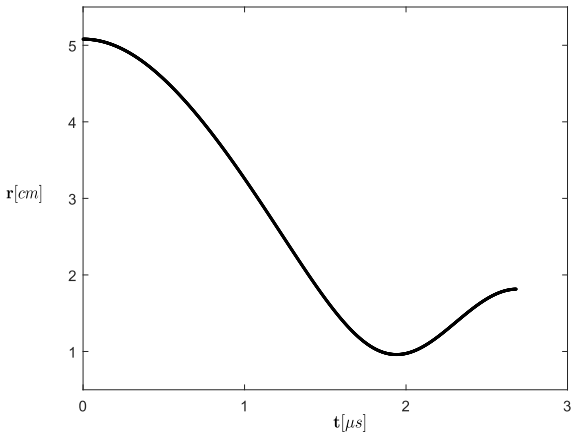
- [Section 2.5, Figures 2–3] The claim that the simulated r(t) and I(t) 'reproduce well the data obtained from actual experiments' is not supported by any quantitative comparison; Figures 2 and 3 show only the model output, without experimental data points or error bars. Since the subsequent temperature estimate and scaling law depend on the model's predictive accuracy, the agreement should be quantified (e.g., with a root-mean-square error) or explicitly stated as qualitative.
- [Section 2.4, after Eq. (31)] The postulate that the kinetic energy of the swept-up ions is fully thermalized into internal energy, with no energy losses, is load-bearing for the absolute temperature values (e.g., kBT0 ≈ 30 eV). The paper acknowledges this is a postulate, but it should discuss how radiation losses (bremsstrahlung is mentioned in the Introduction) or non-thermal ion acceleration would modify the temperature estimate. The scaling law in Eq. (72) may be robust to a constant fractional conversion, but the quantitative claim of impossibility depends on this assumption.
minor comments (5)
- [Abstract] The phrase 'replenish the term disregarded' is awkward; 'restore the term' or 'include the term' would be clearer.
- [Throughout] The notation is inconsistent: 'Z pinch' and 'Z-pinch' are used interchangeably; please standardize.
- [Section 2.2] The phrase 'neglectable resistance' should be 'negligible resistance'.
- [Equation (76)] The typeset equation has unbalanced parentheses; the integral should be closed with a parenthesis. Please check the final version.
- [References] The reference list is heavily weighted toward the 1950s–1970s; citing more recent works on Z-pinch scaling and temperature diagnostics would strengthen the context.
Circularity Check
No significant circularity: the scaling law is a direct consequence of the stated model, definitions, and explicit scaling constraints, not a fit or self-citation chain.
full rationale
The paper's derivation chain is self-contained and non-circular. The temperature is defined by the standard relation kBT = (2/3)(U/N) (Eqs. 39, 47, 59); U is computed from the modified snowplow equations (Eqs. 34, 38); and the scaling results (Eqs. 58-60, 70-72) follow algebraically from the explicitly chosen scaling transformations with alpha and beta held fixed (Eqs. 49-53, 61-65, and constraints 1)-2) in Section 3). No parameter is fitted to the target temperature before 'predicting' it, and no load-bearing step is justified by a self-citation (the paper contains no self-citations at all; the snowplow model is attributed to Rosenbluth et al. [17]). The model-dependent character of the conclusions is acknowledged in the text (e.g., 'we limit ourselves to consider only a particular family among those possible scalations'; caveats about scaling L0), and the sweeping phrasing of conclusion 5 may overgeneralize beyond that family. That is a validity/scope concern, not circularity. The scaling law's being a consequence of T = (2/3)(U/N) plus the chosen scalings is how a model scaling law is normally derived, not a case of assuming the conclusion.
Assumptions & free parameters
assumptions (4)
- domain assumption The current sheath is infinitely thin, the plasma is fully ionized and has negligible resistance, and the sheath sweeps up all particles it encounters.
- ad hoc to paper The internal energy gained by the gas is equal to the kinetic energy imparted to the swept-up ions, assuming full thermalization and no energy losses.
- standard math The kinetic pressure of the plasma is given by pk = 2U/(3V), as for a monatomic ideal gas.
- domain assumption The scaling transformations used in the scaling-law derivation preserve the dimensionless parameters α and β.
Cite this review
Pith. "Pith review of Scaling Law for Discharges in Z pinch Devices." pith.science (2026). https://pith.science/paper/35MJ6OVA
@misc{pith2026250208570,
  author       = {Pith},
  title        = {Pith review of: Scaling Law for Discharges in Z pinch Devices},
  year         = {2026},
  howpublished = {\url{https://pith.science/paper/35MJ6OVA}},
  note         = {Machine review of arXiv:2502.08570}
}
read the original abstract
We consider the snowplow model for studying discharges in Z pinch devices. In this context, to obtain a complete picture on the physics of those discharges, we replenish the term disregarded in the original formulation of the snowplow equations. This is, we now consider not only the magnetic force inward on the current sheath but we take into account also a force outward on it. Such a force results from the kinetic pressure of the gas occluded by the current sheath. The internal energy gained by the gas towards the end of the discharge depends on the full history of the dynamical variables of the system. In other terms, the internal energy is a functional of the dynamical variables of the system. We write down the expression for evaluating that internal energy and we present also the formula for computing the temperature of the gas. On this basis, we derive a scaling law that relates the temperature the gas in a Z pinch experiment would attain with the energetic and spatial wingspan of the corresponding experimental setup.
Figures


Forward citations
Cited by 1 Pith paper
-
Snowplow Model Predictions for Plasma Temperature in Z pinch Discharges
In the modified snowplow model, the plasma temperature at pinch scales as (E/E0)^n, with n=1/2 when only the capacitor voltage is increased.
Reference graph
Works this paper leans on
-
[1]
University of California Radiation Laboratory, Livermore, California, July 3, 1958
Edward Teller, Peaceful Uses of Fusion, Report UCRL-5257 Rev. University of California Radiation Laboratory, Livermore, California, July 3, 1958
work page 1958
-
[2]
Bishop, ’Project Sherwood- The U
Amasa S. Bishop, ’Project Sherwood- The U. S. Program in Controlled Fusion’, Addison-Wesley, Reading, Massachusetts (1958)
work page 1958
-
[3]
M. O. Hagler and M. Kristiansen, ’An Introduction to Con- trolled Thermonuclear Fusion’, Lexington Books D. C. Heath and Company Lexington Massachusetts Toronto (1977). 40
work page 1977
-
[4]
W. H. Bennett: Magnetically Self-focusing Sreams, Phys. Rev. 45, 890 (1934)
work page 1934
-
[5]
Tonks, ’Theory of Magnetic Effects in the Plasma of an Arc’, Phys
L. Tonks, ’Theory of Magnetic Effects in the Plasma of an Arc’, Phys. Rev.56, 360 (1939)
work page 1939
-
[6]
J. D. Jackson, ’Classical Electrodynamics’, John Wiley and Sons, New York (1975)
work page 1975
-
[7]
Lyman Spitzer, Jr., ’Physics of Fully Ionized Gases’, Inter- science Publishers, Inc., New York (1956)
work page 1956
-
[8]
S. Glasstone and R. H. Lovberg: ’Controlled Thermonuclear Reactions’ , D. Van Nostrand Company, Princeton, N. J. (1960)
work page 1960
Show all 17 references
-
[9]
J. D. Lawson: Some Criteria for a Power Producing Thermonu- clear Reactor, Proc. Phys. Soc. B,70 (1957)
1957
-
[10]
Anderson, William R
Oscar A. Anderson, William R. Baker,Stirling A. Colgate, John Ise, Jr., and Robert V. Pyle, Neutron Production in Linear Deuterium Pinches, Phys. Rev.110, 1375 (1958)
1958
-
[11]
M. J. Bernstein and F. Hai, Evidence for Nonthermonuclear Neutron Production in a Plasma Focus Discharge, Phys. Lett. 31A, 317 (1970)
1970
-
[12]
McCall, Calculation of Neutron Yield from a Dense Z Pinch, Phys
Gene H. McCall, Calculation of Neutron Yield from a Dense Z Pinch, Phys. Rev. Lett.62, 1986 (1989). 41
1989
-
[13]
Post, Controlled Fusion Research- An Appplication of the Physics of High Temperature Plasmas, Rev
Richard F. Post, Controlled Fusion Research- An Appplication of the Physics of High Temperature Plasmas, Rev. Mod. Phys. 28, 338 (1956)
1956
-
[14]
Kolb, Magnetic Compression of Plasmas, Rev
Alan C. Kolb, Magnetic Compression of Plasmas, Rev. Mod. Phys. 32, 748 (1960)
1960
-
[15]
D. D. Ryutov, M. S. Derzon and M. K. Matzen: The physics of fast Z pinches, Rev. Mod. Phys.72, 167 (2000)
2000
-
[16]
J. Mather: An Intense Source of Neutrons from the Dense Plasma Focus, Intense Neutron Sources: Proceedings of a United States Atomic Energy Commission/European Nuclear Energy Agency seminar, Santa Fe, New Mexico, 19-23 Septem- ber 1966
1966
-
[17]
M. N. Rosenbluth, R. Garwin and A. Rosenbluth: Infinite Con- ductivity Theory of the Pinch, Report LA-1850, Los Alamos Scientific Laboratory, New Mexico, September 1954. 42
1954
Reviewed August 8, 2026 · model on record in the stance chip above.
Discussion (0). Continue with ORCID to comment.