REVIEW 3 major objections 4 minor 63 references
Revisiting Gauge Ambiguities for DUNE Precision
T0 review · 3 major / 4 minor · reviewed 2026-08-07 · deepseek-v4-flash
Pith's one-line read The paper argues that standard off-shell treatments of bound nucleons in lepton scattering carry a 2–10% theory uncertainty, larger than DUNE's precision target, and that the way out is to compute with off-shell currents directly.
desk verdict Useful quantitative warning about a known gauge ambiguity, but the 'irreducible' label overreaches and the numbers lack detail. read the letter →
The pith
A machine-rendered reading of the paper's core claim, the machinery that carries it, and where it could break.
The reading
What carries the argument
The machinery is the one-body nucleon current for an off-shell initial state and the recipes for restoring its conservation. The paper starts from the de Forest shift $\tilde\omega = \omega + E_{\rm in}^h - \bar E$, which breaks the Ward identity, then examines the Coulomb recipe ($j^q \to (\omega/q) j^0$), the Weyl recipe ($j^0 \to (q/\omega) j^q$), and the Landau recipe ($j^\mu \to j^\mu + (j\cdot q)/Q^2\, q^\mu$), with form factors evaluated at either $Q$ or $\tilde Q$. For the proposed alternative, the machinery is the most general off-shell one-body current (ten form factors instead of four, including the new $f_3$ term), evaluated with spinors built from auxiliary massless spinors; this current automatically satisfies gauge invariance without ad hoc shifts.
What would settle it
Measure the quasielastic electron-carbon cross section at one of the plotted kinematics (for example 1108 MeV beam energy and 37.5 degrees) with sub-percent precision in the quasielastic peak: if the data selects one prescription and excludes the others, the spread between recipes is reducible, not irreducible. Alternatively, compute the proposed off-shell current method with off-shell form factors from chiral perturbation theory at next order: if the result falls outside the 2–10% band, then the band does not bound the true theory uncertainty.
Extended reading notes
Core claim
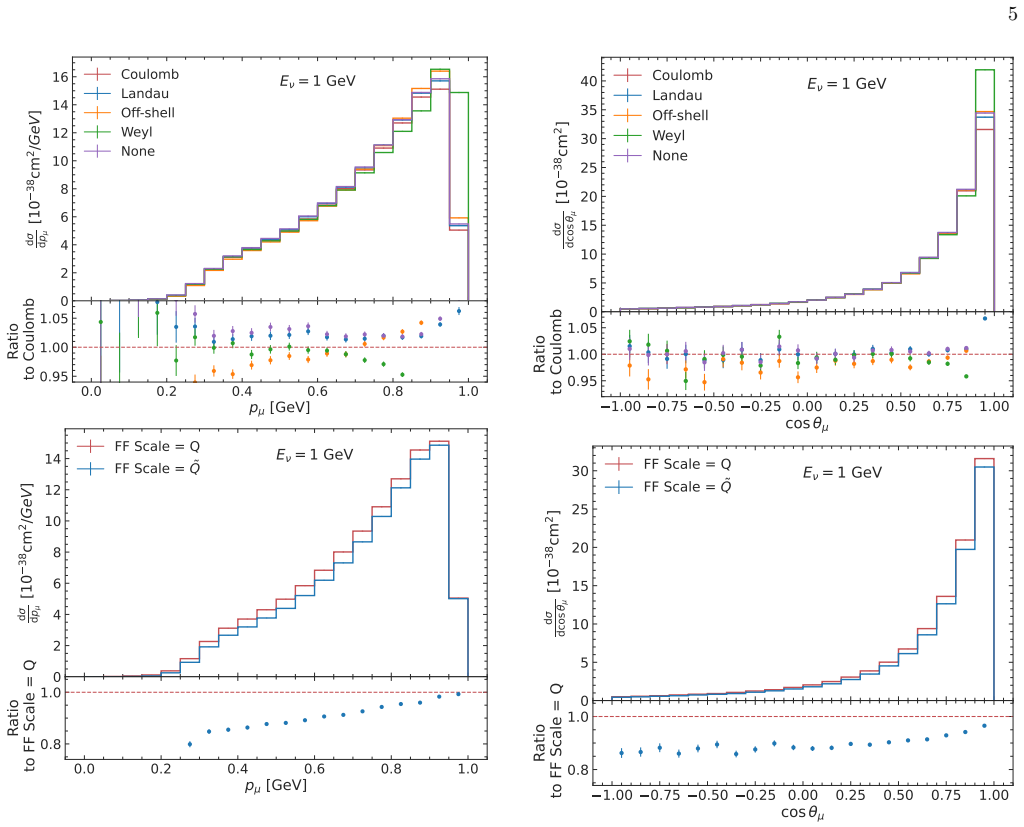
The paper's central claim is that the off-shell treatment of the bound nucleon in the plane-wave impulse approximation, which treats the struck nucleon as quasi-free, is not a negligible technical detail: it changes quasielastic cross sections at a level comparable to the total systematic budget of next-generation neutrino experiments. Starting from the de Forest energy shift $\tilde\omega = \omega + E_{\rm in}^h - \bar E$, the paper shows that the three standard gauge-restoration recipes—Coulomb, Weyl, and Landau—are not numerically equivalent. Landau and Coulomb differ by 2–5%, while the Weyl recipe diverges in the Breit frame and should be discarded. Independently, evaluating the form factors at the original boson momentum $Q$ instead of the shifted $\tilde Q$ changes results by 5–10%. The paper therefore concludes that, within the de Forest prescription, there is an irreducible few-to-ten-percent theory uncertainty, and it offers a direct off-shell-current calculation as the route to a controlled, improvable error estimate.
Load-bearing premise
The load-bearing premise is that the list of tested off-shell treatments (one energy shift, three current-restoration recipes, two form-factor scales) covers all reasonable possibilities; since the paper adds a fourth approach, the quoted 2–10% spread may not bound the real uncertainty.
Editorial extensions
If this is right
- DUNE and other next-generation neutrino experiments will need to include a 2–10% prescription- and scale-dependent uncertainty in the quasielastic channel unless the off-shell current method replaces the de Forest prescription.
- The Weyl recipe should not be used in generators; its correction factor diverges in the Breit frame, making it unusable as a gauge-restoration method.
- A switch between Coulomb and Landau recipes shifts quasielastic cross sections by 2–5%, and a switch in form-factor scale shifts them by an additional 5–10%; this is a normalization effect on top of the physical cross-section shape.
- The off-shell current approach raises the required form factors from four to ten and makes predictions sensitive to the virtuality dependence $f_i(q^2,p^2)$, which can be modeled with vector-meson dominance or chiral perturbation theory and improved order by order.
Reading between the lines
- Because any generator using a spectral function encounters off-shell initial nucleons in other channels—pion production, two-body currents, final-state interactions—the same ambiguity is likely to affect more than the quasielastic cross section, so the 2–10% band may be a lower bound on the total off-shell theory uncertainty.
- The 'irreducible' label depends on treating the tested recipes and scales as exhaustive; since the paper itself proposes another scheme, a natural test is to compute the off-shell current method's predictions and see whether they land inside or outside the 2–10% band.
- High-precision electron-nucleus data, combined with the neutrino data, could in principle constrain the off-shell form-factor dependence $f_i(q^2,p^2)$, converting part of the quoted uncertainty from irreducible to data-driven.
Editorial analysis
A structured set of objections, weighed in public.
Referee Report
Summary. The paper addresses the treatment of bound, off-shell initial-state nucleons in the plane-wave impulse approximation for lepton-nucleus scattering. It argues that the de Forest energy shift in Eq. (15) breaks current conservation, and it compares four ways of handling this: the Coulomb, Weyl, and Landau gauge-restoration recipes of Eqs. (16)-(18), plus a proposed 'off-shell' scheme that uses auxiliary spinors and off-shell form factors. The central numerical claim is that the spread among reasonable prescriptions is 2-5% for gauge restoration and an additional 5-10% for the form-factor scale choice, and that this spread is 'irreducible' and significant compared to the few-percent precision target of DUNE. The paper also proposes a systematically improvable off-shell current method, with the detailed calculation left to future work.
Significance. If the quantitative claims are established, the paper identifies a practically important, often neglected source of theoretical uncertainty in neutrino-nucleus event generators, and it gives a concrete direction for reducing that uncertainty. The use of the Achilles generator to compare prescriptions side by side is useful, and the proposed off-shell method, if implemented, would provide a more principled alternative to the ad hoc de Forest shift. However, the central claim as stated is stronger than the evidence presented: the 'irreducible' characterization is not justified, the numerical bands come from one carbon target at one beam energy with no simulation or statistical details, and the off-shell curves shown do not yet include the off-shell form factor dependence that the proposed method is meant to introduce. The paper is therefore a useful contribution to a genuine problem, but the headline quantitative claims need to be either substantially supported or appropriately qualified.
major comments (3)
- [Eqs. (16)-(18) and the 'irreducible' claim] The central claim that the 2-5% spread between the Coulomb and Landau prescriptions is 'irreducible' is not supported. For a non-conserved off-shell current there are infinitely many conserved extensions, and Eqs. (16) and (18) are only two particular choices. The paper gives no argument that these two choices, together with the Weyl prescription, bracket the full range of physically reasonable off-shell treatments. In fact, the proposed off-shell scheme in Eqs. (19)-(23) is itself another unconstrained extension, so the set of prescriptions considered is demonstrably not closed. The word 'irreducible' should be replaced by a statement such as 'representative spread within the de Forest class' unless a closed characterization of the allowed prescriptions is provided.
- [Figs. 1-3 and the quantitative bands] The numerical values 2-5% and 5-10% rest entirely on the simulations shown in Figs. 1-3, but the text gives no simulation settings (spectral function model, form factor parametrization, event statistics, acceptance or cuts) and no statistical or systematic uncertainties. The neutrino comparisons are for a single 1 GeV beam on carbon and are presented as raw dsigma/dp_mu and dsigma/dcos(theta) distributions; there is no propagation to DUNE event rates, backgrounds, or oscillation sensitivities. As printed, the percentages cannot be checked, and the comparison to the few-percent DUNE precision requirement is asserted rather than demonstrated. The manuscript should add full simulation specifications, error bars or convergence checks, and at least a schematic propagation to a DUNE-relevant observable, or soften the quantitative claims accordingly.
- [Off-shell prescription in Figs. 1-3] The orange 'off-shell' curves in Figs. 1-3 are computed with f_i(q^2,p^2) = F_i(q^2), f_3 = 0, and f_i^{(-)} = 0, as stated in the text near Eq. (23). This choice removes exactly the off-shell form factor dependence that the proposed method is designed to introduce. Consequently, these curves are only a zeroth-order benchmark; they neither validate the off-shell scheme nor bound its uncertainty. The manuscript should clearly label the orange curves as such and either implement the VMD or ChPT model for the off-shell form factors or state explicitly that no off-shell uncertainty estimate is being made.
minor comments (4)
- [Page 2, around Eq. (5)] There is a typo: 'sates' should be 'states' in the sentence introducing Eq. (5).
- [Reference [54]] Reference [54] is incomplete: it lists authors and a year but no journal, volume, page, or DOI. Please complete the citation.
- [Figs. 2-3, bottom panels] The bottom panels of Figs. 2 and 3 appear to label both form-factor scale choices as 'FF Scale = Q'; one of them should be Q-tilde (or otherwise distinguished) to reflect the two choices described in the text.
- [Introduction and abstract] The term 'irreducible' is used in the abstract and in the body before it is defined. Consider defining it explicitly as 'the spread among prescriptions considered here' or defending the stronger meaning at first use.
Circularity Check
No circularity: the paper numerically compares established off-shell prescriptions, and its self-citations are tool citations rather than load-bearing evidence.
full rationale
The paper's central claim is that different existing off-shell prescriptions (Coulomb, Landau, Weyl) and form-factor scale choices produce 2–5% and 5–10% differences in quasielastic cross sections, which it labels 'irreducible' within the de Forest prescription. This is a numerical comparison of explicitly stated, externally sourced formulas (Eqs. 15–18), not a derivation of an output from an input that equals the output. The 2–5% and 5–10% numbers are simulation outputs from the author's Achilles generator, but the generator is a standard event-generation tool and its output is sanity-checked against external electron-carbon data in Fig. 1. Self-citations to Achilles ([33], [45]) and to a related automation paper [47] are tool citations: the paper does not argue for the correctness of its physics by citing its own derivations, and no claimed uniqueness theorem or ansatz is imported from the author's prior work. The 'irreducible' qualifier is an interpretive claim about the ambiguity inherent in the de Forest scheme, not a definitional tautology; the paper even proposes a fourth, systematically improvable off-shell scheme, showing the claim is conditional on the de Forest framework rather than a closed set. The skeptic's point that the set of conserved extensions is unclosed is a legitimate robustness concern but not a circularity, because the paper does not assert that its prescriptions exhaust all possibilities—only that the displayed spread is unavoidable when remaining within the de Forest prescription. No fitted parameter is renamed as a prediction, and no result is justified solely by self-citation.
Assumptions & free parameters
free parameters (2)
- Form-factor momentum scale =
Q vs Q~ (shifted gauge boson momentum)
- Off-shell form-factor model =
f_i(q2,p2) = F_i(q2), f_3=0, f_(-)=0
assumptions (4)
- domain assumption Plane-wave impulse approximation factorizes the hadronic tensor into a sum over one-body currents weighted by a spectral function (Eq. 6).
- domain assumption Off-shell initial nucleons are handled by shifting the gauge boson energy to make the nucleon on-shell (Eq. 15, de Forest prescription).
- domain assumption Negative-energy spectral function contributions can be neglected.
- domain assumption On-shell nucleon form factors can be reused for off-shell kinematics at either scale Q or Q~.
Cite this review
Pith. "Pith review of Revisiting Gauge Ambiguities for DUNE Precision." pith.science (2026). https://pith.science/paper/L4HKZLKL
@misc{pith2026250208727,
  author       = {Pith},
  title        = {Pith review of: Revisiting Gauge Ambiguities for DUNE Precision},
  year         = {2026},
  howpublished = {\url{https://pith.science/paper/L4HKZLKL}},
  note         = {Machine review of arXiv:2502.08727}
}
read the original abstract
The de Forest prescription for handling off-shell initial states in the impulse approximation for lepton-nucleus scattering breaks gauge invariance. We discuss existing methods to address this problem and handle the form factor scale ambiguity. We demonstrate that the irreducible differences between the prescriptions are significant compared to the precision expected of next-generation accelerator neutrino experiments. A novel approach directly using the off-shell currents is proposed as a systematically improvable alternative.
Figures

Reference graph
Works this paper leans on
-
[1]
R. Acciarri et al. (MicroBooNE, LAr1-ND, ICARUS- W A104), (2015), arXiv:1503.01520 [physics.ins-det]
arXiv 2015
-
[2]
F. An et al. (JUNO), J. Phys. G 43, 030401 (2016), arXiv:1507.05613 [physics.ins-det]. cos 0 5 10 15 20 25 30 35 40 d dcos [10 38cm2] Coulomb Landau Off-shell Weyl None 1.00 0.75 0.50 0.25 0.00 0.25 0.50 0.75 1.00 cos 0.95 1.00 1.05 Ratio to Coulomb E = 1 GeV cos 0 5 10 15 20 25 30 d dcos [10 38cm2] FF Scale = Q FF Scale = Q 1.00 0.75 0.50 0.25 0.00 0.25 ...
arXiv 2016
- [3]
-
[4]
Abi et al.(DUNE), (2020), arXiv:2002.03005 [hep-ex]
B. Abi et al.(DUNE), (2020), arXiv:2002.03005 [hep-ex]
arXiv 2020
-
[5]
M. A. Acero et al.(NOvA), Phys. Rev. Lett. 123, 151803 (2019), arXiv:1906.04907 [hep-ex]
arXiv 2019
- [6]
-
[7]
L. A. Ruso et al., (2022), arXiv:2203.09030 [hep-ph]
arXiv 2022
-
[8]
B. Bhattacharya, R. J. Hill, and G. Paz, Phys. Rev. D 84, 073006 (2011), arXiv:1108.0423 [hep-ph]
arXiv 2011
Show all 63 references
-
[9]
A. S. Meyer, M. Betancourt, R. Gran, and R. J. Hill, Phys. Rev. D 93, 113015 (2016), arXiv:1603.03048 [hep- ph]
2016 arXiv
-
[10]
Davoudi, W
Z. Davoudi, W. Detmold, K. Orginos, A. Parre˜ no, M. J. Savage, P. Shanahan, and M. L. Wagman, Phys. Rept. 900, 1 (2021), arXiv:2008.11160 [hep-lat]
2021 arXiv
-
[11]
Borah, R
K. Borah, R. J. Hill, G. Lee, and O. Tomalak, Phys. Rev. D 102, 074012 (2020), arXiv:2003.13640 [hep-ph]
2020 arXiv
-
[12]
A. S. Meyer, A. Walker-Loud, and C. Wilkinson, Ann. Rev. Nucl. Part. Sci. 72, 205 (2022), arXiv:2201.01839 [hep-lat]. 6
2022 arXiv
-
[13]
Benhar, D
O. Benhar, D. day, and I. Sick, Rev. Mod. Phys. 80, 189 (2008), arXiv:nucl-ex/0603029
2008 arXiv
-
[14]
Martini, M
M. Martini, M. Ericson, G. Chanfray, and J. Marteau, Phys. Rev. C 80, 065501 (2009), arXiv:0910.2622 [nucl- th]
2009 arXiv
-
[15]
Martini, M
M. Martini, M. Ericson, G. Chanfray, and J. Marteau, Phys. Rev. C 81, 045502 (2010), arXiv:1002.4538 [hep- ph]
2010 arXiv
-
[16]
J. E. Amaro, M. B. Barbaro, J. A. Caballero, T. W. Donnelly, and C. F. Williamson, Phys. Lett. B 696, 151 (2011), arXiv:1010.1708 [nucl-th]
2011 arXiv
-
[17]
R. Gran, J. Nieves, F. Sanchez, and M. J. Vicente Vacas, Phys. Rev. D 88, 113007 (2013), arXiv:1307.8105 [hep- ph]
2013 arXiv
-
[18]
Benhar, A
O. Benhar, A. Lovato, and N. Rocco, Phys. Rev. C 92, 024602 (2015), arXiv:1502.00887 [nucl-th]
2015 arXiv
-
[19]
Lovato, S
A. Lovato, S. Gandolfi, J. Carlson, S. C. Pieper, and R. Schiavilla, Phys. Rev. Lett. 117, 082501 (2016), arXiv:1605.00248 [nucl-th]
2016 arXiv
-
[20]
Lovato, J
A. Lovato, J. Carlson, S. Gandolfi, N. Rocco, and R. Schi- avilla, Phys. Rev. X 10, 031068 (2020), arXiv:2003.07710 [nucl-th]
2020 arXiv
-
[21]
J. E. Sobczyk, B. Acharya, S. Bacca, and G. Hagen, Phys. Rev. Lett. 127, 072501 (2021), arXiv:2103.06786 [nucl- th]
2021 arXiv
-
[22]
Serber, Phys
R. Serber, Phys. Rev. 72, 1114 (1947)
1947
-
[23]
Metropolis, R
N. Metropolis, R. Bivins, M. Storm, J. M. Miller, G. Friedlander, and A. Turkevich, Phys. Rev. 110, 204 (1958)
1958
-
[24]
H. W. Bertini, Phys. Rev. 131, 1801 (1963)
1963
-
[25]
Cugnon, Phys
J. Cugnon, Phys. Rev. C 22, 1885 (1980)
1980
-
[26]
Boudard, J
A. Boudard, J. Cugnon, S. Leray, and C. Volant, Phys. Rev. C 66, 044615 (2002)
2002
-
[27]
Hayato, Nucl
Y. Hayato, Nucl. Phys. B Proc. Suppl. 112, 171 (2002)
2002
- [28]
-
[29]
Battistoni, F
G. Battistoni, F. Cerutti, A. Ferrari, J. Ranft, S. Roesler, and P. R. Sala, J. Phys. Conf. Ser. 408, 012051 (2013)
2013
-
[30]
Battistoni et al., Annals Nucl
G. Battistoni et al., Annals Nucl. Energy 82, 10 (2015)
2015
-
[31]
Golan, C
T. Golan, C. Juszczak, and J. T. Sobczyk, Phys. Rev. C 86, 015505 (2012), arXiv:1202.4197 [nucl-th]
2012 arXiv
-
[32]
Andreopoulos et al., Nucl
C. Andreopoulos et al., Nucl. Instrum. Meth. A 614, 87 (2010), arXiv:0905.2517 [hep-ph]
2010 arXiv
-
[33]
Isaacson, W
J. Isaacson, W. I. Jay, A. Lovato, P. A. N. Machado, and N. Rocco, Phys. Rev. C 103, 015502 (2021), arXiv:2007.15570 [hep-ph]
2021 arXiv
-
[34]
Kadanoff and G
L. Kadanoff and G. Baym, Quantum Statistical Mechan- ics (Benjamin, New York, 1962)
1962
-
[35]
Botermans and R
W. Botermans and R. Malfliet, Phys. Rept. 198, 115 (1990)
1990
-
[36]
Cassing, V
W. Cassing, V. Metag, U. Mosel, and K. Niita, Phys. Rept. 188, 363 (1990)
1990
-
[37]
S. Teis, W. Cassing, M. Effenberger, A. Hombach, U. Mosel, and G. Wolf, Z. Phys. A 356, 421 (1997), arXiv:nucl-th/9609009
1997 arXiv
-
[38]
O. Buss, T. Gaitanos, K. Gallmeister, H. van Hees, M. Kaskulov, O. Lalakulich, A. B. Larionov, T. Leit- ner, J. Weil, and U. Mosel, Phys. Rept. 512, 1 (2012), arXiv:1106.1344 [hep-ph]
2012 arXiv
- [39]
-
[40]
de Forest, Annals of Physics 45, 365 (1967)
T. de Forest, Annals of Physics 45, 365 (1967)
1967
-
[41]
De Forest, Nucl
T. De Forest, Nucl. Phys. A 392, 232 (1983)
1983
-
[42]
Golan, J
T. Golan, J. T. Sobczyk, and J. Zmuda, Nucl. Phys. B Proc. Suppl. 229-232, 499 (2012)
2012
-
[43]
Aliaga et al
L. Aliaga et al. (MINERvA), Nucl. Instrum. Meth. A 743, 130 (2014), arXiv:1305.5199 [physics.ins-det]
2014 arXiv
-
[44]
Hayato and L
Y. Hayato and L. Pickering, Eur. Phys. J. ST 230, 4469 (2021), arXiv:2106.15809 [hep-ph]
2021 arXiv
-
[45]
Isaacson, W
J. Isaacson, W. I. Jay, A. Lovato, P. A. N. Machado, and N. Rocco, Phys. Rev. D 107, 033007 (2023), arXiv:2205.06378 [hep-ph]
2023 arXiv
-
[46]
Abratenko et al.(MicroBooNE), Phys
P. Abratenko et al.(MicroBooNE), Phys. Rev. Lett. 133, 041801 (2024), arXiv:2402.19281 [hep-ex]
2024 arXiv
-
[47]
Isaacson, S
J. Isaacson, S. H¨ oche, D. Lopez Gutierrez, and N. Rocco, Phys. Rev. D 105, 096006 (2022), arXiv:2110.15319 [hep- ph]
2022 arXiv
-
[48]
Benhar and V
O. Benhar and V. R. Pandharipande, Phys. Rev. C 47, 2218 (1993)
1993
-
[49]
H. W. L. Naus, S. J. Pollock, J. H. Koch, and U. Oelfke, Nucl. Phys. A 509, 717 (1990)
1990
-
[50]
H. W. L. Naus and J. H. Koch, Phys. Rev. C 36, 2459 (1987)
1987
-
[51]
J. J. Kelly, Phys. Rev. C 56, 2672 (1997)
1997
-
[52]
Mougey, M
J. Mougey, M. Bernheim, A. Bussiere, A. Gillibert, X. H. Phan, M. Priou, D. Royer, I. Sick, and G. J. Wagner, Nucl. Phys. A 262, 461 (1976)
1976
-
[53]
R. M. Sealock et al., Phys. Rev. Lett. 62, 1350 (1989)
1989
-
[54]
D. S. Bagdasaryan, M. K. Boyadzhian, G. B. Kazarian, K. P. A. Kechian, E. R. Markarian, G. G. Mkrtchian, O. P. Petrosian, I. A. Troshenkova, and V. O. Tatevosian, (1988)
1988
-
[55]
Barreau et al., Nucl
P. Barreau et al., Nucl. Phys. A 402, 515 (1983)
1983
-
[56]
K. H. Streng, T. F. Walsh, and P. M. Zerwas, Z. Phys. C 2, 237 (1979)
1979
-
[57]
Ballestrero and E
A. Ballestrero and E. Maina, Phys. Lett. B 350, 225 (1995), arXiv:hep-ph/9403244
1995 arXiv
- [58]
-
[59]
L. J. Dixon, in Theoretical Advanced Study Insti- tute in Elementary Particle Physics: Particle Physics: The Higgs Boson and Beyond (2014) pp. 31–67, arXiv:1310.5353 [hep-ph]
2014 arXiv
- [60]
-
[61]
Darm´ e et al
L. Darm´ e et al. , Eur. Phys. J. C 83, 631 (2023), arXiv:2304.09883 [hep-ph]
2023 arXiv
-
[62]
P. C. Tiemeijer and J. A. Tjon, Phys. Rev. C 42, 599 (1990)
1990
-
[63]
J. W. Bos and J. H. Koch, Nucl. Phys. A563, 539 (1993), arXiv:hep-ph/9305233
1993 arXiv
Reviewed August 7, 2026 · model on record in the stance chip above.
Discussion (0). Continue with ORCID to comment.