REVIEW 4 major objections 4 minor 56 references
ReMAC:Digital Multiple Access Computing by Repeated Transmission
T0 review · 4 major / 4 minor · reviewed 2026-08-07 · deepseek-v4-flash
Pith's one-line read Repeated transmissions cut over-the-air computation error by 7.5 dB
desk verdict Coded repetition with joint constellation and pattern design is a useful new trick, but the separability constraint only checks one representative input per output value, so the central correctness guarantee is not established for many-to-one functions. read the letter →
The pith
A machine-rendered reading of the paper's core claim, the machinery that carries it, and where it could break.
The reading
What carries the argument
The load-bearing object is the pair (constellation vector $\mathbf{x}$, repetition matrix $\mathbf{C}$), where each column $\mathbf{c}_\ell$ is a binary vector saying which constellation points are active in time slot $\ell$. The computation constraint is $\mathbf{v}^{(i)} = \mathbf{a}_i^T (\mathbf{x} \otimes \mathbf{1}_L) \odot \mathbf{C}$, and validity requires $\mathbf{v}^{(i)} \neq \mathbf{v}^{(j)}$ whenever $f^{(i)} \neq f^{(j)}$. The paper enforces the stronger squared-distance constraint $\|\mathbf{v}^{(i)} - \mathbf{v}^{(j)}\|_2^2 \geq \sigma_z^2 |f^{(i)} - f^{(j)}|$, then relaxes the NP-hard joint design into a semidefinite program for $\mathbf{x}$ and a McCormick-relaxed linear program for $\mathbf{C}$, alternates until a stationary point, and projects back with Cholesky decomposition and branch-and-bound.
What would settle it
Enumerate all $Q^K$ input tuples for a small case, say $K=4$, $Q=4$ with the product function, run the ReMAC optimization, and compare the noiseless received sequences: if any two tuples with different function outputs produce the same sequence $\mathbf{v}$, the tabular decoder cannot separate them and the claimed guarantee fails. A simpler proxy is to simulate at high SNR and look for an NMSE error floor that does not decrease as SNR grows.
Extended reading notes
Core claim
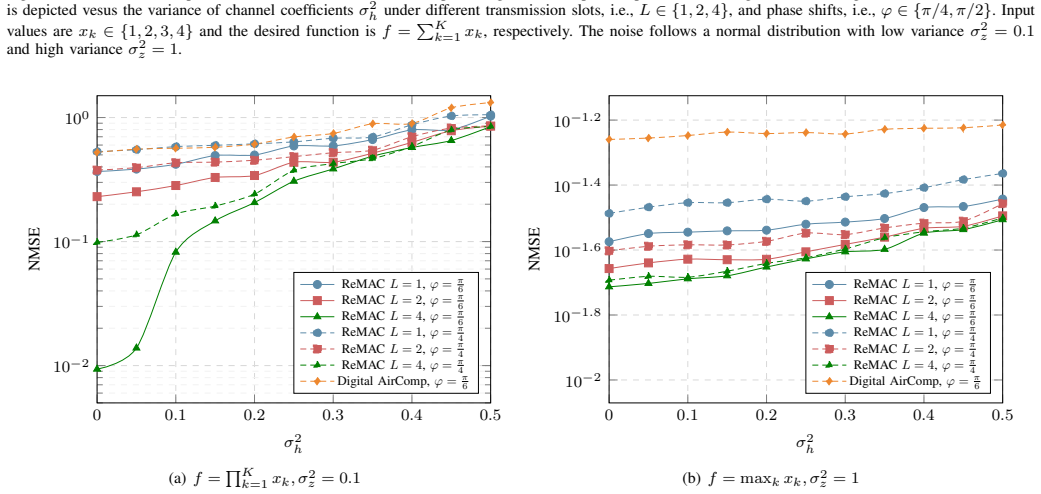
The central claim is that repetition resolves the destructive constellation-point overlaps that prevent a receiver from distinguishing function outputs. Whereas ChannelComp must redesign or enlarge the constellation when two input tuples with different outputs superimpose to the same point, ReMAC allocates each symbol to a subset of L time slots, so the aggregated points form an L-length sequence and equal points in a single slot can be separated by different patterns across slots. The paper formalizes this as an optimization problem that minimizes the total number of transmitted symbols subject to a lower bound on the squared distance between received sequences for distinct outputs, and solves it by alternating between a semidefinite relaxation for the constellation and a McCormick-based linear relaxation plus branch-and-bound for the binary repetition code. Numerical experiments report the 7.5 dB NMSE improvement for the product function under fading, with smaller but consistent gains for sum and maximum.
Load-bearing premise
The whole design stands on the assumption that enforcing distinct received sequences for one representative input tuple per function output value is enough to guarantee correct decoding for every possible input tuple, which is not automatically true for many-to-one functions.
Editorial extensions
If this is right
- ReMAC with more than one time slot strictly reduces NMSE compared with its own single-slot case (ChannelComp) for sum, product, and maximum functions under both noise and fading.
- For the product function under low fading variance, ReMAC reduces computation error by approximately 7.5 dB compared with ChannelComp.
- The alternating minimization converges to a first-order stationary point of the relaxed problem, with an optimality gap that shrinks as $O(1/n)$ and grows with the number of constraints in the original problem.
- ReMAC uses the same single frequency resource as ChannelComp, so it gains reliability through time diversity rather than extra bandwidth, at the cost of latency.
- The optimization is performed offline and stored, so the NP-hard design cost is paid once during system setup and reused in real-time operation.
Reading between the lines
- The representative-tuple constraint in Eq. (8a) could be augmented by an exhaustive verification step over all input tuples, since many-to-one functions may produce collisions among unrepresented tuples that the current constraint set misses.
- The time-slot repetition pattern generalizes directly to other resource dimensions such as frequency subcarriers or MIMO spatial streams, turning ReMAC into a generic resource-allocation code for computation.
- The 7.5 dB gain is demonstrated under perfect CSI and phase-aligned precoding; a natural test is to re-run the design with explicit precoding-error models, where the gap to ChannelComp may shrink and could motivate a co-designed pre-equalizer.
Signed reviews
Editorial analysis
A structured set of objections, weighed in public.
Referee Report
Summary. The paper proposes ReMAC, a digital over-the-air computation scheme in which each node repeats its modulated symbol over L time slots according to a binary on/off pattern, and the access point applies a tabular decoder to the L received symbols. The authors formulate an optimization problem that jointly designs the constellation points and the repetition code under separability constraints, relax it into SDP and LP subproblems, solve them by alternating minimization, and report simulations showing up to about 7.5 dB NMSE improvement over ChannelComp, especially for product functions. The manuscript also contains convergence and optimality-gap analyses for the proposed algorithm.
Significance. The core idea is a natural and potentially useful extension of the ChannelComp framework: adding time diversity through coded repetition while keeping digital modulation is practically relevant and the numerical comparisons against ChannelComp, bit-slicing, and digital AirComp are informative. The paper is largely self-contained, the optimization formulation is developed from scratch, and the authors provide code. If the correctness conditions were fully established, the proposed scheme would be a credible step toward reliable digital AirComp. However, as detailed below, the formal guarantees in the current manuscript are not yet established for the many-to-one functions that the paper actually targets, and the feasibility of the proposed optimization problem is questionable for the reported product-function experiments.
major comments (4)
- [Section II-B (Eqs. (3)-(6)) and Section III (Eq. (8a))] The many-to-one issue raised in the stress-test note is confirmed by the manuscript text. Equation (3) is stated over output values (i,j) in [M]^2, where M is the size of the range of f, but for the functions considered (sum, product, max) each output value has many preimage input tuples. In Eq. (6), v(i) is generated from a single binary support vector a_i, i.e., a single representative input tuple per output value, and constraint (8a) enforces separation only for these representatives. This does not prevent two non-representative tuples u and u' with f(u) != f(u') from producing the same noiseless received sequence v. The tabular decoder in Eq. (5) then assigns one output value to the merged Voronoi cell, so the computation is incorrect for such tuples even without noise. The manuscript nowhere proves, or even states as an assumption, that separating one representative per output value implies separation of all input tuples with different outputs. This is a load-bearing gap in the central claim that ReMAC guarantees valid function computation, and it also means the NMSE results in Figures 6-7 may depend on whether the random test inputs happen to avoid colliding tuples.
- [Eq. (8a)-(8b) and Fig. 4] The threshold in constraint (8a), Delta f_{i,j} = sigma_z^2 |f(i)-f(j)|, appears incompatible with the power constraint ||x||_2^2 <= 1 for the product-function experiment in Fig. 4(b). For K=4 and Q=256, the product range is enormous, so |f(i)-f(j)| can be on the order of 10^9. With ||x||^2 <= 1, the maximum possible value of the left-hand side in (8a) is bounded by a constant that depends only on N=QK and L (roughly on the order of 2KL), while the right-hand side can be orders of magnitude larger even at the SNRs shown in Fig. 4. As written, Problem P0 is therefore likely infeasible for that experiment, and Algorithm 1 cannot produce a feasible code satisfying (8a). The authors should either normalize the function values, reformulate the constraint in terms of constellation spacing rather than raw output differences, or explain why the reported solutions are feasible despite this scaling issue.
- [Appendix C (Eqs. (26)-(29))] The proof of Proposition 2 does not justify the claimed Lipschitz constant L1=1 for the indicator function id_{S3}(W). An indicator function of a closed convex set is not Lipschitz continuous, so the invocation of Theorem 2 of [54] with L1=1 is not supported as written. Since the convergence-rate statement is one of the paper's stated theoretical contributions, the argument needs to be repaired or the proposition needs to be restricted to assumptions under which the alternating minimization objective satisfies the required regularity conditions.
- [Section II-C, Remark 3] The remark assumes 1 < L < min{Q,K}, but the paper's own experiments use L=4 with K=4 in Fig. 4, which violates the stated strict inequality. The remark itself also discusses the case L=K as a legitimate operating point, so the assumption should be reformulated consistently with the experimental setup.
minor comments (4)
- [Section II-C] The statement that ReMAC does not lose spectral efficiency compared to ChannelComp is imprecise: the scheme uses L time slots instead of one, so it consumes more time resources; what is preserved is the use of a single frequency channel.
- [Eq. (6)] The vector a_i is not formally defined. In particular, the manuscript should specify whether it has exactly one nonzero entry per node (a representative tuple) or whether it aggregates multiple preimage tuples in some way, and how its length and sparsity relate to K and Q.
- [Eq. (14)] When W^n has rank greater than one, the rank-one approximation via the leading eigenvector is not accompanied by a bound on how much the approximation degrades the constraints in (8a). Adding such a bound would make the projection step more informative.
- [Fig. 5] The y-axis label 'Gap' is ambiguous. It would help to state explicitly in the caption that the numerical gap is the P2 objective difference at a fixed iteration count n and that the analytical gap is the bound from Proposition 2 evaluated at the same n.
Circularity Check
No significant circularity: ReMAC's 7.5 dB gain is an empirical comparison, and its optimization, relaxations, and convergence analysis are self-contained; the many-to-one representative-tuple issue is a correctness gap, not a circular reduction.
full rationale
The claimed derivation chain is not circular in the sense of deriving its output from its own inputs. The central performance claim (up to about 7.5 dB NMSE reduction over ChannelComp for product functions) is obtained by Monte Carlo simulation of the optimized ReMAC code, not by substituting the answer back into the optimization objective. The optimization problems P0-P4 and the alternating-minimization procedure are constructed in the paper from the system model, and Propositions 1-2 provide lower-bound and convergence arguments derived with standard relaxation and block-coordinate techniques. The references to ChannelComp [15], [34] supply the starting framework and the necessary separability condition in Eq. (3); that condition is a direct logical requirement (distinct function values must map to distinct noiseless received sequences) and is not used as an unverified black box. The self-citations are therefore not load-bearing for the new contribution. The substantive weakness is a correctness gap rather than circularity: in Eqs. (3), (6), and (8a), each output value i is represented by a single binary support vector a_i, so for many-to-one functions the optimized code is only guaranteed to separate the representative input tuples, not all input tuples with different function values. This is an overclaim about guaranteed validity, but it does not make the reported improvement equivalent to the optimization inputs by construction.
Assumptions & free parameters
free parameters (1)
- Separation threshold proportionality constant =
1 (implicit)
assumptions (4)
- domain assumption Idealized channel model: perfect CSI and optimal power control make the effective per-slot channel gain unity.
- ad hoc to paper The reduced constraint set over output values [M]^2, using one representative tuple per output, is sufficient to guarantee valid computation.
- standard math Nearest-neighbor Euclidean decoding is optimal under AWGN.
- domain assumption The alternating minimization applied to P3 and P4 converges to a first-order stationary point of the original problem, via the theorem in [54].
Cite this review
Pith. "Pith review of ReMAC:Digital Multiple Access Computing by Repeated Transmission." pith.science (2026). https://pith.science/paper/5USLQ5Y7
@misc{pith2026250208734,
  author       = {Pith},
  title        = {Pith review of: ReMAC:Digital Multiple Access Computing by Repeated Transmission},
  year         = {2026},
  howpublished = {\url{https://pith.science/paper/5USLQ5Y7}},
  note         = {Machine review of arXiv:2502.08734}
}
abstract
In this paper, we consider the ChannelComp framework, where multiple transmitters aim to compute a function of their values at a common receiver while using digital modulations over a multiple access channel. ChannelComp provides a general framework for computation by designing digital constellations for over-the-air computation. Currently, ChannelComp uses a symbol-level encoding. However, encoding repeated transmissions of the same symbol and performing the function computation using the corresponding received sequence may significantly improve the computation performance and reduce the encoding complexity. In this paper, we propose a new scheme where each transmitter repeats the transmission of the same symbol over multiple time slots while encoding such repetitions and designing constellation diagrams to minimize computational errors. We formally model such a scheme by an optimization problem, whose solution jointly identifies the constellation diagram and the repetition code. We call the proposed scheme ReMAC. To manage the computational complexity of the optimization, we divide it into two tractable subproblems. We verify the performance of ReMAC by numerical experiments. The simulation results reveal that ReMAC can reduce the computation error in noisy and fading channels by approximately up to 7.5$dB compared to standard ChannelComp, particularly for product functions.
Figures


Figures from the paper (5 more)



Reference graph
Works this paper leans on
-
[54]
On the convergence of block coordinate descent type methods,
A. Beck and L. Tetruashvili, “On the convergence of block coordinate descent type methods,” SIAM journal on Optimization , vol. 23, no. 4, pp. 2037–2060, 2013
2013
-
[1]
A novel channel coding scheme for digital multiple access computing,
X. Yan, S. Razavikia, and C. Fischione, “A novel channel coding scheme for digital multiple access computing,” inIEEE International Conference on Communications, 2024, pp. 3851–3857
2024
-
[2]
On the road to 6G: Visions, requirements, key technologies and testbeds,
C.-X. Wang, X. You, X. Gao, X. Zhu, Z. Li, C. Zhang, H. Wang, Y . Huang, Y . Chen, H. Haas et al. , “On the road to 6G: Visions, requirements, key technologies and testbeds,” IEEE Communications Surveys & Tutorials, 2023
work page 2023
-
[3]
Guest editorial: Ultra-low- latency and reliable communications for 6G networks,
S. Mumtaz, V . G. Menon, and M. I. Ashraf, “Guest editorial: Ultra-low- latency and reliable communications for 6G networks,” IEEE Commu- nications Standards Magazine , vol. 5, no. 2, pp. 10–11, 2021
work page 2021
-
[4]
Over- the-air computation: Foundations, technologies, and applications,
Z. Wang, Y . Zhao, Y . Zhou, Y . Shi, C. Jiang, and K. Letaief, “Over- the-air computation: Foundations, technologies, and applications,” arXiv preprint arXiv:2210.10524, 2022
arXiv 2022
-
[5]
Federated learning in mobile edge networks: A comprehensive survey,
W. Y . B. Lim, N. C. Luong, D. T. Hoang, Y . Jiao, Y .-C. Liang, Q. Yang, D. Niyato, and C. Miao, “Federated learning in mobile edge networks: A comprehensive survey,” IEEE Communications Surveys & Tutorials , vol. 22, no. 3, pp. 2031–2063, 2020
2020
-
[6]
L. Xie, S. Song, and K. B. Letaief, “Networked sensing with AI- empowered interference management: Exploiting macro-diversity and array gain in perceptive mobile networks,” IEEE Journal on Selected Areas in Communications , 2023
work page 2023
-
[7]
OFDMA: A broadband wireless access technology,
H. Yin and S. Alamouti, “OFDMA: A broadband wireless access technology,” in 2006 IEEE sarnoff symposium , 2006, pp. 1–4
work page 2006
Show all 56 references
-
[8]
A survey on over-the-air computation,
A. S ¸ahin and R. Yang, “A survey on over-the-air computation,” IEEE Communications Surveys & Tutorials , vol. 25, no. 3, pp. 1877–1908, 2023
1908
-
[9]
Waveforms for computing over the air,
A. P ´erez-Neira, M. Martinez-Gost, A. S ¸ahin, S. Razavikia, C. Fischione, and K. Huang, “Waveforms for computing over the air,” arXiv preprint arXiv:2405.17007, 2024
2024
-
[10]
Over-the-air computation for distributed systems: Something old and something new,
Z. Chen, E. G. Larsson, C. Fischione, M. Johansson, and Y . Malitsky, “Over-the-air computation for distributed systems: Something old and something new,” IEEE Network, 2023
2023
-
[11]
Harnessing interference for analog function computation in wireless sensor networks,
M. Goldenbaum, H. Boche, and S. Sta ´nczak, “Harnessing interference for analog function computation in wireless sensor networks,” IEEE Transactions on Signal Processing, vol. 61, no. 20, pp. 4893–4906, 2013
2013
-
[12]
Broadband digital over- the-air computation for asynchronous federated edge learning,
X. Zhao, L. You, R. Cao, Y . Shao, and L. Fu, “Broadband digital over- the-air computation for asynchronous federated edge learning,” in IEEE International Conference on Communications , 2022, pp. 5359–5364
2022
-
[13]
Federated learning over wireless fading channels,
M. M. Amiri and D. G ¨und¨uz, “Federated learning over wireless fading channels,” IEEE Transactions on Wireless Communications , vol. 19, no. 5, pp. 3546–3557, 2020
2020
-
[14]
Wireless for machine learning: A survey,
H. Hellstr ¨om, J. M. B. da Silva Jr, M. M. Amiri, M. Chen, V . Fodor, H. V . Poor, and C. Fischione, “Wireless for machine learning: A survey,” Foundations and Trends® in Signal Processing, vol. 15, no. 4, pp. 290– 399, 2022
2022
-
[15]
ChannelComp: A general method for computation by communications,
S. Razavikia, J. M. Barros da Silva, and C. Fischione, “ChannelComp: A general method for computation by communications,” IEEE Transac- tions on Communications , vol. 72, no. 2, pp. 692–706, 2024
2024
-
[16]
Computation over multiple-access channels,
B. Nazer and M. Gastpar, “Computation over multiple-access channels,” IEEE Transactions on Information Theory , vol. 53, no. 10, pp. 3498– 3516, 2007
2007
-
[17]
Compute-and-forward: Harnessing interference through struc- tured codes,
——, “Compute-and-forward: Harnessing interference through struc- tured codes,” IEEE Transactions on Information Theory, vol. 57, no. 10, pp. 6463–6486, 2011
2011
-
[18]
Nomographic functions: Efficient computation in clustered gaussian sensor networks,
M. Goldenbaum, H. Boche, and S. Sta ´nczak, “Nomographic functions: Efficient computation in clustered gaussian sensor networks,” IEEE Transactions on Wireless Communications , vol. 14, no. 4, pp. 2093– 2105, 2014
2014
-
[19]
On achievable rates for analog computing real-valued functions over the wireless channel,
M. Goldenbaum, S. Sta ´nczak, and H. Boche, “On achievable rates for analog computing real-valued functions over the wireless channel,” in IEEE International Conference on Communications , 2015, pp. 4036– 4041
2015
-
[20]
MIMO over-the-air computation for high- mobility multimodal sensing,
G. Zhu and K. Huang, “MIMO over-the-air computation for high- mobility multimodal sensing,” IEEE Internet of Things journal , vol. 6, no. 4, pp. 6089–6103, 2018
2018
-
[21]
Blind asynchronous over-the-air federated edge learning,
S. Razavikia, J. A. Peris, J. M. B. Da Silva, and C. Fischione, “Blind asynchronous over-the-air federated edge learning,” in IEEE Globecom Workshops, 2022, pp. 1834–1839
2022
-
[22]
Timely and painless breakups: Off-the-grid blind message recovery and users’ demixing,
S. Daei, S. Razavikia, M. Skoglund, G. Fodor, and C. Fischione, “Timely and painless breakups: Off-the-grid blind message recovery and users’ demixing,” arXiv preprint arXiv:2406.17393 , 2024
2024 arXiv
-
[23]
Power minimization for massive MIMO over-the-air computation with two-timescale hybrid beamform- ing,
X. Zhai, X. Chen, and Y . Cai, “Power minimization for massive MIMO over-the-air computation with two-timescale hybrid beamform- ing,” IEEE Wireless Communications Letters , vol. 10, no. 4, pp. 873– 877, 2020. 15
2020
-
[24]
Secure over-the-air computation using zero-forced artificial noise,
L. Maßny and A. Wachter-Zeh, “Secure over-the-air computation using zero-forced artificial noise,” in IEEE Information Theory Workshop , 2023, pp. 221–226
2023
-
[25]
Fundamental limits of over-the-air optimization: Are analog schemes optimal?
S. K. Jha, P. Mayekar, and H. Tyagi, “Fundamental limits of over-the-air optimization: Are analog schemes optimal?” IEEE Journal on Selected Areas in Information Theory , vol. 3, no. 2, pp. 217–228, 2022
2022
-
[26]
Over-the-air computation over balanced numer- als,
A. S ¸ahin and R. Yang, “Over-the-air computation over balanced numer- als,” in 2022 IEEE Globecom Workshops . IEEE, 2022, pp. 347–352
2022
-
[27]
Digital ver- sus analog transmissions for federated learning over wireless networks,
J. Yao, W. Xu, Z. Yang, X. You, M. Bennis, and H. V . Poor, “Digital ver- sus analog transmissions for federated learning over wireless networks,” arXiv preprint arXiv:2402.09657 , 2024
2024 arXiv
-
[28]
Blind feder- ated learning via over-the-air q-QAM,
S. Razavikia, J. M. B. D. S. J ´unior, and C. Fischione, “Blind feder- ated learning via over-the-air q-QAM,” IEEE Transactions on Wireless Communications, 2024
2024
-
[29]
One-bit over-the-air aggre- gation for communication-efficient federated edge learning: Design and convergence analysis,
G. Zhu, Y . Du, D. G ¨und¨uz, and K. Huang, “One-bit over-the-air aggre- gation for communication-efficient federated edge learning: Design and convergence analysis,” IEEE Transactions on Wireless Communications, vol. 20, no. 3, pp. 2120–2135, 2020
2020
-
[30]
Broadband digital over-the-air computation for wireless federated edge learning,
L. You, X. Zhao, R. Cao, Y . Shao, and L. Fu, “Broadband digital over-the-air computation for wireless federated edge learning,” IEEE Transactions on Mobile Computing , 2023
2023
-
[31]
Over-the-air majority vote computation with modulation on conjugate-reciprocal zeros,
A. S ¸ahin, “Over-the-air majority vote computation with modulation on conjugate-reciprocal zeros,” IEEE Transactions on Wireless Communi- cations, 2024
2024
-
[32]
Massive digital over-the-air computation for communication-efficient federated edge learning,
L. Qiao, Z. Gao, M. B. Mashhadi, and D. G ¨uund¨uz, “Massive digital over-the-air computation for communication-efficient federated edge learning,” IEEE Journal on Selected Areas in Communications , 2024
2024
-
[33]
signSGD: Compressed optimisation for non-convex problems,
J. Bernstein, Y .-X. Wang, K. Azizzadenesheli, and A. Anandkumar, “signSGD: Compressed optimisation for non-convex problems,” inInter- national Conference on Machine Learning. PMLR, 2018, pp. 560–569
2018
-
[34]
Computing functions over-the-air using digital modulations,
S. Razavikia, J. M. Barros da Silva, and C. Fischione, “Computing functions over-the-air using digital modulations,” in IEEE International Conference on Communications , 2023, pp. 5780–5786
2023
-
[35]
SumComp: Coding for digital over-the-air computation via the ring of integers,
S. Razavikia, J. M. B. D. S. J ´unior, and C. Fischione, “SumComp: Coding for digital over-the-air computation via the ring of integers,” IEEE Transactions on Communications , 2024
2024
-
[36]
Digital over-the-air compu- tation: Achieving high reliability via bit-slicing,
J. Liu, Y . Gong, and K. Huang, “Digital over-the-air compu- tation: Achieving high reliability via bit-slicing,” arXiv preprint arXiv:2404.07121, 2024
2024 arXiv
-
[37]
Joint design of coding and modulation for digital over-the-air computation,
X. Xie, C. Hua, J. Hong, and Y . Wei, “Joint design of coding and modulation for digital over-the-air computation,” arXiv preprint arXiv:2311.06829, 2023
2023 arXiv
-
[38]
Optimized power control for over-the-air computation in fading channels,
X. Cao, G. Zhu, J. Xu, and K. Huang, “Optimized power control for over-the-air computation in fading channels,” IEEE Transactions on Wireless Communications, vol. 19, no. 11, pp. 7498–7513, 2020
2020
-
[39]
Optimal power control for over-the-air computation,
——, “Optimal power control for over-the-air computation,” in 2019 IEEE Global Communications Conference , 2019, pp. 1–6
2019
-
[40]
Mobile lattice-coded physical-layer network coding with practical channel alignment,
Y . Tan, S. C. Liew, and T. Huang, “Mobile lattice-coded physical-layer network coding with practical channel alignment,” IEEE Transactions on Mobile Computing , vol. 17, no. 8, pp. 1908–1923, 2018
1908
-
[41]
Over-the-air aggregation for federated learning: Waveform superposition and prototype validation,
H. Guo, Y . Zhu, H. Ma, V . K. Lau, K. Huang, X. Li, H. Nong, and M. Zhou, “Over-the-air aggregation for federated learning: Waveform superposition and prototype validation,” Journal of Communications and Information Networks, vol. 6, no. 4, pp. 429–442, 2021
2021
-
[42]
Transmit beam- forming for physical-layer multicasting,
N. D. Sidiropoulos, T. N. Davidson, and Z.-Q. Luo, “Transmit beam- forming for physical-layer multicasting,” IEEE Transactions on Signal Processing, vol. 54, no. 6, pp. 2239–2251, 2006
2006
-
[43]
Semidefinite programming,
L. Vandenberghe and S. Boyd, “Semidefinite programming,” SIAM review, vol. 38, no. 1, pp. 49–95, 1996
1996
-
[44]
CVX: MATLAB software for disciplined convex programming, version 2.1,
M. Grant and S. Boyd, “CVX: MATLAB software for disciplined convex programming, version 2.1,” 2014
2014
-
[45]
Global optimization algorithm for mixed integer quadratically constrained quadratic program,
Y . Zhao and S. Liu, “Global optimization algorithm for mixed integer quadratically constrained quadratic program,” Journal of Computational and Applied Mathematics , vol. 319, pp. 159–169, 2017
2017
-
[46]
A simplicial branch-and-bound algorithm for solving quadratically constrained quadratic programs,
J. Linderoth, “A simplicial branch-and-bound algorithm for solving quadratically constrained quadratic programs,” Mathematical program- ming, vol. 103, pp. 251–282, 2005
2005
-
[47]
Optimization with Gurobi and Python,
J. P. Pedroso, “Optimization with Gurobi and Python,” INESC Porto and Universidade do Porto,, Porto, Portugal , vol. 1, 2011
2011
-
[48]
Alternating minimizations converge to second-order optimal solutions,
Q. Li, Z. Zhu, and G. Tang, “Alternating minimizations converge to second-order optimal solutions,” in International Conference on Ma- chine Learning. PMLR, 2019, pp. 3935–3943
2019
-
[49]
Ye, Interior point algorithms: theory and analysis
Y . Ye, Interior point algorithms: theory and analysis . John Wiley & Sons, 2011
2011
-
[50]
Antoniou and W.-S
A. Antoniou and W.-S. Lu, Practical optimization: algorithms and engineering applications. Springer, 2007, vol. 19
2007
-
[51]
L. N. Trefethen and D. Bau, Numerical linear algebra . SIAM, 2022
2022
-
[52]
Zhang, Branch-and-bound search algorithms and their computa- tional complexity
W. Zhang, Branch-and-bound search algorithms and their computa- tional complexity . University of Southern California, Information Sciences Institute, 1996
1996
-
[53]
De- terministic global optimization algorithm based on outer approximation for the parameter estimation of nonlinear dynamic biological systems,
A. Mir ´o, C. Pozo, G. Guill´en-Gos´albez, J. A. Egea, and L. Jim´enez, “De- terministic global optimization algorithm based on outer approximation for the parameter estimation of nonlinear dynamic biological systems,” BMC bioinformatics, vol. 13, no. 1, pp. 1–12, 2012
2012
-
[55]
A fast minimization algorithm for the Euler elastica model based on a bilinear decomposi- tion,
Z. Liu, B. Sun, X.-C. Tai, Q. Wang, and H. Chang, “A fast minimization algorithm for the Euler elastica model based on a bilinear decomposi- tion,” SIAM Journal on Scientific Computing , vol. 46, no. 1, pp. A290– A312, 2024
2024
-
[56]
SDP relaxation of homogeneous quadratic optimization: approximation,
Z.-Q. Luo, T.-H. Chang, D. Palomar, and Y . Eldar, “SDP relaxation of homogeneous quadratic optimization: approximation,” Convex Opti- mization in Signal Processing and Communications , vol. 117, 2010
2010
Reviewed August 7, 2026 · model on record in the stance chip above.
Discussion (0). Continue with ORCID to comment.