REVIEW 5 major objections 7 minor 24 references
Low-Resolution Neural Networks
T0 review · 5 major / 7 minor · reviewed 2026-08-07 · deepseek-v4-flash
Pith's one-line read Five weight levels match 32-bit accuracy at 12x less memory
desk verdict A systematic but single-run sweep of uniform grid quantization; the 2.32-bit optimality claim is undercut by an internal contradiction about stability. read the letter →
The pith
A machine-rendered reading of the paper's core claim, the machinery that carries it, and where it could break.
The reading
What carries the argument
The load-bearing mechanism is layer-wise weight quantization with a straight-through gradient estimator. Weights are normalized by a scaled layer mean, rounded to a fixed set of $N$ values according to equations (1) to (4), and used in the forward pass; in the backward pass the quantization step is bypassed via a no-gradient placeholder adapted from VQ-VAE training, so full-precision weights accumulate updates. The quantization grid is chosen so that $N=5$ values yield '2.32-bit' weights, and the key identity is that an odd $N$ includes zero, which the paper argues stabilizes training under augmentation.
What would settle it
Re-running the same architectures and resolutions with multiple random seeds and reporting validation-accuracy distributions would settle the claim; if the spread across seeds for 4-bit and 2.32-bit overlaps substantially, or if some seeds show 32-bit clearly beating 2.32-bit while others show the reverse, the claimed optimality would not survive. Training a 2.32-bit model on ImageNet or a large language task and finding it underperforms 32-bit by more than the CIFAR-10 margins would also test the generality claim.
Extended reading notes
Core claim
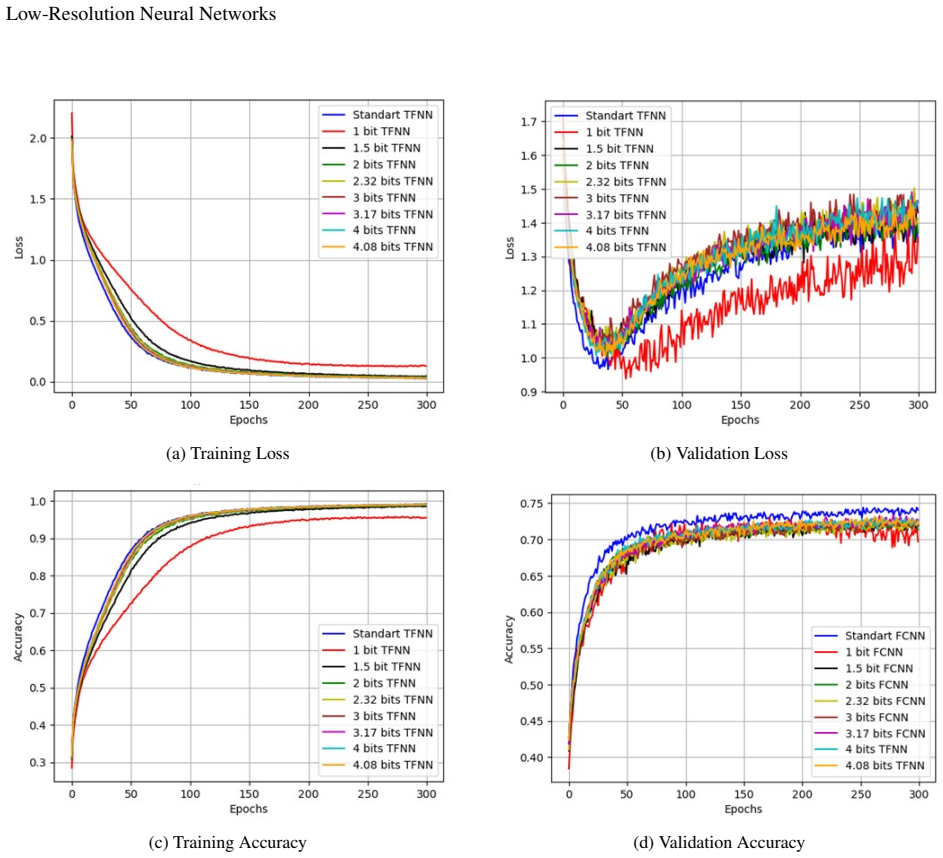
The central discovery is that low-resolution connection weights—quantized during the forward pass while full-precision weights are kept for gradient updates—yield accuracy nearly identical to 32-bit models on CIFAR-10, provided the resolution is at least 2.32 bits (five values: $-1$, $-0.5$, $0$, $0.5$, $1$) and the model is sufficiently large. Weight memory drops by a factor of 12 at this resolution under the paper's byte-based storage scheme. The paper further finds that including zero among the possible weight values stabilizes training, especially when data augmentation is used, and that low-resolution models with many parameters match 32-bit performance within the same number of epochs, while smaller models need more epochs.
Load-bearing premise
The conclusion that 2.32-bit weights are optimal rests on a single representative training run per configuration; the paper states that extensive repetitions produced similar outcomes, but provides no seeds, variance estimates, or final accuracy tables, so if run-to-run variance is large, the ranking of resolutions could change.
Editorial extensions
If this is right
- If the central claim is correct, weight memory can be cut by a factor of 12 (from 32-bit to 2.32-bit) on models like these with negligible accuracy loss, using a simple forward-pass change rather than post-training quantization or specialized training algorithms.
- The technique applies uniformly to fully connected, convolutional, and transformer architectures, so it could become a default low-memory training mode for image classifiers and, with further validation, for other modalities.
- Models with an odd number of quantized values, which include zero as a possible weight, should be preferred for low-bit training, since even-value grids show instability under data augmentation.
- Larger low-resolution models match 32-bit accuracy in the same number of epochs, suggesting that increasing parameter count can compensate for reduced bit width.
- Dedicated hardware that can efficiently multiply small integers is the missing piece for compute speedups; current 8-bit minimum storage granularity limits computational gains even though memory shrinks.
Reading between the lines
- The claimed optimality of 2.32-bit weights is established only on CIFAR-10; testing on ImageNet-scale classification or language modeling would show whether the result survives larger and more diverse tasks.
- Because the quantization grid is normalized by the layer mean, the grid is data-dependent; a testable extension would compare this scheme to a fixed global grid to isolate whether the stability benefit comes from including zero or from the normalization itself.
- The interaction between the straight-through estimator and odd versus even grids could be studied analytically: even grids without zero may create a biased gradient floor that contributes to training instability, a mechanism the paper does not investigate.
- The 12x memory reduction assumes a byte as the minimum storage unit, so storing five weights per byte requires an unpacking step at inference; the paper does not implement or benchmark that packing overhead.
Editorial analysis
A structured set of objections, weighed in public.
Referee Report
Summary. This manuscript studies the effect of quantizing connection weights to between 1 and 4.08 bits (2 to 17 levels) on image classification performance. The authors propose a simple quantization scheme with straight-through gradient approximation (Eqs. 1-4 and Algorithm 1), keeping full-precision latent weights during training, and evaluate fully connected, convolutional, and vision-transformer models on CIFAR-10 against 32-bit baselines. The reported learning curves suggest that several low-resolution configurations approach baseline accuracy, and the authors conclude that 2.32-bit weights (five levels) offer the optimal memory/performance balance and that including zero as a possible weight value stabilizes training under data augmentation. Section 7 provides a memory-reduction table for packed storage.
Significance. The paper addresses a relevant practical question and its central qualitative observation, if confirmed, would be a useful data point: standard architectures can tolerate very coarse weight quantization without specialized training algorithms. Covering three architecture families in a single comparison is a strength, and the packing argument behind the memory-reduction table is straightforward. However, the quantitative support is currently too thin to sustain the 'optimal balance' claim: no final accuracy numbers, error bars, or seed-level results are provided, and one of the stability claims is internally contradicted. The strengths are therefore conditional on a substantial empirical revision.
major comments (5)
- [Section 7; Section 6.2] Section 7 states that the 2.32-bit model demonstrates a 12-fold reduction in memory usage while maintaining stability during training across all model types. Section 6.2, however, explicitly reports that for the simpler VIT1 models under data augmentation, instability occurs in models with 1, 1.5, 2, 2.32, and 3-bit resolution weights. The blanket stability claim for 2.32-bit is therefore false on the paper's own evidence. The optimality conclusion must be restricted to the stable subset of configurations, or supported by additional evidence that the VIT1/2.32 instability is a harmless transient rather than a training failure.
- [Section 4.2] The entire comparison rests on single representative runs. The statement that extensive repetitions were conducted and consistently produced similar outcomes is not accompanied by seeds, variance estimates, or a table of final accuracies. Without this evidence, the ranking of 2.32-bit over neighboring resolutions (2-bit and 3.17-bit) and the augmentation-stability conclusions could be artifacts of run-to-run variation. Please provide multi-seed results (at least 5 seeds) for every configuration, including final test accuracies as mean plus/minus standard deviation.
- [Sections 5.2 and 6.2] The augmented-training comparisons are made after excluding models that show instability, e.g., only the low-resolution VIT models that do not exhibit training instability are said to match 32-bit models. This post-hoc selection conflates the quantization method with the choice of a favorable run. The paper should either report all runs and their stability status, or define a pre-specified criterion (e.g., convergence before epoch T) that is applied uniformly.
- [Section 5.2; Conclusion item 3] The claim that including zero among weight values improves stability is inferred from comparing models with odd and even Nvalues. Such comparisons change both the presence of zero and the number/position of quantization levels, so the effect cannot be attributed to zero alone. A controlled comparison holding the number of levels fixed (e.g., five levels with and without a zero value) is needed to support the mechanistic conclusion.
- [Section 2] The scaling parameter beta is fixed at 1.4 because it yields a uniform distribution for Nvalues=3, but the same beta is used for all Nvalues from 2 to 17. No sensitivity analysis is reported. Since the quantization grid depends on beta through Eq. (2), the conclusion that Nvalues=5 is optimal could be sensitive to this choice. Please report results for at least beta in {1.2, 1.4, 1.6, 1.8} for the Nvalues=4 and Nvalues=5 cases, or justify why beta is not a free parameter.
minor comments (7)
- [Section 1] There are typos such as 'This study study examines' and 'ideia' that should be corrected.
- [Table 1] The table lists 'convlutional' instead of 'convolutional'.
- [Algorithm 6] Line 17 of Algorithm 6 begins with 'matbf x3 =Dropout(...)', which appears to be a formatting/typing error; the intended assignment should use the variable defined in the previous line.
- [Algorithm 7] Line 1 says 'Retrives' instead of 'Retrieves'.
- [Section 5.1 and Algorithm 3] The text gives the FCNN2 layer widths as 512, 256, 128, and 10, but Algorithm 3 uses 1024, 512, 256, 128, and 10; the parameter count should be checked against the actual architecture.
- [References] Reference [14] appears to have an incorrect title; the cited NeurIPS 2016 paper is 'Binarized Neural Networks: Training Neural Networks with Weights and Activations Constrained to +1 or -1' rather than the title listed.
- [Section 6] The phrase 'Visual Transformer' should be 'Vision Transformer' for consistency with standard terminology and with the abbreviation VIT.
Circularity Check
No significant circularity: the paper's claims are empirical comparisons against a fixed 32-bit baseline, with no fitted parameter renamed as prediction and no load-bearing self-citation.
full rationale
The paper's central claims (lower-bit weights can match 32-bit performance; odd Nvalues including zero are more stable; 2.32-bit is the best balance) are inductive summaries of training curves across fixed quantization levels, not derivations from the paper's own assumptions. The quantization pipeline (Eqs. 1-4) is a stated method, not fitted to the conclusions, and β=1.4 is presented as a chosen hyperparameter with a stated rationale rather than a parameter tuned to produce the reported outcome. The memory-reduction table in Section 7 is straightforward arithmetic based on the chosen Nvalues, and the 'optimal balance' sentence is a qualitative ranking of the tested configurations, not a prediction forced by construction. References [22] and [24] are external prior work used to motivate the straight-through gradient estimator; there are no self-citations, author-imported uniqueness theorems, or ansatz-smuggling citations that carry the argument. The paper's internal inconsistency concerning 2.32-bit stability under augmentation (Section 6.2 lists 2.32 as unstable for VIT1, while Section 7 calls it stable across all model types) is a correctness and consistency concern, not a circularity concern. Because no load-bearing step reduces to its own inputs, the circularity score is 0.
Assumptions & free parameters
free parameters (4)
- beta (weight scaling factor) =
1.4
- learning rate =
0.001 (FCNN/CNN), 0.01 (VIT)
- data augmentation ranges =
shift +/-10%, zoom +/-20%, rotation +/-5 degrees, horizontal flip
- training epochs under augmentation =
1000 (FCNN/CNN), 2000 (VIT)
assumptions (5)
- domain assumption CIFAR-10 is representative enough that dataset choice does not significantly influence conclusions.
- domain assumption Straight-through gradient approximation is a valid way to train through quantized weights.
- ad hoc to paper Beta=1.4 is appropriate for all Nvalues from 2 to 17.
- ad hoc to paper Odd/even Nvalues comparisons isolate the effect of zero-valued weights.
- domain assumption Weight mean normalization is a suitable quantizer scale.
Cite this review
Pith. "Pith review of Low-Resolution Neural Networks." pith.science (2026). https://pith.science/paper/5HGEPRQG
@misc{pith2026250208795,
  author       = {Pith},
  title        = {Pith review of: Low-Resolution Neural Networks},
  year         = {2026},
  howpublished = {\url{https://pith.science/paper/5HGEPRQG}},
  note         = {Machine review of arXiv:2502.08795}
}
read the original abstract
The expanding scale of large neural network models introduces significant challenges, driving efforts to reduce memory usage and enhance computational efficiency. Such measures are crucial to ensure the practical implementation and effective application of these sophisticated models across a wide array of use cases. This study examines the impact of parameter bit precision on model performance compared to standard 32-bit models, with a focus on multiclass object classification in images. The models analyzed include those with fully connected layers, convolutional layers, and transformer blocks, with model weight resolution ranging from 1 bit to 4.08 bits. The findings indicate that models with lower parameter bit precision achieve results comparable to 32-bit models, showing promise for use in memory-constrained devices. While low-resolution models with a small number of parameters require more training epochs to achieve accuracy comparable to 32-bit models, those with a large number of parameters achieve similar performance within the same number of epochs. Additionally, data augmentation can destabilize training in low-resolution models, but including zero as a potential value in the weight parameters helps maintain stability and prevents performance degradation. Overall, 2.32-bit weights offer the optimal balance of memory reduction, performance, and efficiency. However, further research should explore other dataset types and more complex and larger models. These findings suggest a potential new era for optimized neural network models with reduced memory requirements and improved computational efficiency, though advancements in dedicated hardware are necessary to fully realize this potential.
Figures


Figures from the paper (10 more)




Reference graph
Works this paper leans on
-
[1]
Cost-efficient sharing algorithms for dnn model serving in mobile edge networks
Hao Dai, Jiashu Wu, Yang Wang, Jerome Yen, Yong Zhang, and Chengzhong Xu. Cost-efficient sharing algorithms for dnn model serving in mobile edge networks. IEEE Transactions on Services Computing, 16(4):2517–2531, 2023. 21 Low-Resolution Neural Networks
work page 2023
-
[2]
Gopalakrishnan, and Pritish Narayanan
Suyog Gupta, Ankur Agrawal, K. Gopalakrishnan, and Pritish Narayanan. Deep learning with limited numerical precision. In International Conference on Machine Learning , 2015
work page 2015
-
[3]
Binaryconnect: training deep neural networks with binary weights during propagations
Matthieu Courbariaux, Yoshua Bengio, and Jean-Pierre David. Binaryconnect: training deep neural networks with binary weights during propagations. In Proceedings of the 28th International Conference on Neural Information Processing Systems - V olume 2, NIPS’15, page 3123–3131, Cambridge, MA, USA, 2015. MIT Press
work page 2015
-
[4]
J. Moosmann, H. Müler, N. Zimmerman, G. Rutishauser, L. Benini, and M. Magno. Flexible and fully quantized lightweight tinyissimoyolo for ultra-low-power edge systems. IEEE Access, 12:75093–75107, 2024
work page 2024
-
[5]
Post-training quantization for vision transformer
Zhenhua Liu, Yunhe Wang, Kai Han, Wei Zhang, Siwei Ma1, and Wen Gao. Post-training quantization for vision transformer. In Proceedings of the 35th Conference on Neural Information Processing Systems , NeurIPS, 2021
work page 2021
-
[6]
Ruihao Gong, Yang Yong, Shiqiao Gu, Yushi Huang, Yunchen Zhang, Xianglong Liu, and Dacheng Tao. Llm- qbench: A benchmark towards the best practice for post-training quantization of large language models. arXiv preprint arXiv:2405.06001v1, 2024
arXiv 2024
- [7]
-
[8]
João Paulo C. de Lima and Luigi Carro. Quantization-aware in-situ training for reliable and accurate edge ai. In 2022 Design, Automation & Test in Europe Conference & Exhibition (DATE) , 2022
work page 2022
Show all 24 references
-
[9]
Neural network quantization with ai model efficiency toolkit (aimet)
Sangeetha Siddegowda, Marios Fournarakis, Markus Nagel, Tijmen Blankevoort, Chirag Patel, and Abhijit Khobare. Neural network quantization with ai model efficiency toolkit (aimet). arXiv arXiv:2201.08442v1, 2022
2022 arXiv
-
[10]
Training high-performance and large-scale deep neural networks with full 8-bit integers
Yukuan Yang, Lei Deng, Shuang Wu, Tianyi Yan, Yuan Xie, and Guoqi Li. Training high-performance and large-scale deep neural networks with full 8-bit integers. Neural Networks, 125:70–82, 2020
2020
-
[11]
Mixed-precision quantized neural networks with progres- sively decreasing bitwidth
Tianshu Chu, Qin Luo, Jie Yang, and Xiaolin Huang. Mixed-precision quantized neural networks with progres- sively decreasing bitwidth. Pattern Recognition, 111:107647, 2021
2021
-
[12]
Binary neural networks: A survey
Haotong Qin, Ruihao Gong, Xianglong Liu, Xiao Bai, Jingkuan Song, and Nicu Sebe. Binary neural networks: A survey. Pattern Recognition, 105:107281, 2020
2020
-
[13]
Binarized neural networks: Training neural networks with weights and activations constrained to +1 or 1
Matthieu Courbariaux, Itay Hubara, Daniel Soudry, Ran El-Yaniv, and Yoshua Bengio. Binarized neural networks: Training neural networks with weights and activations constrained to +1 or 1. arXiv arXiv:1602.02830v3, 2016
2016 arXiv
-
[14]
Quantization-aware in-situ training for reliable and accurate edge ai
Itay Hubara, Matthieu Courbariaux, Daniel Soudry, Ran El-Yaniv, and Yoshua Bengio. Quantization-aware in-situ training for reliable and accurate edge ai. In Proceedings of the 30th Conference on Neural Information Processing Systems, NeurIPS 2016, 2022
2016
-
[15]
Xnor-net: Imagenet classification using binary convolutional neural networks
Mohammad Rastegari, Vicente Ordonez, Joseph Redmon, and Ali Farhadi. Xnor-net: Imagenet classification using binary convolutional neural networks. CoRR, abs/1603.05279, 2016
2016 arXiv
-
[16]
Gxnor-net: Training deep neural networks with ternary weights and activations without full-precision memory under a unified discretization framework
Lei Deng, Peng Jiao, Jing Pei, Zhenzhi Wu, and Guoqi Li. Gxnor-net: Training deep neural networks with ternary weights and activations without full-precision memory under a unified discretization framework. Neural Networks, 100:49–58, 2018
2018
-
[17]
Bitnet: Scaling 1-bit transformers for large language models
Hongyu Wang, Shuming Ma, Li Dong, Shaohan Huang, Lingxiao Ma Huaijie Wang, Fan Yang, Ruiping Wang, Yi Wu, and Furu Wei. Bitnet: Scaling 1-bit transformers for large language models. arXiv arXiv:2310.11453v1, 2023
2023 arXiv
-
[18]
Controlling information capacity of binary neural network
Dmitry Ignatov and Andrey Ignatov. Controlling information capacity of binary neural network. Pattern Recognition Letters, 138:276–281, 2020
2020
-
[19]
Bdnn: Binary convolution neural networks for fast object detection
Hanyu Peng and Shifeng Chen. Bdnn: Binary convolution neural networks for fast object detection. Pattern Recognition Letters, 125:91–97, 2019
2019
-
[20]
Zhiqiang Tang, Xi Peng, Kang Li, and Dimitris N. Metaxas. Towards efficient u-nets: A coupled and quantized approach. IEEE Transactions on Pattern Analysis and Machine Intelligence , 42(8):2038–2050, 2020
2020
-
[21]
The era of 1-bit LLMs: All large language models are in 1.58 bits
Shuming Ma, Hongyu Wang, Lingxiao Ma, Lei Wang, Wenhui Wang, Shaohan Huang, Li Dong, Ruiping Wang, Jilong Xue, and Furu Wei. The era of 1-bit LLMs: All large language models are in 1.58 bits. arXiv arXiv:2402.17764v1, 2024
2024 arXiv
-
[22]
Neural discrete representation learning
Aäron van den Oord, Oriol Vinyals, and Koray Kavukcuoglu. Neural discrete representation learning. CoRR, abs/1711.00937, 2017
2017 arXiv
-
[23]
Learning multiple layers of features from tiny images
Alex Krizhevsky. Learning multiple layers of features from tiny images. Technical report, Computer Science Department, University of Toronto, 2009
2009
-
[24]
neural discrete repre- sentation learning
Michael A. Alcorn. A minimal pytorch implementation of the VQ-V AE model described in "neural discrete repre- sentation learning". https://github.com/airalcorn2/vqvae-pytorch?tab=readme-ov-file , 2023. 22
2023
Reviewed August 7, 2026 · model on record in the stance chip above.
Discussion (0). Continue with ORCID to comment.