REVIEW 5 major objections 4 minor 50 references
PLayer-FL: A Principled Approach to Personalized Layer-wise Cross-Silo Federated Learning
T0 review · 5 major / 4 minor · reviewed 2026-08-07 · deepseek-v4-flash
Pith's one-line read PLayer-FL shows that a federation-sensitivity score computed from first-epoch weights and gradients reliably picks which layers to share across clients, and that splitting there beats existing personalized federated learning methods on…
desk verdict A practical, data-driven split selector for partial FL with a broad empirical study, but the 'optimal split' claim outruns the evidence and the threshold t is never reported. read the letter →
The pith
A machine-rendered reading of the paper's core claim, the machinery that carries it, and where it could break.
The reading
What carries the argument
The federation sensitivity of layer l is F_l(Θ) = Σ_{k=1}^l (1/n_k) Σ_{p=1}^{n_k} (θ_p ∇θ_p)^2, a cumulative, per-parameter-normalized version of the pruning-importance score (θ∇θ)^2. The split point is the smallest layer p where the ratio F_{p+1}/F_p exceeds a threshold t, after aggregating sensitivities across clients. This carries the argument by converting 'safe to federate' into a first-order, computationally cheap quantity that emerges after one epoch and aligns with loss-landscape and representational measures of generalizability.
What would settle it
Run an exhaustive search over all possible split points on the paper's seven datasets; if any split other than the one picked by federation sensitivity achieves higher mean F1 without worsening fairness, the central claim that the metric identifies the optimal federation boundary is falsified.
Extended reading notes
Core claim
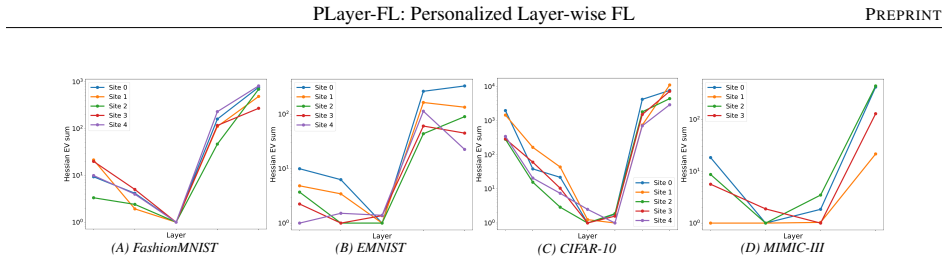
The central discovery is that the layer-wise sum of squared weight-gradient products, normalized per parameter and accumulated from the input, spikes precisely where gradient variance, Hessian eigenvalue sum, and representational similarity indicate the transition from generalizable to task-specific layers. PLayer-FL uses this spike to partition the model after one epoch: early layers are federated, later layers stay local. The paper reports that PLayer-FL achieves the best average rank across seven non-IID datasets, with lower variance across clients and higher participation incentive than FedAvg, FedProx, pFedMe, Ditto, local adaptation, and existing partial-FL baselines.
Load-bearing premise
The whole approach hangs on the assumption that the layer where the one-epoch sensitivity score first spikes is the best place to stop federating for the rest of training, and that a single threshold value works across all datasets and architectures.
Editorial extensions
If this is right
- Partial federated learning no longer needs architecture-specific rules; the same split-selection procedure works on convolutional, fully connected, and transformer models.
- The split is decided during the first epoch, adding only O(P) parameter-level and O(L) layer-level computations, so PLayer-FL has the same asymptotic complexity as FedAvg.
- Because PLayer-FL only chooses which layers to federate, it can be combined with other personalized federated learning algorithms without changing their local update rules.
- If the metric behaves as reported, cross-silo participants can expect more equitable gains and a higher percentage of clients beating both local-only and FedAvg baselines, which strengthens the incentive to join a federation.
- The demonstrated correlation with gradient variance and representational similarity suggests the metric could serve as a general diagnostic for when federation is beneficial, beyond the specific split-selection task.
Reading between the lines
- A natural extension the paper does not test is whether the first-epoch split remains optimal over the full training trajectory; the metric could be recomputed periodically to detect drift, but no evidence is given that it would change.
- The paper never reports the value of threshold t; fixing a canonical default (or a public tuning procedure) would make the method reproducible across architectures and datasets.
- An exhaustive search over all split points on the paper's own datasets would quantify how close the federation-sensitivity split is to the best possible split, a comparison the paper omits.
- If the one-epoch emergence holds, the same sensitivity score could be applied in cross-device settings using a small proxy round or a public calibration dataset, though the paper deliberately scopes itself to cross-silo FL.
Editorial analysis
A structured set of objections, weighed in public.
Referee Report
Summary. The paper proposes PLayer-FL, a partial federated learning algorithm that uses a novel federation-sensitivity metric to select which layers to federate. The metric, inspired by model pruning, is defined as the cumulative, layer-size-normalized (θ·∇θ)^2 importance, computed after a single training epoch. The split point is chosen at the first layer where the relative sensitivity between consecutive layers exceeds a threshold t (Eq. 3, Algorithm 3). The paper first presents a layer-wise generalization analysis using gradient variance, Hessian eigenvalue sums, and CKA, and then evaluates PLayer-FL on seven datasets spanning imaging, tabular, and NLP modalities, comparing against local training, FedAvg, several personalized FL baselines, and a PLayer-FL-Random control. The evaluation reports macro-F1, accuracy, loss, fairness, and incentivization metrics, with Friedman significance tests, and claims that PLayer-FL is competitive or superior across tasks, fairer, and more likely to incentivize participation.
Significance. If validated, PLayer-FL would provide a computationally cheap and architecture-agnostic way to decide layer-wise federation in cross-silo FL, replacing ad-hoc heuristics. The empirical effort is substantial: seven datasets, ten baselines, three metrics, multiple runs, and statistical testing. The inclusion of the PLayer-FL-Random control is a sound experimental design choice. However, the central claim that the method identifies the 'optimal' split point is not yet supported because the threshold t is never reported, the purported threshold stability is not quantified, and the claimed strong correlation with generalization measures is asserted without reported correlation coefficients. These gaps make it difficult to reproduce the method or verify its central message.
major comments (5)
- [Section 6, Algorithm 3, Eq. (3)] The threshold t is a free input to Algorithm 3 and determines the split point, but its value is never reported for any dataset or experiment. The only justification for using a single threshold is the sentence in Section 6: 'we found in our experiments that the transition point remains stable across a wide range of threshold values (Figure 4).' Figure 4, however, plots federation sensitivity against layer index for one epoch and contains no threshold sweep or quantitative stability data. Without reporting the actual t values used, the results are not reproducible, and the abstract's claim that PLayer-FL 'chooses the optimal split point' is not established.
- [Section 5.3, Eq. (3)] Equation (3) as displayed, 'Fp+1(Θc)Fp(Θ) > t', mixes a client-level quantity F_{p+1}(Θ_c) with the aggregated F_p(Θ) and appears to be missing a division operator. The surrounding text describes a comparison of 'relative federation sensitivity between consecutive layers,' which suggests the intended expression is F_{p+1}(Θ)/F_p(Θ) > t, evaluated on the aggregated sensitivity. This should be corrected and stated consistently in both the equation and Algorithm 3.
- [Section 5.3 and Abstract] The Abstract claims that the federation sensitivity metric 'correlates strongly with established generalization measures across diverse architectures,' but no correlation coefficients or significance tests are reported in the manuscript. Figures 1–4 and A.1–A.10 show visual alignment, but visual inspection does not quantify the strength of the relationship. A quantitative correlation analysis (e.g., Spearman rank correlation between the transition point and the generalization metrics, or between layer-wise sensitivity and layer-wise gradient variance) should be added to support this specific claim.
- [Section A.4, Table A.3] Table A.3 lists learning rates for 'PLayer-FL-1' and 'PLayer-FL+1', but no experimental results for these variants are reported anywhere in the paper, including in the accuracy, F1, loss, fairness, or incentivization tables. If these variants were run as ablations to show that the chosen split is near-optimal within a ±1 layer neighborhood, their results must be presented; if they were not run, the rows should be removed or the text should explain why they are listed.
- [Abstract and Section 2] The term 'optimal split point' is used without an explicit optimization objective or a comparison to an oracle or exhaustive search over all possible split points. The PLayer-FL-Random control tests the value of the specific split relative to a random one, but it does not establish optimality. The claims should either be softened to 'a data-driven split that consistently performs well' or supported by an exhaustive split search or oracle-based comparison on at least one dataset.
minor comments (4)
- [Section 7.1.2 and Tables] The algorithm name is spelled 'pFedMe' in tables and 'pFedME' in the text (Section 7.1.2); please unify the spelling for consistency.
- [Section 3.2] The sentence 'a different focus from that of partial FL- the underlying principles still hold relevance' contains an awkward en-dash construction; please revise for readability.
- [Table A.2 caption] The caption ends with 'Of note,' which is an incomplete sentence; either complete the thought or remove the phrase.
- [Section A.1.6] Equation (A.6) defines incentivization as I{P_c > max(S_c, G_c)}, but the text says 'the percentage of clients that outperform their local site model or global model.' The word 'or' is ambiguous; if the intent is to outperform either, the max formula is correct but should be stated as 'either,' and if the intent is both, the formula should use min.
Circularity Check
No demonstrated circularity: the federation-sensitivity split is computed from first-epoch weights and gradients rather than fitted to final performance; the undisclosed threshold t is a reproducibility gap, not a proven circular reduction.
full rationale
The derivation chain is not circular on the evidence in the manuscript. PLayer-FL's split point is chosen by Eq. 3 from a cumulative, layer-size-normalized (theta * gradient)^2 score (Eq. 2) computed after one epoch, before any federation or final-performance feedback; the paper does not report fitting the metric to the test metrics in Tables 1, A.5, or A.12. The metric is explicitly an adaptation of the pruning importance measure of Molchanov et al. (Eq. 1), so the novelty claim is a transparent reinterpretation rather than a hidden renaming. The main weakness is the threshold t in Algorithm 1/3: t is an input whose values are never reported, and the Section 6 sentence 'the transition point remains stable across a wide range of threshold values (Figure 4)' is not backed by a figure plotting transition point vs t. If t had been tuned to validation/test performance, the reported splits would be partially fitted; the manuscript presents no evidence of such tuning, and per the hard rules this cannot be upgraded to a circularity finding without that evidence. This is a reproducibility/correctness gap, not a demonstrated equivalence of input and output. Because the central claim is benchmarked against external baselines using a Friedman test and the metric is not calibrated to those outcomes, no circular step reaches the threshold required to raise the score.
Assumptions & free parameters
free parameters (1)
- threshold t =
not reported
assumptions (4)
- domain assumption Layers with flatter loss landscapes (lower gradient variance or Hessian eigenvalue sum) are more generalizable and safer to federate.
- domain assumption Early layers learn transferable, task-agnostic features while later layers are task-specific.
- ad hoc to paper Federated weight aggregation can be modeled as a perturbation akin to pruning, so the pruning importance (theta * gradient)^2 measures a layer's sensitivity to federation.
- domain assumption First-epoch statistics are retained throughout training, so the split can be decided after one epoch.
Cite this review
Pith. "Pith review of PLayer-FL: A Principled Approach to Personalized Layer-wise Cross-Silo Federated Learning." pith.science (2026). https://pith.science/paper/PTVYOXXM
@misc{pith2026250208829,
  author       = {Pith},
  title        = {Pith review of: PLayer-FL: A Principled Approach to Personalized Layer-wise Cross-Silo Federated Learning},
  year         = {2026},
  howpublished = {\url{https://pith.science/paper/PTVYOXXM}},
  note         = {Machine review of arXiv:2502.08829}
}
read the original abstract
Federated learning (FL) with non-IID data often degrades client performance below local training baselines. Partial FL addresses this by federating only early layers that learn transferable features, but existing methods rely on ad-hoc, architecture-specific heuristics. We first conduct a systematic analysis of layer-wise generalization dynamics in FL, revealing an early-emerging transition between generalizable (safe-to-federate) and task-specific (should-remain-local) layers. Building on this, we introduce Principled Layer-wise Federated Learning (PLayer-FL), which aims to deliver the benefits of federation more robustly. PLayer-FL computes a novel federation-sensitivity metric efficiently after a single training epoch to choose the optimal split point for a given task. Inspired by model pruning, the metric quantifies each layer's robustness to aggregation and highlights where federation shifts from beneficial to detrimental. We show that this metric correlates strongly with established generalization measures across diverse architectures. Crucially, experiments demonstrate that PLayer-FL achieves consistently competitive performance across a wide range of tasks while distributing gains more equitably and reducing client-side regressions relative to baselines.
Figures


Figures from the paper (1 more)

Reference graph
Works this paper leans on
-
[1]
Federated learning with personalization layers
Manoj Ghuhan Arivazhagan, Vinay Aggarwal, Aaditya Kumar Singh, and Sunav Choudhary. Federated learning with personalization layers. arXiv preprint arXiv:1912.00818, 2019
arXiv 1912
-
[2]
Federated learning with hierarchical clustering of local updates to improve training on non-iid data
Christopher Briggs, Zhong Fan, and Peter Andras. Federated learning with hierarchical clustering of local updates to improve training on non-iid data. In 2020 International Joint Conference on Neural Networks (IJCNN), pages 1–9. IEEE, 2020
work page 2020
-
[3]
Leaf: A benchmark for federated settings
Sebastian Caldas, Sai Meher Karthik Duddu, Peter Wu, Tian Li, Jakub Koneˇcn`y, H Brendan McMahan, Virginia Smith, and Ameet Talwalkar. Leaf: A benchmark for federated settings. arXiv preprint arXiv:1812.01097, 2018
arXiv 2018
-
[4]
Entropy-sgd: Biasing gradient descent into wide valleys
Pratik Chaudhari, Anna Choromanska, Stefano Soatto, Yann LeCun, Carlo Baldassi, Christian Borgs, Jennifer Chayes, Levent Sagun, and Riccardo Zecchina. Entropy-sgd: Biasing gradient descent into wide valleys. Journal of Statistical Mechanics: Theory and Experiment, 2019(12):124018, 2019
2019
-
[5]
Shallowing deep networks: Layer-wise pruning based on feature representations
Shi Chen and Qi Zhao. Shallowing deep networks: Layer-wise pruning based on feature representations. IEEE transactions on pattern analysis and machine intelligence, 41(12):3048–3056, 2018
work page 2018
-
[6]
To federate or not to federate: Incentivizing client participation in federated learning
Yae Jee Cho, Divyansh Jhunjhunwala, Tian Li, Virginia Smith, and Gauri Joshi. To federate or not to federate: Incentivizing client participation in federated learning. arXiv preprint arXiv:2205.14840, 2022. 9 PLayer-FL: Personalized Layer-wise FL PREPRINT
arXiv 2022
-
[7]
Exploiting shared representations for personalized federated learning
Liam Collins, Hamed Hassani, Aryan Mokhtari, and Sanjay Shakkottai. Exploiting shared representations for personalized federated learning. In International conference on machine learning, pages 2089–2099. PMLR, 2021
2021
-
[8]
Federated learning for predicting clinical outcomes in patients with covid-19
Ittai Dayan, Holger R Roth, Aoxiao Zhong, Ahmed Harouni, Amilcare Gentili, Anas Z Abidin, Andrew Liu, Anthony Beardsworth Costa, Bradford J Wood, Chien-Sung Tsai, et al. Federated learning for predicting clinical outcomes in patients with covid-19. Nature medicine, 27(10):1735–1743, 2021
2021
Show all 50 references
-
[9]
Statistical comparisons of classifiers over multiple data sets
Janez Demˇsar. Statistical comparisons of classifiers over multiple data sets. The Journal of Machine learning research, 7:1–30, 2006
2006
-
[10]
Fedu: A unified framework for federated multi-task learning with laplacian regularization
Canh T Dinh, Tung T Vu, Nguyen H Tran, Minh N Dao, and Hongyu Zhang. Fedu: A unified framework for federated multi-task learning with laplacian regularization. arXiv preprint arXiv:2102.07148, 400, 2021
2021 arXiv
-
[11]
New metrics to evaluate the performance and fairness of personalized federated learning
Siddharth Divi, Yi-Shan Lin, Habiba Farrukh, and Z Berkay Celik. New metrics to evaluate the performance and fairness of personalized federated learning. arXiv preprint arXiv:2107.13173, 2021
2021 arXiv
-
[12]
Learning to prune deep neural networks via layer-wise optimal brain surgeon
Xin Dong, Shangyu Chen, and Sinno Pan. Learning to prune deep neural networks via layer-wise optimal brain surgeon. Advances in neural information processing systems, 30, 2017
2017
-
[13]
Astraea: Self-balancing federated learning for improving classification accuracy of mobile deep learning applications
Moming Duan, Duo Liu, Xianzhang Chen, Yujuan Tan, Jinting Ren, Lei Qiao, and Liang Liang. Astraea: Self-balancing federated learning for improving classification accuracy of mobile deep learning applications. In 2019 IEEE 37th international conference on computer design (ICCD)...
2019
-
[14]
Layer-wise model pruning based on mutual information
Chun Fan, Jiwei Li, Xiang Ao, Fei Wu, Yuxian Meng, and Xiaofei Sun. Layer-wise model pruning based on mutual information. arXiv preprint arXiv:2108.12594, 2021
2021 arXiv
-
[15]
Learning both weights and connections for efficient neural network
Song Han, Jeff Pool, John Tran, and William Dally. Learning both weights and connections for efficient neural network. Advances in neural information processing systems, 28, 2015
2015
-
[16]
Cross-silo federated learning: Challenges and opportunities
Chao Huang, Jianwei Huang, and Xin Liu. Cross-silo federated learning: Challenges and opportunities. arXiv preprint arXiv:2206.12949, 2022
2022 arXiv
-
[17]
Fantastic generalization measures and where to find them
Yiding Jiang, Behnam Neyshabur, Hossein Mobahi, Dilip Krishnan, and Samy Bengio. Fantastic generalization measures and where to find them. arXiv preprint arXiv:1912.02178, 2019
1912 arXiv
-
[18]
Mimic-iii, a freely accessible critical care database
Alistair EW Johnson, Tom J Pollard, Lu Shen, Li-wei H Lehman, Mengling Feng, Mohammad Ghassemi, Benjamin Moody, Peter Szolovits, Leo Anthony Celi, and Roger G Mark. Mimic-iii, a freely accessible critical care database. Scientific data, 3(1):1–9, 2016
2016
-
[19]
Advances and open problems in federated learning
Peter Kairouz, H Brendan McMahan, Brendan Avent, Aur ´elien Bellet, Mehdi Bennis, Arjun Nitin Bhagoji, Kallista Bonawitz, Zachary Charles, Graham Cormode, Rachel Cummings, et al. Advances and open problems in federated learning. Foundations and trends® in machine learning, 14(...
2021
-
[20]
Similarity of neural network representations revisited
Simon Kornblith, Mohammad Norouzi, Honglak Lee, and Geoffrey Hinton. Similarity of neural network representations revisited. In International conference on machine learning, pages 3519–3529. PMLR, 2019
2019
-
[21]
Optimal brain damage
Yann LeCun, John Denker, and Sara Solla. Optimal brain damage. Advances in neural information processing systems, 2, 1989
1989
-
[22]
Layer-wise adaptive model aggregation for scalable federated learning
Sunwoo Lee, Tuo Zhang, and A Salman Avestimehr. Layer-wise adaptive model aggregation for scalable federated learning. In Proceedings of the AAAI Conference on Artificial Intelligence, volume 37, pages 8491–8499, 2023
2023
-
[23]
Federated learning on non-iid data silos: An experimental study
Qinbin Li, Yiqun Diao, Quan Chen, and Bingsheng He. Federated learning on non-iid data silos: An experimental study. In 2022 IEEE 38th International Conference on Data Engineering (ICDE), pages 965–978. IEEE, 2022
2022
-
[24]
Federated optimization in heterogeneous networks
Tian Li, Anit Kumar Sahu, Manzil Zaheer, Maziar Sanjabi, Ameet Talwalkar, and Virginia Smith. Federated optimization in heterogeneous networks. Proceedings of Machine learning and systems, 2:429–450, 2020
2020
-
[25]
Ditto: Fair and robust federated learning through personalization
Tian Li, Shengyuan Hu, Ahmad Beirami, and Virginia Smith. Ditto: Fair and robust federated learning through personalization. In International Conference on Machine Learning, pages 6357–6368. PMLR, 2021
2021
-
[26]
Convergent learning: Do different neural networks learn the same representations? arXiv preprint arXiv:1511.07543, 2015
Yixuan Li, Jason Yosinski, Jeff Clune, Hod Lipson, and John Hopcroft. Convergent learning: Do different neural networks learn the same representations? arXiv preprint arXiv:1511.07543, 2015
2015 arXiv
-
[27]
Learning efficient convolutional networks through network slimming
Zhuang Liu, Jianguo Li, Zhiqiang Shen, Gao Huang, Shoumeng Yan, and Changshui Zhang. Learning efficient convolutional networks through network slimming. In Proceedings of the IEEE international conference on computer vision, pages 2736–2744, 2017
2017
-
[28]
Rethinking the value of network pruning
Zhuang Liu, Mingjie Sun, Tinghui Zhou, Gao Huang, and Trevor Darrell. Rethinking the value of network pruning. arXiv preprint arXiv:1810.05270, 2018. 10 PLayer-FL: Personalized Layer-wise FL PREPRINT
2018 arXiv
-
[29]
Layer-wised model aggregation for personalized federated learning
Xiaosong Ma, Jie Zhang, Song Guo, and Wenchao Xu. Layer-wised model aggregation for personalized federated learning. In Proceedings of the IEEE/CVF conference on computer vision and pattern recognition , pages 10092–10101, 2022
2022
-
[30]
Understanding deep convolutional networks
St´ephane Mallat. Understanding deep convolutional networks. Philosophical Transactions of the Royal Society A: Mathematical, Physical and Engineering Sciences, 374(2065):20150203, 2016
2016
-
[31]
Three approaches for personalization with applications to federated learning
Yishay Mansour, Mehryar Mohri, Jae Ro, and Ananda Theertha Suresh. Three approaches for personalization with applications to federated learning. arXiv preprint arXiv:2002.10619, 2020
2002 arXiv
-
[32]
Communication- efficient learning of deep networks from decentralized data
Brendan McMahan, Eider Moore, Daniel Ramage, Seth Hampson, and Blaise Aguera y Arcas. Communication- efficient learning of deep networks from decentralized data. In Artificial intelligence and statistics , pages 1273–1282. PMLR, 2017
2017
-
[33]
Importance estimation for neural network pruning
Pavlo Molchanov, Arun Mallya, Stephen Tyree, Iuri Frosio, and Jan Kautz. Importance estimation for neural network pruning. In Proceedings of the IEEE/CVF conference on computer vision and pattern recognition, pages 11264–11272, 2019
2019
-
[34]
Insights on representational similarity in neural networks with canonical correlation
Ari Morcos, Maithra Raghu, and Samy Bengio. Insights on representational similarity in neural networks with canonical correlation. Advances in neural information processing systems, 31, 2018
2018
-
[35]
Fedbabu: Towards enhanced representation for federated image classification
Jaehoon Oh, Sangmook Kim, and Se-Young Yun. Fedbabu: Towards enhanced representation for federated image classification. arXiv preprint arXiv:2106.06042, 2021
2021 arXiv
-
[36]
The federated tumor segmentation (fets) challenge
Sarthak Pati, Ujjwal Baid, Maximilian Zenk, Brandon Edwards, Micah Sheller, G Anthony Reina, Patrick Foley, Alexey Gruzdev, Jason Martin, Shadi Albarqouni, et al. The federated tumor segmentation (fets) challenge. arXiv preprint arXiv:2105.05874, 2021
2021 arXiv
-
[37]
Federated learning enables big data for rare cancer boundary detection
Sarthak Pati, Ujjwal Baid, Brandon Edwards, Micah Sheller, Shih-Han Wang, G Anthony Reina, Patrick Foley, Alexey Gruzdev, Deepthi Karkada, Christos Davatzikos, et al. Federated learning enables big data for rare cancer boundary detection. Nature communications, 13(1):7346, 2022
2022
-
[38]
Pruning algorithms-a survey
Russell Reed. Pruning algorithms-a survey. IEEE transactions on Neural Networks, 4(5):740–747, 1993
1993
-
[39]
Deep inside convolutional networks: Visualising image classification models and saliency maps
Karen Simonyan, Andrea Vedaldi, and Andrew Zisserman. Deep inside convolutional networks: Visualising image classification models and saliency maps. arXiv preprint arXiv:1312.6034, 2013
2013 arXiv
-
[40]
Federated multi-task learning
Virginia Smith, Chao-Kai Chiang, Maziar Sanjabi, and Ameet S Talwalkar. Federated multi-task learning. Advances in neural information processing systems, 30, 2017
2017
-
[41]
Personalized federated learning with moreau envelopes
Canh T Dinh, Nguyen Tran, and Josh Nguyen. Personalized federated learning with moreau envelopes. Advances in Neural Information Processing Systems, 33:21394–21405, 2020
2020
-
[42]
Flamby: Datasets and benchmarks for cross-silo federated learning in realistic healthcare settings
Jean Ogier du Terrail, Samy-Safwan Ayed, Edwige Cyffers, Felix Grimberg, Chaoyang He, Regis Loeb, Paul Mangold, Tanguy Marchand, Othmane Marfoq, Erum Mushtaq, et al. Flamby: Datasets and benchmarks for cross-silo federated learning in realistic healthcare settings. arXiv prepr...
-
[43]
Towards personalized federated learning via heterogeneous model reassembly
Jiaqi Wang, Xingyi Yang, Suhan Cui, Liwei Che, Lingjuan Lyu, Dongkuan DK Xu, and Fenglong Ma. Towards personalized federated learning via heterogeneous model reassembly. Advances in Neural Information Processing Systems, 36, 2024
2024
-
[44]
Towards understanding learning representations: To what extent do different neural networks learn the same representation
Liwei Wang, Lunjia Hu, Jiayuan Gu, Zhiqiang Hu, Yue Wu, Kun He, and John Hopcroft. Towards understanding learning representations: To what extent do different neural networks learn the same representation. Advances in neural information processing systems, 31, 2018
2018
-
[45]
Generalized shape metrics on neural representations
Alex H Williams, Erin Kunz, Simon Kornblith, and Scott Linderman. Generalized shape metrics on neural representations. Advances in Neural Information Processing Systems, 34:4738–4750, 2021
2021
-
[46]
How transferable are features in deep neural networks? Advances in neural information processing systems, 27, 2014
Jason Yosinski, Jeff Clune, Yoshua Bengio, and Hod Lipson. How transferable are features in deep neural networks? Advances in neural information processing systems, 27, 2014
2014
-
[47]
Salvaging federated learning by local adaptation
Tao Yu, Eugene Bagdasaryan, and Vitaly Shmatikov. Salvaging federated learning by local adaptation. arXiv preprint arXiv:2002.04758, 2020
2002 arXiv
-
[48]
Visualizing and understanding convolutional networks
Matthew D Zeiler and Rob Fergus. Visualizing and understanding convolutional networks. In Computer Vision– ECCV 2014: 13th European Conference, Zurich, Switzerland, September 6-12, 2014, Proceedings, Part I 13 , pages 818–833. Springer, 2014
2014
-
[49]
Federated learning with non-iid data
Yue Zhao, Meng Li, Liangzhen Lai, Naveen Suda, Damon Civin, and Vikas Chandra. Federated learning with non-iid data. arXiv preprint arXiv:1806.00582, 2018
2018 arXiv
-
[50]
Fedlp: Layer-wise pruning mechanism for communication-computation efficient federated learning
Zheqi Zhu, Yuchen Shi, Jiajun Luo, Fei Wang, Chenghui Peng, Pingyi Fan, and Khaled B Letaief. Fedlp: Layer-wise pruning mechanism for communication-computation efficient federated learning. In ICC 2023-IEEE International Conference on Communications, pages 1250–1255. IEEE, 202...
2023
Reviewed August 7, 2026 · model on record in the stance chip above.
Discussion (0). Continue with ORCID to comment.