REVIEW 3 major objections 5 minor 53 references
Effects of altermagnetic order, strain and doping in RuO$_2$
T0 review · 3 major / 5 minor · reviewed 2026-08-07 · deepseek-v4-flash
Pith's one-line read Bulk RuO2 is nonmagnetic; altermagnetic order only stabilizes under epitaxial strain.
desk verdict Solid experimental-theoretical paper making a good case for nonmagnetic bulk RuO2, but the AM exclusion rests on a single U value and needs a U/moment scan to be definitive. read the letter →
The pith
A machine-rendered reading of the paper's core claim, the machinery that carries it, and where it could break.
The reading
What carries the argument
The argument turns on a side-by-side comparison of two first-principles descriptions of RuO$_2$: a nonmagnetic GGA calculation with no Hubbard $U$, and an altermagnetic GGA+$U$ calculation in which a Hubbard $U$ of 1.6 eV is applied to Ru $d$-states to enforce the $1\,\mu_B$ moment per Ru atom assumed in the altermagnetic literature. The altermagnetic state is a collinear magnetic order with zero net magnetization but momentum-dependent spin splitting along the $\Gamma$--$M$ line, and that spin splitting, together with the Hubbard $U$ renormalization, lowers the density of states at the Fermi level, suppresses the plasma frequency, and shifts the Raman-active modes upward relative to the nonmagnetic state. The measured optical and Raman data track the nonmagnetic curves, not the altermagnetic ones, and the paper identifies the choice of $U$ as the assumption that makes the altermagnetic comparison possible.
What would settle it
A direct search for the predicted $1\,\mu_B$ moment in bulk RuO$_2$ using polarized neutron diffraction or zero-field muon spin rotation with sensitivity below $0.1\,\mu_B$ would settle the issue: finding a static moment near $1\,\mu_B$ per Ru would overturn the nonmagnetic ground state claim, while a null result would confirm it.
Extended reading notes
Core claim
The central claim is that the electronic, optical, and vibrational properties of bulk RuO$_2$ are described by a nonmagnetic (NM) state, not by the proposed altermagnetic (AM) state. In GGA ($U=0$) calculations, the four Raman-active modes ($B_{1g}$, $E_g$, $A_{1g}$, $B_{2g}$) are within 2 meV of measured values, the plasma frequencies agree with experiment, and the computed reflectivity and refractive index reproduce the magnitude and spectral shape of measured data, including the dip near 2 eV. The AM state, obtained with a Hubbard $U$ of 1.6 eV that forces a $1\,\mu_B$ moment on each Ru ion, gives Raman frequencies up to 4 meV too high, a markedly lower plasma frequency, and a reflectivity roughly 30% below experiment between 0.5 and 2 eV with no 2 eV dip. The paper further shows that epitaxial strain changes the picture: RuO$_2$ strained to TiO$_2$(001) is nonmagnetic, while strain to TiO$_2$(110) makes ferromagnetic and altermagnetic states nearly degenerate and lower in energy than the nonmagnetic state, with the ordering depending strongly on the strain level and the exchange-correlation functional.
Load-bearing premise
The altermagnetic comparison rests on the assumption that a Hubbard $U$ of 1.6 eV—selected to produce the $1\,\mu_B$ moment per Ru assumed in the altermagnetic literature—is appropriate for a metallic system like RuO$_2$; the authors note that short-range screening in metals may make this $U$ too large, and a smaller $U$ would change the AM band structure, reflectivity, and Raman frequencies.
Editorial extensions
If this is right
- Bulk RuO$_2$ should be modeled as a nonmagnetic metal in studies of its transport, superconducting, and catalytic properties; calculations that assume altermagnetic order for bulk RuO$_2$ will mispredict its optical and vibrational response.
- Altermagnetic signatures reported in RuO$_2$ thin films are not intrinsic to the bulk material but instead arise from epitaxial strain, so strain engineering on substrates such as TiO$_2$(110) becomes the key control for realizing altermagnetism.
- Optical reflectivity and Raman spectroscopy can serve as a practical screening test for altermagnetism in rutile oxides: a sample whose measured spectra track the nonmagnetic calculation rather than the GGA+$U$ curves is unlikely to be altermagnetic.
- The near degeneracy between ferromagnetic and altermagnetic states under TiO$_2$(110) strain means that small variations in strain, stoichiometry, or the exchange-correlation functional can flip the predicted ground state, so altermagnetic claims in strained films must be tested against the ferromagnetic alternative.
- The sensitivity to the Hubbard $U$ implies that first-principles predictions of altermagnetism in metallic oxides require a $U$ justified by screening rather than a value chosen to produce an assumed moment; benchmarking $U$ against measured optical or magnetic data is essential.
Reading between the lines
- An extension the authors do not pursue is to apply the same optical-and-Raman comparison to other predicted altermagnetic conductors (such as MnTe or CrSb); if the pattern holds, this would give experimentalists a cheap, non-destructive way to discriminate altermagnetic from nonmagnetic ground states.
- The strain sensitivity reported here suggests a concrete prediction: RuO$_2$ films grown on substrates with carefully tuned lattice mismatch should show a sharp magnetic transition in temperature-dependent Raman or specific heat if altermagnetism is realized, whereas fully relaxed films should remain nonmagnetic to low temperature.
- The $U$-dependence caution extends beyond RuO$_2$: in many metallic oxides, the Hubbard $U$ used to stabilize a $1\,\mu_B$ moment may be an artifact of over-correlated $d$-states, so recomputing the electronic structure with $U$ as a free parameter and comparing against measured reflectivity would test which altermagnetic predictions are robust.
- If ruthenium vacancies (hole doping) are a route to altermagnetism, as earlier work suggested, then controlling oxygen stoichiometry in RuO$_2$ growth should tune the magnetic response; the paper's 5% hole-doping calculation shows negligible optical change, so a measurable test would be to compare the anomalous Hall effect in oxygen-rich versus oxygen-poor films.
Editorial analysis
A structured set of objections, weighed in public.
Referee Report
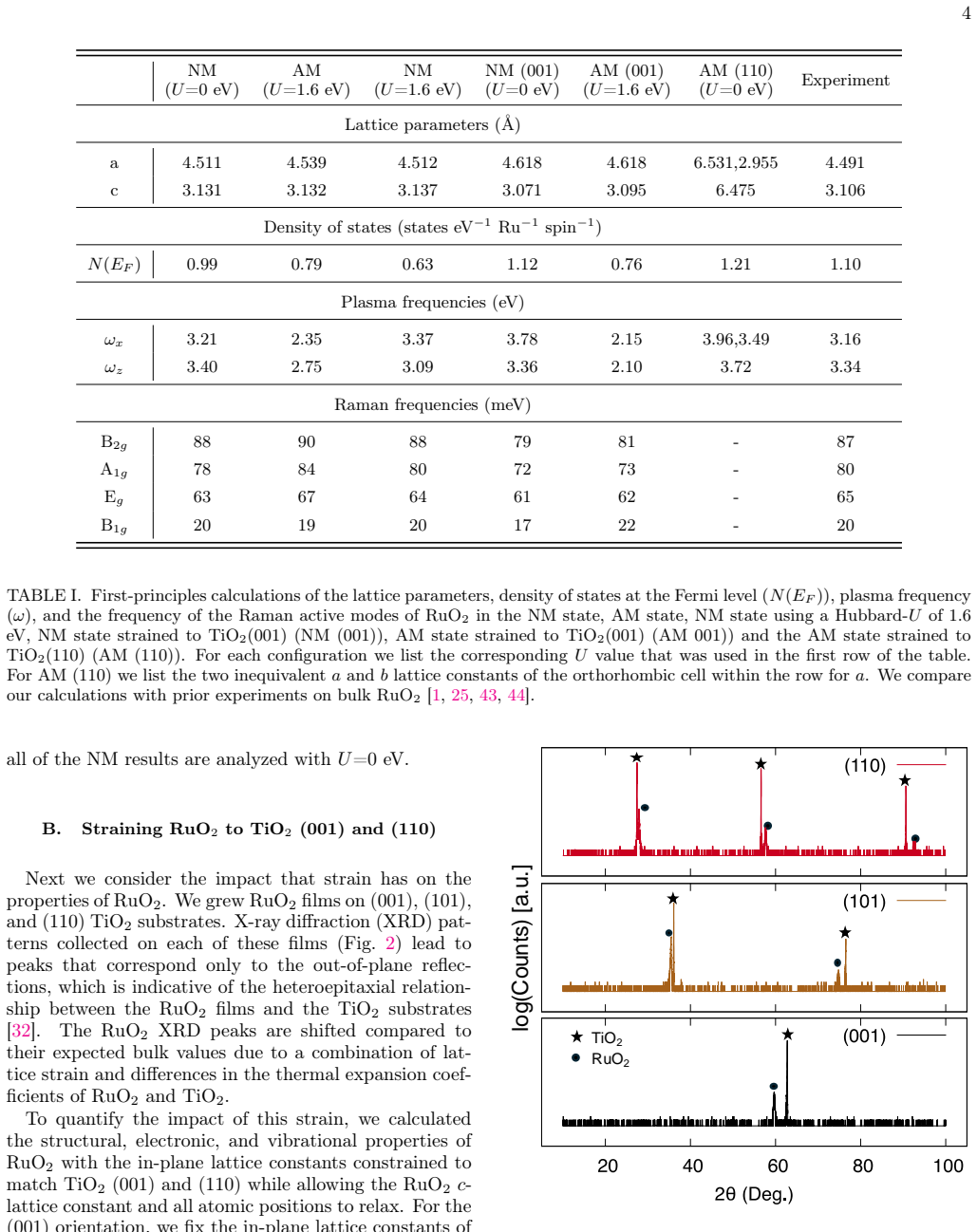
Summary. The paper combines optical reflectance, transmittance, ellipsometry, and temperature-dependent Raman measurements on RuO2 thin films grown on TiO2(001), (101), and (110) with DFT calculations (GGA and GGA+U) of the electronic, optical, and vibrational properties of RuO2 in nonmagnetic (NM) and altermagnetic (AM) states. The authors find that NM GGA calculations reproduce the measured reflectance, refractive index, and Raman frequencies, while AM GGA+U calculations at U=1.6 eV give markedly poorer agreement. They also report that straining RuO2 to match TiO2(110) stabilizes ferromagnetic and altermagnetic states that are nearly degenerate and lower in energy than the NM state, whereas (001) strain leaves the system nonmagnetic. The paper concludes that bulk RuO2 is most consistently described as nonmagnetic and that magnetic ordering is highly sensitive to strain and exchange-correlation treatment.
Significance. If the conclusions hold, this is a valuable contribution to the ongoing debate on altermagnetism in RuO2, providing a broad set of bulk-sensitive optical and vibrational observables that discriminate between NM and AM electronic structures. The study is strengthened by the combination of multiple experimental techniques, the use of one consistent computational framework for all comparisons, and the explicit control calculation of NM with U=1.6 eV, which shows that part of the AM discrepancy arises from a U-induced renormalization. The central exclusion of bulk AM, however, rests on a single value of U selected to force a 1 µB moment, and the authors themselves flag that this U may be too large for a metal. The paper would be significantly strengthened by a U/moment scan for the bulk AM state, which would test whether the AM failure is robust or an artifact of the particular U chosen.
major comments (3)
- [Section III.A, Table I] The bulk AM state is calculated only with U=1.6 eV, a value chosen (Sec. II.B) to produce the 1 µB moment assumed in the altermagnetic literature. The authors state in Section III.A that 'a U value of 1.6 eV may be too large for a metallic system such as RuO2 given the short-range screening in metals.' Because the AM density of states, plasma frequencies, Raman frequencies, and optical reflectivity are all computed at this U, the conclusion (Conclusion item 2) that AM fails to describe the experimental data is a one-point comparison. The NM U=1.6 eV control shifts N(EF) by about 30% and Raman frequencies by up to 2 meV, so a lower-U AM solution with a smaller moment could plausibly be much closer to the NM results. Please provide a U scan for bulk AM (for example U = 0.8, 1.0, 1.2, 1.4, 1.6 eV) and report the moment, N(EF), plasma frequencies, and Raman frequencies for each stable solution, or justify why 1.6 eV is the physically appropriate value.
- [Section III.C and Fig. 5(b)] The calculated reflectivity for both NM and AM includes a Drude term with a fixed relaxation rate of 0.2 eV (Section II.B). The largest NM-AM difference in reflectivity (about 30% below 2 eV) occurs in the spectral range where the Drude contribution is significant, and the reflectivity comparison is therefore sensitive to this fixed parameter. Please show the reflectivity with the Drude term removed or with a range of relaxation rates for both states, so that the comparison targets the interband contributions that are stated as the physical origin of the discrepancy.
- [Section III.B, Table I] The conclusion that RuO2 strained to TiO2(110) stabilizes AM and FM states is based on GGA calculations in which the AM moment is only 0.3 µB and the FM-AM energy difference is 0.9 meV/Ru, a value the authors note is within the precision limit of the calculations. This does not affect the bulk-NM conclusion, but the wording 'stabilizes' in the abstract and conclusions is stronger than these numbers support. Please either add convergence tests for the energy differences (k-point density and strain values) or rephrase to emphasize that the ordering is marginal and highly functional-dependent, as is already stated in the main text.
minor comments (5)
- [Section III.A] The text contains a duplicated word: 'The frequency of these three modes are are up to 4 meV higher than the measured values' should read 'are up to 4 meV higher.'
- [Table I caption] The caption lists 'AM 001)' instead of 'AM (001)' in the column headers; please fix the missing parenthesis.
- [Reference [7]] The publisher is listed as 'American Physics Society'; the correct name is 'American Physical Society.'
- [Section II.B] The phrase 'we used collinear calculations for the calculations of the frequency dependent dielectric function' is redundant; 'collinear spin-polarized calculations' would be clearer.
- [Figure 3(c)] The legend entry 'Equilibrium RuO2(110)' is not explicitly defined in the text; please specify which lattice parameters were used for this curve.
Circularity Check
No significant circularity: the AM state is tested against external optical and Raman data rather than fitted to them, and the central NM conclusion is independently benchmarked.
full rationale
The paper's central comparison is not circular. The altermagnetic calculations are prepared with a Hubbard U of 1.6 eV, chosen to produce a 1 µB moment, an input inherited from the prior altermagnetic literature. However, the subsequent Raman frequencies, reflectivity, refractive index, and density of states are genuine outputs of the calculation; none of these quantities was fitted to the experimental data used for the comparison. The authors even provide a control calculation of the nonmagnetic state at U=1.6 eV, which allows the effects of the Hubbard U to be separated from the effects of magnetic order. The acknowledged limitation that U=1.6 eV 'may be too large for a metallic system such as RuO2' is a robustness concern about the representative AM state, not a circular definition of the conclusion. No equation is shown to be equivalent to its inputs by construction, and no fitted parameter is renamed as a prediction. The one self-citation, reference [32] for the film growth method, is used only as provenance for sample preparation and is not load-bearing for the physical conclusions. The main claims are anchored by independent comparisons to prior bulk optical measurements, specific heat data, and existing nonmagnetic calculations, so the derivation chain is self-contained with respect to the conclusions drawn.
Assumptions & free parameters
free parameters (3)
- Hubbard U on Ru d states =
1.6 eV
- Drude relaxation rate =
0.2 eV
- Hole doping concentration =
5%
assumptions (4)
- domain assumption PBE-GGA with a Hubbard U correction is an adequate electronic-structure theory for metallic RuO2.
- domain assumption The altermagnetic state of RuO2 can be represented by a collinear spin configuration with a 1 µB moment per Ru atom.
- domain assumption The rigid-band approximation describes 5% hole doping in RuO2.
- domain assumption The RuO2 films are coherently strained to the DFT-relaxed TiO2 lattice parameters.
Cite this review
Pith. "Pith review of Effects of altermagnetic order, strain and doping in RuO$_2$." pith.science (2026). https://pith.science/paper/J65JJAAN
@misc{pith2026250208872,
  author       = {Pith},
  title        = {Pith review of: Effects of altermagnetic order, strain and doping in RuO$_2$},
  year         = {2026},
  howpublished = {\url{https://pith.science/paper/J65JJAAN}},
  note         = {Machine review of arXiv:2502.08872}
}
abstract
RuO$_2$, one of the most widely studied transition metal oxides, was recently predicted to host a novel form of collinear magnetic order referred to as altermagnetism. In this study we combine experiment (reflectance, transmittance, ellipsometry and Raman measurements) and first-principles calculations to elucidate the potential role of altermagnetic order, strain and doping on the optical and vibrational properties of RuO$_2$ grown on TiO$_2$ (001), (101) and (110) substrates. Our combined experimental and theoretical results point toward a nonmagnetic ground state as the most consistent description of the optical and vibrational properties of bulk RuO$_2$. RuO$_2$ strained to TiO$_2$ (001) remains nonmagnetic in our calculations. Straining to TiO$_2$ (110) stabilizes ferromagnetic and altermagnetic states that are nearly degenerate and both lower in energy than the nonmagnetic state. The relative energetic ordering of these states is highly sensitive to the level of strain and the choice of exchange-correlation approximation.
Figures


Figures from the paper (2 more)


Reference graph
Works this paper leans on
-
[1]
Nonmagnetic GGA calculations leads to electronic properties that are consistent with experiment, Ra- man frequencies that are within 2 meV of the mea- sured values, and reproduces the magnitude and spectral dependence of the optical properties
-
[2]
Altermagnetic GGA+U calculations leads to Ra- man frequencies that are up to 4 meV higher com- pared to experiment, and fails to describe the elec- tronic and optical properties, both in terms of mag- nitude and spectral dependence
-
[3]
RuO2 strained to TiO2 (001) remains nonmagnetic while straining to TiO2 (110) leads to the altermag- netic and ferromagnetic states being near degener- ate in energy and are both lower in energy than 8 the nonmagnetic configuration based on GGA cal- culations. Applying a large Hubbard-U stabilizes the altermagnetic state for RuO2 strained to TiO2 (001) an...
-
[4]
D. B. Rogers, R. D. Shannon, A. W. Sleight, and J. L. Gillson, Crystal chemistry of metal dioxides with rutile- related structures, Inorg. Chem.8, 841 (1969)
work page 1969
- [5]
-
[6]
M. Karamad, H. A. Hansen, J. Rossmeisl, and J. K. Nørskov, Mechanistic pathway in the electrochemical re- duction of co2 on ruo2, ACS Catal.5, 4075 (2015)
work page 2015
-
[7]
Uchida, T
M. Uchida, T. Nomoto, M. Musashi, R. Arita, and M. Kawasaki, Superconductivity in uniquely strained RuO2 films, Phys. Rev. Lett.125, 147001 (2020)
2020
-
[8]
J. P. Ruf, H. Paik, N. J. Schreiber, H. P. Nair, L. Miao, J. K. Kawasaki, J. N. Nelson, B. D. Faeth, Y. Lee, B. H. Goodge, et al., Strain-stabilized superconductivity, Nat. Comm. 12, 59 (2021)
work page 2021
Show all 53 references
-
[9]
Ryden, A
W. Ryden, A. Lawson, and C. Sartain, Temperature de- pendence of the resistivity of RuO2 and IrO2, Physics Letters A26, 209 (1968)
1968
-
[10]
A. K. Goel, G. Skorinko, and F. H. Pollak, Optical prop- erties of single-crystal rutile RuO2 and IrO2 in the range 0.5 to 9.5 eV, Phys. Rev. B24, 7342 (1981)
1981
-
[11]
Passenheim and D
B. Passenheim and D. McCollum, Heat capacity of RuO2 and IrO2 between 0.54 and 10 k, J. Chem. Phys.51, 320 (1969)
1969
-
[12]
Ryden and A
W. Ryden and A. Lawson, Magnetic susceptibility of IrO2 and RuO2, J. Chem. Phys.52, 6058 (1970)
1970
-
[13]
Graebner, E
J. Graebner, E. Greiner, and W. Ryden, Magnetothermal oscillations in RuO2, OsO2, and IrO2, Phys. Rev. B13, 2426 (1976)
1976
-
[14]
Mattheiss, Electronic structure of RuO2, OsO2, and IrO2, Phys
L. Mattheiss, Electronic structure of RuO2, OsO2, and IrO2, Phys. Rev. B13, 2433 (1976)
1976
-
[15]
K. M. Glassford and J. R. Chelikowsky, Electronic and structural properties of RuO2, Phys. Rev. B 47, 1732 (1993)
1993
-
[16]
Šmejkal, J
L. Šmejkal, J. Sinova, and T. Jungwirth, Beyond conven- tional ferromagnetism and antiferromagnetism: A phase with nonrelativistic spin and crystal rotation symmetry, Phys. Rev. X12, 031042 (2022)
2022
-
[17]
Šmejkal, J
L. Šmejkal, J. Sinova, and T. Jungwirth, Emerging re- search landscape of altermagnetism, Phys. Rev. X12, 040501 (2022)
2022
-
[18]
Hayami, Y
S. Hayami, Y. Yanagi, and H. Kusunose, Momentum- dependent spin splitting by collinear antiferromagnetic ordering, journal of the physical society of japan 88, 123702 (2019)
2019
-
[19]
L.-D. Yuan, Z. Wang, J.-W. Luo, E. I. Rashba, and A. Zunger, Giant momentum-dependent spin splitting in centrosymmetric low-Z antiferromagnets, Phys. Rev. B 102, 014422 (2020)
2020
-
[20]
I. I. Mazin, K. Koepernik, M. D. Johannes, R. González- Hernández, and L. Šmejkal, Prediction of unconventional magnetism in doped FeSb 2, PNAS 118, e2108924118 (2021)
2021
-
[21]
A. Bose, N. J. Schreiber, R. Jain, D.-F. Shao, H. P. Nair, J. Sun, X. S. Zhang, D. A. Muller, E. Y. Tsym- bal, D. G. Schlom,et al., Tilted spin current generated by the collinear antiferromagnet ruthenium dioxide, Na- ture Electronics5, 267 (2022)
2022
-
[22]
Fedchenko, J
O. Fedchenko, J. Minár, A. Akashdeep, S. W. D’Souza, D. Vasilyev, O. Tkach, L. Odenbreit, Q. Nguyen, D. Kut- nyakhov, N. Wind, et al. , Observation of time-reversal symmetry breaking in the band structure of altermag- netic RuO2, Science Advances10, eadj4883 (2024)
2024
-
[23]
Z. Feng, X. Zhou, L. Šmejkal, L. Wu, Z. Zhu, H. Guo, R. González-Hernández, X. Wang, H. Yan, P. Qin,et al., An anomalous hall effect in altermagnetic ruthenium dioxide, Nat. Electron.5, 735 (2022)
2022
-
[24]
S. G. Jeong, S. Lee, B. Lin, Z. Yang, I. H. Choi, J. Y. Oh, S. Song, S. w. Lee, S. Nair, R. Choudhary,et al., Metal- licity and anomalous hall effect in epitaxially strained, atomically thin ruo2 films, Proceedings of the National Academy of Sciences122, e2500831122 (2025)
2025
-
[25]
Noh, G.-H
S. Noh, G.-H. Kim, J. Lee, H. Jung, U. Seo, G. So, J. Lee, S. Lee, M. Park, S. Yang,et al., Tunneling magnetore- sistance in altermagnetic ruo 2-based magnetic tunnel junctions, Physical Review Letters134, 246703 (2025)
2025
-
[26]
Hiraishi, H
M. Hiraishi, H. Okabe, A. Koda, R. Kadono, T. Muroi, D. Hirai, and Z. Hiroi, Nonmagnetic ground state in 9 RuO2 revealed by muon spin rotation, Phys. Rev. Lett. 132, 166702 (2024)
2024
-
[27]
Keßler, L
P. Keßler, L. Garcia-Gassull, A. Suter, T. Prokscha, Z. Salman, D. Khalyavin, P. Manuel, F. Orlandi, I. I. Mazin, R. Valentí, et al. , Absence of magnetic order in RuO2: insights from µSR spectroscopy and neutron diffraction, npj Spintronics2, 50 (2024)
2024
-
[28]
Wenzel, E
M. Wenzel, E. Uykur, S. Rößler, M. Schmidt, O. Janson, A. Tiwari, M. Dressel, and A. A. Tsirlin, Fermi-liquid behavior of nonaltermagnetic RuO2, Phys. Rev. B111, L041115 (2025)
2025
-
[29]
Z. Zhu, J. Strempfer, R. Rao, C. Occhialini, J. Pelliciari, Y. Choi, T. Kawaguchi, H. You, J. Mitchell, Y. Shao- Horn, et al., Anomalous antiferromagnetism in metallic ruo2determinedbyresonantx-rayscattering,Phys.Rev. Lett. 122, 017202 (2019)
2019
-
[30]
Smolyanyuk, I
A. Smolyanyuk, I. I. Mazin, L. Garcia-Gassull, and R. Valentí, Fragility of the magnetic order in the pro- totypical altermagnet RuO2, Phys. Rev. B109, 134424 (2024)
2024
-
[31]
X. Zhou, W. Feng, X. Yang, G.-Y. Guo, and Y. Yao, Crystal chirality magneto-optical effects in collinear an- tiferromagnets, Phys. Rev. B104, 024401 (2021)
2021
-
[32]
P. Rao, A. Mook, and J. Knolle, Tunable band topol- ogy and optical conductivity in altermagnets, Physical Review B110, 024425 (2024)
2024
-
[33]
Adamantopoulos, M
T. Adamantopoulos, M. Merte, F. Freimuth, D. Go, L. Zhang, M. Ležaić, W. Feng, Y. Yao, J. Sinova, L. Šme- jkal, et al., Spin and orbital magnetism by light in rutile altermagnets, npj Spintronics2, 46 (2024)
2024
-
[34]
Šmejkal, A
L. Šmejkal, A. Marmodoro, K.-H. Ahn, R. González- Hernández, I. Turek, S. Mankovsky, H. Ebert, S. W. D’Souza, O. Šipr, J. Sinova,et al., Chiral magnons in al- termagnetic RuO2, Phys. Rev. Lett.131, 256703 (2023)
2023
-
[35]
S. S. Fields, P. G. Callahan, N. G. Combs, C. D. Cress, and S. P. Bennett, Orientation control and mosaicity in heteroepitaxial RuO2 thin films grown through reactive direct current sputtering, Cryst. Growth Des. (2024)
2024
-
[36]
P.HohenbergandW.Kohn,Phys.Rev 136,B864(1964)
1964
-
[37]
Kohn and L
W. Kohn and L. J. Sham, Phys. Rev140, A1133 (1965)
1965
-
[38]
P. E. Blöchl, Phys. Rev. B50, 17953 (1994)
1994
-
[39]
Kresse and J
G. Kresse and J. Hafner, Phys. Rev. B47, 558 (1993)
1993
-
[40]
Kresse and J
G. Kresse and J. Hafner, Phys. Rev. B49, 14251 (1994)
1994
-
[41]
J. P. Perdew, K. Burke, and M. Ernzerhof, Phys. Rev. Lett. 77, 3865 (1996)
1996
-
[42]
S. L. Dudarev, G. A. Botton, S. Y. Savrasov, C. Humphreys, and A. P. Sutton, Electron-energy-loss spectra and the structural stability of nickel oxide: An lsda+ u study, Phys. Rev. B57, 1505 (1998)
1998
-
[43]
Gajdoš, K
M. Gajdoš, K. Hummer, G. Kresse, J. Furthmüller, and F. Bechstedt, Linear optical properties in the projector- augmented wave methodology, Phys. Rev. B73, 045112 (2006)
2006
-
[44]
Togo and I
A. Togo and I. Tanaka, First principles phonon calcu- lations in materials science, Scripta Materialia 108, 1 (2015)
2015
-
[45]
Basak and A
S. Basak and A. Ptok, Lattice dynamics of altermagnetic ruthenium oxide RuO2, Acta Physica Polonica A ISSN 1898-794X 145, 93 (2024)
2024
-
[46]
Rosenblum, W
S. Rosenblum, W. Weber, and B. Chamberland, Raman- scattering observation of the rutile-to-CaCl2 phase tran- sition in RuO2, Phys. Rev. B56, 529 (1997)
1997
-
[47]
Mertig, G
M. Mertig, G. Pompe, and E. Hegenbarth, Specific heat of Nb-Doped RuO2 single crystals, physica status solidi (b) 135, 335 (1986)
1986
-
[48]
De Almeida and R
J. De Almeida and R. Ahuja, Electronic and opticalprop- erties of RuO2 and IrO2, Phys. Rev. B73, 165102 (2006)
2006
-
[49]
Krasovska, E
O. Krasovska, E. Krasovskii, and V. Antonov, Ab initio calculation of the optical and photoelectron properties of ruo 2, Phys. Rev. B52, 11825 (1995)
1995
-
[50]
Kiefer, F
L. Kiefer, F. Wirth, A. Bertin, P. Becker, L. Bohat` y, K. Schmalzl, A. Stunault, J. A. Rodríguez-Velamazán, O. Fabelo, and M. Braden, Crystal structure and ab- sence of magnetic order in single crystalline RuO2, arXiv preprint arXiv:2410.05850 (2024)
2024 arXiv
-
[51]
S. G. Jeong, I. H. Choi, S. Nair, L. Buiarelli, B. Pour- bahari, J. Y. Oh, N. Bassim, A. Seo, W. S. Choi, R. M. Fernandes, et al., Altermagnetic polar metallic phase in ultra-thinepitaxially-strainedRuO 2 films,arXivpreprint arXiv:2405.05838 (2024)
2024 arXiv
-
[52]
J. Song, S. H. Lee, S. Kang, D. Kim, J. H. Jeong, T. Oh, S. Lee, S. Lee, S. Lee, K.-H. Ahn,et al., Spin-orbit cou- pling driven magnetic response in altermagnetic ruo2, Small 21, 2407722 (2025)
2025
-
[53]
Weber, S
M. Weber, S. Wust, L. Haag, A. Akashdeep, K. Leckron, C. Schmitt, R. Ramos, T. Kikkawa, E. Saitoh, M. Kläui, et al., All optical excitation of spin polarization in d-wave altermagnets, arXiv preprint arXiv:2408.05187 (2024)
2024 arXiv
Reviewed August 7, 2026 · model on record in the stance chip above.
Discussion (0). Continue with ORCID to comment.