REVIEW 3 major objections 5 minor 77 references
Dynamics of the Bose-Hubbard Model Induced by On-Site or Long-Range Two-Body Losses
T0 review · 3 major / 5 minor · reviewed 2026-08-07 · deepseek-v4-flash
Pith's one-line read Switching on two-body losses in a weakly interacting Bose-Hubbard chain makes the density decay algebraically with an interaction-dependent exponent; the signature survives long-range losses but vanishes on the 2D square lattice.
desk verdict A useful EoM framework with a new qualitative claim about interaction-dependent decay exponents; the headline exponent needs stronger validation before I'd take it as established. read the letter →
The pith
A machine-rendered reading of the paper's core claim, the machinery that carries it, and where it could break.
The reading
What carries the argument
The machinery is a time-dependent Bogolyubov theory for the dissipative Bose-Hubbard model. The $k=0$ condensate mode is factorized and the Lindblad master equation is reduced to equations of motion for the quadratic correlators $G_k(t)=\langle \hat b_k^\dagger \hat b_k\rangle_t$ and $F_k(t)=\langle \hat b_{-k}\hat b_k\rangle_t$, for the condensate and for each finite momentum (Eq. (11) for on-site losses, Eq. (13) for long-range losses). The central object that carries the claim is the density's pseudo-closed equation, $dn/dt=-2\gamma n^2 - 4\gamma n\,L^{-1}\sum_{q\neq0}[G_q(t)+\mathrm{Re}\,F_q(t)]$, obtained after replacing $\mathrm{Re}\,F_0$ by $G_0$ and using condensate dominance. This equation makes the interaction correction explicit: the finite-momentum correlators, non-zero only for $U>0$, lower the decay rate and thereby change the algebraic exponent; the same structure, with the loss kernel $\tilde\gamma(q)=L\mathcal{G}_q$, governs long-range losses and explains the 2D collapse to the non-interacting decay.
What would settle it
Recompute the exponent from the EoM while tracking the condensate fraction $G_0(t)/N(t)$ across the fitting window (e.g. $L=100$, $t=50$, $U=0.3J$, $\gamma=0.1J$): if depletion becomes so strong that $N(t)\gg\sum_{k\neq0}G_k(t)$ fails before the fit, the fitted $b(U)$ is an artifact of truncation. The decisive cross-check would be a quasi-exact quantum-trajectory simulation on a chain large enough and long enough to resolve the power-law window, or a cold-atom measurement of $n(t)$ after a light-assisted loss quench that records the slope as $U$ is varied at fixed small $\gamma$.
Extended reading notes
Core claim
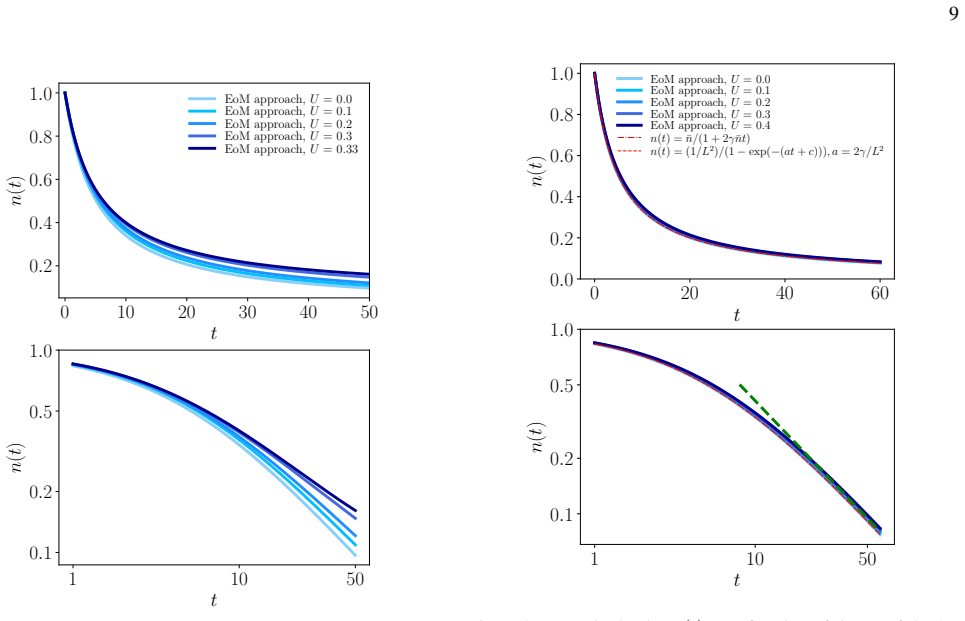
The central discovery is that interactions slow the loss-induced depletion of a 1D Bose-Hubbard superfluid through an effective loss rate that is not simply proportional to $\gamma n(t)^2$. Within the Bogolyubov equations of motion, the density obeys the pseudo-closed equation $dn/dt = -2\gamma n^2 - 4\gamma n \, L^{-1}\sum_{q\neq 0}[G_q(t)+\mathrm{Re}\,F_q(t)]$, where the interaction-generated finite-momentum occupation $G_q$ and squeezing correlator $F_q$ reduce the total decay rate as $U$ grows. Fitting the intermediate-time density to $n(t)\propto t^b$ up to $t=50$ yields an exponent $b$ that softens with interaction: for $\gamma=0.1J$, $b$ goes from about $-0.9$ at $U=0$ toward $-0.5$ near $U=0.33J$, while at fixed weak $U$ the exponent depends only weakly on $\gamma$. The same interaction-dependent algebraic decay holds when the losses are long-range, with the on-site rate replaced by the effective rate $\tilde\gamma(0)=L\mathcal{G}_0$ appearing through the momentum-space loss kernel. On the 2D square lattice the interaction correction is instead negligible at these parameters, because the tight-binding bandwidth dominates $U$, so the density decay coincides with the non-interacting case; the authors argue the same applies on hypercubic lattices of dimension $D\ge 2$.
Load-bearing premise
The result stands on the mean-field assumption that the condensate stays dominant—specifically that $N(t)\gg \sum_{k\neq 0}G_k(t)$—together with the decoupling $\langle \hat n_0^2\rangle_t=\langle \hat n_0\rangle_t^2$, over the whole intermediate-time window up to $t=50$ where the power-law exponent is fitted; the paper itself notes the approximation degrades as $n(t)$ becomes small.
Editorial extensions
If this is right
- In 1D with $\gamma\lesssim U\ll J$, larger $U$ slows the density decay, changing $b$ from about $-0.9$ toward $-0.5$; the exponent is nearly $\gamma$-independent once $\gamma$ is not too small.
- At large dissipation ($\gamma\approx J$) the interaction dependence is erased: density profiles for different $U$ collapse onto one curve with a single exponent, so the algebraic decay there is dissipation-controlled.
- For long-range two-body losses with power-law exponent $\alpha$, the interaction-dependent exponent reappears whenever the effective rate $\tilde\gamma(0)$ matches the on-site case; strong long-range losses likewise remove the $U$ dependence.
- On the 2D square lattice, and by the same argument on any hypercubic lattice, the weak-interaction density decay is $U$-independent and follows the non-interacting formula at small coupling.
- The pseudo-closed equation exactly reduces to $dn/dt=-2\gamma n^2$ when $U=0$, so the non-interacting $t^{-1}$ law and its interacting modification are captured in a single analytic expression.
Reading between the lines
- Editorial inference: if the near-$\gamma$-independence of $b$ holds beyond the fitted window, the decay exponent is a potential interaction thermometer—one late-time density slope from a loss quench would estimate $U$ without a full spectral measurement.
- Editorial inference: the 2D argument that the tight-binding bandwidth swamps $U$ at fixed weak coupling suggests the $U$-dependent algebraic decay is effectively one-dimensional within this mean-field picture; running the EoM at $D=3$ with larger $U$ would test how sharp the dimensionality crossover is.
- Editorial inference: the long-range results imply a tunable knob: by varying $\alpha$ and $\Gamma$ so that $\tilde\gamma(0)$ stays fixed, one could probe whether the decay law depends only on the effective rate and not on the spatial shape of the loss kernel, a statement the paper leaves implicit.
Editorial analysis
A structured set of objections, weighed in public.
Referee Report
Summary. This manuscript studies the quench dynamics of the Bose-Hubbard model after suddenly switching on two-body losses, for on-site and power-law long-range loss processes. The authors derive equations of motion for the quadratic bosonic correlators within a time-dependent Bogolyubov mean-field treatment, and benchmark them against tensor-network quantum-jump simulations for small chains. They report that, in one dimension, the intermediate-time density decays algebraically with an exponent whose magnitude decreases with increasing interaction U, that this interaction-dependent algebraic decay persists for long-range losses, and that it is absent on the two-dimensional square lattice, where the density follows essentially the noninteracting decay.
Significance. The paper proposes a transparent analytical framework for a relevant dissipative lattice problem and supports it with quantitative benchmarks against tensor networks for L=12,18 up to t=10. The central physical claim, if it survives closer scrutiny, would be of interest to the cold-atom community because loss processes are endemic in optical-lattice experiments and the predicted interaction-dependent exponent is a falsifiable, measurable signature. The derivation is self-contained: the EoMs follow from the Lindblad equation and Bogolyubov theory, with no fitted parameters entering the power-law prediction, and the noninteracting limit and the D-dimensional generalization are provided analytically. The main weakness is that the headline exponent is extracted from the EoMs alone in a regime where the validity assumptions have not been checked.
major comments (3)
- [Sec. IV.B, Fig. 4 and Eq. (16)] The interaction-dependent exponent b(U) is the central result, but the regime in which it is extracted is not validated. The benchmarks in Figs. 1, 2 and Appendix G establish the EoMs for L=12,18 and t<=10, while Fig. 4 integrates Eq. (11) at L=100 up to t=50, where n(t) has decayed to values between roughly 0.1 and 0.4. The derivation of the pseudo-closed equation (16) explicitly uses the mean-field condition N(t) >> sum_{q neq 0} G_q(t), yet the paper reports no diagnostic for the depletion ratio R(t)=sum_{q neq 0}G_q(t)/G_0(t) along the trajectories used for the fits. The authors should provide R(t) for the parameters of Fig. 4, and ideally test the stability of b(U) against a less severe truncation or against tensor-network data at longer times; the same caveat applies to the long-range result in Fig. 7.
- [Sec. IV.B, Fig. 4 and Eq. (A7)] The fitted exponent is an effective finite-window exponent, not an asymptotic one, and its interaction dependence may be partly a window artefact. The authors themselves note that the noninteracting fit gives b approximately -0.9 instead of -1 and that Eq. (A7) implies an exponential decay at long times for finite L. Since the same finite-size and finite-window effects contaminate the interacting curves, the claim that b(U) is a physical interaction-dependent exponent requires showing that the extracted values are stable when the fit interval, the system size L, and the dissipation gamma are varied; for example, one could fit over different windows, compare L=100 and L=200, and check that the U to 0 limit of b approaches -1 as the window is lengthened.
- [Sec. VI and Appendix H] The analytical argument for the absence of interaction dependence in 2D is incomplete. Appendix H states that Re(F_k(t)) is U-independent because it does not depend on B_k(t) according to its EoM at Eq. (B7); however, the real part of dF_k/dt in Eq. (B7d) contains 2A_k(t) Im(F_k(t)), and A_k(t) includes B_k(t) through Eq. (B6b). The conclusion may still follow if the tight-binding dispersion dominates B_k(t) for the relevant k and times, but this must be quantified, for example by reporting the ratio B_k(t)/(4J[sin^2(kx/2)+sin^2(ky/2)]) or by comparing the EoM results with and without the U term in A_k. As written, the dimensional argument in Appendix H is not sufficient to support the 2D claim in the abstract.
minor comments (5)
- [Caption of Fig. 6] The symbol 'square' is used in the caption where the dissipation strength Gamma is meant; replace it with Gamma for clarity.
- [Eq. (14)] The notation F_q, G_q, H_q in Eq. (14) overloads F_q and G_q, which also denote the correlators F_q(t) and G_q(t); use different symbols, for example f_q, g_q, h_q, to avoid confusion.
- [Eq. (12a) and Eq. (B5b)] The Heaviside function is denoted Theta_H(U) in Eq. (12a) and theta(U) in Eq. (B5b); unify the notation.
- [Right panel of Fig. 3] The right panel of Fig. 3 shows the fitted b(gamma) without any measure of fit quality or fit-interval sensitivity; adding residuals or a stated fitting range would help assess whether the plateau at b approximately -0.8 is meaningful.
- [Sec. IV.B] The sentence 'the previous physical property requires gamma approximately U << J' is vague; please make precise the sense in which gamma and U are comparable, since the text elsewhere contrasts the small-gamma and large-gamma regimes.
Circularity Check
No significant circularity: the central power-law decay and its interaction-dependent exponent are outputs of a self-contained Bogolyubov EoM derivation, benchmarked against independent tensor-network simulations.
full rationale
The paper's main claims are derived from the Lindblad master equation plus a standard Bogolyubov mean-field decoupling, and the reported power-law exponent b(U) is extracted from the numerical solution of the resulting EoMs, Eqs. (11) and (13), not imposed as an input. No parameter is fitted to the benchmark data or to the algebraic-decay ansatz in a way that would force the predicted exponent; the fit nfit(t)=at^b is only a diagnostic characterization of the computed curves. The benchmark comparisons in Figs. 1-2, 5-6 and Appendix G use independent tensor-network quantum-jump simulations, so the central 1D results have external numerical support. The self-citations in the paper are not load-bearing: Ref. [68] provides the standard quadratic Bogolyubov form of the Bose-Hubbard Hamiltonian, and Refs. [74]-[76] are cited only in the concluding outlook on quench spectroscopy. The PCE derivation in Sec. IV C does assume the mean-field condition N(t) >> sum_{k≠0} G_k(t), and the skeptical concern that this condition is not explicitly monitored up to t=50 is a legitimate validity or correctness risk, but it is not circularity: the EoMs and the PCE are not equivalent to their inputs by construction, and the power-law behavior is not defined in terms of the fitted exponent. The 2D result is likewise obtained from the same EoM framework extended to the square lattice, Eq. (B7), and is explained analytically in Appendix H rather than assumed. Overall, the derivation chain is self-contained, with only minor non-load-bearing self-citations, so the circularity score is 1.
Assumptions & free parameters
assumptions (4)
- domain assumption The k=0 mode is macroscopically occupied and can be decoupled from finite-momentum modes; factorization of the condensate correlators is used.
- domain assumption The time-dependent Hamiltonian coefficients A_k(t) and B_k(t) depend only on the instantaneous density n(t), treated self-consistently.
- domain assumption For long-range losses, the dissipation kernel is translation invariant and can be represented in reciprocal space.
- ad hoc to paper In 2D, the tight-binding dispersion dominates A_k so that the U-dependence in A_k is negligible, and Re(F_k) is asserted to be independent of B_k.
Cite this review
Pith. "Pith review of Dynamics of the Bose-Hubbard Model Induced by On-Site or Long-Range Two-Body Losses." pith.science (2026). https://pith.science/paper/45ZRWTLF
@misc{pith2026250209008,
  author       = {Pith},
  title        = {Pith review of: Dynamics of the Bose-Hubbard Model Induced by On-Site or Long-Range Two-Body Losses},
  year         = {2026},
  howpublished = {\url{https://pith.science/paper/45ZRWTLF}},
  note         = {Machine review of arXiv:2502.09008}
}
read the original abstract
We present a theoretical study of the dissipative dynamics of the Bose-Hubbard model induced by on-site or long-range two-body losses. We first consider the one-dimensional chain and the two-dimensional square lattice, and study the dynamics induced by the sudden switch-on of two-body losses on a weakly-interacting superfluid state. The time-dependent density is obtained in the spirit of the Bogolyubov approach by calculating theoretically the equations of motion associated to the relevant quadratic bosonic correlators. In the one-dimensional case, our results compare very well with quasi-exact numerical calculations based on the quantum jump method implemented using tensor networks. We find that the intermediate-time dynamics of the density displays an algebraic decay characterized by an interaction-dependent power-law exponent. The latter property still holds for long-range two-body loss processes but it is absent in the two-dimensional square lattice with on-site losses.
Figures


Figures from the paper (6 more)



Reference graph
Works this paper leans on
-
[1]
Hence, we get N (t) = G0(t) and the following EoM asso- ciated to N (t): d dt N (t) = − 2γ L N (t)(N (t) − 1). (A6) The latter admits an analytical solution given by: N (t) = 1 1 − e−(at+c) , a= 2γ L , c= ln N (0) N (0) − 1 , (A7) where N (0) = ¯nL denotes the total number of bosonic atoms initially present on the lattice. Therefore, for the condensate de...
-
[2]
Quasiparticle engineering and entan- glement propagation in a quantum many-body system,
P. Jurcevic, B. P. Lanyon, P. Hauke, C. Hempel, P. Zoller, R. Blatt, and C. F. Roos, “Quasiparticle engineering and entan- glement propagation in a quantum many-body system,” Nature 511, 202–205 (2014)
work page 2014
-
[3]
Non-local propagation of correlations in quantum systems with long-range interactions,
Philip Richerme, Zhe-Xuan Gong, Aaron Lee, Crystal Senko, Jacob Smith, Michael Foss-Feig, Spyridon Michalakis, Alexey V . Gorshkov, and Christopher Monroe, “Non-local propagation of correlations in quantum systems with long-range interactions,” Nature 511, 198–201 (2014)
work page 2014
-
[4]
Light-cone-like spreading of correlations in a quantum many-body system,
Marc Cheneau, Peter Barmettler, Dario Poletti, Manuel Endres, Peter Schauss, Takeshi Fukuhara, Christian Gross, Immanuel Bloch, Corinna Kollath, and Stefan Kuhr, “Light-cone-like spreading of correlations in a quantum many-body system,” Na- ture (London) 481, 484–487 (2012)
work page 2012
-
[5]
Colloquium: Nonequilibrium dy- namics of closed interacting quantum systems,
Anatoli Polkovnikov, Krishnendu Sengupta, Alessandro Silva, and Mukund Vengalattore, “Colloquium: Nonequilibrium dy- namics of closed interacting quantum systems,” Rev. Mod. Phys. 83, 863–883 (2011)
work page 2011
-
[6]
Christian Gogolin and Jens Eisert, “Equilibration, thermali- sation, and the emergence of statistical mechanics in closed quantum systems,” Reports on Progress in Physics 79, 056001 (2016)
work page 2016
-
[7]
Evolution of entangle- ment entropy in one-dimensional systems,
Pasquale Calabrese and John Cardy, “Evolution of entangle- ment entropy in one-dimensional systems,” Journal of Statis- tical Mechanics: Theory and Experiment 2005, P04010 (2005)
work page 2005
-
[8]
Quantum states and phases in driven open quantum systems with cold atoms,
S. Diehl, A. Micheli, A. Kantian, B. Kraus, H. P. B ¨uchler, and P. Zoller, “Quantum states and phases in driven open quantum systems with cold atoms,” Nature Physics 4, 878–883 (2008)
work page 2008
Show all 77 references
-
[9]
Preparation of entangled states by quantum markov processes,
B. Kraus, H. P. B ¨uchler, S. Diehl, A. Kantian, A. Micheli, and P. Zoller, “Preparation of entangled states by quantum markov processes,” Phys. Rev. A78, 042307 (2008)
2008
-
[10]
Quantum computation and quantum-state engineering driven by dissipation,
Frank Verstraete, Michael M. Wolf, and J. Ignacio Cirac, “Quantum computation and quantum-state engineering driven by dissipation,” Nature Physics 5, 633–636 (2009)
2009
-
[11]
Exactly solvable model of quan- tum diffusion,
M. Esposito and P. Gaspard, “Exactly solvable model of quan- tum diffusion,” Journal of Statistical Physics 121 (2005)
2005
-
[12]
Emergence of diffusion in finite quantum systems,
M. Esposito and P. Gaspard, “Emergence of diffusion in finite quantum systems,” Phys. Rev. B71, 214302 (2005)
2005
-
[13]
Crossover between ballistic and diffusive trans- port: the quantum exclusion process,
Viktor Eisler, “Crossover between ballistic and diffusive trans- port: the quantum exclusion process,” Journal of Statistical Me- chanics: Theory and Experiment 2011, P06007 (2011)
2011
-
[14]
Light-cone and diffu- sive propagation of correlations in a many-body dissipative system,
Jean-S ´ebastien Bernier, Ryan Tan, Lars Bonnes, Chu Guo, Dario Poletti, and Corinna Kollath, “Light-cone and diffu- sive propagation of correlations in a many-body dissipative system,” Physical Review Letters 120 (2018), 10.1103/phys- revlett.120.020401
2018 doi
-
[15]
Diffusion and thermaliza- tion in a boundary-driven dephasing model,
Xhek Turkeshi and Marco Schir ´o, “Diffusion and thermaliza- tion in a boundary-driven dephasing model,” Phys. Rev. B104, 144301 (2021)
2021
-
[16]
Vincenzo Alba and Federico Carollo, “Spreading of correla- 17 0 10 20 t 0.0 0.2 0.4 0.6 0.8 1.0 n(t) EoM approach, U = 0.1 EoM approach, U = 0.2 EoM approach, U = 0.3 EoM approach, U = 0.33 1 10 20 t 0.1 0.2 0.5 1.0 n(t) Figure 12. Bosonic density n(t) as a function of time t ...
2021
-
[17]
Degenerate bose gases with uni- form loss,
Pjotrs Gri ˇsins, Bernhard Rauer, Tim Langen, J ¨org Schmied- mayer, and Igor E. Mazets, “Degenerate bose gases with uni- form loss,” Phys. Rev. A93, 033634 (2016)
2016
-
[18]
Cooling of a one- dimensional bose gas,
B. Rauer, P. Griˇsins, I. E. Mazets, T. Schweigler, W. Rohringer, R. Geiger, T. Langen, and J. Schmiedmayer, “Cooling of a one- dimensional bose gas,” Phys. Rev. Lett.116, 030402 (2016)
2016
-
[19]
Strong dissi- pation inhibits losses and induces correlations in cold molecular gases,
N. Syassen, D. M. Bauer, M. Lettner, T. V olz, D. Dietze, J. J. Garc´ıa-Ripoll, J. I. Cirac, G. Rempe, and S. D¨urr, “Strong dissi- pation inhibits losses and induces correlations in cold molecular gases,” Science 320, 1329–1331 (2008)
2008
-
[20]
Observation of dipolar spin-exchange interactions with lattice-confined polar molecules,
Bo Yan, Steven A. Moses, Bryce Gadway, Jacob P. Covey, Kaden R. A. Hazzard, Ana Maria Rey, Deborah S. Jin, and Jun Ye, “Observation of dipolar spin-exchange interactions with lattice-confined polar molecules,” Nature 501 (2013)
2013
-
[21]
Controlling the dynamics of an open many- body quantum system with localized dissipation,
G. Barontini, R. Labouvie, F. Stubenrauch, A. V ogler, V . Guar- rera, and H. Ott, “Controlling the dynamics of an open many- body quantum system with localized dissipation,” Phys. Rev. Lett. 110, 035302 (2013)
2013
-
[22]
Free fermions with a localized source,
P L Krapivsky, Kirone Mallick, and Dries Sels, “Free fermions with a localized source,” Journal of Statistical Mechanics: The- ory and Experiment 2019, 113108 (2019)
2019
-
[23]
Free bosons with a localized source,
P L Krapivsky, Kirone Mallick, and Dries Sels, “Free bosons with a localized source,” Journal of Statistical Mechanics: The- ory and Experiment 2020, 063101 (2020)
2020
-
[24]
Thermal radiation and dissipa- tive phase transition in a bec with local loss,
Dries Sels and Eugene Demler, “Thermal radiation and dissipa- tive phase transition in a bec with local loss,” Annals of Physics 412, 168021 (2020)
2020
-
[25]
Noninteracting fermionic systems with localized losses: Exact results in the hydrodynamic limit,
Vincenzo Alba and Federico Carollo, “Noninteracting fermionic systems with localized losses: Exact results in the hydrodynamic limit,” Physical Review B 105 (2022), 10.1103/physrevb.105.054303
2022 doi
-
[26]
Correla- tion engineering via nonlocal dissipation,
K. Seetharam, A. Lerose, R. Fazio, and J. Marino, “Correla- tion engineering via nonlocal dissipation,” Phys. Rev. Res. 4, 013089 (2022)
2022
-
[27]
Universality class of ising critical states with long-range losses,
Jamir Marino, “Universality class of ising critical states with long-range losses,” Phys. Rev. Lett.129, 050603 (2022)
2022
-
[28]
One-dimensional spin-1/2 fermionic gases with two- body losses: Weak dissipation and spin conservation,
Lorenzo Rosso, Davide Rossini, Alberto Biella, and Leonardo Mazza, “One-dimensional spin-1/2 fermionic gases with two- body losses: Weak dissipation and spin conservation,” Phys. Rev. A 104, 053305 (2021)
2021
-
[29]
Dynamical theory for one-dimensional fermions with strong two-body losses: Universal non-hermitian zeno physics and spin-charge separation,
Lorenzo Rosso, Alberto Biella, Jacopo De Nardis, and Leonardo Mazza, “Dynamical theory for one-dimensional fermions with strong two-body losses: Universal non-hermitian zeno physics and spin-charge separation,” Phys. Rev. A 107, 013303 (2023)
2023
-
[30]
Dissipative dynamics of a fermionic superfluid with two-body losses,
Giacomo Mazza and Marco Schir `o, “Dissipative dynamics of a fermionic superfluid with two-body losses,” Phys. Rev. A 107, L051301 (2023)
2023
-
[31]
Many-body open quantum systems,
Rosario Fazio, Jonathan Keeling, Leonardo Mazza, and Marco Schir `o, “Many-body open quantum systems,” (2024), arXiv:2409.10300 [quant-ph]
2024 arXiv
-
[32]
Heinz-Peter Breuer and Francesco Petruccione, The Theory of Open Quantum Systems (Oxford University Press, 2007)
2007
-
[33]
Non- hermitian physics,
Yuto Ashida, Zongping Gong, and Masahito Ueda, “Non- hermitian physics,” Advances in Physics 69, 249–435 (2020)
2020
-
[34]
Quantum trajectories and open many-body quantum systems,
Andrew J. Daley, “Quantum trajectories and open many-body quantum systems,” Advances in Physics 63, 77–149 (2014)
2014
-
[35]
Quantum simulations with ultracold quantum gases,
Immanuel Bloch, Jean Dalibard, and Sylvain Nascimb `ene, “Quantum simulations with ultracold quantum gases,” Nat. Phys. 8, 267–276 (2012)
2012
-
[36]
Quantum simulations with ultracold atoms in optical lattices,
Christian Gross and Immanuel Bloch, “Quantum simulations with ultracold atoms in optical lattices,” Science357, 995–1001 (2017)
2017
-
[37]
Probing the super- fluid–to–mott insulator transition at the single-atom level,
W. S. Bakr, A. Peng, M. E. Tai, R. Ma, J. Simon, J. I. Gillen, S. F ¨olling, L. Pollet, and M. Greiner, “Probing the super- fluid–to–mott insulator transition at the single-atom level,” Sci- ence 329, 547–550 (2010)
2010
-
[38]
Quantum quench of an atomic mott insulator,
David Chen, Matthew White, Cecilia Borries, and Brian De- Marco, “Quantum quench of an atomic mott insulator,” Phys. Rev. Lett. 106, 235304 (2011)
2011
-
[39]
Probing the relax- ation towards equilibrium in an isolated strongly correlated one- dimensional Bose gas,
S. Trotzky, Y .-A. Chen, A. Flesch, I. P. McCulloch, U. Schollw ¨ock, J. Eisert, and I. Bloch, “Probing the relax- ation towards equilibrium in an isolated strongly correlated one- dimensional Bose gas,” Nat. Phys. 8, 325–330 (2012)
2012
-
[40]
Sweeping from the superfluid to the mott phase in the bose-hubbard model,
Ralf Sch ¨utzhold, Michael Uhlmann, Yan Xu, and Uwe R. Fis- cher, “Sweeping from the superfluid to the mott phase in the bose-hubbard model,” Phys. Rev. Lett.97, 200601 (2006)
2006
-
[41]
Bo- goliubov theory of quantum correlations in the time-dependent bose-hubbard model,
Uwe R. Fischer, Ralf Sch ¨utzhold, and Michael Uhlmann, “Bo- goliubov theory of quantum correlations in the time-dependent bose-hubbard model,” Phys. Rev. A77, 043615 (2008)
2008
-
[42]
Dissipation-induced hard-core boson gas in an optical lattice,
J J Garc ´ıa-Ripoll, S D ¨urr, N Syassen, D M Bauer, M Lettner, G Rempe, and J I Cirac, “Dissipation-induced hard-core boson gas in an optical lattice,” New Journal of Physics 11, 013053 (2009)
2009
-
[43]
Steady- state quantum zeno effect of driven-dissipative bosons with dy- namical mean-field theory,
Matteo Secl `ı, Massimo Capone, and Marco Schir `o, “Steady- state quantum zeno effect of driven-dissipative bosons with dy- namical mean-field theory,” Phys. Rev. A106, 013707 (2022). 18
2022
-
[44]
Chiral control of quan- tum states in non-hermitian spin–orbit-coupled fermions,
Zejian Ren, Dong Liu, Entong Zhao, Chengdong He, Ka Kwan Pak, Jensen Li, and Gyu-Boong Jo, “Chiral control of quan- tum states in non-hermitian spin–orbit-coupled fermions,” Na- ture Physics 18 (2022)
2022
-
[45]
Cooling a strongly-interacting quantum gas by interac- tion modulation,
Daniel Eberz, Andreas Kell, Moritz Breyer, and Michael K¨ohl, “Cooling a strongly-interacting quantum gas by interac- tion modulation,” (2024), arXiv:2410.10642
2024 arXiv
-
[46]
Nonex- ponential one-body loss in a bose-einstein condensate,
S. Knoop, J. S. Borbely, R. van Rooij, and W. Vassen, “Nonex- ponential one-body loss in a bose-einstein condensate,” Physi- cal Review A 85 (2012), 10.1103/physreva.85.025602
2012 doi
-
[47]
Two body loss rate in a magneto- optical trap of metastable He,
Browaeys, A., Poupard, J., Robert, A., Nowak, S., Rooi- jakkers, W., Arimondo, E., Marcassa, L., Boiron, D., West- brook, C. I., and Aspect, A., “Two body loss rate in a magneto- optical trap of metastable He,” Eur. Phys. J. D 8 (2000), 10.1007/s100530050027
2000 doi
-
[48]
State-dependent interactions in ultra- cold 174yb probed by optical clock spectroscopy,
L Franchi, L F Livi, G Cappellini, G Binella, M Inguscio, J Catani, and L Fallani, “State-dependent interactions in ultra- cold 174yb probed by optical clock spectroscopy,” New Journal of Physics 19, 103037 (2017)
2017
-
[49]
Observation of the mott in- sulator to superfluid crossover of a driven-dissipative bose- hubbard system,
Takafumi Tomita, Shuta Nakajima, Ippei Danshita, Yosuke Takasu, and Yoshiro Takahashi, “Observation of the mott in- sulator to superfluid crossover of a driven-dissipative bose- hubbard system,” Science Advances 3, e1701513 (2017)
2017
-
[50]
Experiments and theory in cold and ultracold colli- sions,
John Weiner, Vanderlei S. Bagnato, Sergio Zilio, and Paul S. Julienne, “Experiments and theory in cold and ultracold colli- sions,” Rev. Mod. Phys.71, 1–85 (1999)
1999
-
[51]
Anomalous decay of coherence in a dis- sipative many-body system,
Bouganne Rapha ¨el, Bosch Aguilera Manel, Ghermaoui Alexis, and Beugnon J´erˆome, “Anomalous decay of coherence in a dis- sipative many-body system,” Nature Physics16 (2020)
2020
-
[52]
Three-body decay of a rubid- ium bose-einstein condensate,
J. S ¨oding, D. Gu ´ery-Odelin, P. Desbiolles, F. Chevy, H. In- amori, and J. Dalibard, “Three-body decay of a rubid- ium bose-einstein condensate,” Applied Physics B 69 (1999), 10.1007/s003400050805
1999 doi
-
[53]
Observation of reduced three- body recombination in a correlated 1d degenerate bose gas,
B. Laburthe Tolra, K. M. O’Hara, J. H. Huckans, W. D. Phillips, S. L. Rolston, and J. V . Porto, “Observation of reduced three- body recombination in a correlated 1d degenerate bose gas,” Phys. Rev. Lett. 92, 190401 (2004)
2004
-
[54]
Three-body recombination at large scattering lengths in an ultracold atomic gas,
Tino Weber, Jens Herbig, Michael Mark, Hanns-Christoph N¨agerl, and Rudolf Grimm, “Three-body recombination at large scattering lengths in an ultracold atomic gas,” Phys. Rev. Lett. 91, 123201 (2003)
2003
-
[55]
Dipolar collisions of polar molecules in the quantum regime,
K.-K. Ni, S. Ospelkaus, D. Wang, G. Qu´em´ener, B. Neyenhuis, M. H. G. de Miranda, J. L. Bohn, J. Ye, and D. S. Jin, “Dipolar collisions of polar molecules in the quantum regime,” Nature 464 (2010)
2010
-
[56]
Long-lived nonthermal states realized by atom losses in one-dimensional quasicondensates,
A. Johnson, S. S. Szigeti, M. Schemmer, and I. Bouchoule, “Long-lived nonthermal states realized by atom losses in one-dimensional quasicondensates,” Phys. Rev. A 96, 013623 (2017)
2017
-
[58]
Losses in interacting quantum gases: Ultraviolet divergence and its regularization,
Isabelle Bouchoule, L ´ea Dubois, and L ´eo-Paul Barbier, “Losses in interacting quantum gases: Ultraviolet divergence and its regularization,” Phys. Rev. A104, L031304 (2021)
2021
-
[59]
Complex contact in- teraction for systems with short-range two-body losses,
Ce Wang, Chang Liu, and Zhe-Yu Shi, “Complex contact in- teraction for systems with short-range two-body losses,” Phys. Rev. Lett. 129, 203401 (2022)
2022
-
[60]
Weakly interacting Bose gas with two-body losses,
Chang Liu, Zheyu Shi, and Ce Wang, “Weakly interacting Bose gas with two-body losses,” SciPost Phys. 16, 116 (2024)
2024
-
[61]
Quantum reaction-limited reaction–diffusion dynamics of noninteracting bose gases,
Shiphrah Rowlands, Igor Lesanovsky, and Gabriele Per- fetto, “Quantum reaction-limited reaction–diffusion dynamics of noninteracting bose gases,” New Journal of Physics 26, 043010 (2024)
2024
-
[62]
Discrete- phase-space method for driven-dissipative dynamics of strongly interacting bosons in optical lattices,
Kazuma Nagao, Ippei Danshita, and Seiji Yunoki, “Discrete- phase-space method for driven-dissipative dynamics of strongly interacting bosons in optical lattices,” Phys. Rev. A110, 063310 (2024)
2024
-
[63]
Sachdev, Quantum Phase Transitions(Cambridge University Press, Cambridge, UK, 2001)
S. Sachdev, Quantum Phase Transitions(Cambridge University Press, Cambridge, UK, 2001)
2001
-
[64]
One dimensional bosons: From condensed matter systems to ultracold gases,
M. A. Cazalilla, R. Citro, T. Giamarchi, E. Orignac, and M. Rigol, “One dimensional bosons: From condensed matter systems to ultracold gases,” Rev. Mod. Phys. 83, 1405–1466 (2011)
2011
-
[65]
One- dimensional Bose-Hubbard model with nearest-neighbor inter- action,
Till D. K ¨uhner, Steven R. White, and H. Monien, “One- dimensional Bose-Hubbard model with nearest-neighbor inter- action,” Phys. Rev. B61, 12474–12489 (2000)
2000
-
[66]
Exact diagonalization plus renormalization-group theory: Accurate method for a one- dimensional superfluid-insulator-transition study,
V A Kashurnikov and BV Svistunov, “Exact diagonalization plus renormalization-group theory: Accurate method for a one- dimensional superfluid-insulator-transition study,” Phys. Rev. B 53, 11776 (1996)
1996
-
[67]
Dynamic properties of the one-dimensional bose-hubbard model,
S Ejima, H Fehske, and F Gebhard, “Dynamic properties of the one-dimensional bose-hubbard model,” Europhys. Lett. 93, 30002 (2011)
2011
-
[68]
Loop updates for quantum Monte Carlo simulations in the canonical ensemble,
SMA Rombouts, Kris Van Houcke, and Lode Pollet, “Loop updates for quantum Monte Carlo simulations in the canonical ensemble,” Phys. Rev. Lett.96, 180603 (2006)
2006
-
[69]
Twofold correlation spreading in a strongly correlated lattice bose gas,
Julien Despres, Louis Villa, and Laurent Sanchez-Palencia, “Twofold correlation spreading in a strongly correlated lattice bose gas,” Scientific Reports 9 (2019)
2019
-
[70]
Dynamic structure factor of one-dimensional lattice bosons in a disordered potential: a spectral fingerprint of the bose-glass phase,
Guillaume Roux, Anna Minguzzi, and Tommaso Roscilde, “Dynamic structure factor of one-dimensional lattice bosons in a disordered potential: a spectral fingerprint of the bose-glass phase,” New Journal of Physics 15, 055003 (2013)
2013
-
[71]
The density-matrix renormalization group,
U. Schollw ¨ock, “The density-matrix renormalization group,” Rev. Mod. Phys. 77, 259–315 (2005)
2005
-
[72]
The density-matrix renormalization group in the age of matrix product states,
Ulrich Schollw ¨ock, “The density-matrix renormalization group in the age of matrix product states,” Ann. Phys. (NY) 326, 96– 192 (2011)
2011
-
[73]
The ITensor Software Library for Tensor Network Cal- culations,
Matthew Fishman, Steven R. White, and E. Miles Stouden- mire, “The ITensor Software Library for Tensor Network Cal- culations,” SciPost Phys. Codebases , 4 (2022)
2022
-
[74]
Codebase release 0.3 for ITensor,
Matthew Fishman, Steven R. White, and E. Miles Stoudenmire, “Codebase release 0.3 for ITensor,” SciPost Phys. Codebases , 4–r0.3 (2022)
2022
-
[75]
Quench spectroscopy for dissipative and non- hermitian quantum lattice models,
Julien Despres, “Quench spectroscopy for dissipative and non- hermitian quantum lattice models,” (2024), arXiv:2412.00637
2024 arXiv
-
[76]
Unraveling the excitation spectrum of many-body systems from quantum quenches,
Louis Villa, Julien Despres, and Laurent Sanchez-Palencia, “Unraveling the excitation spectrum of many-body systems from quantum quenches,” Phys. Rev. A100, 063632 (2019)
2019
-
[77]
Local quench spectroscopy of many-body quantum systems,
L. Villa, J. Despres, S. J. Thomson, and L. Sanchez-Palencia, “Local quench spectroscopy of many-body quantum systems,” Phys. Rev. A 102, 033337 (2020)
2020
-
[78]
The effect of atom losses on the distribution of rapidities in the one-dimensional Bose gas,
Isabelle Bouchoule, Benjamin Doyon, and Jerome Dubail, “The effect of atom losses on the distribution of rapidities in the one-dimensional Bose gas,” SciPost Phys. 9, 044 (2020)
2020
Reviewed August 7, 2026 · model on record in the stance chip above.
Discussion (0). Continue with ORCID to comment.