REVIEW 4 major objections 4 minor 19 references
Joint Transceiver Design for RIS Enhanced Dual-Functional Radar-Communication with Movable Antenna
T0 review · 4 major / 4 minor · reviewed 2026-08-07 · deepseek-v4-flash
Pith's one-line read Jointly optimizing movable-antenna positions, RIS reflection coefficients, beamforming, and receive filtering can raise radar SINR by roughly 5 dB over fixed-position arrays while holding communication QoS, according to the paper's…
desk verdict Novel formulation, sound framework, but the omitted SCA constants and missing convergence proof make the 5 dB gain conditional rather than established. read the letter →
The pith
A machine-rendered reading of the paper's core claim, the machinery that carries it, and where it could break.
The reading
What carries the argument
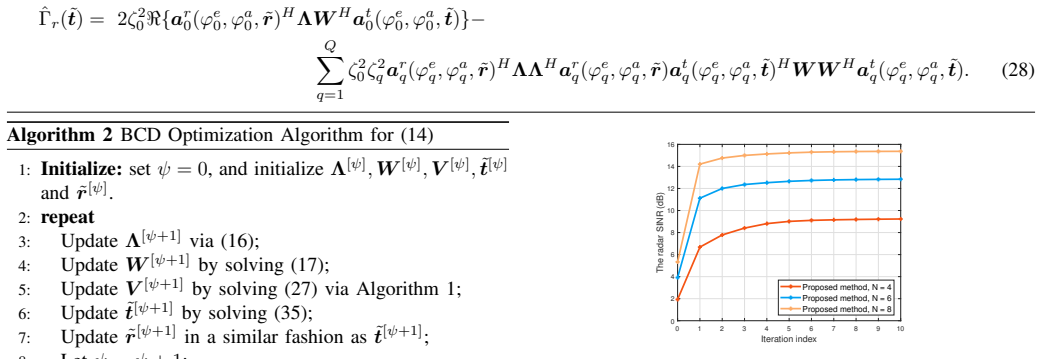
The argument runs on the field-response phase model for movable antennas, $g(t_n)$, whose entries are phases $e^{j\frac{2\pi}{\lambda}\rho(t_n,\psi^e_j,\psi^a_j)}$ depending on each antenna's in-region position. This phase model converts antenna-position variables into phases inside the radar steering matrices, letting the optimization move antenna locations. On top of that, the paper applies the fractional-programming transformation of the radar SINR into $\hat{\Gamma}_r(W,\tilde{r},\tilde{t},\Lambda) = \zeta_0^2 \mathrm{tr}(2\Re\{W^H A_0(\tilde{r},\tilde{t})^H \Lambda\} - \Lambda^H(\Xi+\sigma_r^2 I_N)\Lambda)$, with the optimal auxiliary $\Lambda^\star$ in closed form; then SCA surrogate functions handle the non-convex QoS and minimum-separation constraints, and a penalty method enforces the RIS unit-modulus constraints.
What would settle it
Run the same joint design with a near-field (spherical-wavefront) channel model instead of the far-field response model; if the movable-antenna SINR gain over fixed positions shrinks toward zero or reverses as the moving-region size approaches the BS-RIS distance, the 5 dB claim rests on the far-field assumption.
Extended reading notes
Core claim
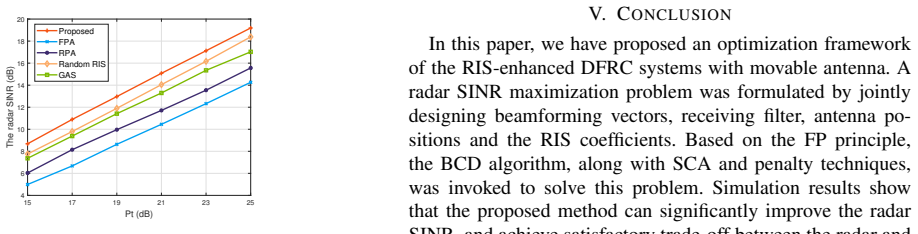
The central claim is that radar SINR in an RIS-enhanced DFRC system can be maximized by moving the transceiver antennas as part of the optimization, and that doing so pays off. Using a far-field geometric channel model in which antenna motion only changes link phases, the paper reformulates the radar SINR through fractional programming, then alternates updates of the auxiliary matrix, beamformers, RIS coefficients, and antenna positions. The numerical result singled out by the paper is a radar SINR improvement of about 5 dB over the fixed-position-antenna benchmark at the same transmit power, with convergence typically within six iterations and little sensitivity to the communication SINR threshold because the movable antennas supply extra spatial degrees of freedom.
Load-bearing premise
The paper assumes the far-field condition: as antennas move, each path's angle and amplitude stay constant, so only the phase of each link changes.
Editorial extensions
If this is right
- Combining movable-antenna position optimization with RIS phase tuning yields roughly a 5 dB radar SINR improvement over a fixed-position array at equal transmit power.
- The proposed BCD-FP-SCA-penalty procedure converges in about six iterations for the tested antenna counts, so the joint design is computationally plausible for online use.
- Raising the communication SINR threshold barely lowers the achieved radar SINR, indicating that movable antennas absorb the QoS burden with their extra spatial degrees of freedom.
- The same framework extends MA transceiver design to RIS-covered dead zones, where the RIS provides the only communication link between BS and users.
Reading between the lines
- The 5 dB figure is computed under far-field assumptions; a near-field or position-dependent-blockage model would likely shrink the gain, so an experimental benchmark with reconfigurable or stepper-motor antennas would be a more demanding test.
- The framework suggests a dual objective in which positions are optimized to maximize communication rate under a radar SINR floor, which the paper does not run but the variable structure supports.
- Quantized position grids (as in the greedy antenna selection baseline) capture only part of the gain; this implies that mechanical positioning accuracy on the order of a wavelength fraction may matter for realizing the reported advantage.
- A robust version that accounts for angle uncertainty in target and clutter steering vectors would be a natural next step, since the current SINR expression assumes known angles.
Editorial analysis
A structured set of objections, weighed in public.
Referee Report
Summary. The paper studies an RIS-enhanced dual-functional radar-communication (DFRC) system in which the base station antennas are movable within local regions. It formulates a radar SINR maximization problem under per-user communication QoS constraints, minimum antenna separation constraints, transmit power, and unit-modulus RIS constraints, and proposes to solve it by block coordinate descent that alternates between the fractional-programming auxiliary variable, transmit beamformers, RIS phase coefficients, and transmit/receive antenna positions. The antenna-position block uses successive convex approximation with quadratic surrogates, and the RIS block uses a penalty method. Simulation results claim roughly 5 dB radar SINR gain over a fixed-position-antenna (FPA) baseline and monotone convergence within a few iterations.
Significance. If validated, the paper would provide a useful design framework for exploiting movable-antenna spatial degrees of freedom in RIS-aided DFRC systems, and the comparison against RPA, random-RIS, and GAS baselines is informative. The fractional-programming reformulation is algebraically standard, the block structure is clearly organized, and the simulation setup is mostly specified. However, the SCA surrogates for the antenna-position block rely on constants that are neither specified nor computable from the text, a conjugation error appears in the RIS-phase block, and the convergence/feasibility claims are not backed by constraint-violation or unit-modulus-violation metrics. These issues must be resolved before the reported radar SINR gain can be considered reproducible and attributable to the proposed algorithm.
major comments (4)
- [Section III-D, Eqs. (31), (33), (35)] The constants delta_0 and delta_k are never specified. For (35d) to imply the true QoS constraint (32), the surrogate (33) must be a global upper bound on f_k over the whole feasible region, which requires a verified Hessian bound; for (31) to be a global lower bound on the objective, the relevant condition is a bound on the spectral norm (or the lower end of the Hessian spectrum) of the Hessian, not merely delta_0 I ⪰ grad^2 Gamma_r as written. The statement that the calculation is 'similar to [12]' is not sufficient. If these constants are too small, the t-update can satisfy (35d) while violating the true communication constraint (32), and the monotone convergence reported in Fig. 2 is not guaranteed. Please report the actual constants or a backtracking procedure to determine them, and add a per-iteration feasibility check.
- [Section III-C, Eq. (22)] There is a conjugation error in the transformation of the RIS-phase constraint. With v = [v_1, ..., v_M]^H and V = diag(v_m), for \tilde h_{k,j} = diag(h_k^H) H(\tilde t) w_j one obtains h_k^H V H(\tilde t) w_j = v^T \tilde h_{k,j}, so |h_k^H V H(\tilde t) w_j|^2 = v^H \tilde h_{k,j}^* \tilde h_{k,j}^T v, not v^H \tilde h_{k,j} \tilde h_{k,j}^H v. Unless \tilde h_{k,j} is redefined with a conjugate, Eqs. (22)-(25) and Algorithm 1 maximize a different function from the actual user SINR. Please correct the definition or the quadratic form and re-check the numerical results.
- [Algorithm 2 and Section IV] Convergence to a feasible point is not established. The RIS block is solved by a penalty method with only |v_m| <= 1 enforced at each inner step, and no projection or post-processing is described to recover exact unit-modulus phases; the final point may therefore not correspond to physically implementable RIS coefficients. In addition, BCD updates use the fractional-programming auxiliary variable fixed from the previous block, so the equivalence in (15) is only valid at the optimum; the monotone objective curve in Fig. 2 does not imply that all constraints in (14) are satisfied. Please report constraint-violation metrics, final unit-modulus error, and, if needed, a feasibility-restoration step.
- [Section IV, baseline descriptions] The FPA and RPA baselines are described only by antenna geometry ('uniform planar arrays' and 'randomly distributed in the moving region'), without stating whether the same beamforming and RIS optimization is applied to them. If FPA simply uses a fixed UPA without the same W/V/RIS optimization, then the 5 dB gain in Fig. 3 conflates movable-antenna gains with gains from the optimization framework itself. Please state explicitly that all baselines use the same per-block optimization with only the position degrees of freedom removed, or provide an ablation isolating the MA contribution.
minor comments (4)
- [Throughout] There are numerous typos, including 'INTR ODUTION' in the section header, 'assmue', 'expessed', 'refomulate', and 'interation' in the Fig. 2 caption; these should be corrected.
- [Section IV] The values of the SCA constants delta_0 and delta_k, the penalty parameters rho_1 and tau, the thresholds xi_1 and xi_2, and the initialization of all blocks are not reported; please include them for reproducibility.
- [Section II-A] The far-field assumption is reasonable for the simulated geometry (A = 2 lambda = 0.2 m versus link distances around 30 m), but stating the Fraunhofer distance check explicitly would help readers assess when the geometric channel model is valid.
- [Section III-C, Eq. (24)] The inequality in (24) requires positive values of eta^(l) and z_k^(l); this positivity condition should be stated explicitly.
Circularity Check
No significant circularity; the derivation chain is self-contained.
full rationale
The paper's central claim is a simulation-based performance comparison, not a quantity derived from fitted inputs. The radar SINR objective (11) is taken from a standard signal model, the MVDR filter (12) and the FP reformulation (15) are exact equivalences from cited external works ([15], [17]), and the optimization is carried out against fixed benchmark schemes (FPA, RPA, random RIS, GAS) with all system parameters explicitly stated. The SCA surrogates (31) and (33) are standard second-order Taylor bounds, and the unspecified Hessian-bound constants δ₀ and δₖ are delegated to the external reference [12] (W. Ma, L. Zhu, R. Zhang), not to the authors' own prior work; this is a reproducibility or correctness concern, not circularity. There is no fitted parameter renamed as a prediction, no load-bearing self-citation, no ansatz smuggled in via citation, and no known result merely relabeled. The reported ~5 dB gain over FPA is an outcome of the numerical model rather than an identity built into the formulation.
Assumptions & free parameters
free parameters (4)
- Initial penalty factor rho_1 =
10^{-2} to 10^{-1} times M (not fixed in paper)
- Penalty update factor tau =
> 1, no specific value given
- Convergence thresholds xi_1 and xi_2 =
Not specified numerically
- SCA constants delta_0 and delta_k =
Not specified
assumptions (4)
- domain assumption Geometry-based far-field channel model with L discrete paths
- domain assumption Point target and clutter modeled as LoS, with only second-order statistics of the complex coefficients known
- domain assumption Perfect channel state information available
- standard math MVDR filter optimality and FP transform from references [15] and [17]
Cite this review
Pith. "Pith review of Joint Transceiver Design for RIS Enhanced Dual-Functional Radar-Communication with Movable Antenna." pith.science (2026). https://pith.science/paper/ALL5HGNO
@misc{pith2026250209023,
  author       = {Pith},
  title        = {Pith review of: Joint Transceiver Design for RIS Enhanced Dual-Functional Radar-Communication with Movable Antenna},
  year         = {2026},
  howpublished = {\url{https://pith.science/paper/ALL5HGNO}},
  note         = {Machine review of arXiv:2502.09023}
}
read the original abstract
Movable antennas (MAs) have shown significant potential in enhancing the performance of dual-functional radar-communication (DFRC) systems. In this paper, we investigate the MA-based transceiver design for DFRC systems, where a reconfigurable intelligent surface (RIS) is employed to enhance the communication quality in dead zones. To enhance the radar sensing performance, we formulate an optimization problem to maximize the radar signal-to-interference-plus-noise ratio (SINR) by jointly optimizing the beamforming vectors, receiving filter, antenna positions, and RIS reflecting coefficients. To tackle this challenging problem, we develop a fractional programming-based optimization framework, incorporating block coordinate descent (BCD), successive convex approximation (SCA), and penalty techniques. Simulation results demonstrate that the proposed method can significantly improve the radar SINR and achieve a satisfactory balance between the radar and communication performance compared with existing benchmark schemes.
Figures

Figures from the paper (1 more)

Reference graph
Works this paper leans on
-
[10]
Movable-antenna aided secure transmission for RIS-ISAC systems,
Y . Ma, K. Liu, Y . Liu, L. Zhu, and Z. Xiao, “Movable-antenna aided secure transmission for RIS-ISAC systems,” arXiv preprint arXiv:2410.03426, 2024
arXiv 2024
-
[11]
Movable Antenna-enabled RIS-aided Integrated Sensing and Communication
H. Wu, H. Ren, C. Pan, and Y . Zhang, “Movable antenna-enabled RIS-aided integrated sensing and communication,” arXiv preprint arXiv:2407.03228, 2024
work page Pith review arXiv 2024
-
[12]
MIMO capacity characterization for movable antenna systems,
W. Ma, L. Zhu, and R. Zhang, “MIMO capacity characterization for movable antenna systems,” IEEE Trans. Wireless Commun. , vol. 23, no. 4, pp. 3392–3407, 2024
work page 2024
-
[1]
Joint radar and communication design: Applications, state-of-the-art, and the road ahead,
F. Liu, C. Masouros, A. P. Petropulu, H. Griffiths, and L. Hanzo, “Joint radar and communication design: Applications, state-of-the-art, and the road ahead,” IEEE Trans. Commun., vol. 68, no. 6, pp. 3834–3862, 2020
2020
-
[2]
Orthogonal time frequency space modulation—part III: ISAC and potential applications,
W. Yuan, Z. Wei, S. Li, R. Schober, and G. Caire, “Orthogonal time frequency space modulation—part III: ISAC and potential applications,” IEEE Commun. Lett , vol. 27, no. 1, pp. 14–18, 2022
work page 2022
-
[3]
NOMA-aided joint radar and multicast-unicast communication systems,
X. Mu, Y . Liu, L. Guo, J. Lin, and L. Hanzo, “NOMA-aided joint radar and multicast-unicast communication systems,” IEEE J. Sel. Areas Commun., vol. 40, no. 6, pp. 1978–1992, 2022
1978
-
[4]
Constrained utility maximization in dual-functional radar-communication multi-UA V networks,
X. Wang, Z. Fei, J. A. Zhang, J. Huang, and J. Yuan, “Constrained utility maximization in dual-functional radar-communication multi-UA V networks,” IEEE Trans. Commun., vol. 69, no. 4, pp. 2660–2672, 2021
work page 2021
-
[5]
Movable antenna-enhanced wireless communications: General architectures and implementation methods,
B. Ning et al. , “Movable antenna-enhanced wireless communications: General architectures and implementation methods,” arXiv e-prints , p. arXiv:2407.15448, Jul. 2024
arXiv 2024
Show all 19 references
-
[6]
Movable-antenna position optimization: A graph-based approach,
W. Mei et al., “Movable-antenna position optimization: A graph-based approach,” IEEE Wireless Commun. Lett., vol. 13, no. 7, pp. 1853–1857, 2024
2024
-
[7]
Movable antenna enabled integrated sensing and com- munication,
W. Lyu et al. , “Movable antenna enabled integrated sensing and com- munication,” IEEE Trans. Wireless Commun. , 2025
2025
-
[8]
Fluid antenna-assisted isac systems,
L. Zhou, J. Yao, M. Jin, T. Wu, and K.-K. Wong, “Fluid antenna-assisted isac systems,” IEEE Wireless Commun. Lett. , 2024
2024
-
[9]
An overview of signal processing techniques for RIS/IRS- aided wireless systems,
C. Pan et al., “An overview of signal processing techniques for RIS/IRS- aided wireless systems,” IEEE J. Sel. Topics Signal Process. , vol. 16, no. 5, pp. 883–917, 2022
2022
-
[13]
Modeling and performance analysis for movable antenna enabled wireless communications,
L. Zhu, W. Ma, and R. Zhang, “Modeling and performance analysis for movable antenna enabled wireless communications,” IEEE Trans. Wireless Commun., vol. 23, no. 6, pp. 6234–6250, 2024
2024
-
[14]
QoS-aware precoder optimization for radar sensing and multiuser communications under per-antenna power constraints,
C. Wang et al., “QoS-aware precoder optimization for radar sensing and multiuser communications under per-antenna power constraints,” IEEE Trans. Signal Process., vol. 71, pp. 2235–2250, 2023
2023
-
[15]
High-resolution frequency-wavenumber spectrum analysis,
J. Capon, “High-resolution frequency-wavenumber spectrum analysis,” Proc. IEEE, vol. 57, no. 8, pp. 1408–1418, 1969
1969
-
[16]
Generalized transceiver beamforming for DFRC with MIMO radar and MU-MIMO communication,
L. Chen et al. , “Generalized transceiver beamforming for DFRC with MIMO radar and MU-MIMO communication,” IEEE J. Sel. Areas Commun., vol. 40, no. 6, pp. 1795–1808, 2022
2022
-
[17]
Fractional programming for communication systems—part I: Power control and beamforming,
K. Shen and W. Yu, “Fractional programming for communication systems—part I: Power control and beamforming,” IEEE Trans. Signal Process., vol. 66, no. 10, pp. 2616–2630, 2018
2018
-
[18]
Successive convex approximation: Analysis and appli- cations,
M. Razaviyayn, “Successive convex approximation: Analysis and appli- cations,” Ph.D. dissertation, University of Minnesota, 2014
2014
-
[19]
Convex optimization,
S. Boyd, “Convex optimization,” Cambridge UP, 2004
2004
Reviewed August 7, 2026 · model on record in the stance chip above.
Discussion (0). Continue with ORCID to comment.