REVIEW 3 major objections 6 minor 43 references
Accelerating Bayesian Sampling for Massive Black Hole Binaries with Prior Constraints from Conditional Variational Autoencoder
T0 review · 3 major / 6 minor · reviewed 2026-08-07 · deepseek-v4-flash
Pith's one-line read Using the central 99.73% interval of a conditional variational autoencoder posterior as a narrowed prior cuts massive-black-hole-binary inference runtime by about sixfold while yielding a statistically similar posterior.
desk verdict A practical CVAE-prior-narrowing speedup for MBHB nested sampling, with a credible validation but a missing coverage test and reproducibility gaps. read the letter →
The pith
A machine-rendered reading of the paper's core claim, the machinery that carries it, and where it could break.
The reading
What carries the argument
The load-bearing object is the CVAE's central 99.73% interval per parameter, used to define a narrowed prior. The CVAE has two encoders and a decoder: one encoder maps strain data to a distribution over a latent space, the other maps data together with the true parameters into the same latent space during training, and the decoder turns latent samples plus data into a Gaussian-mixture approximation of the posterior; the training loss is reconstruction error plus KL divergence between the two encoders. At test time, the data-only encoder and decoder produce an approximate posterior in about one second. The argument then relies on the fact that prior volume outside the high-likelihood region contributes almost no posterior weight, so setting it to zero leaves the posterior nearly unchanged while letting nested sampling skip low-weight early iterations. The runtime gain comes from this reduced search space, not from any modification of the likelihood.
What would settle it
Run the pipeline on a new, larger set of in-distribution signals and count the fraction of true injected parameters that fall inside the CVAE's 99.73% interval for each of the nine parameters; if the empirical coverage is substantially below 99.73%, or if narrowed-prior posteriors exclude true values where full-prior posteriors do not, the central claim fails. A sharper test is to feed an out-of-distribution signal with a different waveform model or a signal-to-noise ratio far outside the training range and check whether the narrowed-prior posterior still agrees with the full-prior posterior.
Extended reading notes
Core claim
The paper establishes that a CVAE posterior, although broader and lighter-tailed than a true Bayesian posterior, still localizes the high-likelihood region well enough to serve as a prior constraint rather than as the final inference. For each of the nine source parameters, the authors take the range from the 0.135th to the 99.865th percentile of the CVAE's marginal posterior, intersect it with the original full prior, and feed this narrowed box to nested sampling. Across 50 test signals, the runtime fell by a factor of about 6 on average, and the symmetric KL divergence between the narrowed-prior and full-prior posteriors was similar in magnitude to the divergence between two independent full-prior sampling runs. The implication is that the deep model does not need to be a faithful posterior estimator; it only needs to contain the true parameters within its central interval.
Load-bearing premise
The load-bearing premise is that the CVAE's central 99.73% interval always contains the true source parameters, so the high-likelihood region is never excluded by the narrowed prior.
Editorial extensions
If this is right
- For the 50 in-distribution MBHB test signals, prior narrowing preserves posterior accuracy at the level of run-to-run sampling scatter while reducing nested-sampling runtime by roughly a factor of 6.
- Because the CVAE serves only as a preprocessing step, its known tail inaccuracies do not enter the final parameter estimates and uncertainties, which still come from standard Bayesian sampling.
- The intersection rule requires only that the CVAE central interval covers the true parameters, not that the CVAE posterior has the correct shape, making the method applicable to other approximate estimators.
- The same hybrid strategy should transfer to other high-signal-to-noise gravitational-wave sources for which fast deep-learning estimators exist but are not yet accurate enough to replace sampling.
Reading between the lines
- The paper validates the approach on only 50 in-distribution synthetic instances and never directly measures how often true parameters fall inside the narrowed prior; a calibration step that widens the interval until empirical coverage reaches the nominal 99.73% level would make the pipeline more reliable for out-of-distribution or low-SNR signals.
- Prior narrowing is orthogonal to likelihood accelerations such as relative binning or reduced-order quadrature, so combining them could compound the speedup rather than compete with it.
- Per-parameter percentile boxes cannot capture strong correlations or multimodality; an alternative prior based on the CVAE's full joint credible region might preserve the speedup while better respecting the true posterior's shape.
- A testable extension is to use the CVAE to build an importance-sampling proposal instead of a hard prior cutoff, converting the runtime reduction into an unbiased estimator whose effective sample size can be monitored.
Editorial analysis
A structured set of objections, weighed in public.
Referee Report
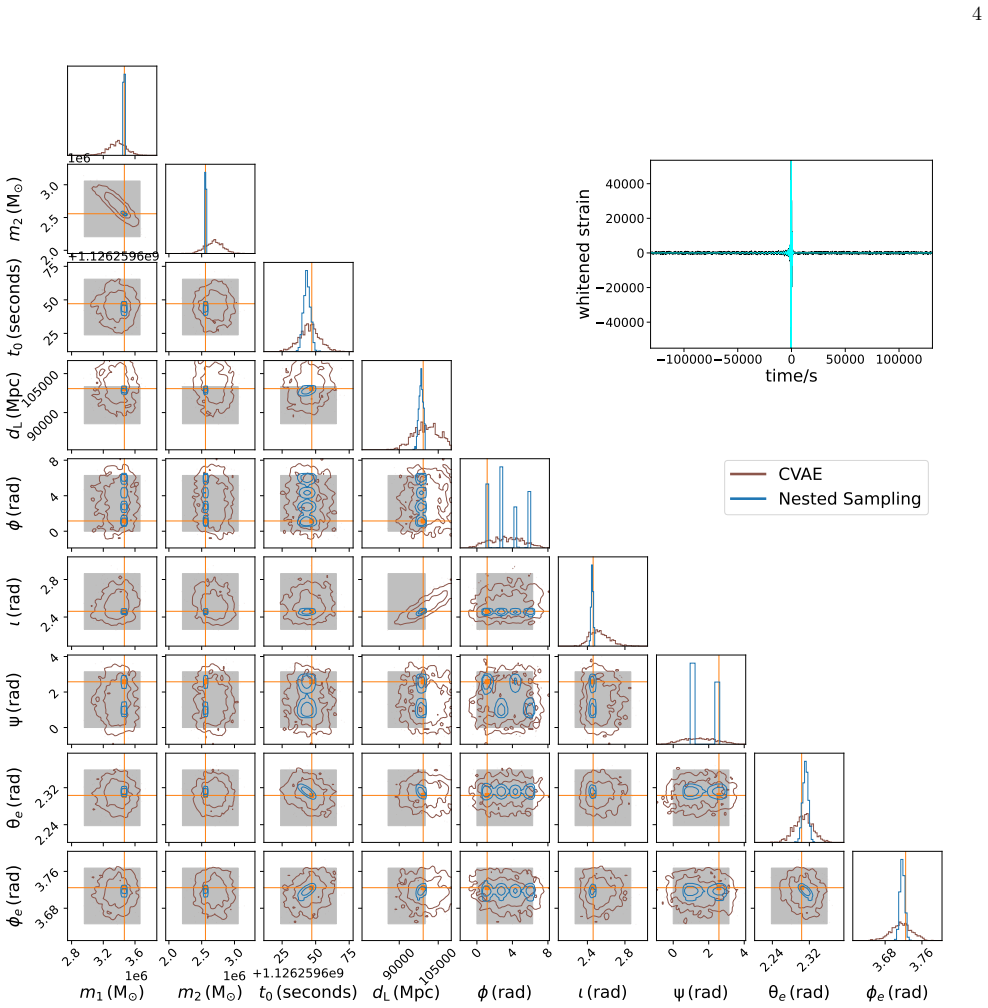
Summary. The paper proposes a two-stage inference pipeline for massive black hole binary signals observed by a Taiji-TianQin-LISA network. A conditional variational autoencoder (CVAE) is trained on 6e5 synthetic instances to produce an approximate posterior in about one second; its per-parameter central 99.73% intervals are intersected with the original priors of Table I to form a narrowed prior, and PyMultiNest nested sampling is then run under this narrowed prior. On 50 test instances the authors report an average runtime reduction of about a factor of 6, with narrowed-prior posteriors whose symmetric KL divergence to full-prior posteriors is similar to the run-to-run scatter of two full nested-sampling runs. One representative instance is shown in detail, and a boxplot comparison is given in Fig. 3.
Significance. The proposed method is well motivated: if the narrowed prior reliably contains the high-likelihood region, the speedup comes essentially for free, since the CVAE evaluation is cheap and intersecting with the original prior prevents the introduction of support outside the original parameter space. The experimental design is also thoughtful: comparing narrowed-prior against full-prior posteriors and anchoring the comparison with a full-prior-versus-full-prior baseline is the correct control. The main weaknesses are that the coverage property is never measured directly, and the speedup is summarized by a single average. These are fixable with additional analyses, and the paper would be a useful contribution to rapid pre-processing for space-based GW parameter estimation if those analyses are added.
major comments (3)
- [Section III B (prior-narrowing rule)] The central assumption of the method—that the intersection of the CVAE's per-parameter central 99.73% intervals with the original prior never excludes the high-likelihood region—is not tested directly. The paper validates this only indirectly through the DsKL comparison in Fig. 3, but Gaussian KDE has unbounded support and can smooth over hard truncation, making the test insensitive to the exact scenario that would bias the result. Please report the empirical coverage rate of the true injected parameters within the narrowed prior across the 50 instances, per parameter and stratified by SNR, and discuss any instances where the true value falls outside the narrowed prior; this is the load-bearing check for the method.
- [Section III B (runtime results)] The speedup claim "reduced by a factor of ~6 on average" is reported as a single average, with only the one detailed instance's runtimes (47.5 h to 3.9 h) shown. Please provide the distribution of per-instance speedups (median and range), the reduction in prior volume achieved by the narrowing, and specify the hardware, PyMultiNest settings (nlive, stopping criterion, random seeds), and whether the full-prior and narrowed-prior runs used identical settings. Without these details the factor-of-six claim cannot be assessed or reproduced.
- [Section IV (Conclusions)] The concluding statement that the method "can also be applied to other gravitational wave sources with high signal-to-noise ratios" is not supported by the experiments, which are entirely in-distribution (same prior, same waveform model, same noise PSD) and include only one explicitly illustrated SNR (501.2). Please either remove this generalization or add tests at lower SNR and under modest distribution shift; at minimum, explicitly state that the validation is in-distribution.
minor comments (6)
- [Eq. (7)] The real-part operator is written as "R"; please use \(\Re\) or \(\mathrm{Re}\) to avoid ambiguity with other symbols in the paper.
- [Fig. 2 and Table I] The axis labels for \(\theta_e\) and \(\phi_e\) appear as "e (rad)" in the rendered figure; please fix the labels.
- [Section III A] The description that CVAE distributions exhibit "lighter tails, appearing broader" is ambiguous; please clarify the intended meaning and quantify the width and tail behavior.
- [Appendix B] The sample-based DsKL estimator uses KDE densities that can be near zero in the tails; please state the bandwidth selection procedure and any regularization used to avoid undefined logarithms.
- [General] The paper does not state whether the training data, trained model, and code will be made available; please add an availability statement.
- [Fig. 3] Adding the DsKL values for the individual detailed instance and the number of test instances per box would help readers assess the spread.
Circularity Check
No circularity: the CVAE prior-narrowing is an independent amortized inference input, and the final Nested Sampling result is validated against full-prior Nested Sampling rather than derived from the CVAE itself.
full rationale
The paper's derivation chain is not circular. The CVAE is trained with a variational objective on simulated signal/parameter pairs, not on the Nested Sampling outputs that later serve as the accuracy benchmark. The narrowed prior is defined as the intersection of the CVAE's central 99.73% interval with the original prior, and the subsequent Nested Sampling run uses the exact likelihood of Eq. (6) with that modified prior. The final posterior is therefore not equal to the CVAE posterior by construction; it is a new Bayesian calculation whose input is a data-dependent prior box. The central validation compares the narrowed-prior Nested Sampling posterior to the full-prior Nested Sampling posterior via symmetric KL divergence and calibrates the result against the run-to-run scatter of two independent full-prior Nested Sampling runs. That comparison is an independent check rather than a re-statement of the CVAE output. The main limitations are robustness concerns rather than circularity: the CVAE is trained on the same prior, waveform, and noise model used in the evaluation, so all 50 test instances are in-distribution, and the paper does not directly measure the empirical coverage rate of the true parameters inside the narrowed prior. Those omissions weaken the generalization claim but do not make the acceleration result equivalent to the method's inputs. There are no load-bearing self-citations: the cited variational-inference proofs are external, and the prior-narrowing idea is only inspired by prior work, not justified by it. Overall, the central claim is self-contained and empirically supported for the tested in-distribution regime.
Assumptions & free parameters
free parameters (6)
- CVAE 99.73% prior coverage fraction =
0.9973 (hand-chosen)
- CVAE architecture hyperparameters =
not specified
- Initial learning rate r0 =
1e-4
- Learning-rate decay denominator =
1e5 iterations
- PyMultiNest live points and stopping criterion =
not reported
- KDE bandwidth for symmetric KL divergence =
not reported
assumptions (6)
- domain assumption The data consist of stationary Gaussian noise with known PSDs (Eqs. 6 and 7).
- domain assumption IMRPhenomPv3 restricted to the (2,2) mode adequately describes MBHB signals for this analysis.
- domain assumption The detector response model of the A/E channels with 20-degree orbital separation is correct.
- domain assumption Training, validation, and test sets are independent and identically distributed from the same prior and noise distributions.
- standard math Nested-sampling prior-volume ratios follow Beta(nlive,1) and the stopping criterion is reliable.
- standard math The CVAE loss upper-bounds the true negative log-likelihood as proven in Refs [17,37].
Cite this review
Pith. "Pith review of Accelerating Bayesian Sampling for Massive Black Hole Binaries with Prior Constraints from Conditional Variational Autoencoder." pith.science (2026). https://pith.science/paper/BTINJ5RX
@misc{pith2026250209266,
  author       = {Pith},
  title        = {Pith review of: Accelerating Bayesian Sampling for Massive Black Hole Binaries with Prior Constraints from Conditional Variational Autoencoder},
  year         = {2026},
  howpublished = {\url{https://pith.science/paper/BTINJ5RX}},
  note         = {Machine review of arXiv:2502.09266}
}
abstract
A Conditional Variational Autoencoder (CVAE) model is employed for parameter inference on gravitational waves (GW) signals of massive black hole binaries, considering joint observations with a network of three space-based GW detectors. Our experiments show that the trained CVAE model can estimate the posterior distribution of source parameters in approximately one second, while the standard Bayesian sampling method, utilizing parallel computation across 16 CPU cores, takes an average of 20 hours for a GW signal instance. However, the sampling distributions from CVAE exhibit lighter tails, appearing broader when compared to the standard Bayesian sampling results. By using CVAE results to constrain the prior range for Bayesian sampling, the sampling time is reduced by a factor of $\sim$6 while maintaining the similar precision of the Bayesian results.
Figures


Figures from the paper (1 more)

Reference graph
Works this paper leans on
-
[1]
B. P. Abbott, R. Abbott, T. Abbott, M. Abernathy, F. Acernese, K. Ackley, C. Adams, T. Adams, P. Ad- desso, R. X. Adhikari, et al., Observation of gravitational waves from a binary black hole merger, Phys. Rev. Lett. 116, 061102 (2016)
work page 2016
-
[2]
B. P. Abbott, R. Abbott, T. Abbott, S. Abraham, F. Ac- ernese, K. Ackley, C. Adams, R. Adhikari, V. Adya, C. Affeldt, et al., Gwtc-1: a gravitational-wave transient catalog of compact binary mergers observed by ligo and virgo during the first and second observing runs, Physical Review X 9, 031040 (2019)
work page 2019
-
[3]
R. Abbott, T. Abbott, S. Abraham, F. Acernese, K. Ack- ley, A. Adams, C. Adams, R. Adhikari, V. Adya, C. Af- feldt, et al. , Gwtc-2: compact binary coalescences ob- served by ligo and virgo during the first half of the third observing run, Physical Review X 11, 021053 (2021)
work page 2021
-
[4]
R. Abbott, T. Abbott, F. Acernese, K. Ackley, C. Adams, N. Adhikari, R. Adhikari, V. Adya, C. Affeldt, D. Agar- wal, et al. , Gwtc-3: Compact binary coalescences ob- served by ligo and virgo during the second part of the third observing run, Physical Review X 13, 041039 (2023)
work page 2023
-
[5]
W.-R. Hu and Y.-L. Wu, The taiji program in space for gravitational wave physics and the nature of gravity, Na- tional Science Review 4, 685 (2017)
work page 2017
-
[6]
P. Amaro-Seoane, H. Audley, S. Babak, J. Baker, E. Ba- rausse, P. Bender, E. Berti, P. Binetruy, M. Born, D. Bor- toluzzi, et al., Laser interferometer space antenna (2017), arXiv:1702.00786 [astro-ph.IM]
arXiv 2017
- [7]
-
[8]
Y. Gong, J. Luo, and B. Wang, Concepts and status of chinese space gravitational wave detection projects, Na- ture Astronomy 5, 881 (2021)
work page 2021
Show all 43 references
-
[9]
Zhang, Y
C. Zhang, Y. Gong, H. Liu, B. Wang, and C. Zhang, Sky localization of space-based gravitational wave detectors, Phys. Rev. D 103, 103013 (2021)
2021
-
[10]
Q. Hu, M. Li, R. Niu, and W. Zhao, Joint observations of space-based gravitational-wave detectors: Source lo- calization and implications for parity-violating gravity, Phys. Rev. D 103, 064057 (2021)
2021
-
[11]
I. W. Harry, S. Fairhurst, and B. S. Sathyaprakash, A hi- erarchical search for gravitational waves from supermas- sive black hole binary mergers, Classical and Quantum Gravity 25, 184027 (2008)
2008
-
[12]
Marsat, J
S. Marsat, J. G. Baker, and T. D. Canton, Exploring the bayesian parameter estimation of binary black holes with lisa, Phys. Rev. D 103, 083011 (2021)
2021
-
[13]
W. K. Hastings, Monte carlo sampling methods using markov chains and their applications, Biometrika 57, 97 (1970)
1970
-
[14]
Christensen and R
N. Christensen and R. Meyer, Using markov chain monte carlo methods for estimating parameters with gravita- tional radiation data, Phys. Rev. D 64, 022001 (2001)
2001
-
[15]
Raymond, M
V. Raymond, M. V. van der Sluys, I. Mandel, V. Kalogera, C. R¨ over, and N. Christensen, The effects of ligo detector noise on a 15-dimensional markov-chain monte carlo analysis of gravitational-wave signals, Clas- sical and Quantum Gravity 27, 114009 (2010). 8 2.550 2.565 m2 ...
2010
-
[16]
Skilling, Nested sampling for general Bayesian compu- tation, Bayesian Analysis 1, 833 (2006)
J. Skilling, Nested sampling for general Bayesian compu- tation, Bayesian Analysis 1, 833 (2006)
2006
-
[17]
Gabbard, C
H. Gabbard, C. Messenger, I. S. Heng, F. Tonolini, and R. Murray-Smith, Bayesian parameter estimation using conditional variational autoencoders for gravitational- wave astronomy, Nature Physics 18, 112 (2022)
2022
-
[18]
S. R. Green and J. Gair, Complete parameter inference for gw150914 using deep learning, Machine Learning: Science and Technology 2, 03LT01 (2021)
2021
-
[19]
M. Du, B. Liang, H. Wang, P. Xu, Z. Luo, and Y. Wu, Advancing space-based gravitational wave as- tronomy: Rapid parameter estimation via normalizing flows, Sci. China Phys. Mech. Astron. 67, 230412 (2024), arXiv:2308.05510 [astro-ph.IM]
2024 arXiv
-
[20]
M. Dax, S. R. Green, J. Gair, M. P¨ urrer, J. Wildberger, J. H. Macke, A. Buonanno, and B. Sch¨ olkopf, Neural importance sampling for rapid and reliable gravitational- wave inference, Phys. Rev. Lett. 130, 171403 (2023)
2023
-
[21]
Ye, H.-M
C.-Q. Ye, H.-M. Fan, A. Torres-Orjuela, J.-d. Zhang, and Y.-M. Hu, Identification of gravitational waves from extreme-mass-ratio inspirals, Phys. Rev. D 109, 124034 (2024)
2024
-
[22]
Zackay, L
B. Zackay, L. Dai, and T. Venumadhav, Relative bin- ning and fast likelihood evaluation for gravitational wave 9 parameter estimation (2018), arXiv:1806.08792 [astro- ph.IM]
2018 arXiv
-
[23]
Leslie, L
N. Leslie, L. Dai, and G. Pratten, Mode-by-mode rela- tive binning: Fast likelihood estimation for gravitational waveforms with spin-orbit precession and multiple har- monics, Phys. Rev. D 104, 123030 (2021)
2021
-
[24]
Vinciguerra, J
S. Vinciguerra, J. Veitch, and I. Mandel, Accelerating gravitational wave parameter estimation with multi-band template interpolation, Classical and Quantum Gravity 34, 115006 (2017)
2017
-
[25]
Canizares, S
P. Canizares, S. E. Field, J. Gair, V. Raymond, R. Smith, and M. Tiglio, Accelerated gravitational wave parameter estimation with reduced order modeling, Phys. Rev. Lett. 114, 071104 (2015)
2015
-
[26]
Cai, Z.-K
R.-G. Cai, Z.-K. Guo, B. Hu, C. Liu, Y. Lu, W.-T. Ni, W.-H. Ruan, N. Seto, G. Wang, and Y.-L. Wu, On net- works of space-based gravitational-wave detectors, Fun- damental Research 4, 1072 (2024)
2024
-
[27]
Liang, Y
D. Liang, Y. Gong, A. J. Weinstein, C. Zhang, and C. Zhang, Frequency response of space-based interfer- ometric gravitational-wave detectors, Phys. Rev. D 99, 104027 (2019)
2019
-
[28]
H. Liu, C. Zhang, Y. Gong, B. Wang, and A. Wang, Exploring nonsingular black holes in gravitational per- turbations, Phys. Rev. D 102, 124011 (2020)
2020
-
[29]
R. Niu, X. Zhang, T. Liu, J. Yu, B. Wang, and W. Zhao, Constraining screened modified gravity with spaceborne gravitational-wave detectors, The Astrophysical Journal 890, 163 (2020)
2020
-
[30]
Buchner, A
J. Buchner, A. Georgakakis, K. Nandra, L. Hsu, C. Rangel, M. Brightman, A. Merloni, M. Salvato, J. Donley, and D. Kocevski, X-ray spectral modelling of the agn obscuring region in the cdfs: Bayesian model se- lection and catalogue, Astronomy & Astrophysics 564, A125 (2014)
2014
-
[31]
Feroz and M
F. Feroz and M. P. Hobson, Multimodal nested sam- pling: an efficient and robust alternative to markov chain monte carlo methods for astronomical data analyses, Monthly Notices of the Royal Astronomical Society 384, 449 (2008)
2008
-
[32]
Feroz, M
F. Feroz, M. P. Hobson, and M. Bridges, Multinest: an efficient and robust bayesian inference tool for cosmol- ogy and particle physics, Monthly Notices of the Royal Astronomical Society 398, 1601 (2009)
2009
-
[33]
J. S. Speagle, dynesty: a dynamic nested sampling pack- age for estimating bayesian posteriors and evidences, Monthly Notices of the Royal Astronomical Society 493, 3132 (2020)
2020
-
[34]
Barbary, nestle: Pure python, mit-licensed imple- mentation of nested sampling algorithms for evaluat- ing bayesian evidence, https://github.com/kbarbary/ nestle
K. Barbary, nestle: Pure python, mit-licensed imple- mentation of nested sampling algorithms for evaluat- ing bayesian evidence, https://github.com/kbarbary/ nestle
-
[35]
W. J. Handley, M. P. Hobson, and A. N. Lasenby, poly- chord: next-generation nested sampling, Monthly No- tices of the Royal Astronomical Society453, 4384 (2015)
2015
-
[36]
K. Sohn, H. Lee, and X. Yan, Learning structured output representation using deep conditional generative mod- els, in Advances in Neural Information Processing Sys- tems, Vol. 28, edited by C. Cortes, N. Lawrence, D. Lee, M. Sugiyama, and R. Garnett (Curran Associates, Inc., 2015)
2015
-
[37]
Tonolini, J
F. Tonolini, J. Radford, A. Turpin, D. Faccio, and R. Murray-Smith, Variational inference for computa- tional imaging inverse problems, Journal of Machine Learning Research 21, 1 (2020)
2020
-
[38]
S. Khan, K. Chatziioannou, M. Hannam, and F. Ohme, Phenomenological model for the gravitational-wave sig- nal from precessing binary black holes with two-spin ef- fects, Phys. Rev. D 100, 024059 (2019)
2019
-
[39]
C. M. Biwer, C. D. Capano, S. De, M. Cabero, D. A. Brown, A. H. Nitz, and V. Raymond, Pycbc inference: A python-based parameter estimation toolkit for compact binary coalescence signals, Publications of the Astronom- ical Society of the Pacific 131, 024503 (2019)
2019
-
[40]
Ashton, M
G. Ashton, M. H¨ ubner, P. D. Lasky, C. Talbot, K. Ack- ley, S. Biscoveanu, Q. Chu, A. Divakarla, P. J. Easter, B. Goncharov, et al. , Bilby: A user-friendly bayesian in- ference library for gravitational-wave astronomy, The As- trophysical Journal Supplement Series 241, 27 (2019)
2019
-
[41]
I. M. Romero-Shaw, C. Talbot, S. Biscoveanu, V. D’emilio, G. Ashton, C. Berry, S. Coughlin, S. Galaudage, C. Hoy, M. H¨ ubner,et al., Bayesian infer- ence for compact binary coalescences with bilby: valida- tion and application to the first ligo–virgo gravitational- wave trans...
2020
-
[42]
R. B. Nerin, O. Bulashenko, O. G. Freitas, and J. A. Font, Parameter estimation of microlensed gravitational waves with conditional variational autoencoders (2024), arXiv:2412.00566 [gr-qc]
2024 arXiv
-
[43]
Parzen, On estimation of a probability density func- tion and mode, The annals of mathematical statistics 33, 1065 (1962)
E. Parzen, On estimation of a probability density func- tion and mode, The annals of mathematical statistics 33, 1065 (1962)
1962
Reviewed August 7, 2026 · model on record in the stance chip above.
Discussion (0). Continue with ORCID to comment.