REVIEW 3 major objections 6 minor 112 references
Variational quantum thermalizers based on weakly-symmetric nonunitary multi-qubit operations
T0 review · 3 major / 6 minor · reviewed 2026-08-07 · deepseek-v4-flash
Pith's one-line read A variational quantum thermalizer whose unitary layers are interleaved with weakly-symmetric multi-qubit dissipative channels prepares Gibbs states of paradigmatic spin models at all temperatures, with fidelity above 0.99 in the Ising…
desk verdict The weak/strong symmetry analysis and dissipative gate designs are a keeper, but the entropy estimator at the core of the cost function has a backwards rescaling and a gaming-prone regularizer, so the numerical claims need major revision before I would trust them. read the letter →
The pith
A machine-rendered reading of the paper's core claim, the machinery that carries it, and where it could break.
The reading
What carries the argument
The load-bearing object is the weakly symmetric multi-qubit nonunitary layer: a quantum channel that commutes with the symmetry representation as a whole, so that each individual jump operator may fail to commute and can transfer population between symmetry sectors. These layers are implemented by dissipation engineering, in which a weak drive and an auxiliary decaying oscillator produce effective multi-qubit jump operators such as $L_{\kappa,0}^{\mathrm{eff}} = \sqrt{\kappa_f}\,|11\rangle\langle 10| + \sqrt{\kappa_{af}}\,|01\rangle\langle 00|$, with rates tuned by detunings. Training minimizes the free energy $F = \beta\langle H\rangle - S$, with the von Neumann entropy $S$ estimated by the scaled subsystem entropy $S_{n_a} = \frac{n_a}{n} S(\cdot|_{n_a})$, justified by a white-noise model of random circuits interleaved with Pauli channels, and regularized by $(1-|\Delta S|)$ to prevent the optimizer from inflating subsystem entropy without raising the full entropy.
What would settle it
Run the converged six-qubit transverse-field Ising ansatz at an intermediate temperature, perform full tomography on the output, and compare the exact von Neumann entropy with the scaled three-qubit entropy used during training; if the difference is not small for the trained circuit, the cost function is not evaluating free energy and the near-unit fidelities would not be reproduced by an exact-entropy optimization.
Extended reading notes
Core claim
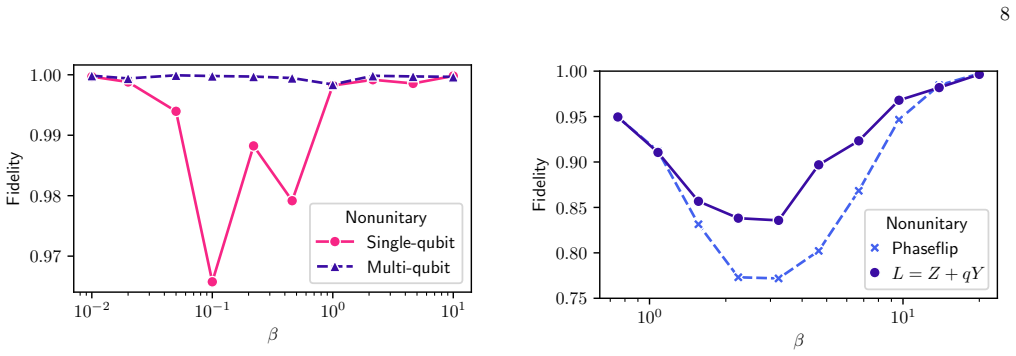
The central claim is that a variational ansatz alternating parameterized unitaries with weakly-symmetric multi-qubit nonunitary channels prepares the Gibbs state $\rho_G = e^{-\beta H}/Z$ of a Hamiltonian at all temperatures. The multi-qubit channels are engineered dissipative jumps: a weak drive excites selected multi-qubit states into a strongly shifted manifold, and decay of an auxiliary oscillator completes a nonunitary step, so no ancilla qubits or measurements are required. Numerically, the paper reports that for the Ising model the multi-qubit operations achieve near-perfect state preparation with fidelity above 0.99 across temperatures, and for the transverse-field Ising model at criticality and the Heisenberg model with a transverse field they significantly outperform single-qubit noise, especially at the intermediate temperatures where previous thermalizers struggle. The paper also shows that a strongly symmetric channel is confined to one symmetry sector, bounding its high-temperature fidelity by 0.5, while a weakly symmetric channel can mix sectors and reach the Gibbs state, and it proves that its approximate dissipative evolution approaches an efficient noncommutative Gibbs sampler in diamond norm as $\mathcal{O}(\beta)$ at high temperatures.
Load-bearing premise
The scaled subsystem entropy estimate assumes that the full $n$-qubit output state's von Neumann entropy is faithfully captured by the entropy of a small ($n_a = 3$ or $4$) translation-invariant subsystem; if the optimizer drives the circuit to a state whose subsystem entropy grows while the full entropy stays put, the free-energy cost function misranks states and the reported high fidelities would not survive.
Editorial extensions
If this is right
- Multi-qubit nonunitary layers give near-perfect thermal state preparation for the Ising model, with fidelity above 0.99 at all tested temperatures, whereas single-qubit channels fall short.
- For the transverse-field Ising model at criticality and the Heisenberg model with a transverse field, weakly-symmetric two-qubit dissipators outperform single-qubit noise and cannot be emulated by single-qubit channels combined with unitaries.
- Weak symmetry, rather than strong symmetry, is the right design target for Gibbs state preparation because it allows population to move between symmetry sectors; strong symmetry caps fidelity at 0.5 for high temperatures.
- The approximate dissipative dynamics reproduces the evolution of an efficient noncommutative Gibbs sampler at high temperatures, with diamond-norm deviation scaling as $\mathcal{O}(\beta)$ as $\beta \to 0$.
- Restricting the ansatz to symmetric unitaries and weakly symmetric channels roughly halves the number of optimization iterations needed for convergence.
Reading between the lines
- A direct test the paper does not run: optimize the same ansatz with an exact entropy estimator (full tomography for small systems) and compare converged fidelities; if they match, the scaled subsystem entropy is not the limiting factor, and if they do not, the reported 0.99 fidelities depend on the approximation.
- The weak-symmetry design principle should transfer to other settings with blockade symmetries, such as lattice gauge theories and generalized Gibbs ensembles, where strong symmetry also freezes the wrong sectors.
- Because the white-noise justification of the entropy approximation is derived for random circuits, the method's reliability for non-random trained circuits is an open question; the regularization term is a partial patch, not a proof.
- The same entropy-splitting idea, applied to non-translation-invariant Hamiltonians by summing entropies of tractable subsystems, is mentioned but untested in the paper and could extend the method to quantum Boltzmann machine training.
Editorial analysis
A structured set of objections, weighed in public.
Referee Report
Summary. The paper proposes a variational quantum thermalizer (VQT) that alternates unitary layers with nonunitary channels realized through dissipation engineering, and uses weak and strong symmetries to design both the unitary and the nonunitary elements. The central claim is that this approach prepares Gibbs states of paradigmatic spin models (Ising, transverse-field Ising, and Heisenberg with a transverse field) at all temperatures. Since the von Neumann entropy of the full state is not directly observable, the authors introduce a scaled subsystem entropy as a surrogate in a free-energy cost function, together with a multiplicative consistency factor based on two subsystem sizes. Numerical simulations on six qubits report high fidelities with the exact Gibbs state, and a symmetry-sector argument is used to explain why strongly symmetric channels are incapable of preparing high-temperature states. Appendices contain derivations of the entropy approximation, the weak/strong symmetry formalism, a connection to an efficient quantum Gibbs sampler, and a physical implementation of the multi-qubit nonunitary operations.
Significance. If the central claim is established, the paper would provide a practical, ancilla-free route to thermal-state preparation on near-term devices, with a clear design principle (weak versus strong symmetry) for choosing nonunitary operations. The dissipation-engineering implementations in Appendix D are concrete and connect to existing trapped-ion and superconducting platforms. The paper also contributes a benchmark comparison of entropy-estimation methods and a data-availability link, which support reproducibility. However, the main numerical results depend crucially on the entropy surrogate, and as written the surrogate contains a scaling error and a regularization whose behavior is not controlled, so the present version does not yet substantiate the 'all temperatures' claim.
major comments (3)
- [Section IV, Eq. (5)] The rescaling in Eq. (5) is inverted. For a translation-invariant state with entropy density s, the output of the n_a-qubit circuit has entropy n_a s, so the full n-qubit entropy is (n/n_a) S_{n_a}(A|_{n_a}), not (n_a/n) S_{n_a}(A|_{n_a}). As written, Eq. (5) underestimates the full entropy by a factor (n/n_a)^2, which is a factor 4 for the n=6, n_a=3 case used later. This also contradicts the text's statement that the approximation is exact for the fully mixed state, and it is inconsistent with the error analysis in Eqs. (8)-(9), where S_n and S_{n_a} are compared without any rescaling. Because Eq. (5) defines the entropy term in the cost function (10), the algorithm as written does not minimize a free energy; this needs to be corrected and the numerical experiments re-evaluated with the correct scaling.
- [Section IV, Eq. (10)] The multiplicative factor (1-|ΔS|) is not a regularizer in any standard sense. When |ΔS| approaches 1, the cost is forced toward zero independent of both the energy and the entropy, so states with maximally inconsistent subsystem entropy estimates become global minima of the cost landscape; when |ΔS| exceeds 1, the cost becomes negative, which the optimizer can exploit. For the chosen parameters n=6, n_a=3, n_b=4, entropy differences of order log 2 are reachable, and under the published Eq. (5) even product states give |ΔS|=7/6 log2 ≈ 0.808, with larger differences possible. The paper provides no argument that the optimizer cannot drive ΔS into the problematic regime, and no alternative additive consistency penalty is analyzed.
- [Section IV and Section VI, Figs. 5, 6, 8] The entropy surrogate is justified analytically only for random circuit instances, as the authors themselves note in Section IV when they state that the optimizer can increase the subsystem entropy without changing the full-system entropy. The main numerical claims for the multi-qubit ansätze are reported only as best-of-initialization runs, and no cross-check against training with the exact entropy is provided for those ansätze. Since the cost function is an approximation, selecting the run with the lowest approximate cost may preferentially select runs that exploit the surrogate error. To support the 'all temperatures' claim, the paper should report, for the multi-qubit ansätze, a comparison between approximate-entropy and exact-entropy training (analogous to Fig. 9 for the single-qubit case), together with averages or standard deviations rather than only the best run.
minor comments (6)
- [Section IV, Eq. (4)] The free energy is defined as F = β⟨H⟩ - S, which differs from the standard Helmholtz free energy E - T S by a factor T; this is equivalent as a cost function but should be flagged to avoid confusion.
- [Section IV, after Eq. (5)] The statement that the entropy approximation is exact for the fully mixed state is only true with the corrected rescaling; as written, Eq. (5) gives n_a^2/n log2 instead of n log2 for an n-qubit completely mixed state.
- [Appendix A 2, after Eq. (A4)] The formula for the single-qubit entropy is missing a minus sign; it should read S = -(1-Λ/2) log(1-Λ/2) - (Λ/2) log(Λ/2).
- [Section VI, first paragraph] The description 'we neglect the fluctuations due to the inefficient optimization procedure' indicates that all main figures are best-of-initialization results; reporting the average and standard deviation over initializations would substantially strengthen the empirical claims.
- [Appendix B 4, Eq. (B22)] The notation 'θ({111, XXX, X11, 1XX}) = {0, π, π, 0}' should specify the ordering of group elements so that the phases can be matched to the character table that follows.
- [Section IV, Eq. (10)] The factor (1-|ΔS|) is described as a regularization term, but it is a multiplicative factor on the entire cost; this terminology is misleading and should be changed.
Circularity Check
No significant circularity: the Gibbs-state fidelity is benchmarked externally and the free-energy cost is minimized rather than fit to the target; the paper's own limitation passages are soundness caveats, not input-output identifications.
full rationale
The paper's central derivation chain is not circular. The variational parameters are trained by minimizing a free-energy cost, and the reported success metric is the Uhlmann-Jozsa fidelity against the exact Gibbs state (Sec. VI), an external benchmark that is not built into the cost function. The entropy surrogate in Eq. (5) is a heuristic justified by a random-circuit white-noise model (Eqs. 6-9) and by numerical benchmarking; its failure mode is explicitly acknowledged in Sec. IV: 'the optimizer that minimizes the free energy can reduce its cost by increasing the entropy of the subsystem, while the entropy of the entire system is not changed.' The regularization in Eq. (10) is a heuristic, and the statement that 'the global minimum of the cost landscape does not produce the target Gibbs state' is a soundness and robustness limitation, not a circular reduction. Similarly, Eq. (5) appears to contain a scaling typo because the infinite-temperature limit is not exact as written, but this is an algebraic or reproducibility issue, not a case of the result being equivalent to its inputs by construction. The high-temperature connection to the Gibbs sampler of Ref. [4] in App. C is an independent bound, and the physical implementation of the nonunitary layers relies on externally demonstrated dissipation engineering (Ref. [57]) and standard adiabatic elimination (Ref. [96]). The many self-citations in the paper support experimental feasibility and standard methods rather than carrying the load of the central claim that the optimized states match the exact Gibbs states. Therefore, no circular step is established.
Assumptions & free parameters
free parameters (4)
- Subsystem sizes n_a=3, n_b=4 =
3 and 4 qubits
- Regularization weight (implicit coefficient 1 on 1-|ΔS|) =
1
- TFIM channel parameter q in L=Z+qY =
not stated (variational or hand-set)
- Heisenberg jump rates κ_f and κ_af =
tuned through detunings, values not listed
assumptions (6)
- standard math Lindblad master equation describes the open-system dynamics
- domain assumption Adiabatic elimination in the κ >> Ω limit yields the stated effective jump operators
- domain assumption Translation invariance of the target Hamiltonian and ansatz permits rescaling subsystem entropy
- domain assumption Random-circuit white-noise approximation (Eq 6) describes output states of the noisy ansatz
- standard math Gibbs state commutes with symmetries of the Hamiltonian
- standard math Subadditivity of von Neumann entropy
Cite this review
Pith. "Pith review of Variational quantum thermalizers based on weakly-symmetric nonunitary multi-qubit operations." pith.science (2026). https://pith.science/paper/ICN53Q4S
@misc{pith2026250209698,
  author       = {Pith},
  title        = {Pith review of: Variational quantum thermalizers based on weakly-symmetric nonunitary multi-qubit operations},
  year         = {2026},
  howpublished = {\url{https://pith.science/paper/ICN53Q4S}},
  note         = {Machine review of arXiv:2502.09698}
}
read the original abstract
We propose incorporating multi-qubit nonunitary operations in Variational Quantum Thermalizers (VQTs). VQTs are hybrid quantum-classical algorithms that generate the thermal (Gibbs) state of a given Hamiltonian, with applications in quantum algorithms and simulations. However, current algorithms struggle at intermediate temperatures, where the target state is nonpure but exhibits entanglement. We devise multi-qubit nonunitary operations that harness weak symmetries and thereby improve the performance of the algorithm. Utilizing dissipation engineering, we create these nonunitary multi-qubit operations without the need for measurements or additional qubits. To train the ansatz, we develop and benchmark novel methods for entropy estimation of quantum states, expanding the toolbox for quantum state characterization. We demonstrate that our approach can prepare thermal states of paradigmatic spin models at all temperatures. Our work thus creates new opportunities for simulating open quantum many-body systems.
Figures


Figures from the paper (5 more)



Reference graph
Works this paper leans on
-
[1]
Estimate by sampling from
-
[2]
Estimate entropy by simulating subsystem
-
[3]
internal symmetry internal & spatial no symmetry (c) FIG
Return updated parameters . internal symmetry internal & spatial no symmetry (c) FIG. 1. Overview. (a) The hybrid algorithm. The quantum circuit begins with an initial unitary layer U0, followed by m layers, which are composed of unitary operations Uθj interleaved with nonunitary layers Eλj . The parameters of all layers are trained using the free energy ...
-
[4]
The entropy of a subsystem of size na is computed and rescaled to ap- proximate the entropy of the full system
Scaled Subsystem Entropy In the main text, we introduce a scaled entropy approx- imation for translation-invariant systems. The entropy of a subsystem of size na is computed and rescaled to ap- proximate the entropy of the full system. For further details, refer to Sec. IV of the main text
-
[5]
[19] derive an analytic approxima- tion of the entropy of an ansatz that interleavesm unitary layers with m layers of depolarizing channels
Analytic Entropy approximation The authors of Ref. [19] derive an analytic approxima- tion of the entropy of an ansatz that interleavesm unitary layers with m layers of depolarizing channels. The au- thors calculate the entropy of the state produced by an ansatz that first applies all m layers of the depolarizing channel followed bym unitary layers. The a...
-
[6]
(A6) Here ρj signifies the partial trace over all subsystems but the j-th one
V ariational Entropy Estimation Evaluating the entropy of a product state is as simple as S(ρ1 ⊗ρ2 ⊗ · · · ⊗ρn) = S(ρ1) +S(ρ2) +· · ·+S(ρn). (A6) Here ρj signifies the partial trace over all subsystems but the j-th one. For a general state, the entropy is upper bounded by the sum of entropies of subsystems S(ρ) ≤ S(ρ1) + S(ρ2) + · · ·+ S(ρn). (A7) Further...
-
[7]
This allows us to benchmark the scaled subsystem entropy against the variational entropy estimation
Comparison for translation invariant system We consider a system with translation invariance. This allows us to benchmark the scaled subsystem entropy against the variational entropy estimation. We consider the Heisenberg model with a transverse field H = X k XkXk+1 + YjYk+1 + ZkZk+1 + X k Xk. (A10) We initialize the ansatz in the symmetry sector of the g...
-
[8]
These definitions can be found in any group theory textbook [88]
Preliminaries We first review relevant concepts from group and rep- resentation theory. These definitions can be found in any group theory textbook [88]. For a review in the context of quantum machine learning consider [89]. Symmetries are organized in groups. Recall the defini- tion of a (finite) group. Definition B.1 (Group) A group consists of a set G ...
Show all 112 references
-
[9]
For all g, h, c∈ G, (g · h) · c = g · (h · c)
Composition is associative. For all g, h, c∈ G, (g · h) · c = g · (h · c)
-
[10]
There exists an identity element e in G such that for any g in G e,·g = g · e = g
-
[11]
For every element g in G there exists an element g−1 such that g · g−1 = g−1 · g = e. When we consider how a symmetry group acts on a phys- ical system, we require a mechanism to translate the ab- stract group into the physical Hilbert space that describes the system. This mec...
-
[12]
[74], we introduce symmetry conditions for quantum channels
W eak and strong symmetry conditions Following Ref. [74], we introduce symmetry conditions for quantum channels. Consider a model described by Hamiltonian H with symmetry group G with unitary representation Rg for g in G. Definition B.6 (W eak symmetry) A channel E sat- isfies...
-
[13]
Symmetries of Lindbladian We consider quantum systems described by Lindblad master equations for the implementation of quantum channels. The dynamics of a quantum system coupled to a Markovian reservoir can be captured by a Master equation in Lindblad form [91]: L(ρ) = − i ℏ [...
-
[14]
Rg X i KiρK † i # = 1 |G| X g χα(g) Tr
Symmetry sectors One can use symmetries to partition a quantum sys- tem’s Hilbert space into distinct subspaces. The main advantage is that they allow us to reduce the dimension of the problem we have to consider greatly simplifying it [92, 93] The projector onto the symmetry ...
-
[15]
We can simplify the im- plementation of the jump operator by applying a unitary 17 transformation
Engineering of the single-qubit TFIM jump The jump operator used for the TFIM has a form L = √p (Z + dY ) , (D2) with p and d real parameters. We can simplify the im- plementation of the jump operator by applying a unitary 17 transformation. Application of a unitary operator U...
-
[16]
(D12) We consider a physical system of two qubits and four levels {|0⟩ , |1⟩ , |e⟩ , |f ⟩} coupled to an oscillator mode with ladder operator a and b
Engineering of the two-qubit Heisenberg jumps The jump operators we use to prepare thermal states of the Heisenberg model are: Leff κ,0 = √κf |11⟩ ⟨10| + √κaf |01⟩ ⟨00| , (D11) Leff κ,1 = √κf |00⟩ ⟨01| + √κaf |10⟩ ⟨11| . (D12) We consider a physical system of two qubits and fo...
-
[17]
R. P. Feynman, Int. J. Theor. Phys. 21, 467 (1982)
1982
-
[18]
Peruzzo, J
A. Peruzzo, J. McClean, P. Shadbolt, M.-H. Yung, X.-Q. Zhou, P. J. Love, A. Aspuru-Guzik, and J. L. O’Brien, Nat. Commun. 5, 4213 (2014)
2014
-
[19]
Beguˇ si´ c, J
T. Beguˇ si´ c, J. Gray, and G. K.-L. Chan, Sci. Adv. 10, eadk4321 (2024)
2024
-
[20]
C.-F. Chen, M. J. Kastoryano, and A. Gily´ en, An effi- cient and exact noncommutative quantum Gibbs sampler (2023), arXiv:2311.09207
2023
-
[21]
Y. Cao, J. Romero, J. P. Olson, M. Degroote, P. D. John- son, M. Kieferov´ a, I. D. Kivlichan, T. Menke, B. Per- opadre, N. P. D. Sawaya, S. Sim, L. Veis, and A. Aspuru- Guzik, Chem. Rev. 119, 10856 (2019)
2019
-
[22]
Mazzola, R
G. Mazzola, R. Helled, and S. Sorella, Phys. Rev. Lett. 120, 025701 (2018)
2018
-
[23]
E. Gull, O. Parcollet, and A. J. Millis, Phys. Rev. Lett. 110, 216405 (2013)
2013
-
[24]
Bauer, S
B. Bauer, S. Bravyi, M. Motta, and G. K.-L. Chan, Chem. Rev. 120, 12685 (2020)
2020
-
[25]
F. G. Brandao and K. M. Svore, in 2017 IEEE 58th An- nual Symposium on Foundations of Computer Science (FOCS) (IEEE, Berkeley, CA, 2017) pp. 415–426
2017
-
[26]
Watts, Y
O. Watts, Y. Kikuchi, and L. Coopmans, Quantum Semidefinite Programming with Thermal Pure Quantum States (2023), arXiv:2310.07774
2023 arXiv
- [27]
-
[28]
Zoufal, A
C. Zoufal, A. Lucchi, and S. Woerner, Quantum Machine Intelligence 3, 7 (2021)
2021
-
[29]
M. H. Amin, E. Andriyash, J. Rolfe, B. Kulchytskyy, and R. Melko, Phys. Rev. X 8, 021050 (2018)
2018
-
[30]
Bravyi, A
S. Bravyi, A. Chowdhury, D. Gosset, and P. Wocjan, Nat. Phys. 18, 1367 (2022)
2022
-
[31]
Martyn and B
J. Martyn and B. Swingle, Phys. Rev. A 100, 032107 (2019)
2019
-
[32]
A. N. Chowdhury, G. H. Low, and N. Wiebe, (2020), arXiv:2002.00055
2020 arXiv
-
[33]
Y. Wang, G. Li, and X. Wang, Phys. Rev. Appl 16, 054035 (2021)
2021
-
[34]
Warren, L
A. Warren, L. Zhu, N. J. Mayhall, E. Barnes, and S. E. Economou, Adaptive variational algorithms for quantum Gibbs state preparation (2022), arXiv:2203.12757
2022 arXiv
-
[35]
Foldager, A
J. Foldager, A. Pesah, and L. K. Hansen, Sci. Rep. 12, 3862 (2022)
2022
-
[36]
Consiglio, in Numerical Computations: Theory and Algorithms, Vol
M. Consiglio, in Numerical Computations: Theory and Algorithms, Vol. 14478 (Springer Nature Switzerland, Cham, 2025) pp. 56–70, series Title: Lecture Notes in Computer Science
2025
-
[37]
Ilin and I
Y. Ilin and I. Arad, IEEE Trans. Quantum Eng. 6, 1 (2025)
2025
-
[38]
Fromm, O
M. Fromm, O. Philipsen, M. Spannowsky, and C. Winterowd, Simulating Z2 Lattice Gauge Theory with the Variational Quantum Thermalizer (2023), arXiv:2306.06057
2023 arXiv
-
[39]
X. Wang, Y. Chai, M. Demidik, X. Feng, K. Jansen, and C. T¨ uys¨ uz, Symmetry enhanced variational quantum imaginary time evolution (2023), arXiv:2307.13598
2023 arXiv
-
[40]
Selisko, M
J. Selisko, M. Amsler, T. Hammerschmidt, R. Drautz, and T. Eckl, Quantum Sci. Technol. 9, 015026 (2024)
2024
-
[41]
Polla, Y
S. Polla, Y. Herasymenko, and T. E. O’Brien, Phys. Rev. A 104, 012414 (2021)
2021
-
[42]
Holmes, G
Z. Holmes, G. Muraleedharan, R. D. Somma, Y. Subasi, and B. S ¸ahino˘ glu, Quantum6, 825 (2022)
2022
-
[43]
Temme, T
K. Temme, T. J. Osborne, K. G. Vollbrecht, D. Poulin, and F. Verstraete, Nature 471, 87 (2011)
2011
-
[44]
Yung and A
M.-H. Yung and A. Aspuru-Guzik, Proceedings of the National Academy of Sciences 109, 754 (2012)
2012
-
[45]
Wocjan and K
P. Wocjan and K. Temme, Communications in Mathe- matical Physics 402, 3201 (2023)
2023
-
[46]
P. Rall, C. Wang, and P. Wocjan, Quantum 7, 1132 (2023)
2023
-
[47]
C.-F. Chen, M. J. Kastoryano, F. G. S. L. Brand˜ ao, and A. Gily´ en, Quantum Thermal State Preparation (2023), arXiv:2303.18224. 19
2023 arXiv
- [48]
-
[49]
Preskill, Quantum 2, 79 (2018)
J. Preskill, Quantum 2, 79 (2018)
2018
-
[50]
Scarani, M
V. Scarani, M. Ziman, P. ˇStelmachoviˇ c, N. Gisin, and V. Buˇ zek, Phys. Rev. Lett.88, 097905 (2002)
2002
-
[51]
Wu and T
J. Wu and T. H. Hsieh, Phys. Rev. Lett. 123, 220502 (2019)
2019
-
[52]
Kraus, H
B. Kraus, H. P. B¨ uchler, S. Diehl, A. Kantian, A. Micheli, and P. Zoller, Phys. Rev. A 78, 042307 (2008)
2008
-
[53]
Reiter, D
F. Reiter, D. Reeb, and A. S. Sørensen, Phys. Rev. Lett. 117, 040501 (2016)
2016
-
[54]
Farhi, J
E. Farhi, J. Goldstone, and S. Gutmann, A Quan- tum Approximate Optimization Algorithm (2014), arXiv:1411.4028
2014 arXiv
-
[55]
Jamio lkowski, Rep
A. Jamio lkowski, Rep. Math. Phys. 3, 275 (1972)
1972
-
[56]
Choi, Linear Algebra and its Applications 10, 285 (1975)
M.-D. Choi, Linear Algebra and its Applications 10, 285 (1975)
1975
-
[57]
M. J. Kastoryano, F. Reiter, and A. S. Sørensen, Phys. Rev. Lett. 106, 090502 (2011)
2011
-
[58]
Y. Lin, J. P. Gaebler, F. Reiter, T. R. Tan, R. Bowler, A. S. Sørensen, D. Leibfried, and D. J. Wineland, Nature 504, 415 (2013)
2013
-
[59]
Morigi, J
G. Morigi, J. Eschner, C. Cormick, Y. Lin, D. Leibfried, and D. J. Wineland, Phys. Rev. Lett.115, 200502 (2015)
2015
-
[60]
D. C. Cole, J. J. Wu, S. D. Erickson, P.-Y. Hou, A. C. Wilson, D. Leibfried, and F. Reiter, New J. Phys. 23, 073001 (2021)
2021
-
[61]
D. C. Cole, S. D. Erickson, G. Zarantonello, K. P. Horn, P.-Y. Hou, J. J. Wu, D. H. Slichter, F. Reiter, C. P. Koch, and D. Leibfried, Phys. Rev. Lett. 128, 080502 (2022)
2022
-
[62]
Malinowski, C
M. Malinowski, C. Zhang, V. Negnevitsky, I. Rojkov, F. Reiter, T.-L. Nguyen, M. Stadler, D. Kienzler, K. K. Mehta, and J. P. Home, Phys. Rev. Lett. 128, 080503 (2021)
2021
-
[63]
Doucet, F
E. Doucet, F. Reiter, L. Ranzani, and A. Kamal, Phys. Rev. Res. 2, 023370 (2020)
2020
-
[64]
Singkanipa and D
P. Singkanipa and D. A. Lidar, Beyond unital noise in variational quantum algorithms: noise-induced barren plateaus and fixed points (2024)
2024
-
[65]
P. M. Harrington, E. J. Mueller, and K. W. Murch, Na- ture Reviews Physics 4, 660 (2022)
2022
-
[66]
Kronwald, F
A. Kronwald, F. Marquardt, and A. A. Clerk, New J. Phys. 16, 063058 (2014)
2014
-
[67]
G. S. Agarwal and S. Huang, Phys. Rev. A 93, 043844 (2016)
2016
-
[68]
Rojkov, D
I. Rojkov, D. Layden, P. Cappellaro, J. Home, and F. Re- iter, Phys. Rev. Lett. 128, 140503 (2022)
2022
-
[69]
J. T. Barreiro, M. M¨ uller, P. Schindler, D. Nigg, T. Monz, M. Chwalla, M. Hennrich, C. F. Roos, P. Zoller, and R. Blatt, Nature 470, 486 (2011)
2011
-
[70]
Reiter, A
F. Reiter, A. S. Sørensen, P. Zoller, and C. A. Muschik, Nat. Commun. 8, 1822 (2017)
2017
-
[71]
Wang and J
C. Wang and J. M. Gertler, Phys. Rev. Res. 1, 033198 (2019)
2019
-
[72]
Rojkov, M
I. Rojkov, M. Simoni, E. Zapusek, F. Reiter, and J. Home, Stabilization of cat-state manifolds using non- linear reservoir engineering (2024)
2024
-
[73]
Van Mourik, E
M. Van Mourik, E. Zapusek, P. Hrmo, L. Gerster, R. Blatt, T. Monz, P. Schindler, and F. Reiter, Phys. Rev. Lett. 132, 040602 (2024)
2024
-
[74]
Reiter, L
F. Reiter, L. Tornberg, G. Johansson, and A. S. Sørensen, Phys. Rev. A 88, 032317 (2013)
2013
-
[75]
Zapusek, A
E. Zapusek, A. Javadi, and F. Reiter, Quantum Sci. Tech- nol. 8, 015001 (2023)
2023
- [76]
-
[77]
S. Wang, E. Fontana, M. Cerezo, K. Sharma, A. Sone, L. Cincio, and P. J. Coles, Nat. Commun. 12, 6961 (2021)
2021
-
[78]
Boixo, S
S. Boixo, S. V. Isakov, V. N. Smelyanskiy, R. Babbush, N. Ding, Z. Jiang, M. J. Bremner, J. M. Martinis, and H. Neven, Nat. Phys. 14, 595 (2018)
2018
-
[79]
A. M. Dalzell, N. Hunter-Jones, and F. G. S. L. Brand˜ ao, Random quantum circuits transform local noise into global white noise (2021)
2021
-
[80]
J.-F. Chen, K. S. Rai, P. Emonts, D. Farina, M. P lodzie´ n, P. Grzybowski, M. Lewenstein, and J. Tura, Boosting thermalization of classical and quantum many-body sys- tems (2024), arXiv:2411.03420
2024
-
[81]
Zheng, C
H. Zheng, C. Kang, G. S. Ravi, H. Wang, K. Setia, F. T. Chong, and J. Liu, in 2023 IEEE International Confer- ence on Quantum Computing and Engineering (QCE) (IEEE, Bellevue, W A, USA, 2023) pp. 236–245
2023
-
[82]
Sauvage, M
F. Sauvage, M. Larocca, P. J. Coles, and M. Cerezo, Quantum Sci. Technol. 9, 015029 (2024)
2024
-
[83]
B. T. Gard, L. Zhu, G. S. Barron, N. J. Mayhall, S. E. Economou, and E. Barnes, npj Quantum Inf. 6, 10 (2020)
2020
-
[84]
Park, Efficient ground state preparation in varia- tional quantum eigensolver with symmetry breaking lay- ers (2021)
C.-Y. Park, Efficient ground state preparation in varia- tional quantum eigensolver with symmetry breaking lay- ers (2021)
2021
-
[85]
J. J. Meyer, M. Mularski, E. Gil-Fuster, A. A. Mele, F. Arzani, A. Wilms, and J. Eisert, PRX Quantum 4, 010328 (2023)
2023
-
[86]
Larocca, F
M. Larocca, F. Sauvage, F. M. Sbahi, G. Verdon, P. J. Coles, and M. Cerezo, PRX Quantum 3, 030341 (2022)
2022
-
[87]
Schatzki, M
L. Schatzki, M. Larocca, Q. T. Nguyen, F. Sauvage, and M. Cerezo, npj Quantum Inf. 10, 12 (2024)
2024
-
[88]
Muser, E
T. Muser, E. Zapusek, V. Belis, and F. Reiter, Phys. Rev. A 110, 032434 (2024)
2024
-
[89]
Buˇ ca and T
B. Buˇ ca and T. Prosen, New J. Phys.14, 073007 (2012)
2012
-
[90]
de Groot, A
C. de Groot, A. Turzillo, and N. Schuch, Quantum 6, 856 (2022)
2022
-
[91]
Misguich and P
G. Misguich and P. Sindzingre, J. Phys.: Condens. Mat- ter 19, 145202 (2007)
2007
-
[92]
Y. Y. Lifshitz, E. Bairey, E. Arbel, G. Aleksandrowicz, H. Landa, and I. Arad, Practical Quantum State Tomog- raphy for Gibbs states (2023)
2023
-
[93]
A. Gu, L. Cincio, and P. J. Coles, Nat. Commun. 15, 312 (2024)
2024
-
[94]
Scholl, M
P. Scholl, M. Schuler, H. J. Williams, A. A. Eberharter, D. Barredo, K.-N. Schymik, V. Lienhard, L.-P. Henry, T. C. Lang, T. Lahaye, A. M. L¨ auchli, and A. Browaeys, Nature 595, 233 (2021)
2021
-
[95]
Y. Kim, A. Eddins, S. Anand, K. X. Wei, E. Van Den Berg, S. Rosenblatt, H. Nayfeh, Y. Wu, M. Zale- tel, K. Temme, and A. Kandala, Nature 618, 500 (2023)
2023
-
[96]
Sachdev, Quantum Phase Transitions, 2nd ed
S. Sachdev, Quantum Phase Transitions, 2nd ed. (Cam- bridge University Press, 2011)
2011
-
[97]
N. Moll, P. Barkoutsos, L. S. Bishop, J. M. Chow, A. Cross, D. J. Egger, S. Filipp, A. Fuhrer, J. M. Gam- betta, M. Ganzhorn, et al., Quantum Sci. Technol. 3, 030503 (2018)
2018
-
[98]
Consiglio, J
M. Consiglio, J. Settino, A. Giordano, C. Mastroianni, F. Plastina, S. Lorenzo, S. Maniscalco, J. Goold, and T. J. G. Apollaro, Phys. Rev. A 110, 012445 (2024)
2024
-
[99]
Reiter, F
F. Reiter, F. Lange, S. Jain, M. Grau, J. P. Home, and Z. Lenarˇ ciˇ c, Phys. Rev. Res.3, 033142 (2021). 20
2021
-
[100]
Schmale and H
T. Schmale and H. Weimer, Stabilizing quantum sim- ulations of lattice gauge theories by dissipation (2024), arXiv:2404.16454
2024 arXiv
-
[101]
M. M. Wauters, E. Ballini, A. Biella, and P. Hauke, Symmetry-protection Zeno phase transition in monitored lattice gauge theories (2024), arXiv:2405.18504
2024 arXiv
-
[102]
https://github.com/Elias-Hubb/VQT
-
[103]
Virtanen, R
P. Virtanen, R. Gommers, T. E. Oliphant, M. Haber- land, T. Reddy, D. Cournapeau, E. Burovski, P. Peter- son, W. Weckesser, J. Bright, et al., Nat. Methods 17, 261 (2020)
2020
-
[104]
Fulton and J
W. Fulton and J. Harris, Representation Theory, Gradu- ate Texts in Mathematics, Vol. 129 (Springer New York, New York, NY, 2004)
2004
-
[105]
Ragone, P
M. Ragone, P. Braccia, Q. T. Nguyen, L. Schatzki, P. J. Coles, F. Sauvage, M. Larocca, and M. Cerezo arxiv.2210.07980 (2022)
2022 arXiv
-
[106]
M. A. Nielsen and I. L. Chuang, Quantum computation and quantum information, 10th ed. (Cambridge Univer- sity Press, Cambridge ; New York, 2010)
2010
-
[107]
Lindblad, Communications in Mathematical Physics 48, 119 (1976)
G. Lindblad, Communications in Mathematical Physics 48, 119 (1976)
1976
-
[108]
Marvian, Phys
I. Marvian, Phys. Rev. B 95, 045111 (2017)
2017
-
[109]
de Groot, D
C. de Groot, D. T. Stephen, A. Molnar, and N. Schuch, J. Phys. A: Math. Theor. 53, 335302 (2020)
2020
-
[110]
Lewandowski and J
Z. Lewandowski and J. Szynal, J. Comput. Appl. Math. 99, 529 (1998)
1998
-
[111]
Terashima and M
H. Terashima and M. Ueda, International Journal of Quantum Information 03, 633 (2005)
2005
-
[112]
Reiter and A
F. Reiter and A. S. Sørensen, Phys. Rev. A 85, 032111 (2012)
2012
Reviewed August 7, 2026 · model on record in the stance chip above.
Discussion (0). Sign in to comment.