REVIEW 3 major objections 6 minor 36 references
The fall of asteroid 2024 XA$_1$ and the location of possible meteorites
T0 review · 3 major / 6 minor · reviewed 2026-08-07 · deepseek-v4-flash
Pith's one-line read The paper locates possible meteorites from 2024 XA1 in overlapping strewn fields about 37 km northeast of Kiliyer, with roughly 1 km uncertainty.
desk verdict A solid ab initio strewn-field study of a freshly-orbited impactor; the search coordinates are the usable product, but the 1 km precision is inherited, not computed for this event. read the letter →
The pith
A machine-rendered reading of the paper's core claim, the machinery that carries it, and where it could break.
The reading
What carries the argument
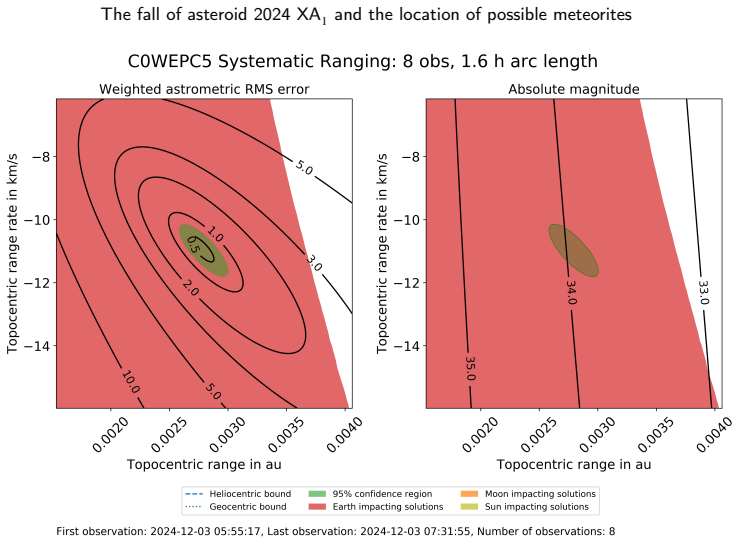
The load-bearing machinery is the ab initio strewn-field model: starting from the 100 km entry state, it integrates the meteoroid's motion under gravity and aerodynamic drag, triggers one main fragmentation when the aerodynamic pressure exceeds an assumed mechanical strength $S$, assigns pre-chosen fragment masses from 1 kg down to 1 g, gives all fragments the same initial velocity with no lateral component, and uses a Meteo Expert wind profile for the dark-flight phase. The orbit that feeds this model is computed by the Aegis least-squares and Line-of-Variations impact-monitoring pipeline from the available astrometric observations. Webcam footage showing at least two flares during entry is used as evidence that fragmentation actually occurred, matching the model's qualitative picture.
What would settle it
A ground search that thoroughly covers the Table 4 fields and instead finds meteorites several kilometers away, or a rerun of the dark-flight simulation using an independently measured post-event wind profile that moves the terminal points by more than 1 km, would show that the model or its wind input is wrong.
Extended reading notes
Core claim
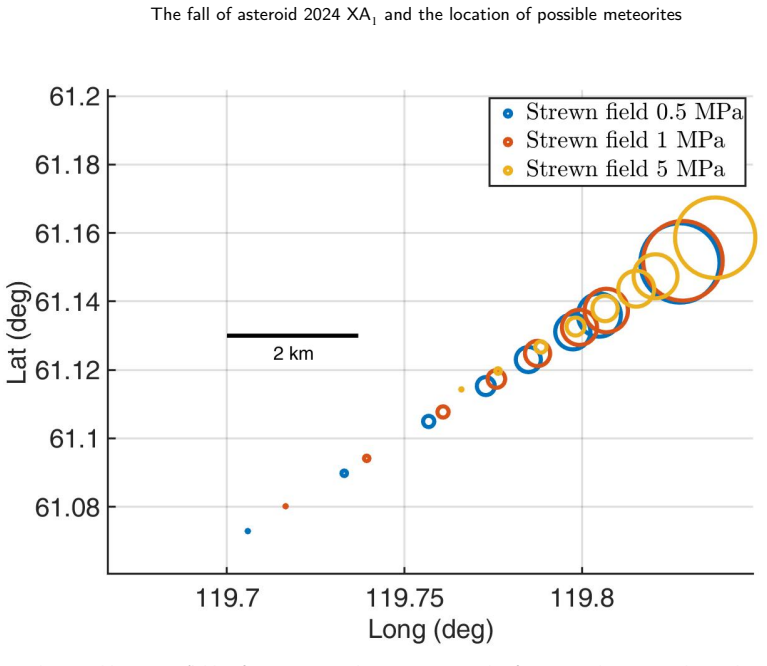
The central claim is that 2024 XA1's entry trajectory is now known precisely enough that the possible meteorite landing zone can be given as a small, walkable area. The entry state vector at 100 km altitude (2024-12-03 16:14:52.87 UTC, Lat. 60.6285 N, East Long. 119.0713, speed 15.5241 km/s, inclination 50.6 degrees) has a 1-sigma uncertainty of 220 m, and the ab initio fall simulation places kilogram-sized fragments at Lat. 61.151 N, East Long. 119.828 for the 0.5 MPa case, with all three assumed-strength fields overlapping within about 10 km, 37 km northeast of Kiliyer village. The paper presents the Table 4 coordinates as the best target for future meteorite search campaigns, with a positional uncertainty of order 1 km based on previous validated falls.
Load-bearing premise
The prediction assumes the asteroid broke into pieces exactly once, at a height set by an assumed strength, and that the wind profile used for the dark flight is the real wind; if either is wrong, the coordinates in Table 4 could shift by more than the stated 1 km.
Editorial extensions
If this is right
- A meteorite search campaign should concentrate on the overlapping Table 4 fields, centered about 37 km northeast of Kiliyer, where a 10 km traverse covers all three strength hypotheses.
- Recovered meteorites from this zone would be the first samples tied to a meter-sized asteroid whose heliocentric orbit is known to the accuracy reported here, enabling a direct meteorite-asteroid linkage.
- The 220 m entry-state uncertainty and roughly 1 km strewn-field uncertainty mean the predicted site can be checked with a modest ground effort.
- The absence of meteorites in the predicted field would not contradict the paper's claim, since the model explicitly allows complete disintegration, but it would motivate revisiting the strength and fragmentation assumptions.
- The same ab initio approach, building on earlier recovered falls, can be applied to future imminent impactors where no fireball camera network exists.
Reading between the lines
- If fragments are recovered, comparing their exact positions with the model's mass-dependent spread would calibrate the single-fragmentation assumption; the webcam's two flares suggest the real fragmentation history is richer than modeled, so the 1 km uncertainty may be optimistic for the smallest fragments.
- The same method could be run as a prediction engine: for future imminent impactors with no local camera coverage, an ab initio strewn field computed hours before impact could be distributed to local authorities, turning meteorite recovery into a planned operation rather than a post-hoc search.
- The overlap of the three strength-dependent fields is a favorable property of this event's steep entry; for shallower entries the uncertainty in strength would produce widely separated fields, so the method should be tested on a shallow-entry case before generalizing.
- A future reanalysis with an independently measured wind profile, for example from a reanalysis product or a radiosonde at the fall time, would provide a strong check of the 1 km uncertainty claim; if terminal points shift by more than 1 km, the Table 4 uncertainty estimate would need revision.
Editorial analysis
A structured set of objections, weighed in public.
Referee Report
Summary. Gianotto et al. report the operational response of ESA's NEOCC (Meerkat and Aegis systems) to the imminent impactor 2024 XA1, discovered approximately 10 hours before entry over the Sakha Republic, Russia. The paper presents the orbit determination from 79 astrometric observations, giving a 1-sigma uncertainty of 220 m on the entry state at 100 km altitude (Table 3), and uses the ab initio strewn-field model of Carbognani et al. (2025) with Meteo Expert wind profiles and three assumed strengths (0.5, 1, 5 MPa) to predict possible meteorite fall locations (Table 4, Fig. 8). The nominal 1 kg-fragment positions for the three strengths lie within about 1 km of each other, about 37 km northeast of Kiliyer village, and the paper quotes an overall position uncertainty of the order of 1 km.
Significance. The paper is a useful case study of an imminent-impact event and provides an actionable search area for meteorite recovery. The orbit determination is careful, with full use of reported astrometric uncertainties, and the entry state is well constrained. The strewn-field prediction is genuinely ab initio: no data from the 2024 XA1 fireball or from recovered meteorites were used to set the model parameters, so the prediction is falsifiable by future ground searches. The authors are transparent about the main assumptions (strength, fragment masses, single fragmentation, wind model). The central weakness is quantitative: the quoted ~1 km uncertainty on the Table 4 coordinates is transferred from prior events rather than derived for this one, and the dominant environmental input, the wind profile, is not accompanied by any uncertainty estimate or independent validation.
major comments (3)
- [Sec. 2.3 and Table 4] The stated uncertainty 'of the order of 1 km' on the strewn-field positions is taken from Carbognani et al. (2025) on the basis of three other falls (2024 BX1, 2023 CX1, 2008 TC3) and is not computed for 2024 XA1. The wind profile used in the dark-flight model is a proprietary Meteo Expert product, and the paper provides no uncertainty estimate for that profile and no comparison with independent data such as the Olekminsk radiosonde at 16 UTC or an ERA5 reanalysis. For a 1 kg fragment in dark flight over several minutes, a sustained horizontal wind error of only 5 m/s would displace the landing point by roughly 1.5 km, which is larger than the claimed precision. Because Table 4 is the actionable product for a ground search, the authors should either quantify the wind-model uncertainty through an independent intercomparison or reduce the claimed precision to a range that reflects this unquantified contribution.
- [Sec. 2.3 and Sec. 3.4] The fall model assumes exactly one main fragmentation, yet the webcam video (Fig. 6) shows at least two flares and the text states that 'the asteroid fragmented during the fall.' The paper relies on Carbognani et al. (2025) for the assertion that multiple fragmentations do not significantly affect the final strewn field, but no sensitivity test is presented for the present event. Since the fragmentation altitude determines the dark-flight start (40.6 km at 0.5 MPa versus 23.7 km at 5 MPa), a second fragmentation event would alter the effective drag history and could shift the predicted coordinates by an amount that is not currently in the error budget. Please demonstrate robustness to multiple fragmentations, for example by rerunning the model with two fragmentation events at plausible heights corresponding to the observed flares, or explicitly add this uncertainty to the stated precision.
- [Sec. 3.4] The paper reports that the preliminary strewn field, computed with 40 astrometric observations, was 'approximately 1.6 km to the east' of the definitive field computed with all 79 observations. This is an internal indication that the predicted positions are sensitive to the input trajectory at a level comparable to or larger than the claimed 1 km uncertainty. The authors should reconcile this 1.6 km shift with the quoted uncertainty, for example by showing that the final entry-state uncertainty of 220 m (Table 3) maps to a strewn-field shift smaller than 1 km, or by enlarging the stated uncertainty to reflect the observed spread between intermediate and final predictions.
minor comments (6)
- [Table 3] The header 'Them mean trajectory parameters' contains a typo; it should read 'The mean trajectory parameters.'
- [Fig. 7] The y-axis label 'N mber of observations' is missing a 'u'; it should be 'Number of observations.'
- [Fig. 4 caption] The caption uses 'geocetric' where 'geocentric' is intended.
- [Sec. 3.4] The text gives the dark-flight starting latitude as 'Lat. 61.1◦ E'; this should be 'Lat. 61.1◦ N' (the longitude is 119.7◦ E).
- [Authors/affiliations] The affiliation list contains a duplicated entry for INAF after the first affiliation block; the duplicate should be removed.
- [Sec. 2.3] For reproducibility, the model description should state whether ablation and mass loss are included and specify the drag coefficient and integration scheme, or explicitly refer the reader to the exact equations in Carbognani et al. (2025); the current summary is too brief to allow an independent implementation.
Circularity Check
No significant circularity: the Table 4 strewn-field coordinates are forward predictions from independent inputs; the inherited 1 km uncertainty rests on prior recovered-fall calibration.
full rationale
The paper's central product, Table 4, is an ab initio forward calculation: the entry state (Table 3) comes from an independent least-squares orbit solution using astrometry, the wind profile comes from Meteo Expert, and the strength values and fragment masses are explicit priors. No data from the 2024 XA1 fireball or from recovered meteorites enter the computation, so there is no self-definitional step and no fitted parameter renamed as a prediction. The only author-overlapping citation is Carbognani et al. (2025), used for the fall model and for the 1 km uncertainty claim. That citation is not a bare self-citation: it reports validation on three previous falls with recovered meteorites (2008 TC3, 2023 CX1, 2024 BX1), so it is externally falsifiable evidence rather than an assumption that presupposes the present result. The webcam's two flares indicate more than one fragmentation, and the model's single-fragmentation simplification is justified by a robustness result cited from the same prior work; this is a modeling-assumption risk, not a circular reduction. The unquantified proprietary wind profile could shift the coordinates, but that is an accuracy and uncertainty concern, not circularity. Accordingly, no circular step can be exhibited from the paper's text.
Assumptions & free parameters
free parameters (3)
- Mechanical strength S =
0.5, 1, 5 MPa (three cases)
- Fragment masses =
1, 0.3, 0.2, 0.1, 0.05, 0.02, 0.005, 0.001 kg
- Wind profile =
Meteo Expert proprietary model prediction for 16 UTC, 3 Dec 2024
assumptions (4)
- domain assumption Single main fragmentation model: the meteoroid breaks once when aerodynamic pressure exceeds an assumed strength S, and all fragments retain the parent velocity with no lateral component.
- domain assumption The Meteo Expert wind profile is representative of the actual atmosphere along the dark flight trajectory.
- domain assumption The 1 km positional uncertainty of the strewn field, established for 2008 TC3, 2023 CX1, and 2024 BX1, transfers to 2024 XA1.
- standard math Standard orbit determination assumptions: the reported astrometric uncertainties are correct and the least-squares fit is valid.
Cite this review
Pith. "Pith review of The fall of asteroid 2024 XA$_1$ and the location of possible meteorites." pith.science (2026). https://pith.science/paper/MRMY3XOJ
@misc{pith2026250209712,
  author       = {Pith},
  title        = {Pith review of: The fall of asteroid 2024 XA$_1$ and the location of possible meteorites},
  year         = {2026},
  howpublished = {\url{https://pith.science/paper/MRMY3XOJ}},
  note         = {Machine review of arXiv:2502.09712}
}
abstract
Asteroid 2024 XA$_1$ was discovered on 3 December 2024 at 05:54 UTC by the Bok telescope in Kitt Peak, Arizona, and impacted Earth about 10 hours later over a remote area of the Sakha Republic (Russia). The estimated size of the object was about one meter, and the atmospheric entry produced a bright fireball that was captured by a webcam and several eyewitnesses. The first impact alert was issued at 07:50 UTC by the Meerkat Asteroid Guard of the European Space Agency, which triggered subsequent follow-up observations that confirmed both the object to be real and the occurrence of the impact with Earth. Here we present the operations and results from the NEO Coordination Centre (NEOCC) upon the impact event. Because the entry likely dropped meteorites on the ground, we also estimate the possible strewn fields for future meteorite search campaigns.
Figures


Figures from the paper (5 more)


Reference graph
Works this paper leans on
-
[1]
author Bischoff, A. , author Patzek, M. , author Barrat, J.A. , author Berndt, J. , author Busemann, H. , author Degering, D. , author Di Rocco, T. , author Ek, M. , author Harries, D. , author Godinho, J.R.A. , author Heinlein, D. , author Kriele, A. , author Krietsch, D. , author Maden, C. , author Marchhart, O. , author Marshal, R.M. , author Martschin...
work page 2024
-
[2]
author Bischoff , A. , author Patzek , M. , author Di Rocco , T. , author Pack , A. , author Stojic , A. , author Berndt , J. , author Peters , S. , year 2023 . title Saint-Pierre-le-Viger (L5-6) from asteroid 2023 CX _ 1 recovered in the Normandy, France 220 years after the historic fall of L'Aigle (L6 breccia) in the neighborhood . journal MAPS volume 5...
-
[3]
author Borovi c ka , J. , author Spurn \'y , P. , year 2008 . title The Carancas meteorite impact - Encounter with a monolithic meteoroid . journal Astronomy and Astrophysics volume 485 , pages L1--L4 . :10.1051/0004-6361:200809905
-
[4]
author Bowell , E. , author Hapke , B. , author Domingue , D. , author Lumme , K. , author Peltoniemi , J. , author Harris , A.W. , year 1989 . title Application of photometric models to asteroids. , in: editor Binzel , R.P. , editor Gehrels , T. , editor Matthews , M.S. (Eds.), booktitle Asteroids II , pp. pages 524--556
work page 1989
-
[5]
Source regions of carbonaceous meteorites and NEOs
author Bro z , M. , author Vernazza , P. , author Marsset , M. , author Binzel , R.P. , author DeMeo , F. , author Birlan , M. , author Colas , F. , author Anghel , S. , author Bouley , S. , author Blanpain , C. , author Gattacceca , J. , author Jeanne , S. , author Jorda , L. , author Lecubin , J. , author Malgoyre , A. , author Steinhausser , A. , autho...
work page Pith review arXiv 2024
-
[6]
author Bro z , M. , author Vernazza , P. , author Marsset , M. , author DeMeo , F.E. , author Binzel , R.P. , author Vokrouhlick \'y , D. , author Nesvorn \'y , D. , year 2024 b. title Young asteroid families as the primary source of meteorites . journal Nature volume 634 , pages 566--571 . :10.1038/s41586-024-08006-7, arXiv:2403.08552 http://arxiv.org/ab...
arXiv 2024
-
[7]
Identifying parent bodies of meteorites among near-Earth asteroids
author Carbognani , A. , author Fenucci , M. , year 2023 . title Identifying parent bodies of meteorites among near-Earth asteroids . journal MNRAS volume 525 , pages 1705--1725 . :10.1093/mnras/stad2382, arXiv:2308.01931 http://arxiv.org/abs/2308.01931
work page Pith review arXiv 2023
-
[8]
author Carbognani , A. , author Fenucci , M. , author Salerno , R. , author Micheli , M. , year 2025 . title Ab initio strewn field for small asteroids impacts . journal Icarus volume 425 , pages 116345 . :10.1016/j.icarus.2024.116345, arXiv:2410.15823 http://arxiv.org/abs/2410.15823
arXiv 2025
Show all 36 references
-
[9]
, author Koschny , D
author Conversi , L. , author Koschny , D. , author Micheli , M. , author Kresken , R. , author Moreta , P.R. , author Kugel , U. , author Doelling , E. , author Cano , J.L. , author Cennamo , R. , author Faggioli , L. , author Foglietta , A. , author Moissl , R. , author Oliv...
2021
-
[10]
u ller , T. , author Popescu , M. , author Tanga , P. , author Berthelsen , L. , author F \
author Conversi , L. , author Licandro , J. , author Delbo , M. , author Fitzsimmons , A. , author Muinonen , K. , author M \"u ller , T. , author Popescu , M. , author Tanga , P. , author Berthelsen , L. , author F \"o hring , D. , author Micheli , M. , author Moissl , R. , y...
2023
-
[11]
, author Dimare , L
author Del Vigna , A. , author Dimare , L. , author Bracali Cioci , D. , year 2021 . title The Manifold Of Variations: impact location of short-term impactors . journal Celestial Mechanics and Dynamical Astronomy volume 133 , pages 26 . :10.1007/s10569-021-10024-w, arXiv:2102....
2021 arXiv
-
[12]
, author Jedicke , R
author Denneau , L. , author Jedicke , R. , author Grav , T. , author Granvik , M. , author Kubica , J. , author Milani , A. , author Vere s , P. , author Wainscoat , R. , author Chang , D. , author Pierfederici , F. , author Kaiser , N. , author Chambers , K.C. , author Heasl...
2013 arXiv
-
[13]
, author Bland, P.A
author Devillepoix, H.A. , author Bland, P.A. , author Sansom, E.K. , author Towner, M.C. , author Cup \'a k, M. , author Howie, R.M. , author Hartig, B.A. , author Jansen-Sturgeon, T. , author Cox, M.A. , year 2019 . title Observation of metre-scale impactors by the desert fi...
2019
-
[14]
, author Buzzi , L
author Devog \`e le , M. , author Buzzi , L. , author Micheli , M. , author Cano , J.L. , author Conversi , L. , author Jehin , E. , author Ferrais , M. , author Oca \ n a , F. , author F \"o hring , D. , author Drury , C. , author Benkhaldoun , Z. , author Jenniskens , P. , y...
2024 arXiv
-
[15]
, author Del Vigna , A
author Dimare , L. , author Del Vigna , A. , author Bracali Cioci , D. , author Bernardi , F. , year 2020 . title Use of the semilinear method to predict the impact corridor on ground . journal Celestial Mechanics and Dynamical Astronomy volume 132 , pages 20 . :10.1007/s10569...
2020 arXiv
-
[16]
, author Chesley , S.R
author Farnocchia , D. , author Chesley , S.R. , author Micheli , M. , year 2015 . title Systematic ranging and late warning asteroid impacts . journal Icarus volume 258 , pages 18--27 . :10.1016/j.icarus.2015.05.032, arXiv:1504.00025 http://arxiv.org/abs/1504.00025
2015 arXiv
-
[17]
, author Faggioli , L
author Fenucci , M. , author Faggioli , L. , author Gianotto , F. , author Bracali Cioci , D. , author Cano , J.L. , author Conversi , L. , author Devog \`e le , M. , author Di Girolamo , G. , author Drury , C. , author F \"o hring , D. , author Gisolfi , L. , author Kresken ,...
2024
-
[18]
o hring , D. , author Conversi , L. , author Micheli , M. , author D \
author F \"o hring , D. , author Conversi , L. , author Micheli , M. , author D \"o lling , E. , author Moreta , P.R. , year 2024 . title Site selection for the second Flyeye telescope: A simulation study for optimizing near-earth object discovery . journal Icarus volume 424 ,...
2024
-
[19]
, author Christensen , E
author Fuls , C. , author Christensen , E. , author Fay , D. , author Fazekas , J. , author Gibbs , A. , author Grauer , A. , author Gray , B. , author Groller , H. , author Hogan , J. , author Kowalski , R. , author Larson , S. , author Leonard , G. , author Rankin , D. , aut...
2023
-
[20]
u hauf , M. , author Cano , J.L. , author Conversi , L. , author Faggioli , L. , author Fenucci , M. , author F \
author Gianotto , F. , author Fr \"u hauf , M. , author Cano , J.L. , author Conversi , L. , author Faggioli , L. , author Fenucci , M. , author F \"o hring , D. , author Koschny , D. , author Kresken , R. , author Micheli , M. , author Moissl , R. , author Oliviero , D. , aut...
2023
-
[21]
, author Kahn , S.M
author Ivezi \'c , Z . , author Kahn , S.M. , author Tyson , J.A. , author Abel , B. , author Acosta , E. , author Allsman , R. , author Alonso , D. , author AlSayyad , Y. , author Anderson , S.F. , author Andrew , J. , author Angel , J.R.P. , author Angeli , G.Z. , author Ans...
2019 arXiv
-
[22]
, author Gabadirwe , M
author Jenniskens , P. , author Gabadirwe , M. , author Yin , Q.Z. , author Proyer , A. , author Moses , O. , author Kohout , T. , author Franchi , F. , author Gibson , R.L. , author Kowalski , R. , author Christensen , E.J. , author Gibbs , A.R. , author Heinze , A. , author ...
2021 arXiv
-
[23]
, author Shaddad , M.H
author Jenniskens , P. , author Shaddad , M.H. , author Numan , D. , author Elsir , S. , author Kudoda , A.M. , author Zolensky , M.E. , author Le , L. , author Robinson , G.A. , author Friedrich , J.M. , author Rumble , D. , author Steele , A. , author Chesley , S.R. , author...
2009
-
[24]
, author Vida , D
author Kareta , T. , author Vida , D. , author Micheli , M. , author Moskovitz , N. , author Wiegert , P. , author Brown , P.G. , author McCausland , P.J.A. , author Devillepoix , H.A.R. , author Male c i \'c , B. , author Prtenjak , M.T. , author S egon , D. , author Shafrans...
2024 arXiv
-
[25]
, author Artemieva , N.A
author Kenkmann , T. , author Artemieva , N.A. , author W \"u nnemann , K. , author Poelchau , M.H. , author Elbeshausen , D. , author N \'u \ n ez Del Prado , H. , year 2009 . title The Carancas meteorite impact crater, Peru: Geologic surveying and modeling of crater formatio...
2009
-
[26]
, author Masiero , J.R
author Mainzer , A.K. , author Masiero , J.R. , author Abell , P.A. , author Bauer , J.M. , author Bottke , W. , author Buratti , B.J. , author Carey , S.J. , author Cotto-Figueroa , D. , author Cutri , R.M. , author Dahlen , D. , author Eisenhardt , P.R.M. , author Fernandez ...
2023 arXiv
-
[27]
, author Vernazza , P
author Marsset , M. , author Vernazza , P. , author Bro z , M. , author Thomas , C.A. , author DeMeo , F.E. , author Burt , B. , author Binzel , R.P. , author Reddy , V. , author McGraw , A. , author Avdellidou , C. , author Carry , B. , author Slivan , S. , author Polishook ,...
2024 arXiv
-
[28]
, author Chesley , S.R
author Milani , A. , author Chesley , S.R. , author Chodas , P.W. , author Valsecchi , G.B. , year 2002 . title Asteroid Close Approaches: Analysis and Potential Impact Detection , in: editor Bottke , Jr., W.F. , editor Cellino , A. , editor Paolicchi , P. , editor Binzel , R....
2002
-
[29]
, author Chesley , S.R
author Milani , A. , author Chesley , S.R. , author Sansaturio , M.E. , author Tommei , G. , author Valsecchi , G.B. , year 2005 a. title Nonlinear impact monitoring: line of variation searches for impactors . journal Icarus volume 173 , pages 362--384 . :10.1016/j.icarus.2004.09.002
2005 doi
-
[30]
, author Gronchi , G.F
author Milani , A. , author Gronchi , G.F. , year 2009 . title Theory of Orbit Determination . publisher Cambridge University Press . :10.1017/CBO9781139175371
2009 doi
-
[31]
, author Sansaturio , M.E
author Milani , A. , author Sansaturio , M.E. , author Tommei , G. , author Arratia , O. , author Chesley , S.R. , year 2005 b. title Multiple solutions for asteroid orbits: Computational procedure and applications . journal Astronomy and Astrophysics volume 431 , pages 729--7...
2005 doi
-
[32]
, author Trigo-Rodr \' guez , J.M
author Pe \ n a-Asensio , E. , author Trigo-Rodr \' guez , J.M. , author Rimola , A. , year 2022 . title Orbital Characterization of Superbolides Observed from Space: Dynamical Association with Near-Earth Objects, Meteoroid Streams, and Identification of Hyperbolic Meteoroids ...
2022 arXiv
-
[33]
, author Harris , A.W
author Pravec , P. , author Harris , A.W. , year 2007 . title Binary asteroid population. 1. Angular momentum content . journal Icarus volume 190 , pages 250--259 . :10.1016/j.icarus.2007.02.023
2007 doi
-
[34]
, author Jenniskens , P
author Shaddad , M.H. , author Jenniskens , P. , author Numan , D. , author Kudoda , A.M. , author Elsir , S. , author Riyad , I.F. , author Ali , A.E. , author Alameen , M. , author Alameen , N.M. , author Eid , O. , author Osman , A.T. , author Abubaker , M.I. , author Yousi...
2010
-
[35]
, author Del Vigna , A
author Spoto , F. , author Del Vigna , A. , author Milani , A. , author Tommei , G. , author Tanga , P. , author Mignard , F. , author Carry , B. , author Thuillot , W. , author David , P. , year 2018 . title Short arc orbit determination and imminent impactors in the Gaia era...
2018 arXiv
-
[36]
, author Denneau , L
author Tonry , J.L. , author Denneau , L. , author Heinze , A.N. , author Stalder , B. , author Smith , K.W. , author Smartt , S.J. , author Stubbs , C.W. , author Weiland , H.J. , author Rest , A. , year 2018 . title ATLAS: A High-cadence All-sky Survey System . journal PASP ...
2018 arXiv
Reviewed August 7, 2026 · model on record in the stance chip above.
Discussion (0). Continue with ORCID to comment.