REVIEW 3 major objections 4 minor 42 references
Searching for the $2^+$ partner of the $T_{cs0}(2870)$ in the $B^- \to D^- D^0 K^0_S$ reaction
T0 review · 3 major / 4 minor · reviewed 2026-08-07 · deepseek-v4-flash
Pith's one-line read A small peak in the $B^- \to D^- D^0 K^0_S$ mass spectrum may be the predicted $2^+$ partner of the exotic $T_{cs0}(2870)$, and angular moments of the same data can identify its spin.
desk verdict A clear, honest proposal to look for the 2+ partner via angular moments; the evidence is a possibly fluctuating bump, but the method and the call to reanalyze existing LHCb data are sound. read the letter →
The pith
A machine-rendered reading of the paper's core claim, the machinery that carries it, and where it could break.
The reading
What carries the argument
The central object is the set of angular moments defined by $\mathrm{d}\Gamma_l/\mathrm{d}M_{\rm inv} = \int \mathrm{d}\tilde\Omega\, \frac{\mathrm{d}\Gamma}{\mathrm{d}M_{\rm inv}\,\mathrm{d}\tilde\Omega}\, Y_{l0}$, with the decay amplitude written as $t = aY_{00} + bY_{20} + cY_{10}$. The $a$ term carries the $J=0$ $T_{cs0}(2870)$ plus background, $b$ represents a hypothetical $J=2$ state produced through a D-wave in $D^0\bar K^0$, and $c$ represents a hypothetical $J=1$ state through a P-wave. Integrating products of three spherical harmonics turns each moment into a sum of quadratic terms $|a|^2$, $|b|^2$, $|c|^2$ and interference terms; the key point is that moments such as $\mathrm{d}\Gamma_2/\mathrm{d}M_{\rm inv}$ contain the linear term $2\,\mathrm{Re}(ab^*)$, so the small $J=2$ signal is magnified even when its quadratic contribution to the angle-integrated spectrum is invisible.
What would settle it
Measure the moments $\mathrm{d}\Gamma_1/\mathrm{d}M_{\rm inv}$ and $\mathrm{d}\Gamma_2/\mathrm{d}M_{\rm inv}$ from the published event sample in the $D^0 K^0_S$ mass region 2.65-2.85 GeV; if neither moment shows the predicted interference structure at the fitted mass, or if the small bump disappears when the data are rebinned with more statistics, the central claim is refuted.
Extended reading notes
Core claim
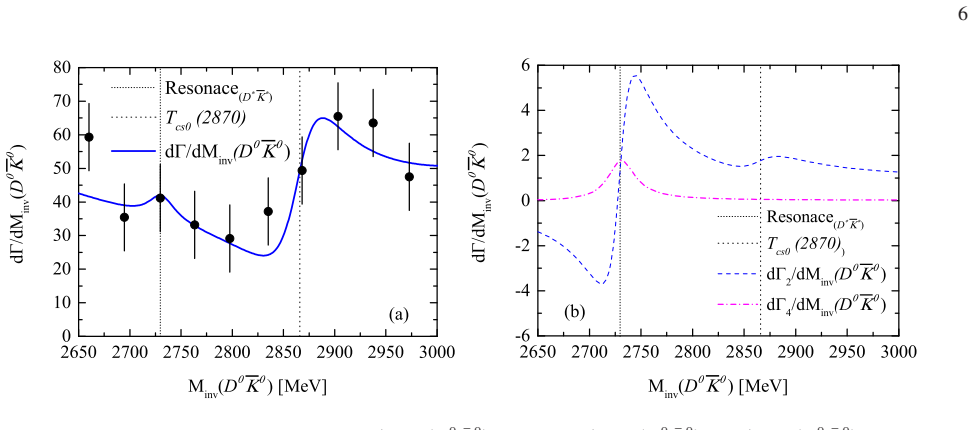
The authors fit the measured $D^0 K^0_S$ mass distribution with a background plus a resonance under three spin hypotheses, $J=0$, $1$, and $2$. All three hypotheses fit the angle-integrated distribution almost equally well, giving a resonance mass around 2708, 2731, or 2730 MeV and a width of about 32 MeV. The discrimination comes from the moments $\mathrm{d}\Gamma_l/\mathrm{d}M_{\rm inv}$, which pick out different interference terms: for a $J=2$ state, $\mathrm{d}\Gamma_2/\mathrm{d}M_{\rm inv}$ contains the interference of the $J=0$ $T_{cs0}(2870)$ with the new resonance through the term $2\,\mathrm{Re}(ab^*)$, and the signal is amplified by roughly a factor $\sqrt{5\pi}\approx 4$ relative to the quadratic peak in the mass distribution; for $J=1$, the analogous large signal appears in $\mathrm{d}\Gamma_1/\mathrm{d}M_{\rm inv}$. The authors conclude that constructing these moments from the published data would decide which spin should be assigned to the small peak.
Load-bearing premise
The claim rests on the small bump near 2700-2730 MeV in the $D^0 K^0_S$ mass distribution being a real resonance and not a statistical fluctuation of the background, which the paper itself notes cannot be excluded.
Editorial extensions
If this is right
- If the small peak is the $2^+$ partner, $\mathrm{d}\Gamma_2/\mathrm{d}M_{\rm inv}$ will show a large interference structure around 2.73 GeV that is clearly visible above the background.
- If the peak is instead $J=1$, the strong structure appears in $\mathrm{d}\Gamma_1/\mathrm{d}M_{\rm inv}$ and not in $\mathrm{d}\Gamma_2$, so the pattern of moments identifies the spin.
- Reconstructing the moments from the already published event sample, as was done for the related $B^- \to D^- D^+ K^-$ reaction, is enough to test the claim without waiting for new data.
- With better statistics available in future runs, the small peak can be confirmed or ruled out as a genuine resonance, resolving whether the bump is real or a fluctuation.
Reading between the lines
- The same moment trick could be applied to any narrow bump sitting on a large background, provided an interfering partner state is known; the linearity in the small amplitude is what buys the factor of roughly four in visibility.
- The fitted masses (2708-2731 MeV) sit below the 2778 MeV predicted for the $2^+$ $D^*\bar K^*$ state; if a $J=2$ signal is confirmed at the lower mass, the molecular prediction would need revision or the state would need a different interpretation.
- If a $J=2$ state is confirmed here, it would complete the spin triplet of $D^*\bar K^*$ molecules, with the $0^+$ $T_{cs0}(2870)$ and the $1^+$ state that cannot decay to $D\bar K$, strengthening the molecular picture for these exotic mesons.
- A cleaner test would be to check whether the bump's position shifts with the $D^0 K^0_S$ threshold or with the assumed background shape; if it tracks a threshold effect, the moment structure would differ from that of a genuine Breit-Wigner resonance.
Editorial analysis
A structured set of objections, weighed in public.
Referee Report
Summary. The paper analyzes the B^- -> D^- D^0 K^0_S reaction measured by LHCb. Pinning a small enhancement in the D^0 K^0_S invariant mass distribution near 2.70-2.73 GeV, the authors fit the mass spectrum under three spin hypotheses for a putative new resonance (J=0, 1, or 2) added to the known T_cs0(2870) signal and an S-wave background. They then compute angular moments dGamma_l/dM_inv, arguing that the moments linear in the new resonance amplitude, particularly dGamma_2/dM_inv for the J=2 case, would show a strongly magnified interference signal and thus allow the spin of the state to be identified from existing data. The paper concludes with a call for the experimental evaluation of these moments.
Significance. If the small bump is a real resonance, the paper offers a practical observable - the angular moments - that could discriminate the spin of a predicted D*K* molecular partner of the Tcs0(2870), for which the angle-integrated mass distribution is essentially insensitive to the spin hypothesis. The moment method is physically motivated and the paper makes explicit, falsifiable predictions that differ qualitatively among the J=0, J=1, and J=2 scenarios. It also openly acknowledges that the peak could be a statistical fluctuation, showing commendable caution. The main value is as a stimulus for an experimental moment analysis rather than an established discovery claim.
major comments (3)
- [Section III, Tables I-III and Figs. 3-5] The central prediction rests on the assumption that the small D^0 K^0_S bump near 2.73 GeV is a genuine resonance, yet the paper supplies no significance estimate, no uncertainties on the fitted resonance parameters (M_R, Gamma_R, a', b', c'), and no chi^2 or likelihood for any of the three fits. Given the authors' own statement in the Introduction that the peak 'is compatible with a statistical fluctuation' and the repeated caveat in the Conclusions, the manuscript should either quantify the local/global significance of the bump (e.g., fit with and without the resonance) or explicitly reframe the entire calculation as a conditional illustration whose validity requires an unverified assumption. As it stands, the size of the predicted moment signals is entirely dependent on this unquantified assumption.
- [Section III, Eq. (7) and Figs. 4(b), 5(b)] The predicted moments dGamma_1/dM_inv and dGamma_2/dM_inv are computed from the same fitted amplitudes a, b, c whose parameters (including M_R, Gamma_R, a'_0, a''_0, b', c') were adjusted to reproduce the angle-integrated dGamma/dM_inv data. Consequently, the 'magnification' of the moment signal is a renormalization of the fitted bump height, not an independent prediction. For example, the factor sqrt(5 pi) ~ 4 quoted for dGamma_1 is derived by normalizing |c|^2 to the mass distribution. To make the claim that the moment signal 'should be perfectly visible' quantitative, the authors should propagate statistical and systematic uncertainties from the fits through Eq. (7), or ideally perform a direct fit to the full two-dimensional angular-mass distribution from LHCb data.
- [Section III, Cases 1-3] The three spin hypotheses produce visually indistinguishable fits to the angle-integrated mass distribution (Figs. 3a, 4a, 5a), which the paper itself notes. This is not a flaw in principle, since the moments are meant to break the degeneracy, but without any fit-quality statistic (chi^2, AIC, or a likelihood ratio) the manuscript offers no quantitative support for preferring the J=2 case over J=0 or J=1. At minimum, the authors should report the fit quality for each case so that readers can judge whether the different moment predictions are being made from equally valid starting points.
minor comments (4)
- [Eq. (3)] Please specify the normalization convention for the spherical harmonics and the integration measure in the moment definition, e.g., whether the integral is over dOmega = sin(theta) dtheta dphi with the standard real Y_l0, since the numerical factors in Eq. (7) depend on this convention.
- [Fig. 3(b)] The text notes that dGamma_0/dM_inv is just dGamma/dM_inv times (4 pi)^(-1/2); it would be clearer to state this in the figure caption as well, so that the reader does not mistake it for an independent observable.
- [Throughout] There are several typographical inconsistencies, such as the mixing of D^0K^0_S and D^0 \bar{K}^0 notation and the non-uniform subscript formatting for K^0_S; a careful proofread would improve readability.
- [Section I, Refs. [2,3]] In the Conclusions the phrase 'the dGamma_3 moments in [32] and the LHCb experiment [2]' is ambiguous because [2] is the earlier B^+ paper; please clarify whether the coincidence refers to the moment spectrum of Ref. [3] (LHCb B^+ -> D+D-K+) or to new LHCb data.
Circularity Check
No load-bearing circularity: the moment spectra are genuine model predictions from fitted amplitudes, and the statistical-fluctuation caveat is a data-limitation issue, not a circular step.
full rationale
The paper fits the amplitudes a, b, c (with Breit-Wigner terms and a parabolic background) to the angle-integrated D0KS mass distribution in each of three spin hypotheses, then evaluates angular moments from the same amplitudes. This is a standard calibration-then-prediction workflow, not circular: the moments depend on interference terms such as 2Re(ab*), 2Re(ac*), and 2Re(bc*), which are not determined by the angle-integrated dGamma/dMinv fit alone, and the claimed magnification rests on these linear interference terms rather than on simply re-inserting the fitted |b|^2 or |c|^2 into the moment formula. The fitted masses and widths are explicitly conditional inputs, and the paper repeatedly warns that the small peak 'is compatible with a statistical fluctuation' (Introduction) and that 'with the present statistics and separation of experimental points, one cannot exclude that the small peak discussed here could be a statistical fluctuation' (Conclusions). The self-citations to [4], [5], and [32] provide the molecular prediction and the moment formalism, but these are externally published, independently corroborated by many other works cited in the paper, and are not used to forbid alternative spin assignments; no uniqueness theorem is imported. Therefore no circular step can be exhibited: the central proposal is a conditional, falsifiable prediction about angular moments that is not equivalent by construction to the fitted input.
Assumptions & free parameters
free parameters (11)
- alpha (background parabola coefficient) =
37 to 39 across cases
- beta (background parabola coefficient) =
44 to 77 across cases
- a0 (S-wave background amplitude) =
via alpha, beta
- a''_0 (Tcs0(2870) amplitude) =
11 to 12 across cases
- a'_0 (new J=0 resonance amplitude) =
1
- c' (new J=1 resonance amplitude) =
50
- b' (new J=2 resonance amplitude) =
461
- M_R0, Gamma_R0 =
2708 MeV, 32 MeV
- M_R1, Gamma_R1 =
2731 MeV, 32 MeV
- M_R2, Gamma_R2 =
2730 MeV, 32 MeV
- sqrt(s0) (background reference scale) =
2870 MeV
assumptions (6)
- domain assumption The full transition amplitude for B- -> D- D0 K0bar is t = a Y00 + b Y20 + c Y10, with only S, P, D partial waves.
- ad hoc to paper The small peak near 2.73 GeV is a real resonance and not a statistical fluctuation.
- ad hoc to paper The background in the D0 K0bar mass distribution is well described by a parabola of the form in Eq. (10).
- domain assumption A 2+ D* K* molecular state exists with mass around 2778 MeV as predicted in [5], and its coupling to D0 K0bar is given by the D-wave term b' k^2.
- domain assumption The production mechanism is B- -> D- D*+ K*- followed by rescattering into D0 K0bar.
- standard math Integrals of products of three spherical harmonics follow the standard Gaunt formulas used in Eq. (7).
invented entities (3)
-
2+ D* K* molecular partner of Tcs0(2870), candidate mass ~2730 MeV
independent evidence
-
J=0 resonance R0 (Case 1)
-
J=1 resonance R1 (Case 2)
Cite this review
Pith. "Pith review of Searching for the $2^+$ partner of the $T_{cs0}(2870)$ in the $B^- \to D^- D^0 K^0_S$ reaction." pith.science (2026). https://pith.science/paper/KBN2KZSJ
@misc{pith2026250210342,
  author       = {Pith},
  title        = {Pith review of: Searching for the $2^+$ partner of the $T_cs0(2870)$ in the $B^- \to D^- D^0 K^0_S$ reaction},
  year         = {2026},
  howpublished = {\url{https://pith.science/paper/KBN2KZSJ}},
  note         = {Machine review of arXiv:2502.10342}
}
abstract
We study the $B^- \to D^- D^0 K^0_S$ reaction, recently analyzed by the LHCb collaboration, where a clear signal for the exotic $T_{cs0}(2870)$ state has been reported. We call the attention to a small peak in the $D^0 K^0_S$ mass distribution that could correspond to a state of the same nature as the $T_{cs0}(2870)$ ($D^* \bar K^*$ nature in the molecular picture) but with $J^P= 2^+$. In order to magnify the signal for the state, we calculate the moments of the angle-mass distribution, which are linear in the resonance signal, rather than quadratic for the angle integrated mass distribution. We find spectra for the moments with a strength far bigger than that for the angle integrated mass distribution, which should encourage the evaluation of these moments from the present measurements of the reaction.
Figures


Figures from the paper (2 more)

Reference graph
Works this paper leans on
- [32]
- [1]
- [2]
- [3]
- [4]
-
[5]
R. Molina and E. Oset, Phys. Lett. B 811, 135870 (2020), [Erratum: Phys.Lett.B 837, 137645 (2023)]
work page 2020
- [6]
-
[7]
Karliner and J
M. Karliner and J. L. Rosner, Phys. Rev. D 102, 094016 (2020)
2020
Show all 42 references
-
[8]
X.-G. He, W. Wang, and R. Zhu, Eur. Phys. J. C 80, 1026 (2020)
2020
-
[9]
T. Guo, J. Li, J. Zhao, and L. He, Phys. Rev. D 105, 054018 (2022)
2022
-
[10]
¨Ozdem and K
U. ¨Ozdem and K. Azizi, Eur. Phys. J. A 58, 171 (2022)
2022
-
[11]
Wang, Int
Z.-G. Wang, Int. J. Mod. Phys. A 35, 2050187 (2020)
2020
-
[12]
S. S. Agaev, K. Azizi, and H. Sundu, Nucl. Phys. A 1011, 122202 (2021)
2021
-
[13]
H.-X. Chen, W. Chen, R.-R. Dong, and N. Su, Chin. Phys. Le tt. 37, 101201 (2020)
2020
-
[14]
He and D.-Y
J. He and D.-Y . Chen, Chin. Phys. C 45, 063102 (2021)
2021
-
[15]
T. J. Burns and E. S. Swanson, Phys. Lett. B 813, 136057 (2021)
2021
-
[16]
Kong, J.-T
S.-Y . Kong, J.-T. Zhu, D. Song, and J. He, Phys. Rev. D 104, 094012 (2021)
2021
-
[17]
Ke, Y .-F
H.-W. Ke, Y .-F. Shi, X.-H. Liu, and X.-Q. Li, Phys. Rev. D 106, 114032 (2022)
2022
-
[18]
Z. Y u, Q. Wu, and D.-Y . Chen, Eur. Phys. J. C 84, 985 (2024)
2024
-
[19]
Z.-M. Ding, Q. Huang, and J. He, Eur. Phys. J. C 84, 822 (2024)
2024
-
[20]
G. Yang, J. Ping, and J. Segovia, Phys. Rev. D 103, 074011 (2021)
2021
-
[21]
G.-J. Wang, L. Meng, L.-Y . Xiao, M. Oka, and S.-L. Zhu, Eu r. Phys. J. C 81, 188 (2021)
2021
-
[22]
Hu, X.-Y
M.-W. Hu, X.-Y . Lao, P . Ling, and Q. Wang, Chin. Phys. C 45, 021003 (2021)
2021
-
[23]
G. Yang, J. Ping, and J. Segovia, Symmetry 12, 1869 (2020)
2020
-
[24]
Tan and J
Y . Tan and J. Ping, Chin. Phys. C 45, 093104 (2021)
2021
-
[25]
S. S. Agaev, K. Azizi, and H. Sundu, Phys. Rev. D 106, 014019 (2022)
2022
-
[26]
Wei, Y .-H
J. Wei, Y .-H. Wang, C.-S. An, and C.-R. Deng, Phys. Rev. D 106, 096023 (2022)
2022
-
[27]
Liu, R.-H
F.-X. Liu, R.-H. Ni, X.-H. Zhong, and Q. Zhao, Phys. Rev. D 107, 096020 (2023)
2023
-
[28]
P . G. Ortega, D. R. Entem, F. Fernandez, and J. Segovia, P hys. Rev. D 108, 094035 (2023)
2023
-
[29]
Chen, J.-J
Y .-K. Chen, J.-J. Han, Q.-F. L¨ u, J.-P . Wang, and F.-S. Yu, Eur. Phys. J. C 81, 71 (2021)
2021
-
[30]
T. J. Burns and E. S. Swanson, Phys. Rev. D 103, 014004 (2021)
2021
-
[31]
L. M. Abreu, Phys. Rev. D 103, 036013 (2021)
2021
-
[33]
Lin and X.-Y
Q.-Y . Lin and X.-Y . Wang, Eur. Phys. J. C82, 1017 (2022)
2022
-
[34]
Z.-Y . Yang, Q. Wang, and W. Chen (2024), 2412.02997
2024 arXiv
-
[35]
H.-X. Chen, W. Chen, X. Liu, Y .-R. Liu, and S.-L. Zhu, Rep t. Prog. Phys. 86, 026201 (2023)
2023
-
[36]
Chau, Phys
L.-L. Chau, Phys. Rept. 95, 1 (1983)
1983
-
[37]
Lyu, M.-Y
W.-T. Lyu, M.-Y . Duan, C.-W. Xiao, E. Wang, and E. Oset, Eur. Phys. J. C 84, 1302 (2024)
2024
-
[38]
Molina and E
R. Molina and E. Oset, Phys. Rev. D 107, 056015 (2023)
2023
-
[39]
Song, Z.-Y
J. Song, Z.-Y . Yang, and E. Oset, Phys. Lett. B 861, 139294 (2025)
2025
- [40]
-
[41]
Aaij et al
R. Aaij et al. (LHCb), Phys. Rev. D 94, 072001 (2016)
2016
-
[42]
Navas et al
S. Navas et al. (Particle Data Group), Phys. Rev. D 110, 030001 (2024)
2024
Reviewed August 7, 2026 · model on record in the stance chip above.
Discussion (0). Continue with ORCID to comment.