REVIEW 2 major objections 6 minor 1 cited by
New Constraints on DMS and DMDS in the Atmosphere of K2-18 b from JWST MIRI
T0 review · 2 major / 6 minor · reviewed 2026-08-16 · deepseek-v4-flash
Pith's one-line read An independent JWST mid-infrared spectrum of K2-18 b shows spectral features that fit the sulfur molecules DMS and/or DMDS at about 3-sigma significance.
desk verdict First MIRI LRS spectrum of K2-18 b is a real step forward, but the 3-sigma DMS/DMDS claim rests on STP/N2 cross-sections that may not hold at the planet's low-pressure, H2-rich, ~400 K photosphere. read the letter →
The pith
A machine-rendered reading of the paper's core claim, the machinery that carries it, and where it could break.
The reading
What carries the argument
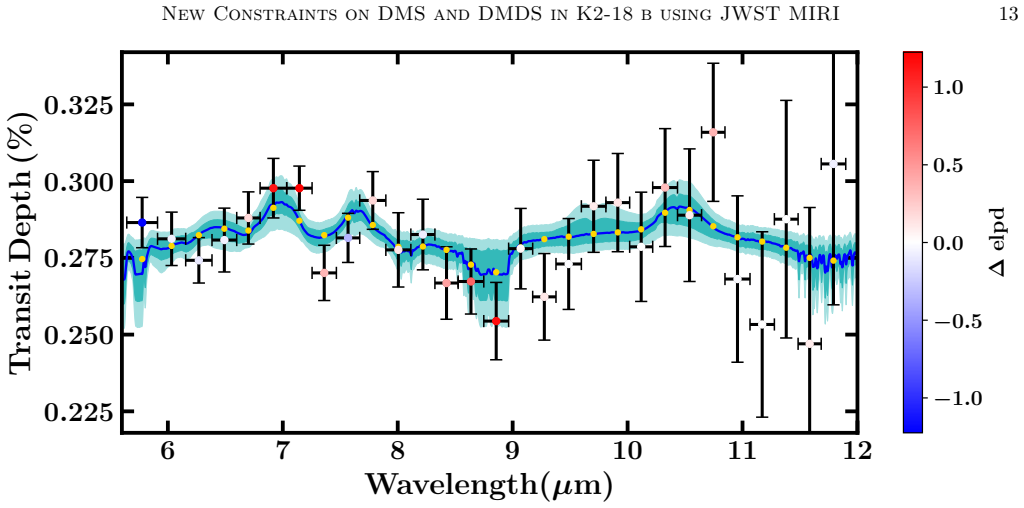
The load-bearing element is the MIRI LRS transmission spectrum itself, binned at 0.2 µm with time-correlated noise accounted for, combined with a hierarchical Bayesian retrieval that scans opacities of 20 molecules. The discriminating pattern is a double-peak feature between 6.8-8 µm plus a broad peak near 9.8 µm for DMS and near 10.5 µm for DMDS, with features of about 300-400 ppm amplitude. The retrieval uses laboratory absorption cross sections for DMS and DMDS measured at Earth-like conditions (1 bar, 298 K, nitrogen broadening), and a leave-one-out analysis shows that the detection is driven by several spectral points rather than a single outlier.
What would settle it
Measure DMS and DMDS absorption cross sections at 1-10 mbar in an H2-dominated gas mixture at 300-600 K and rerun the canonical retrieval; if the Bayesian evidence for the molecules falls below about 2σ or the best-fit mixing ratios drop below 10 ppmv, the central claim would be refuted. A further useful test is a second MIRI transit or a near-infrared 3-5 µm observation that fails to reproduce the DMS/DMDS pattern.
Extended reading notes
Core claim
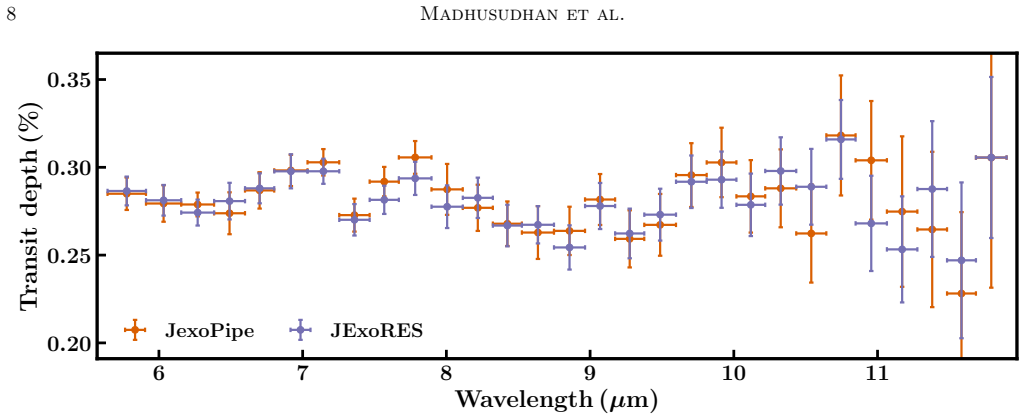
The central claim is that the 6-12 µm JWST MIRI LRS transmission spectrum of K2-18 b is inconsistent with a featureless spectrum at 3.4-sigma significance and can only be explained, among the molecules considered, by DMS and/or DMDS, at 2.9-3.2 sigma. When both molecules are included in the retrieval, DMDS is the preferred carrier of the features while DMS is largely unconstrained; removing either molecule lets the other absorb the same spectral bands because their mid-infrared features overlap. Single-molecule retrievals yield DMS at 2.9-3.0 sigma and DMDS at 3.0-3.2 sigma, with log10 volume mixing ratios near -3.4 and -3.2 respectively, and the paper concludes that at least one of the two molecules exceeds 10 ppmv. The paper treats this as new independent evidence for a possible sulfur biosignature on K2-18 b, complementary to the earlier near-infrared detections of methane and carbon dioxide.
Load-bearing premise
The abundance and detection rest on the assumption that the laboratory absorption cross sections for DMS and DMDS, measured at Earth-like pressure and temperature in nitrogen, are accurate for the low-pressure hydrogen-rich gas probed in transmission; if they are not, the same spectral features could shift, weaken, or belong to different molecules.
Editorial extensions
If this is right
- The MIRI data provide an independent detection path from the near-infrared NIRISS/NIRSpec observations, so the DMS/DMDS signal does not depend on the detector-offset systematics that weakened the earlier DMS hint.
- At the retrieved abundances, steady-state levels above 10 ppmv of DMS or DMDS would require a sustained source; the photochemical models the paper discusses imply biogenic ocean fluxes more than about 20 times Earth's, which would make the molecules a plausible biosignature if the detection holds.
- One to three additional MIRI transits, roughly 8-24 hours of JWST time, should raise the combined significance to 4-5 sigma and test whether the features repeat.
- The MIRI upper limits on methane and carbon dioxide are consistent with the roughly 1 percent abundances measured earlier, so the new spectrum does not conflict with the previously reported composition.
Reading between the lines
- The DMS-DMDS overlap means the current data cannot cleanly separate the two molecules; observations in wavelength regions where their bands differ more, or high-resolution spectroscopy, would be needed to decide which molecule is actually present.
- If laboratory measurements show that hydrogen-broadened DMS and DMDS cross sections at low pressure differ from the nitrogen-broadened Earth-like data, the retrieved mixing ratios and photospheric temperature would shift, and the biosignature interpretation might need revision.
- The paper's false-positive discussion points to abiotic production of DMS and DMDS from CH4 and H2S in laboratory discharge and UV experiments; photochemical models that include the measured high CO2 abundance could predict whether such abiotic routes can sustain the inferred concentrations, giving a testable abiotic alternative.
Signed reviews
Editorial analysis
A structured set of objections, weighed in public.
Referee Report
Summary. The paper presents a JWST MIRI LRS transmission spectrum of the sub-Neptune K2-18 b over approximately 6-12 microns, reduced via two independent pipelines (JExoRES and JexoPipe). Atmospheric retrievals with the AURA framework, considering 20 molecular species, find that the spectrum is best explained by a combination of dimethyl sulfide (DMS) and dimethyl disulfide (DMDS), with a combined detection significance of 2.9-3.2 sigma and retrieved mixing ratios of at least about 10 ppmv. The authors perform extensive robustness tests, including different detrending, binning, limb-darkening treatments, GP-based correction for time-correlated noise, and a leave-one-out cross-validation analysis. They explicitly note that the DMS and DMDS opacities used are measured at near-STP with N2 broadening, which may not represent the H2-rich, low-pressure, roughly 400 K photosphere probed.
Significance. If the detection holds, this would be the first mid-infrared transmission spectrum of a habitable-zone sub-Neptune and an independent line of evidence for a potential biosignature gas on K2-18 b, complementing the earlier tentative DMS hint from NIRISS/NIRSpec. The paper's strengths are the dual-pipeline reduction, the thorough robustness campaign, the leave-one-out analysis, and the explicit caveat about cross-section limitations. The circularity burden is low: all abundances are free parameters fitted to the new MIRI data, and prior context is used only for priors and consistency comparisons. However, the headline significance and abundance claims rest on spectroscopic parameters whose applicability to the retrieved conditions is unquantified, and the mapping from Bayesian evidence to quoted sigma is not specified. These issues must be addressed before the central claim can be considered secure.
major comments (2)
- [Section 4.1 and Appendix B] The retrieval adopts HITRAN/PNNL cross sections for DMS and DMDS (Sharpe et al. 2004; Gordon et al. 2017) measured at 1 bar and 298 K with N2 broadening, whereas the retrieved photosphere is at log(P_ref/bar) = -4.32(+1.15/-0.93) and T ~ 422(+141/-133) K in an H2-dominated atmosphere (Section 3.2). As the authors state in Section 4.1, the retrieved mixing ratios and temperature are strongly dependent on these cross sections. Since the model selection, the Bayes factors in Table 2, and the leave-one-out analysis in Section 3.3 all use the same opacities, an unquantified error in the cross-section temperature/broadening could shift the >10 ppmv abundance claim and the 2.9-3.2 sigma significance. I request a quantitative sensitivity test, such as repeating key retrievals with cross sections that are scaled or convolved with a pressure-broadened line shape appropriate for H2 at millibar pressures, or, failing that, a revised abstract that explicitly conditions the detection significance and abundances on the STP/N2-broadened cross sections.
- [Section 3.1 and Table 2] The paper reports detection significances in sigma, such as DMS (2.9 sigma) and DMDS (3.2 sigma), derived from the Bayes factor ln(B), but the conversion formula is not specified. Using the common nested-model approximation sigma = sqrt(2 ln B) yields 2.4 sigma for the DMS-only case (ln(B)=2.86) and 2.8 sigma for the DMDS-only case (ln(B)=3.81), both lower than the quoted values. Please specify the exact relation used, including any effective-number-of-parameters correction, or report significance based on the posterior probability of the abundance exceeding a threshold, so that the headline 3-sigma claim is reproducible.
minor comments (6)
- [Figure 3 caption] The caption states 'The individual spectral contributions of these molecules are shown in Figure 3,' which is self-referential; it should reference Figure 14 or be removed.
- [Section 3.2] The text says 'The offset is retrieved to be 12+51/-58 ppm,' but Table 3 gives delta_MIRI = -12(+51/-58) ppm; please check the sign convention and ensure consistency between the text and the table.
- [Section 3.3] The text contains the typo 'a model that includes DMDS and DMDS'; this should read 'DMS and DMDS.'
- [References] Benneke et al. 2019a and 2019b are listed with identical journal, page, and DOI (ApJL 887, L14, 10.3847/2041-8213/ab59dc); please correct the bibliographic data for one of the two entries.
- [Table 2] In the row 'DMS + DMDS JExoRES (Exp+Linear1)', the DMS abundance is given as '1 < -2.44', which appears to be a formatting artifact; the upper limit should be displayed consistently with other rows.
- [Section 3.1] The sentence 'the model without DMS and DMDS is only marginally favoured over a flat spectrum below 2-sigma significance' is ambiguous; please specify whether 'the model' refers to the maximal model or the canonical model with DMS and DMDS removed.
Circularity Check
No significant circularity: the DMS/DMDS detection is a free-parameter retrieval on new MIRI data, not a re-statement of its inputs.
full rationale
The paper's central claim—new independent evidence for DMS and/or DMDS from MIRI LRS at 2.9-3.2 sigma—is obtained by fitting DMS, DMDS, CH4, CO2, and nuisance parameters as free variables to a newly reduced MIRI transmission spectrum, and comparing Bayesian evidences with and without these molecules. No quantity derived from the spectrum is fed back into the definition of the model or the cross sections; the DMS/DMDS mixing ratios are outputs of the retrieval, not inputs. Self-citations to Madhusudhan et al. (2023b) enter only as priors on orbital parameters, prior abundance context, and consistency checks; the detection itself is driven by the new MIRI data and the leave-one-out analysis, which the paper explicitly computes. The acknowledged dependence of the retrieved abundances on HITRAN cross sections measured at STP with N2 broadening (Gordon et al. 2017; Section 4.1) is an external assumption about line opacities, not a circular reduction: it qualifies the interpretation but does not make the derivation equivalent to its inputs. No fitted parameter is relabeled as a prediction, and no load-bearing 'uniqueness theorem' is imported from prior work. Hence no specific circular step can be quoted.
Assumptions & free parameters
free parameters (9)
- DMDS volume mixing ratio (log10 X_DMDS) =
-3.48 (+1.24 / -2.27) in canonical retrieval
- DMS volume mixing ratio (log10 X_DMS) =
Unconstrained in canonical model (95% upper limit < -2.44); -3.42 (+1.16 / -1.44) in DMS-only retrieval
- CH4 volume mixing ratio (log10 X_CH4) =
-6.66 (+3.22 / -3.22) in canonical retrieval
- CO2 volume mixing ratio (log10 X_CO2) =
-6.42 (+2.75 / -3.47)
- Reference pressure log10(P_ref/bar) =
-4.32 (+1.15 / -0.93)
- MIRI spectrum offset delta_MIRI (ppm) =
12 (+51 / -58)
- P-T profile parameters (6) =
T0, alpha1, alpha2, log P1, log P2, log P3 (medians in Table 3)
- Cloud/haze parameters (4) =
log(a)=2.23, gamma=-9.51, log(Pc)=-2.20, phi=0.49
- Other molecular mixing ratios in maximal retrieval (18 species) =
Unconstrained (upper limits)
assumptions (5)
- domain assumption The terminator is modeled as a plane-parallel atmosphere in hydrostatic equilibrium with a parameterized T-P profile (Section 3).
- domain assumption Molecular mixing ratios are uniform across the observable photosphere (Section 3).
- domain assumption The 20-molecule opacity set is sufficient to explain the MIRI features (Section 3.1).
- ad hoc to paper HITRAN cross sections for DMS and DMDS at 1 bar and 298 K with N2 broadening are applicable to the H2-rich low-pressure terminator (Appendix B and Section 4.1).
- domain assumption Stellar and orbital parameters (period, a/R*, inclination) from prior literature are correct (Section 2).
Cite this review
Pith. "Pith review of New Constraints on DMS and DMDS in the Atmosphere of K2-18 b from JWST MIRI." pith.science (2026). https://pith.science/paper/JYH7ZOKM
@misc{pith2026250412267,
  author       = {Pith},
  title        = {Pith review of: New Constraints on DMS and DMDS in the Atmosphere of K2-18 b from JWST MIRI},
  year         = {2026},
  howpublished = {\url{https://pith.science/paper/JYH7ZOKM}},
  note         = {Machine review of arXiv:2504.12267}
}
abstract
The sub-Neptune frontier has opened a new window into the rich diversity of planetary environments beyond the solar system. The possibility of hycean worlds, with planet-wide oceans and H$_2$-rich atmospheres, significantly expands and accelerates the search for habitable environments elsewhere. Recent JWST transmission spectroscopy of the candidate hycean world K2-18 b in the near-infrared led to the first detections of carbon-bearing molecules CH$_4$ and CO$_2$ in its atmosphere, with a composition consistent with predictions for hycean conditions. The observations also provided a tentative hint of dimethyl sulfide (DMS), a possible biosignature gas, but the inference was of low statistical significance. We report a mid-infrared transmission spectrum of K2-18 b obtained using the JWST MIRI LRS instrument in the ~6-12 $\mu$m range. The spectrum shows distinct features and is inconsistent with a featureless spectrum at 3.4-$\sigma$ significance compared to our canonical model. We find that the spectrum cannot be explained by most molecules predicted for K2-18 b with the exception of DMS and dimethyl disulfide (DMDS), also a potential biosignature gas. We report new independent evidence for DMS and/or DMDS in the atmosphere at 3-$\sigma$ significance, with high abundance ($\gtrsim$10 ppmv) of at least one of the two molecules. More observations are needed to increase the robustness of the findings and resolve the degeneracy between DMS and DMDS. The results also highlight the need for additional experimental and theoretical work to determine accurate cross sections of important biosignature gases and identify potential abiotic sources. We discuss the implications of the present findings for the possibility of biological activity on K2-18 b.
Figures


Figures from the paper (13 more)



Forward citations
Cited by 1 Pith paper
-
Are there Spectral Features in the MIRI/LRS Transmission Spectrum of K2-18b?
In 5 of 6 Gaussian feature tests, the K2-18b MIRI/LRS spectrum prefers a flat line over spectral features, with only weak evidence (ln(B)=1.21) for features at fixed wavelengths.
Reference graph
Works this paper leans on
-
[1]
Abel , M., Frommhold , L., Li , X., & Hunt , K. L. C. 2011, Journal of Physical Chemistry A, 115, 6805, 10.1021/jp109441f
-
[2]
K., Gao , P., Adams Redai , J., et al
Alam , M. K., Gao , P., Adams Redai , J., et al. 2025, , 169, 15, 10.3847/1538-3881/ad8eb5
-
[3]
Alderson , L., Batalha , N. E., Wakeford , H. R., et al. 2024, , 167, 216, 10.3847/1538-3881/ad32c9
-
[4]
Auwera, J. V., & Fayt, A. 2006, Journal of Molecular Structure, 780-781, 134, 10.1016/j.molstruc.2005.04.052
-
[5]
V., Moazzen-Ahmadi, N., & Flaud, J.-M
Auwera, J. V., Moazzen-Ahmadi, N., & Flaud, J.-M. 2007, Astrophysical Journal, 662, 750, 10.1086/515567
doi:10.1086/515567 2007
-
[6]
Azzam , A. A. A., Tennyson , J., Yurchenko , S. N., & Naumenko , O. V. 2016, , 460, 4063, 10.1093/mnras/stw1133
-
[7]
Barber , R. J., Strange , J. K., Hill , C., et al. 2014, , 437, 1828, 10.1093/mnras/stt2011
-
[8]
Barber , R. J., Tennyson , J., Harris , G. J., & Tolchenov , R. N. 2006, , 368, 1087, 10.1111/j.1365-2966.2006.10184.x
arXiv 2006
Show all 138 references
-
[9]
B., Col \'o n , K
Barclay , T., Kostov , V. B., Col \'o n , K. D., et al. 2021, , 162, 300, 10.3847/1538-3881/ac2824
2021 doi
-
[10]
J., Crouzet , N., Cubillos , P
Bell , T. J., Crouzet , N., Cubillos , P. E., et al. 2024, Nature Astronomy, 8, 879, 10.1038/s41550-024-02230-x
2024 doi
-
[12]
2019 b , , 887, L14, 10.3847/2041-8213/ab59dc
---. 2019 b , , 887, L14, 10.3847/2041-8213/ab59dc
2019 doi
-
[13]
2024, JWST Reveals CH \ \_4\ , CO \ \_2\ , and H \ \_2\ O in a Metal -rich Miscible Atmosphere on a Two - Earth - Radius Exoplanet , arXiv
Benneke, B., Roy, P.-A., Coulombe, L.-P., et al. 2024, JWST Reveals CH \ \_4\ , CO \ \_2\ , and H \ \_2\ O in a Metal -rich Miscible Atmosphere on a Two - Earth - Radius Exoplanet , arXiv. http://arxiv.org/abs/2403.03325
2024 arXiv
- [14]
-
[15]
2015, , 526, 678, 10.1038/nature15707
Bieler , A., Altwegg , K., Balsiger , H., et al. 2015, , 526, 678, 10.1038/nature15707
2015 doi
-
[16]
2021, , 646, A15, 10.1051/0004-6361/202039072
Blain , D., Charnay , B., & B \'e zard , B. 2021, , 646, A15, 10.1051/0004-6361/202039072
2021 doi
-
[17]
1988, , 326, 509, 10.1086/166112
Borysow , J., Frommhold , L., & Birnbaum , G. 1988, , 326, 509, 10.1086/166112
1988 doi
-
[18]
Bouanich, J.-P., Blanquet, G., Walrand, J., & Courtoy, C. P. 1986, Journal of Quantitative Spectroscopy and Radiative Transfer, 36, 295, 10.1016/0022-4073(86)90053-1
1986 doi
-
[19]
2021, The Exoplanet Characterization Toolkit (ExoCTK), 1.0.0, Zenodo, 10.5281/zenodo.4556063
Bourque, M., Espinoza, N., Filippazzo, J., et al. 2021, The Exoplanet Characterization Toolkit (ExoCTK), 1.0.0, Zenodo, 10.5281/zenodo.4556063
2021 doi
-
[20]
P., et al
Bouwman , J., Kendrew , S., Greene , T. P., et al. 2023, , 135, 038002, 10.1088/1538-3873/acbc49
2023 doi
-
[21]
2011, Journal of Quantitative Spectroscopy and Radiative Transfer, 112, 2446, 10.1016/j.jqsrt.2011.06.018
Bray, C., Perrin, A., Jacquemart, D., & Lacome, N. 2011, Journal of Quantitative Spectroscopy and Radiative Transfer, 112, 2446, 10.1016/j.jqsrt.2011.06.018
2011 doi
-
[22]
2021, The Journal of Open Source Software, 6, 3001, 10.21105/joss.03001
Buchner , J. 2021, The Journal of Open Source Software, 6, 3001, 10.21105/joss.03001
2021 doi
-
[23]
2014, , 564, A125, 10.1051/0004-6361/201322971
Buchner , J., Georgakakis , A., Nandra , K., et al. 2014, , 564, A125, 10.1051/0004-6361/201322971
2014 doi
-
[24]
2020, in Astronomical Society of the Pacific Conference Series, Vol
Bushouse , H. 2020, in Astronomical Society of the Pacific Conference Series, Vol. 527, Astronomical Data Analysis Software and Systems XXIX, ed. R. Pizzo , E. R. Deul , J. D. Mol , J. de Plaa , & H. Verkouter , 583
2020
-
[25]
Castelli , F., & Kurucz , R. L. 2003, in IAU Symposium, Vol. 210, Modelling of Stellar Atmospheres, ed. N. Piskunov , W. W. Weiss , & D. F. Gray , A20. astro-ph/0405087
2003 arXiv
-
[26]
C., Krissansen-Totton , J., Kiang , N
Catling , D. C., Krissansen-Totton , J., Kiang , N. Y., et al. 2018, Astrobiology, 18, 709, 10.1089/ast.2017.1737
2018
-
[27]
L., Naumenko , O., Keely , S., et al
Chubb , K. L., Naumenko , O., Keely , S., et al. 2018, , 218, 178, 10.1016/j.jqsrt.2018.07.012
2018 doi
-
[28]
2017, , 608, A35, 10.1051/0004-6361/201731558
Cloutier , R., Astudillo-Defru , N., Doyon , R., et al. 2017, , 608, A35, 10.1051/0004-6361/201731558
2017 doi
-
[29]
2019, , 621, A49, 10.1051/0004-6361/201833995
---. 2019, , 621, A49, 10.1051/0004-6361/201833995
2019 doi
-
[30]
2024, , 530, 3252, 10.1093/mnras/stae633
Constantinou , S., & Madhusudhan , N. 2024, , 530, 3252, 10.1093/mnras/stae633
2024 doi
-
[31]
2023, , 943, L10, 10.3847/2041-8213/acaead
Constantinou , S., Madhusudhan , N., & Gandhi , S. 2023, , 943, L10, 10.3847/2041-8213/acaead
2023 doi
- [32]
-
[33]
W., & Sephton , M
Court , R. W., & Sephton , M. A. 2012, , 73, 233, 10.1016/j.pss.2012.08.026
2012 doi
-
[34]
J., et al
Cubillos , P., Harrington , J., Loredo , T. J., et al. 2017, , 153, 3, 10.3847/1538-3881/153/1/3
2017 doi
-
[35]
2024, , 968, L22, 10.3847/2041-8213/ad5204
Damiano , M., Bello-Arufe , A., Yang , J., & Hu , R. 2024, , 968, L22, 10.3847/2041-8213/ad5204
2024 doi
-
[36]
2001, Journal of Molecular Spectroscopy, 208, 281, 10.1006/jmsp.2001.8400
Daumont, L., Auwera, J., Teffo, J.-L., Perevalov, V., & Tashkun, S. 2001, Journal of Molecular Spectroscopy, 208, 281, 10.1006/jmsp.2001.8400
2001
-
[38]
2011 b , Astrobiology, 11, 419, 10.1089/ast.2010.0509
---. 2011 b , Astrobiology, 11, 419, 10.1089/ast.2010.0509
2011
-
[39]
2024, Nature, 625, 51, 10.1038/s41586-023-06849-0
Dyrek, A., Min, M., Decin, L., et al. 2024, Nature, 625, 51, 10.1038/s41586-023-06849-0
2024 doi
-
[40]
C., \"O berg , K
Fayolle , E. C., \"O berg , K. I., J rgensen , J. K., et al. 2017, Nature Astronomy, 1, 703, 10.1038/s41550-017-0237-7
2017 doi
-
[41]
C., Bastelberger , S
Felton , R. C., Bastelberger , S. T., Mandt , K. E., et al. 2022, Journal of Geophysical Research (Planets), 127, e06853, 10.1029/2021JE006853
2022 doi
-
[42]
P., & Bridges, M
Feroz, F., Hobson, M. P., & Bridges, M. 2009, Monthly Notices of the Royal Astronomical Society, 398, 1601, 10.1111/j.1365-2966.2009.14548.x
2009
-
[43]
2017, , 154, 220, 10.3847/1538-3881/aa9332
Foreman-Mackey , D., Agol , E., Ambikasaran , S., & Angus , R. 2017, , 154, 220, 10.3847/1538-3881/aa9332
2017 doi
-
[44]
W., Lang, D., & Goodman, J
Foreman-Mackey, D., Hogg, D. W., Lang, D., & Goodman, J. 2013, Publications of the Astronomical Society of the Pacific, 125, 306, 10.1086/670067
2013 doi
- [45]
-
[46]
2017, MNRAS, 472, 2334, 10.1093/mnras/stx1601
Gandhi , S., & Madhusudhan , N. 2017, MNRAS, 472, 2334, 10.1093/mnras/stx1601
2017 doi
-
[47]
N., et al
Gandhi , S., Brogi , M., Yurchenko , S. N., et al. 2020, , 495, 224, 10.1093/mnras/staa981
2020 doi
-
[48]
P., Mather , J
Gardner , J. P., Mather , J. C., Clampin , M., et al. 2006, , 123, 485, 10.1007/s11214-006-8315-7
2006 doi
-
[49]
Glein, C. R. 2024, The Astrophysical Journal Letters, 964, L19, 10.3847/2041-8213/ad3079
2024 doi
-
[50]
2014, , 149, 184, 10.1016/j.jqsrt.2014.07.005
Golebiowski , D., de Ghellinck d'Elseghem Vaernewijck , X., Herman , M., Vander Auwera , J., & Fayt , A. 2014, , 149, 184, 10.1016/j.jqsrt.2014.07.005
2014 doi
-
[51]
2010, Journal of Quantitative Spectroscopy and Radiative Transfer, 111, 2256, 10.1016/j.jqsrt.2010.01.031
Gomez, L., Jacquemart, D., Lacome, N., & Mandin, J.-Y. 2010, Journal of Quantitative Spectroscopy and Radiative Transfer, 111, 2256, 10.1016/j.jqsrt.2010.01.031
2010 doi
-
[52]
2017, Journal of Quantitative Spectroscopy and Radiative Transfer, 10.1016/j.jqsrt.2017.06.038
Gordon, I., Rothman, L., Hill, C., et al. 2017, Journal of Quantitative Spectroscopy and Radiative Transfer, 10.1016/j.jqsrt.2017.06.038
2017 doi
-
[53]
E., Rothman , L
Gordon , I. E., Rothman , L. S., Hargreaves , R. J., et al. 2022, Journal of Quantitative Spectroscopy and Radiative Transfer, 277, 107949, 10.1016/j.jqsrt.2021.107949
2022
-
[54]
Grant, D., & Wakeford, H. R. 2024, Journal of Open Source Software, 9, 6816, 10.21105/joss.06816
2024 doi
-
[55]
K., Wakeford, H
Grant, D., Lewis, N. K., Wakeford, H. R., et al. 2023, The Astrophysical Journal Letters, 956, L32, 10.3847/2041-8213/acfc3b
2023 doi
-
[56]
P., Bell , T
Greene , T. P., Bell , T. J., Ducrot , E., et al. 2023, , 618, 39, 10.1038/s41586-023-05951-7
2023 doi
-
[57]
2024, , 976, 74, 10.3847/1538-4357/ad8565
H \"a nni , N., Altwegg , K., Combi , M., et al. 2024, , 976, 74, 10.3847/1538-4357/ad8565
2024 doi
-
[58]
J., Allen , N
Harrison , J. J., Allen , N. D. C., & Bernath , P. F. 2012, , 113, 2189, 10.1016/j.jqsrt.2012.07.021
2012 doi
-
[59]
M., Lewis , N
He , C., H \"o rst , S. M., Lewis , N. K., et al. 2020, Nature Astronomy, 4, 986, 10.1038/s41550-020-1072-9
2020 doi
-
[60]
2023, , 524, 377, 10.1093/mnras/stad1580
Holmberg , M., & Madhusudhan , N. 2023, , 524, 377, 10.1093/mnras/stad1580
2023 doi
-
[62]
2024, , 683, L2, 10.1051/0004-6361/202348238
Holmberg , M., & Madhusudhan , N. 2024, , 683, L2, 10.1051/0004-6361/202348238
2024 doi
-
[63]
1986, Publications of the Astronomical Society of the Pacific, 98, 609, 10.1086/131801
Horne, K. 1986, Publications of the Astronomical Society of the Pacific, 98, 609, 10.1086/131801
1986 doi
-
[64]
2021, , 921, 27, 10.3847/1538-4357/ac1789
Hu , R. 2021, , 921, 27, 10.3847/1538-4357/ac1789
2021 doi
-
[65]
Innes , H., Tsai , S.-M., & Pierrehumbert , R. T. 2023, , 953, 168, 10.3847/1538-4357/ace346
2023 doi
-
[66]
2022, Astron
Kawauchi , K., et al. 2022, Astron. Astrophys., 666, A4, 10.1051/0004-6361/202243381
2022 doi
-
[67]
Kempton , E. M. R., Zhang , M., Bean , J. L., et al. 2023, , 620, 67, 10.1038/s41586-023-06159-5
2023 doi
-
[68]
2015, , 127, 623, 10.1086/682255
Kendrew , S., Scheithauer , S., Bouchet , P., et al. 2015, , 127, 623, 10.1086/682255
2015 doi
-
[69]
N., Sagan , C., Bandurski , E
Khare , B. N., Sagan , C., Bandurski , E. L., & Nagy , B. 1978, Science, 199, 1199, 10.1126/science.199.4334.1199
1978
-
[70]
Kipping , D. M. 2013, , 435, 2152, 10.1093/mnras/stt1435
2013 doi
-
[71]
2019, Journal of Quantitative Spectroscopy and Radiative Transfer, 10.1016/j.jqsrt.2019.04.001
Kochanov, R., Gordon, I., Rothman, L., et al. 2019, Journal of Quantitative Spectroscopy and Radiative Transfer, 10.1016/j.jqsrt.2019.04.001
2019 doi
-
[72]
2015, Publications of the Astronomical Society of the Pacific, 127, 1161, 10.1086/683602
Kreidberg, L. 2015, Publications of the Astronomical Society of the Pacific, 127, 1161, 10.1086/683602
2015 doi
-
[73]
Krissansen-Totton , J., Olson , S., & Catling , D. C. 2018, Science Advances, 4, eaao5747, 10.1126/sciadv.aao5747
2018 doi
-
[74]
2024, Astronomy & Astrophysics, 686, A131, 10.1051/0004-6361/202348928
Leconte, J., Spiga, A., Clément, N., et al. 2024, Astronomy & Astrophysics, 686, A131, 10.1051/0004-6361/202348928
2024 doi
-
[75]
W., Parenteau , M
Leung , M., Schwieterman , E. W., Parenteau , M. N., & Fauchez , T. J. 2022, , 938, 6, 10.3847/1538-4357/ac8799
2022 doi
-
[76]
E., Rothman , L
Li , G., Gordon , I. E., Rothman , L. S., et al. 2015, , 216, 15, 10.1088/0067-0049/216/1/15
2015 doi
-
[77]
2023, , 955, L22, 10.3847/2041-8213/acf7c4
Lim , O., Benneke , B., Doyon , R., et al. 2023, , 955, L22, 10.3847/2041-8213/acf7c4
2023 doi
-
[78]
N., Yu , X., Glein , C
Luu , C. N., Yu , X., Glein , C. R., et al. 2024, , 977, L51, 10.3847/2041-8213/ad9eb1
2024 doi
-
[79]
I., Rigby , F., & Barrier , E
Madhusudhan , N., Moses , J. I., Rigby , F., & Barrier , E. 2023 a , Faraday Discussions, 245, 80, 10.1039/D3FD00075C
2023 doi
-
[80]
C., Welbanks, L., Piette, A
Madhusudhan, N., Nixon, M. C., Welbanks, L., Piette, A. A. A., & Booth, R. A. 2020, The Astrophysical Journal, 891, L7, 10.3847/2041-8213/ab7229
2020 doi
- [81]
-
[83]
2023, The Astrophysical Journal Letters, 956, L13, 10.3847/2041-8213/acf577
Madhusudhan, N., Sarkar, S., Constantinou, S., et al. 2023, The Astrophysical Journal Letters, 956, L13, 10.3847/2041-8213/acf577
2023 doi
-
[84]
2009, , 707, 24, 10.1088/0004-637x/707/1/24
Madhusudhan, N., & Seager, S. 2009, , 707, 24, 10.1088/0004-637x/707/1/24
2009 doi
-
[85]
M., MacDonald , R
May , E. M., MacDonald , R. J., Bennett , K. A., et al. 2023, , 959, L9, 10.3847/2041-8213/ad054f
2023 doi
-
[86]
2022, arXiv e-prints, arXiv:2210.14293, 10.48550/arXiv.2210.14293
Meadows , V., Graham , H., Abrahamsson , V., et al. 2022, arXiv e-prints, arXiv:2210.14293, 10.48550/arXiv.2210.14293
2022 doi
- [87]
-
[88]
T., Morton , T
Montet , B. T., Morton , T. D., Foreman-Mackey , D., et al. 2015, , 809, 25, 10.1088/0004-637X/809/1/25
2015 doi
-
[89]
E., Stevenson , K
Moran , S. E., Stevenson , K. B., Sing , D. K., et al. 2023, , 948, L11, 10.3847/2041-8213/accb9c
2023 doi
-
[90]
E., Dicken , D., Argyriou , I., et al
Morrison , J. E., Dicken , D., Argyriou , I., et al. 2023, , 135, 075004, 10.1088/1538-3873/acdea6
2023 doi
-
[91]
u ller, H., Schl\
M\" u ller, H., Schl\" o der, F., Stutzki, J., & Winnewisser, G. 2005, Journal of Molecular Structure, 742, 215, 10.1016/j.molstruc.2005.01.027
2005 doi
-
[92]
2016, Journal of Quantitative Spectroscopy and Radiative Transfer, 177, 49, 10.1016/j.jqsrt.2016.03.007
Nikitin, A., Dmitrieva, T., & Gordon, I. 2016, Journal of Quantitative Spectroscopy and Radiative Transfer, 177, 49, 10.1016/j.jqsrt.2016.03.007
2016 doi
-
[93]
S., Gustafsson , M., Burgdorf , M., & Meadows , V
Orton , G. S., Gustafsson , M., Burgdorf , M., & Meadows , V. 2007, , 189, 544, 10.1016/j.icarus.2007.02.003
2007 doi
- [94]
-
[95]
Pierrehumbert , R. T. 2023, , 944, 20, 10.3847/1538-4357/acafdf
2023 doi
-
[96]
Piette, A. A. A., & Madhusudhan, N. 2020, The Astrophysical Journal, 904, 154, 10.3847/1538-4357/abbfb1
2020 doi
-
[97]
2019, , 482, 1485, 10.1093/mnras/sty2544
Pinhas , A., Madhusudhan , N., Gandhi , S., & MacDonald , R. 2019, , 482, 1485, 10.1093/mnras/sty2544
2019 doi
-
[98]
D., Lee , E
Powell , D., Feinstein , A. D., Lee , E. K. H., et al. 2024, , 626, 979, 10.1038/s41586-024-07040-9
2024 doi
-
[99]
1975, Origins of Life, 6, 91, 10.1007/BF01372393
Raulin , F., & Toupance , G. 1975, Origins of Life, 6, 91, 10.1007/BF01372393
1975 doi
-
[100]
W., Shearer , R
Reed , N. W., Shearer , R. L., McGlynn , S. E., et al. 2024, , 973, L38, 10.3847/2041-8213/ad74da
2024 doi
-
[101]
D., & Hodges , J
Reed , Z. D., & Hodges , J. T. 2015, , 159, 87, 10.1016/j.jqsrt.2015.03.010
2015 doi
-
[102]
V., & Barbe, A
R\' e galia-Jarlot, L., Hamdouni, A., Thomas, X., der Heyden, P. V., & Barbe, A. 2002, Journal of Quantitative Spectroscopy and Radiative Transfer, 74, 455, 10.1016/S0022-4073(01)00267-9
2002 doi
-
[103]
E., Rothman , L
Richard , C., Gordon , I. E., Rothman , L. S., et al. 2012, , 113, 1276, 10.1016/j.jqsrt.2011.11.004
2012 doi
-
[104]
E., Pica-Ciamarra , L., Holmberg , M., et al
Rigby , F. E., Pica-Ciamarra , L., Holmberg , M., et al. 2024, , 975, 101, 10.3847/1538-4357/ad6c38
2024 doi
-
[105]
S., Gordon , I
Rothman , L. S., Gordon , I. E., Barber , R. J., et al. 2010, , 111, 2139, 10.1016/j.jqsrt.2010.05.001
2010 doi
-
[106]
2019, , 489, 594, 10.1093/mnras/stz2086
Rubin , M., Altwegg , K., Balsiger , H., et al. 2019, , 489, 594, 10.1093/mnras/stz2086
2019 doi
-
[107]
Sagan , C., & Khare , B. N. 1971, , 168, 563, 10.1086/151109
1971 doi
-
[108]
2024, , 531, 2731, 10.1093/mnras/stae1230
Sarkar , S., Madhusudhan , N., Constantinou , S., & Holmberg , M. 2024, , 531, 2731, 10.1093/mnras/stae1230
2024 doi
-
[109]
2018, , 155, 257, 10.3847/1538-3881/aac108
Sarkis , P., Henning , T., K \"u rster , M., et al. 2018, , 155, 257, 10.3847/1538-3881/aac108
2018 doi
-
[110]
R., et al
Scarsdale , N., Wogan , N., Wakeford , H. R., et al. 2024, , 168, 276, 10.3847/1538-3881/ad73cf
2024 doi
-
[111]
L., et al
Scheucher , M., Wunderlich , F., Grenfell , J. L., et al. 2020, ApJ, 898, 44
2020
-
[112]
2024, , 168, 104, 10.3847/1538-3881/ad58e0
Schlawin , E., Mukherjee , S., Ohno , K., et al. 2024, , 168, 104, 10.3847/1538-3881/ad58e0
2024 doi
-
[113]
W., & Leung , M
Schwieterman , E. W., & Leung , M. 2024, Reviews in Mineralogy and Geochemistry, 90, 465, 10.2138/rmg.2024.90.13
2024 doi
-
[114]
W., Kiang , N
Schwieterman , E. W., Kiang , N. Y., Parenteau , M. N., et al. 2018, Astrobiology, 18, 663, 10.1089/ast.2017.1729
2018
-
[115]
2013 a , , 775, 104, 10.1088/0004-637X/775/2/104
Seager , S., Bains , W., & Hu , R. 2013 a , , 775, 104, 10.1088/0004-637X/775/2/104
2013 doi
-
[116]
2013 b , , 777, 95, 10.1088/0004-637X/777/2/95
---. 2013 b , , 777, 95, 10.1088/0004-637X/777/2/95
2013 doi
-
[117]
F., Meadows , V., et al
Segura , A., Kasting , J. F., Meadows , V., et al. 2005, Astrobiology, 5, 706, 10.1089/ast.2005.5.706
2005 doi
-
[118]
W., Johnson, T
Sharpe, S. W., Johnson, T. J., Sams, R. L., et al. 2004, Applied Spectroscopy, 58, 1452, 10.1366/0003702042641281
2004 doi
-
[119]
Shorttle, O., Jordan, S., Nicholls, H., Lichtenberg, T., & Bower, D. J. 2024, The Astrophysical Journal Letters, 962, L8, 10.3847/2041-8213/ad206e
2024 doi
-
[120]
2004, in American Institute of Physics Conference Series, Vol
Skilling , J. 2004, in American Institute of Physics Conference Series, Vol. 735, Bayesian Inference and Maximum Entropy Methods in Science and Engineering: 24th International Workshop on Bayesian Inference and Maximum Entropy Methods in Science and Engineering, ed. R. Fischer...
2004 doi
-
[121]
2020, Astrobiology, 20, 235, 10.1089/ast.2018.1954
Sousa-Silva , C., Seager , S., Ranjan , S., et al. 2020, Astrobiology, 20, 235, 10.1089/ast.2018.1954
2020
-
[122]
2009, Journal of Quantitative Spectroscopy and Radiative Transfer, 110, 2082, 10.1016/j.jqsrt.2009.05.013
Sung, K., Toth, R., Brown, L., & Crawford, T. 2009, Journal of Quantitative Spectroscopy and Radiative Transfer, 110, 2082, 10.1016/j.jqsrt.2009.05.013
2009 doi
-
[123]
A., Perevalov , V
Tashkun , S. A., Perevalov , V. I., Gamache , R. R., & Lamouroux , J. 2015, , 152, 45, 10.1016/j.jqsrt.2014.10.017
2015 doi
-
[124]
2010, Journal of Quantitative Spectroscopy and Radiative Transfer, 111, 1193, 10.1016/j.jqsrt.2009.10.014
Toth, R., Sung, K., Brown, L., & Crawford, T. 2010, Journal of Quantitative Spectroscopy and Radiative Transfer, 111, 1193, 10.1016/j.jqsrt.2009.10.014
2010 doi
-
[125]
2021, , 922, L27, 10.3847/2041-8213/ac399a
Tsai , S.-M., Innes , H., Lichtenberg , T., et al. 2021, , 922, L27, 10.3847/2041-8213/ac399a
2021 doi
-
[126]
F., & Schwieterman , E
Tsai , S.-M., Innes , H., Wogan , N. F., & Schwieterman , E. W. 2024, , 966, L24, 10.3847/2041-8213/ad3801
2024 doi
-
[127]
P., Rocchetto , M., et al
Tsiaras , A., Waldmann , I. P., Rocchetto , M., et al. 2016, pylightcurve: Exoplanet lightcurve model , Astrophysics Source Code Library, record ascl:1612.018
2016
-
[128]
P., Tinetti , G., Tennyson , J., & Yurchenko , S
Tsiaras , A., Waldmann , I. P., Tinetti , G., Tennyson , J., & Yurchenko , S. N. 2019, Nature Astronomy, 451
2019
-
[129]
S., Tennyson , J., Yurchenko , S
Underwood , D. S., Tennyson , J., Yurchenko , S. N., et al. 2016, , 459, 3890, 10.1093/mnras/stw849
2016 doi
-
[130]
2017, Statistics and computing, 27, 1413
Vehtari, A., Gelman, A., & Gabry, J. 2017, Statistics and computing, 27, 1413
2017
-
[131]
M., Wilson , G
VonNiederhausern , D. M., Wilson , G. M., & Giles , N. F. 2006, J. Chem. Eng. Data, 51, 1990
2006
-
[132]
E., He , C., et al
Vuitton , V., Moran , S. E., He , C., et al. 2021, , 2, 2, 10.3847/PSJ/abc558
2021 doi
-
[133]
L., Batalha , N
Wallack , N. L., Batalha , N. E., Alderson , L., et al. 2024, , 168, 77, 10.3847/1538-3881/ad3917
2024 doi
-
[134]
2023, , 165, 112, 10.3847/1538-3881/acab67
Welbanks , L., McGill , P., Line , M., & Madhusudhan , N. 2023, , 165, 112, 10.3847/1538-3881/acab67
2023 doi
-
[135]
J., Beatty , T
Welbanks , L., Bell , T. J., Beatty , T. G., et al. 2024, , 630, 836, 10.1038/s41586-024-07514-w
2024 doi
-
[136]
N., Holman , M
Winn , J. N., Holman , M. J., Bakos , G. \'A ., et al. 2007, , 134, 1707, 10.1086/521599
2007 doi
-
[137]
F., Batalha , N
Wogan , N. F., Batalha , N. E., Zahnle , K. J., et al. 2024, JWST Observations of K2-18b Can Be Explained by a Gas-rich Mini-Neptune with No Habitable Surface , 10.3847/2041-8213/ad2616
2024 doi
-
[138]
2024, , 971, L48, 10.3847/2041-8213/ad6b25
Yang , J., & Hu , R. 2024, , 971, L48, 10.3847/2041-8213/ad6b25
2024 doi
-
[139]
I., Fortney , J
Yu , X., Moses , J. I., Fortney , J. J., & Zhang , X. 2021, , 914, 38, 10.3847/1538-4357/abfdc7
2021 doi
-
[140]
N., Barber , R
Yurchenko , S. N., Barber , R. J., & Tennyson , J. 2011, , 413, 1828, 10.1111/j.1365-2966.2011.18261.x
2011
-
[141]
N., & Tennyson , J
Yurchenko , S. N., & Tennyson , J. 2014, , 440, 1649, 10.1093/mnras/stu326
2014 doi
-
[142]
1996, in IAU Colloq
Zahnle , K. 1996, in IAU Colloq. 156: The Collision of Comet Shoemaker-Levy 9 and Jupiter, ed. K. S. Noll , H. A. Weaver , & P. D. Feldman , 183--212
1996
Reviewed August 16, 2026 · model on record in the stance chip above.
Discussion (0). Continue with ORCID to comment.