REVIEW 4 major objections 3 minor 2 cited by
Weizs\"acker-Williams Gluon Helicity Distribution and Inclusive Dijet Production in Longitudinally Polarized Electron-Proton Collisions
T0 review · 4 major / 3 minor · reviewed 2026-08-16 · deepseek-v4-flash
Pith's one-line read At small x, the angle-averaged longitudinal double-spin asymmetry for back-to-back quark-antiquark dijets in polarized electron-proton collisions uniquely isolates the Weizsäcker-Williams gluon helicity TMD, whose double-logarithmic…
desk verdict A careful analytic calculation that identifies inclusive dijet DSA as a clean probe of the WW gluon helicity TMD and shows its DLA evolution matches the dipole gluon helicity equation; the reduction from Eq. (135) to Eq. (167) is the step to check. read the letter →
The pith
A machine-rendered reading of the paper's core claim, the machinery that carries it, and where it could break.
The reading
What carries the argument
The workhorse is the polarized Wilson-line correlator $G^{WW}_{10}(s)$, built from an eikonal light-cone Wilson line $V$ and a sub-eikonal insertion $V_j^{G[2]}$ containing the covariant-derivative operator $D_j - \bar D_j$; its Fourier transform with respect to the transverse separation gives the WW gluon helicity TMD. The evolution argument uses the light-cone operator treatment: one step of small-x evolution is computed diagram by diagram with background-field propagators for eikonal and sub-eikonal gluons, organized by whether the two background-field insertions lie inside or outside the shock wave representing the target. The double-logarithmic approximation and the large-$N_c$ limit simplify the structure: the new tri-pole correlators that make the single-logarithmic equation unclosed drop out, and the surviving $K$ and $L$ diagrams reproduce the known evolution kernel for the dipole amplitude $G_2$. This machinery is what converts an operator statement into the equality of two TMDs.
What would settle it
A direct calculation of the single-logarithmic transverse corrections to Eq. (135) that retains the tri-pole correlators of Eqs. (143) and (144) would settle the central claim: if any of these correlators feeds back into the $G^{WW}_{10}$ kernel with a non-zero coefficient at order $\alpha_s \ln(1/x)$, the equality $g^{GWW}_{1L} \approx g^{Gdip}_{1L}$ fails. Experimentally, the angle-averaged dijet double-spin asymmetry in polarized electron-proton collisions, measured as a function of $x$ in the back-to-back region, would reveal whether the small-x growth rate matches the shared DLA prediction or a modified one.
Extended reading notes
Core claim
On the paper's own terms, the central discovery is that the back-to-back limit of inclusive quark-antiquark dijet production in longitudinally polarized electron-proton scattering yields a clean probe of the WW gluon helicity TMD, not the dipole one. Eq. (110) expresses the azimuthally averaged numerator of the double-spin asymmetry $A_{LL}$ as a coefficient times $g^{GWW}_{1L}(x, \Delta_\perp^2)$, with the Levi-Civita structure projecting out the helicity TMD while the linearly polarized gluon distribution drops out. The accompanying evolution analysis defines the polarized Wilson-line correlator $G^{WW}_{10}$ and derives its small-x equation; after the UV-divergent real and virtual contributions cancel in the double-logarithmic approximation, only the $K$ and $L$ diagrams survive, yielding Eq. (167), which is the same evolution equation as for the dipole amplitude $G_2$. The paper therefore concludes that $g^{GWW}_{1L}(x,k_T^2) \approx g^{Gdip}_{1L}(x,k_T^2)$ at small $x$ outside the saturation region, so the small-x asymptotics previously found for the dipole gluon helicity distribution applies equally to the WW distribution.
Load-bearing premise
The argument assumes that the corrections involving a single logarithm of transverse momentum, which can mix the WW distribution with new three-point color correlators, do not shift the leading small-x growth; if those corrections act at the same order as the double logarithms the paper keeps, the predicted equality between the WW and dipole gluon helicity distributions would fail.
Editorial extensions
If this is right
- Back-to-back dijet measurements in polarized electron-proton scattering give direct access to the WW gluon helicity TMD at small $x$; at leading order in the back-to-back expansion no linearly polarized gluon distribution contaminates the asymmetry.
- Because the WW and dipole gluon helicity TMDs obey the same double-logarithmic evolution at large $N_c$ outside saturation, the previously computed small-$x$ asymptotics for the dipole distribution also describe the WW distribution.
- The measured asymmetry can test the small-$x$ helicity evolution equations and help fix their initial conditions for phenomenological spin-structure analyses, since either TMD can be used once the two agree.
- Inside the saturation region the two TMDs are expected to differ, so the observable carries information about saturation effects in helicity-dependent scattering, although a full single-logarithmic treatment is needed to quantify this.
Reading between the lines
- Editorial inference: if a future complete single-logarithmic evolution closes the WW equation through a helicity-dependent evolution kernel, the same dijet asymmetry could distinguish the WW and dipole TMDs at moderate $x$, where DLA and SLA predictions diverge.
- Editorial inference: the sub-leading term in the back-to-back expansion, proportional to the momentum imbalance, is expected to involve the twist-3 WW helicity-flip TMD $h^{\perp WW}_{3L}$; a next-to-leading back-to-back calculation would turn the observable into a multi-TMD probe.
- Editorial inference: because the paper's central equality holds only in the linearized regime, testing the observable in both dilute and dense kinematics could provide a clean experimental handle on where saturation corrections begin to affect helicity distributions.
Signed reviews
Editorial analysis
A structured set of objections, weighed in public.
Referee Report
Summary. This paper studies the small-x Weizsaecker-Williams (WW) gluon helicity TMD. It derives an operator expression for the small-x limit of the WW gluon helicity distribution, computes the longitudinal double-spin asymmetry for inclusive quark-antiquark dijet production in polarized electron-proton collisions, and shows that in the back-to-back limit the angle-averaged asymmetry probes the WW gluon helicity TMD. It then constructs the small-x evolution of the relevant WW operator using the light-cone operator treatment, and in the double-logarithmic approximation (DLA), at large N_c, and in the linearized regime, reduces this evolution to the same equation as the dipole gluon helicity amplitude G_2. The central quantitative claim is Eq. (171), g_G^WW approximately equal to g_G^dip, with the caveat that the equivalence holds only outside the saturation region and that the full evolution is not closed at single-logarithmic order.
Significance. If the derivation is correct, the paper provides a genuinely new observable for the WW gluon helicity TMD and establishes a nontrivial equivalence between the WW and dipole gluon helicity distributions in the DLA, large-N_c, linearized regime. The operator treatment is a strength: Appendix B reproduces the known unpolarized WW evolution and anchors the method. The factorization statement in Eq. (110) is concrete and falsifiable at the EIC, and the paper is transparent about the incomplete single-logarithmic status of Eq. (135). However, the DLA reduction leading to Eq. (167) is the load-bearing step and, in its current form, several intermediate algebraic claims are stated without being shown.
major comments (4)
- [IV.D, Eqs. (135)-(153)] The DLA cancellation A+B+C+D+E+G+H=0 in Eq. (153) is load-bearing: it removes all UV-divergent terms and leaves only the K and L contributions that produce Eq. (167). The manuscript presents the ingredients in Eqs. (145)-(152) but not the explicit algebra showing that the neighbor-correlator integrals cancel exactly, including the longitudinal and transverse integration limits. A missed factor or a missed logarithmic region in any of these terms would change the homogeneous kernel of Eq. (167) and invalidate the equality with the dipole G_2 equation. The authors should provide the full reduction, or an independent check, rather than a summary statement.
- [IV.D, Eq. (151)] The factor 2 in the x_2 to x_1 limit, epsilon_{ji} [...] approximately equal to 2 G_10^WW, is essential for the coefficient of Gamma_W in Eq. (152) and hence for the final DLA equation. The step is presented as an approximate equality without the intermediate Wilson-line algebra that combines Eq. (141b), the definition of G_10^WW in Eq. (111), and the neighbor-correlator substitution. Because the difference between coefficient 2 and any other value would directly change Eq. (167), the authors should show this reduction in full, including the role of the c.c. term.
- [IV.D, text before Eq. (136) and Eqs. (167)-(171)] The manuscript states that Eq. (135) contains only the DLA plus SLA_L piece and omits the single-logarithmic transverse (SLAT) contributions and the mixing with the type-3 polarized Wilson line V^{G[3]}. It then asserts that these missing terms do not affect the DLA asymptotics. This is an assumption rather than a demonstrated statement. In particular, the claim that V^{G[3]} does not mix with the WW operator in the DLA is said to have been explicitly verified but no calculation is shown. Since Eq. (167) is obtained by dropping these terms, the authors should provide an explicit argument, for example a power-counting or operator-mixing analysis at DLA order, establishing that the omitted contributions cannot feed back into the double-logarithmic kernel.
- [III.C, Eqs. (90)-(93) and (110)] The claim that the back-to-back limit of the double-spin asymmetry uniquely probes the WW gluon helicity TMD rests on discarding the type-1 sub-eikonal contributions and the V^{q[2]} quark contributions as subleading in Delta_perp/p_T. For the gluon part, the rotational argument after Eq. (93) is plausible, and Appendix A supports the identification with a twist-3 TMD. However, the quark axial-current contributions and the F^{+-}-type polarized Wilson line contributions are not shown to vanish at leading power in the back-to-back expansion. Since these pieces are part of the full expression in Eq. (80), the authors should either provide the explicit leading-power analysis for all discarded operators or soften the uniquely claim accordingly.
minor comments (3)
- [Throughout] There are several typos, for example 'trasverse' in Section II, 'snall-x' in the heading of Section IV.D, 'gluojn' in the line containing Eq. (170), and 'alredy' in the discussion after Eq. (163). These should be corrected in a revised version.
- [Eqs. (135) and (141)] The notation 'c.c.' in Eqs. (135) and (141)-(142) is ambiguous when applied to terms that already contain real parts or double angle brackets. The authors should specify explicitly whether the complex conjugate is taken of the entire preceding term, and where exactly it is placed.
- [IV.D, Eq. (137)] The decomposition of the impact-parameter-integrated polarized dipole amplitude into G_1 and G_2 is used before these functions are defined in the text. The authors should either define G_1 and G_2 explicitly or insert a reference to the precise equations in Ref. [70] at the point of first use.
Circularity Check
No significant circularity; the WW helicity TMD cross section and evolution are derived explicitly, with the dipole result used only as an external benchmark.
full rationale
The paper's central steps are: (1) the small-x operator expression for the WW gluon helicity TMD in Eq. (15); (2) the diagrammatic derivation of the dijet double-spin asymmetry in the back-to-back limit, Eq. (110); (3) the light-cone operator treatment (LCOT) derivation of the evolution equation Eq. (135), reduced in DLA to Eq. (167); and (4) the comparison of Eq. (167) with the dipole amplitude G2 evolution from Ref. [70], yielding Eq. (171). None of these steps fits a parameter to the quantity it predicts. Equation (110) follows from an explicit calculation of the sub-eikonal dijet cross section, Eqs. (49), (72), and (80), followed by a systematic back-to-back expansion; the identification with the WW helicity TMD is a comparison with the independently defined operator expression in Eq. (108), not an identity imposed on the cross section by construction. The evolution equation is derived diagram-by-diagram in Sec. IV without assuming the dipole result; the dipole equation enters only at the final comparison stage as an external result with stated assumptions (large Nc, DLA, linearized regime) that do not include the WW helicity distribution. Self-citations to Refs. [42, 43, 70] are used for standard Wilson-line identities and for the known dipole evolution, which serve as external benchmarks, and Appendix B independently reproduces the unpolarized WW evolution from Ref. [31], anchoring the operator method. The paper explicitly notes that Eq. (135) is incomplete at single-logarithmic order and that the DLA reduction relies on cancellations and the non-mixing of tri-pole operators that are stated as verified but not shown in full detail; these are correctness and verification risks, not circularity. No fitted input is relabeled as a prediction, and no uniqueness theorem from the authors' prior work is invoked to forbid alternatives.
Assumptions & free parameters
assumptions (5)
- domain assumption A^- = 0 light-cone gauge and the shockwave/color glass condensate background field approximation; transverse segments of gauge links vanish.
- domain assumption Sub-eikonal expansion truncated at order 1/s, with only the V^{G[2]} and V^{q[2]} operators contributing at leading order in the back-to-back limit; type-1 and V^{q[2]} terms are subleading in Delta_perp/p_T.
- ad hoc to paper The type-3 polarized Wilson line V^{G[3]} does not mix with the WW operator in the DLA and does not contribute to the DLA dijet asymmetry.
- domain assumption DLA, large-Nc, and linearized dilute regime with S close to 1; saturation effects are neglected.
- ad hoc to paper The evolution equation Eq. (135) is complete at DLA+SLA_L but ignores SLAT and IR single-log contributions; the missing terms are assumed not to alter the DLA asymptotics.
Cite this review
Pith. "Pith review of Weizs\"acker-Williams Gluon Helicity Distribution and Inclusive Dijet Production in Longitudinally Polarized Electron-Proton Collisions." pith.science (2026). https://pith.science/paper/MTAKJT5Y
@misc{pith2026250412979,
  author       = {Pith},
  title        = {Pith review of: Weizs\"acker-Williams Gluon Helicity Distribution and Inclusive Dijet Production in Longitudinally Polarized Electron-Proton Collisions},
  year         = {2026},
  howpublished = {\url{https://pith.science/paper/MTAKJT5Y}},
  note         = {Machine review of arXiv:2504.12979}
}
abstract
It is well-known that the back-to-back (correlation) limit of inclusive quark-antiquark dijet production in unpolarized high energy electron-proton collisions can probe the Weizs\"{a}cker-Williams (WW) gluon transverse momentum-dependent distribution (TMD) at small $x$ \cite{Dominguez:2010xd, Dominguez:2011wm}. In this paper, we consider a helicity-dependent version of the same process: we study the double-spin asymmetry for inclusive quark-antiquark dijet production in longitudinally polarized electron-proton scattering at high energies. We show that in the back-to-back limit this process probes the WW gluon helicity TMD. Furthermore, we derive the small-$x$ evolution equation for the operator related to the WW gluon helicity distribution. We find that in the double-logarithmic approximation and in the large-$N_c$ limit, the small-$x$ asymptotics of the WW gluon helicity distribution is governed by exactly the same evolution equation as that for the dipole gluon helicity distribution. The longitudinal double-spin asymmetry for inclusive dijet production in the longitudinally polarized electron-proton collisions can thus test the small-$x$ helicity evolution equations and facilitate constraining the initial conditions for phenomenology based on these equations.
Figures

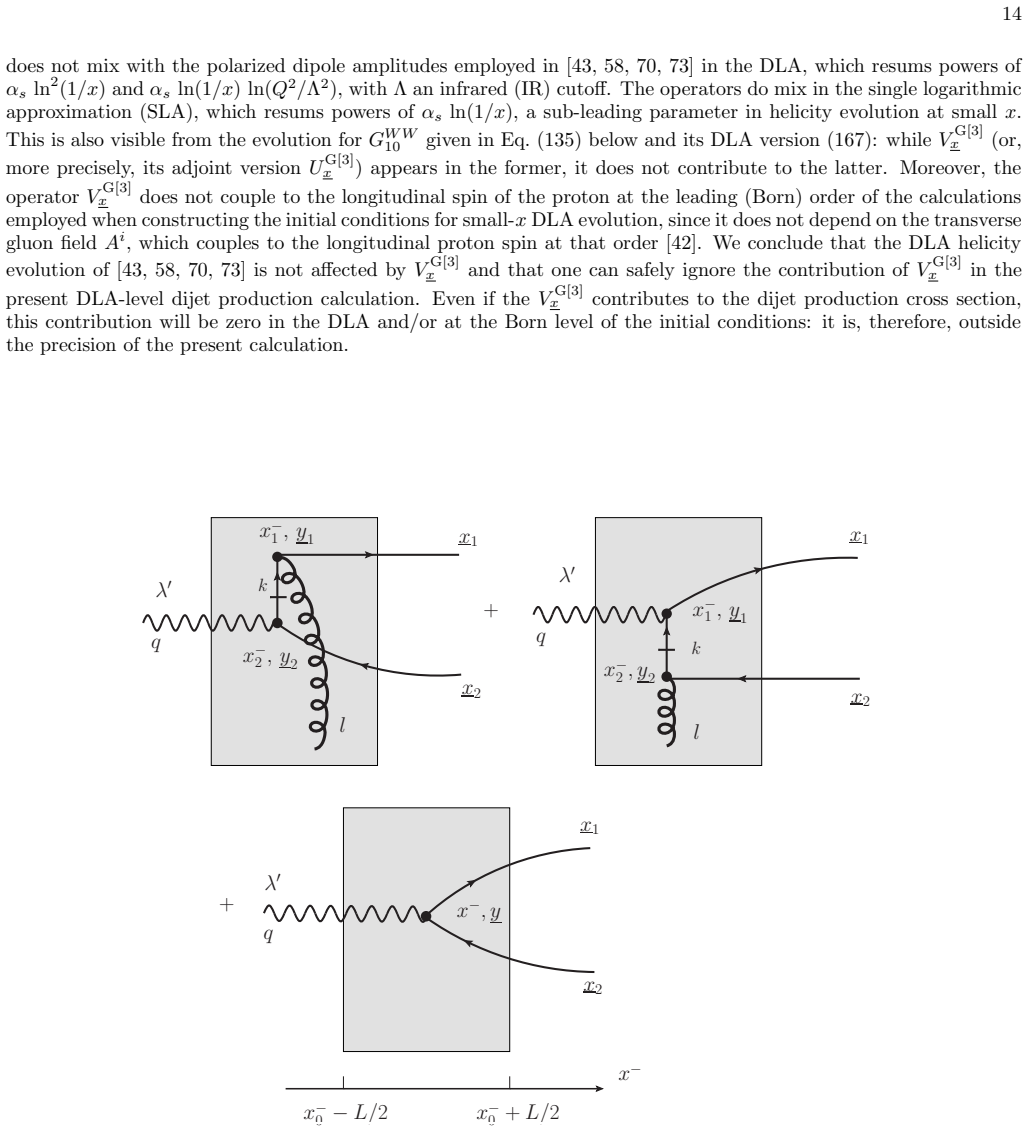

Figures from the paper (7 more)


Forward citations
Cited by 2 Pith papers
-
Gluonic nucleon energy correlators and fracture functions for Color Glass Condensate
Gluonic nucleon energy correlators in the CGC reduce at eikonal accuracy to the unpolarized and linearly polarized gluon components, both given by the adjoint dipole S-matrix, and the linearly polarized one drives a s...
-
Parton distributions in the shockwave formalism
A single shockwave Feynman-rule framework reproduces and extends prior small-x parton distributions, yielding new quark GTMD/GPD/PDF and diffractive-TMD results.
Reference graph
Works this paper leans on
-
[3]
The one with the transverse position x0 is located before the shockwave, while the one with the transverse position x1 is located after the shockwave
Diagrams J′,K′,L′,M′ For the diagramK′, both field strengths become quantum fields. The one with the transverse position x0 is located before the shockwave, while the one with the transverse position x1 is located after the shockwave. Once again, employing the propagator (120), we obtain K′ = αs 2π2Nc zZ Λ2/s dz′ z′ Z d2x2 δil x2 20 − 2xi 20xl 20 x4 20 δj...
-
[2]
The other quantum field comes from the eikonal Wilson line at transverse position x1 and is located to the right (after) the shockwave (the shockwave is understood to be at x− = 0)
Diagrams D′,E′,F′,G′,H′,I′ For diagram E′, the background field at x0 becomes a quantum field and it is located to the left (before) the shockwave. The other quantum field comes from the eikonal Wilson line at transverse position x1 and is located to the right (after) the shockwave (the shockwave is understood to be at x− = 0). The contribution of the dia...
-
[1]
Diagrams A′,B′,C′ + + A′ B′ C′ x0 x1 FIG. 8. Diagrams for one step of evolution for Oij 01 resulting from virtual gluon radiation. In this subset of diagrams, the two background gluon fields stay inside the shockwave. The three diagrams in Fig. 8 are similar to the virtual diagrams in the derivation of the BK/JIMWLK equation. We just quote the result here...
-
[4]
Evolution equation Collecting Eqs. (B3), (B9), (B10), (B17), and differentiating both sides of the resulting equation with respect to rapidity Y ∼ ln(zs), one obtains the final result for the small- x evolution of Oij 01, the correlator related to the unpolarized WW gluon distribution: d dY Oij 01(Y ) =− αsNc 2π2 Z d2x2 x2 10 x2 20x2 21 Oij 01(Y ) (B18) −...
-
[5]
is calculated using the LCOT method, employing the background-field gluon propagator in Eq
In this subset of diagrams, one of the two background gluon field strength is located inside the shockwave, while the other one is located outside the shockwave. is calculated using the LCOT method, employing the background-field gluon propagator in Eq. (120). This yields E′ =−g2 2Nc −ig 4π3 zZ Λ2/s dz′ z′ Z d2x2 2xi 20xl 20−δilx2 20 x4 20 −xl 21 x2 21 Z ...
-
[6]
In this subset of diagrams, both background gluon field strengths are located outside the shockwave. Diagrams G′ and H′ can be obtained from the expression for diagrams D′ +E′ by interchanging the transverse positions x0↔x1 and spatial indices i↔j, G′ +H′ = −αs 2π2Nc zZ Λ2/s dz′ z′ Z d2x2 x2 10 x2 20x2 21 xj 10 x2 10 + xj 21 x2 21 ! × D tr h Vx0∂iV† x0 Vx...
-
[7]
D. Kharzeev, E. Levin, and L. McLerran, Jet azimuthal correlations and parton saturation in the color glass condensate, Nucl. Phys. A 748, 627 (2005), arXiv:hep-ph/0403271
arXiv 2005
-
[8]
J. Jalilian-Marian, A. Kovner, L. D. McLerran, and H. Weigert, The Intrinsic glue distribution at very small x, Phys. Rev. D 55, 5414 (1997), arXiv:hep-ph/9606337
arXiv 1997
Show all 149 references
-
[9]
Dominguez, B.-W
F. Dominguez, B.-W. Xiao, and F. Yuan, kt-factorization for Hard Processes in Nuclei, Phys. Rev. Lett. 106, 022301 (2011), arXiv:1009.2141 [hep-ph]
2011 arXiv
-
[10]
Dominguez, C
F. Dominguez, C. Marquet, B.-W. Xiao, and F. Yuan, Universality of Unintegrated Gluon Distributions at small x, Phys. Rev. D 83, 105005 (2011), arXiv:1101.0715 [hep-ph]
2011 arXiv
-
[11]
Accardi et al., Electron Ion Collider: The Next QCD Frontier: Understanding the glue that binds us all, Eur
A. Accardi et al., Electron Ion Collider: The Next QCD Frontier: Understanding the glue that binds us all, Eur. Phys. J. A 52, 268 (2016), arXiv:1212.1701 [nucl-ex]
2016 arXiv
-
[12]
Boer et al., Gluons and the quark sea at high energies: Distributions, polarization, tomography, (2011), arXiv:1108.1713 [nucl-th]
D. Boer et al., Gluons and the quark sea at high energies: Distributions, polarization, tomography, (2011), arXiv:1108.1713 [nucl-th]
2011 arXiv
-
[13]
Prokudin, Y
A. Prokudin, Y. Hatta, Y. Kovchegov, and C. Marquet, eds., Proceedings, Probing Nucleons and Nuclei in High Energy Collisions: Dedicated to the Physics of the Electron Ion Collider: Seattle (WA), United States, October 1 - November 16, 2018 (WSP, 2020) arXiv:2002.12333 [hep-ph]
2018 arXiv
-
[14]
Abdul Khalek et al., Science Requirements and Detector Concepts for the Electron-Ion Collider: EIC Yellow Report, Nucl
R. Abdul Khalek et al., Science Requirements and Detector Concepts for the Electron-Ion Collider: EIC Yellow Report, Nucl. Phys. A 1026, 122447 (2022), arXiv:2103.05419 [physics.ins-det]
2022 arXiv
-
[15]
Balitsky, Factorization and high-energy effective action, Phys
I. Balitsky, Factorization and high-energy effective action, Phys. Rev. D60, 014020 (1999), hep-ph/9812311
1999 arXiv
-
[16]
Y. V. Kovchegov, Small x F(2) structure function of a nucleus including multiple pomeron exchanges, Phys. Rev. D 60, 034008 (1999), arXiv:hep-ph/9901281
1999 arXiv
-
[17]
M. A. Braun, Inclusive jet production on the nucleus in the perturbative QCD with Nc → ∞ , Phys. Lett. B483, 105 (2000), arXiv:hep-ph/0003003
2000 arXiv
-
[18]
Y. V. Kovchegov and K. Tuchin, Inclusive gluon production in dis at high parton density, Phys. Rev.D65, 074026 (2002), hep-ph/0111362
2002 arXiv
-
[19]
Kharzeev, Y
D. Kharzeev, Y. V. Kovchegov, and K. Tuchin, Cronin effect and high p(T) suppression in pA collisions, Phys. Rev. D 68, 094013 (2003), arXiv:hep-ph/0307037
2003 arXiv
-
[20]
Y. V. Kovchegov and E. Levin, Quantum Chromodynamics at High Energy , Vol. 33 (Oxford University Press, 2013)
2013
-
[21]
However, before specifying the integration limits, we need to clarify the approximation under which Eq
multiplying the kernel, along with the constraint from the ultraviolet (UV) region, min{x2 20,x 2 21}> 1/z′s. However, before specifying the integration limits, we need to clarify the approximation under which Eq. (135) was derived. Similar to the unpolarized small-x evolution...
-
[22]
’t Hooft, A Planar Diagram Theory for Strong Interactions, Nucl
G. ’t Hooft, A Planar Diagram Theory for Strong Interactions, Nucl. Phys. B 72, 461 (1974)
1974
-
[23]
Balitsky, Operator expansion for high-energy scattering, Nucl
I. Balitsky, Operator expansion for high-energy scattering, Nucl. Phys. B 463, 99 (1996), arXiv:hep-ph/9509348
1996 arXiv
-
[24]
L. V. Gribov, E. M. Levin, and M. G. Ryskin, Semihard Processes in QCD, Phys. Rept. 100, 1 (1983)
1983
-
[25]
Y. V. Kovchegov, Unitarization of the BFKL pomeron on a nucleus, Phys. Rev. D61, 074018 (2000), hep-ph/9905214
2000 arXiv
-
[26]
Jalilian-Marian, A
J. Jalilian-Marian, A. Kovner, and H. Weigert, The Wilson renormalization group for low x physics: Gluon evolution at finite parton density, Phys. Rev. D59, 014015 (1998), hep-ph/9709432
1998 arXiv
-
[27]
Jalilian-Marian, A
J. Jalilian-Marian, A. Kovner, A. Leonidov, and H. Weigert, The Wilson renormalization group for low x physics: Towards the high density regime, Phys. Rev. D59, 014014 (1998), hep-ph/9706377
1998 arXiv
-
[28]
Weigert, Unitarity at small Bjorken x, Nucl
H. Weigert, Unitarity at small Bjorken x, Nucl. Phys. A703, 823 (2002), hep-ph/0004044
2002 arXiv
-
[29]
Iancu, A
E. Iancu, A. Leonidov, and L. D. McLerran, The renormalization group equation for the color glass condensate, Phys. Lett. B510, 133 (2001)
2001
-
[30]
Iancu, A
E. Iancu, A. Leonidov, and L. D. McLerran, Nonlinear gluon evolution in the color glass condensate. 1., Nucl. Phys. A 692, 583 (2001), arXiv:hep-ph/0011241. 42
2001 arXiv
-
[31]
This exercise serves as baseline and a cross check of the operator method we use
using the LCOT method. This exercise serves as baseline and a cross check of the operator method we use. In [31], the small-x evolution equation for WW gluon distribution is obtained from the corresponding evolution equation for color quadrupole by further taking transverse de...
-
[32]
Ferreiro, E
E. Ferreiro, E. Iancu, A. Leonidov, and L. McLerran, Nonlinear gluon evolution in the color glass condensate. 2., Nucl. Phys. A 703, 489 (2002), arXiv:hep-ph/0109115
2002 arXiv
-
[33]
Iancu and R
E. Iancu and R. Venugopalan, The Color glass condensate and high-energy scattering in QCD, in Quark-gluon plasma 4 , edited by R. C. Hwa and X.-N. Wang (2003) pp. 249–3363, arXiv:hep-ph/0303204
2003 arXiv
-
[34]
Weigert, Evolution at smallxbj: The Color Glass Condensate, Prog
H. Weigert, Evolution at smallxbj: The Color Glass Condensate, Prog. Part. Nucl. Phys. 55, 461 (2005), hep-ph/0501087
2005 arXiv
-
[35]
Jalilian-Marian and Y
J. Jalilian-Marian and Y. V. Kovchegov, Saturation physics and deuteron-Gold collisions at RHIC, Prog. Part. Nucl. Phys. 56, 104 (2006), arXiv:hep-ph/0505052 [hep-ph]
2006 arXiv
-
[36]
Gelis, E
F. Gelis, E. Iancu, J. Jalilian-Marian, and R. Venugopalan, The Color Glass Condensate, Ann. Rev. Nucl. Part. Sci. 60, 463 (2010), arXiv:1002.0333 [hep-ph]
2010 arXiv
-
[37]
J. L. Albacete and C. Marquet, Gluon saturation and initial conditions for relativistic heavy ion collisions, Prog. Part. Nucl. Phys. 76, 1 (2014), arXiv:1401.4866 [hep-ph]
2014 arXiv
-
[38]
Morreale and F
A. Morreale and F. Salazar, Mining for Gluon Saturation at Colliders, Universe 7, 312 (2021), arXiv:2108.08254 [hep-ph]
2021 arXiv
-
[39]
Dominguez, A
F. Dominguez, A. H. Mueller, S. Munier, and B.-W. Xiao, On the small- x evolution of the color quadrupole and the Weizs¨ acker–Williams gluon distribution, Phys. Lett. B705, 106 (2011), arXiv:1108.1752 [hep-ph]
2011 arXiv
-
[40]
Dominguez, J.-W
F. Dominguez, J.-W. Qiu, B.-W. Xiao, and F. Yuan, On the linearly polarized gluon distributions in the color dipole model, Phys. Rev. D 85, 045003 (2012), arXiv:1109.6293 [hep-ph]
2012 arXiv
-
[41]
Jalilian-Marian and Y
J. Jalilian-Marian and Y. V. Kovchegov, Inclusive two-gluon and valence quark-gluon production in DIS and pA, Phys. Rev. D 70, 114017 (2004), [Erratum: Phys.Rev.D 71, 079901 (2005)], arXiv:hep-ph/0405266
2004 arXiv
-
[42]
Caucal, F
P. Caucal, F. Salazar, and R. Venugopalan, Dijet impact factor in DIS at next-to-leading order in the Color Glass Condensate, JHEP 11, 222, arXiv:2108.06347 [hep-ph]
-
[43]
Caucal, F
P. Caucal, F. Salazar, B. Schenke, and R. Venugopalan, Back-to-back inclusive dijets in DIS at small x: Sudakov sup- pression and gluon saturation at NLO, JHEP 11, 169, arXiv:2208.13872 [hep-ph]
-
[44]
Caucal, F
P. Caucal, F. Salazar, B. Schenke, T. Stebel, and R. Venugopalan, Back-to-back inclusive dijets in DIS at small x: gluon Weizs¨ acker-Williams distribution at NLO, JHEP08, 062, arXiv:2304.03304 [hep-ph]
-
[45]
Caucal, F
P. Caucal, F. Salazar, B. Schenke, T. Stebel, and R. Venugopalan, Back-to-Back Inclusive Dijets in Deep Inelastic Scattering at Small x: Complete NLO Results and Predictions, Phys. Rev. Lett. 132, 081902 (2024), arXiv:2308.00022 [hep-ph]
2024 arXiv
-
[46]
Taels, T
P. Taels, T. Altinoluk, G. Beuf, and C. Marquet, Dijet photoproduction at low x at next-to-leading order and its back- to-back limit, JHEP 10, 184, arXiv:2204.11650 [hep-ph]
-
[47]
Altinoluk, N
T. Altinoluk, N. Armesto, G. Beuf, M. Martinez, and C. A. Salgado, Next-to-eikonal corrections in the CGC: gluon production and spin asymmetries in pA collisions, JHEP 07, 068, arXiv:1404.2219 [hep-ph]
-
[48]
Balitsky and A
I. Balitsky and A. Tarasov, Rapidity evolution of gluon TMD from low to moderate x, JHEP 10, 017, arXiv:1505.02151 [hep-ph]
-
[49]
Balitsky and A
I. Balitsky and A. Tarasov, Gluon TMD in particle production from low to moderate x, JHEP 06, 164, arXiv:1603.06548 [hep-ph]
-
[50]
Y. V. Kovchegov, D. Pitonyak, and M. D. Sievert, Small- x Asymptotics of the Gluon Helicity Distribution, JHEP 10, 198, arXiv:1706.04236 [nucl-th]
-
[51]
Y. V. Kovchegov and M. D. Sievert, Small-x Helicity Evolution: an Operator Treatment, Phys. Rev. D 99, 054032 (2019), arXiv:1808.09010 [hep-ph]
2019 arXiv
-
[52]
G. A. Chirilli, Sub-eikonal corrections to scattering amplitudes at high energy, JHEP 01, 118, arXiv:1807.11435 [hep-ph]
-
[53]
Jalilian-Marian, Quark jets scattering from a gluon field: from saturation to high pt, Phys
J. Jalilian-Marian, Quark jets scattering from a gluon field: from saturation to high pt, Phys. Rev. D99, 014043 (2019), arXiv:1809.04625 [hep-ph]
2019 arXiv
-
[54]
Jalilian-Marian, Rapidity loss, spin and angular asymmetries in scattering of a quark from color field of a proton (nucleus), (2019), arXiv:1912.08878 [hep-ph]
J. Jalilian-Marian, Rapidity loss, spin and angular asymmetries in scattering of a quark from color field of a proton (nucleus), (2019), arXiv:1912.08878 [hep-ph]
2019 arXiv
-
[55]
Altinoluk, G
T. Altinoluk, G. Beuf, A. Czajka, and A. Tymowska, Quarks at next-to-eikonal accuracy in the CGC: Forward quark- nucleus scattering, Phys. Rev. D 104, 014019 (2021), arXiv:2012.03886 [hep-ph]
2021 arXiv
-
[56]
Boussarie and Y
R. Boussarie and Y. Mehtar-Tani, Gauge invariance of transverse momentum dependent distributions at small x, Phys. Rev. D 103, 094012 (2021), arXiv:2001.06449 [hep-ph]
2021 arXiv
-
[57]
Boussarie and Y
R. Boussarie and Y. Mehtar-Tani, A novel formulation of the unintegrated gluon distribution for DIS, Phys. Lett. B 831, 137125 (2022), arXiv:2006.14569 [hep-ph]
2022 arXiv
-
[58]
Y. V. Kovchegov and M. G. Santiago, Quark sivers function at small x: spin-dependent odderon and the sub-eikonal evolution, JHEP 11, 200, [Erratum: JHEP 09, 186 (2022)], arXiv:2108.03667 [hep-ph]
2022 arXiv
-
[59]
Altinoluk and G
T. Altinoluk and G. Beuf, Quark and scalar propagators at next-to-eikonal accuracy in the CGC through a dynamical background gluon field, Phys. Rev. D 105, 074026 (2022), arXiv:2109.01620 [hep-ph]
2022 arXiv
-
[60]
Y. V. Kovchegov and M. G. Santiago, T-odd leading-twist quark TMDs at small x, JHEP 11, 098, arXiv:2209.03538 [hep-ph]
-
[61]
Altinoluk, G
T. Altinoluk, G. Beuf, A. Czajka, and A. Tymowska, DIS dijet production at next-to-eikonal accuracy in the CGC, Phys. Rev. D 107, 074016 (2023), arXiv:2212.10484 [hep-ph]
2023 arXiv
-
[62]
Altinoluk, N
T. Altinoluk, N. Armesto, and G. Beuf, Probing quark transverse momentum distributions in the color glass conden- sate: Quark-gluon dijets in deep inelastic scattering at next-to-eikonal accuracy, Phys. Rev. D 108, 074023 (2023), arXiv:2303.12691 [hep-ph]
2023 arXiv
-
[63]
Altinoluk, G
T. Altinoluk, G. Beuf, and J. Jalilian-Marian, Renormalization of the gluon distribution function in the background field formalism, (2023), arXiv:2305.11079 [hep-ph]
2023 arXiv
-
[64]
Li, Small x physics beyond eikonal approximation: an effective Hamiltonian approach, JHEP07, 158, arXiv:2304.12842 43 [hep-ph]
M. Li, Small x physics beyond eikonal approximation: an effective Hamiltonian approach, JHEP07, 158, arXiv:2304.12842 43 [hep-ph]
-
[65]
Altinoluk, G
T. Altinoluk, G. Beuf, and S. Mulani, Forward parton-nucleus scattering at next-to-eikonal accuracy in the CGC, (2024), arXiv:2411.15047 [hep-ph]
2024 arXiv
-
[66]
Y. V. Kovchegov, D. Pitonyak, and M. D. Sievert, Helicity Evolution at Small-x, JHEP 01, 072, [Erratum: JHEP 10, 148 (2016)], arXiv:1511.06737 [hep-ph]
2016 arXiv
-
[67]
Hatta, Y
Y. Hatta, Y. Nakagawa, F. Yuan, Y. Zhao, and B. Xiao, Gluon orbital angular momentum at small- x, Phys. Rev. D 95, 114032 (2017), arXiv:1612.02445 [hep-ph]
2017 arXiv
-
[68]
Y. V. Kovchegov, D. Pitonyak, and M. D. Sievert, Helicity Evolution at Small x: Flavor Singlet and Non-Singlet Observ- ables, Phys. Rev. D95, 014033 (2017), arXiv:1610.06197 [hep-ph]
2017 arXiv
-
[69]
Y. V. Kovchegov, D. Pitonyak, and M. D. Sievert, Small- x asymptotics of the quark helicity distribution, Phys. Rev. Lett. 118, 052001 (2017), arXiv:1610.06188 [hep-ph]
2017 arXiv
-
[70]
Y. V. Kovchegov, D. Pitonyak, and M. D. Sievert, Small- x Asymptotics of the Quark Helicity Distribution: Analytic Results, Phys. Lett. B772, 136 (2017), arXiv:1703.05809 [hep-ph]
2017 arXiv
-
[71]
Y. V. Kovchegov, Orbital Angular Momentum at Small x, JHEP 03, 174, arXiv:1901.07453 [hep-ph]
1901 arXiv
-
[72]
Boussarie, Y
R. Boussarie, Y. Hatta, and F. Yuan, Proton Spin Structure at Small- x, Phys. Lett. B797, 134817 (2019), arXiv:1904.02693 [hep-ph]
2019 arXiv
-
[73]
Cougoulic and Y
F. Cougoulic and Y. V. Kovchegov, Helicity-dependent generalization of the JIMWLK evolution, Phys. Rev. D 100, 114020 (2019), arXiv:1910.04268 [hep-ph]
2019 arXiv
-
[74]
Y. V. Kovchegov and Y. Tawabutr, Helicity at Small x: Oscillations Generated by Bringing Back the Quarks, JHEP 08, 014, arXiv:2005.07285 [hep-ph]
2005 arXiv
-
[75]
Cougoulic and Y
F. Cougoulic and Y. V. Kovchegov, Helicity-dependent extension of the McLerran–Venugopalan model, Nucl. Phys. A 1004, 122051 (2020), arXiv:2005.14688 [hep-ph]
2020 arXiv
-
[76]
G. A. Chirilli, High-energy operator product expansion at sub-eikonal level, JHEP 06, 096, arXiv:2101.12744 [hep-ph]
-
[77]
Y. V. Kovchegov, A. Tarasov, and Y. Tawabutr, Helicity evolution at small x: the single-logarithmic contribution, JHEP 03, 184, arXiv:2104.11765 [hep-ph]
-
[78]
Cougoulic, Y
F. Cougoulic, Y. V. Kovchegov, A. Tarasov, and Y. Tawabutr, Quark and gluon helicity evolution at small x: revised and updated, JHEP 07, 095, arXiv:2204.11898 [hep-ph]
-
[79]
Borden and Y
J. Borden and Y. V. Kovchegov, Analytic solution for the revised helicity evolution at small x and large Nc: New resummed gluon-gluon polarized anomalous dimension and intercept, Phys. Rev. D 108, 014001 (2023), arXiv:2304.06161 [hep-ph]
2023 arXiv
-
[80]
Adamiak, Y
D. Adamiak, Y. V. Kovchegov, and Y. Tawabutr, Helicity evolution at small x: Revised asymptotic results at large Nc and Nf, Phys. Rev. D 108, 054005 (2023), arXiv:2306.01651 [hep-ph]
2023 arXiv
-
[81]
Borden, Y
J. Borden, Y. V. Kovchegov, and M. Li, Helicity Evolution at Small x: Quark to Gluon and Gluon to Quark Transition Operators, (2024), arXiv:2406.11647 [hep-ph]
2024 arXiv
-
[82]
Bartels, B
J. Bartels, B. Ermolaev, and M. Ryskin, Nonsinglet contributions to the structure function g1 at small x, Z.Phys. C70, 273 (1996), arXiv:hep-ph/9507271 [hep-ph]
1996 arXiv
-
[83]
Bartels, B
J. Bartels, B. Ermolaev, and M. Ryskin, Flavor singlet contribution to the structure function G(1) at small x, Z.Phys. C72, 627 (1996), arXiv:hep-ph/9603204 [hep-ph]
1996 arXiv
-
[84]
V. G. Gorshkov, V. N. Gribov, L. N. Lipatov, and G. V. Frolov, Doubly logarithmic asymptotic behavior in quantum electrodynamics, Sov. J. Nucl. Phys. 6, 95 (1968), [Yad. Fiz.6,129(1967)]
1968
-
[85]
Kirschner and L
R. Kirschner and L. Lipatov, Double Logarithmic Asymptotics and Regge Singularities of Quark Amplitudes with Flavor Exchange, Nucl.Phys. B213, 122 (1983)
1983
-
[86]
Kirschner, Reggeon interactions in perturbative QCD, Z.Phys
R. Kirschner, Reggeon interactions in perturbative QCD, Z.Phys. C65, 505 (1995), arXiv:hep-th/9407085 [hep-th]
1995 arXiv
-
[87]
Kirschner, Regge asymptotics of scattering with flavor exchange in QCD, Z.Phys
R. Kirschner, Regge asymptotics of scattering with flavor exchange in QCD, Z.Phys. C67, 459 (1995), arXiv:hep- th/9404158 [hep-th]
1995
-
[88]
Griffiths and D
S. Griffiths and D. Ross, Studying the perturbative Reggeon, Eur.Phys.J. C12, 277 (2000), arXiv:hep-ph/9906550 [hep- ph]
2000 arXiv
-
[89]
Bl¨ umlein and A
J. Bl¨ umlein and A. Vogt, The Singlet contribution to the structure function g1 (x, Q**2) at small x, Phys. Lett. B 386, 350 (1996), arXiv:hep-ph/9606254
1996 arXiv
-
[90]
Blumlein and A
J. Blumlein and A. Vogt, On the behavior of nonsinglet structure functions at small x, Phys. Lett. B 370, 149 (1996), arXiv:hep-ph/9510410
1996 arXiv
-
[91]
Altarelli and G
G. Altarelli and G. Parisi, Asymptotic Freedom in Parton Language, Nucl. Phys. B126, 298 (1977)
1977
-
[92]
Y. L. Dokshitzer, Calculation of the Structure Functions for Deep Inelastic Scattering and e+e− Annihilation by Pertur- bation Theory in Quantum Chromodynamics, Sov. Phys. JETP 46, 641 (1977)
1977
-
[93]
E. B. Zijlstra and W. L. van Neerven, Order-α2 s corrections to the polarized structure functiong1(x,Q 2), Nucl. Phys. B417, 61 (1994), [Erratum: Nucl.Phys.B 426, 245 (1994), Erratum: Nucl.Phys.B 773, 105–106 (2007), Erratum: Nucl.Phys.B 501, 599–599 (1997)]
1994
-
[94]
Mertig and W
R. Mertig and W. L. van Neerven, The Calculation of the two loop spin splitting functions P(ij)(1)(x), Z. Phys. C 70, 637 (1996), arXiv:hep-ph/9506451
1996 arXiv
-
[95]
Moch and J
S. Moch and J. A. M. Vermaseren, Deep inelastic structure functions at two loops, Nucl. Phys. B 573, 853 (2000), arXiv:hep-ph/9912355
2000 arXiv
-
[96]
W. L. van Neerven and A. Vogt, NNLO evolution of deep inelastic structure functions: The Singlet case, Nucl. Phys. B 588, 345 (2000), arXiv:hep-ph/0006154
2000 arXiv
-
[97]
J. A. M. Vermaseren, A. Vogt, and S. Moch, The Third-order QCD corrections to deep-inelastic scattering by photon exchange, Nucl. Phys. B 724, 3 (2005), arXiv:hep-ph/0504242. 44
2005 arXiv
-
[98]
S. Moch, J. A. M. Vermaseren, and A. Vogt, The Three-Loop Splitting Functions in QCD: The Helicity-Dependent Case, Nucl. Phys. B 889, 351 (2014), arXiv:1409.5131 [hep-ph]
2014 arXiv
-
[99]
Bl¨ umlein, P
J. Bl¨ umlein, P. Marquard, C. Schneider, and K. Sch¨ onwald, The three-loop polarized singlet anomalous dimensions from off-shell operator matrix elements, JHEP 01, 193, arXiv:2111.12401 [hep-ph]
-
[100]
Bl¨ umlein and M
J. Bl¨ umlein and M. Saragnese, The N3LO scheme-invariant QCD evolution of the non-singlet structure functions F2NS(x,Q2) and g1NS(x,Q2), Phys. Lett. B 820, 136589 (2021), arXiv:2107.01293 [hep-ph]
2021 arXiv
-
[101]
Davies, C
J. Davies, C. H. Kom, S. Moch, and A. Vogt, Resummation of small-x double logarithms in QCD: inclusive deep-inelastic scattering, JHEP 08, 135, arXiv:2202.10362 [hep-ph]
-
[102]
Bl¨ umlein, P
J. Bl¨ umlein, P. Marquard, C. Schneider, and K. Sch¨ onwald, The massless three-loop Wilson coefficients for the deep- inelastic structure functions F 2, FL, xF3 and g1, JHEP 11, 156, arXiv:2208.14325 [hep-ph]
-
[103]
Adamiak, N
D. Adamiak, N. Baldonado, Y. V. Kovchegov, W. Melnitchouk, D. Pitonyak, N. Sato, M. D. Sievert, A. Tarasov, and Y. Tawabutr (Jefferson Lab Angular Momentum (JAM)), Global analysis of polarized DIS and SIDIS data with improved small-x helicity evolution, Phys. Rev. D 108, 11400...
2023 arXiv
-
[104]
Y. V. Kovchegov and M. Li, Gluon double-spin asymmetry in the longitudinally polarized p + p collisions, JHEP 05, 177, arXiv:2403.06959 [hep-ph]
-
[105]
Y. V. Kovchegov and B. Manley, Elastic dijet production in electron scattering on a longitudinally polarized proton at small x: A portal to orbital angular momentum distributions, Phys. Rev. D 111, 054017 (2025), arXiv:2410.21260 [hep-ph]
2025 arXiv
-
[106]
Bhattacharya, R
S. Bhattacharya, R. Boussarie, and Y. Hatta, Signature of the Gluon Orbital Angular Momentum, Phys. Rev. Lett. 128, 182002 (2022), arXiv:2201.08709 [hep-ph]
2022 arXiv
-
[107]
Bhattacharya, D
S. Bhattacharya, D. Zheng, and J. Zhou, Probing the Quark Orbital Angular Momentum at Electron-Ion Colliders Using Exclusiveπ0 Production, Phys. Rev. Lett. 133, 051901 (2024), arXiv:2312.01309 [hep-ph]
2024 arXiv
-
[108]
Bhattacharya, R
S. Bhattacharya, R. Boussarie, and Y. Hatta, Exploring orbital angular momentum and spin-orbit correlations for gluons at the Electron-Ion Collider, Phys. Rev. D 111, 034019 (2025), arXiv:2404.04209 [hep-ph]
2025 arXiv
-
[109]
Metz and J
A. Metz and J. Zhou, Distribution of linearly polarized gluons inside a large nucleus, Phys. Rev. D 84, 051503 (2011), arXiv:1105.1991 [hep-ph]
2011 arXiv
-
[110]
Adolph et al
C. Adolph et al. (COMPASS), Leading and Next-to-Leading Order Gluon Polarization in the Nucleon and Longitudinal Double Spin Asymmetries from Open Charm Muoproduction, Phys. Rev. D 87, 052018 (2013), arXiv:1211.6849 [hep-ex]
2013 arXiv
-
[111]
Adolph et al
C. Adolph et al. (COMPASS), Leading order determination of the gluon polarisation from DIS events with high-pT hadron pairs, Phys. Lett. B 718, 922 (2013), arXiv:1202.4064 [hep-ex]
2013 arXiv
-
[112]
Adolph et al
C. Adolph et al. (COMPASS), Leading-order determination of the gluon polarisation from semi-inclusive deep inelastic scattering data, Eur. Phys. J. C 77, 209 (2017), arXiv:1512.05053 [hep-ex]
2017 arXiv
-
[113]
B. S. Page, X. Chu, and E. C. Aschenauer, Experimental Aspects of Jet Physics at a Future EIC, Phys. Rev. D 101, 072003 (2020), arXiv:1911.00657 [hep-ph]
2020 arXiv
-
[114]
Borsa, D
I. Borsa, D. de Florian, and I. Pedron, Dijet production in neutral current and charged current polarized deep inelastic scattering, Phys. Rev. D 105, 074025 (2022), arXiv:2112.08223 [hep-ph]
2022 arXiv
-
[115]
Agostini, T
P. Agostini, T. Altinoluk, and N. Armesto, Next-to-eikonal corrections to dijet production in Deep Inelastic Scattering in the dilute limit of the Color Glass Condensate, JHEP 07, 137, arXiv:2403.04603 [hep-ph]
-
[116]
Altinoluk, G
T. Altinoluk, G. Beuf, A. Czajka, and C. Marquet, Back-to-back dijet production in DIS at next-to-eikonal accuracy and twist-3 gluon TMDs, Phys. Rev. D 111, 014010 (2025), arXiv:2410.00612 [hep-ph]
2025 arXiv
-
[117]
Altinoluk, G
T. Altinoluk, G. Beuf, E. Blanco, and S. Mulani, Quark TMDs from back-to-back dijet production at forward rapidities in pA collisions beyond eikonal accuracy in the CGC, (2024), arXiv:2412.08485 [hep-ph]
2024
-
[118]
M. E. Peskin and D. V. Schroeder, An Introduction to quantum field theory (Addison-Wesley, Reading, USA, 1995)
1995
-
[119]
L. F. Abbott, Introduction to the Background Field Method, Acta Phys. Polon. B 13, 33 (1982)
1982
-
[120]
P. J. Mulders and J. Rodrigues, Transverse momentum dependence in gluon distribution and fragmentation functions, Phys. Rev. D 63, 094021 (2001), arXiv:hep-ph/0009343
2001 arXiv
-
[121]
Meissner, A
S. Meissner, A. Metz, and K. Goeke, Relations between generalized and transverse momentum dependent parton distri- butions, Phys. Rev. D 76, 034002 (2007), arXiv:hep-ph/0703176
2007 arXiv
-
[122]
Anselmino, M
M. Anselmino, M. Boglione, U. D’Alesio, E. Leader, S. Melis, and F. Murgia, The general partonic structure for hadronic spin asymmetries, Phys. Rev. D 73, 014020 (2006), arXiv:hep-ph/0509035
2006 arXiv
-
[123]
Mueller and S
A. Mueller and S. Munier, p⊥-broadening and production processes versus dipole/quadrupole amplitudes at next-to- leading order, Nucl.Phys. A893, 43 (2012), arXiv:1206.1333 [hep-ph]
2012 arXiv
-
[124]
Li, Quasiclassical Gluon Fields and Low’s Soft Theorem at Small Momentum-Fraction x, Phys
M. Li, Quasiclassical Gluon Fields and Low’s Soft Theorem at Small Momentum-Fraction x, Phys. Rev. Lett. 133, 021902 (2024), arXiv:2402.17568 [hep-ph]
2024 arXiv
-
[125]
Li, Quasiclassical evaluation of gluon saturation induced helicity effects, Phys
M. Li, Quasiclassical evaluation of gluon saturation induced helicity effects, Phys. Rev. D 111, 034027 (2025), arXiv:2411.13431 [hep-ph]
2025 arXiv
-
[126]
L. D. McLerran and R. Venugopalan, Computing quark and gluon distribution functions for very large nuclei, Phys. Rev. D 49, 2233 (1994), arXiv:hep-ph/9309289
1994 arXiv
-
[127]
L. D. McLerran and R. Venugopalan, Gluon distribution functions for very large nuclei at small transverse momentum, Phys. Rev. D 49, 3352 (1994), arXiv:hep-ph/9311205
1994 arXiv
-
[128]
L. D. McLerran and R. Venugopalan, Green’s functions in the color field of a large nucleus, Phys. Rev. D50, 2225 (1994), hep-ph/9402335
1994 arXiv
-
[129]
H. Liu, X. Xie, and Z. Lu, Gluon TMDs from J/ψ production in longitudinally polarized deeply inelastic scattering, Phys. Lett. B 849, 138439 (2024), arXiv:2310.00609 [hep-ph]
2024 arXiv
-
[130]
Bacchetta, U
A. Bacchetta, U. D’Alesio, M. Diehl, and C. A. Miller, Single-spin asymmetries: The Trento conventions, Phys. Rev. D 45 70, 117504 (2004), arXiv:hep-ph/0410050
2004 arXiv
-
[131]
V. M. Braun and D. Y. Ivanov, Exclusive diffractive electroproduction of dijets in collinear factorization, Phys. Rev. D 72, 034016 (2005), arXiv:hep-ph/0505263
2005 arXiv
-
[132]
M¨ antysaari, K
H. M¨ antysaari, K. Roy, F. Salazar, and B. Schenke, Gluon imaging using azimuthal correlations in diffractive scattering at the Electron-Ion Collider, Phys. Rev. D 103, 094026 (2021), arXiv:2011.02464 [hep-ph]
2021 arXiv
-
[133]
Bhattacharya, R
S. Bhattacharya, R. Boussarie, and Y. Hatta, Spin-orbit entanglement in the Color Glass Condensate, Phys. Lett. B 859, 139134 (2024), arXiv:2404.04208 [hep-ph]
2024 arXiv
-
[134]
Arens, O
T. Arens, O. Nachtmann, M. Diehl, and P. V. Landshoff, Some tests for the helicity structure of the pomeron in e p collisions, Z. Phys. C 74, 651 (1997), arXiv:hep-ph/9605376
1997 arXiv
-
[135]
Diehl and S
M. Diehl and S. Sapeta, On the analysis of lepton scattering on longitudinally or transversely polarized protons, Eur. Phys. J. C 41, 515 (2005), arXiv:hep-ph/0503023
2005 arXiv
-
[136]
G. P. Lepage and S. J. Brodsky, Exclusive processes in perturbative quantum chromodynamics, Phys. Rev. D22, 2157 (1980)
1980
-
[137]
S. J. Brodsky, H.-C. Pauli, and S. S. Pinsky, Quantum chromodynamics and other field theories on the light cone, Phys. Rept. 301, 299 (1998), arXiv:hep-ph/9705477
1998 arXiv
-
[138]
Y. V. Kovchegov and B. Manley, Orbital angular momentum at small x revisited, JHEP 02, 060, [Erratum: JHEP 08, 140 (2024)], arXiv:2310.18404 [hep-ph]
2024 arXiv
-
[139]
Dumitru, T
A. Dumitru, T. Lappi, and V. Skokov, Distribution of Linearly Polarized Gluons and Elliptic Azimuthal Anisotropy in Deep Inelastic Scattering Dijet Production at High Energy, Phys. Rev. Lett. 115, 252301 (2015), arXiv:1508.04438 [hep-ph]
2015 arXiv
-
[140]
Dumitru, V
A. Dumitru, V. Skokov, and T. Ullrich, Measuring the Weizs¨ acker-Williams distribution of linearly polarized gluons at an electron-ion collider through dijet azimuthal asymmetries, Phys. Rev. C 99, 015204 (2019), arXiv:1809.02615 [hep-ph]
2019 arXiv
-
[141]
Adamiak, Y
D. Adamiak, Y. V. Kovchegov, W. Melnitchouk, D. Pitonyak, N. Sato, and M. D. Sievert (Jefferson Lab Angular Momentum), First analysis of world polarized DIS data with small-x helicity evolution, Phys. Rev. D 104, L031501 (2021), arXiv:2102.06159 [hep-ph]
2021 arXiv
-
[142]
Adamiak, N
D. Adamiak, N. Baldonado, Y. V. Kovchegov, M. Li, W. Melnitchouk, D. Pitonyak, N. Sato, M. D. Sievert, A. Tarasov, and Y. Tawabutr, First study of polarized proton-proton scattering with small-x helicity evolution, (2025), arXiv:2503.21006 [hep-ph]
2025 arXiv
-
[143]
A. H. Mueller, B.-W. Xiao, and F. Yuan, Sudakov Resummation in Small-x Saturation Formalism, Phys. Rev. Lett. 110, 082301 (2013), arXiv:1210.5792 [hep-ph]
2013 arXiv
-
[144]
A. H. Mueller, B.-W. Xiao, and F. Yuan, Sudakov double logarithms resummation in hard processes in the small-x saturation formalism, Phys. Rev. D 88, 114010 (2013), arXiv:1308.2993 [hep-ph]
2013 arXiv
-
[145]
Adamczyk et al
L. Adamczyk et al. (STAR), Measurement of the cross section and longitudinal double-spin asymmetry for di-jet produc- tion in polarized pp collisions at √s = 200 GeV, Phys. Rev. D 95, 071103 (2017), arXiv:1610.06616 [hep-ex]
2017 arXiv
-
[146]
Adam et al
J. Adam et al. (STAR), Longitudinal double-spin asymmetry for inclusive jet and dijet production in pp collisions at√s = 510 GeV, Phys. Rev. D 100, 052005 (2019), arXiv:1906.02740 [hep-ex]
2019
-
[147]
M. S. Abdallah et al. (STAR), Longitudinal double-spin asymmetry for inclusive jet and dijet production in polarized proton collisions at √s = 200 GeV, Phys. Rev. D 103, L091103 (2021), arXiv:2103.05571 [hep-ex]
2021
-
[148]
M. S. Abdallah et al. (STAR), Longitudinal double-spin asymmetry for inclusive jet and dijet production in polarized proton collisions at √s = 510 GeV, Phys. Rev. D 105, 092011 (2022), arXiv:2110.11020 [hep-ex]
2022
-
[149]
Aschenauer et al
E.-C. Aschenauer et al. (RHIC SPIN), The RHIC Cold QCD Program, (2023), arXiv:2302.00605 [nucl-ex]
2023 arXiv
Reviewed August 16, 2026 · model on record in the stance chip above.
Discussion (0). Continue with ORCID to comment.