REVIEW 4 major objections 4 minor 66 references
Non-singular anisotropic solutions for strange star model in $f(\mathcal{R},\mathcal{T},\mathcal{R}_{\zeta\gamma}\mathcal{T}^{\zeta\gamma})$ gravity theory
T0 review · 4 major / 4 minor · reviewed 2026-08-16 · deepseek-v4-flash
Pith's one-line read The paper claims that two anisotropic strange star solutions in f(R,T,RμνTμν) gravity are non-singular, stable, and physically viable for the compact object 4U 1820-30.
desk verdict Routine f(R,T,Q) compact-star paper whose viability analysis is done at coupling values that do not satisfy the surface boundary condition used to match real stars; the central claim is unsupported as written. read the letter →
The pith
A machine-rendered reading of the paper's core claim, the machinery that carries it, and where it could break.
The reading
What carries the argument
The central object is the non-minimal coupling term $\mathcal{R}_{\zeta\gamma}\mathcal{T}^{\zeta\gamma}$ added to the Einstein-Hilbert action. It generates an extra geometric force that makes the energy-momentum tensor non-conserved, and the paper relies on two explicit forms of this coupling. To solve the resulting highly nonlinear field equations, the Durgapal-Fuloria spacetime ansatz and the MIT bag equation of state are used as closure conditions, reducing the system to a one-parameter family in $\eta$ for each model.
What would settle it
Compute the surface radial pressure $P_r(R)$ for 4U 1820-30 using the matched constants $d_1,d_2$ at each plotted $\eta$; any nonzero value shows that the analyzed interior fails the exterior matching condition that defines the stellar model.
Extended reading notes
Core claim
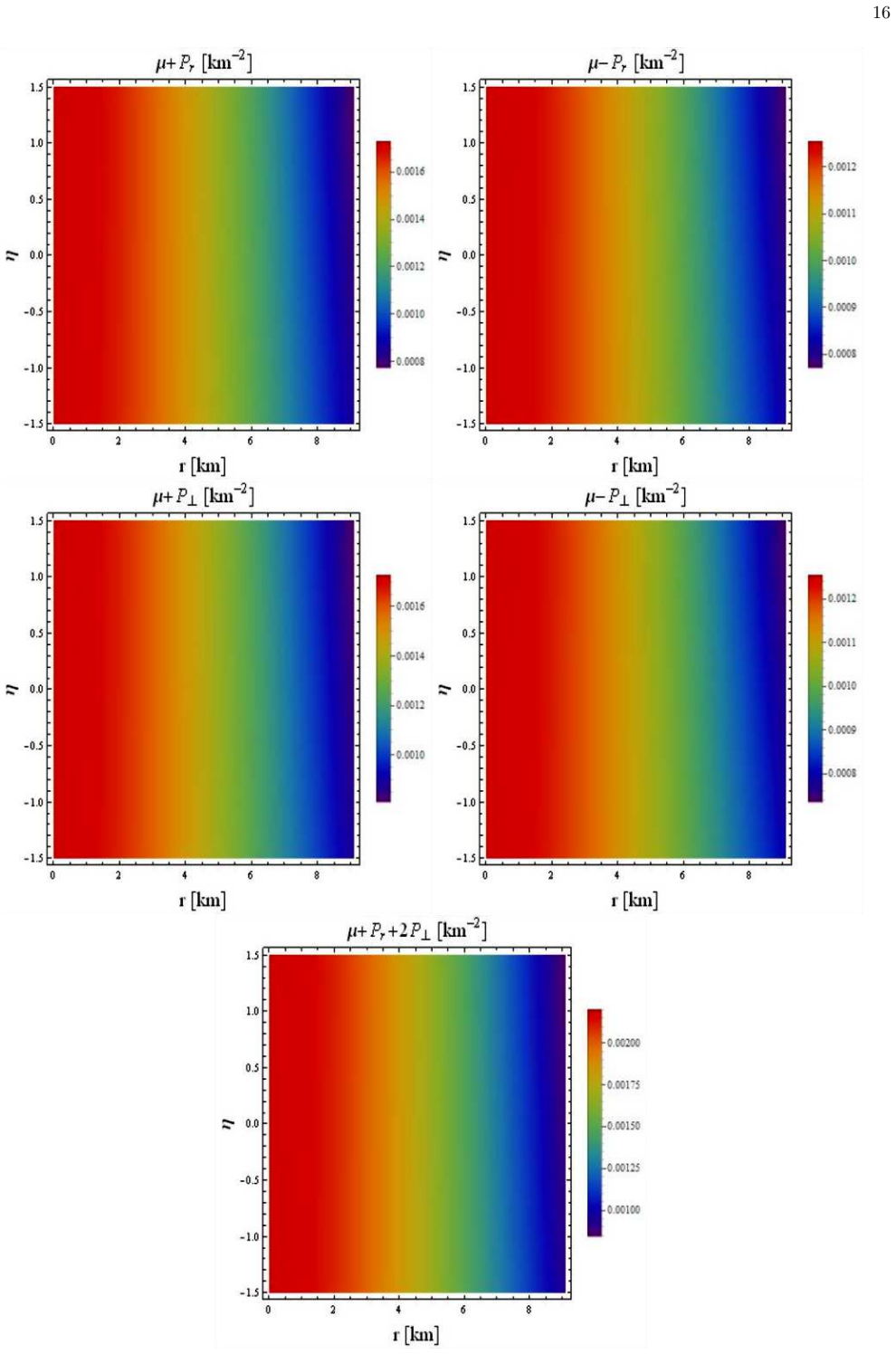
Within this framework the paper derives the full anisotropic field equations for two model choices, $f=\mathcal{R}+\eta\mathcal{R}_{\zeta\gamma}\mathcal{T}^{\zeta\gamma}$ and $f=\mathcal{R}(1+\eta\mathcal{R}_{\zeta\gamma}\mathcal{T}^{\zeta\gamma})$. Using the Durgapal-Fuloria ansatz and the MIT bag relation $P_r=(\mu-4B_c)/3$, the authors obtain explicit expressions for density and pressures, fix the metric constants by continuity with the Schwarzschild exterior for 4U 1820-30, and report that across the interval $\eta=-1.5,0,1.5$ the solutions have positive finite central density, decreasing outward profiles, positive anisotropy growing outward, mass and compactness within Buchdahl's bound, surface redshift below theoretical limits, all energy conditions satisfied, TOV equilibrium, and stability by causality, cracking, and adiabatic-index tests.
Load-bearing premise
The plots and stability tests assume that the values $\eta=-1.5,0,1.5$ describe the boundary-matched star, but imposing the surface condition $P_r=0$ on Model 1 for 4U 1820-30 gives $\eta\approx -243$ to $-203$, so the tested and matched configurations are not the same.
Editorial extensions
If this is right
- Both models provide explicit nonsingular strange-star interiors in this modified gravity and are claimed to satisfy all standard physical viability conditions for 4U 1820-30.
- The two functional forms give measurably different density and pressure profiles, so a comparison with future mass-radius data could distinguish which coupling form describes real quark stars.
- At $\eta=0$ the solutions reduce to general relativity, making the modified theory's deviations from GR continuously tunable and testable.
- Because all plotted energy conditions and stability indicators hold, the coupling term does not introduce an immediate instability for the chosen parameter range.
Reading between the lines
- If the surface boundary condition is taken seriously, Model 1's matched parameter for 4U 1820-30 is roughly $\eta\approx -243$ to $-203$, not the plotted values; the viability of those actually matched solutions has not been plotted and should be checked separately.
- The same construction could be applied systematically to the other seven stars in the paper's tables, turning the predicted $\eta$ values into a test of whether the coupling improves mass-radius agreement relative to GR.
- The extra force generated by the non-conserved energy-momentum tensor is likely responsible for much of the stability margin; isolating its contribution at each $\eta$ would make the mechanism behind the stability claim explicit.
Signed reviews
Editorial analysis
A structured set of objections, weighed in public.
Referee Report
Summary. The paper constructs two anisotropic strange star models in f(R,T,RζγT^ζγ) gravity, using the Durgapal-Fuloria ansatz and the MIT bag equation of state. The authors derive the field equations for two functional forms (Model 1: R+ηRζγT^ζγ; Model 2: R(1+ηRζγT^ζγ)), match the interior to the Schwarzschild exterior via the first fundamental form, and then test matter variables, energy conditions, TOV equilibrium, causality, and adiabatic stability for η = -1.5, 0, 1.5. In Section V they impose the vanishing radial pressure condition Pr(R)=0 to determine η for an array of stars, and conclude that both models are well-behaved and suitable for modeling 4U 1820-30.
Significance. If the central claim were supported, the paper would provide two non-singular anisotropic strange star solutions in this modified gravity theory, with explicit field equations and standard physical tests. The algebraic derivation of the matter variables and the matching procedure are substantial, and the paper makes its calculations available in detail. However, the physical analysis is performed at parameter values that are inconsistent with the boundary-matched values obtained later; the conclusion that the models describe 4U 1820-30 is therefore not currently supported by the evidence presented.
major comments (4)
- [Section IV vs. Section V] The physical viability analysis in Section IV (Figures 2-12) is restricted to η = -1.5, 0, 1.5 with Bc = 90 MeV/fm^3, but the boundary condition Pr(R)=0 for 4U 1820-30 yields η ≈ -243, -223, -203 for Model 1 (Table III) and η ≈ 6.67, 3.31, 0.35 for Model 2 (Table IV). The analyzed configurations are therefore not the stellar models that match the observed mass and radius. The paper never repeats the energy-condition, TOV, or stability tests at the boundary-matched η values, so no evidence supports the concluding claim that the matched models are physically viable.
- [Section IV, Tables I and II] The incompatibility is quantitatively confirmed by the surface densities in Tables I and II. For the MIT bag EoS (15), Pr(R)=0 implies μ(R)=4Bc; with Bc=90 MeV/fm^3 this gives μ_s ≈ 6.4×10^14 g/cm^3, whereas Tables I and II list surface densities of roughly 8.6-9.5×10^14 g/cm^3 and 8.4-14.4×10^14 g/cm^3 for the plotted η values. Thus the graphed solutions do not satisfy the surface boundary condition used to match the star.
- [Section V] The vanishing-pressure constraint for Model 2 is stated to be omitted because it is too lengthy, yet Table IV reports fitted values of η for eight stars. Without the explicit constraint or a reproducible algorithm, these numerical results cannot be verified. This is a reproducibility gap in a load-bearing part of the paper.
- [Tables III and IV] If η is a coupling constant of the theory, it should be universal. The fitted values in Tables III and IV vary by hundreds (Model 1: from -826 to 143; Model 2: from -7.31 to 20.89) across the listed stars. The paper does not address whether any single value of η can simultaneously describe the array of stars, which undermines the statement that the results align with observed information of an array of stars.
minor comments (4)
- [Figure 1] Figure 1 is described as showing metric components versus η and r, but the Durgapal-Fuloria components in Eq. (20) do not depend on η; the curves for different η should coincide. Please clarify whether the figure is meant to show only r-dependence.
- [Eq. (26)] The mass function m(r) is defined with an integral from 0 to R, but for a radial profile the upper limit should be r. This appears to be a typographical error in the definition.
- [Eqs. (15) and (16)-(19)] The MIT bag EoS is referred to as (g14a) in the text after Eq. (15); this label seems to be an artifact and should be corrected to Eq. (15).
- [Throughout] The phrase 'disappearing radial pressure' is unusual; 'vanishing radial pressure' is the standard terminology.
Circularity Check
No significant circularity; the models are calibrated to observed mass/radius and checked for internal consistency, though the Section V boundary-matched η is not the η used in the Section IV viability plots.
full rationale
The paper's derivation chain is an ansatz-based stellar modeling procedure, not a circular derivation. It fixes the Durgapal-Fuloria metric constants d1 and d2 by matching to the Schwarzschild exterior at the observed mass and radius of 4U 1820-30, imposes the MIT bag equation of state, solves the f(R,T,RζγTζγ) field equations for the matter variables, and then tests those solutions against regularity, energy conditions, TOV equilibrium, causality, and adiabatic-index bounds. Those tests are internal consistency checks on a constructed solution, and satisfying them is not equivalent by construction to the chosen ansatz or to the input mass and radius. The parameter η is explicitly fitted in Section V using the surface condition Pr(R)=0, and the fitted values are reported in Tables III and IV rather than being disguised as predictions. No equation is defined in terms of the conclusion, and no fitted quantity is renamed as an independent prediction. The self-citations to the Durgapal-Fuloria ansatz are ordinary references for a metric choice, not load-bearing uniqueness arguments. The serious weakness is a correctness gap, not circularity: for 4U 1820-30 the boundary-matched η values in Tables III and IV are very different from the η=-1.5, 0, 1.5 values used in all Section IV plots, so the configurations whose stability and energy conditions are verified are not shown to satisfy the stellar-surface boundary condition. That concern is a matter of internal consistency and reproducibility, not a circular reduction of the paper's outputs to its inputs.
Assumptions & free parameters
free parameters (2)
- η (theory coupling constant) =
Tables III and IV: ranges from -826 to 143 depending on model, star, and bag constant; Section IV uses -1.5, 0, 1.5
- Bag constant Bc =
90 MeV/fm^3 in Section IV; 73, 83, 93 MeV/fm^3 in Section V
assumptions (5)
- domain assumption The f(R,T,Q) field equations and the non-conservation equation from Haghani et al. are correct.
- domain assumption The matter Lagrangian is Lm = -µ.
- domain assumption Strange quark matter follows the MIT bag EoS Pr=(µ-4Bc)/3.
- ad hoc to paper The Durgapal-Fuloria metric is a valid interior ansatz and can be matched to the Schwarzschild exterior using the first fundamental form.
- domain assumption The second junction condition reduces to Pr=0 at the surface.
Cite this review
Pith. "Pith review of Non-singular anisotropic solutions for strange star model in $f(\mathcal{R},\mathcal{T},\mathcal{R}_{\zeta\gamma}\mathcal{T}^{\zeta\gamma})$ gravity theory." pith.science (2026). https://pith.science/paper/OZ4V6L7S
@misc{pith2026250414159,
  author       = {Pith},
  title        = {Pith review of: Non-singular anisotropic solutions for strange star model in $f(\mathcalR,\mathcalT,\mathcalR_\zeta\gamma\mathcalT^\zeta\gamma)$ gravity theory},
  year         = {2026},
  howpublished = {\url{https://pith.science/paper/OZ4V6L7S}},
  note         = {Machine review of arXiv:2504.14159}
}
abstract
This article focuses on different anisotropic models within the framework of a specific modified $f(\mathcal{R},\mathcal{T},\mathcal{R}_{\zeta\gamma}\mathcal{T}^{\zeta\gamma})$ gravity theory. The study adopts a static spherically symmetric spacetime to determine the field equations for two different modified models: (i) $f(\mathcal{R},\mathcal{T},\mathcal{R}_{\zeta\gamma}\mathcal{T}^{\zeta\gamma})=\mathcal{R}+\eta\mathcal{R}_{\zeta\gamma}\mathcal{T}^{\zeta\gamma}$, and (ii) $f(\mathcal{R},\mathcal{T},\mathcal{R}_{\zeta\gamma}\mathcal{T}^{\zeta\gamma})=\mathcal{R}(1+\eta\mathcal{R}_{\zeta\gamma}\mathcal{T}^{\zeta\gamma})$, where $\eta$ is a constant parameter. To address the additional degrees of freedom in the field equations and obtain their corresponding unique solution, the Durgapal-Fuloria spacetime geometry and MIT bag model are utilized. Matching conditions are applied to determine unknown constants within the chosen spacetime geometry. We adopt a certain range of model parameters to analyze the physical characteristics of the developed models in the interior distribution of a particular compact star candidate 4U 1820-30. Energy conditions and some other tests are also implemented to ensure their viability and stability. Additionally, the disappearing radial pressure constraint is employed to find the values of the model parameter, aligning with the observed information of an array of stars. The study concludes that both of our models are well-behaved and satisfy all necessary conditions, and thus we observe them suitable for the modeling of astrophysical objects.
Figures


Figures from the paper (9 more)




Reference graph
Works this paper leans on
-
[1]
Buchdahl, Non-linear Lagrangians and cosmologica l theory, Mon
H.A. Buchdahl, Non-linear Lagrangians and cosmologica l theory, Mon. Not. R. Astron. Soc. 150 (1970) 1-8
work page 1970
-
[2]
S. Nojiri, S.D. Odintsov, Modified gravity with negative and positive powers of curvature: Unification of inflation an d cosmic acceleration, Phys. Rev. D 68 (2003) 123512
work page 2003
-
[3]
/Multiply 10/Minus 6 0.00001 0.000015 r /LBracket1km/RBracket1 f j /LBracket1km/Minus 2/RBracket1 FIG. 10: Variation in fa (solid), fh (dotted) and fy (dashed) versus r for Model 1 (left) and Model 2 (right). the corresponding expression using Eq.( 4) for both models as dPr dr + A′ 0 2 (µ + Pr) − 2 r (P⊥ − Pr) − 2ηe−A1 ηR + 16π [ A′ 0µ 8 ( A′2 0 − A′ 0A1 ...
-
[4]
A.V. Astashenok, S. Capozziello, S.D. Odintsov, Maxima l neutron star mass and the resolution of the hyperon puzzle i n modified gravity, Phys. Rev. D 89 (2014) 103509
work page 2014
-
[5]
/Multiply 10/Minus 6 0.00001 0.000015 r /LBracket1km/RBracket1 f j /LBracket1km/Minus 2/RBracket1 Η/Equal/Minus 1.5 Η/Equal 1.5 0 2 4 6 8 /Minus 0.00001 /Minus 5. /Multiply 10/Minus 6 0
- [6]
-
[7]
Y.S. Song, W. Hu, I. Sawicki, Large scale structure of f (R) gravity, Phys. Rev. D 75 (2007) 044004
work page 2007
- [8]
Show all 66 references
-
[9]
Such radiations always travel through space, and hence, there occur a stretching in th eir wavelengths, leading to the redshift phenomenon
A massive object, nestled within a potent gravity field, emits radiat ions. Such radiations always travel through space, and hence, there occur a stretching in th eir wavelengths, leading to the redshift phenomenon. Its formula is given as z(r) = 1√ 1 − 2β(r) − 1. (27) Theoreti...
-
[10]
Mustafa, I
G. Mustafa, I. Hussain, M.F. Shamir, Stable Wormholes in the Background of an Exponential f (R) Gravity, Universe 6 (2020) 48. 24
2020
-
[11]
Capozziello, S
S. Capozziello, S. Nojiri, S.D. Odintsov, A. Troisi, Cos mological viability of f (R)-gravity as an ideal fluid and its compat- ibility with a matter dominated phase, Phys. Lett. B 639 (200 6) 135
-
[12]
Harko, F.S.N
T. Harko, F.S.N. Lobo, S. Nojiri, S.D. Odintsov, f (R, T ) gravity, Phys. Rev. D 84 (2011) 024020
2011
-
[13]
Visser, Energy conditions in the epoch of galaxy forma tion, Science 276 (1997) 88
M. Visser, Energy conditions in the epoch of galaxy forma tion, Science 276 (1997) 88
1997
-
[14]
Naseer, M
T. Naseer, M. Sharif, Implications of vanishing comple xity condition in f (R) theory, Eur. Phys. J. C 84 (2024) 554
2024
-
[15]
Bertolami, C.G
O. Bertolami, C.G. Boehmer, T. Harko, F.S.N. Lobo, Extr a force in f (R) modified theories of gravity, Phys. Rev. D 75 (2007) 104016
2007
-
[16]
Maurya, A
S.K. Maurya, A. Banerjee, F. Tello-Ortiz, Buchdahl mod el in f (R, T ) gravity: A comparative study with standard Ein- stein’s gravity, Phys. Dark Universe 27 (2020) 100438
2020
-
[17]
(34) On the other hand, combining the same condition with ( 19), we can get the constraints for Model 2 , which we are left due to a very lengthy expression
corresponding to Model 1 as, we have 7ηM2R ( 79 √ R5(9R − 14M) + 193R3) − 98ηM3( 6 √ R5(9R − 14M) + 11R3) − 8BcR2{ 56π 2R8 − 4πη R4( 196M2 − 259MR + 93R2) + η2M ( 2744M3 + 31R3 − 3283M2R + 938MR2)} − 40π R5( √ R5(9R − 14M) − 3R3) + MR2{ 28π × ( 3R2 √ R5(9R − 14M) − 8R5) − 131η...
-
[18]
Sharif, M
M. Sharif, M. Zubair, Thermodynamic behavior of partic ular f (R, T )-gravity models, J. Exp. Theor. Phys. 117 (2013) 248-257
2013
-
[19]
Shabani, M
H. Shabani, M. Farhoudi, f (R, T ) cosmological models in phase space, Phys. Rev. D 88 (2013) 0 44048
2013
-
[20]
A. Das, S. Ghosh, B.K. Guha, S. Das, F. Rahaman, S. Ray, Gr avastars in f (R, T ) gravity, Phys. Rev. D 95 (2017) 124011
2017
-
[21]
Mustafa, M
G. Mustafa, M. Zubair, S. Waheed, X. Tiecheng, Realisti c stellar anisotropic model satisfying Karmarker conditio n in f (R, T ) gravity, Eur. Phys. J. C 80 (2020) 26
2020
-
[22]
P. Rej, P. Bhar, Charged strange star in f (R, T ) gravity with linear equation of state, Astrophys. Space Sc i. 366 (2021) 35
2021
-
[23]
Errehymy, Y
A. Errehymy, Y. Khedif, G. Mustafa, M. Daoud, Anisotrop ic stars of class one space-time in f (R, T ) gravity under the simplest linear functional of the matter-geometry couplin g, Chin. J. Phys. 77 (2022) 1502
2022
-
[24]
Sharif, T
M. Sharif, T. Naseer, Anisotropic complexity-free mod els in modified f (R, T ) theory, Ann. Phys. 459 (2023) 169527
2023
-
[25]
Sharif, T
M. Sharif, T. Naseer, Effect of extended gravitational d ecoupling on isotropization and complexity in f (R, T ) theory, Class. Quantum Grav. 40 (2023) 035009
2023
-
[26]
Naseer, M
T. Naseer, M. Sharif, Study of Decoupled Cosmological S olutions in f (R, T ) Theory, Fortschr. Phys. 71 (2023) 2300004
2023
-
[27]
Haghani, T
Z. Haghani, T. Harko, F.S.N. Lobo, H.R. Sepangi, S. Shah idi, Further matters in space-time geometry: f (R, T, R µν T µν ) gravity, Phys. Rev. D 88 (2013) 044023
2013
-
[28]
Sharif, M
M. Sharif, M. Zubair, Study of thermodynamic laws in f (R, T, R µν T µν ) gravity, J. Cosmol. Astropart. Phys. 11 (2013) 042
2013
-
[29]
Odintsov, D
S.D. Odintsov, D. S´ aez-G´ omez,f (R, T, R µν T µν ) gravity phenomenology and ΛCDM universe, Phys. Lett. B 725 (2013) 437-444
2013
-
[30]
Ayuso, J.B
I. Ayuso, J.B. Jim´ enez, ´A. De la Cruz-Dombriz, Consistency of universally nonminim ally coupled f (R, T, R µν T µν ) theories, Phys. Rev. D 91 (2015) 104003
2015
-
[31]
Baffou, M.J.S
E.H. Baffou, M.J.S. Houndjo, J. Tosssa, Exploring stabl e models in f (R, T, R µν T µν ) gravity, Astrophys. Space Sci. 361 (2016) 376
2016
-
[32]
Sharif, A
M. Sharif, A. Waseem, Physical behavior of anisotropic compact stars in f (R, T, R µν T µν ) gravity, Can. J. Phys. 94 (2016) 1024-1039
2016
-
[33]
Yousaf, M.Z
Z. Yousaf, M.Z. Bhatti, T. Naseer, Study of static charg ed spherical structure in f (R, T, Q ) gravity, Eur. Phys. J. Plus 135 (2020) 353
2020
-
[34]
Yousaf, M.Z
Z. Yousaf, M.Z. Bhatti, T. Naseer, Measure of complexit y for dynamical self-gravitating structures, Int. J. Mod. P hys. D 29 (2020) 2050061
2020
-
[35]
Yousaf, et al., The measure of complexity in charged c elestial bodies in f (R, T, R µν T µν ) gravity, Phys
Z. Yousaf, et al., The measure of complexity in charged c elestial bodies in f (R, T, R µν T µν ) gravity, Phys. Dark Universe 29 (2020) 100581
2020
-
[36]
Yousaf, M.Z
Z. Yousaf, M.Z. Bhatti, T. Naseer, Evolution of the char ged dynamical radiating spherical structures, Ann. Phys. 4 20 (2020) 168267
2020
-
[37]
Yousaf, M.Z
Z. Yousaf, M.Z. Bhatti, T. Naseer, New definition of comp lexity factor in f (R, T, R µν T µν ) gravity, Phys. Dark Universe 28 (2020) 100535
2020
-
[38]
Yousaf, et al., Influence of modification of gravity on the complexity factor of static spherical structures, Mon
Z. Yousaf, et al., Influence of modification of gravity on the complexity factor of static spherical structures, Mon. Not. R. Astron. Soc. 495 (2020) 4334-4346
2020
-
[39]
Naseer, M
T. Naseer, M. Sharif, A. Fatima, S. Manzoor, Constructi ng traversable wormhole solutions in f (R, L m) theory, Chin. J. Phys. 86 (2023) 350
2023
-
[40]
Sharif, T
M. Sharif, T. Naseer, Study of charged compact stars in n on-minimally coupled gravity, Fortschr. Phys. 71 (2023) 22 00147
2023
-
[41]
Das, P.C
B. Das, P.C. Ray, I. Radinschi, F. Rahaman, S. Ray, Isotr opic cases of static charged fluid spheres in general relativ ity, Int. J. Mod. Phys. D 20 (2011) 1675
2011
-
[42]
Bordbar, A.R
G.H. Bordbar, A.R. Peivand, Computation of the structu re of a magnetized strange quark star, Res. Astron. Astrophy s. 11 (2011) 851
2011
-
[43]
Haensel, J.L
P. Haensel, J.L. Zdunik, R. Schaefer, Strange quark sta rs, Astron. Astrophys. 160 (1986) 121
1986
-
[44]
Cheng, Z.G
K.S. Cheng, Z.G. Dai, T. Lu, Strange stars and related as trophysical phenomena, Int. J. Mod. Phys. D 7 (1998) 139
1998
-
[45]
M.K. Mak, T. Harko, An exact anisotropic quark star mode l, Chin. J. Astron. Astrophys. 2 (2002) 248
2002
-
[46]
P. Rej, P. Bhar, Model of hybrid star with baryonic and st range quark matter in Tolman-Kuchowicz spacetime, Int. J. Geom. Methods Mod. 19 (2022) 2250104
2022
-
[47]
P. Rej, A. Errehymy, M. Daoud, Charged strange star mode l in Tolman-Kuchowicz spacetime in the background of 5D Einstein-Maxwell-Gauss-Bonnet gravity, Eur. Phys. J. C 83 (2023) 392. 25
2023
-
[48]
Demorest, T
P.B. Demorest, T. Pennucci, S.M. Ransom, M.S.E. Robert s, J.W.T. Hessels, A two-solar-mass neutron star measured u sing Shapiro delay, Nature 467 (2010) 1081
2010
-
[49]
Rahaman, K
F. Rahaman, K. Chakraborty, P.K.F. Kuhfittig, G.C. Shit , M. Rahman, A new deterministic model of strange stars, Eur. Phys. J. C 74 (2014) 3126
2014
-
[50]
Shahzad, G
M.R. Shahzad, G. Abbas, Strange stars with MIT bag model in the Rastall theory of gravity, Int. J. Geom. Methods Mod. Phys. 16 (2019) 1950132
2019
-
[51]
Errehymy, A
A. Errehymy, A. Ditta, G. Mustafa, S.K. Maurya, A Abdel- Aty, Anisotropic electrically charged stars in f (Q) symmetric teleparallel gravity, Eur. Phys. J. Plus, 137 (2022) 1311
2022
-
[52]
Misner, D.H
C.W. Misner, D.H. Sharp, Relativistic equations for ad iabatic, spherically symmetric gravitational collapse, P hys. Rev. 136 (1964) B571
1964
-
[53]
Kalam, A.A
M. Kalam, A.A. Usmani, F. Rahaman, S.M. Hossein, I. Kara r, R. Sharma, A relativistic model for strange quark star, In t. J. Theor. Phys. 52 (2013) 3319
2013
-
[54]
Arba˜ nil, M
J.D.V. Arba˜ nil, M. Malheiro, Radial stability of anis otropic strange quark stars, J. Cosmol. Astropart. Phys. 11 (2016) 012
2016
-
[55]
Naseer, M
T. Naseer, M. Sharif, S. Manzoor, A. Fatima, Anisotropi c Durgapal-Fuloria neutron stars in f (R, T 2) gravity, Mod. Phys. Lett. A 39 (2024) 2450048
2024
-
[56]
Lake, All static spherically symmetric perfect-flui d solutions of Einstein’s equations, Phys
K. Lake, All static spherically symmetric perfect-flui d solutions of Einstein’s equations, Phys. Rev. D 67 (2003) 1 04015
2003
-
[57]
Naseer, M
T. Naseer, M. Sharif, Estimating the role of bag constan t and modified theory on anisotropic stellar models, Chin. J. Phys. 88 (2024) 10-31
2024
-
[58]
G¨ uver, P
T. G¨ uver, P. Wroblewski, L. Camarota, F. ¨Ozel, The Mass and Radius of the Neutron Star in 4 U 1820 − 30, Astrophys. J. 719 (2010) 1807
2010
-
[59]
Buchdahl, General relativistic fluid spheres, Phy s
H.A. Buchdahl, General relativistic fluid spheres, Phy s. Rev. 116 (1959) 1027
1959
-
[60]
Ivanov, Maximum bounds on the surface redshift of a nisotropic stars, Phys
B.V. Ivanov, Maximum bounds on the surface redshift of a nisotropic stars, Phys. Rev. D 65 (2002) 104011
2002
-
[61]
Tello-Ortiz, S.K
F. Tello-Ortiz, S.K. Maurya, Y. Gomez-Leyton, Class I a pproach as MGD generator, Eur. Phys. J. C 80 (2020) 324
2020
-
[62]
Dayanandan, T.T
B. Dayanandan, T.T. Smitha, S.K. Maurya, Self-gravita ting anisotropic star using gravitational decoupling, Phy s. Scr. 96 (2021) 125041
2021
-
[63]
Abreu, H
H. Abreu, H. Hernandez, L.A. Nunez, Sound speeds, crack ing and the stability of self-gravitating anisotropic comp act objects, Class. Quantum Grav. 24 (2007) 4631
2007
-
[64]
Naseer, M
T. Naseer, M. Sharif, Decoupled anisotropic Buchdahl’ s relativistic models in f (R, T ) theory, Phys. Scr. 99 (2024) 035001
2024
-
[65]
Herrera, Cracking of self-gravitating compact obje cts, Phys
L. Herrera, Cracking of self-gravitating compact obje cts, Phys. Lett. A 165 (1992) 206
1992
-
[66]
Heintzmann, W
H. Heintzmann, W. Hillebrandt, Neutron stars with an an isotropic equation of state-Mass, redshift and stability, Astron. Astrophys. 38 (1975) 51-55
1975
Reviewed August 16, 2026 · model on record in the stance chip above.
Discussion (0). Continue with ORCID to comment.