REVIEW 3 major objections 3 minor 49 references
Effects of the Matter Potential at One-Loop Level on Neutrino Oscillations in Long-Baseline Experiments
T0 review · 3 major / 3 minor · reviewed 2026-08-16 · deepseek-v4-flash
Pith's one-line read One-loop matter correction adds 0.4 sigma to DUNE's neutrino mass-ordering sensitivity.
desk verdict First GLoBES estimate of the one-loop MSW correction for DUNE, with a clean scheme conversion, but the 0.4σ mass-ordering gain is likely inflated because the density uncertainty is not treated as a fitted nuisance parameter. read the letter →
The pith
A machine-rendered reading of the paper's core claim, the machinery that carries it, and where it could break.
The reading
What carries the argument
The central object is the one-loop corrected MSW matter potential, reduced to a simple ratio identity: with on-shell parameters $\{\alpha, m_W, m_Z\}$ the charged-current potential receives a 5.8% correction, but because the Fermi constant $G_\mu$ already absorbs a 3.8% radiative correction to muon decay ($\Delta r$), the net correction in the $G_\mu$ scheme is 2.0%. This 2.0% is implemented as a rescaling of the matter density profile in the oscillation simulation, and the effect propagates through the three-flavor appearance probability, whose sign-sensitive term $\sin(\Delta_{31}-aL)$ is what discriminates normal from inverted mass ordering.
What would settle it
If a first-principles two-loop or alternative-scheme calculation of the charged-current matter potential in the $G_\mu$ scheme gave a correction clearly different from 2.0%, the predicted event shift would change by roughly the same percentage. More directly, DUNE data themselves can falsify the claim: with normal ordering, the correction predicts about 11 excess $\nu_e$ events over the full 6.5-year neutrino-mode run; if the observed spectrum shows no corresponding energy-dependent excess within systematic uncertainties, the $0.4\sigma$ improvement would not materialize.
Extended reading notes
Core claim
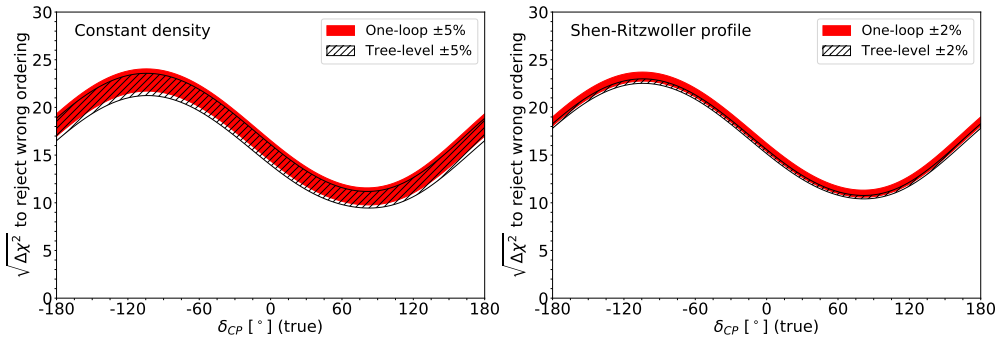
The discovery the paper pins down is quantitative: the one-loop corrected charged-current matter potential, when expressed via the Fermi constant $G_\mu$, exceeds the tree-level potential by about 2.0%, and this shift shows up in the $\nu_\mu\to\nu_e$ appearance channel. In the DUNE configuration, the correction raises the expected $\nu_e$ event count by 11 events (and lowers $\bar\nu_e$ events), which translates into a roughly $0.4\sigma$ better exclusion of the wrong mass ordering and an earlier crossing of $5\sigma$ by 4–9 days depending on the assumed true $\delta_{\rm CP}$. The result holds for both constant-density and more realistic mantle density profiles, and is more visible when the matter-density uncertainty is smaller. For CP-violation discovery and precision, the corrections make no significant difference.
Load-bearing premise
The load-bearing premise is that the one-loop corrected charged-current potential is correctly captured by a constant 2.0% rescaling of the tree-level $G_\mu$ matter potential; if the scheme conversion or the underlying reference calculation were off, the reported $0.4\sigma$ and 4–9 day numbers would shift in proportion.
Editorial extensions
If this is right
- In DUNE's planned 13-year run, including one-loop matter corrections yields a roughly $0.4\sigma$ higher significance for ruling out the wrong mass ordering than tree-level analyses, regardless of the true value of $\delta_{\rm CP}$.
- The $5\sigma$ discovery of the mass ordering arrives 4 to 9 days earlier with the correction, depending on the true CP phase considered ($180^\circ$, $212^\circ$, or $270^\circ$).
- The same one-loop effects leave DUNE's CP-violation discovery potential and $\delta_{\rm CP}$ precision essentially unchanged.
- The effect is more distinguishable from systematic uncertainties when the more precise Shen-Ritzwoller density profile (with 2% uncertainty) is used than with a constant density profile (with 5% uncertainty).
- Future long-baseline analyses should incorporate one-loop matter-potential corrections consistently, since the 2.0% correction is comparable in size to current matter-density profile uncertainties.
Reading between the lines
- If the $0.4\sigma$ gain is real, combined mass-ordering analyses involving DUNE, JUNO, and other experiments could see a similar fractional shift in global significance, potentially accelerating the overall resolution of the ordering beyond what the paper simulates for DUNE alone.
- The 4–9 day earlier discovery could be tested as a function of correction size: a two-loop correction of order 0.04% would be expected to shrink the time gain proportionally, which a reader could check by rescaling the matter potential in the same simulation setup.
- Because the paper implements the correction as a matter-density rescaling, an equivalent implementation as a direct shift in the vacuum-matter Hamiltonian should yield identical event spectra; verifying that equivalence in Monte Carlo would confirm that the reported sensitivities are not an artifact of the implementation choice.
- The predicted ~11 excess $\nu_e$ events and corresponding deficit in $\bar\nu_e$ events suggest that, with enough DUNE data, the size of the one-loop correction could in principle be measured rather than assumed, turning a theory input into an observable parameter.
Signed reviews
Editorial analysis
A structured set of objections, weighed in public.
Referee Report
Summary. This paper quantifies the impact of one-loop electroweak radiative corrections to the matter (MSW) potential on the physics reach of DUNE. Starting from the one-loop calculation in Ref. [10], the authors convert the 5.8% correction in the on-shell {alpha, m_W, m_Z} scheme into a 2.0% correction when the potential is expressed in terms of the Fermi constant G_mu, using the relation sqrt(2)G_mu = pi alpha m_Z^2/[m_W^2(m_Z^2-m_W^2)](1+Delta r) with Delta r ~ 3.8% (Eq. 2.5). They implement this 2.0% correction as a uniform rescaling of the matter density in GLoBES simulations of DUNE, using both a constant density profile and the Shen-Ritzwoller profile, and find that the sensitivity to the neutrino mass ordering improves by about 0.4 sigma and that 5 sigma resolution is reached 4-9 days earlier, while CP-violation sensitivities are essentially unchanged.
Significance. If established, this result would be a useful quantitative statement for the DUNE analysis community: standard electroweak radiative corrections to the matter potential are comparable to the 2% matter-density uncertainty and should be included in future analyses. The main strength of the paper is the clean scheme conversion in Eq. (2.5), which correctly reduces the 5.8% on-shell correction to a 2.0% correction relative to G_mu, and the fact that the input correction is a parameter-free Standard Model calculation from the authors' earlier work. However, the headline numerical claims are not yet established because the one-loop correction is implemented as a density rescaling and the paper's treatment of the matter-density uncertainty does not clearly profile the density as a nuisance parameter in the chi-square minimization. The paper also does not provide simulation code or parameter files, which makes the few-tenths-of-a-sigma claims difficult to verify independently.
major comments (3)
- [Section 3, Figs. 3 and 4] Because the 2.0% one-loop correction is implemented as a uniform rescaling of the matter density, a tree-level simulation with rho_true multiplied by 1.02 is exactly equivalent to the one-loop simulation at rho_true. The paper's Fig. 3 treatment of the density uncertainty is described as 'varying the true value of rho within its uncertainties,' and the improvement is said to be obtained 'by marginalizing the sensitivities for the true values of rho and delta_CP.' This is not the same as allowing rho to float as a nuisance parameter in the chi-square minimization. Since the 2% shift lies inside the quoted 2% uncertainty of the Shen-Ritzwoller profile, the tree-level and one-loop hypotheses become nearly degenerate when rho is profiled, and the residual difference is essentially the pull penalty for shifting rho. Please rerun the analysis with rho treated as a profiled nuisance parameter with a Gaussian prior, and report whether the ~0.4 sigma and 4-9 day differences survive. If they do not survive, the abstract and summary should be revised accordingly.
- [Section 3, Figs. 3 and 4] The statistical treatments in the two main figures appear to differ: the text states for Fig. 4 that 'the minimization of chi2_IO also includes rho,' whereas for Fig. 3 the density uncertainty is described only as a variation of the true value of rho. This makes the 0.4 sigma claim and the 4-9 day claim not directly comparable, and the reader cannot tell which statistical definition underlies the headline numbers. Please clarify exactly which parameters are profiled or marginalized in each figure, and give a precise definition of the reported '0.4 sigma CL improvement,' including whether it is an envelope, an average, or a minimum over the scanned true values of rho and delta_CP.
- [Section 3] The numerical results are not reproducible as presented: no GLoBES configuration files or parameter tables are supplied, and the exact chi-square construction, including systematic pulls and the treatment of the density uncertainty, is only cited to Ref. [14]. Given that the central claim is a difference of a few tenths of a sigma, the authors should provide the simulation setup as supplementary material, or at minimum specify the full likelihood function, the list of fitted parameters with their priors, and the exact matter-density implementation used for each figure.
minor comments (3)
- [Section 3, Fig. 3] The phrase 'marginalizing the sensitivities for the true values of rho and delta_CP' is statistically unclear, since true values of parameters are not nuisance parameters to be marginalized over. Please define the operation precisely, for example as a minimum, average, or envelope over the scanned grid of true values.
- [Section 2.1 and Table 1] The 2.0% correction is used as an exact input, but no uncertainty estimate is given for Delta r or for the one-loop coupling correction. Since the light-quark masses in Table 1 are treated as effective masses with hadronic uncertainties, a short propagation of these uncertainties into the 2.0% number would help the reader assess whether the claimed 0.4 sigma effect is stable at the required precision.
- [Section 2.1, Eq. (2.5)] The notation in Eq. (2.5) is potentially confusing: G_LO^mu = G_mu(1 - Delta r) and G_NLO^mu = G_mu are introduced in the same equation, and the hat notation on V_CC and on the couplings is not defined in the text. A brief sentence defining G_LO^mu, G_NLO^mu, and the hatted quantities would improve readability.
Circularity Check
No significant circularity: the 2.0% one-loop matter-potential correction is an externally fixed Standard Model input, and the DUNE sensitivity results are simulated rather than fitted.
full rationale
The paper's central derivation chain is self-contained in the sense required by the circularity test. The 2.0% correction to the charged-current matter potential is obtained in Section 2.1 by combining the one-loop correction from Ref. [10] (about 5.8% in the on-shell scheme) with the muon-decay correction Delta r approximately 3.8% via Eq. (2.4), yielding Eq. (2.5): V_CC-hat approximately sqrt(2) G_mu N_e c_e_V,CC (1 + Delta c_e_V,CC - Delta r). This is a fixed Standard Model input; it is not fitted to DUNE event rates, to the mass-ordering sensitivity, or to any other quantity that the paper then claims to predict. The subsequent simulation work in Section 3 translates this fixed 2.0% correction into a rescaling of the matter density profile and computes oscillation probabilities, event spectra, and sensitivity metrics. None of these outputs is used to define or fit the 2.0% input, so there is no self-definitional step and no fitted-input-called-prediction pattern. The self-citation to Ref. [10] is real and load-bearing numerically, but it is not circular under the stated rules: Ref. [10] is a parameter-free one-loop Standard Model calculation with stated input parameters (on-shell masses and alpha), its assumptions do not include the DUNE sensitivity result, and it is externally checkable rather than being an unverified assertion imported from the authors. The implementation of one-loop effects 'as corrections to the matter density profile' is a mathematical rescaling of the potential, but it does not create circularity because the correction magnitude is fixed by the electroweak calculation and is not inferred from the density uncertainty or from the experimental sensitivity being analyzed. The skeptic's concern that a 2% density nuisance parameter might absorb the 2% correction is a legitimate statistical-robustness question about whether the 0.4 sigma and 4-9 day claims survive a full profiling treatment; it is not a circularity in the derivation itself. Under the hard rule that only concrete reductions of outputs to inputs count as circularity, no such reduction is present here.
Assumptions & free parameters
assumptions (6)
- domain assumption Three-flavor neutrino oscillation framework with PMNS matrix (Eq. 2.1) and approximate appearance probability P_mu_e (Eq. 2.2) from Refs. [18-21].
- domain assumption Tree-level matter potential expressed with G_mu and the relation sqrt(2)G_mu = pi alpha m_Z^2/[m_W^2(m_Z^2 - m_W^2)](1 + Delta r) with Delta r about 3.8% (Eq. 2.4).
- domain assumption One-loop corrections to vector couplings, in particular Delta c_e_V,CC / c_e_V,CC about 5.8% and NC corrections about 8.2%, from Ref. [10].
- domain assumption The flavor-universal NC potential does not affect oscillation probabilities, and flavor-dependent NC corrections are three orders of magnitude smaller (footnote 1).
- domain assumption The DUNE TDR configuration from Ref. [14], implemented in GLoBES, faithfully represents the experiment's exposure, backgrounds, and systematic uncertainties.
- domain assumption True oscillation parameters are fixed to NuFIT 6.0 best-fit values, with true ordering taken as NO (and IO in the mirrored analysis), and selected true delta_CP values of 180, 212, and 270 degrees.
Cite this review
Pith. "Pith review of Effects of the Matter Potential at One-Loop Level on Neutrino Oscillations in Long-Baseline Experiments." pith.science (2026). https://pith.science/paper/23AFUW4Y
@misc{pith2026250415998,
  author       = {Pith},
  title        = {Pith review of: Effects of the Matter Potential at One-Loop Level on Neutrino Oscillations in Long-Baseline Experiments},
  year         = {2026},
  howpublished = {\url{https://pith.science/paper/23AFUW4Y}},
  note         = {Machine review of arXiv:2504.15998}
}
abstract
In this work, we investigate in a quantitative way how much radiative corrections to the matter potential for neutrino oscillations can impact the sensitivity to neutrino mass ordering in long-baseline accelerator experiments. Using numerical simulations for the future experiment DUNE, we find that the statistical significance for excluding the incorrect mass ordering can be enhanced by about $0.4\sigma$ if a one-loop correction of $2.0\%$ -- based on the Fermi coupling constant $G^{}_\mu$ derived from measurements of muon lifetime -- is included. The radiative corrections at one-loop level lead to resolving the neutrino mass ordering at $5\sigma$ confidence level 4-9 days earlier than at tree level. In contrast, the sensitivity to leptonic CP violation in DUNE is essentially unchanged. Finally, we emphasize that one-loop corrections should be incorporated into analyses of future neutrino oscillation data in a consistent and systematic manner.
Figures


Figures from the paper (1 more)

Reference graph
Works this paper leans on
-
[14]
Abi, et al., Experiment Simulation Configurations Approximating DUNE TDR (3 2021)
B. Abi, et al., Experiment Simulation Configurations Approximating DUNE TDR (3 2021). arXiv:2103.04797
arXiv 2021
- [10]
-
[1]
Navas, et al., Review of Particle Physics, Phys
S. Navas, et al., Review of Particle Physics, Phys. Rev. D 110 (2024) 030001
work page 2024
-
[2]
Xing, Flavor structures of charged fermions and massive neutrinos, Phys
Z.-z. Xing, Flavor structures of charged fermions and massive neutrinos, Phys. Rept. 854 (2020) 1–147. arXiv:1909.09610
arXiv 2020
-
[3]
An, et al., Neutrino physics with JUNO, J
F. An, et al., Neutrino physics with JUNO, J. Phys. G 43 (2016) 030401. arXiv:1507.05613. 11
arXiv 2016
-
[4]
B. Abi, et al., Deep Underground Neutrino Experiment (DUNE), Far Detector Technical Design Report, Volume II: DUNE Physics (2 2020). arXiv:2002.03005
arXiv 2020
-
[5]
P. F. De Salas, S. Gariazzo, O. Mena, C. A. Ternes, M. T´ ortola, Neutrino Mass Ordering from Oscillations and Beyond: 2018 Status and Future Prospects, Front. Astron. Space Sci. 5 (2018) 36. arXiv:1806.11051
arXiv 2018
-
[6]
Wolfenstein, Neutrino oscillations in matter, Phys
L. Wolfenstein, Neutrino oscillations in matter, Phys. Rev. D 17 (1978) 2369–2374
work page 1978
Show all 49 references
-
[7]
Wolfenstein, Neutrino oscillations and stellar collapse, Phys
L. Wolfenstein, Neutrino oscillations and stellar collapse, Phys. Rev. D 20 (1979) 2634–2635
1979
-
[8]
S. P. Mikheyev, A. Y. Smirnov, Resonance enhancement of oscillations in matter and solar neutrino spectroscopy, Sov. J. Nucl. Phys. 42 (1985) 913–917
1985
-
[9]
S. P. Mikheyev, A. Y. Smirnov, Resonant Amplification of ν Oscillations in Matter and Solar-Neutrino Spectroscopy, Nuovo Cim. C 9 (1986) 17–26
1986
-
[11]
Abusleme, et al., Sub-percent precision measurement of neutrino oscillation parameters with JUNO, Chin
A. Abusleme, et al., Sub-percent precision measurement of neutrino oscillation parameters with JUNO, Chin. Phys. C 46 (2022) 123001. arXiv:2204.13249
2022
-
[12]
Capozzi, W
F. Capozzi, W. Giar` e, E. Lisi, A. Marrone, A. Melchiorri, A. Palazzo, Neutrino masses and mixing: Entering the era of subpercent precision (3 2025). arXiv:2503.07752
2025 arXiv
-
[13]
J. N. Bahcall, M. Kamionkowski, A. Sirlin, Solar neutrinos: Radiative corrections in neutrino- electron scattering experiments, Phys. Rev. D 51 (1995) 6146–6158. arXiv:astro-ph/ 9502003
1995
-
[15]
W. Shen, M. H. Ritzwoller, Crustal and uppermost mantle structure beneath the United States, J. Geophys. Res. Solid Earth 121 (2016) 4306–4342
2016
-
[16]
Pontecorvo, Mesonium and Antimesonium, Sov
B. Pontecorvo, Mesonium and Antimesonium, Sov. Phys. JETP 6 (1958) 429–431
1958
-
[17]
Z. Maki, M. Nakagawa, S. Sakata, Remarks on the Unified Model of Elementary Particles, Prog. Theor. Phys. 28 (1962) 870–880
1962
-
[18]
Cervera, A
A. Cervera, A. Donini, M. B. Gavela, J. J. Gomez C´ adenas, P. Hern´ andez, O. Mena, S. Rigolin, Golden measurements at a neutrino factory, Nucl. Phys. B 579 (2000) 17–55, [Erratum: Nucl. Phys. B 593 (2001) 731–732]. arXiv:hep-ph/0002108
2000 arXiv
-
[19]
Freund, Analytic approximations for three neutrino oscillation parameters and probabili- ties in matter, Phys
M. Freund, Analytic approximations for three neutrino oscillation parameters and probabili- ties in matter, Phys. Rev. D 64 (2001) 053003. arXiv:hep-ph/0103300. 12
2001 arXiv
-
[20]
E. K. Akhmedov, R. Johansson, M. Lindner, T. Ohlsson, T. Schwetz, Series expansions for three-flavor neutrino oscillation probabilities in matter, JHEP 04 (2004) 078. arXiv: hep-ph/0402175
2004 arXiv
-
[21]
Nunokawa, S
H. Nunokawa, S. J. Parke, J. W. F. Valle, CP violation and neutrino oscillations, Prog. Part. Nucl. Phys. 60 (2008) 338–402. arXiv:0710.0554
2008 arXiv
-
[22]
Giunti, C
C. Giunti, C. W. Kim, Fundamentals of Neutrino Physics and Astrophysics, Oxford University Press, 2007
2007
-
[23]
Z.-z. Xing, S. Zhou, Neutrinos in Particle Physics, Astronomy and Cosmology, Springer Berlin, Heidelberg, 2011
2011
-
[24]
Sirlin, Theoretical Considerations Concerning the Z 0 Mass, Phys
A. Sirlin, Theoretical Considerations Concerning the Z 0 Mass, Phys. Rev. Lett. 67 (1991) 2127–2130
1991
-
[25]
Sirlin, Observations concerning mass renormalization in the electroweak theory, Phys
A. Sirlin, Observations concerning mass renormalization in the electroweak theory, Phys. Lett. B 267 (1991) 240–242
1991
-
[26]
Pilaftsis, Resonant CP violation induced by particle mixing in transition amplitudes, Nucl
A. Pilaftsis, Resonant CP violation induced by particle mixing in transition amplitudes, Nucl. Phys. B 504 (1997) 61–107. arXiv:hep-ph/9702393
1997 arXiv
-
[27]
Jegerlehner, Renormalizing the standard model, Conf
F. Jegerlehner, Renormalizing the standard model, Conf. Proc. C 900603 (1990) 476–590
1990
-
[28]
W. J. Marciano, Spin and precision electroweak physics, in: 21st Annual SLAC Summer Institute on Particle Physics: Spin Structure in High-energy Processes (School: 26 Jul–3 Aug 1993, Topical Conference: 4–6 Aug 1993) (SSI 93), 1993, pp. 35–56
1993
-
[29]
W. J. Marciano, A. Sirlin, Some general properties of the O(α) corrections to parity violation in atoms, Phys. Rev. D 29 (1984) 75–88, [Erratum: Phys. Rev. D 31 (1985) 213]
1984
-
[30]
W. F. L. Hollik, Radiative Corrections in the Standard Model and Their Role for Precision Tests of the Electroweak Theory, Fortsch. Phys. 38 (1990) 165–260
1990
-
[31]
Denner, Techniques for the Calculation of Electroweak Radiative Corrections at the One- Loop Level and Results for W-physics at LEP 200, Fortsch
A. Denner, Techniques for the Calculation of Electroweak Radiative Corrections at the One- Loop Level and Results for W-physics at LEP 200, Fortsch. Phys. 41 (1993) 307–420. arXiv: 0709.1075
1993 arXiv
-
[32]
F. J. Botella, C. S. Lim, W. J. Marciano, Radiative corrections to neutrino indices of refrac- tion, Phys. Rev. D 35 (1987) 896–901
1987
-
[33]
Sirlin, Radiative corrections in the SU(2)L×U(1) theory: A simple renormalization frame- work, Phys
A. Sirlin, Radiative corrections in the SU(2)L×U(1) theory: A simple renormalization frame- work, Phys. Rev. D 22 (1980) 971–981
1980
-
[34]
Denner, S
A. Denner, S. Dittmaier, Electroweak radiative corrections for collider physics, Phys. Rept. 864 (2020) 1–163. arXiv:1912.06823. 13
2020 arXiv
-
[35]
Ohlsson, H
T. Ohlsson, H. Snellman, Neutrino oscillations with three flavors in matter: Applications to neutrinos traversing the Earth, Phys. Lett. B 474 (2000) 153–162, [Erratum: Phys. Lett. B 480 (2000) 419]. arXiv:hep-ph/9912295
2000 arXiv
-
[36]
Jacobsson, T
B. Jacobsson, T. Ohlsson, H. Snellman, W. Winter, Effects of random matter density fluc- tuations on the neutrino oscillation transition probabilities in the Earth, Phys. Lett. B 532 (2002) 259–266. arXiv:hep-ph/0112138
2002 arXiv
-
[37]
Jacobsson, T
B. Jacobsson, T. Ohlsson, H. Snellman, W. Winter, The effects of matter density uncertainties on neutrino oscillations in the Earth, J. Phys. G 29 (2003) 1873–1876. arXiv:hep-ph/ 0209147
2003
-
[38]
Ohlsson, W
T. Ohlsson, W. Winter, Role of matter density uncertainties in the analysis of future neutrino factory experiments, Phys. Rev. D 68 (2003) 073007. arXiv:hep-ph/0307178
2003 arXiv
-
[39]
Shan, B.-L
L.-Y. Shan, B.-L. Young, X.-m. Zhang, CP violating neutrino oscillation and uncertainties in Earth matter density, Phys. Rev. D 66 (2002) 053012. arXiv:hep-ph/0110414
2002 arXiv
-
[40]
R. J. Geller, T. Hara, Geophysical aspects of very long baseline neutrino experiments, Nucl. Instrum. Meth. A 503 (2003) 187–191. arXiv:hep-ph/0111342
2003 arXiv
-
[41]
Huber, M
P. Huber, M. Lindner, W. Winter, Superbeams vs. neutrino factories, Nucl. Phys. B 645 (2002) 3–48. arXiv:hep-ph/0204352
2002 arXiv
-
[42]
Shan, X.-M
L.-Y. Shan, X.-M. Zhang, Solar neutrino zenith angle distribution and uncertainty in Earth’s matter density, Phys. Rev. D 65 (2002) 113011
2002
-
[43]
K. J. Kelly, S. J. Parke, Matter density profile shape effects at DUNE, Phys. Rev. D 98 (2018) 015025. arXiv:1802.06784
2018 arXiv
-
[44]
Ghosh, O
M. Ghosh, O. Yasuda, Effect of matter density in T2HK and DUNE, Nucl. Phys. B 989 (2023) 116142. arXiv:2210.09103
2023 arXiv
-
[45]
Roe, Matter density versus distance for the neutrino beam from Fermilab to Lead, South Dakota, and comparison of oscillations with variable and constant density, Phys
B. Roe, Matter density versus distance for the neutrino beam from Fermilab to Lead, South Dakota, and comparison of oscillations with variable and constant density, Phys. Rev. D 95 (2017) 113004. arXiv:1707.02322
2017 arXiv
-
[46]
Huber, M
P. Huber, M. Lindner, W. Winter, Simulation of long-baseline neutrino oscillation experi- ments with GLoBES (General Long Baseline Experiment Simulator), Comput. Phys. Com- mun. 167 (2005) 195–202. arXiv:hep-ph/0407333
2005 arXiv
-
[47]
Huber, J
P. Huber, J. Kopp, M. Lindner, M. Rolinec, W. Winter, New features in the simulation of neutrino oscillation experiments with GLoBES 3.0 (General Long Baseline Experiment Simulator), Comput. Phys. Commun. 177 (2007) 432–438. arXiv:hep-ph/0701187
2007 arXiv
-
[48]
Esteban, M
I. Esteban, M. C. Gonzalez-Garcia, M. Maltoni, I. Martinez-Soler, J. P. Pinheiro, T. Schwetz, NuFit-6.0: updated global analysis of three-flavor neutrino oscillations, JHEP 12 (2024) 216. arXiv:2410.05380. 14
2024 arXiv
-
[49]
Esteban, et al., NuFIT 6.0, http://www.nu-fit.org/ (2024)
I. Esteban, et al., NuFIT 6.0, http://www.nu-fit.org/ (2024). 15
2024
Reviewed August 16, 2026 · model on record in the stance chip above.
Discussion (0). Continue with ORCID to comment.