REVIEW 2 major objections 5 minor 1 cited by
Lattice QCD determination of the radiative decay rates $h_{c}\to \eta_{c}\, \gamma$ and $h_{b}\to \eta_{b}\, \gamma$
T0 review · 2 major / 5 minor · reviewed 2026-08-16 · deepseek-v4-flash
Pith's one-line read Lattice QCD gives Γ(h_c→η_c γ)=0.604(24) MeV and the first prediction Γ(h_b→η_b γ)=46.0(4.8) keV.
desk verdict First lattice QCD result for h_b -> eta_b gamma plus a sharpened h_c width; solid charm part, bottom part rests on unquantified disconnected diagrams and a phenomenological heavy-mass extrapolation. read the letter →
The pith
A machine-rendered reading of the paper's core claim, the machinery that carries it, and where it could break.
The reading
What carries the argument
The load-bearing object is the single on-shell transition form factor F_1 ≡ F_1(0) that encodes all nonperturbative QCD in the decay rate, extracted from a three-point correlation function of η_c and h_c interpolating operators with the electromagnetic current, and placed at q²=0 with twisted boundary conditions. For the b case, the paper computes ratios r_λ(m_H)=F_1(m_H)/F_1(m_H/λ) at consecutive heavy-quark masses (the ratio method, introduced in Ref. [33]) to suppress statistical errors and cutoff effects, reconstructs F_1(m_H) from F_1(m_c), and extrapolates to m_b with several NRQCD-motivated scaling ansätze, including F_1√m_{η_H}=const and variants with Coulombic or string-potential velocity scaling, combined through a Bayesian information criterion.
What would settle it
Perform the same computation with a lattice spacing fine enough to set a bottom quark directly (or with a relativistic bottom action) and compare the resulting $F_b^{1}$ with −0.290(15); alternatively, measure Γ(h_b→η_b γ) experimentally, since the paper's value implies Γ(h_b)=88(13) keV through the measured branching fraction, and a future direct measurement outside that window would rule out the extrapolation.
Extended reading notes
Core claim
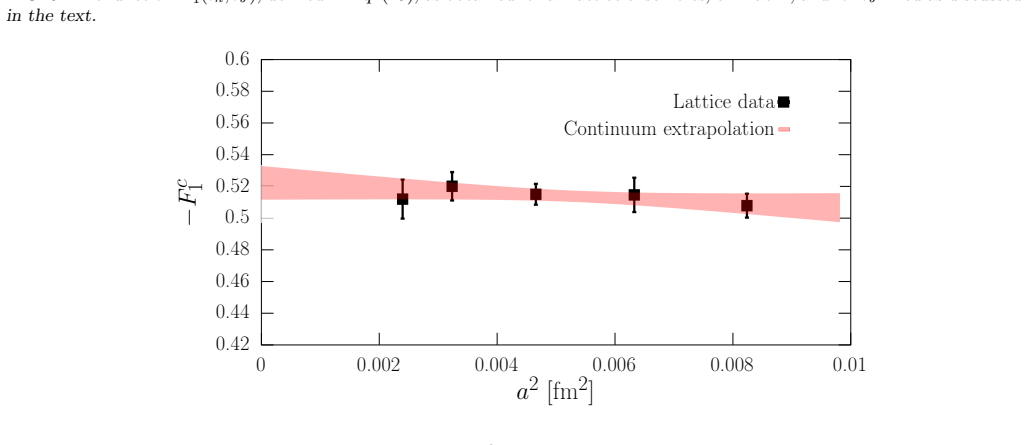
The central discovery is that the transition matrix elements for h_c→η_c γ at q²=0 can be computed with sub-2% precision, and that the same connected-diagram computation extended to fictitious heavy-quark mesons follows a clean scaling law F_1(m_H)√m_{η_H} ≈ const that permits a controlled extrapolation to the physical b quark. In the continuum limit the authors report Γ(h_c→η_c γ)=0.604(24) MeV from $F_c^{1}$=-0.522(10) and, for the first time in lattice QCD, Γ(h_b→η_b γ)=46.0(4.8) keV from $F_b^{1}$=-0.290(15). The h_c result agrees with the experimental measurement, and it improves on previous lattice determinations by using physical sea quark masses and five lattice spacings. The paper also notes that combining its widths with measured branching fractions yields total widths of Γ(h_c)=1.007(78) MeV and Γ(h_b)=88(13) keV, more precise than direct measurements.
Load-bearing premise
The extrapolation from the simulated heavy quark masses (up to about three times the charm mass) to the physical b quark assumes that the scaling laws fitted to those masses keep working all the way to the b quark.
Editorial extensions
If this is right
- The h_c→η_c γ rate becomes the most precise lattice determination to date, sharpening the comparison with experiment and making the combined lattice-plus-experiment total width Γ(h_c)=1.007(78) MeV the best available constraint on that state.
- Combining Γ(h_b→η_b γ)=46.0(4.8) keV with the measured branching fraction yields Γ(h_b)=88(13) keV, a prediction of a total width that has not been directly measured.
- The clean observation F_1√m_{η_H}≈const over the simulated mass range provides a benchmark that potential-NRQCD descriptions of E1 quarkonium transitions should reproduce.
- The b-quark form factor, being the first lattice value, gives a first-principles point of comparison for quark-model and pNRQCD predictions, two of which currently sit about 2σ from the lattice width.
Reading between the lines
- If the dropped quark-disconnected diagrams shift these electric-dipole form factors no more than they shift charmonium masses (a few MeV out of ~3 GeV), the central values stand; the paper leaves that magnitude unquantified, so the natural next check is to compute them with the method cited for future work.
- The same ratio-method ladder could be extended to a direct bottom-quark simulation on finer or anisotropic lattices, turning the m_H→m_b extrapolation into an interpolation and testing the stability of F_b^1.
- A precise future measurement of Γ(h_b→η_b γ) would not only test QCD but also sharpen the inferred total width of h_b, which is the quantity that searches for pseudoscalar admixtures, such as axion-like particles or extra Higgs states, would use.
Signed reviews
Editorial analysis
A structured set of objections, weighed in public.
Referee Report
Summary. The paper presents lattice QCD computations of the hadronic matrix elements for the electric-dipole radiative decays h_c -> eta_c gamma and h_b -> eta_b gamma. The charmonium calculation is performed directly at the physical charm quark mass using N_f=2+1+1 ETMC ensembles at five lattice spacings, yielding F_c^1 = -0.522(10) and Gamma(h_c -> eta_c gamma) = 0.604(24) MeV. The bottomonium calculation uses the ratio method with heavy quark masses m_H = lambda^{n-1} m_c up to roughly 3 m_c, followed by a continuum extrapolation and then a heavy-quark extrapolation to m_b using three NRQCD-inspired functional forms. The authors obtain F_b^1 = -0.290(15) and Gamma(h_b -> eta_b gamma) = 46.0(4.8) keV, which they identify as the first lattice QCD estimate of this quantity.
Significance. If the quoted uncertainties are reliable, the charmonium result is a clear improvement over previous lattice determinations, and the bottomonium result would be a valuable first lattice-QCD-based prediction for a quantity currently known only from quark models and pNRQCD. The calculation benefits from physical sea quark masses, five lattice spacings, small cutoff effects, and a transparent continuum-limit analysis using the BAIC. The ratio method is used thoughtfully to reduce statistical and discretization errors. However, two load-bearing systematic issues remain: the quark-disconnected contributions are dropped without a numerical estimate, and the h_b result rests on an extrapolation in the heavy-quark mass across a region with no lattice data. These issues do not invalidate the central claims, but they need to be addressed before the quoted error bars can be taken at face value.
major comments (2)
- [Section II, Fig. 1; Section V] The neglect of quark-disconnected diagrams is an unquantified systematic that affects both central results. The quoted uncertainty on F_c^1 is about 1.9% (Table II and Eq. (24)), while the h_c width error is 4%; the h_b result inherits the same approximation both through F1(m_c) in Eq. (42) and through each ratio r_lambda in Eq. (39). The Zweig/SU(3) suppression arguments given in Section II (footnote to Fig. 1) indicate that the disconnected contribution should be small, but they do not provide a numerical bound. The reference cited there, Ref. [39], constrains charmonium masses, not the transition matrix element. Since Section V states that the impact 'can and should be studied separately,' the error budget is incomplete as it stands. Please provide a numerical estimate of the disconnected contribution, or add a conservative systematic uncertainty to both Gamma(h_c -> eta_c gamma) and Gamma(h_b -> eta_b gamma).
- [Section III.C, Eqs. (51), (53), (55)] The heavy-quark extrapolation is the load-bearing step for the first h_b result. The lattice data extend only to m_H around 3 m_c (Table IV), while the physical point is at m_b/m_c about 4.58, so the fit is extrapolated across an additional factor of roughly 1.5 in m_H with no data in that window. The three ansaetze give F_b^1 = -0.285(10), -0.298(20), and -0.293(15), and the BAIC combination gives -0.290(15); this spread is an estimate of model variation only among fits that share the same NRQCD-motivated scaling assumption. If the effective heavy-quark velocity scaling changes outside the fitted window, all three forms could be biased in the same direction, and the quoted 5% error would be an underestimate. Please quantify the extrapolation uncertainty in a way that does not rely entirely on the BAIC weight, for example by showing the sensitivity to the fit range or by assigning an additional model-selection uncertainty based on the envelope of the ansaetze.
minor comments (5)
- [Fig. 3 caption] The caption says 'all four gauge ensembles' but Table I and the text describe five ensembles; this should be corrected.
- [Abstract] There is a duplicated definite article in 'except for the the coarsest lattice'; please fix this typo.
- [Fig. 16] The label 'BES-IIII' in the left panel should read 'BESIII'.
- [Eq. (30)] The expression for the smearing radius r_0(m_H) should match the definition given in Section II for r_0; please check whether the square root over n(m_H) has been omitted in the displayed formula.
- [Section II.B] It would be helpful to state explicitly whether the A48 ensemble, with m_pi about 175 MeV, is treated as a physical-mass ensemble in the continuum extrapolation or whether a separate light-quark-mass systematic is assigned.
Circularity Check
No circularity: the lattice form factors are computed from independent correlator data, and the heavy-quark extrapolation is a fit over a range that does not include the target b-quark point.
full rationale
The derivation chain is self-contained. The h_c form factor F_c^1 is extracted directly from three-point correlation functions via Eq. (19) and the large-time limit (20), then continuum-extrapolated from the values in Table II; there is no fitted parameter that is later renamed as the prediction. The h_b result uses the ratio method of Ref. [33]: the ratios r_lambda(m_H) in Eqs. (38)-(40) are independent lattice determinations, and F_1(m_H) is reconstructed in Eq. (42) as a product of measured ratios times F_1(m_c). The final m_H -> m_b step fits the independent F_1(m_H) values (Table V) to the NRQCD-inspired forms (51), (53) and (55), with the physical b-quark point lying outside the simulated range (m_etaH up to about 6.6 GeV versus m_eta_b ~ 9.4 GeV). The quoted result F_b^1 = -0.290(15) is therefore an extrapolation, not a re-expression of the fit parameters. Self-citations such as Refs. [30] and [33] supply methodology and are not used as evidence that the numerical result is correct; no uniqueness theorem or prior claim by the same authors is invoked to forbid alternative fits. The unquantified quark-disconnected contributions, acknowledged in Section V ('Their impact can and should be studied separately'), are a genuine systematic limitation and a correctness risk, but they do not make any derived quantity equal to its input by construction. Consequently, no circular step can be exhibited from the paper's equations.
Assumptions & free parameters
free parameters (3)
- Type-A extrapolation coefficients alpha, beta, gamma =
Not tabulated; the fitted form Eq. (51) yields F_b^1 = -0.285(10)
- Type-B extrapolation coefficients alpha', beta', gamma' =
Not tabulated; the fitted form Eq. (53) yields F_b^1 = -0.298(20)
- Type-C extrapolation coefficients alpha, beta, gamma =
Not tabulated; the fitted form Eq. (55) yields F_b^1 = -0.293(15)
assumptions (5)
- domain assumption Wilson-Clover twisted mass fermions provide a valid lattice discretization of QCD with automatic O(a) improvement for parity-even observables.
- domain assumption The ratio method and BAIC weighting provide unbiased estimates of continuum quantities.
- domain assumption NRQCD velocity scaling relations, Eqs. (47)-(50), motivate the heavy-quark mass dependence of the form factor.
- domain assumption Quark-disconnected diagrams contribute negligibly to the h_c/h_b to eta_c/eta_b gamma transition form factors.
- domain assumption The momentum k can be tuned using experimental masses without introducing O(a) errors beyond the stated O(a^2) cutoff effects.
Cite this review
Pith. "Pith review of Lattice QCD determination of the radiative decay rates $h_{c}\to \eta_{c}\, \gamma$ and $h_{b}\to \eta_{b}\, \gamma$." pith.science (2026). https://pith.science/paper/EYCW7KOC
@misc{pith2026250416807,
  author       = {Pith},
  title        = {Pith review of: Lattice QCD determination of the radiative decay rates $h_c\to \eta_c\, \gamma$ and $h_b\to \eta_b\, \gamma$},
  year         = {2026},
  howpublished = {\url{https://pith.science/paper/EYCW7KOC}},
  note         = {Machine review of arXiv:2504.16807}
}
abstract
We present the results of our lattice QCD computation of the hadronic matrix elements relevant to the $h_{c}\to \eta_{c}\gamma$ and $h_{b}\to \eta_{b}\gamma$ decays by using the gauge configurations produced by the Extended Twisted Mass Collaboration with $N_{f}=2+1+1$ dynamical Wilson-Clover twisted mass fermions at five different lattice spacings with physical dynamical $u$ , $d$, $s$ and $c$ quark masses (except for the the coarsest lattice for which the lightest sea quark corresponds to a pion with $m_{\pi}\simeq 175~\mathrm{MeV}$). While the hadronic matrix element for $h_{c}\to \eta_{c}\gamma$ is obtained directly, the one relevant to $h_{b}\to\eta_{b}\gamma$ is reached by working with heavy quark masses $m^{(n)}_{H} = \lambda^{n-1} m_{c}$, with $\lambda \sim 1.24$ and $n=1,2, \ldots ,6$, and then extrapolated to $m_{b}$ by several judicious ans\"atze. In the continuum limit we obtain $\Gamma( h_{c}\to \eta_{c} \gamma ) = 0.604(24)~\mathrm{MeV}$, which is by a factor of $2.3$ more accurate than the previous lattice estimates, and in good agreement with the experimental measurement. In the $b$-quark case we obtain $\Gamma( h_{b}\to \eta_{b} \gamma) =46.0(4.8)~\mathrm{keV}$.
Figures


Figures from the paper (13 more)




Forward citations
Cited by 1 Pith paper
-
Lattice QCD study of the $\chi_{c1}\to J/\psi \, \gamma$ decay
A first-principles lattice QCD calculation gives Gamma(chi_c1 to J/psi gamma) = 0.3265(79) MeV and a2 = -0.0666(22), consistent with experiment and far more precise than prior lattice results.
Reference graph
Works this paper leans on
-
[39]
Sheikholeslami and R
B. Sheikholeslami and R. Wohlert, Nucl. Phys. B 259, 572 (1985)
1985
-
[1]
(20) Note again that we included ZV (g2
-
[2]
(19), the values of which are listed in Table I
in Eq. (19), the values of which are listed in Table I. As already discussed in the previous Section, and illustrated in Fig. 2, we compute Cµ 3pt(th;tJ) by placing the interpolating field of the ηc meson at a fixed time t = 0, the charm quark component of the electromagnetic current is then inserted in a charm quark line at a fixed −tJ < 0, while the tim...
work page 1967
-
[3]
B. Aubert et al. (BaBar), Phys. Rev. Lett. 101, 071801 (2008), [Erratum: Phys.Rev.Lett. 102, 029901 (2009)], 0807.1086
arXiv 2008
-
[4]
G. T. Bodwin, E. Braaten, and G. P. Lepage, Phys. Rev. D 51, 1125 (1995), [Erratum: Phys.Rev.D 55, 5853 (1997)], hep-ph/9407339
arXiv 1995
-
[5]
N. Brambilla, A. Pineda, J. Soto, and A. Vairo, Nucl. Phys. B 566, 275 (2000), hep-ph/9907240
arXiv 2000
-
[6]
S. Fleming, I. Z. Rothstein, and A. K. Leibovich, Phys. Rev. D 64, 036002 (2001), hep-ph/0012062
arXiv 2001
-
[7]
N. Brambilla, A. Pineda, J. Soto, and A. Vairo, Rev. Mod. Phys. 77, 1423 (2005), hep-ph/0410047
arXiv 2005
Show all 77 references
-
[8]
B. G. Fulsom et al. (Belle), Phys. Rev. Lett. 121, 232001 (2018), 1807.01201
2018 arXiv
- [9]
- [10]
-
[11]
Navas et al
S. Navas et al. (Particle Data Group), Phys. Rev. D 110, 030001 (2024)
2024
-
[12]
A. G. Shamov and O. L. Rezanova, Phys. Lett. B 839, 137766 (2023), 2210.13930
2023 arXiv
-
[13]
B. A. Kniehl, A. A. Penin, A. Pineda, V. A. Smirnov, and M. Steinhauser, Phys. Rev. Lett. 92, 242001 (2004), [Erratum: Phys.Rev.Lett. 104, 199901 (2010)], hep-ph/0312086
2004 arXiv
-
[14]
Recksiegel and Y
S. Recksiegel and Y. Sumino, Phys. Lett. B 578, 369 (2004), hep-ph/0305178
2004 arXiv
-
[15]
Manke et al
T. Manke et al. (CP-PACS), Phys. Rev. D 62, 114508 (2000), hep-lat/0005022. 24
2000 arXiv
- [16]
-
[17]
A. X. El-Khadra, A. S. Kronfeld, and P. B. Mackenzie, Phys. Rev. D 55, 3933 (1997), hep-lat/9604004
1997 arXiv
-
[18]
Burch, C
T. Burch, C. DeTar, M. Di Pierro, A. X. El-Khadra, E. D. Freeland, S. Gottlieb, A. S. Kronfeld, L. Levkova, P. B. Mackenzie, and J. N. Simone, Phys. Rev. D 81, 034508 (2010), 0912.2701
2010 arXiv
- [19]
-
[20]
R. J. Dowdall et al. (HPQCD), Phys. Rev. D 85, 054509 (2012), 1110.6887
2012 arXiv
- [21]
- [22]
-
[23]
Andreas, O
S. Andreas, O. Lebedev, S. Ramos-Sanchez, and A. Ringwald, JHEP 08, 003 (2010), 1005.3978
2010 arXiv
- [24]
-
[25]
Domingo, U
F. Domingo, U. Ellwanger, and M.-A. Sanchis-Lozano, Phys. Rev. Lett. 103, 111802 (2009), 0907.0348
2009 arXiv
-
[26]
Dermisek, J
R. Dermisek, J. F. Gunion, and B. McElrath, Phys. Rev. D 76, 051105 (2007), hep-ph/0612031
2007 arXiv
-
[27]
J. E. Kim, Phys. Rept. 150, 1 (1987)
1987
-
[28]
Merlo, F
L. Merlo, F. Pobbe, S. Rigolin, and O. Sumensari, JHEP 06, 091 (2019), 1905.03259
2019 arXiv
-
[29]
Bauer, M
M. Bauer, M. Neubert, S. Renner, M. Schnubel, and A. Thamm, JHEP 09, 056 (2022), 2110.10698
2022 arXiv
-
[30]
Di Luzio, A
L. Di Luzio, A. W. M. Guerrera, X. Ponce D´ ıaz, and S. Rigolin, JHEP 06, 217 (2024), 2402.12454
2024 arXiv
-
[31]
J. J. Dudek, R. G. Edwards, and D. G. Richards, Phys. Rev. D 73, 074507 (2006), hep-ph/0601137
2006 arXiv
- [32]
-
[33]
G. C. Donald, C. T. H. Davies, E. Follana, K. Hornbostel, J. Komijani, J. Koponen, G. P. Lepage, C. McNeile, and J. Shigemitsu, Phys. Rev. D 86, 094501 (2012), 1208.2855
2012 arXiv
-
[34]
Colquhoun, L
B. Colquhoun, L. J. Cooper, C. T. H. Davies, and G. P. Lepage (Particle Data Group, HPQCD, (HPQCD Collaboration)‡), Phys. Rev. D 108, 014513 (2023), 2305.06231
2023 arXiv
- [35]
- [36]
- [37]
-
[38]
Alexandrou et al
C. Alexandrou et al. (Extended Twisted Mass Collaboration (ETMC)) (2024), 2411.08852
2024 arXiv
-
[40]
Di Palma, G
R. Di Palma, G. Gagliardi, and F. Sanfilippo, PoS LA TTICE2023, 152 (2024)
2024
-
[41]
Hatton, C
D. Hatton, C. T. H. Davies, B. Galloway, J. Koponen, G. P. Lepage, and A. T. Lytle (HPQCD), Phys. Rev. D 102, 054511 (2020), 2005.01845
2020 arXiv
-
[42]
R. G. Petry, D. Harnett, R. Lewis, and R. M. Woloshyn, Phys. Rev. D 78, 074502 (2008), 0803.4141
2008 arXiv
-
[43]
E. T. Neil and J. W. Sitison, Phys. Rev. D 109, 014510 (2024), 2208.14983
2024 arXiv
- [44]
- [45]
- [46]
- [47]
-
[48]
Balasubramamian and B
R. Balasubramamian and B. Blossier, Eur. Phys. J. C 80, 412 (2020), 1912.09937
2020 arXiv
-
[49]
Atoui, V
M. Atoui, V. Mor´ enas, D. Beˇ cirevic, and F. Sanfilippo, Eur. Phys. J. C74, 2861 (2014), 1310.5238
2014 arXiv
-
[50]
Blossier, P.-H
B. Blossier, P.-H. Cahue, J. Heitger, S. La Cesa, J. Neuendorf, and S. Zafeiropoulos, Phys. Rev. D 105, 054515 (2022), 2110.10061
2022 arXiv
-
[51]
Brambilla, P
N. Brambilla, P. Pietrulewicz, and A. Vairo, Phys. Rev. D 85, 094005 (2012), 1203.3020
2012 arXiv
-
[52]
W. E. Caswell and G. P. Lepage, Phys. Lett. B 167, 437 (1986)
1986
-
[53]
Pineda and J
A. Pineda and J. Soto, Nucl. Phys. B Proc. Suppl. 64, 428 (1998), hep-ph/9707481
1998 arXiv
-
[54]
Segovia, S
J. Segovia, S. Steinbeißer, and A. Vairo, Phys. Rev. D 99, 074011 (2019), 1811.07590
2019 arXiv
-
[55]
Ablikim et al
M. Ablikim et al. (BESIII), Phys. Rev. Lett. 116, 251802 (2016), 1603.04936
2016 arXiv
-
[56]
Ablikim et al
M. Ablikim et al. (BESIII), Phys. Rev. D 106, 072007 (2022), 2204.09413
2022
- [57]
-
[58]
Segovia, P
J. Segovia, P. G. Ortega, D. R. Entem, and F. Fern´ andez, Phys. Rev. D 93, 074027 (2016), 1601.05093
2016 arXiv
-
[59]
Ebert, R
D. Ebert, R. N. Faustov, and V. O. Galkin, Phys. Rev. D 67, 014027 (2003), hep-ph/0210381
2003 arXiv
- [60]
- [61]
- [62]
- [63]
- [64]
-
[65]
Abdel-Rehim, F
A. Abdel-Rehim, F. Burger, A. Deuzeman, K. Jansen, B. Kostrzewa, L. Scorzato, and C. Urbach, PoS LA TTICE2013, 414 (2014), 1311.5495
2014 arXiv
-
[66]
Deuzeman, K
A. Deuzeman, K. Jansen, B. Kostrzewa, and C. Urbach, PoS LA TTICE2013, 416 (2014), 1311.4521
2014 arXiv
-
[67]
Kostrzewa, S
B. Kostrzewa, S. Bacchio, J. Finkenrath, M. Garofalo, F. Pittler, S. Romiti, and C. Urbach (ETM), PoS LA TTICE2022, 340 (2023), 2212.06635
2023 arXiv
-
[68]
Deuzeman, S
A. Deuzeman, S. Reker, and C. Urbach (ETM), Comput. Phys. Commun. 183, 1321 (2012), 1106.4177
2012 arXiv
-
[69]
Frommer, K
A. Frommer, K. Kahl, S. Krieg, B. Leder, and M. Rottmann, SIAM J. Sci. Comput. 36, A1581 (2014), 1303.1377
2014 arXiv
-
[70]
Alexandrou, S
C. Alexandrou, S. Bacchio, J. Finkenrath, A. Frommer, K. Kahl, and M. Rottmann, Phys. Rev. D 94, 114509 (2016), 1610.02370
2016 arXiv
-
[71]
Bacchio, C
S. Bacchio, C. Alexandrou, and J. Finkerath, EPJ Web Conf. 175, 02002 (2018), 1710.06198. 25
2018 arXiv
-
[72]
Alexandrou, S
C. Alexandrou, S. Bacchio, and J. Finkenrath, Comput. Phys. Commun. 236, 51 (2019), 1805.09584
2019 arXiv
-
[73]
Jo´ o, D
B. Jo´ o, D. D. Kalamkar, T. Kurth, K. Vaidyanathan, and A. Walden, in High Performance Computing: ISC High Performance 2016 International Workshops, ExaComm, E-MuCoCoS, HPC-IODC, IXPUG, IWOPH, Pˆ 3MA, VHPC, WOPSSS, Frankfurt, Germany, June 19–23, 2016, Revised Selected Papers...
2016
-
[74]
Schr¨ ock, S
M. Schr¨ ock, S. Simula, and A. Strelchenko, PoSLA TTICE2015, 030 (2016), 1510.08879
2016 arXiv
-
[75]
M. A. Clark, R. Babich, K. Barros, R. C. Brower, and C. Rebbi, Comput. Phys. Commun. 181, 1517 (2010), 0911.3191
2010 arXiv
-
[76]
Babich, M
R. Babich, M. A. Clark, B. Joo, G. Shi, R. C. Brower, and S. Gottlieb, in SC11 International Conference for High Performance Computing, Networking, Storage and Analysis Seattle, Washington, November 12-18, 2011 (2011), 1109.2935
2011 arXiv
-
[77]
M. A. Clark, B. Jo´ o, A. Strelchenko, M. Cheng, A. Gambhir, and R. C. Brower, inSC ’16: Proceedings of the International Conference for High Performance Computing, Networking, Storage and Analysis (2016), pp. 795–806, 1612.07873
2016 arXiv
Reviewed August 16, 2026 · model on record in the stance chip above.
Discussion (0). Continue with ORCID to comment.